Send Your RFQ to Synbase Steel
Prefer to send drawings, BOMs or attachment lists by email? sales@synbasesteel.com

A vendor-neutral engineering guide (updated July 2026).
LSAW pipe is a large-diameter, longitudinal submerged arc welded steel pipe used for high-pressure line pipe that seamless and ERW pipe can’t address. A lsaw steel pipe is made by bending a single steel plate into a circle and welding it on one straight seam from two sides using the submerged arc welding process. In this guide, you’ll find out how an lsaw steel pipe is manufactured, the difference between SSAW and seamless pipe, which standard and grade you should select, how to decide the pipe wall thickness and most importantly, what most buyer’s guide doesn’t reveal-how to verify the weld seam and the mill certificate before making payment.
LSAW pipe in one paragraph
An LSAW pipe is a large-diameter steel pipe manufactured from a single steel plate that is rolled into a cylinder and welded along one straight seam. This longitudinal submerged arc welded pipe is joined along a straight line. In most cases, double-sided submerged arc welding (DSAW) is applied. Specification range for this type of pipe typically varies from OD 16 inches (406 mm) to 60 inches (1524 mm). API 5L grades X42 to X80 are common and it’s utilized in applications where higher pressures are present such as in the transmission of oil, gas, and water and can’t be covered by seamless or ERW pipes. Seamless pipe are normally used up to the size of OD 24, while ERW is mostly used for small and medium diameters up to 20 (508mm).
| Outside diameter | 16″–60″ (406–1524 mm) |
| Wall thickness | 6–40 mm |
| Grades | API 5L Gr.B, X42–X80 (PSL1 / PSL2) |
| Seam | One longitudinal seam, two-pass (inside + outside) SAW |
| Forming | JCOE or UOE plate forming + mechanical expansion |
| Inspection | 100% ultrasonic (UT) + radiography (RT) + hydrostatic test |
| Governing standards | API 5L / ISO 3183 / EN 10208-2 |
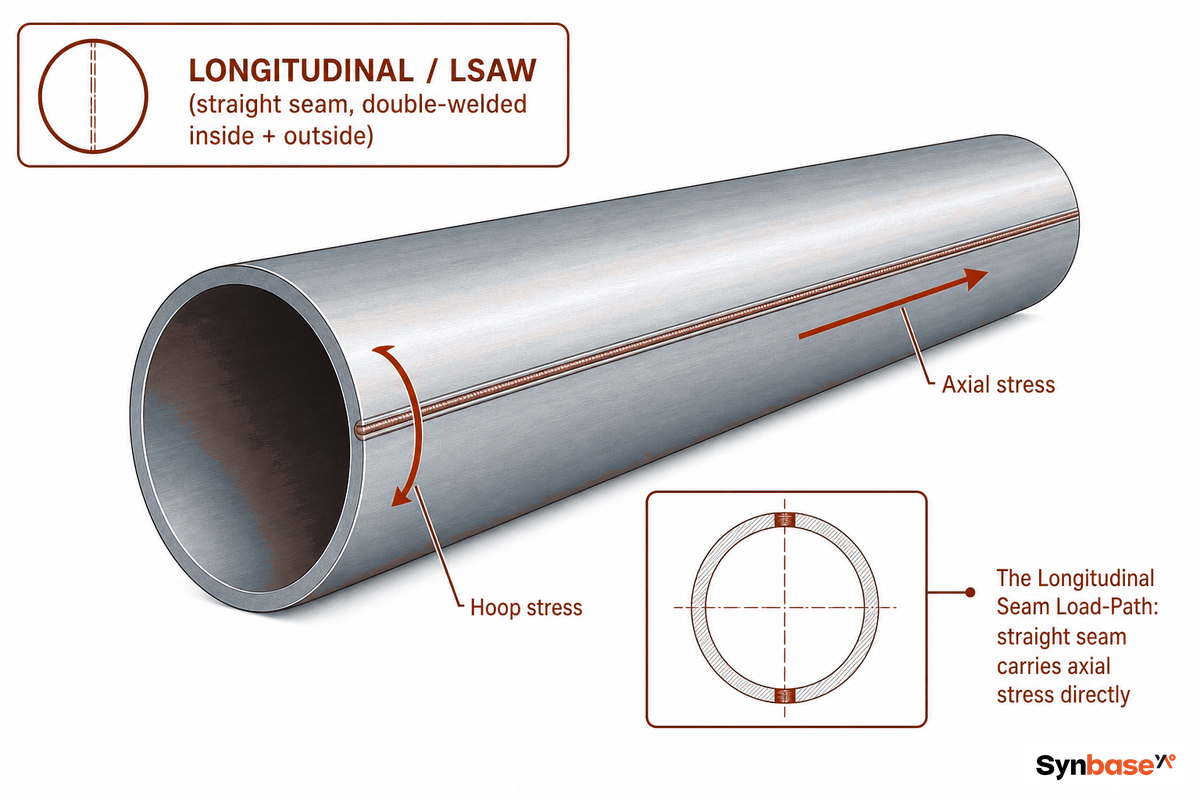
A large-diameter carbon steel welded pipe, LSAW (Longitudinal Submerged Arc Welded) is manufactured from a flat steel plate formed into a cylinder with a single straight weld seam running parallel to the pipe axis. Its seam is double-welded – once on the inside and once on the outside – beneath a protective layer of granular flux to prevent atmospheric contamination, which gives it the name “submerged arc welded.” Because it’s double-welded, it’s often also called “double submerged arc welded” (DSAW), and the API 5L delivery designation is SAWL.
When specifying, engineers prefer this pipe over spiral pipe or coil-based products because the orientation of the weld seam is optimized for handling stress in pressurized applications. In a pressurized pipe, stress acts in two directions: circumferential hoop stress and axial stress along the pipe’s length. A longitudinal weld seam is parallel to the pipe axis, placing it directly in line to carry axial stress without being subjected to shear stress from crossing the stress line at an angle, as occurs with a spiral seam. This geometric property, what we call the Longitudinal Seam Load-Path, not chemical composition, is why LSAW is the industry standard for high-pressure pipe lines, and why the weld seam is a primary concern in this guide.
Specified as a large-diameter, high-pressure pipeline, LSAW (Longitudinal Submerged Arc Welded) steel pipe is rolled from a single steel plate and welded on one straight seam by two sides submerged arc welding. Sizes of LSAW pipe are usually specified from OD 16 (406 mm) up to 60 (1524 mm) in API 5L Grades from X42 up to X80, mainly used for oil transmission, gas transmission and water transmission purposes in which ERW and seamless pipe are unavailable for such sizes and pressure. An LSAW pipe can also be called DSAW (Double Submerged Arc Welded) pipe or SAWL under the API 5L specification.
A common and costly mistake is treating an LSAW pipe like an ERW pipe. An ERW line tops out near NPS 20 at lower pressure, while an LSAW pipe carries API 5L X70 at a 20 mm wall out to 60 inches — a different pressure class entirely, and the wrong substitution can under-rate a trunk line before it is ever buried.
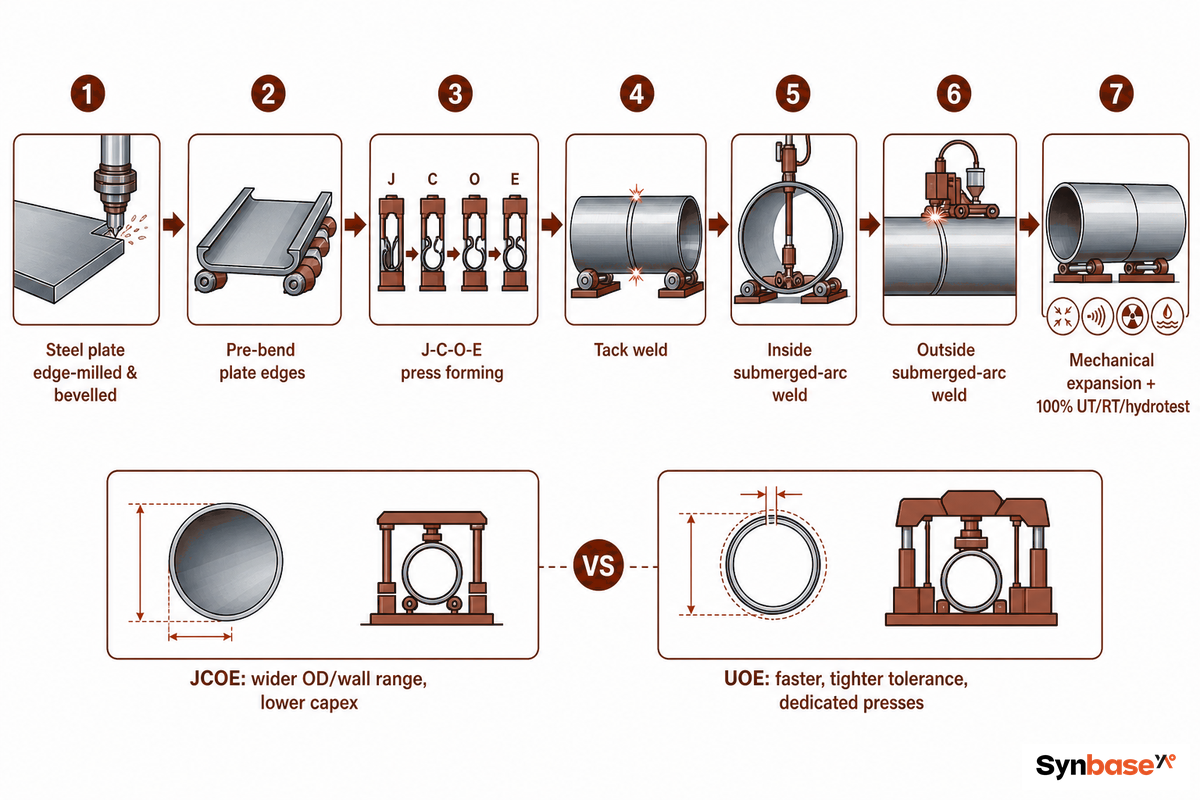
An LSAW pipe is manufactured by rolling up a plate into an open tube, welding the seam at both ends and, last but not least, expand it to the required outside diameter. In the early stages of the pipe procurement cycle the purchasing organisation decides the formation process for its pipe: JCOE, UOE etc. Selecting the formation method is in reality the first buying decision the customer indirectly takes, because the form of formation determines size limits, allowable tolerances, and influences cost levels for the mill. For fabrication equipment selection, pipe welding equipment from Aubrik provides a starting point for reviewing pipe-welding setups. For workpiece support and rotation, assess pipe welding rotators from RESIZE against the pipe diameter and load; rotators are only one part of a fabrication setup, not a complete LSAW mill.
JCOE press-forms a plate into a J, then a C, then an O, then expands (E), all in a single press line. UOE uses separate presses to form the plate into a U, then an O, prior to expansion. That difference is practical: numerical simulations of the JCO-E method demonstrate how decisions made during forming impact how much ovality and out-of-roundness the press line will hold before the final expansion operation “rounds it out.” JCOE is capable of handling a broader array of diameter/thickness combinations on relatively low capital equipment; UOE is faster for large volume applications and has excellent dimensional consistency, but requires costly, dedicated press equipment.
| Factor | JCOE | UOE |
|---|---|---|
| Size flexibility | Wide OD / wall range on one line | Fixed die sets, less flexible |
| Throughput | Slower, step-by-step press | Faster, high-volume batches |
| Dimensional tolerance | Good; depends on expansion control | Tighter, repeatable roundness |
| Capital cost | Lower | High (dedicated presses) |
| Best fit | Mixed diameters, thick wall, short-to-medium runs | Long runs of one size at volume |
Buyer anxiety always focuses on the seam being the stress raiser. Just the opposite is true due to manufacturing process. Following the inner and outer SAW, pipe is mechanically expanded – typically 0.8-1.3% of the pipe OD – which eliminates stress, pushes seam strength closer to that of parent metal, and improves roundness.
Even one of the process patents for LSAW pipe which was awarded (CN103357697A, Shandong Shengli Steel Pipe, filed 2013) reorders the operations of forming end to eliminate end stress by putting end forming prior to expansion of pipe OD to prevent cracking due to end stress during OD expansion. The seam is designed not accidentally formed.
Mechanical expansion isn’t simply a resizing operation. When a pipe is cold expanded through out its entire body, expansion of 0.8-1.3% provides a uniform yield strength along the entire length of the pipe and within the seam, while bringing ovality into API 5L tolerance. Ask your mill what their expansion ratio is and for a record of their post expansion ovality; both are important quality indicators a coiled product can’t provide.
Each step of lsaw pipe manufacturing traces back to the plate: mills start from a hot rolled carbon steel pipe plate — or, for smaller runs, coiled steel strip — and the size steel strip or plate width fixes the final pipe diameter. Using steel plates rather than coil is what lets the forming process reach heavy wall. After the arc welding pipe passes, a uniform expansion process relieves residual stress so the pipe welding zone matches the body — the heart of pipe manufacturing for large-diameter line pipe.
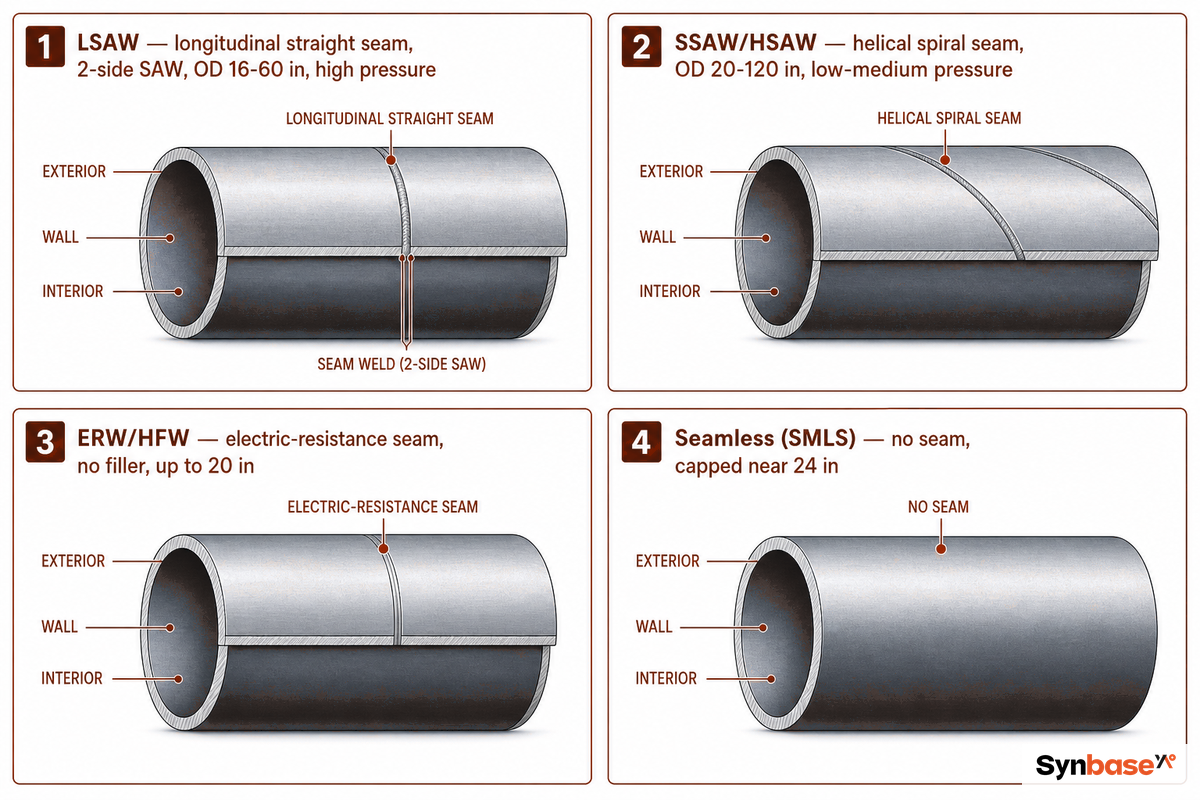
Make your choice on the pipe by seam and service – not just habit LSAW rules for the axial containment needs of large-diameter transmission lines, SSAW (spiral) dominates in super-large lower-pressure lines where material cost rules, ERW fits in smaller bores and low pressure applications and seamless holds the small-bore, high pressure and sour-cyclic ground (limited to just under 24-inches per ASME B36.10). Chart 1 shows the relationship of the four options against what’s most likely to dictate a purchase order.
| Process | Seam | OD range | Pressure fit | Relative cost | Best for |
|---|---|---|---|---|---|
| LSAW / DSAW | Longitudinal, 2-side SAW | 16″–60″ | High (Class 1–2) | Mid | Large-diameter high-pressure oil & gas trunk lines |
| SSAW / HSAW | Spiral SAW | 20″–120″ | Low–medium (Class 3–4) | Low | Water, low-pressure, ultra-large diameter |
| ERW / HFW | Electric resistance | ½″–20″ | ≤ Class 600, non-sour | Low | Municipal water, low-pressure gas, small bore |
| Seamless | None | ⅛″–24″ | Highest (sour, cyclic) | High | Wellheads, small-bore high pressure |
An ERW pipe joins a coil seam by electrical resistance and no filler addition, suitable for smaller diameter sizes under approx. NPS 20 and non-sour service. An LSAW pipe begins from plate and applies a double submerged arc weld; sizes go up to NPS 60 and are focused on high-pressure transmission.
Within the 16-20” overlap, both are applicable, but above that size ERW falls away, and LSAW (or spiral SSAW) are the only welded options. Key deciding factors include diameter, wall thickness, and sour or high-pressure service.
HSAW (helical submerged arc welded, an alternate name for an ssaw steel pipe) spirals the seam around, whereas LSAW takes it along the axis straight down. The spiral seam of an ssaw pipe spreads the stresses but is actually subjected to more total stress than an LSAW seam. This means it can take the pressure off of a spiral seam spread across multiple directions and also allows mills to create much larger diameter pipes at a reasonable cost out of narrower coil stock, although it’s not as dimensionally precise and it can experience more internal stresses.
A LSAW’s straight seam has higher structural rigidity in one direction, making it the preferred option for when axial load containment is critical and a greater emphasis is placed on accuracy.
Being upfront about that trade-off is important: independent research at Swansea University has shown that in seam welded pipe the selection process doesn’t always give sufficient attention to local risk and the corrosive nature of the service environment and wall thickness is generally adjusted for risk instead of letting the seam specification solely dictate fitness.
In other words, the choice is often based on common practices rather than solely the structural properties of the pipe. For a very large diameter, low pressure raw water main a spiral ssaw pipe makes sense – as does offering both at a well-run pipe mill. See our selection guide to steel pipe for seamless and the broader category of welded steel pipes for further detail.
Put lsaw and ssaw side by side and the seam tells the story: an lsaw welded steel pipe runs one straight seam, while a spiral welded line uses a spiral submerged arc (spiral submerged arc welded) seam laid by a spiral welding process, which widens the heat affected zone of ssaw seams. An erw steel pipe — electric resistance welded steel joined with no filler — sits below both on pressure rating.
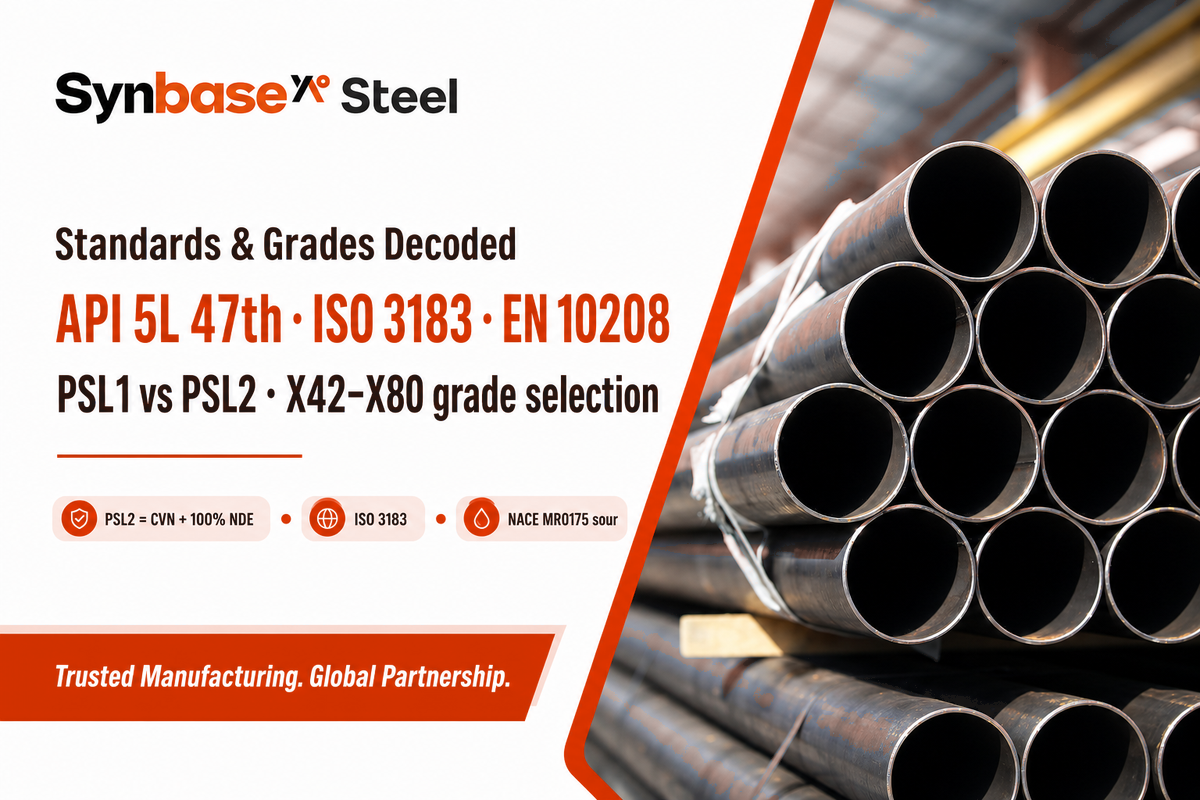
You’ll need to specify the LSAW line pipe against a governing standard, a specific steel grade, and a Product Specification Level (PSL); “an X65 pipe” does none of the above. Typically, API Specification 5L (now in its 47th edition with the publication of API 5L 47th edition, June 2026 – the new version includes updates across over 15 sections compared to the 46th edition, including enhanced specifications for HFW pipe quality and provisions for CO transport), ISO 3183 is the internationally accepted standard, and EN 10208-2 is for European gas transmission.
Steel grade defines the yield and tensile strengths, and the PSL determines how strict are the tests and controls.
Adding the Charpy V-notch impact testing required in PSL2 to API 5L gives higher impact energy requirements, restricted chemistry ranges and 100% non-destructive inspection-all reasons why line pipe for transmission is almost always specified to PSL2, not PSL1.
PSL1 offers standard controls for benign applications; PSL2 incorporates impact energy (fracture control) tests, upper as well as lower limits on tensile and yield strengths, and controls on the carbon equivalent (CE) and traceability. That X designation (e.g. X42 to X80) defines the specified minimum yield strength, with the upper grade specifications approaching low alloy steel territory.
| Grade | SMYS (MPa) | Min tensile (MPa) |
|---|---|---|
| X42 | 290 | 415 |
| X52 | 359 | 455 |
| X60 | 414 | 517 |
| X65 | 448 | 531 |
| X70 | 483 | 565 |
| X80 | 555 | 625 |
One common and costly mistake is to automatically jump to the highest available grade. According to the Interstate Natural Gas Association of America (INGAA), selecting the highest strength grade is neither feasible or practical, nor may it serve you well in an audit – plus higher grades are often stronger, harder and thus more prone to hydrogen and sulfide-stress cracking in sour service. As the ledger below demonstrates, the correct answer is to grade the pipe, and match PSL to the service.
This is also where LSAW intersects with the rest of the line pipe family. Grade selection in the rest of the line pipe family is discussed in our API 5L line pipe grade selection tool.
Here’s a chart that relates the ten most frequent services to the correct API 5L grade, PSL, wall band, coating, mandated test and the one common spec-error that will under-read each line most often.
| Service | Grade | PSL | Wall band | Coating | Mandatory test | Common spec-error trap |
|---|---|---|---|---|---|---|
| Raw water transmission | Gr.B / X42 | PSL1 | 6–12 mm | 3LPE / cement | Hydrostatic | Over-specifying PSL2 and paying for CVN you don’t need |
| Onshore oil gathering | X42 / X52 | PSL2 | 8–16 mm | 3LPE | CVN + 100% UT | Skipping CVN on a PSL2 line |
| Gas transmission (rural Class 1) | X60 / X65 | PSL2 | 10–20 mm | 3LPE / FBE | CVN + UT + RT | Using Class 1 factor in a populated corridor |
| Gas transmission (urban Class 3) | X65 / X70 | PSL2 | 14–25 mm | 3LPE / 3LPP | CVN + UT + RT | Under-rating wall for the location class |
| Sour gas (H₂S) | X52 / X65 (S) | PSL2 + Annex H | 12–22 mm | 3LPE + HIC-resistant | HIC / SSC per NACE MR0175 | Picking the hardest grade — worse for cracking |
| Offshore / subsea | X65 / X70 | PSL2 (Q) | 16–35 mm | 3LPP + concrete weight | Low-temp CVN + DWTT | Ignoring collapse / design factor 0.60 |
| Arctic / low-temp | X65 / X70 | PSL2 (Q) | 14–28 mm | 3LPE | CVN to −46 °C | Testing CVN only at −20 °C |
| Structural piling | Gr.B / X52 | PSL1 | 10–30 mm | Bare / painted | Dimensional (ASTM A252) | Buying line-pipe PSL2 for a driven pile |
| Slurry / process | X52 / X60 | PSL2 | 12–25 mm | Internal liner / FBE | CVN + UT | No allowance for internal abrasion |
| Hydrogen-blend service | X52 / X65 | PSL2 + fracture control | 12–25 mm | 3LPE / FBE | CVN + hardness (≤ 250 HV) | Assuming a legacy X70 line is H₂-ready |
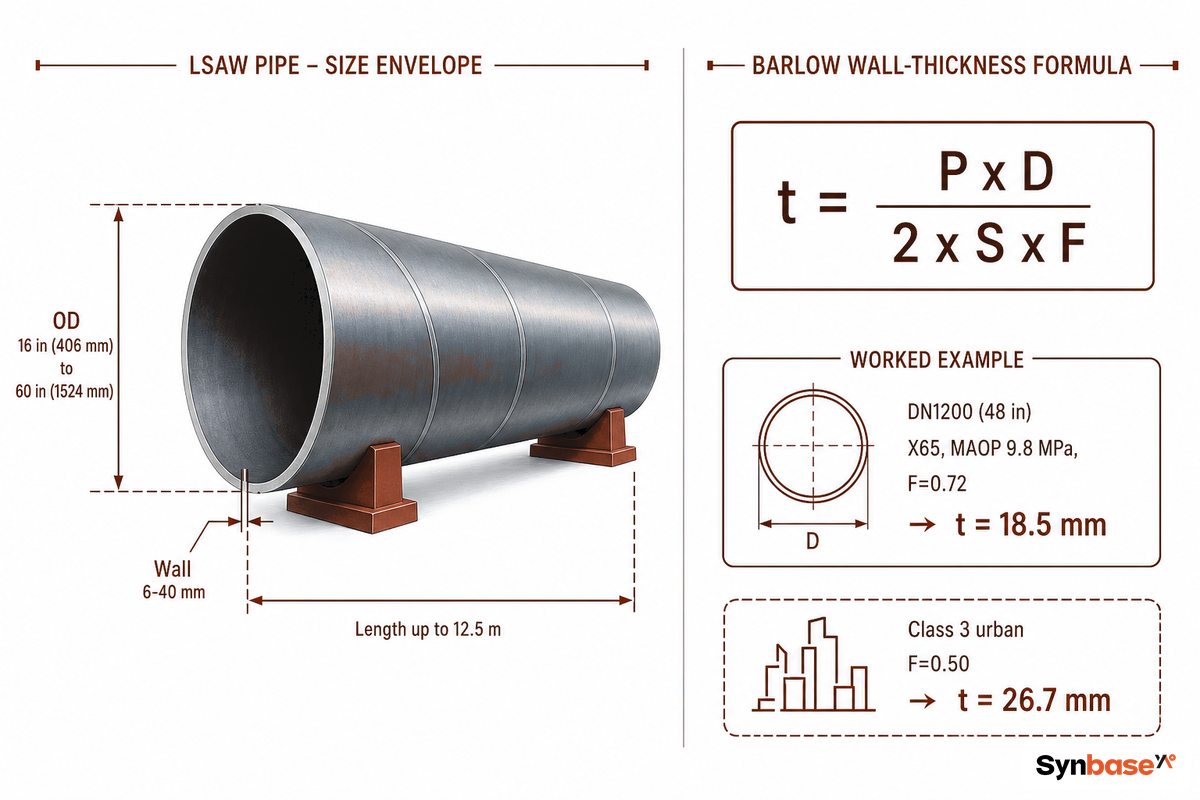
These pipes cover OD 16 to 60 (406-1524 mm) and a range of wall thicknesses between 6 and 40 mm and lengths as long as 12.5m (approx.12.5m, or 40 feet). Wall thicknesses and tolerances for out-of-roundness, straightness, and end-bevels fall within the ranges defined by API 5L for the pipe body. But that envelope, and knowing the limits of seamless pipes, doesn’t automatically tell you the wall thickness required.
| Parameter | Range | Reference |
|---|---|---|
| Outside diameter | 16″–60″ (406–1524 mm) | API 5L / ISO 3183 |
| Wall thickness | 6–40 mm | API 5L |
| Length | up to 12.5 m | Per project |
| End bevel | 30° ± 5° | ASME B16.25 |
Pressure-line wall thickness is designed by the Barlow / pipeline design formula: t = (P × D) / (2 × S × F) where t = wall thickness, P = design (maximum allowable operating) pressure, D = outside diameter, S = specified minimum yield strength, and F = location-class design factor. For an ASME B31.8 gas line, F is 0.72 for rural Class 1, 0.60 for Class 2, 0.50 for Class 3, and 0.40 for Class 4. An ASME B31.4 liquid line has F = 0.72 for onshore and F = 0.60 for offshore.
For P = 9.8 MPa, we’ve a DN1200 (48 / D = 1219 mm) line of X65 (S = 448 MPa) rural Class 1 so F = 0.72:
t = (9.8 × 1219) / (2 × 448 × 0.72) = 11946.2 / 645.12 = 18.5 mm
Round up to a conventional 20 mm wall, then add corrosion allowance. Draw that same line through a Class 3 urban corridor (F=0.50) and the wall increases to 26.7 mm – same reason why the table above identifies “under-rating wall for the location class.” Your P, D, grade and class will allow you to size any LSAW pipe.
Get the wall wrong and the failure is expensive: an under-rated wall on a high-pressure line risks rupture, while over-speccing wastes steel on every length. Per ASME B31.8, always size to the location class — a Class 3 urban corridor needs a 26.7 mm wall where a rural Class 1 line needs 18.5 mm for the same DN1200 X65 service.
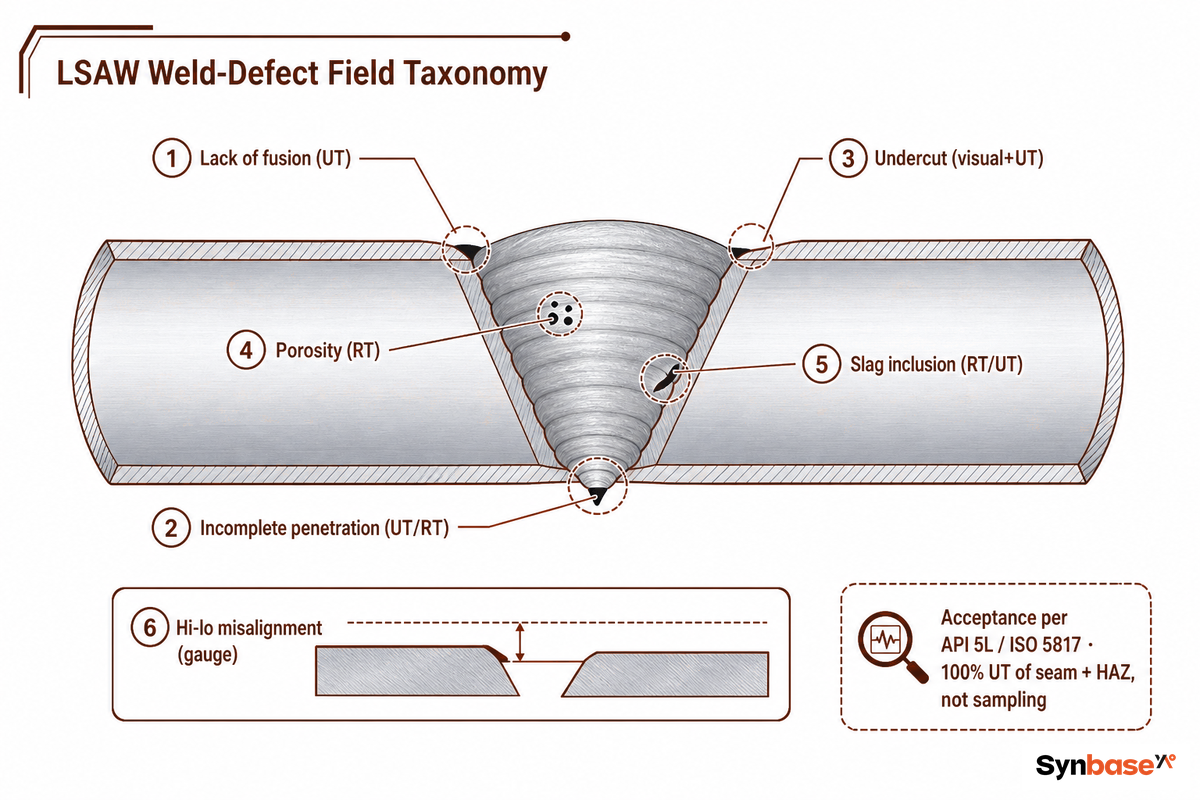
It’s the longitudinal seam that provides both the structural integrity and the inherent vulnerability of an LSAW pipe; the identification of defects on that seam is the one place where buyers can offer the greatest value.Lack of fusionandincomplete penetration are the safety most-relevant types of LSAW defects, hence the reason the longitudinal weld undergoes 100% ultrasonic examination, rather than a sampling method. A welded joint under sample is an uncaught weld: for an over-the-road or a high-pressure pipeline application, a single missing planar defect can result in total failure. Here’s the breakdown – the LSAW defect taxomony, or what’s being reviewed in the field:
Those 10 defect categories longitudinal seams can take is outlined here, along with its origin, the test to discover it, the acceptance level based on API 5L, and what happens if the seam makes it to field. ISO 6520-1 takes it further than API 5L line pipe to define weld geometric defects, and ISO 5817 identifies weld quality levels used by many buyers to establish a welding scope.
| Defect class | Root cause | Detection method | Acceptance basis | Field consequence |
|---|---|---|---|---|
| Lack of fusion | Low heat input, poor bead overlap | UT (primary), RT | API 5L — planar, rejectable | Crack initiation under pressure |
| Incomplete penetration | Misaligned inside/outside passes | UT, RT | API 5L — planar, rejectable | Reduced wall, leak path |
| Undercut | Excess current, fast travel | Visual + UT | API 5L depth / length limits | Stress raiser at toe |
| Porosity | Moisture / contaminated flux | RT (primary) | API 5L cluster / size limits | Localized weakening |
| Slag inclusion | Poor interpass cleaning | RT, UT | API 5L size / density limits | Fatigue nucleation |
| Hi-lo / misalignment | Edge mismatch at forming | Visual + gauge | API 5L offset tolerance | Stress concentration, poor fit-up |
| Hook crack | Non-metallic inclusions in plate | UT | API 5L — rejectable | Seam splitting in service |
| Arc strike | Stray arc on pipe body | Visual + MT | API 5L — grind & retest | Local hard spot, cracking |
| HAZ softening | Excess heat input | Hardness survey | Grade hardness cap (e.g. ≤ 250 HV) | Lower strength beside seam |
| Burn-through | Excess penetration, thin root | Visual + RT | API 5L — rejectable | Hole / repair-weld scar |
Test report values which are significant for the purchaser is more restricted: 100% UT on seam and HAZ, RT of the seam, and hydrostatic test to slightly higher than the minimum on the API 5L of every length. For Charpy V-notch values in typical PSL2 line pipe you’re looking for single values of ≥ 27–36 J and a mean of ≥ 45 J at test temperature. Reliably finding these is also a science, see Brunel’s thesis on ultrasonic inspection of welds which quantifies the impact of probe pressure and couplant changes, hence the advantages of a fully automated, calibrated 100% UT over a hand test.
“On a longitudinal seam, the inside-then-outside SAW pass plus full-body expansion is what brings weld strength to parent-metal level. We hold 100% UT on the seam and heat-affected zone because a sampled weld is not a controlled weld, on a high-pressure line, one missed defect is the whole project.”
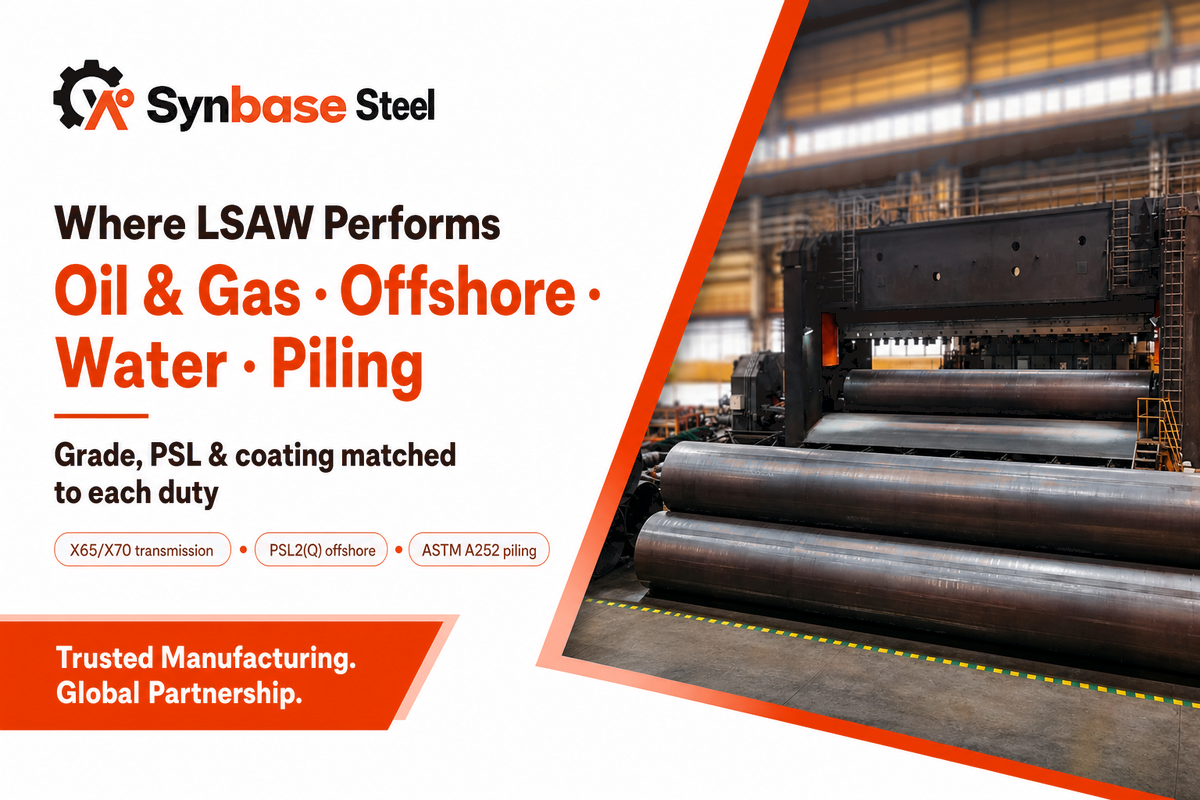
An LSAW pipe is your answer whenever the requirement is for large-diameter transmission across a distance with a higher operating pressure. Its four natural homes include energy, water, structure, and process-each requiring a specific grade and PSL. In all four cases, the critical factor is the weld reliability and resistance to corrosion will determine how many years a trunk line or gas pipeline will perform reliably at higher pressures.
Map the application to the spec first. Map it to the price later.
No single sourcing challenge blinds buyers more often than sour service. Suppose a DN800 gathering line is carrying wet gas with measurable HS. Instinct drives you to spec high X-grade material for strength, but in sour service, chemistry comes first, then strength; what you want is PSL2+Annex H to NACE MR0175 / ISO 15156 with HIC/SSC testing and a maximum hardness level – even if that is just modest X52 or X65. Specify just strength and you will build a pipeline that might pass pressure calculation, but which may still crack in the field. Trade data highlights how significant the issue can be: the U.S. International Trade Commission’s review of large diameter welded pipe provides an overview of how the market is dominated by few producers, which highlights how buying teams can find themselves constrained.
The application of lsaw steel spans oil and gas pipelines, structural steel for piling, and slurry lines where corrosion resistance decides service life. Across the oil and gas industry — and the wider gas industry — the highest grades edge toward alloy steel pipe territory for sour and high-pressure duty.
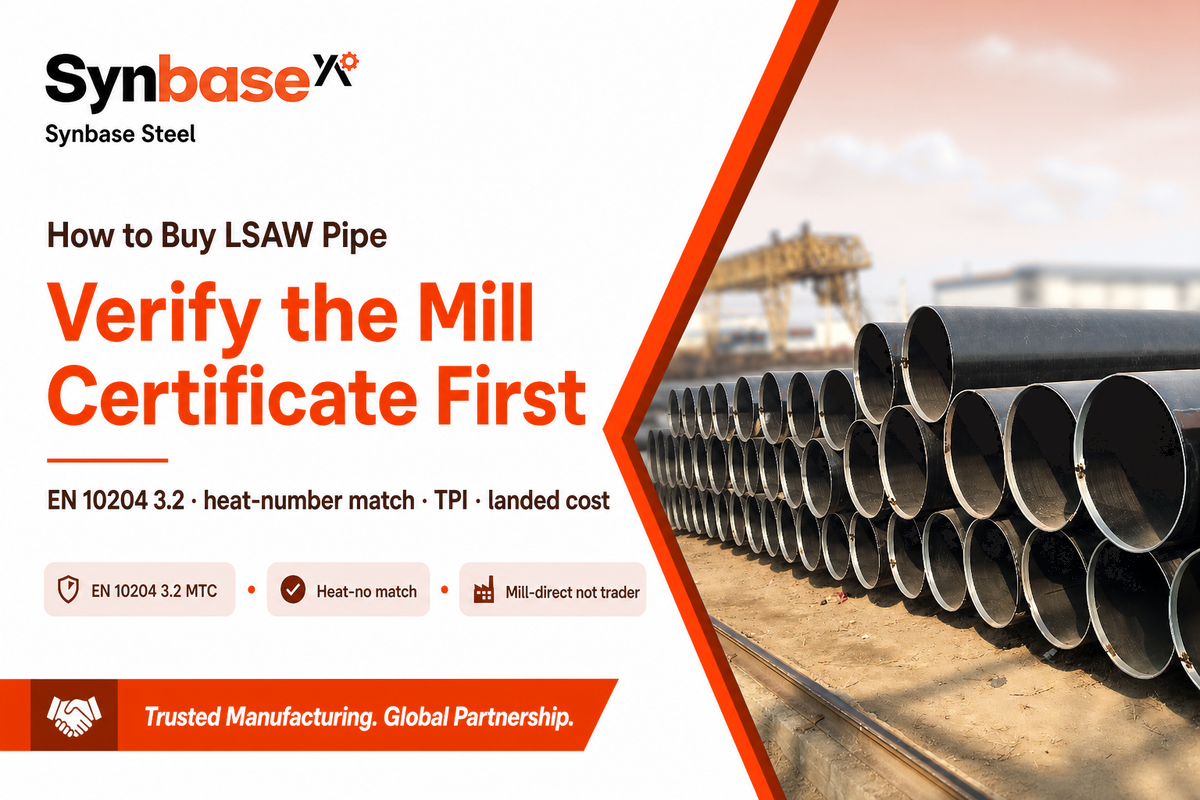
In international LSAW purchases, no risk outweighs having a certificate that doesn’t match the actual pipe. Document control is the strongest countermeasure: ensure that a witnessed, EN 10204 3.2 test certificate comes from the mill and matches the heat number embossed on the pipe, and build in a third party pre-shipment inspection from an agency like SGS, Bureau Veritas, TV or Lloyds. This verification is only possible if the buying organization buys directly from the pipe manufacturer of record-the factory which actually manufactured the plate and per formed the welding-and not from a layered series of intermediaries.
This attention to the heat number should extend to any flanges, fittings and any stainless steel pipe that complete the pipeline project, not just the mainline pipe. In terms of cost, LSAW pipe can actually be cheaper than alternative manufacturing methods in large diameters. Material utilization from plate steel for welded pipe can be upwards of 90%, while that of billet machined seamless products typically ranges from 65 to 75%. Commercially available seamless is capped near 24 inches under ASME B36.10. Large-diameter options can therefore be large-scale LSAW products. Added cost for LSAW pipe typically occurs in the welding and subsequent inspections, with non-destructive testing representing roughly a 5 to 10 percent increase over without it, which is a justifiable expense because verified welds are the foundation of safety on the cheaper route. Risk isn’t in the welding process itself but rather in the verification of that weld through trustworthy documentation. Buyers looking at quotes from mills versus distributors will benefit from comparing any bid against specifications for mill-direct LSAW pipe production with traceable MTCs.
Vet the steel pipe manufacturer the way you would any critical supplier: confirm the lsaw pipe manufacturer runs its own lsaw steel pipe factory (a real pipe factory, not a trading desk), ask how the quality of lsaw pipe is documented per heat, and weigh the price of lsaw against landed cost — including the pipe fittings that complete the run.
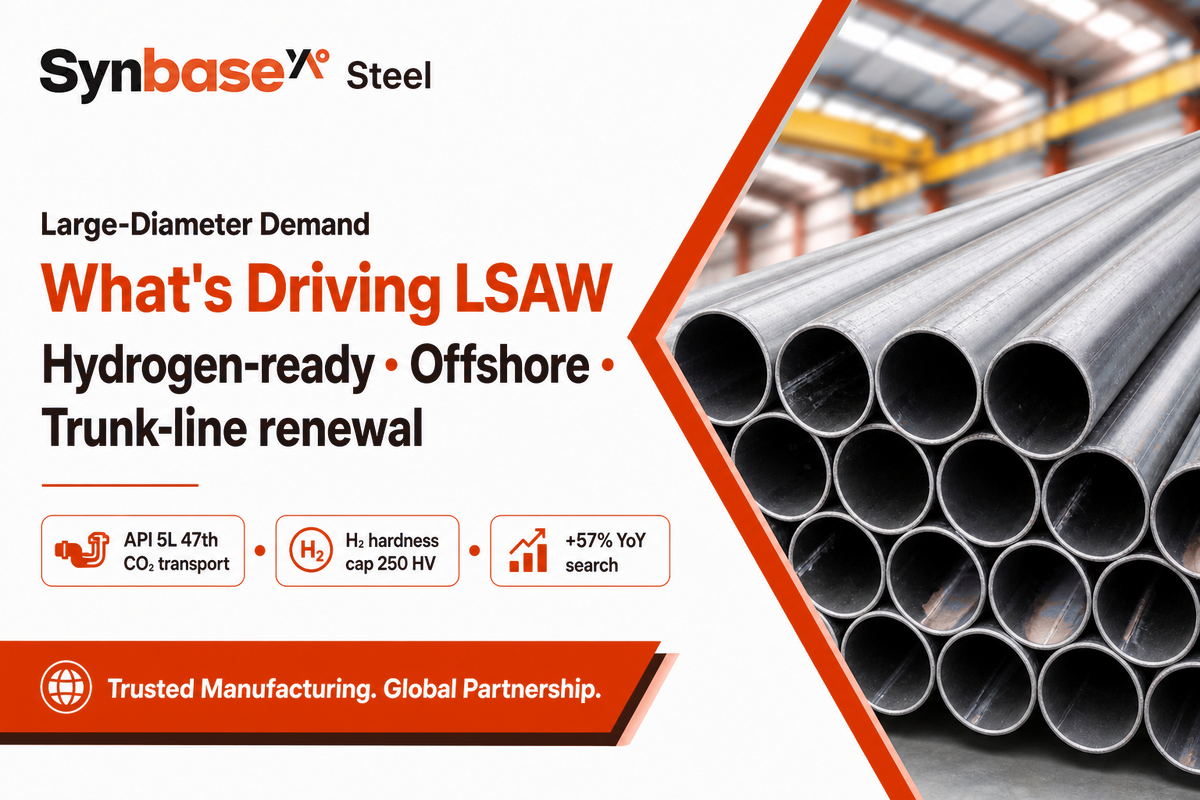
Three factors are tugging at large-diameter longitudinal line pipe demand, fundamentally altering the gas market in ways that favor the LSAW capabilities exactly: the move towards a hydrogen-ready infrastructure, the increasing play on the offshore and deepwater frontier and the aging of trunk lines, with demand driven not just by market statistics but by events in the market that buyers can work into planning efforts and an evolving landscape shaped by anti-dumping and countervailing actions against welded line pipe.
Consider a 2026 hydrogen-blend retrofit: a buyer specifying a 48-inch API 5L X65 PSL2 line with a 250 HV hardness cap and CVN tested to −20 °C is sizing for the driver, not the headline market number — exactly the spec decision that avoids an embrittlement failure once hydrogen enters the line.
This hydrogen shift is the most apparent. Reporting in Pipeline & Gas Journal had global pipeline construction at close to 42,000 miles as of mid-2024, thanks in large part to LNG and hydrogen infrastructure, and research in Offshore Technology reveals hydrogen service feasibility varies depending on diameter, pressure, and hydrogen concentration. This is where LSAW is key: hydrogen service benefits from hard, thick-wall, low-temperature-qualified pipe with hardness limitations – the PSL2 fracture control boundary, rather than some long-ago assumption that old lines were “H-ready.” In fact, high-strength API 5L grades are susceptible to hydrogen embrittlement – research by U.S.
DOE/NETL into API 5L pipeline steels prompted the “H-cap” instead of the highest-strength grade. The same 47th-edition update that stresses better weld quality also addresses the addition of CO-transport specs, creating another large-diameter market besides hydrogen. While various market research firms value the overall LSAW market in the low-teens billions, growing at mid-single digits, this data is viewed as more context and direction, as the important story here’s the specification change, not the gross number.
For any project that starts in 2026, your next two actions will be: First, place locks on PSL2 mill capacity earlier than you would have placed them even three years ago, as all the qualified large diameter capacity is competing among LNG, hydrogen, and replacement work at once. Second, check out your destination duty status prior to placement of orders and not after – a USITC sunset review has continued anti-dumping orders on large-diameter welded pipe, which can eliminate welded versus seamless pricing advantage altogether.
One risk to plan around: buyers who assume a legacy X70 line is hydrogen-ready can hit embrittlement failures. Per U.S. DOE/NETL data, hydrogen service should cap hardness near 250 HV rather than chase the highest grade — a spec decision worth locking before 2026 project bids close.
Ordering big diameter, high pressure line pipe, and would like mill-direct, MTC-traceable LSAW pipe tested and documented to match service conditions?
This guide is written from the vantage point of a mill-of-record: Synbase Steel Co., Ltd., the pipeline-cluster enterprise of E-CHENG STEEL GROUP, produces LSAW, SSAW, and seamless line pipe to API 5L / ISO 9001 with 100% ultrasonic testing tied to each pipe’s heat number. We deliberately kept this article vendor-neutral, the LSAW-vs-SSAW trade-offs, the Barlow wall calculation, and the weld-defect taxonomy apply whoever you buy from. Reviewed by the Synbase Steel Co., Ltd. technical team.
Synbase Steel supplies steel pipe, fittings, flanges, valves and OCTG for oil and gas, petrochemical, power, water and industrial projects. Our technical guides are written to help buyers compare standards, grades, dimensions, coatings, inspection requirements and commercial terms before sending an RFQ.
We focus on practical specification work: matching pipe process to service conditions, checking wall thickness and end finish, reviewing MTC and NDT requirements, and clarifying documentation before production or shipment.
Project support across seamless pipe, ERW, LSAW, SSAW, buttweld fittings, forged flanges, valves and oilfield tubulars.
Specification review for ASTM, ASME, API, EN and DIN standards, including material grade, pressure class, coating and inspection scope.