Send Your RFQ to Synbase Steel
Prefer to send drawings, BOMs or attachment lists by email? sales@synbasesteel.com

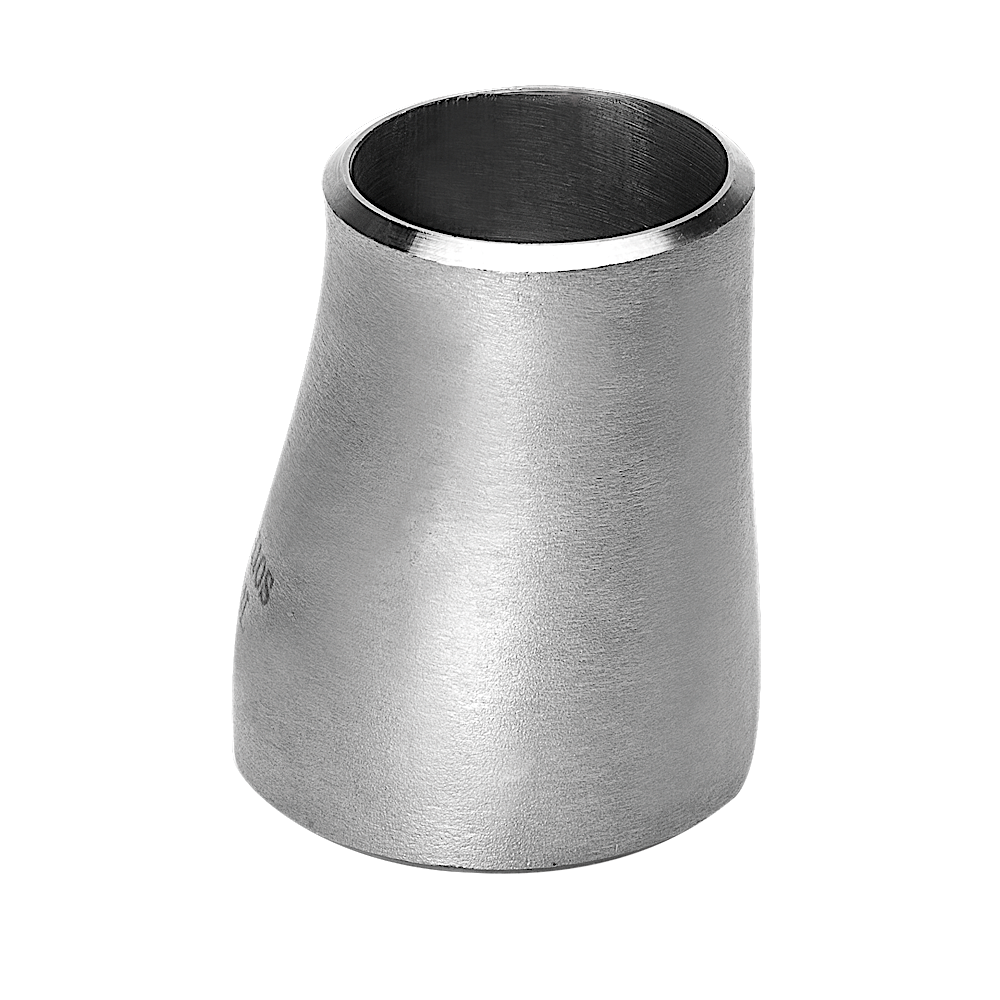
Eccentric reducers solve the one problem a concentric reducer cannot: they keep one side of the pipe bore flat, so air can’t pool — or liquid can’t drain back — across a change in diameter. Synbase manufactures butt-weld eccentric reducers in carbon steel, stainless steel, and alloy steel from NPS 1/2″ to 60″, to ASME B16.9 and MSS SP-75 dimensional standards, with full EN 10204 3.1 traceability.
Request a Quote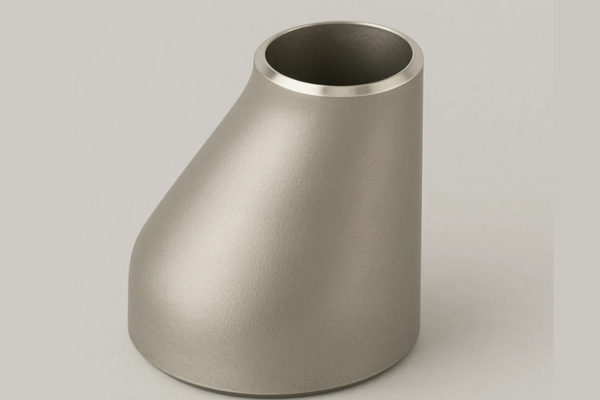
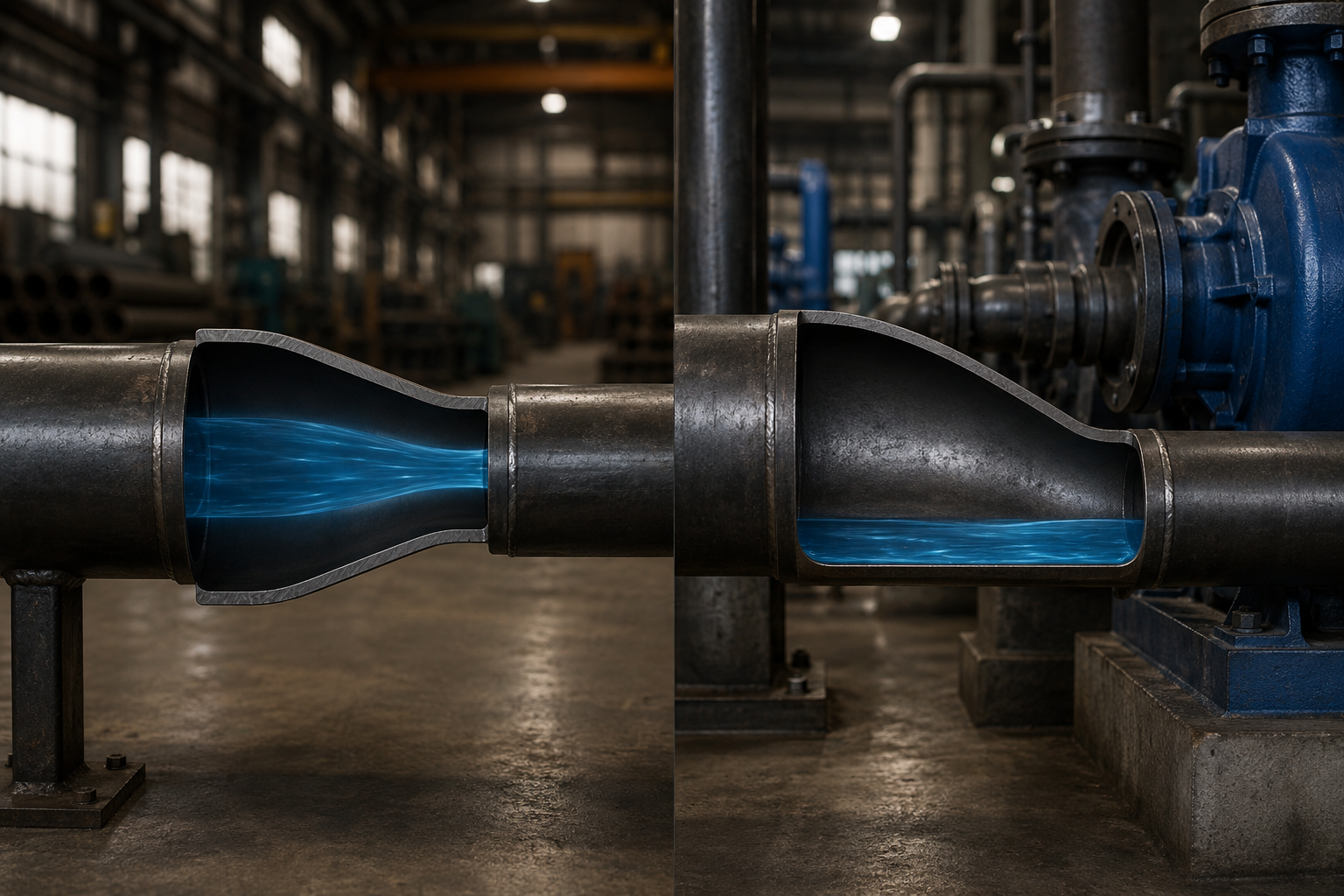
On horizontal pipe lines, a concentric reducer forces both sides of the bore to converge towards centerline, creating a high pool at the top where air and vapor can trap, and a low pool at the bottom where liquid and solids can gather. In the case of a pump suction line, that trapped air isn’t just inconvenient; it’s the number-one culprit behind cavitation. Field data compiled by the Hydraulic Institute attributes more than 50% of cavitation-related failures in new installations to inadequate suction piping design — meaning maintenance teams keep replacing pump seals and impellers without ever fixing the underlying piping fault. The same offset geometry is also used to keep transitions clear of settled solids in circulation lines — a function documented in public patents such as CN104722542B.
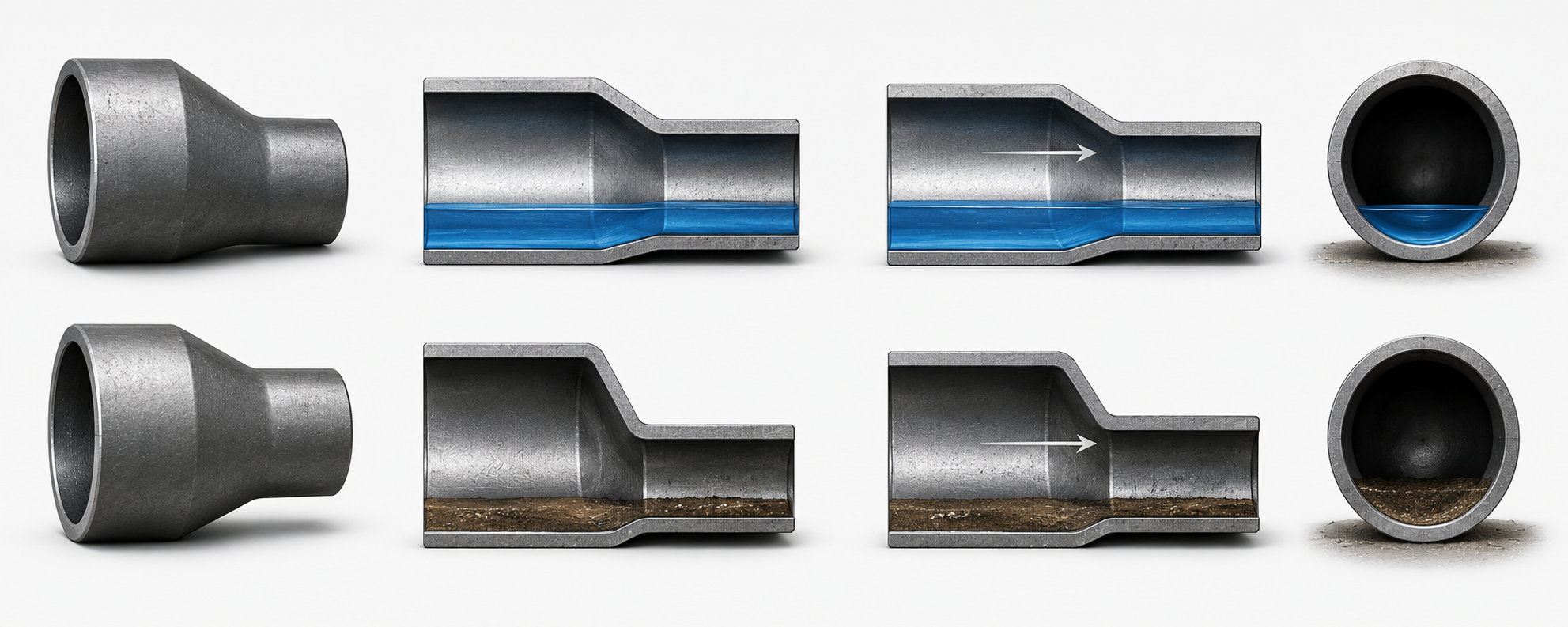
An eccentric reducer accomplishes the same line-size change without converging to a single centerline. This results in one side remaining flat and uninterrupted – either upward or downward. Installed flat side up, an eccentric reducer maintains a flat ceiling above the bore; air and vapors rise back toward their source rather than accumulating at the pump suction nozzle. Installed flat side down, it provides a flat floor for liquids and solids to drain away, rather than pool. That is the entirety of the raison d’être for an eccentric reducer fitting: the simple geometric fact of one continuing flat wall.
The rest of this page is written for the people who have to make that call: the engineer matching grades and dimensions, the purchasing agent reviewing traceability paperwork, and the project manager who needs the right parts on site, on schedule. We don’t simply pull from stock — we manufacture these reducers ourselves, so the specifications below are what we actually form and certify, not a page plucked from a catalogue.
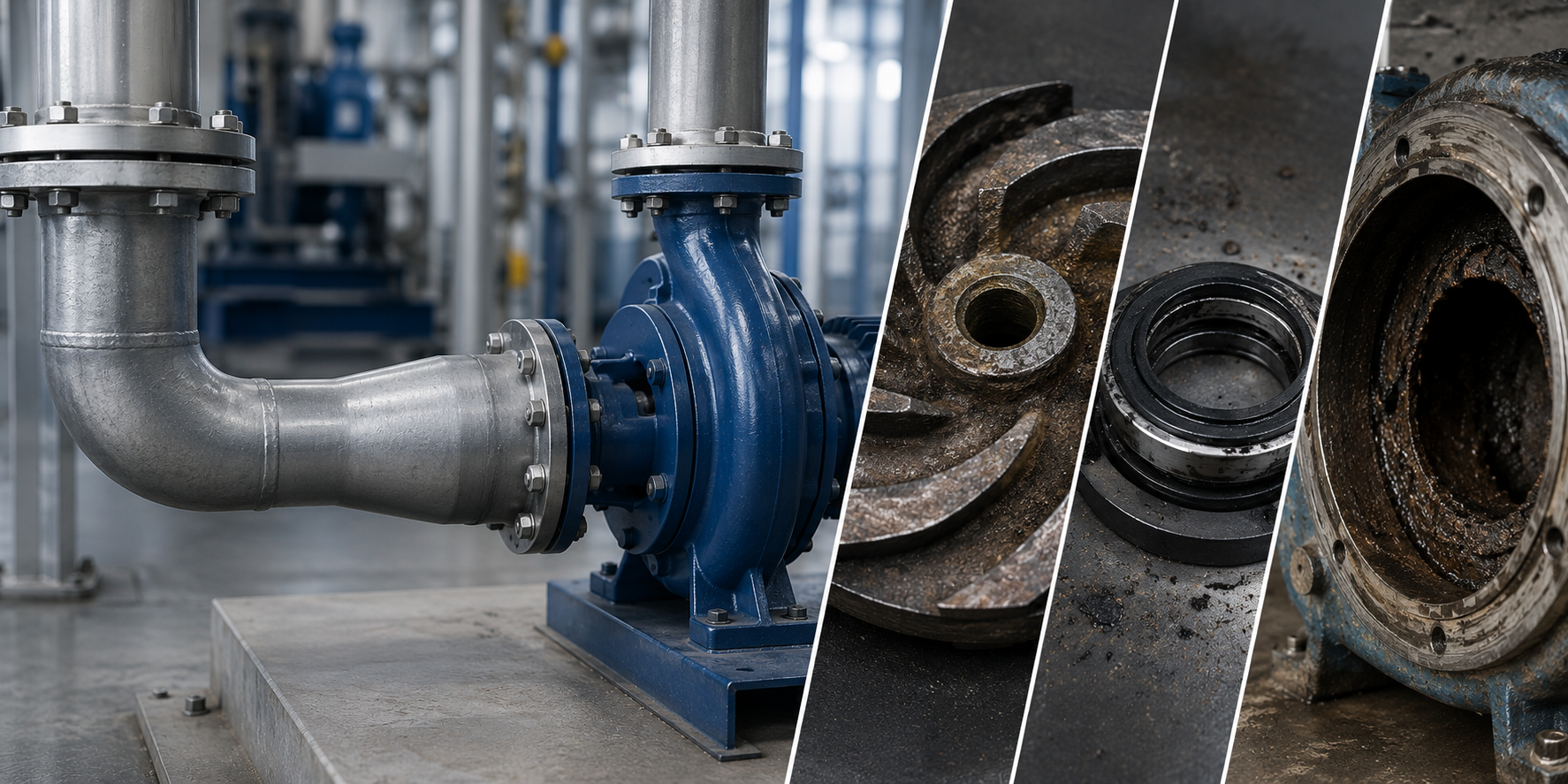
Because the problem, in the form of a trapped air pocket, reoccurs until the entire system is corrected, not just the damaged pump reconditioned, the actual decision in any case involving a critical suction line isn’t how much can we save on this reducer vs. buying a cheaper fitting; the choice is one properly specified eccentric reducer fitting against a lifetime of costly seal and impeller replacement. We design each to the ASME B16.9 standard and certify to ISO 9001, meaning that if your line calls for a 4″×3″ or 12″×10″ transition in a given grade, the reducer you receive is exactly that — not an off-brand substitution sourced from another vendor.
Selecting the right eccentric reducer starts by pairing the fitting’s metallurgy with the attached pipe because when you weld in a butt-weld fitting, it immediately becomes a part of the pressure boundary. The consequences of a mismatched grade range from a failed inspection to failure-in-service, with the insidious hidden threat of sensitization developing in the weld zone, leading to cracked pipe months after tie-in.
Synbase supply three material families tied to a recognizable ASME/ASTM or MSS standard, so your inspector knows to look at your mill certificate for a proven, rather than a self-proclaimed, pedigree. We control grade from the melt, unlike a distributor picking and mixing from various origins.
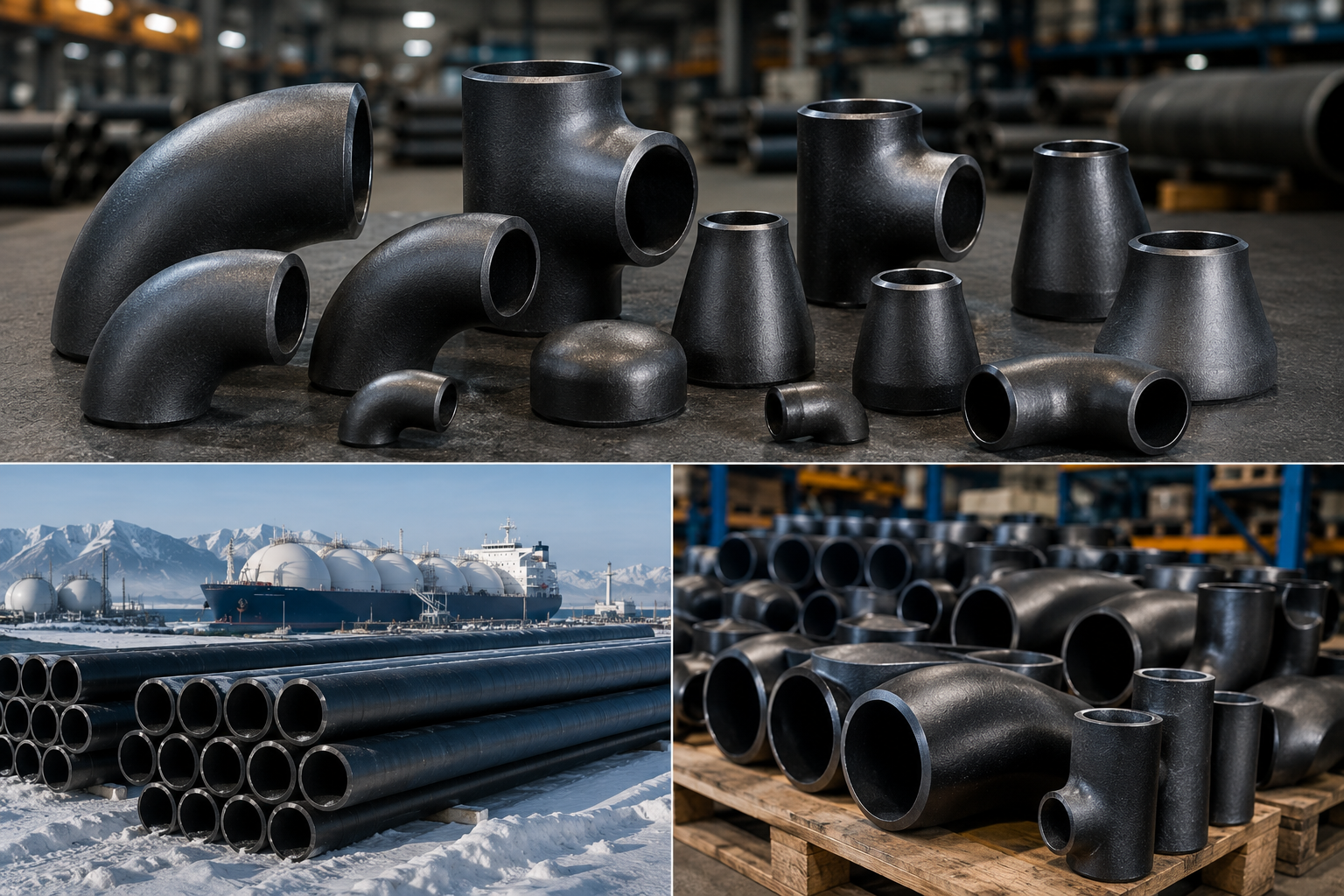
ASTM A234 WPB is the workhorse carbon steel grade for ASME B16.9 butt weld fittings — hot formed and fully normalized. For LNG yards and cold-climate applications, the right choice is a low-temp grade such as impact-tested A420 WPL6.
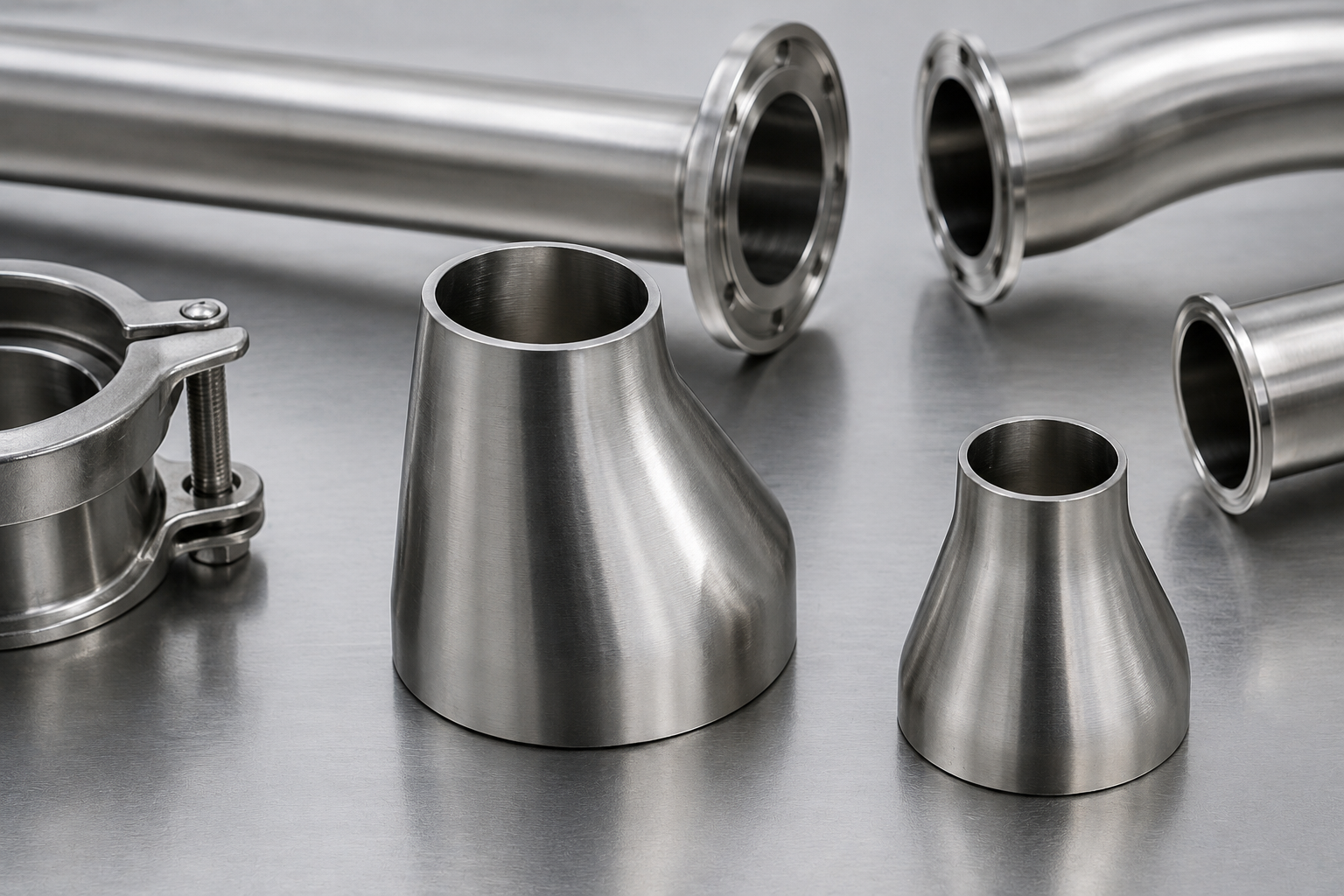
For applications requiring a non-corrosive surface and minimal cross-contamination-such as 316L Sanitary pipe and instrumentation lines-the eccentric reducer is often the first choice. “L” stainless steels (“L” for “low-carbon”) prevent sensitization in the Heat Affected Zone post-weld by precluding the precipitation of chromium carbides at the grain boundaries that the higher-carbon grades succumb to. A sensitized fitting may look okay, but when exposed to, say, chloride, pitting is likely to develop along the HAZ.
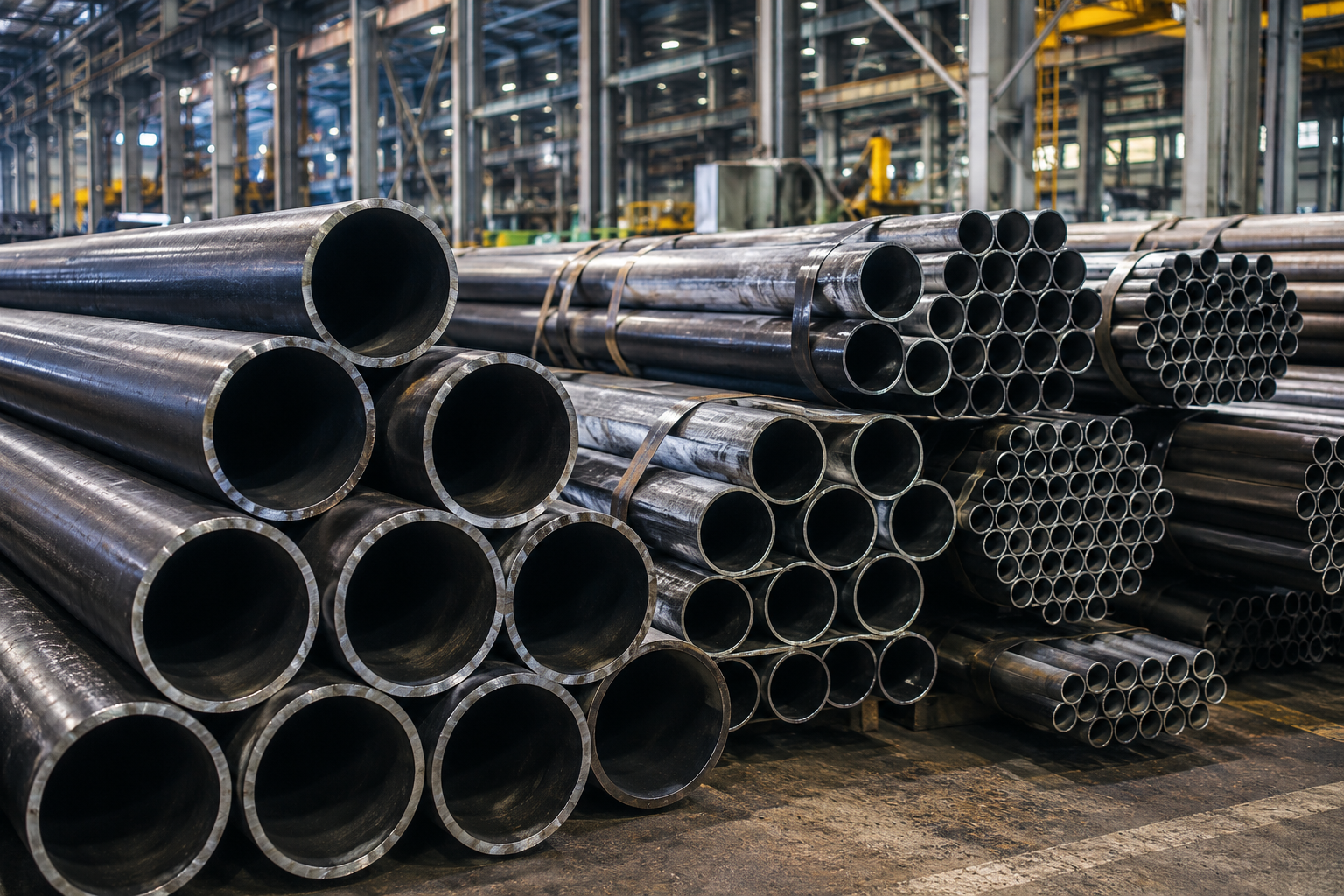
Our chrome-moly grades used in refineries and for high-temperature pipe lines and transfer lines. For higher-value alloys not on the common BOMs we draw on strategic partnerships with mill groups. High-value specialty lines sizes/grades are not stuck behind large minimum purchase requirements with our partners, so we maintain a broad offering.
For NPS 1/2 – NPS 48, ASME B16.9 sets the standard for ratings, dimensions, tolerances, markings and material identification. For greater than NPS 48 (DN1200), you look to the standard for pipe transmission lines and greater wall thicknesses. MSS SP-75 dictates WPHY grades and dimension series to cover higher pressure requirements. Every Synbase reducer supplied is stamped with a traceable Heat Number and a listed ASME/MSS standard.
| Service condition | Reducer type | Orientation | Why |
|---|---|---|---|
| Horizontal pump suction, source below pump | Eccentric | Flat side up | Prevents air pocket at nozzle |
| Horizontal pump suction, flooded from above | Eccentric | Flat side down | Prevents liquid/sediment pooling |
| Horizontal vapor / steam line | Eccentric | Flat side down | Lets condensate drain forward |
| Vertical run (any flow) | Concentric | n/a | No top/bottom pocket exists vertically |
| Clean liquid, minimal turbulence priority | Concentric | n/a | Symmetric flow, lower cost |
Connecting two pipe sizes on a given pipeline, with two ways to do it and thus two distinct outcomes. “Smooth flow” versus “prevent backflow,” as engineers, these are not vague goals. Here is the real set of criteria to weigh:
| Decision variable | Concentric reducer | Eccentric reducer |
|---|---|---|
| Centerline | Shared (symmetric cone) | Offset (one wall flat) |
| Top-of-bore profile, horizontal | Steps up — air pocket forms | Flat (FSU) — no air pocket |
| Bottom-of-bore profile, horizontal | Steps down — sediment pocket | Flat (FSD) — full drainage |
| Primary use | Vertical lines, clean liquid | Horizontal pump suction, vapor, slurry |
| Pump suction suitability | Not recommended horizontal | Recommended (correct orientation) |
| End-to-end length, 4″×3″ | 101.6 mm | 101.6 mm (identical per B16.9) |
| Relative cost | Lower | Slightly higher (offset forming) |
General rule: where you are horizontal and air will get in, or will pool and stagnate, and that will cause you trouble, an eccentric is never an afterthought – it’s the most sensible option. Concentrics belong on straight vertical lines or on horizontal lines carrying clear liquid where pockets and stagnant layers cannot possibly form. A discussion of these boundary conditions can be found in our pipe fitting 101 companion post.
Here’s the real trade-off: the concentric style is fractionally less expensive to manufacture since the uniform, symmetric cone shape is formed in a single die pass, while the offset eccentric profile requires an additional formation step. The honest trade-off cuts the other way, though: on a 6″×4″ pump suction line moving viscous crude or slurry, going with the concentric to save a few dollars is a classic installation mistake — it reintroduces the air pocket and the cavitation that results. Synbase manufactures both forms to the same ASME B16.9 dimensional series, so the choice is driven by service condition, not by what a distributor happens to stock. An eccentric pipe reducer specified for the wrong orientation is no better than the wrong type entirely.
The most-repeated dictum in piping handbooks is ‘eccentric reducer, flat side up.’ The problem? It is also the most violated -because the flat side doesn’t always go up. The NFPA drawing standards and instructions on orientation cover only the top flat, prompting installation practices to take it for granted in all situations. In reality, orientation is a function of where the liquid is coming from relative to the pump.
We see the same failure pattern repeatedly on imported suction skids: an eccentric reducer welded flat-side-up on a flooded-from-top line. The drawing said ‘flat side up,’ so that’s what got fabricated — and the pump kept losing prime.
Since the suction line is frequently one or two sizes larger than the pump inlet, that is why the reducer is needed at all — the lower flow velocity and friction loss protect NPSH available. Place the reducer outlet 4–6 pipe diameters from the suction nozzle, and keep 5–10 diameters of straight run before any elbow, so flow reaches the impeller uniformly.
Why this matters to the bottom line: trapped air via a reducer and the attendant cavitation are the cause of all the bad pump stuff (impeller damage, mechanical seal kills, efficiency loss from derating the pump), they reoccur every time you rebuild the pump and haven’t fixed the piping and are repeatable failure items all the way back to the root cause.
The more honest version of the rule: install the right reducer and orient it for your service. We take care of that at the drawing phase and provide a labeled fitting tag indicating orientation so the eccentric weld reducer arrives at your pipe fitter correctly labeled to its line. The cheapest cavitation insurance policy is getting the orientation right on site. For abrasive slurry duty, wear-resistant bimetallic inner-wall constructions are documented in public patents such as CN204986123U and can be specified on request.
The end-to-end length (dimension H) and outside diameters below are fixed by ASME B16.9 / MSS SP-75 — identical for concentric and eccentric reducers of the same size pair, which is why one dimensional series covers both. Here’s the common failure: an incoming reducer that doesn’t meet tolerance and won’t seat at the bevel, leaving the fitter to weld it out-of-square, grind the bevels, or reject the part outright. Because Synbase forms to the B16.9 tolerance band and verifies H and OD before shipping, you get parts that match your drawing — use the table below to confirm exact spool lengths and bevel ODs before you cut.
| NPS (large × small) | Large end OD (mm) | Small end OD (mm) | End-to-end H (mm) |
|---|---|---|---|
| 3/4 × 1/2 | 26.7 | 21.3 | 38.1 |
| 1 × 3/4 | 33.4 | 26.7 | 50.8 |
| 1-1/2 × 1-1/4 | 48.3 | 42.2 | 63.5 |
| 2 × 1-1/2 | 60.3 | 48.3 | 76.2 |
| 2-1/2 × 2 | 73.0 | 60.3 | 88.9 |
| 3 × 2 | 88.9 | 60.3 | 88.9 |
| 4 × 3 | 114.3 | 88.9 | 101.6 |
| 6 × 4 | 168.3 | 114.3 | 139.7 |
| 8 × 6 | 219.1 | 168.3 | 152.4 |
| 10 × 8 | 273.1 | 219.1 | 177.8 |
| 12 × 10 | 323.9 | 273.1 | 203.2 |
| 16 × 14 | 406.4 | 355.6 | 355.6 |
| 20 × 18 | 508.0 | 457.2 | 508.0 |
| 24 × 22 | 609.6 | 558.8 | 508.0 |
| 36 × 34 | 914.0 | 864.0 | 609.6 |
| 60 × 56 | 1524.0 | 1422.0 | 711.2 |
The No. 1 cause of hesitation with a new supplier is not cost-it is fear that the Mill Test Certificate does not truly correspond to the material on the pipe. The document used to establish product traceability in international steel trading is the Mill Test Certificate (MTC) and an “invalid MTC,” one whose grade or heat number has been fraudulently changed, represents a tangible product risk. At Synbase, every order is accompanied by an EN 10204 3.1 certificate with an unbroken audit trail from product to the heat, allowing verification at intake rather than assumption. Our quality management system is certified to ISO 9001, and the fittings are CE-marked for EU conformity.
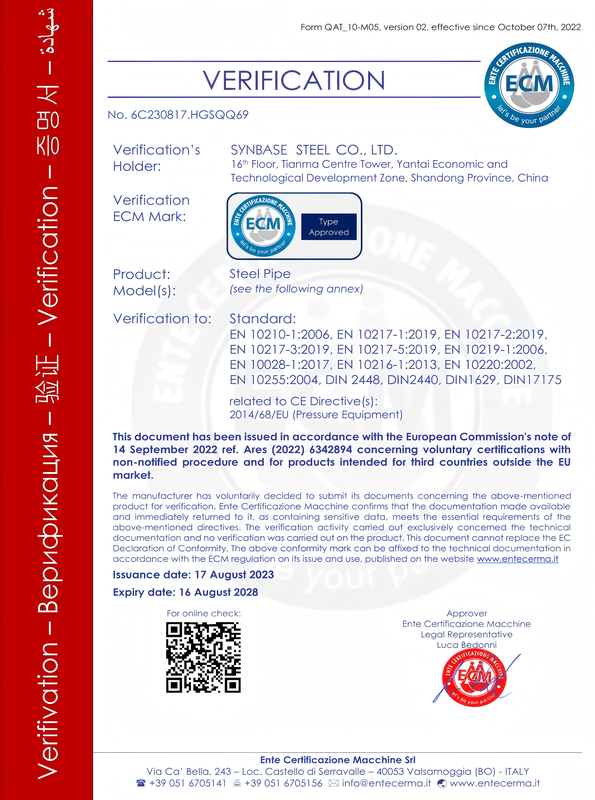
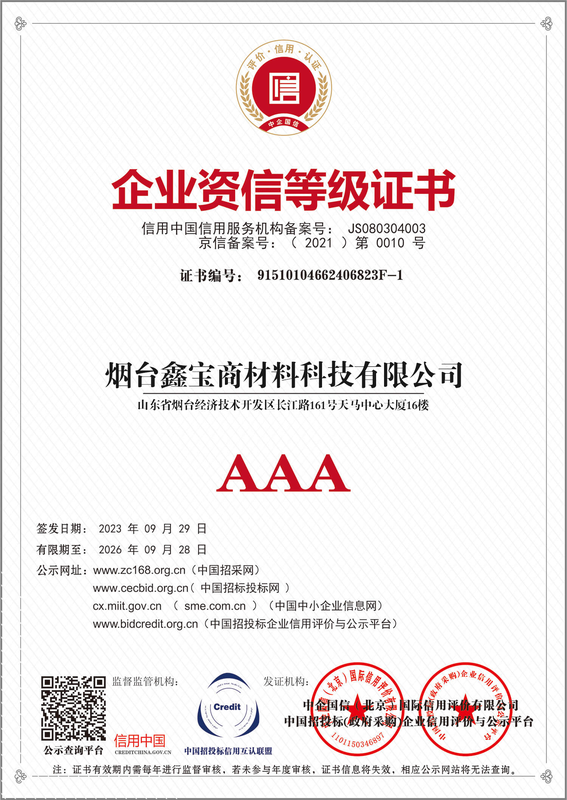
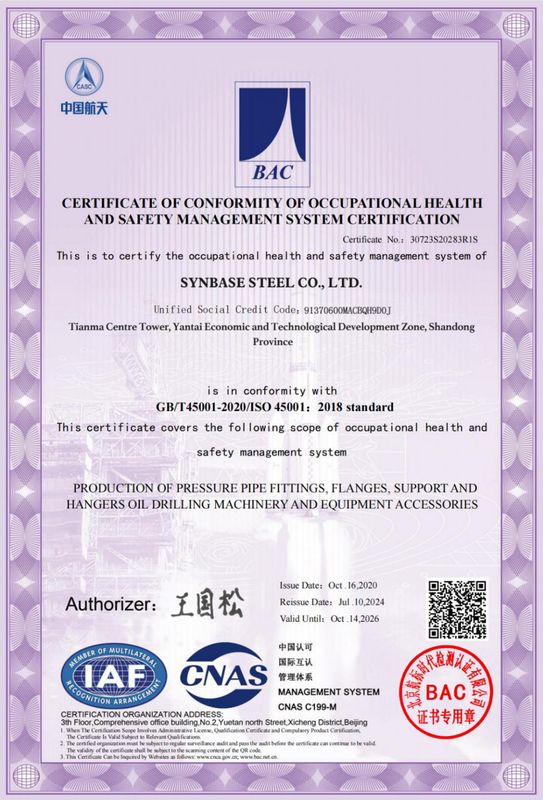
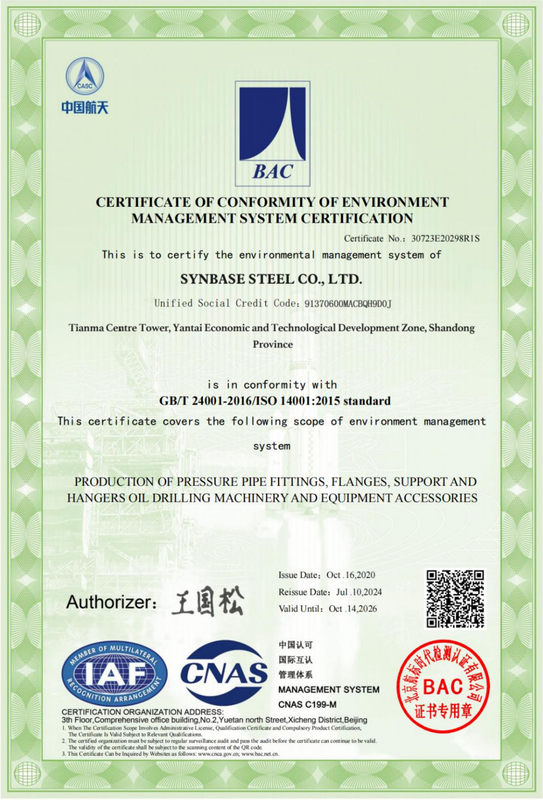
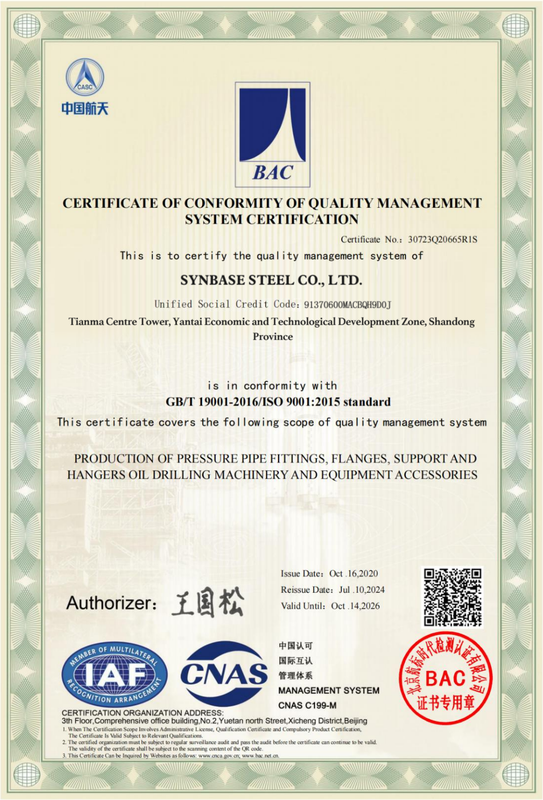
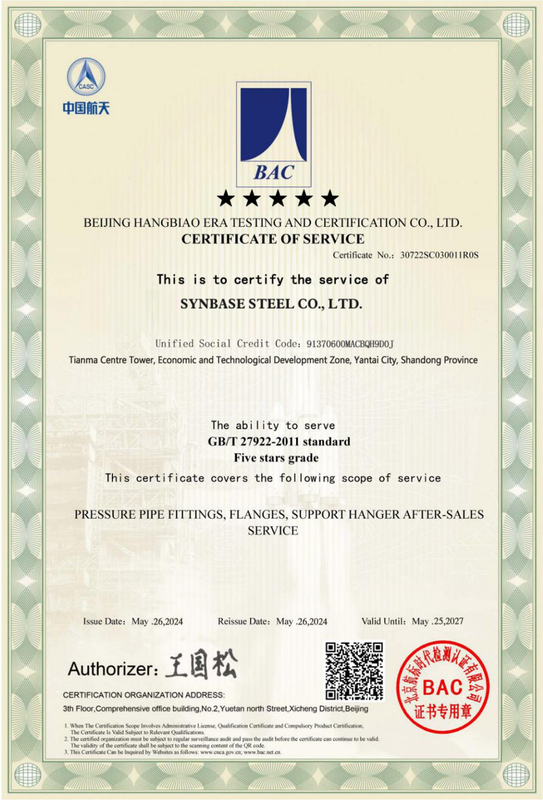
ISO 9001
Quality Mgmt System
ISO 14001
Environmental Mgmt
ISO 45001
Occupational H&S
CE
EU Conformity
EN 10204 3.1
Mill Test Certificate
CISA Member
China Iron & Steel Assoc.
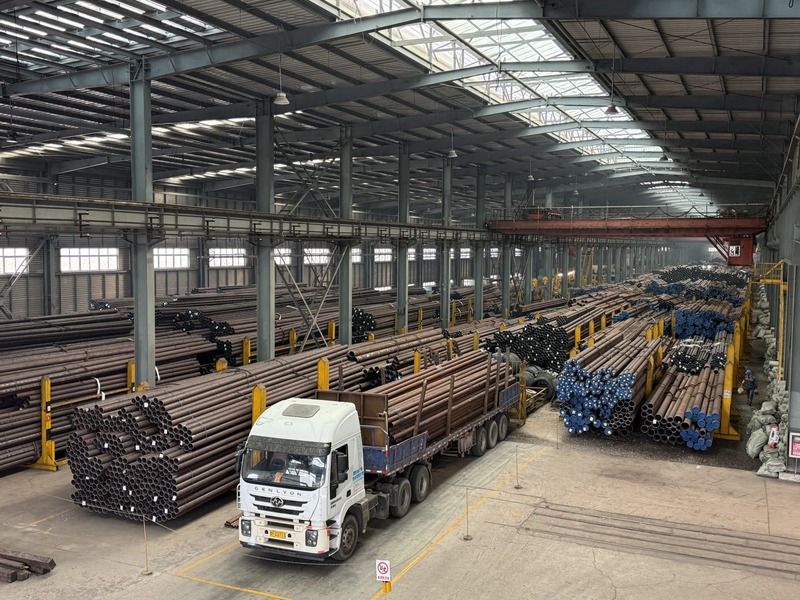
Power behind the fittings is the E-CHENG Steel Group -an integrated supply chain solution from manufacturing pipe (seamless and welded), fittings, flanges, and valves, with strong strategic sourcing alliances with primary steel makers including Baosteel, Tianjin Pipe (TPCO), Ansteel and TISCO. We use this base to provide grade and size inventory readily, serving national oil companies and EPCs in over 100 countries, without the typical limitations of special ordering any specific alloy run.
Third Party (SGS, BV, TV), Positive Material Identification (PMI) of the fitting body, NACE MR0175 Sour Service compliance are readily available options, coordinated at the time of order and not as after-market negotiations. It matters from a structural perspective as a certificate is of little value without the traceability of the heat number, and on a critical energy project, incorrect grade cost >> fitting cost. Unlike a broker who might sell mixed stock from multiple mills, Synbase guarantees what it makes.
An eccentric reducer is not typically ordered alone; it is part of a greater pipeline project requirement along side fittings, flanges, and perhaps pipe spools. What determines your quotation and lead-time is much more the following combination than the standalone part number. Instead of trying to quote from a pricing guide that will be inevitably inaccurate, here are the factors that drive the cost.
A common procurement risk is the fragmented shipment: reducers turn up weeks after the elbows, the spool can’t be welded, and the project schedule slips. Because Synbase manufactures the full butt-weld family in-house — reducers, elbows, tees, and flanges from NPS 1/2″ to 60″ in A234, A403, and alloy grades — your order ships consolidated from one warehouse, unlike when a broker assembles orders from multiple manufacturing facilities. We cater to clients across Southeast Asia, the Middle East and Europe, with our sales and engineering support team available 24/7 providing quotations, technical consultations and global tracking of materials. Every piece ships marked and certified to ASME B16.9 with its EN 10204 3.1 record. To secure your precise costings and lead time, forward your line lists or fitting schedules and we will issue an accurate quotation based on your current project requirements.


Use an eccentric reducer wherever on a horizontal run where the maintenance of a single flat bore is important, such as pump suctions (to ensure no air accumulates), steam or vapor lines (to drain condensate) or wastewater or slurries (to avoid settling). Use a concentric reducer for vertical pipe runs and horizontal clean-liquid applications where a bottom or top pocket is not formed.
It depends upon how the liquid enters the line. If it comes from below a pump and has air trapped that need to vent out of the pump suction opening, the eccentric reducer should have the flat side facing up to serve as a “cap” on the pocket at the fitting bottom. If the pipe is supplied full from above and has vapors entrained within it, and the goal is to promote air removal as well as ensure maximum drainage in the run, have the flat side down. Copying a “flat side up” arrangement on a top supply line can encourage unwanted pocketing of the liquid.
The fitting will be marked with grade, heat number, size and standard (ASME B16.9 or MSS SP-75). The end-to-end measurement and outside diameter of the bevels can then be measured and compared to the appropriate dimensional table. The heat number stamped on the fitting should correspond to the EN 10204 3.1 Mill Test Certificate. A valid 3.1 certificate must be back-traced to the melt – without this, altering a 3.1 certificate from something it’s not is easy.
Carbon steel (A234 WPB/WPC, low-temp A420 WPL6, high-yield MSS SP-75 WPHY 42-70), stainless steel (A403 WP304/304L/316/316L), chrome-moly alloy (WP1/5/9/11/12/22 grades) in sizes NPS 1/2 to 60, and schedule sizes ranging from 10S to XXS in ASME B16.9 / MSS SP-75 standards with full EN 10204 3.1 certification.
ASME B16.9 describes dimensions, tolerances, marking, and material of butt-weld fittings up to NPS 48. The MSS SP-75 series expands the dimensional series to above 48, and also adds the WPHY high-yield grade family used on transmission pipelines. The European equivalent is EN 10253-2.