Send Your RFQ to Synbase Steel
Prefer to send drawings, BOMs or attachment lists by email? sales@synbasesteel.com

A single failed string can kill an entire oil or gas well. Synbase produces all the common grades of API 5CT casing, supplies a heat-traceable EN 10204 3.1 certificate with each length, and can even help your engineers specify exactly what you need.
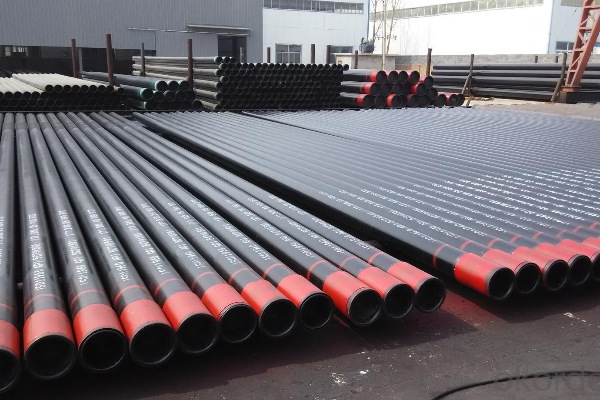
API 5CT casing is the string of steel pipe inserted into a drilled wellbore to keep the hole from caving in and maintain formation integrity. Synbase offers it per API Specification 5CT, 11th Edition in any grade from J55 through Q125, with the thread connection your project requires, from API threads to premium connections.
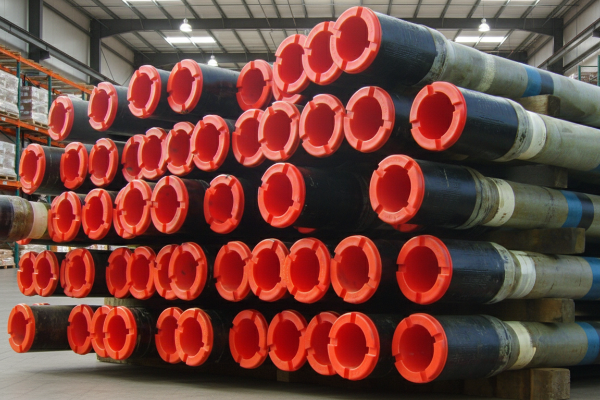
Casing accounts for roughly 70% of the tubular steel in a well, and it’s the critical string that, once set and cemented, can’t be retrieved and replaced. Any weakness in a specified grade of casing may not be immediately apparent when it leaves the mill, but it shows up later as a collapse, a leak, or sulfide stress corrosion cracking. Casing lines the drilled hole to isolate formations and carry well loads, as defined in the U.S. OSHA drilling eTool.
Your price for making that mistake isn’t the cost of the pipe, alone. For example, “even an incorrectly specified one level, a single casing-string failure could escalate from production loss to loss of the entire well and a multi-million-dollar remediation,” reports oilfield tubular guide lines.
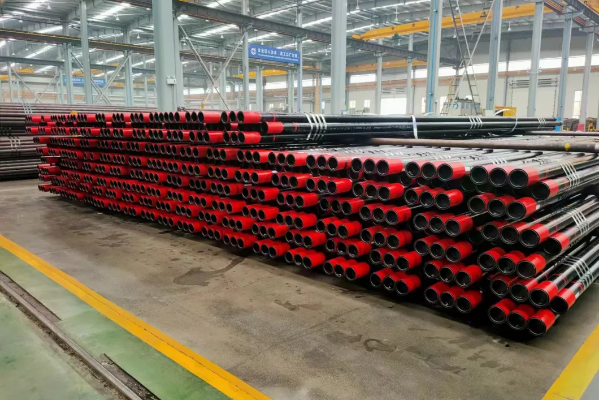
Holds back unconsolidated surface ground supporting the wellhead. Length 40 to 300 feet. Diameter to 30 inches.
Protects aquifers that contain fresh water; supports a blowout preventer (BOP). Length 500 to 1,000 feet.
Seals zones of anomalous pressure, an unstable zone, or areas of lost circulation.
Contains the final string over the productive horizon; is designed to transmit production and injection loads.
Each of these types of casing sees a different load and a different chemistry, so they don’t all call for the same grade. That specific mix of mechanical and chemical loads is precisely why selecting casing is a function of engineering, and precisely why Synbase qualifies well conditions before making any grade recommendation.
Not sure which grade each string needs?
Request a free grade-to-well recommendation →Selecting a grade begins with identifying yield strengths and maximum hardness required for the particular well, then selecting a connecting thread designed to withstand the loads. Here’s our application department’s classification system for handling a casing RFQ; it sorts them first by the required grade.
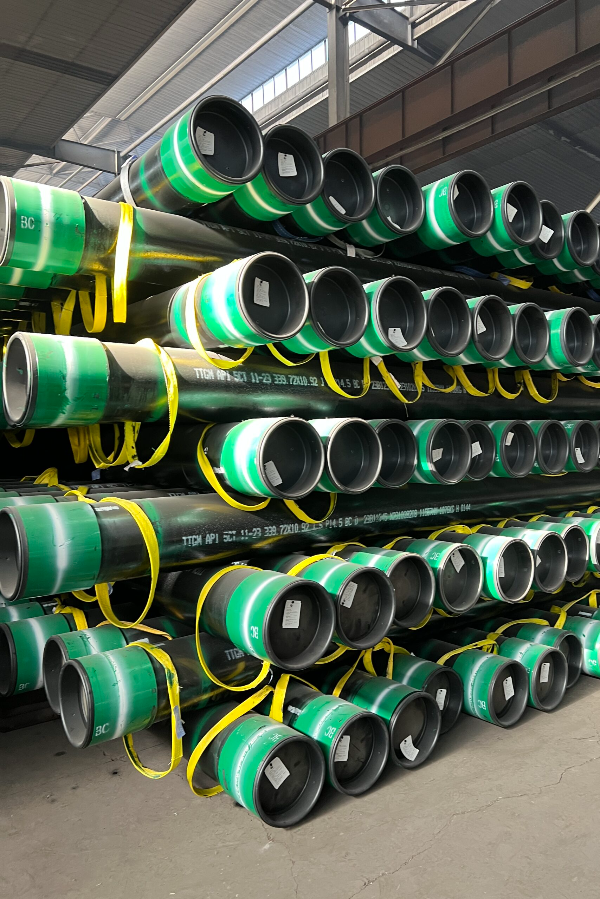
Synbase manufactures each row in the above table from 4” through 20” OD and within this range covers wall thickness ranges from 5.21 mm to 16.13 mm and lengths R1, R2, and R3. Connectivity options include all three API casing threads, short (STC), long (LTC), and buttress (BTC) — plus a range of licensed premium connections including VAM TOP, NEW VAM, Hydril and TPCQ for tight, gas-service connections. The ladder also lists M65, a steel grade between K55 and N80, and each higher strength grade trades cost for load capacity rather than buying universal margin. Tubing size, pipe connections, and thread type are matched per string, and every API 5CT J55 through Q125 order ships as API 5CT steel to Spec 5CT with full traceability.
Each API 5CT steel grade is set by its chemical composition and heat treatment: J55 and K55 ship as-rolled, while N80Q, L80, C90, T95, and P110 are quench-and-tempered for controlled tensile strength and elongation. PSL-2 and PSL-3 tighten chemical properties, NDE, and dimensional tolerance over PSL-1. For sour and deep wells, hardness, corrosion resistance, and a corrosive-service test package are specified alongside any coating, and grade C90 and above carry an SSC-resistant qualification across drilling operations and well completion in oil and gas fields.
Most casing leaks start at the coupling, which is why connection design is its own field, USPTO records active OCTG coupling patents such as US 11,970,913 and US 11,680,451. For sour or high-pressure gas wells, specify a metal-to-metal premium connection rather than an API thread alone.
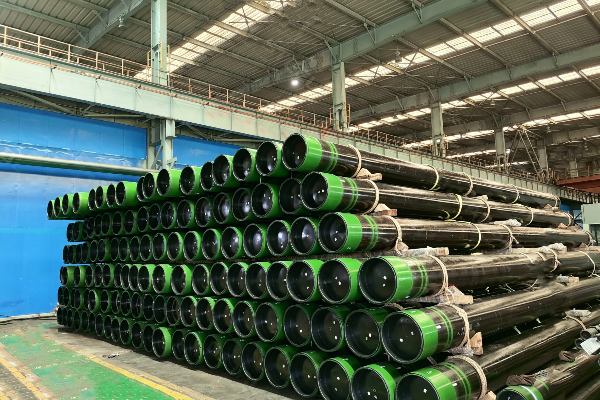
Here’s the most universally overlooked rule to avoid. The strong steel isn’t always the safe bet. Grade selection is a function of two unrelated factors — both of which, yield point for collapse and burst, can fail even superior steel: sour service.
Work the well condition first, then let the grade follow. The decision tree below is the path our engineers use before a single joint is quoted, and it keeps strength and the sour-service limits set by ISO 15156 as two separate questions.
| Well condition | Depth / pressure | Sour (H2S)? | Recommended grade | Why |
|---|---|---|---|---|
| Shallow water / surface string | Low | No | J55 / K55 | Adequate yield, lowest cost |
| Medium depth, moderate pressure | Medium | No | N80-1 / N80Q | Higher yield, collapse margin |
| Deep, high pressure | High | No | P110 | 758–965 MPa yield for HP loads |
| Deepest HPHT | Very high | No | Q125 | 862–1034 MPa, maximum strength |
| Sour, moderate depth | Medium | Yes | L80-1 | HRC ≤23 resists SSC |
| Sour, deeper / higher load | High | Yes | C90 / T95 | Sour-qualified high strength |
| Sour HPHT | Very high | Yes | C110 | Highest sour-qualified yield |
| Wet CO2 / mild sour | Medium | CO2 | L80-13Cr | 13Cr resists CO2 corrosion |
Reason for the sour lines: that’s precisely the point of departure for the integrity failure – choosing strength only when operating in a H2S well.
Have an H2S reading for your reservoir? Send it for a sour-service grade check →
The costliest grade of error in casing is considering P110 as a general all around good substitute. It is the high strength yield of P110 that disallows it from sour services. According to NACE MR0175 / ISO 15156, when a well become “sour”, H2S partial pressure reach > 0.3 kPa (0.05psia), P110 and Q125 steel is no longer allowed at these pressures.
| Grade | Yield (MPa) | Sour service? | Hardness control | Relative cost |
|---|---|---|---|---|
| J55 / K55 | 379–552 | Not for sour | None | Lowest |
| N80-1 | 552–758 | Not for sour | None | Low |
| L80-1 | 552–655 | Yes — standard sour | ≤23 HRC controlled | Moderate |
| C90 / T95 | 621–758 | Yes — high-strength sour | Capped + tempered | High |
| C110 | 758–828 | Yes — SSC Region 2/3 | Tightly capped | Highest sour |
| P110 | 758–965 | No — prohibited in sour | None | High |
| Q125 | 862–1034 | No — non-sour only | None | Highest |
The whole table may be read two ways, not pay a P110 premium for shallow, sweet wells which have J55 – don’t in this case put J55 in a reservoir requiring L80 cracking resistance.
Honestly, it’s simpler than the sales pitch: match the grade to the load and the chemistry. That trade-off is genuine, a sour grade compromises yield to gain hardness control, and it’s exactly the right call in H2S.
Per ISO 15156-2, our grade of sour has hardness limitation that makes them Sour-qualified – in H2S sour service, excess strength beyond hardness limit is undesirable not beneficial.
“The enquiry we push back on most is a buyer asking for P110 on a sour well because it sounds stronger. We requote it as L80 or C90, lower yield, but hardness-controlled, because the stronger pipe is the one that cracks. Matching the grade to the H2S reading is the cheapest insurance on the whole string.”
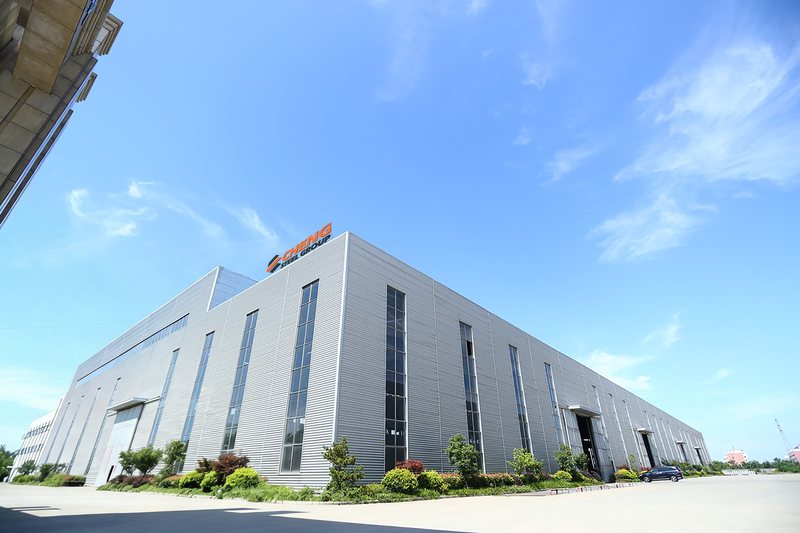
OCTG is awarded on documentation and delivered tonnage, not on name recognition. Synbase supplies casing into projects through E-CHENG STEEL GROUP, which has worked with national oil companies and EPC contractors across more than 100 countries.
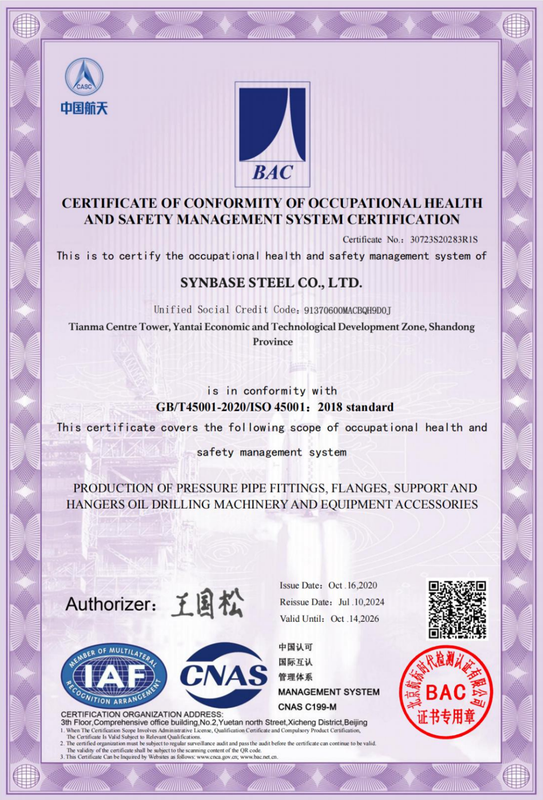
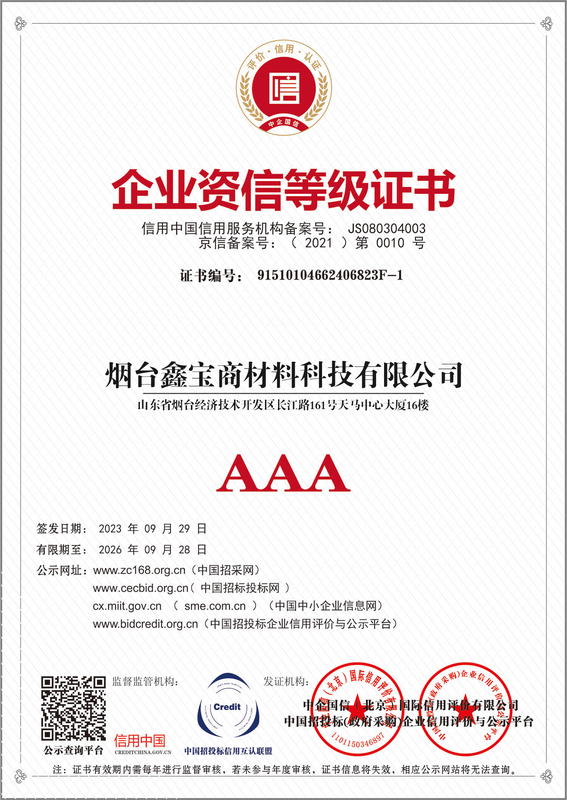
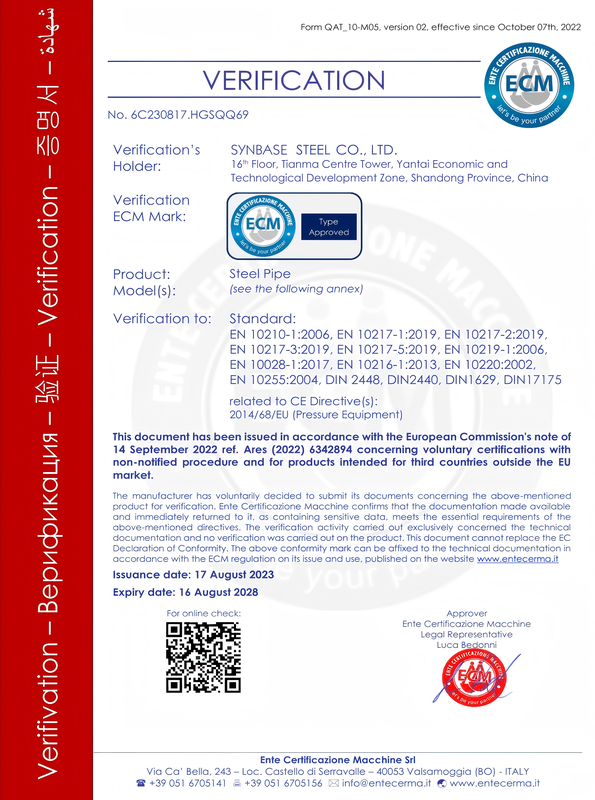
Regulators like the U.S. Bureau of Safety and Environmental Enforcement hold casing to barrier standards, so the documentation behind a string of tubulars matters as much as the steel itself. That’s a problem that a newer mill tackles through verifiable certifications instead of vague promises.
Buyers hesitate with a new OCTG supplier over certificate trust, and the concern is well founded: counterfeit mill certificates exist precisely because the document is what a buyer relies on. Heat-number traceability is the defense, a chain that links every joint back to the steel melt and its actual test result.
For sour or high-pressure strings, Synbase arranges 3.2 certification witnessed by a third party such as SGS, BV, or Lloyd’s, and we won’t claim a result we can’t test. On a casing string, an unverified heat is a future failure, not a discount.
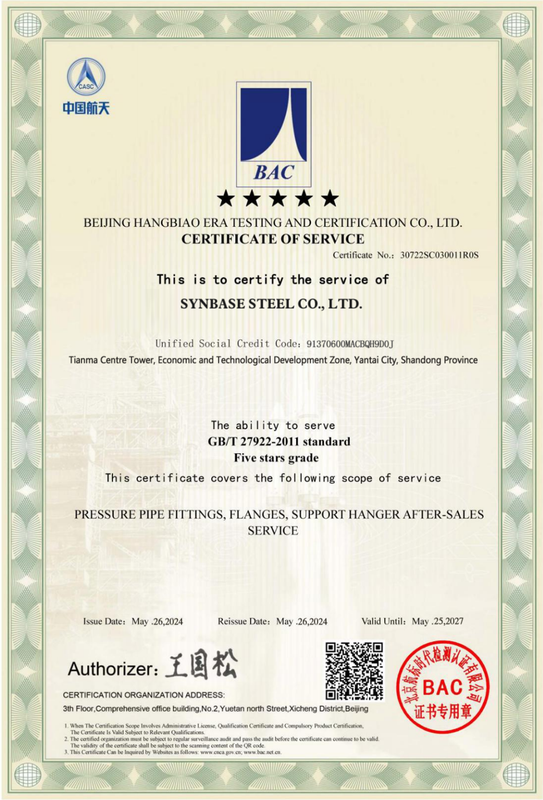
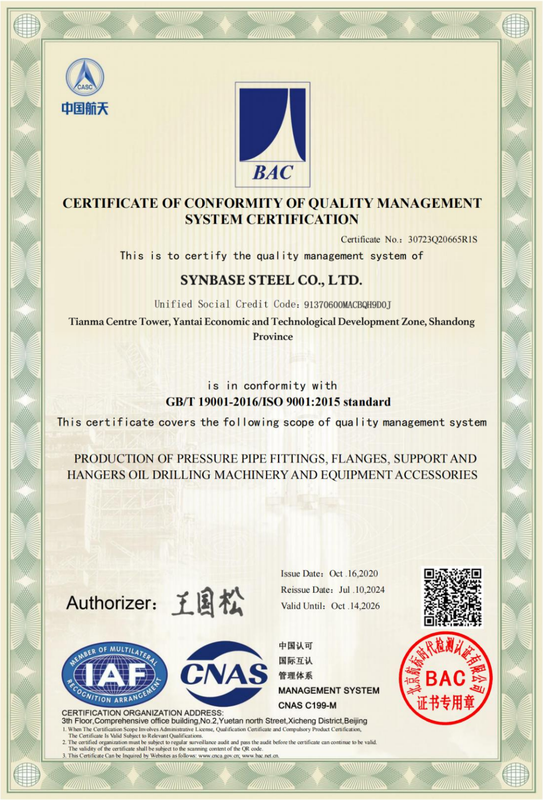
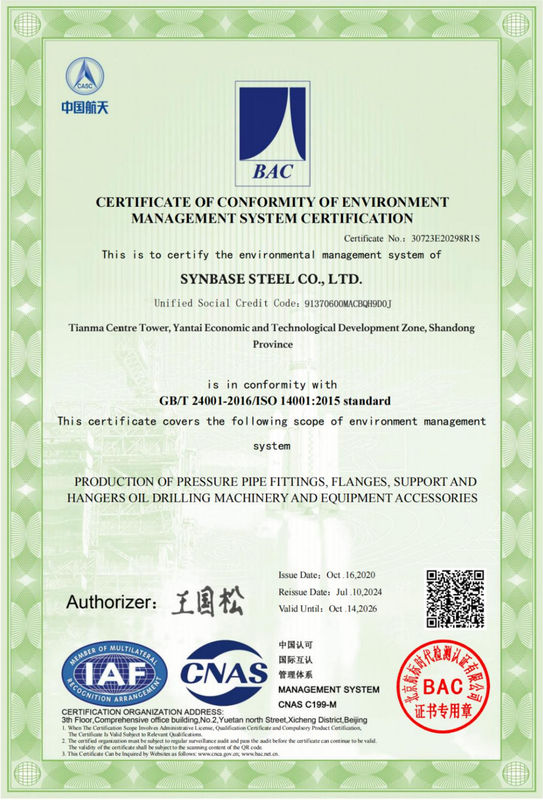
A single list price for API 5CT casing would mislead, because landed cost is driven by the order and the inspection scope, not the tonne alone. Synbase prices each quotation from the factors below rather than a flat rate.
Grade and service class, sour grades (L80, C90, T95, C110) carry more test and hardness scope than J55/N80.
Connection type, premium gas-tight connections add machining and licensing cost over API STC/LTC/BTC.
Inspection level, a full-length OCTG inspection by EMI/UT and 3.2 third-party witness adds cost and time over standard 3.1.
Logistics scope, sea freight, duty, thread protectors, and dunnage all sit between mill price and the wellsite.
One filter does more than any other a buyer can write: the certification line itself. Putting “Material Certification per EN 10204 3.1″ in the RFQ screens out any supplier who can’t produce heat-level traceability.
Under the API 5CT standard, these tubulars split into casing and API 5CT tubing, and the same OCTG inspection applies to both. Working from the group’s integrated supply chain, production, processing, warehousing, and logistics under one operator, Synbase coordinates lead time rather than brokering it.
Send your grade, OD, wall, connection, quantity, and inspection level for a spec-matched quotation.
Request a quote →Utilize our technical tools to calculate casing weight, tally lengths, and select appropriate grades for standard and sour-service well environments.
Determine string weight, joint lengths, and tally requirements for API 5CT casing operations.
Filter and select compliant casing grades based on well depth, pressure, and mechanical load parameters.
Verify NACE MR0175 / ISO 15156 compliance for H2S environments and hardness-controlled grades.
API 5CT is the American Petroleum Institute specification for API 5CT casing and tubing used in oil and gas wells, and these API standards cover grades, dimensions, chemistry, mechanical properties, and connections. Casing is the larger-diameter pipe that lines the drilled hole and is cemented in place to isolate formations and support the well.
The API 5CT grades run from J55 and K55 through N80 (type 1 and quenched), L80, C90, T95, C110, P110, and Q125, spanning about 379 MPa to 1,034 MPa minimum yield. J55 and K55 suit shallow wells, N80 and P110 cover deeper higher-pressure wells, and L80/C90/T95/C110 are the hardness-controlled grades for sour (H2S) service.
No. Under NACE MR0175 / ISO 15156, P110 is not permitted in sour (H2S) service because its high hardness makes it susceptible to sulfide stress cracking. For sour wells the correct choices are L80, C90, T95, or C110, which control hardness to resist cracking even though their yield strength is lower.
A well is treated as sour once the H2S partial pressure in the gas phase exceeds 0.3 kPa (0.05 psia), per NACE MR0175 / ISO 15156. Above that threshold the casing must be a hardness-controlled sour grade, regardless of how much strength the depth and pressure otherwise call for.
API 5CT covers OCTG — casing and tubing run inside a well — while API 5L covers line pipe that transports oil and gas above ground or along a pipeline. They use different grade systems and test regimes, so casing for a well is specified to 5CT, not 5L.
Yes. Every heat ships with an EN 10204 3.1 mill test certificate naming the heat number, chemistry, and measured mechanical results, with the heat number stamped on the pipe to match. For sour or critical strings, 3.2 third-party witnessed certification through SGS, BV, or Lloyd’s is available on request.
Synbase supplies API 5CT casing in OD 114.3–508 mm (4½”–20″), wall 5.21–16.13 mm, in range lengths R1, R2, and R3. Connections include API STC, LTC, and BTC threads plus licensed premium connections such as VAM TOP, NEW VAM, Hydril, and TPCQ for gas-tight service.