Send Your RFQ to Synbase Steel
Prefer to send drawings, BOMs or attachment lists by email? sales@synbasesteel.com

Integrated drill pipe bodies with weld on tool joints in grades E75, X95 G105 and S135-the design, specification and approval are developed for your deep, horizontal and HPHT drilling operations.
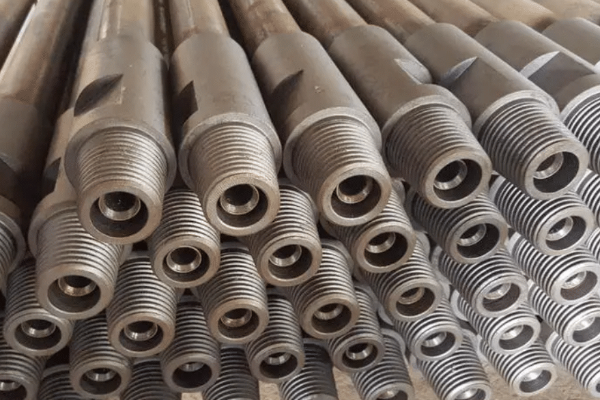
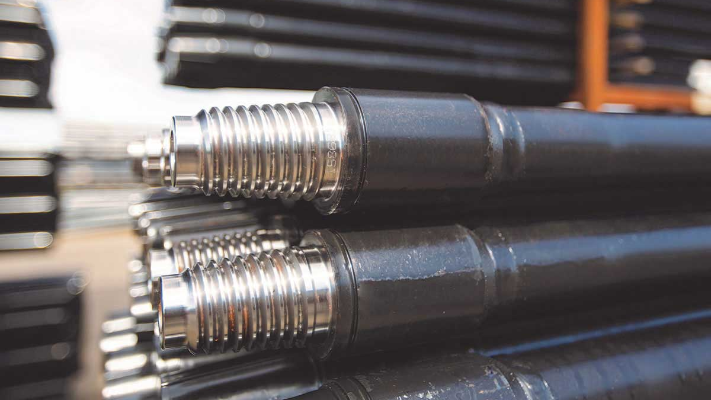
API 5DP drill pipe consists of the seamlessly drawn steel pipe through which the rotary torque is transferred from the drilling rig floor to the drill bit as the drilling mud is pumped downhole through oil & gas drilling operations; the seamless pipe body, upset to accommodate tool joints, is attached to weld-on tool joints – the points where most drill programs succeed or fail.
Failure analysis can be brutal in terms of the breakdown of risk. In excess of 95% of all drill pipe failures are bottomhole assembly (BHA) related washouts. The minority fail via fatigue.
It’s rarely the grade of the steel alone – it’s cyclic stress and downhole vibration, thousands of oscillations where the pipe is rotated, bent, and held under high-pressure conditions. That focuses fatigue on the tool joint and slip region.
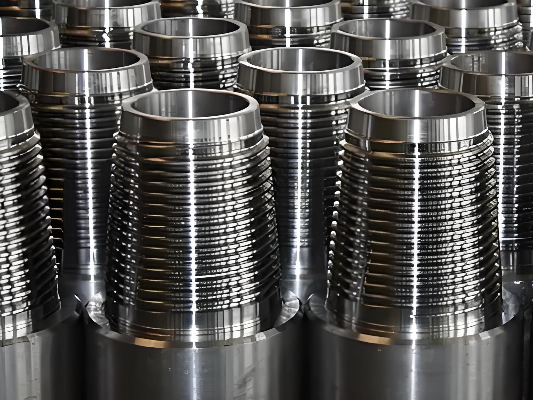
This is why oil and gas exploration programs specify drill pipe to the API 5DP / ISO 11961 standard: it sets the technical delivery conditions for steel drill pipe – dimensions, mechanical properties and inspection rules – that protect the integrity of the drill string as it circulates drilling fluid and resists internal and external pressure downhole.
Selecting drill pipe is a matter of load conditions, well trajectory, inspection requirements and service life – not simply grade or price. Use the following tables of hard numbers to match pipe to the project.
“Stronger is not automatically better. In sour (H2S) service, S135 and higher grades are more susceptible to sulfide stress cracking, yet past roughly 20,000 ft you need them just to support the string’s own weight. We size grade to depth and environment together, never to a single number.”
This trade-off is a genuine one: currently, the industry lacks a specific international standard for drill pipe resistant to H2S and practice still differs from supplier to supplier. We help make this concrete below with our selection guidelines.
Synbase makes API 5DP drill pipe grades in four standard classes – where the number is the minimum yield in ksi. The API 5DP drill pipe specification also governs drill pipe manufacturing – upset geometry, the number of tool joints, and the three product specification levels (PSL-1 to PSL-3). Higher grades carry a longer string and higher torque, because grade, wall and connection each fail in their own way, and Synbase engineers match all three to your program.
| Grade | Min Yield | Min Tensile | Best-fit service |
|---|---|---|---|
| E75 (E-75) | 75 ksi / 517 MPa | 100 ksi / 689 MPa | Shallow & conventional wells |
| X95 (X-95) | 95 ksi / 655 MPa | 105 ksi / 724 MPa | Medium-depth wells |
| G105 | 105 ksi / 724 MPa | 115 ksi / 793 MPa | Deep & high-torque directional |
| S135 | 135 ksi / 931 MPa | 145 ksi / 1000 MPa | Ultra-deep · directional · HPHT |
These drill pipe sizes are manufactured according to the API 5DP / ISO 11961 standard and API RP 7G, and are available in the complete size range with internal-external upset (IEU) ends – a design offering high tool-joint OD relative to its internal diameter (compared to the pipe body).
| OD | Nominal wt (lb/ft) | Wall (in) | Approx ID (in) | Typical connection |
|---|---|---|---|---|
| 2-3/8″ | 6.65 | 0.280 | 1.815 | NC26 |
| 2-7/8″ | 10.40 | 0.362 | 2.151 | NC31 |
| 3-1/2″ | 13.30 | 0.368 | 2.764 | NC38 |
| 4″ | 14.00 | 0.330 | 3.340 | NC40 |
| 4-1/2″ | 16.60 | 0.337 | 3.826 | NC46 |
| 5″ | 19.50 | 0.362 | 4.276 | NC50 |
| 5-1/2″ | 21.90 | 0.361 | 4.778 | 5-1/2 FH |
| 6-5/8″ | 25.20 | 0.330 | 5.965 | 6-5/8 FH |
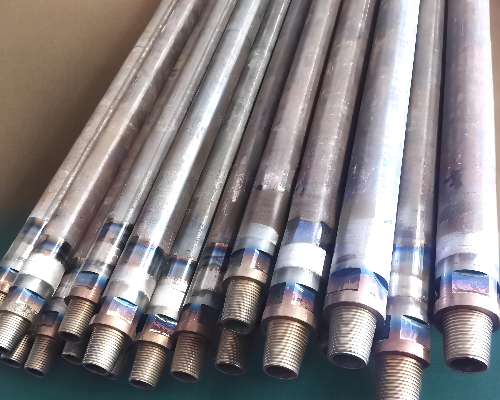
The available tool-joint connections include NC26, NC31, NC38, NC40, NC46, and NC50; larger sizes are supplied with full-hole (5-1/2 FH, 6-5/8 FH) ends. Ensure that your choice of connections matches your rig’s existing drill string and BHA pin/box ends.
Submit your rig’s connections and we’ll verify makeup torque and bore compatibility prior to shipment so that your string can be put into service without issue.
We manufacture and heat treat all of our tool joints on-site and can provide tight-hold tolerances and concentricity-a level of control unattainable by third-party suppliers, where any trade-offs are unknown until a downhole gall occurs.
Starting with these basic dimensions, our engineers tune the design to your mud weight, dogleg severity, and hydrogen sulfide partial pressure requirements.
| Grade | Yield | Indicative depth / service | Sour (H2S) caution |
|---|---|---|---|
| E75 | 75 ksi | < 8,000 ft, conventional vertical | Lowest SSC risk |
| X95 | 95 ksi | 8,000–12,000 ft | Moderate — qualify per service |
| G105 | 105 ksi | 12,000–18,000 ft directional | Evaluate SSC exposure |
| S135 | 135 ksi | > 18,000 ft · HPHT · ERD | Higher SSC susceptibility — qualify carefully for sour |
Beyond standard drill pipe, Synbase supplies the connected string for oil and gas industry drilling applications – heavy weight drill pipe (HWDP) per API Spec 7-1, drill collars, and matching OCTG pipe, all built to the API Specification 5DP drill pipe rules. Add heavy weight drill pipe (HWDP) where the string needs a transition section.
Need pipe matched to a specific rig and connection set?
Get the Grade Selection Guide →Used drill pipe is categorized by its residual wall thickness, which indicates the remaining strength of the pipe. Knowledge of your string’s classification differentiates prudent expense from downhole liability.
| Attribute | New API 5DP | Premium Class (used) | Class 2 (used) |
|---|---|---|---|
| Min remaining wall | 100% spec | ≥ 80% of new | ≥ 65% of new |
| Relative body capacity | Baseline | ~80% | ~65% |
| Fatigue margin | Full | Reduced | Significantly reduced |
| Typical use | Critical / deep / sour | General drilling | Shallow / low-risk only |
A Class 2 joint with 65% remaining wall, though inexpensive, possesses a more reduced fatigue margin than its stronger counterparts, a point of failure that occurs at critical juncture near your BHA.
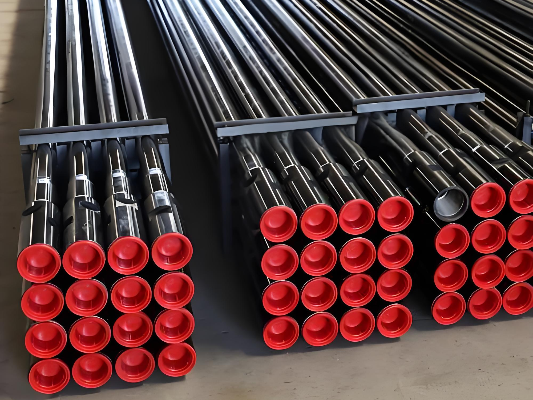
Our drill pipe bodies are manufactured from hot-rolled, seamless steel as opposed to a longitudinally welded seam. A seamless body eliminate the welded line as a initiation point for corrosion and fatigue during high-stress, cyclical downhole operation.
Visual inspection often doesn’t tell the story; two seemingly similar drill pipe joints can diverge by 15 percentage points of remaining wall. In the absence of a validated UT/EMI inspection grade, even a seemingly low cost string could result in significant fishing expenditures.
The honest version is that classification beats price-shopping, and the trade-off is real: each Synbase string ships with verified inspection reports confirming it meets the API 5DP / ISO 11961 standard – eliminating guesswork.
The most economical drill pipe is the one that never fail. Sustained longevity comes from controlling the three most critical elements of fatigue life: steel quality, weld-line reliability and detailed inspection.
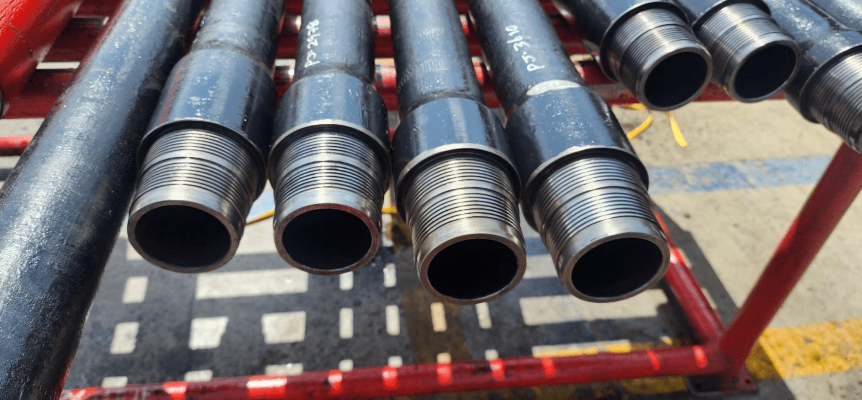
These rejection reasons are precisely the flaws third-party surveyors (SGS, BV, DNV) indicate at arrival. We identify each at the mill so you don’t pay to find them later.
“We reject on the inspection bench, not at the customer’s yard. A galled thread or a slip-cut crack costs us one joint; downhole it can cost a fishing job. That math decides what leaves our floor.” — Chen Wei, QA/QC Director, Synbase OCTG
Tool-joint fatigue failures are prevented at the design stage: stress relief grooves at weldings and pin/box shoulders diminish cyclic stress amplitude in rotating bent pipe, documented in several published tool-joint patents (e.g. US5355968A, CA2128114C, WO2013033684A1). Inspection then verifies design intent. Both layers are shipped with each order.
can erase the savings from an entire string of under-spec pipe — once you add trip time, fishing, and a possible side-track. Total Cost of Drill String Failure, not unit price, is the number that matters.
Framework based on published drill-string failure analysis (SPE/IADC, Oil & Gas Journal). Exact NPT cost varies by rig and well — request a quote for a program-specific estimate.
This is important because Twist-off root causes often stem from a defect that should never have shipped. Synbase supplies documented mill test reports for each joint, so the proof move with the string, unlike a third-party lot, where all documentation is lost in transit.
In the field, that string runs on land and offshore rigs from 517 MPa conventional work to 931 MPa deep-well and HPHT programs across 100+ countries. The E-CHENG STEEL GROUP cluster runs seamless and welded pipe mills, processing, and large-scale warehousing – so volume production ships from controlled stock, not brokered lots.
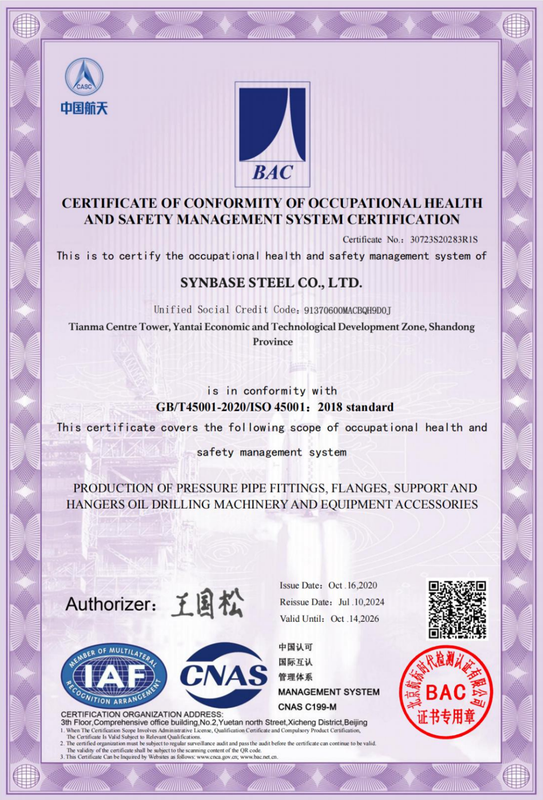
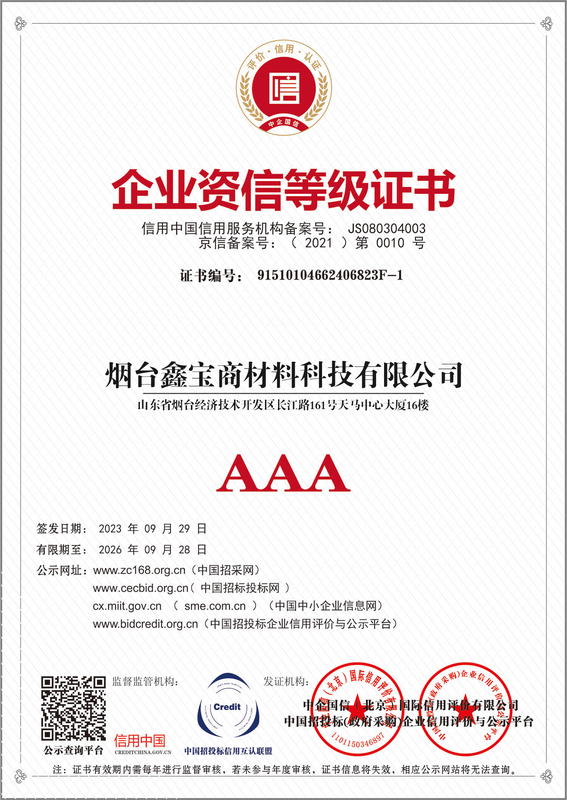
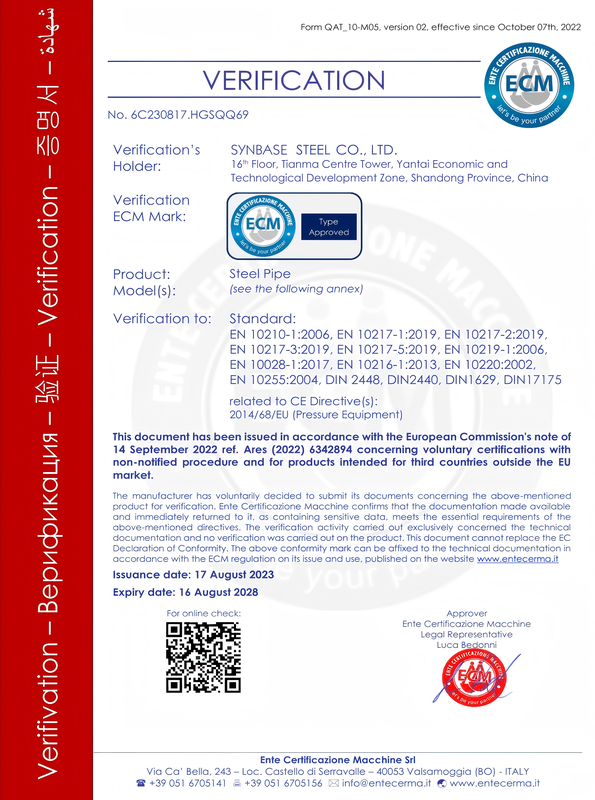
For new vendors, certification isn’t optional: it’s the evidence trail your QA system requires before any joints hit your program. Synbase follows international standards and provides certification before you buy.
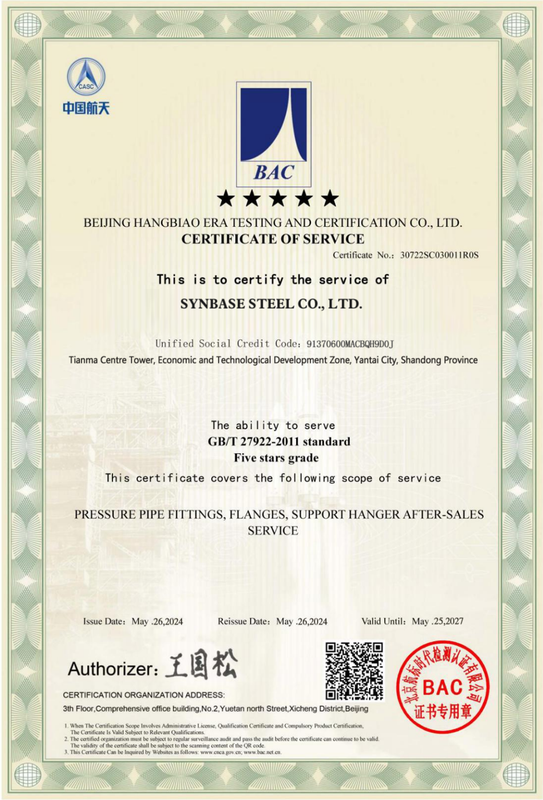
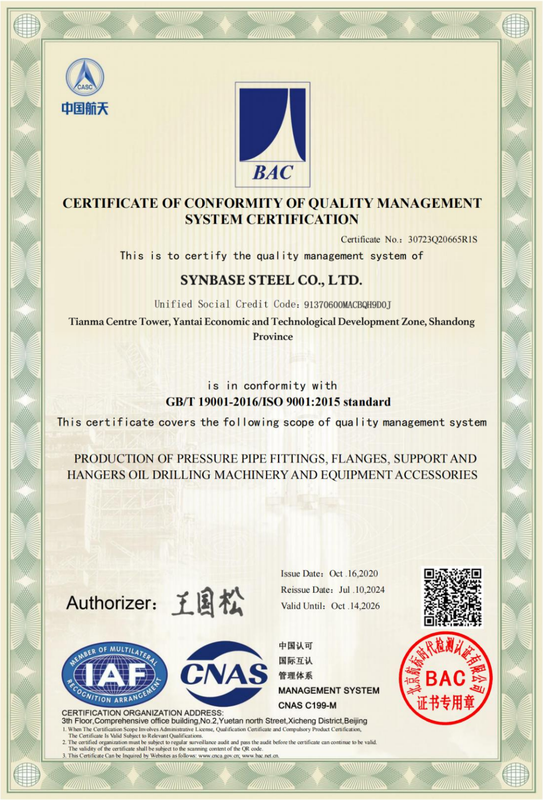
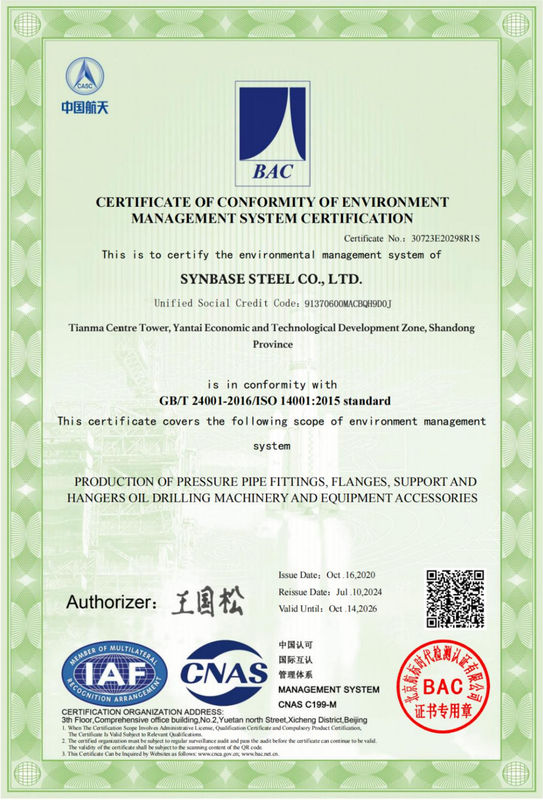
Access our technical utilities to calculate string weight, determine appropriate API 5DP grades, and specify tool joint connections for your drilling program.
Calculate total string weight based on pipe parameters.
Select the appropriate API 5DP steel grade corresponding to well depth requirements.
Identify standard drill pipe dimensions and match compatible tool joint connections.
Send grade, size, connection and footage – get a price, a lead time and the inspection documentation your QA team needs.
Technical clarifications on grades, specifications, sizing, and quality control. Review our compiled responses to common procurement and engineering inquiries.
Four standard grades: E75 (75 ksi yield), X95 (95 ksi), G105 (105 ksi) and S135 (135 ksi). The number is the minimum yield strength in ksi; higher grades carry deeper, higher-torque strings.
API 5DP is the current specification dedicated to drill pipe, aligned with ISO 11961. Earlier drill pipe requirements sat under API 5D / API Spec 7; API 5DP consolidates the technical delivery conditions for the upset body and weld-on tool joint into one standard.
Heavy weight drill pipe (HWDP) has a thicker wall and longer tool joints than standard drill pipe. It sits in the transition zone above the drill collars to improve fatigue resistance and reduce the stress concentration there.
Collars are stiff and heavy for weight-on-bit; HWDP is the lighter, flexible buffer above them.
A common 5″ drill pipe has a nominal weight of 19.50 lb/ft with a 0.362″ wall and an NC50 connection. Heavier 5″ configurations (e.g. 25.60 lb/ft, 0.500″ wall) are used for higher-load strings.
NC26, NC31, NC38, NC40, NC46 and NC50, plus full-hole (5-1/2 FH, 6-5/8 FH) on larger pipe. We match the connection to your existing drill string and confirm makeup torque before production.
The pin is the male threaded end; the box is the female end it makes up into. IEU means internal-external upset, the body is thickened both inward and outward at the ends, giving the strongest tool-joint configuration.
No. In sour (H2S) service, high-strength grades such as S135 are more susceptible to sulfide stress cracking, so grade is chosen against depth and environment together. Past about 20,000 ft, though, S135 is often required simply to support the string’s own weight.
API 5DP manufacture plus documented UT, EMI and MPI inspection is what lets your QA team accept pipe without re-proving it joint by joint. For a new supplier especially, that audit trail, certificates, mill test reports and traceable inspection records travelling with the shipment, is the single thing that turns a rejection at receipt into an approval, which is why we issue it as standard rather than on request.