Send Your RFQ to Synbase Steel
Prefer to send drawings, BOMs or attachment lists by email? sales@synbasesteel.com

type A and B, Long and Short pattern ,carbon steel up to duplex . Factory-direct from E-CHENG STEEL GROUP. Dimensional tracing to ASME B16.9.
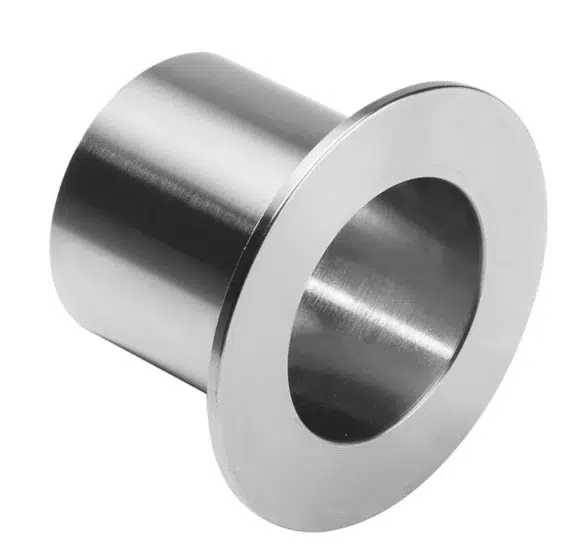
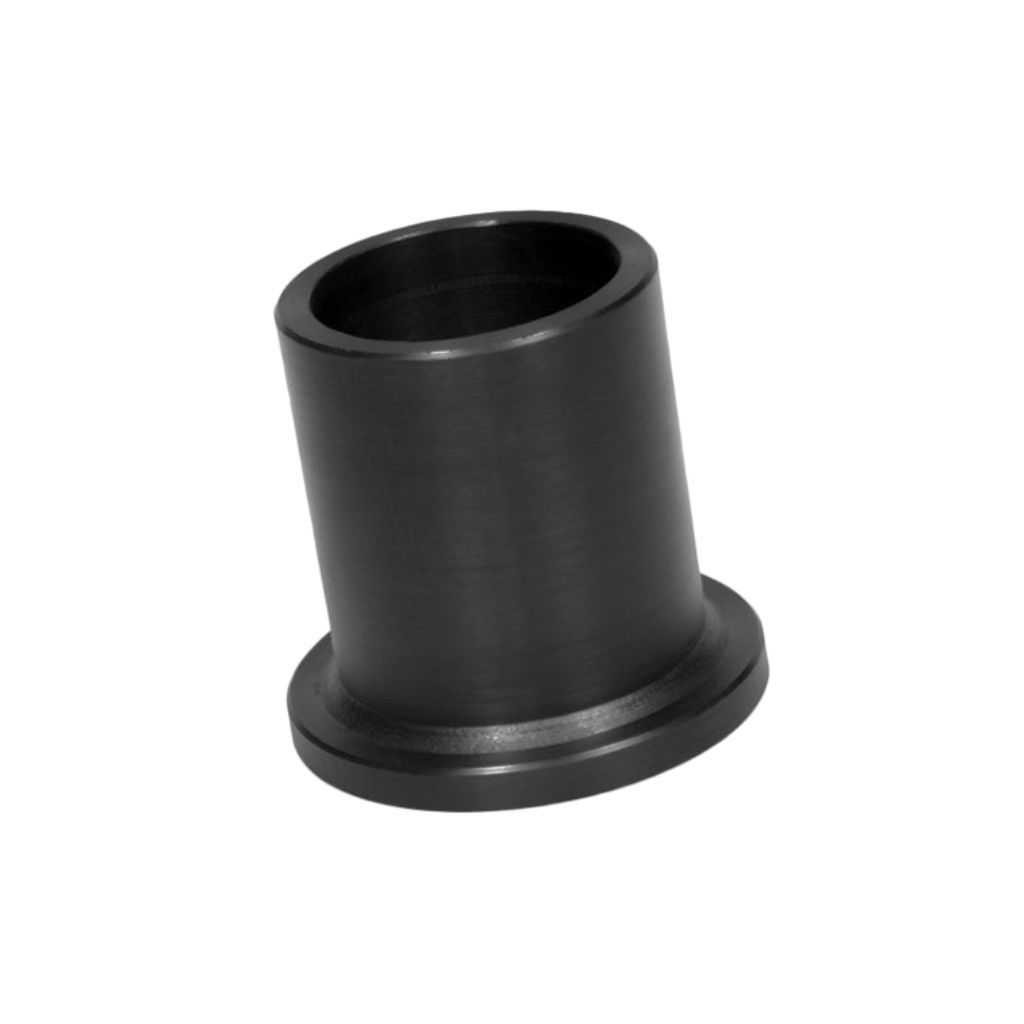
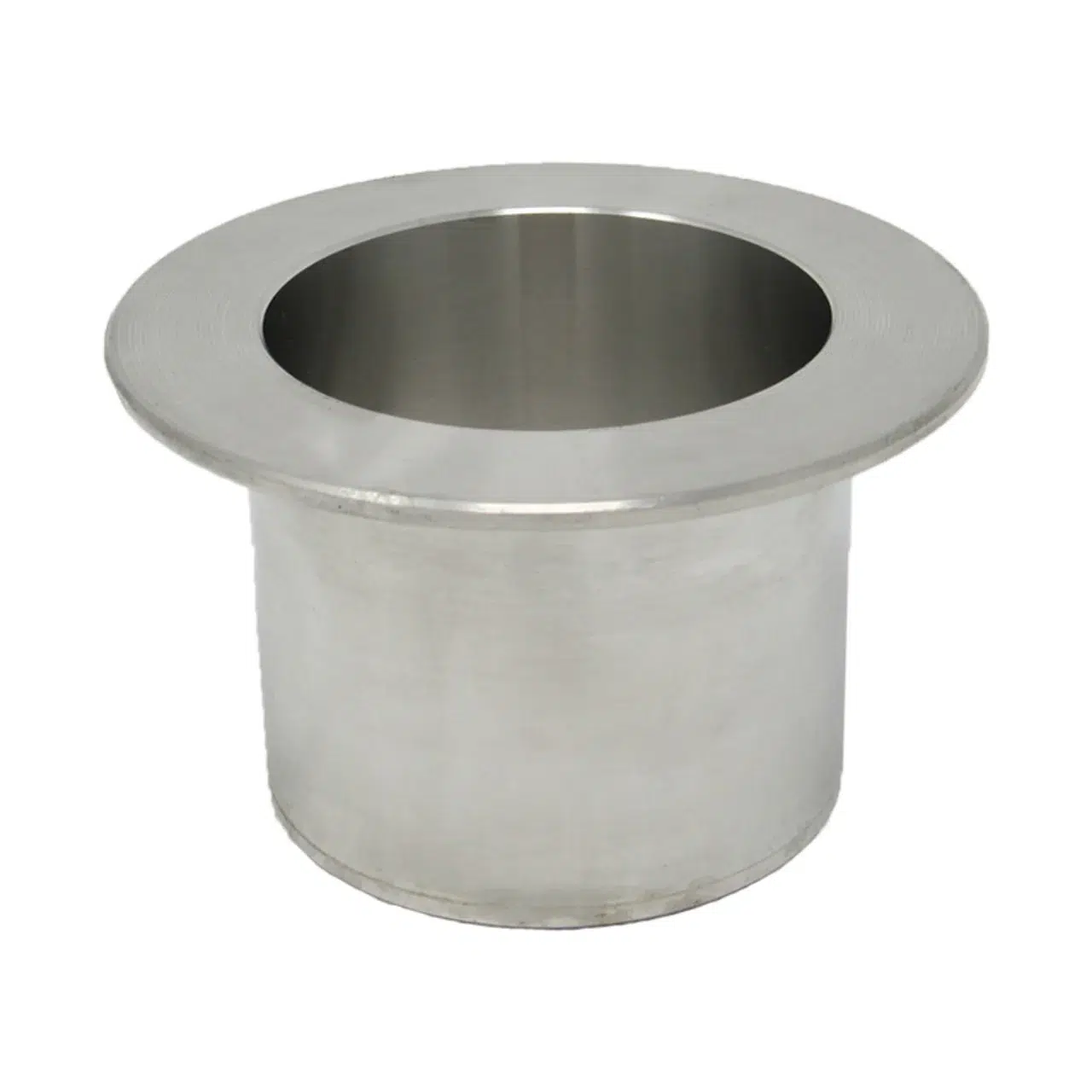
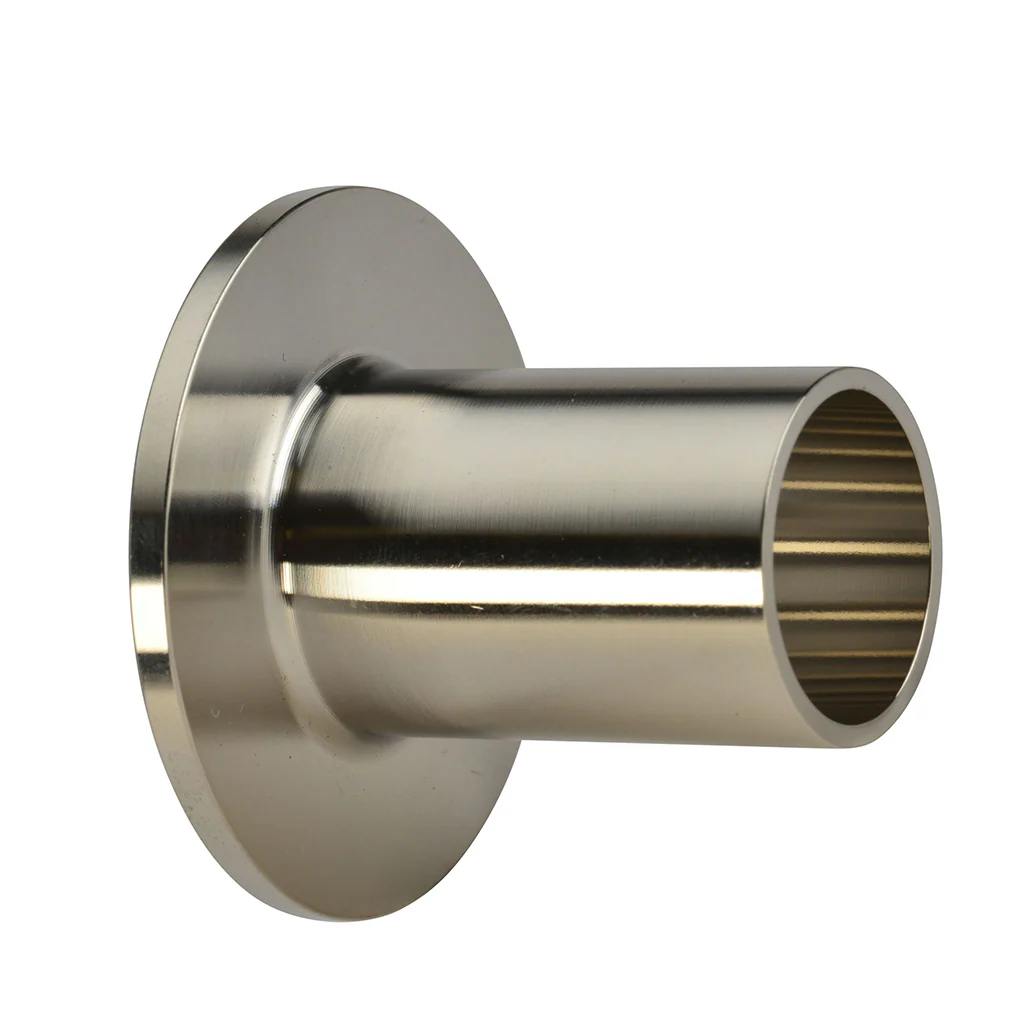
Stub Ends are fabricated and sized in accordance with ASME B16.9 (Factory Made Wrought Buttwelding Fittings) with the following types and forms in ASME Carbon Steel, Stainless steel, Alloy Steel and Duplex grades or as per MSS SP-43 for stainless steel lightweight utility line fittings. They are available in the following two types and two forms suitable for various pressure rating and application like:
"The lap thickness, T, shall not be less than nominal pipe wall thickness."
ASME B16.9, Dimensional Notes (confirmed by three independent source checks)Synbase Steel Co., Ltd... is a subsidiary of E-CHENG STEEL GROUP. We produce stub ends range from NPS to NPS 24 (DN15 to DN600). The range of grades includes carbon steel WPB and WPC, stainless steel 304L, 316L, high temperature steel WPB5, WPB9, WPC9, WPC9-T, WPB12, WPB53, WPB57, WPC57, WPB168, and duplex steel S31803, S32750 with mill stock certificate (MS C ) which confirmed by BaoSteel,TPCO,ANSTEEL, TISCO.
A lap joint stub end assembly is the opposite to a welded flange, where the weld must be cut to change orientation, access the joint for inspection, or replace the gasket. They do not require an additional layer of structural complexity, and the design decision becomes much more straight-forward: we can pay a little more for a two piece assembly (stub end + loose backing flange) to enable simple and repeatable re-assembly of the joint as and when it’s required. We supply lap joint stub ends to ASME B16.9, designed and documented in the technical specification to meet this need.
Two seat designs combined with two pattern lengths result in a four way stub end option matrix. Specifying an incorrect configuration against a service condition is a frequent procurement mistake - a short pattern fitting for a 600# elevated temperature line is out of dimensional compliance with ASME B16.9 specifications for that pressure class, for instance.
When buying the right part online from Synbase , it can sometimes be difficult to decide what type of stub end to get. Today we're going to review the main types of stub ends and give a decision matrix to help simplify your selections.
This type of stub end is more formally known as a "conical seat" or "standard lap stub end." The conical transition between the bore and the lap face matches the raised face on standard ASME B16.5 lap joint flange and provides a beveled or angled contact. Type A stub ends are most often encountered on carbon and alloy steel lines that fall within pressure classes 150 to 2500.
Like Type A stub ends, these feature a lapped lap face no beveled edge. However, Type B is designed for use on flat-face lap joint flange and is found almost exclusively on lighter-wall stainless steel lines built to mss SP-43 specification, typically Class 300 Schedule 5S or 10S. Type B stub ends are ideal in food processing, dairy operations, and the pharmaceutical industry where hygienic concerns related to cip (clean-in-place) or sip (sterilize-in-place) require an ultra-smooth bore configuration.
A long-pattern stub end has a larger dimension between face-to-end (F). This provides additional weld engagement and is necessary for ensuring proper compliance with class 600 and higher pressure ratings on most pipe sizes. It’s usually the default choice for critical or high-temperature applications, and any work that strictly follows the ASME B16.9 standards at higher classes.
These stub ends decrease face-to-end length by approximately a third. They can be used for class 150 and 300 applications and are widely used on less critical applications such as utilities, certain low-pressure process loops, and HVAC adjacent industrial systems where face-to-face dimension is limited. ASME B16.9 Note 3 indicates that Class 300 (and many class 600 applications) requires an extra check when using a short pattern stub end.
Here is a helpful table which can guide your selection:
| Application Scenario | Type | Pattern | Pressure Class | Key Reason |
|---|---|---|---|---|
| Standard process piping, water, steam, gas | Type A | Short | 150 | Standard flat-face Class 150 lap joint flanges, lowest-cost assembly |
| Elevated temperature service (>260°C / 500°F) | Type A | Long | 300–1500 | Greater weld engagement resists thermal cycling distortion |
| Dissimilar metal: CS flange + SS stub end | Type A | Long | 150–600 | Mix-and-match assembly reduces total material cost; SS stub end provides corrosion resistance at the flow surface |
| Cryogenic service, LNG, liquid nitrogen | Type A | Long | 150–900 | Thermal contraction and low-temperature impact; ASTM A420 WPL3/WPL6 material required |
| Offshore and marine piping | Type A | Long | 150–600 | Vibration resistance; marine-grade duplex or 316L material recommended |
| Lightweight SS utility lines, SCH 5S / 10S | Type B | Short | 150–300 | MSS SP‑43 flat-face design; flat lap minimises face load on thin-wall pipe |
| Pharmaceutical / food-grade, CIP/SIP | Type B | Short | 150 | Smooth bore critical; Ra surface finish requirement; SS 304L or 316L + electropolish |
| Frequent dismantling for inspection / cleaning | Type A or B | Either | Per service | Primary benefit of lap joint design — flange can be rotated and removed without cutting the weld |
| High-pressure service, Class 600–2500 | Type A | Long | 600–2500 | Short pattern not dimensionally compliant for Class 600+ in NPS 8 and above (ASME B16.9 Note 3) |
There is no 'best' pattern, only a correct one, which relates to the service pressure class you are operating at. Unlike a pipe tee, for instance, where the overall length is determined by a set of established rules, stub ends have two different lengths (short vs. long). As the end-user, you need to specify the length, and getting that selection wrong will result in your stub end not being dimensionally correct for the installed pressure class. Our decision tree above Eliminates That Possibility!
Get Your Size Quoted in 24 HoursALL SYNBASE STUB ENDS conform to the dimensions set forth in ASME B16.9 (2018 Edition).The chart below covers manycommonlyspecified sizes(through NPS 12) forboth Long and Short Pattern.For all other dimensions, please contact Synbase.
One of the most common dimensional issues when ordering stub ends is any OD discrepancy from published ASME B16.9 tolerance or suppliers catalogs, which results in misalignment to the mating lap joint flange ID, unbalanced gasket load around 360, a significant hydro test schedule impact, and possible leaks when the piping is in service. Often these OD discrepancies arise because suppliers only publish catalog/rounded dimensions rather than providing published OD tolerance bands. We mitigate this issue with 100% dimensional inspection of each component to ASME B16.9 tolerance limits, each item is gauged, logged and heat traced to traceability under ISO 9001.
Each component is measured against ASME B16.9 dimensions to a calibrated measurement device and rather than batch sampling we use engineers a per piece inspection record, providing you a verifiable traceability against the order & Heat Number with each Material Test Report (MTR). PMI is also an optional offering for alloys and duplex.
Material Selection The choice of material dictates the corrosion resistance, maximum operating temperatures, and the suitability for multi-metal applications. There are corresponding ASTM material specifications associated with each grade that dictates required chemical analysis, tensile, yield, and impact strengths.
| Material | ASTM Spec | Temp Range | Key Service Media | Primary Advantage | Typical Application |
|---|---|---|---|---|---|
| Carbon Steel WPB / WPC | ASTM A234 | −29°C to 427°C | Steam, gas, hydrocarbons, non-corrosive fluids | Lowest unit cost; widely available | General utilities, oil refinery feed lines, steam headers |
| SS 304L / 304 | ASTM A403 WP304L | −196°C to 425°C | Mild acids, water, food-grade fluids | Corrosion resistance, food-safe | Dairy, pharmaceutical, water treatment, food processing |
| SS 316L / 316 | ASTM A403 WP316L | −196°C to 425°C | Chloride environments, seawater, acids | Superior Mo-enhanced chloride resistance vs 304 | Marine, coastal chemical plants, salt-water injection |
| Alloy WP22 / WP91 | ASTM A234 | up to 649°C | High-temperature steam, hydrogen service | Creep resistance, elevated-temperature tensile strength | Power plant main steam lines, refinery high-temp reactors |
| Duplex S31803 / S32750 | ASTM A815 | −50°C to 316°C | Chloride-rich, H₂S sour service (NACE MR0175) | 2× strength of austenitic SS; dual corrosion resistance | Offshore topside, subsea, oil country sour service |
We avoid costly mistakes with an understanding of when 316L should be specified over 304L, for instance in low- chloride service. Or when to avoid carbon steel WPB in process lines where chlorides are present, as as little as 50- 200 PPM of chlorides above 60 C causes a rapid pitting mechanism. the answer to selection: chemistry, temperature, and the absence or presence of chlorides, rather than a general inclination for “more-noble” material; 316L costs approximately 25% more to 40% more per fitting as 304L, with near zero performance advantage where low- chloride levels are not present . We supply grade-specific MTR’s with measured heat analysis, you see what you specified; not minimum “published’ specification.
Where flow path integrity is critical for corrosion but the balance of assembly doesn’t demand “stainless”, you can provide stainless stub end for SS corrosion resistance with carbon steel backed flange at significant cost reduction versus an SS- SS flange joint.
"Quick bolt-hole alignment" — flange rotates freely without moving the pipe spool.
Check Stock for Your Material Grade
Submit RFQ for custom specs →Synbase and E-CHENG STEEL GROUP maintain comprehensive quality, environmental, and occupational safety certifications, expanded with classification society certifications for offshore, marine, and oil and gas applications.
| Certification | Scope | Applicable To |
|---|---|---|
| ISO 9001:2015 | Quality Management System — design, production, delivery | All products and services |
| ISO 14001:2015 | Environmental Management System | Production operations |
| ISO 45001:2018 | Occupational Health and Safety Management | Production operations |
| CE Marking | European conformity — piping components and pressure equipment | Export to EU; PED 2014/68/EU compliance |
| API | Oil and gas equipment qualification | Upstream and midstream oil and gas |
| ABS | Classification society — marine and offshore structural products | Marine piping, offshore platforms |
| DNV | Classification society — maritime and energy | Offshore, subsea, energy projects |
| BV | Classification society — marine and industrial | Shipbuilding, industrial piping |
| LR | Classification society — marine engineering | Marine, offshore, power generation |
When you see a certification stating ISO 9001, be aware of the scope of the certification. Unlike many suppliers who only list "ISO 9001" but provide no mention of a particular product scope, at Synbase, we certify every aspect of the production and testing of each stub end batch under every approval. Our ASME B16.9 approved production also falls under applicable classification society approvals from ABS, DNV, BV, and Lloyd’s Register. Classification society approvals include regular production audits, and focus on technical compliance to specific product standards and areas, not merely company registration. A generic "ISO 9001" certificate can give an idea of the quality system the manufacturer employs. However, classification society approvals provide the crucial product-specific technical certification for the technicality required in Marine, Offshore, and oil & gas specifications.
Each batch of stub ends undergo a clearly defined six step inspection sequence prior to being dispatched. The purpose of these steps是确保在进行任何机械加工或进一步处理(如表面处理或喷漆)之前,没有引入任何不合格项。
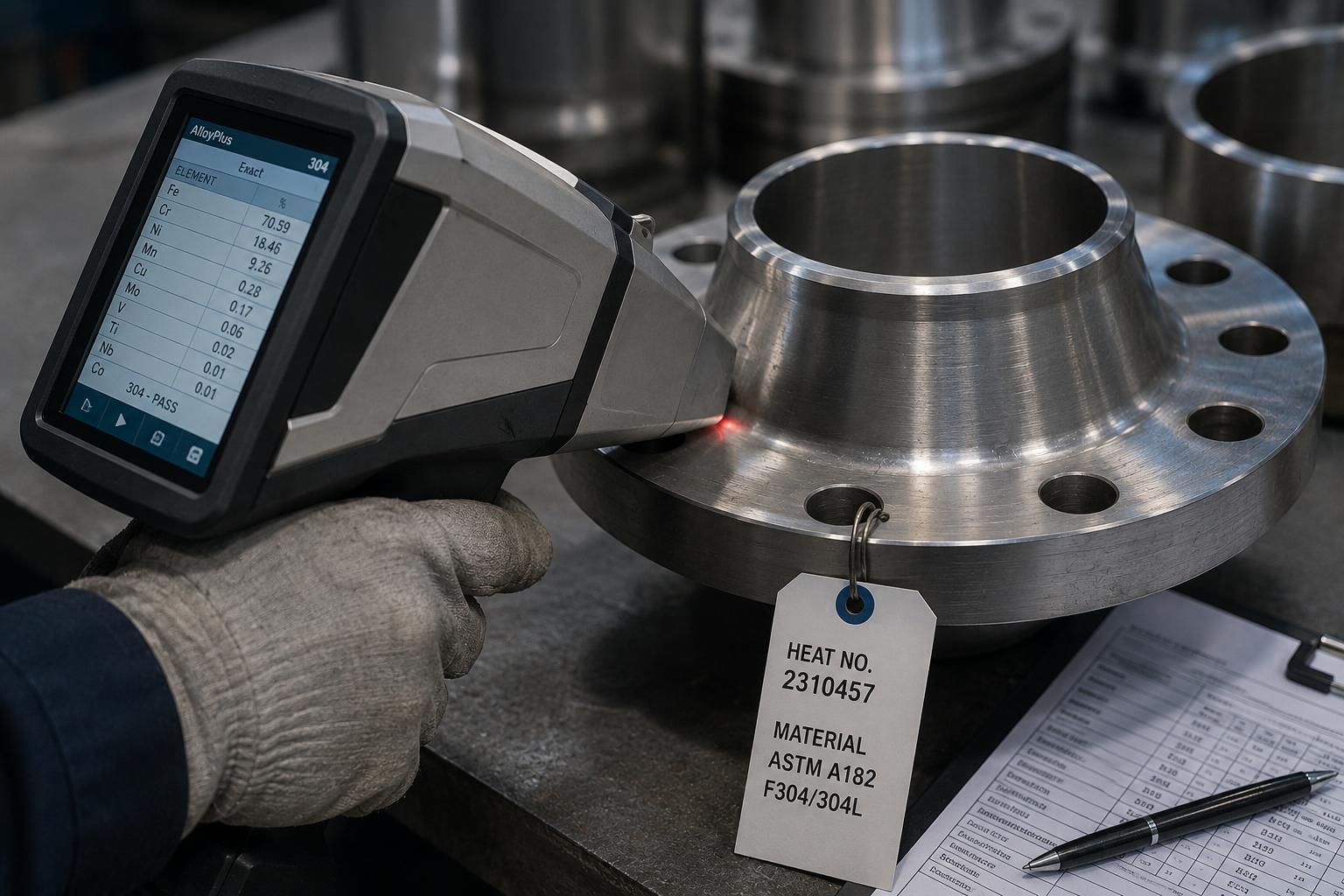
Material test checks for correct alloy material through PMI (positive material identification) tests, which are undertaken on each incoming batch...
Material test checks for correct alloy material through PMI (positive material identification) tests, which are undertaken on each incoming batch of material using XRF analysis. Each batch will be tagged with a Heat Number, and remain on all documentation before any material processing begins.
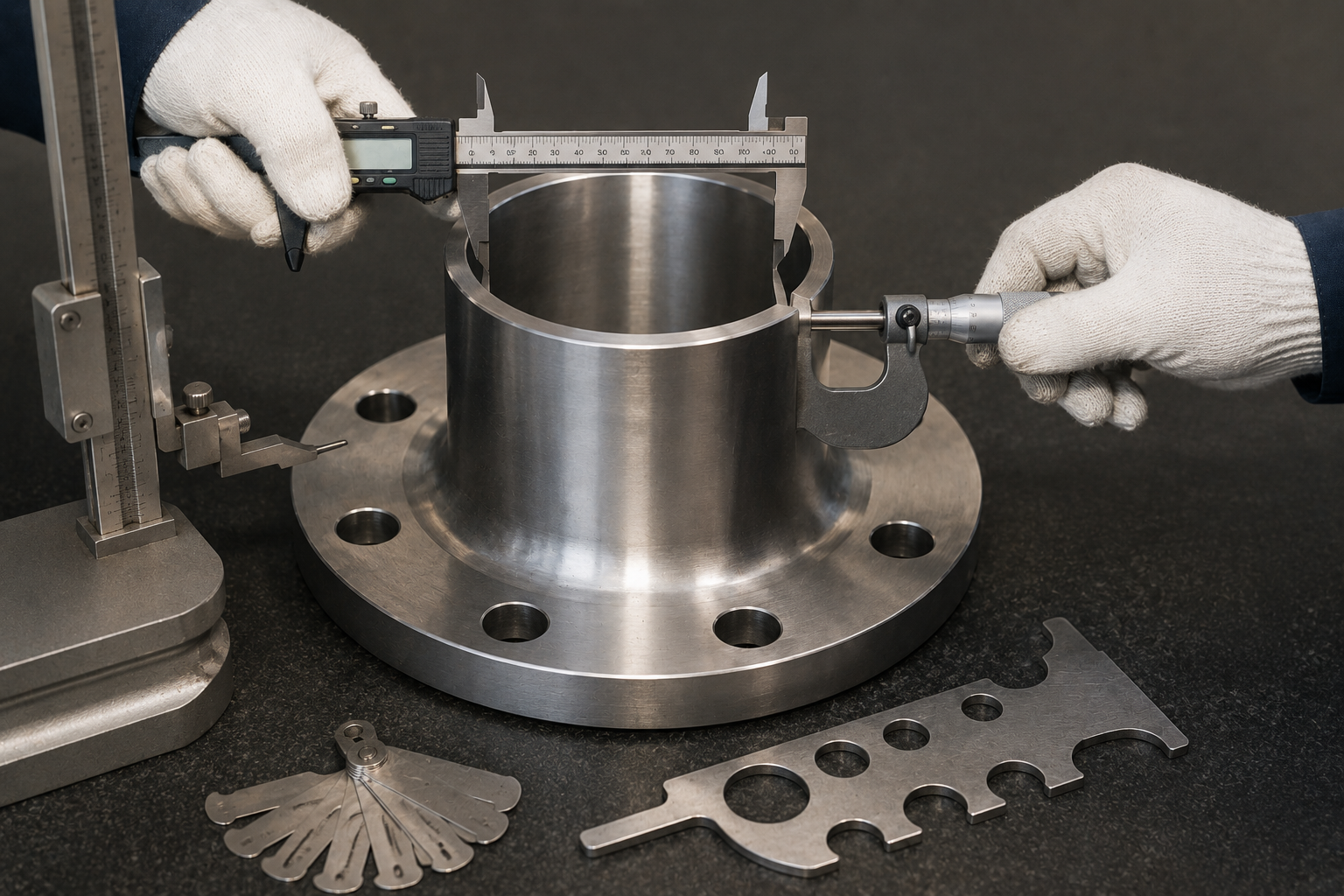
Outer diameter, minimum wall thickness, facing end to end face (F/H), flange overlap diameter (G) and radius (R) checks with calibrated gauge...
Outer diameter, minimum wall thickness, facing end to end face (F/H), flange overlap diameter (G) and radius (R) checks with calibrated gauge work, within the requirements of ASME B16.9 tolerance. Material is batch sampled to the ASME standard or tested to the required percentage for all critical service items, including all Long Weld Neck style fittings.
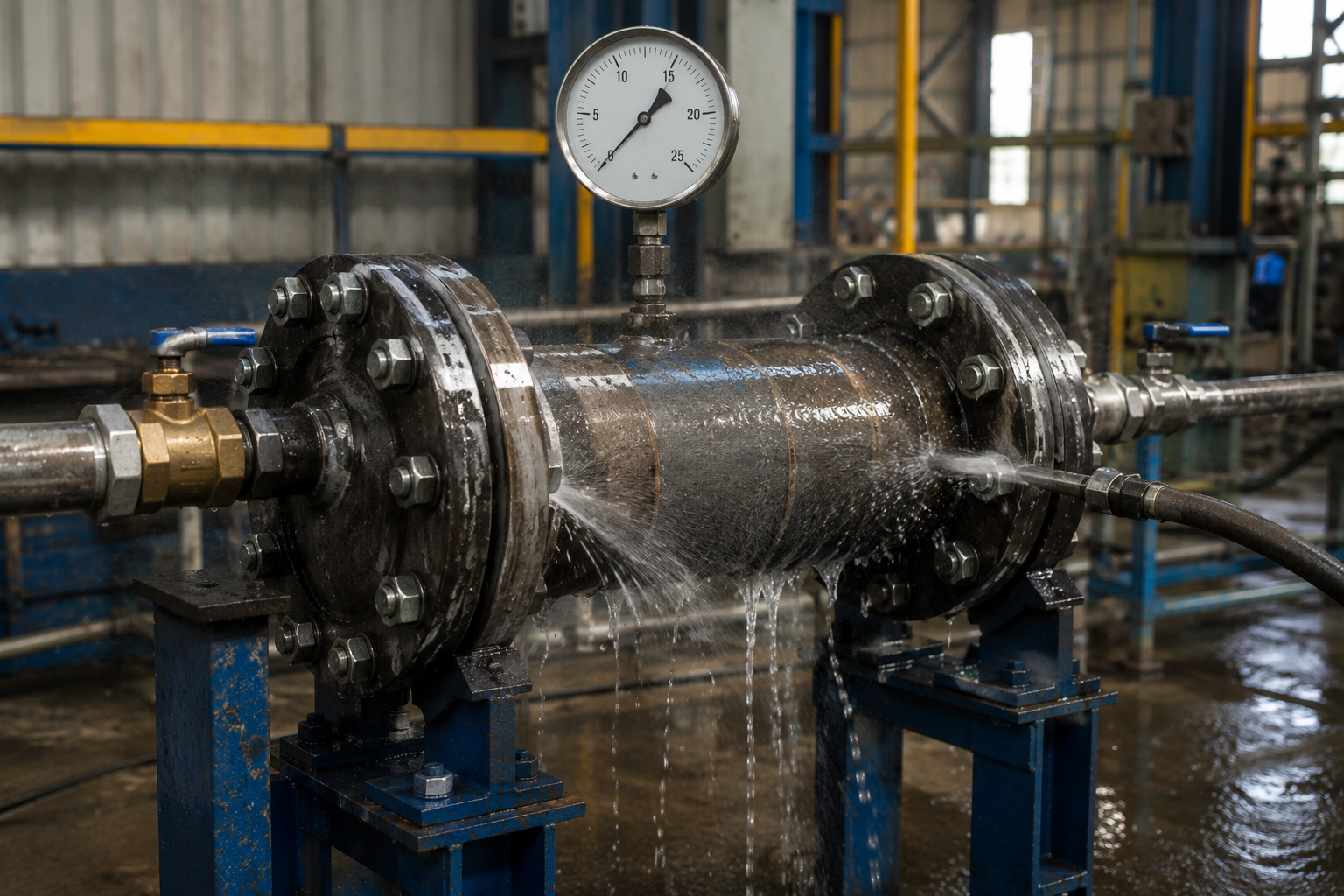
Hydro test, which is a proof of the pressure carrying capability of the fitting to the rated pressure times 1.5 (150%) as per the requirements...
Hydro test, which is a proof of the pressure carrying capability of the fitting to the rated pressure times 1.5 (150%) as per the requirements of ASME B16.9 / ASME B31.3 . Test pressures and hold times are recorded on the documentation package.
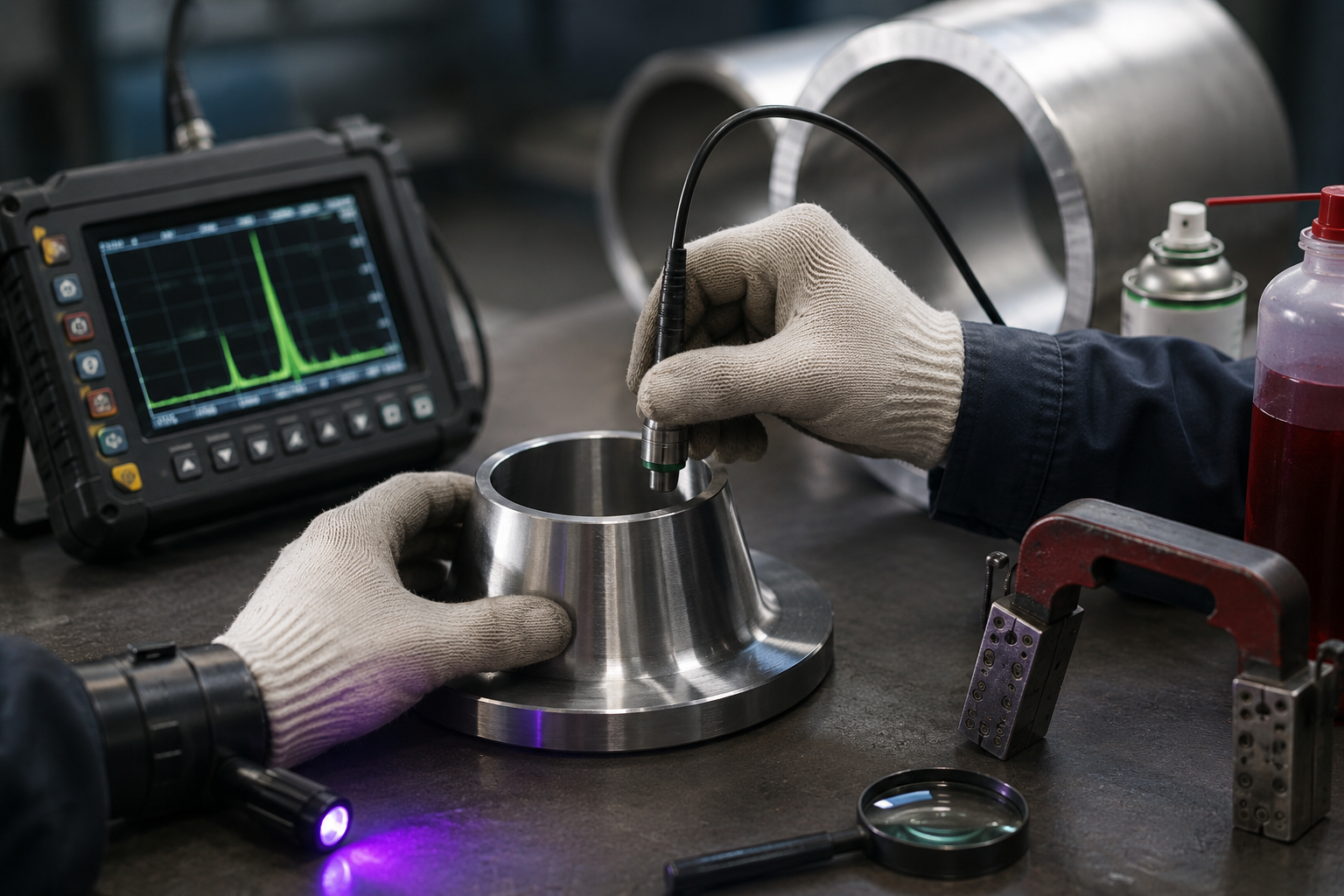
All pieces are internally and externally inspected for surface cracks, laminations, pits and lap joint geometry to assure continuity...
All pieces are internally and externally inspected for surface cracks, laminations, pits and lap joint geometry to assure continuity. All lap joint type stub ends (weld neck) receive inspection for weld integrity. Radiographic examination (RT) or Ultrasonic examination (UT) may be required for the weld seams of certain stub ends on weld neck style and may be supplied with all MTR and CO documents or shipped from our stock. Penetrant Testing (PT) and magnetic particle testing (MT) available upon request.
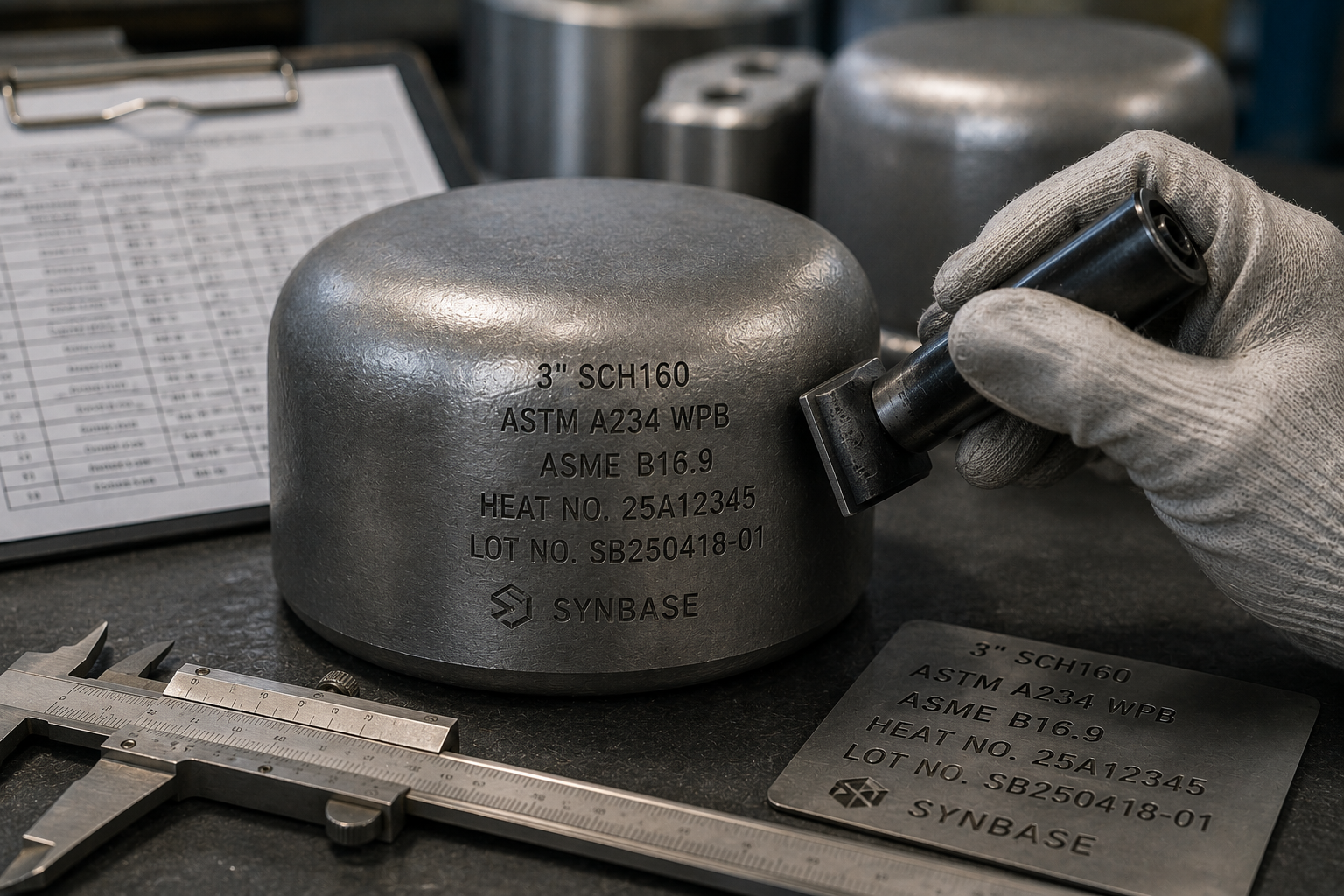
Each fitting stamped or stenciled with size, schedule, grade, heat/lot number, applicable standard(s) such as ASME B16.9, Synbase code...
Each fitting stamped or stenciled with size, schedule, grade, heat/lot number, applicable standard(s) such as ASME B16.9, Synbase manufacturer’s code. Marking shall be as per ASME B16.9 MANDATORY marking and tracing requirements.
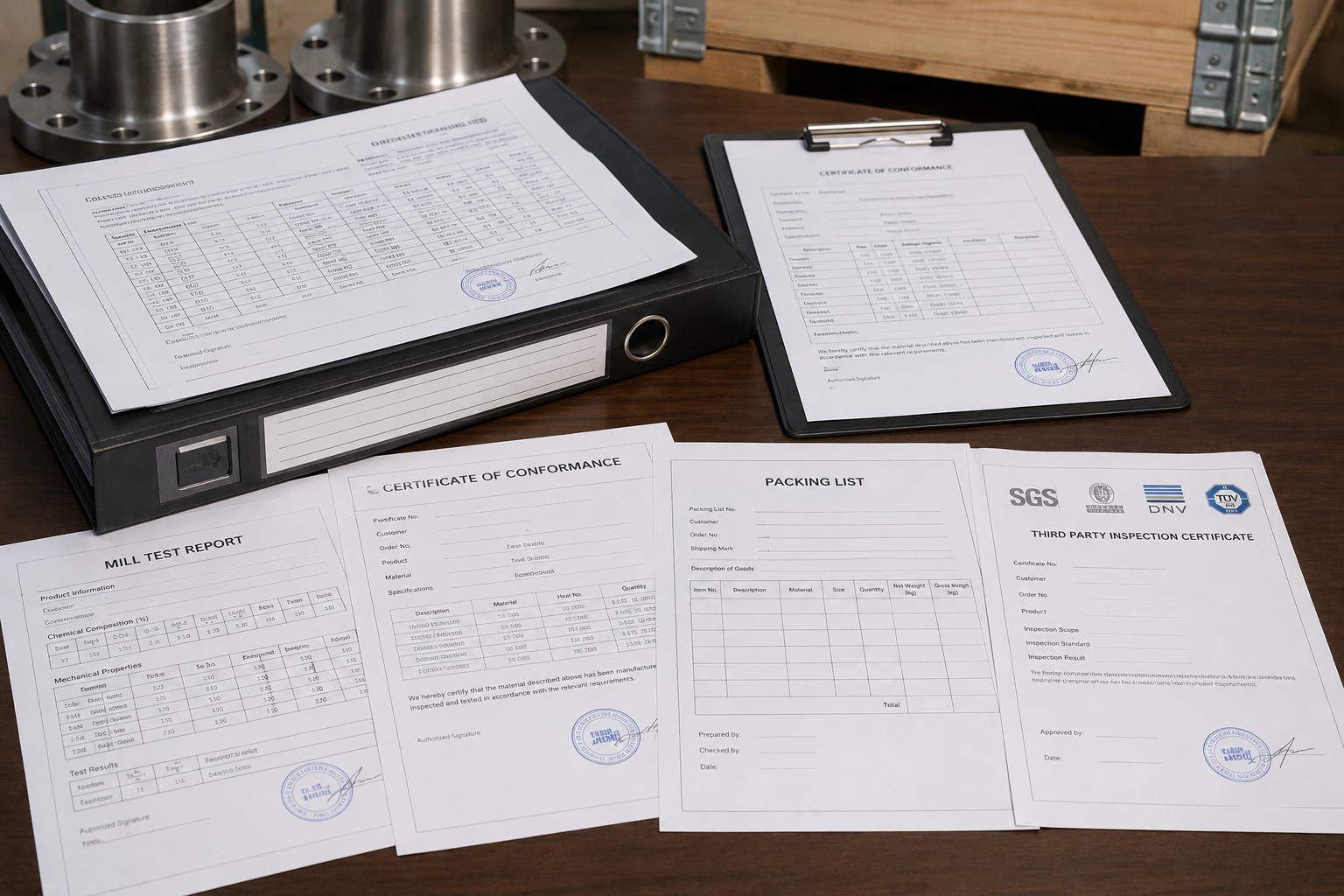
Mill test report, which is a copy of the full mill test certificate with detailed chemical composition and mechanical property tests...
Mill test report, which is a copy of the full mill test certificate with detailed chemical composition and mechanical property tests, alongside a Certificate of Conformance (CO) covering your specific order, Packing List and all third party inspection certificates such as, but not limited to, SGS, BV, DNV or TUV as requested are all compiled and shipped with every consignment.
A lap joint stub end can be found on any piping application where ease of field installation, frequency of dismantling, economical mixed-metal configurations or ease of maintenance requires a non-welded rotating flanged connection over an ordinary welded flanged connection.
| Industry | Typical Service | Recommended Grade | Key Driver |
|---|---|---|---|
| Oil & Gas — Midstream | Pipeline flanged connections, meter runs, pig launcher terminations | CS WPB, WPC | Cost, bolt-hole alignment efficiency on large-bore pipe |
| Petrochemical | Process piping, reactor inlet/outlet, heat exchanger connections | SS 316L, Alloy WP22/WP91, Duplex S31803 | Corrosion resistance, temperature capability, material mixing |
| Power Generation | High-temperature steam lines, turbine extraction piping | Alloy WP22, WP91 | Creep resistance above 500°C; ASME Class 600–2500 |
| Pharmaceutical / Food | CIP/SIP lines, hygienic process piping, water-for-injection | SS 304L / 316L, electropolished | FDA / GMP compliance, smooth bore Ra requirements, easy disassembly |
| Marine & Offshore | Topside piping, ballast systems, seawater cooling loops | SS 316L, Duplex S32750 | Salt-spray corrosion resistance; ABS/DNV/BV approved material |
| Cryogenic / LNG | Liquefied natural gas, liquid nitrogen, liquid oxygen process piping | SS 304L, ASTM A420 WPL3/WPL6 | Sub-zero impact toughness; Charpy impact test required |
When working in Offshore, Chemical processing, and in the OEM production areas, contact Synbase for an RFQ. Specify service fluid, temperature range, class of construction and any required third-party certifications.
Contact Synbase for an RFQ →In addition to the stock ASME B16.9 catalogue ranges listed above, our E-CHENG STEEL GROUP facility can accommodate non-standard manufacturing parameters covering materials, size and thickness. This includes stub ends:
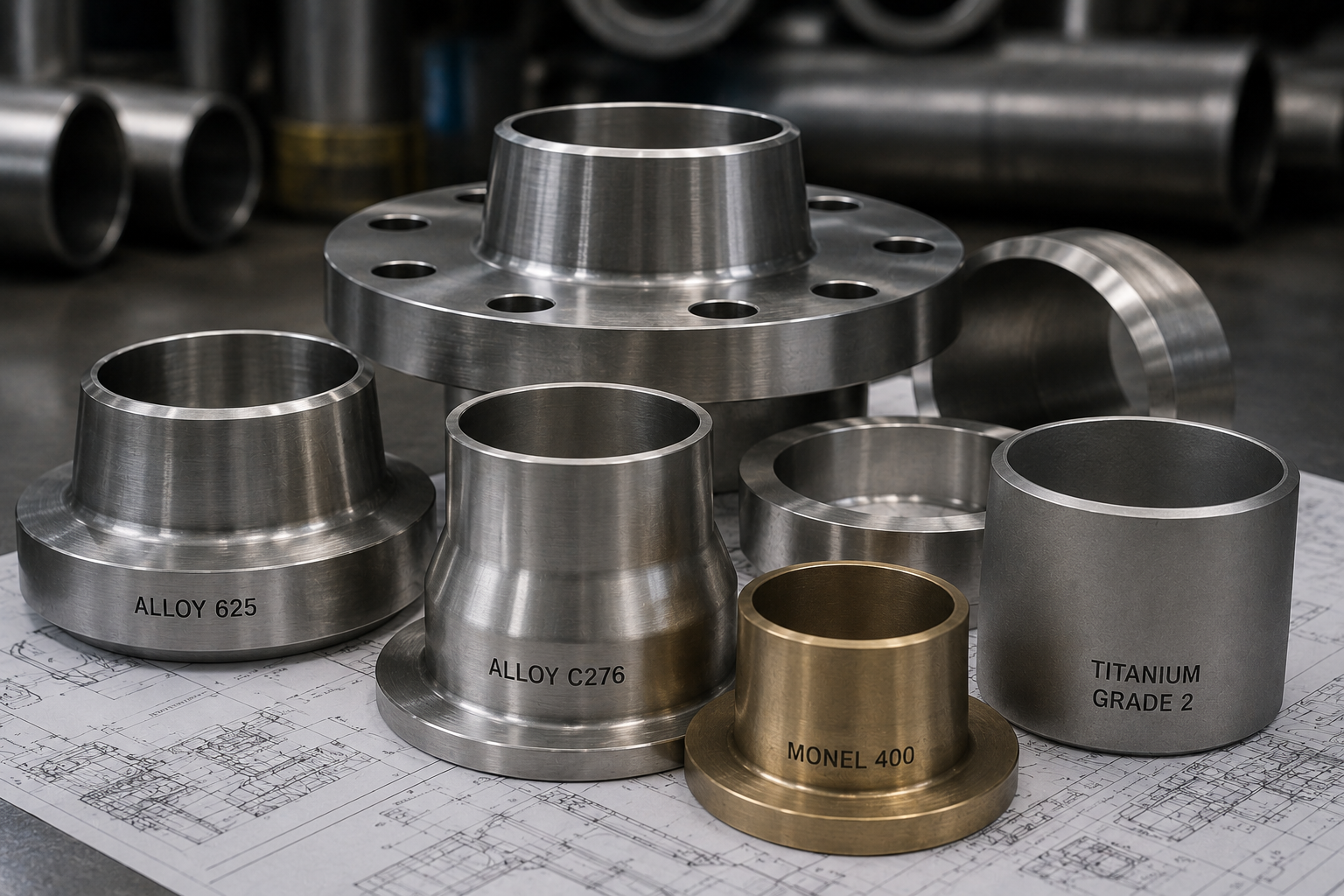
For nickel-based and high-alloyed stainless steels, including Alloy 625 (Inconel equivalent, ASTM B363 WPN06625), Alloy C276 (Hastelloy equivalent), Monel 400, and pure commercial titanium (Grade 2). These material grades are purchased to order with available mill certifications NACE MR0175 / ISO 15156 for HS service. Lead times typically are in the 4-8 week range for these exotic grades dependent on the mills stock.
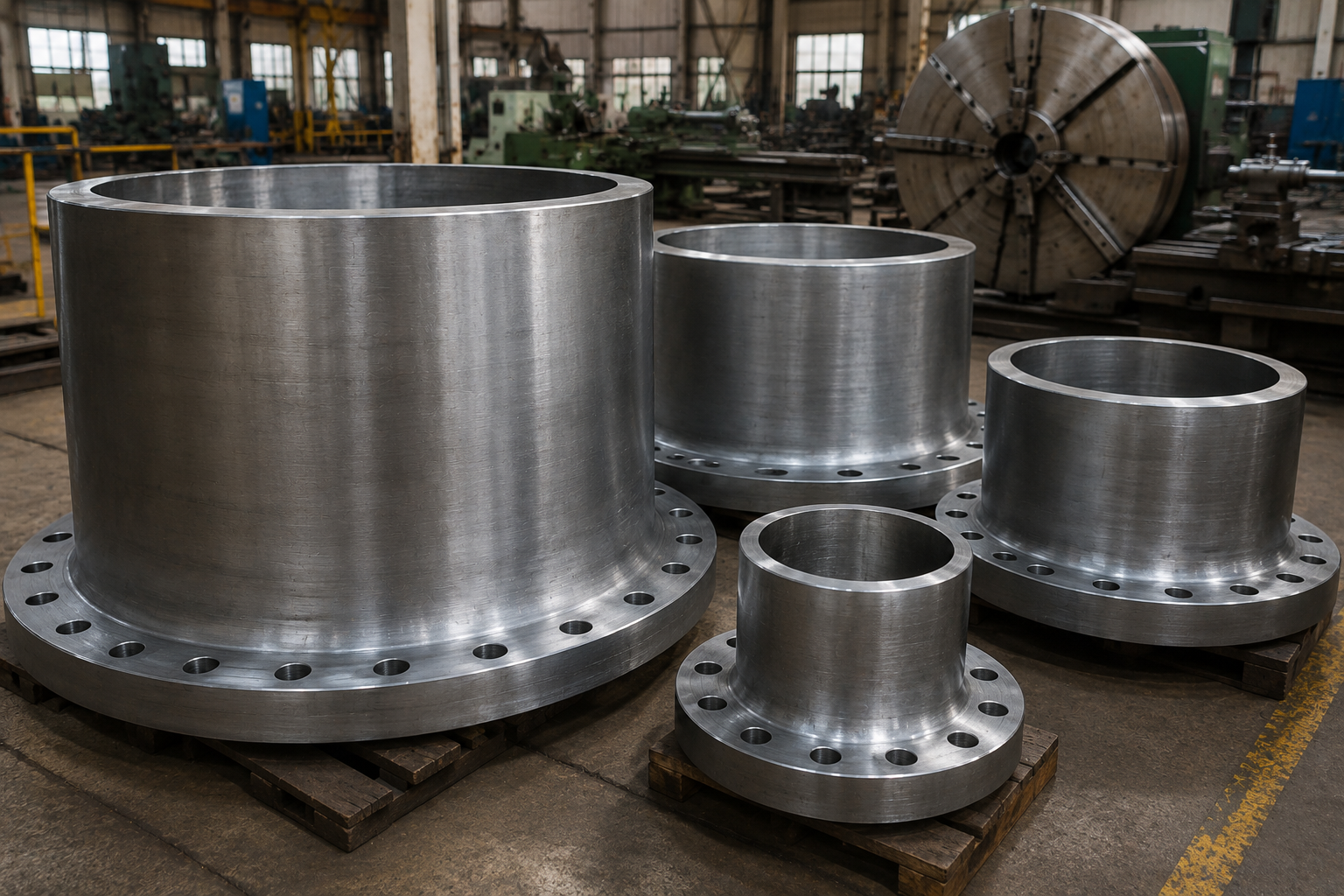
For standard dimensions size range NPS 14-24 (DN350-DN600) - material can either be ex stock or made to order, we've experience manufacturing fittings with wall thickness beyond available ASME B36.10 / B36.19, including double extra strong (XXS) as well as fittings where the minimum wall thickness needs to be specifically engineered.
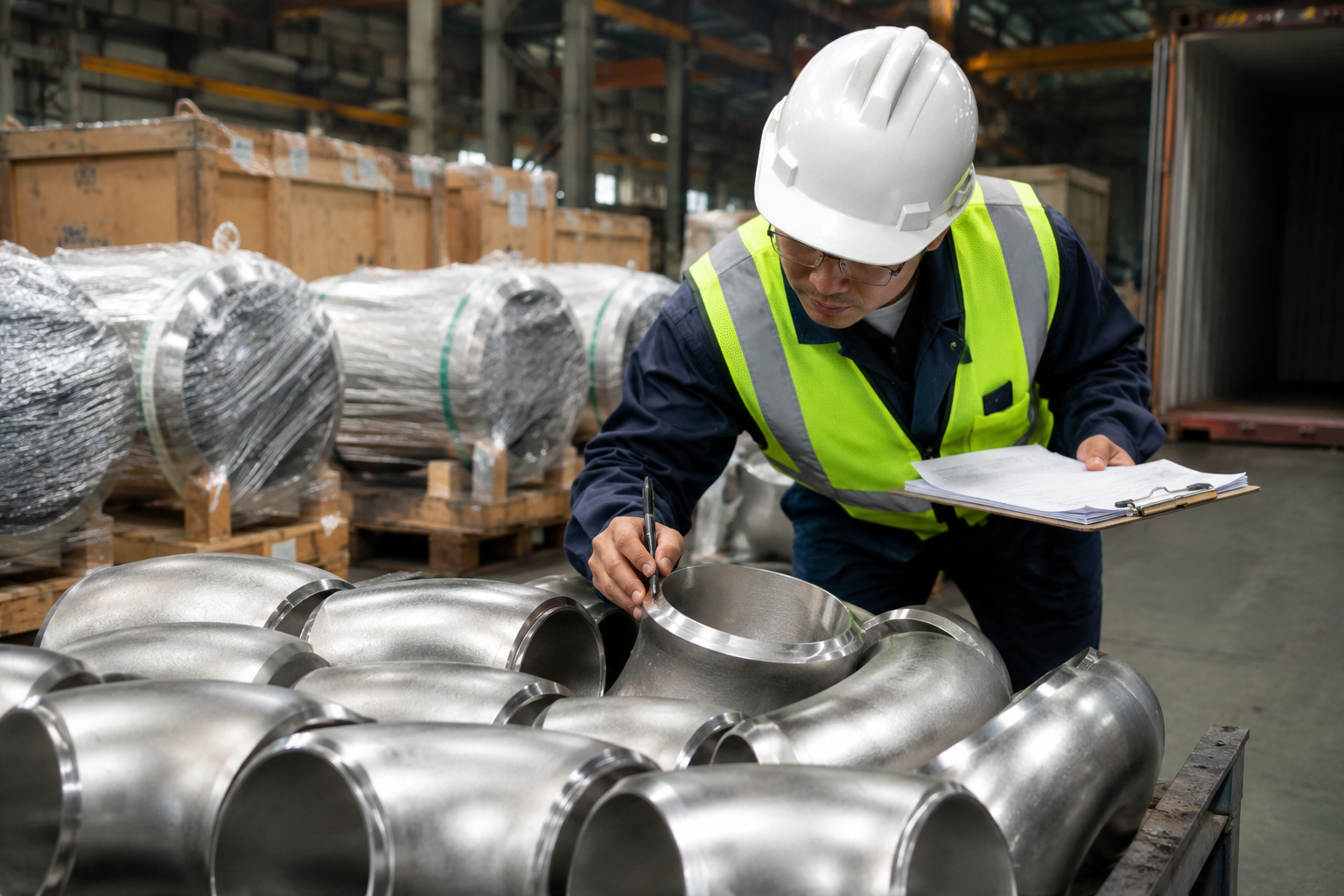
Synbase manages independent inspection at our manufacturing plant with Third Party Inspectors such as SGS, Bureau Veritas, DNV or TV SD, should it be required in support of Letters of Credit, independent QA, or a customer requirement. A full package of export documentation will be prepared including a commercial invoice, packing list, Certificate of Origin, Bills of Lading, MTR's and CO according to your requirements and INCOTERMS 2020 terms (i.e. FOB Tianjin / CIF destination port).
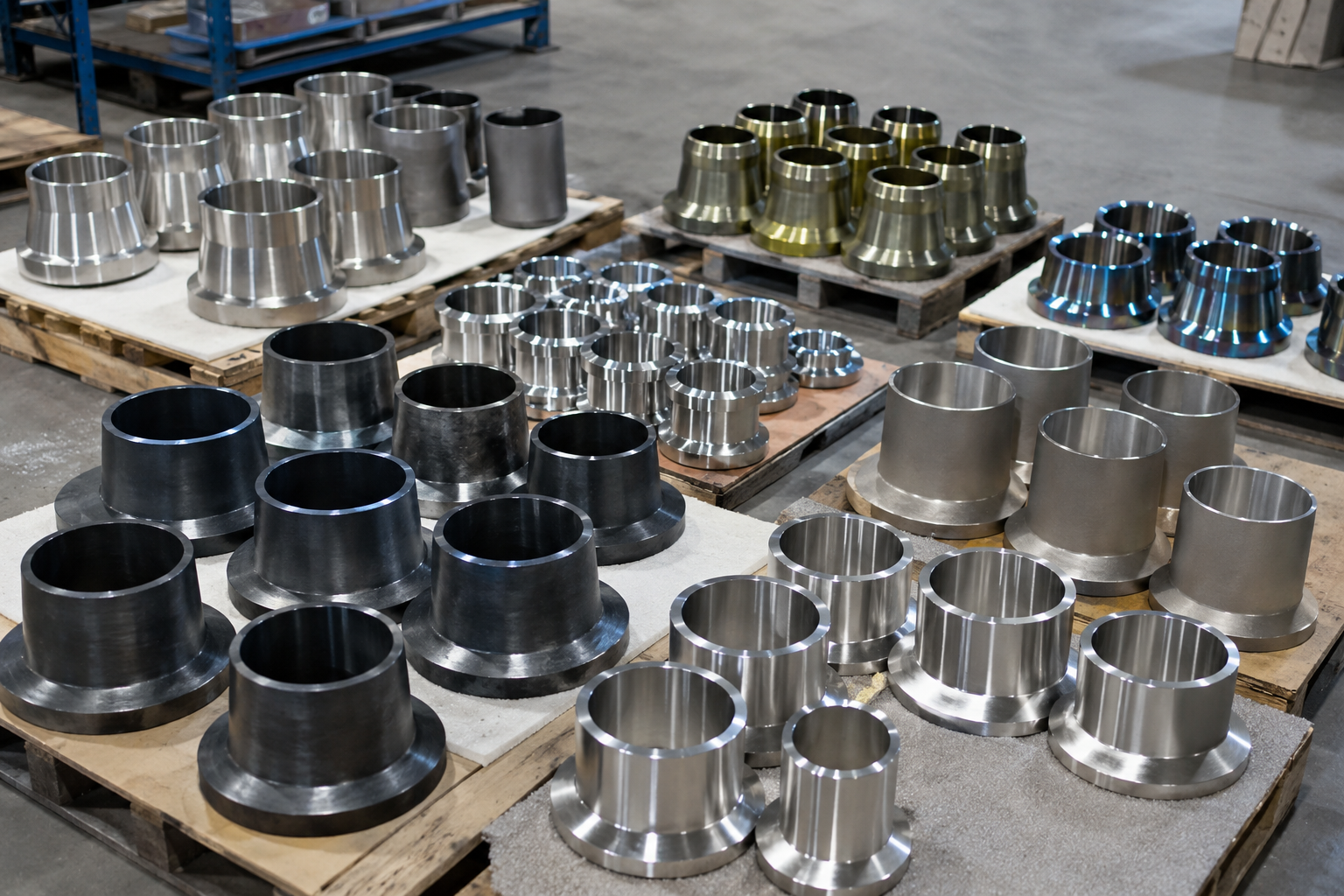
Standard carbon steel and stainless steel stub ends in normal schedules (i.e. SCH 40, 80, 10S, 40S) can generally be shipped within 2-3 weeks of receiving the order. For alloy and duplex grades, lead time is in the range of 3-5 weeks and for nickel alloys and exotic grades, it would be 4-8 weeks. For minimal order requirements, please contact us for material and size specific details.
The pitfall in ordering specialty alloy is buying into nominal certification where heat chemistry drives service life. Unlike A234 standard Carbon Steel WPB where any heat within the spec performs the same, 625 and C276 alloys have very narrow chemistry specifications where a 0.5% difference in Moly would represent an order of magnitude difference in corrosion resistance in HCl Service at 150°C. This error can be astronomically expensive for buying on nominal grade with no proof via PMI testing for that specific heat. Synbase can't promise a heat of alloy complies to the specification without data, which is why for nickel alloys, duplex and all high alloys we conduct XRF PMI tests on all heats and included in the documentation set. Provide your material spec, NPS, schedule and service temperature for a quick RFQ and the compliance data for your project.
Utilize our suite of interactive tools to streamline your stub end procurement process. From dimensional tolerances to material compatibility, these utilities are designed for piping engineers and EPC estimators.
Determine the correct Long or Short pattern stub end based on your required pressure class, NPS size, and ASME B16.9 compliance constraints.
Launch Selector →Instantly retrieve exact ASME B16.9 dimensional data, acceptable manufacturing tolerances, and estimated weights for any specified pipe size.
Open Lookup Tool →Cross-reference your service media, operating temperature, and chloride presence to find the optimal carbon, stainless, or alloy steel grade.
Start Selection →A stub end and a lap joint (LJ) flange work as a mated pair. The stub end is butt-welded to the pipe and provides the pressure-sealing face; the LJ flange slides freely over the pipe and carries bolt load only. Because the flange rotates independently, you can align bolt holes without rotating the pipe — a key advantage in tight installations or when connecting dissimilar materials. ASME B16.9 governs stub end dimensions; ASME B16.5 governs the mating lap joint flange.
ASME B16.9 defines two face geometries. Type A has a conical transition (nominal 11°) between the pipe bore and the lap face, making it compatible with standard raised-face lap joint flanges — the default for petrochemical, power, and oil and gas service. Type B has a flat face with a small inside radius, used where the inside edge must match specific older or metric flange configurations. Confirm face geometry with your flange supplier before ordering.
ASME B16.9 stub ends are produced to match standard pipe schedules: SCH 10, SCH 20, SCH 40, SCH 80, SCH 120, SCH 160, and stainless schedules 10S, 40S, and 80S. Wall thickness determines bore diameter and directly affects pressure capacity at temperature. Synbase manufactures stub ends from SCH 10 through SCH 160 across NPS ½" to 24" (DN15–DN600); heavy-wall and extra-heavy schedules are available on inquiry.
Yes. Beyond carbon steel (ASTM A234 WPB/WPC) and stainless grades (304L, 316L), Synbase produces stub ends in duplex UNS S31803/S32205, super duplex S32750/S32760, and high-alloy materials including Alloy 20, Hastelloy C-276, Inconel 625, and titanium Grade 2. PMI testing is standard on every heat for alloy and duplex grades. Lead times range from 3–5 weeks for duplex to 4–8 weeks for nickel alloys depending on stock availability.
Stub ends are not independently pressure-rated components. System pressure class is set by the mating lap joint flange — Class 150, 300, 600, 900, 1500, or 2500 per ASME B16.5. The stub end must match the flange bore and lap face diameter for the chosen class and pipe schedule. For design confirmation, reference ASME B31.3 Process Piping, which specifies allowable stress values by material and temperature for the complete piping assembly.
ASME B16.9 covers stub ends from NPS ½" to NPS 48" (DN15–DN1200) in long pattern and NPS ½" to 24" in short pattern. The standard defines OD, minimum wall thickness, and end-to-end length for each NPS and schedule combination. Synbase's standard production range is NPS ½" to 24" (DN15–DN600). Larger diameters, special schedules, and non-standard end-to-end lengths are available as custom orders.