Send Your RFQ to Synbase Steel
Prefer to send drawings, BOMs or attachment lists by email? sales@synbasesteel.com

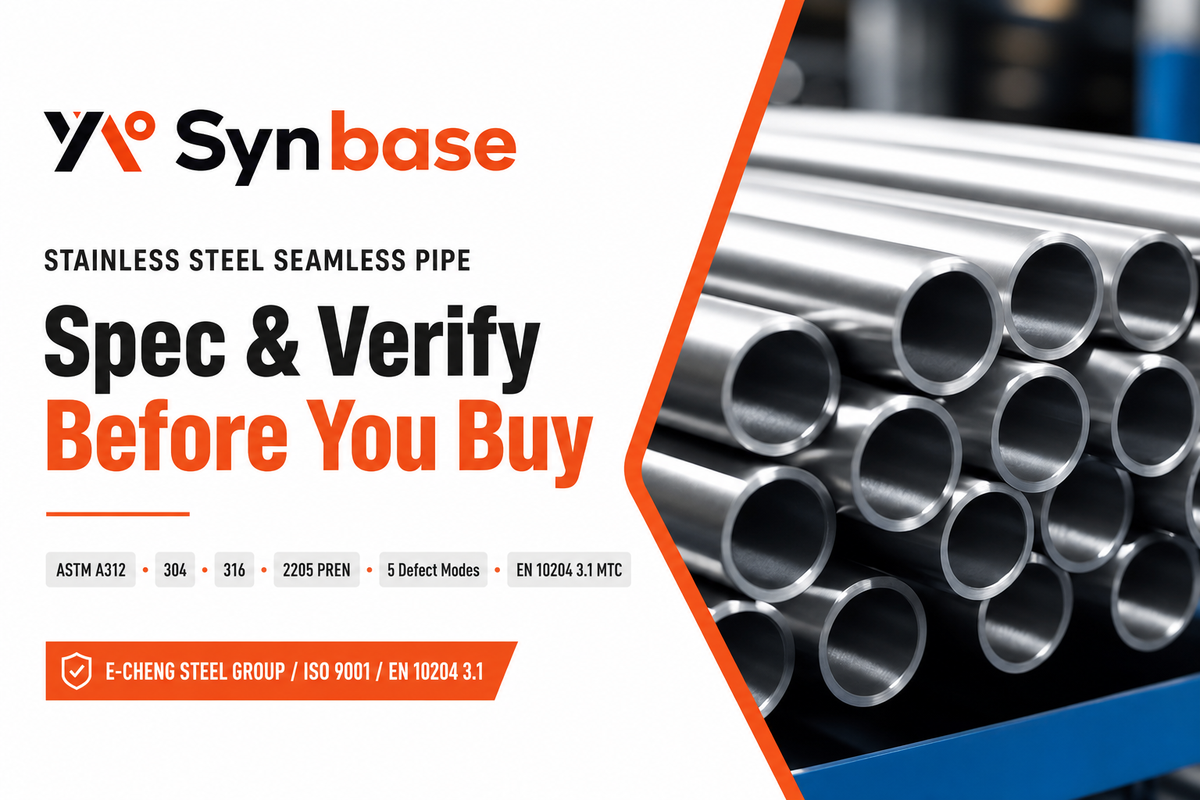
A buyer’s guide to standards, grades, defects, and acceptance testing. Updated June 2026.
Stainless steel seamless pipe is corrosion-resistant pipe formed from a solid billet that is pierced and cold-drawn with no longitudinal weld, so it carries higher, more predictable pressure where a seam would be a corrosion or failure path. That single structural fact, no seam, is why it is specified for high-pressure, crevice-sensitive, and high-purity service.
But that ‘no seam’ line is usually where product pages end. This is the buyer’s guide for everything else on them: getting your service routed to the right ASTM standard, understanding the defect modes the seamless process can introduce, and the acceptance tests that prove pipe matches its cert.
| Pressure-pipe standard | ASTM A312 / ASME SA-312 (TP304/304L, TP316/316L) |
| Tube standards | A269 (instrument/general), A213 (boiler/heat-exchanger), A511 (mechanical) |
| Common grades | 304/304L, 316/316L, 321, Duplex 2205, Super-duplex 2507 |
| Size & schedule | NPS 1/8″–24″+ ; Sch 5S / 10S / 40S / 80S / 160 ; 20 ft lengths |
| Condition | Solution-annealed & pickled (bright-annealed / polished on request) |
| Acceptance | Hydrostatic OR nondestructive electric test, dimensional, MTR per EN 10204 3.1 |
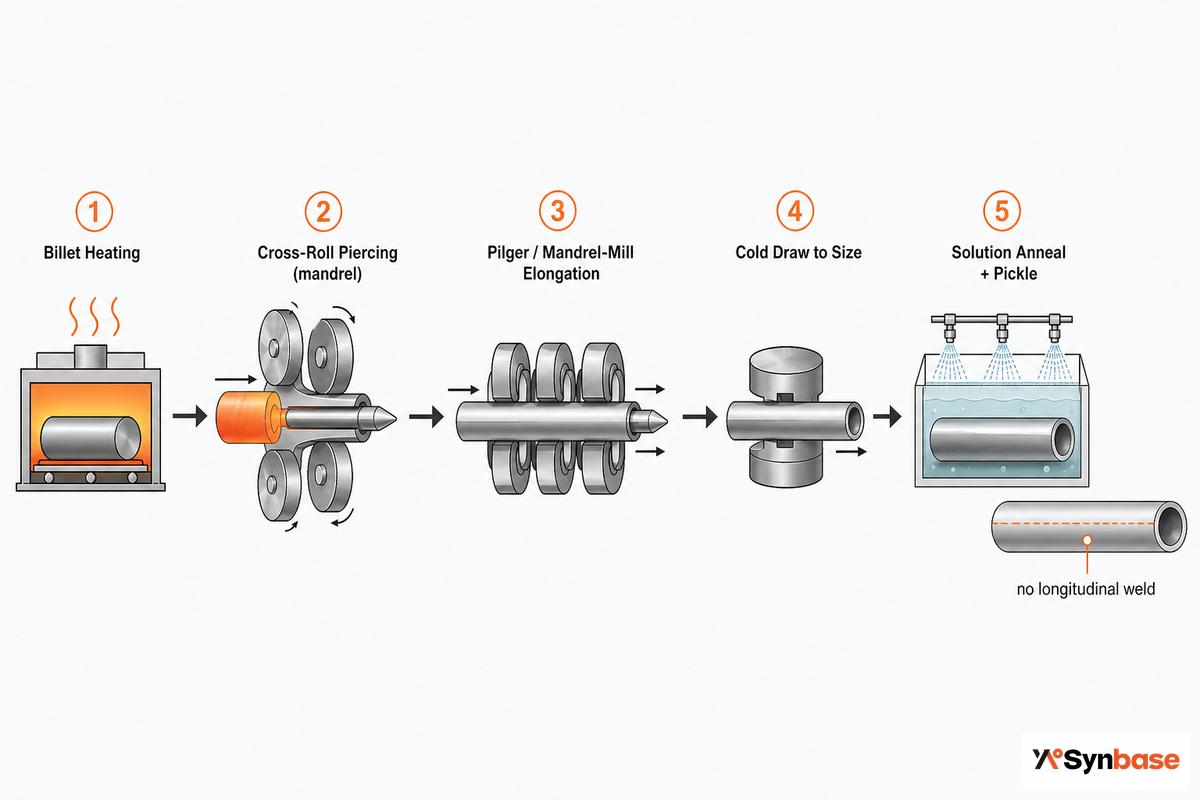
Seamless starts as a solid stainless billet.
The billet is heated and pierced over a mandrel (the Mannesmann process) then elongated and reduced on a pilger or mandrel mill, often with 90%+ cross-section reduction in one pass, and then cold-drawn on dies for smaller diameters. The process ends with a final solution anneal which restores the grain structure and resistance, and the finished seamless pipe is furnished to ASTM A312. No weld line appears anywhere in the wall.
Why does that make a difference in your specification?
A weld is a discontinuity, a HAZ (heat-affected zone) where Chromium depletion can occur and a line where stress can concentrate. Eliminate it, and the grain continues without interruption around the pipe’s circumference, meaning pressure capacity is inherent in the pipe’s structure, created at pierce, rather than added by a weld. This seamless premium is that entire concept, and as we’ll see in the next section, is a relatively narrow advantage compared to what many buyers believe.
Seamless eliminates the seam as a corrosion and stress path — but it creates process defects of its own (detailed below). “No weld” is a benefit, not an inherent promise of quality.
Seamless stainless steel pipe and seamless tube serve the same demanding roles: high-pressure fluid transfer in oil and gas, hygienic lines in food processing, and the corrosion resistance that marine applications demand. The same tubular products are stocked as stainless steel tubing — including 304 stainless steel and 316 stainless steel tubing, plus higher-alloy grades — usually supplied solution-annealed with a pickled or polished finish. Seamless tubing for instrumentation is dimensioned by outside and inside diameter, while the working pressure of a pipe follows from the schedule and wall you set during fabrication. Compared with welded stainless tubing, seamless stainless steel tubing and stainless steel seamless tube are favored for aerospace and other critical applications where surface polishing and tight tolerance matter; the same stainless tube and stainless steel seamless tubing grades are routine in instrumentation, and reputable tubing suppliers stock high-quality stainless seamless tubing across these forms. Across industrial applications, these pipe schedules, fittings, and seamless stainless tubing are specified for strength and corrosion resistance, with the enhanced corrosion resistance of higher alloys held in inventory for harsh service — where a smooth finish, sound mechanical properties, and resistance to corrosive media, plus correct end beveling, all matter.
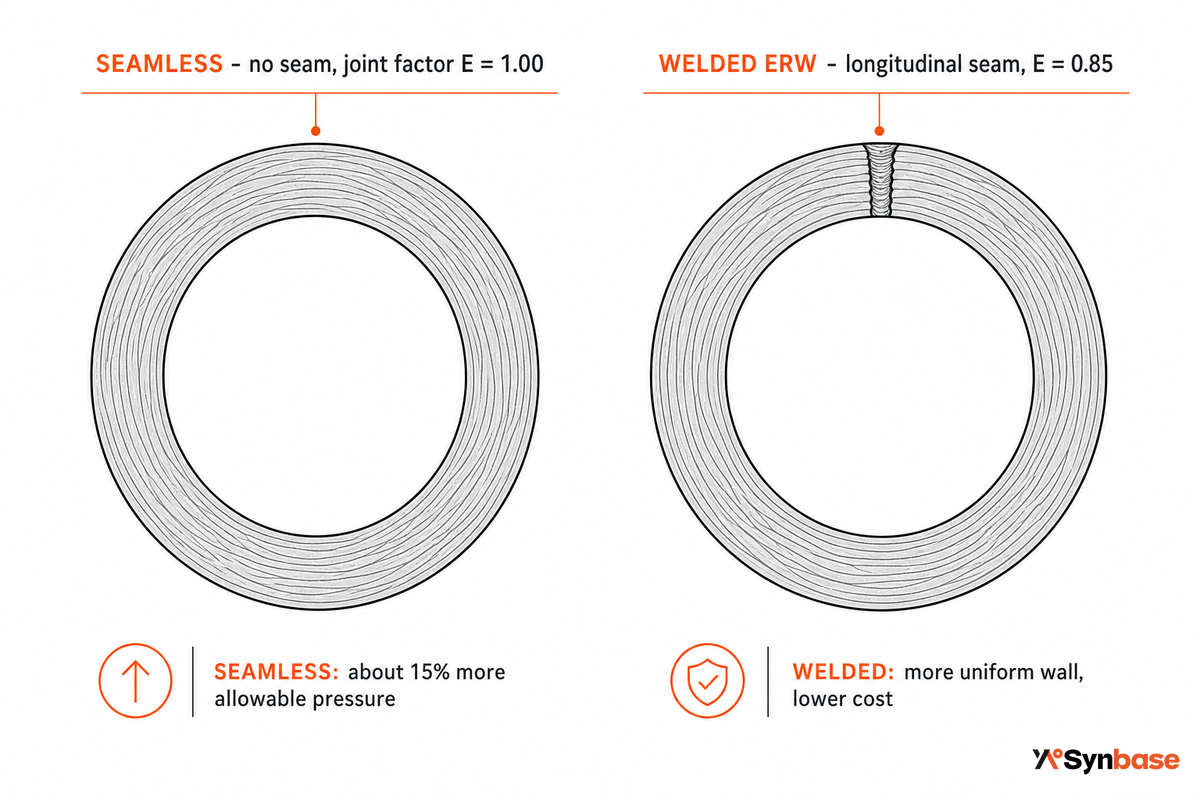
So, is welded or seamless stainless steel pipe better?
Neither is universally better, they fail differently. The reason seamless can be rated for higher pressure is a code mechanism, not a blanket strength advantage: design codes such as ASME B31.3 apply a longitudinal weld-joint quality factor, typically 0.85 for welded versus 1.00 for seamless, which derates a welded line’s allowable pressure by roughly 15%. That factor is a code allowance for the seam, not a measured strength loss in the base metal, which is why modern welded-and-drawn pipe (ASTM A249/A269) closes much of the gap on static, low-pressure service.
Field metallurgists put it bluntly: seamless isn’t “stronger” so much as differently flawed. Welded pipe gives you a uniform wall and a clean surface; seamless always carries some wall variation, commonly over ±10% in a length, and the thinnest spot will always be thinner than an equivalent welded wall. That matters when you size branch reinforcement or run a pipe near its pressure limit.
But at what cost? “Seamless is 30-50% more expensive” is another widely quoted statement that doesn’t hold water outside a few parameters: it’s real in thin wall/small diameter sizes but pretty much on parity with thick wall/ ~8 NPS. Never take that percentage at face value, work up your sizes and wall thickness before pricing.
“Piping codes don’t tell you which to use, there are too many special cases, so they leave it to the user. Seamless isn’t better than welded; it just has different defects.”
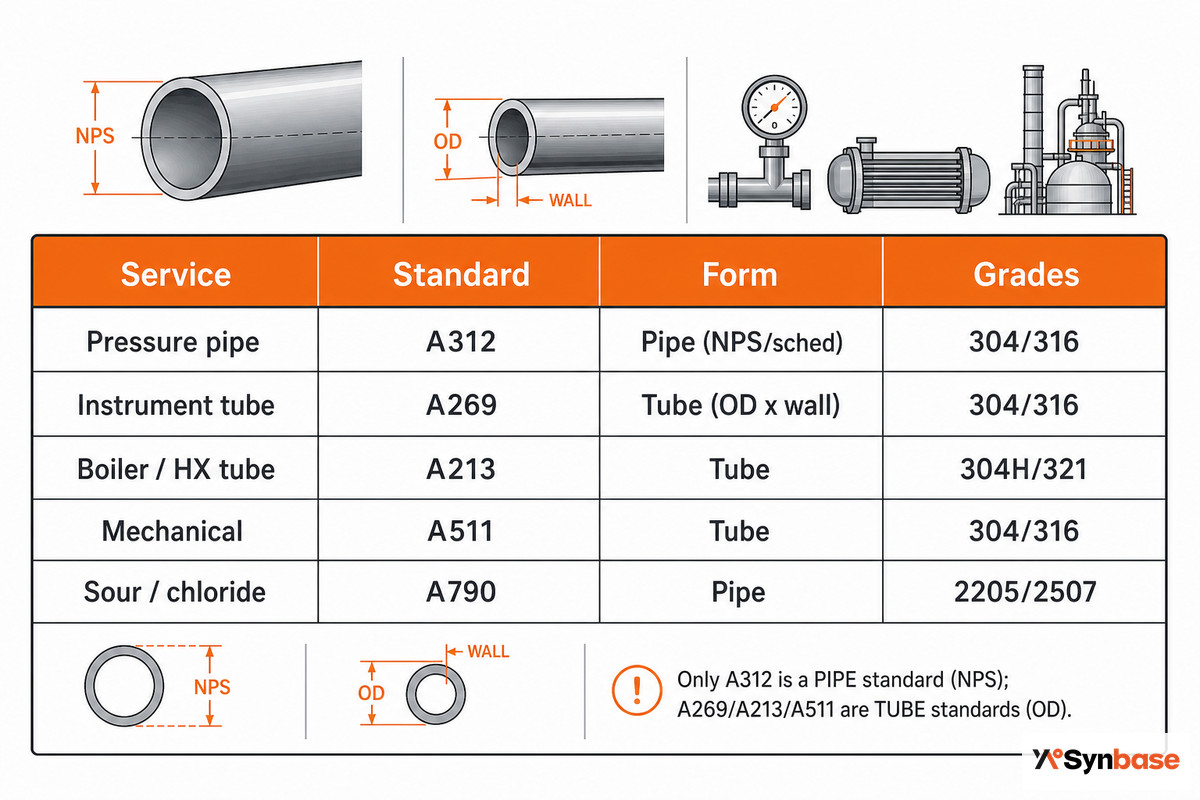
What happens most frequently is to specify a grade “304 seamless” but fail to cite the governing standard. You’re buying based on the standard – NOT the grade – which dictates dimensions, the bands within tolerance, and the tests you can rely on; check out the Service-to-Standard Router to find the standard associated with your service and order the document not just the material. If comparing steel pipe and fittings from BalingSteel with this requirement, verify the quoted product standard and dimensions separately from the grade name.
| Service category | Standard | Form | Typical grades |
|---|---|---|---|
| Pressure pipe (ASME B31.x) | ASTM A312 / SA-312 | Pipe (NPS & schedule) | 304/304L, 316/316L |
| Instrument / hydraulic tube | ASTM A269 | Tube (OD × wall) | 304, 316 |
| Boiler & heat-exchanger tube | ASTM A213 / SA-213 | Tube (tighter wall tol.) | 304H, 316, 321 |
| Mechanical / structural | ASTM A511 | Tube (not pressure-rated) | 304, 316 |
| High-purity (pharma/semicon) | A269 + ASME BPE | Tube (electropolished) | 316L |
| General corrosion-resisting | ASTM A269 | Tube (OD × wall) | 304/304L, 316/316L |
| Cryogenic / low-temperature | ASTM A312 | Pipe (NPS & schedule) | 304/304L |
| High-temperature (>540°C) | A312 / A213 | Pipe / tube | 304H, 321 |
| Sour / chloride service | ASTM A790 / A312 | Pipe (NPS & schedule) | 2205, 2507 |
Scopes per ASTM A312/A269/A213/A511 standard definitions.
One distinction is easy to miss: only A312 is a pipe standard, dimensioned by NPS and schedule. A269, A213, and A511 are tube standards, dimensioned by actual OD and wall (covered in the next section), with their own tolerance and test regimes. Specifying A312 dimensions against a tube standard, or vice versa, is a common cross-shopping error. The split matters because the tests travel with the standard: A213 boiler tube carries tighter wall tolerance and stricter testing than A269, so it costs more, and ordering A213 for a job that only needs A269 is a quiet overspend. Name A312 for any pressure pipe routed under ASME B31.1 or B31.3.
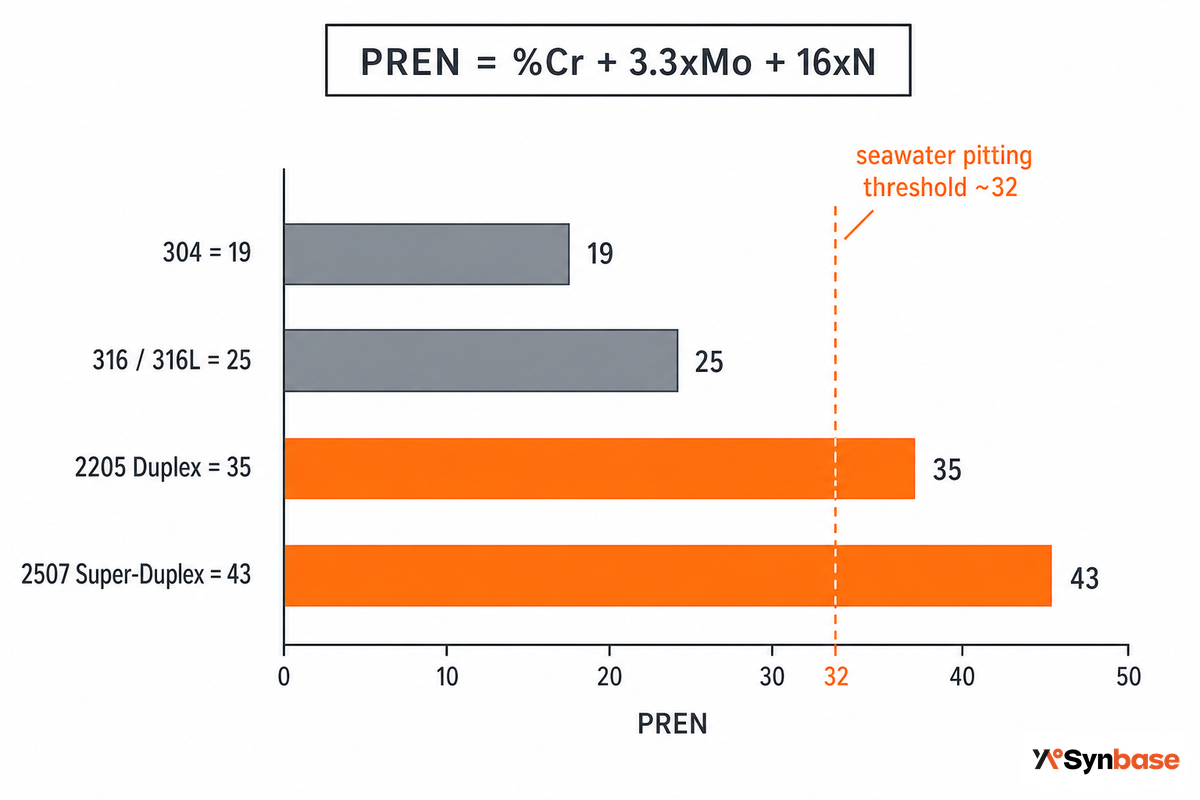
Is either 316 or 304 better for most services and applications? You may wonder what grade stainless steel is preferable for most types of chloride service, and in those cases you can’t go wrong choosing stainless steel 316 for its molybdenum content that’s anywhere between 2-3%, however if it’s for anything else such as very warm ocean water both grades fall far short and it would be advisable to instead opt for the duplex grade of 2205 instead. The number used for assessing these levels of pitting resistance is called the Pitting Resistance Equivalent Number and it can be calculated as followed:
PREN = %Cr + 3.3 × %Mo + 16 × %N. Using standard nominal chemistries:
• 304 (18 Cr, ~0 Mo, 0.06 N) → PREN ≈ 19
• 316/316L (16.5 Cr, 2.1 Mo, 0.05 N) → PREN ≈ 25
• 2205 duplex (22 Cr, 3.1 Mo, 0.17 N) → PREN ≈ 35
However, you can’t rely solely on Pitting Resistance Equivalent Number as your determining factor; a common number used as a guide line for what’s adequate for even salty ocean environments is anywhere around 32, however this estimation may only stand true for certain conditions as a different kind of corrosion – known as crevice corrosion – can still be of concern and some actual applications requiring the highest degree of resistance, such as warmer chlorinated waters, call for PREN values in excess of 40 (e.g., duplex 2507). For such reasons 316 PREN values of about 25 are considered unsuitable for warm chloride situations where duplex metals fare better.
In summary, 304 / 304L can work just fine with just about any standard service or food-processing application — both are among the grades furnished to ASTM A312 as TP304/TP316L — while it’s wise to always select the L grades of these two metals if any type of welding is involved, as it helps mitigate welding-induced intergranular and sensitization damage via the 0.03% of contained carbon which limits harmful sensitization. For the full chloride-versus-temperature grade ladder, see our stainless seamless pipe hub. For a wider material-family shortlist, review stainless steel and nickel alloys from TiAlloy; a different alloy still requires a service-specific engineering assessment.
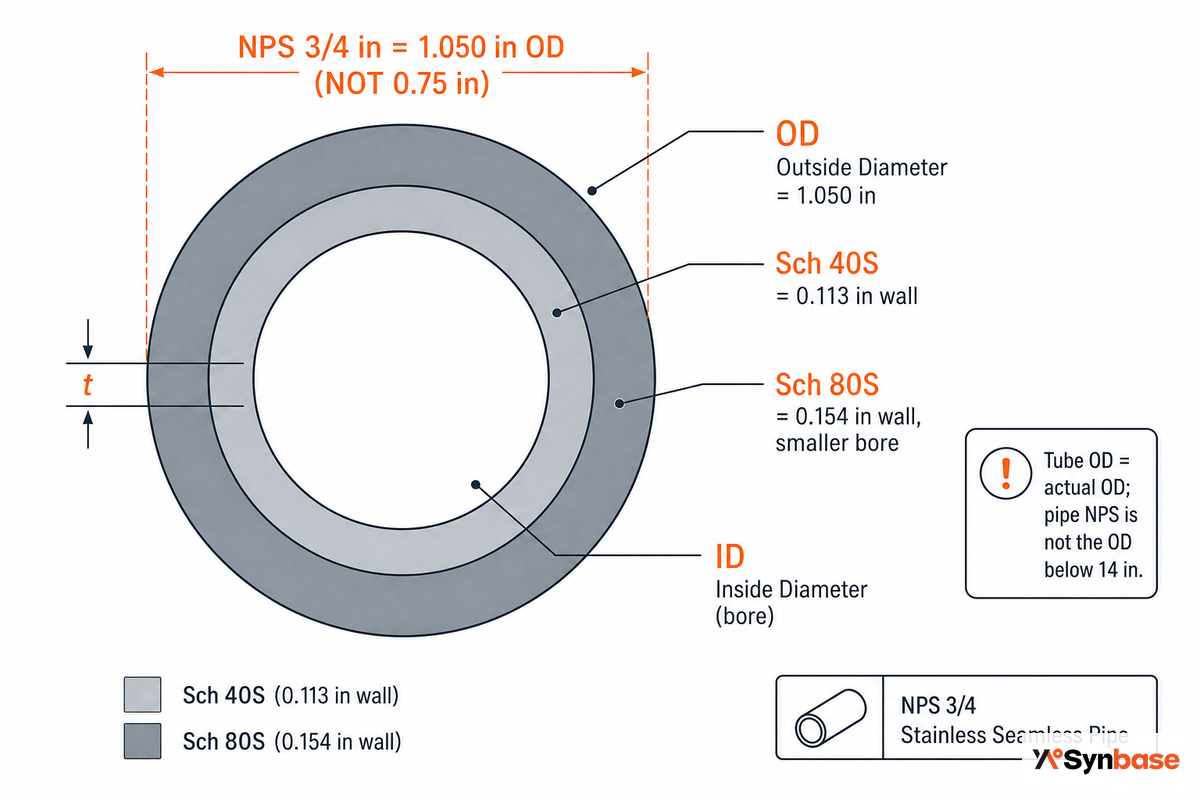
Here’s the trap that produce wrong orders: for pipe, NPS isn’t the outside diameter. An NPS 3/4″ pipe has a 1.050″ OD; NPS 1″ is 1.315″; NPS 2″ is 2.375″. Only at NPS 14″ and above does the NPS number equal the OD. Tube, by contrast, is dimensioned by its actual OD × wall, so ordering A312 pipe by a tube OD is the single most common dimensional error.
| NPS | OD (in) | Sch 5S | Sch 10S | Sch 40S | Sch 80S |
|---|---|---|---|---|---|
| 1/4″ | 0.540 | — | 0.065 | 0.088 | 0.119 |
| 3/8″ | 0.675 | — | 0.065 | 0.091 | 0.126 |
| 1/2″ | 0.840 | 0.065 | 0.083 | 0.109 | 0.147 |
| 3/4″ | 1.050 | 0.065 | 0.083 | 0.113 | 0.154 |
| 1″ | 1.315 | 0.065 | 0.109 | 0.133 | 0.179 |
| 1-1/4″ | 1.660 | 0.065 | 0.109 | 0.140 | 0.191 |
| 2″ | 2.375 | 0.065 | 0.109 | 0.154 | 0.218 |
| 3″ | 3.500 | 0.083 | 0.120 | 0.216 | 0.300 |
| 4″ | 4.500 | 0.083 | 0.120 | 0.237 | 0.337 |
| 6″ | 6.625 | 0.109 | 0.134 | 0.280 | 0.432 |
| 8″ | 8.625 | 0.109 | 0.148 | 0.322 | 0.500 |
| 10″ | 10.750 | 0.134 | 0.165 | 0.365 | 0.500 |
Sizes per ASME B36.19M. The “S” in the schedule stand for stainless material; make sure this is current for your purchase order.
Since seamless wall thickness can vary by as much as 10% and more, a schedule number is a nominal design value – not necessarily the min wall thickness of your specific product at all points around the O.D..
Using the standard’s minus-tolerance minimum wall for your pressure design guards against this wall variation, use our stainless pipe wall-thickness reference to convert a schedule to a design wall.
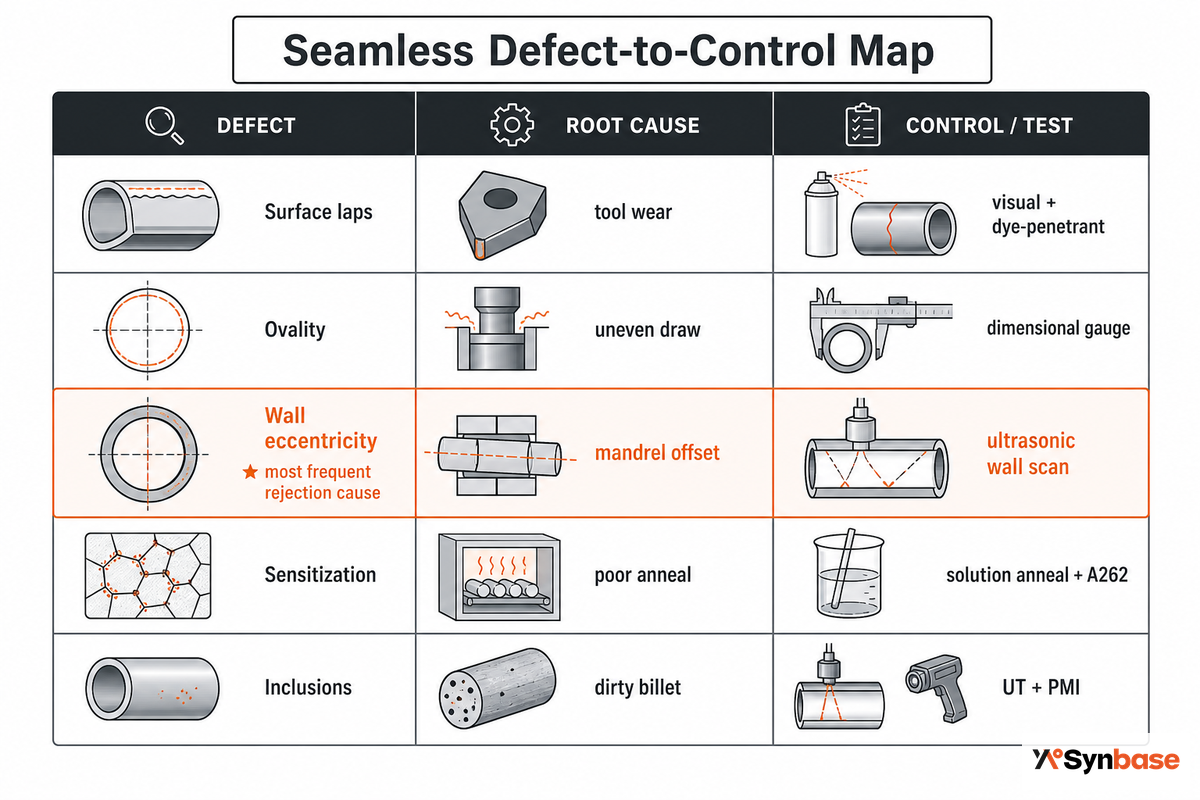
The common problems with seamless pipe are process artifacts from piercing and cold drawing, not corrosion failures. The marketing story is “seamless equals flawless”; the inspection reality is that wall eccentricity, not corrosion, drives most seamless rejections. The Seamless Defect-to-Control Map below ties each defect to its root cause and the test that catches it, so you can write it straight into your purchase order.
| Defect mode | Root cause in process | Control / test that catches it |
|---|---|---|
| Surface laps, scratches, pits, folds | Tool wear / contamination in piercing & drawing | Visual + dye-penetrant; eddy-current on critical lines |
| Ovality / out-of-round | Uneven draw, handling | Dimensional gauging to B36.19M tolerance |
| Wall eccentricity (thin spot) | Piercing-mandrel misalignment | Ultrasonic wall scan + minimum-wall acceptance |
| Residual stress / cracking, sensitization | Cold work without proper anneal | Mandatory solution anneal + ASTM A262 IGC test |
| Non-metallic inclusions | Billet cleanliness | Ultrasonic inspection + PMI |
Watch out for wall eccentricity.
Because a seamless hot shell can drift relative to the mandrel in cold drawn, it’s a very common phenomenon for your minimum wall thickness (and potentially more) to fall below the schedule number. If you’re operating near minimum design margins, spec a cold-drawn ultrasonic wall scan on your PO with an objective, min wall accept criterion.
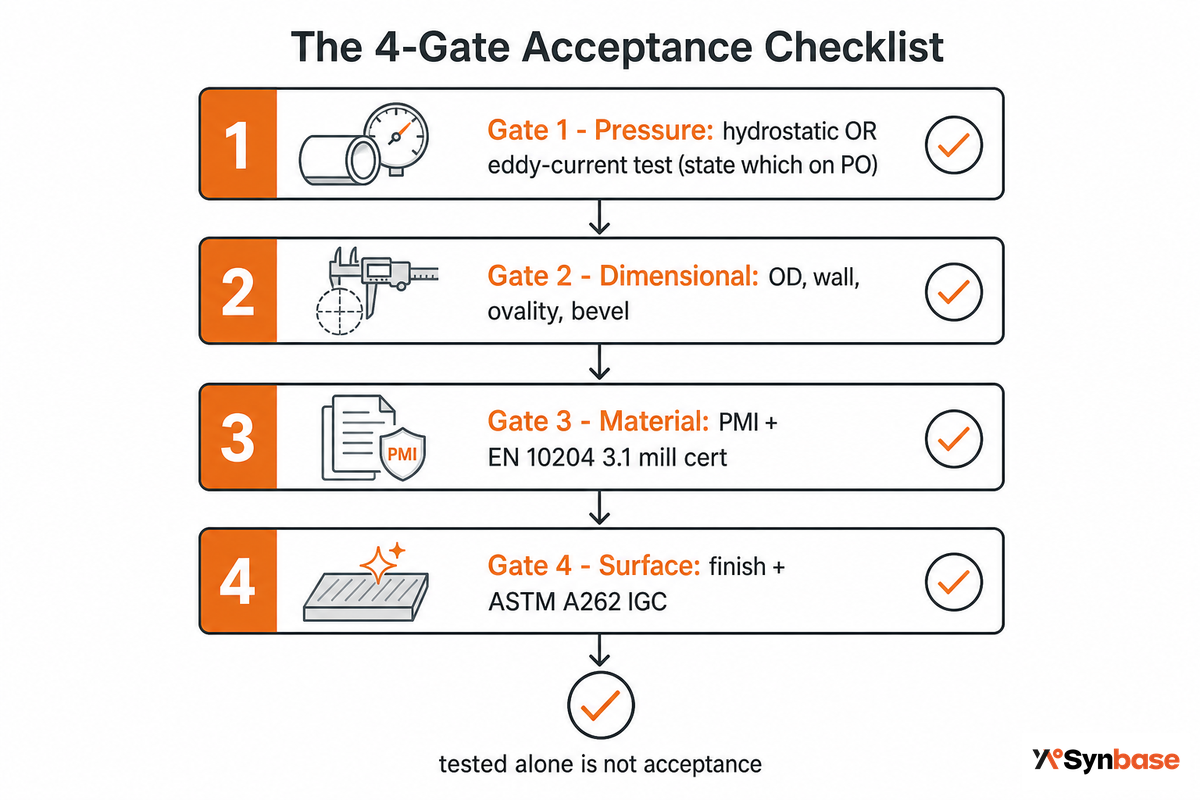
The 4-Gate Acceptance Check For A312 Seamless How can I check before installation that seamless A312 pipe matches our PO?
Four crucial gateways:
The most critical gateway for most purchasers is Gate 3. An EN 10204 3.1 certificate documents the actual test results for the material you received, independently validated by the manufacturer’s inspection function, unlike a general statement of compliance such as an EN 10204 2.1 or 2.2 declaration. For any wetted part or pressure boundary, insist on a 3.1 certificate and verify it field by field with our mill certificate verification guide.
As a pipeline-cluster mill within the E-CHENG Steel Group, our seamless production lines ship solution-annealed, pickled stainless pressure pipe with EN 10204 3.1 heat-traceable mill certificates and PMI at dispatch, under one ISO 9001 system, from NPS 1/8″ to 24″+. Buyers can, and on critical service should, require the same evidence on every import order.
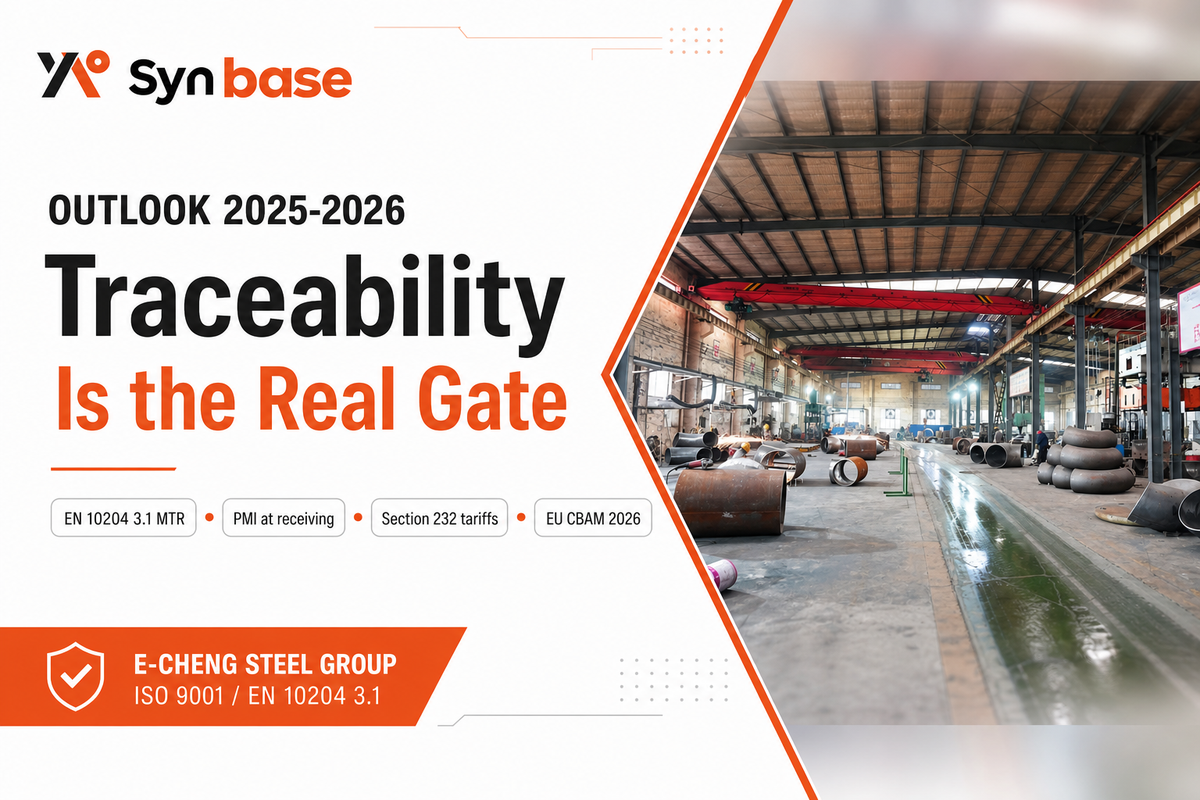
The change to plan for is not price, but proof. EPC contractors and oil-and-gas QA teams are increasingly specifying EN 10204 3.1 material certificates plus PMI at receiving for pressure boundaries and sour service, because under-spec and falsified mill certificates have moved verification from the paperwork to the dock. The standards backbone reinforces this: ASTM A312 already mandates a nondestructive or hydrostatic test on every pipe, and 3.1 documentation is becoming the floor rather than the upgrade.
Import economics shifted alongside the paperwork: U.S. Section 232 steel tariffs rose from 25% to 50% in June 2025, while the EU’s Carbon Border Adjustment Mechanism enters its definitive period for iron and steel in 2026, adding an embedded-emissions declaration to the documentation that travels with a heat. Traceability now spans test results, origin, and carbon data on the same order.
For 2026 purchasing, spec and test-method-not vendor choice-is key: mandating 3.1 plus PMI for any wetted-or-pressure-retaining line, and dismissing 2.1/2.2 self-declaration for such applications.
A growing market (seamless stainless pipeline expected to rise 5-6%/year this decade) supports this direction but doesn’t drive it-traceability does, and you control traceability at the purchase order.
Sourcing stainless steel seamless pipe with full EN 10204 3.1 traceability?
This guide draws on ASTM and ASME pressure-pipe standards, IMOA and Nickel Institute corrosion data, and the seamless production and inspection practice of Synbase Steel Co., Ltd. — an E-CHENG Steel Group affiliate and pipeline-cluster mill that ships stainless seamless pipe with EN 10204 3.1 traceability and PMI to projects in over 100 countries. Reviewed by the Synbase Steel Co., Ltd. technical team, June 2026.
Synbase Steel supplies steel pipe, fittings, flanges, valves and OCTG for oil and gas, petrochemical, power, water and industrial projects. Our technical guides are written to help buyers compare standards, grades, dimensions, coatings, inspection requirements and commercial terms before sending an RFQ.
We focus on practical specification work: matching pipe process to service conditions, checking wall thickness and end finish, reviewing MTC and NDT requirements, and clarifying documentation before production or shipment.
Project support across seamless pipe, ERW, LSAW, SSAW, buttweld fittings, forged flanges, valves and oilfield tubulars.
Specification review for ASTM, ASME, API, EN and DIN standards, including material grade, pressure class, coating and inspection scope.