Send Your RFQ to Synbase Steel
Prefer to send drawings, BOMs or attachment lists by email? sales@synbasesteel.com
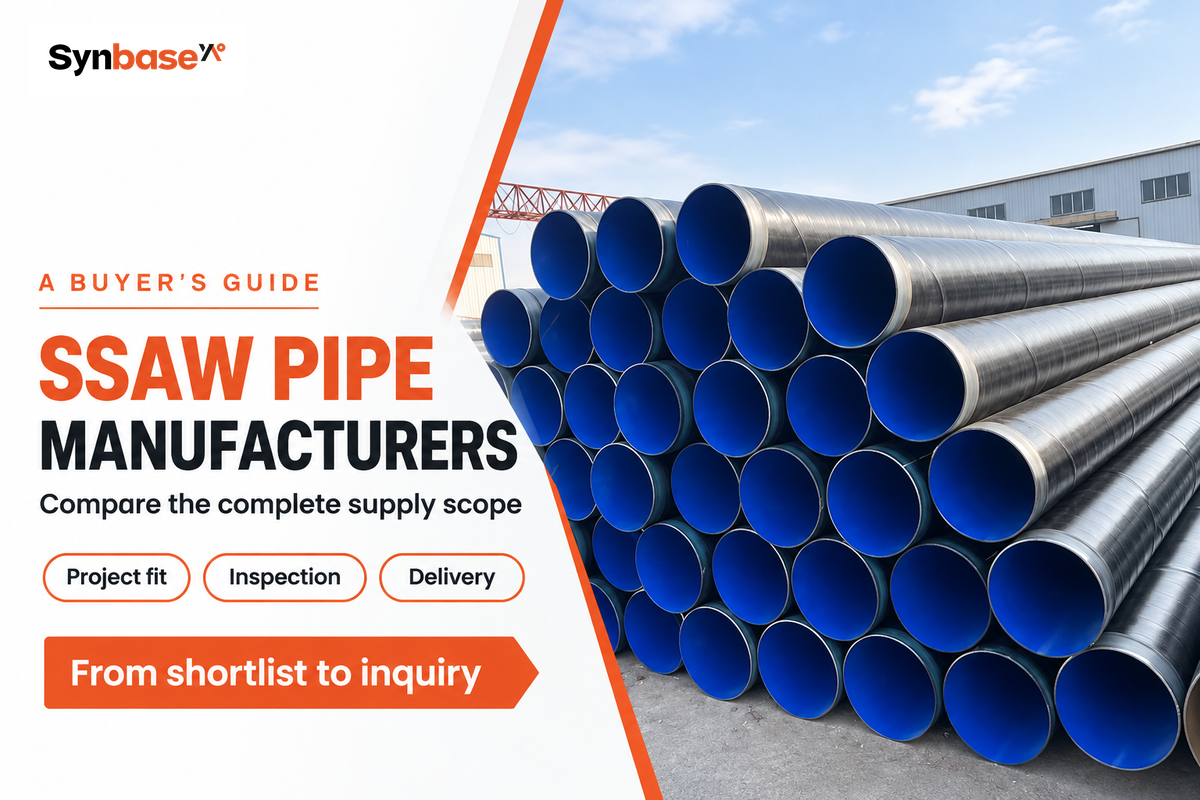
SSAW pipe manufacturers form steel coils into a spiral shape. They join the seam using submerged arc welding technology. To select a mill, consider the product route, verify the diameter and wall thickness together, and compare offers for the same delivery point. A long product list doesn’t help in taking a decision.
A water-main contractor, a piling buyer and a natural gas procurement team can all search for spiral welded pipe while needing different suppliers. This guide connects those applications to actual manufacturer examples and a practical quotation comparison. Start with the project specification; use the tables below to decide which bidders deserve a place on your shortlist.
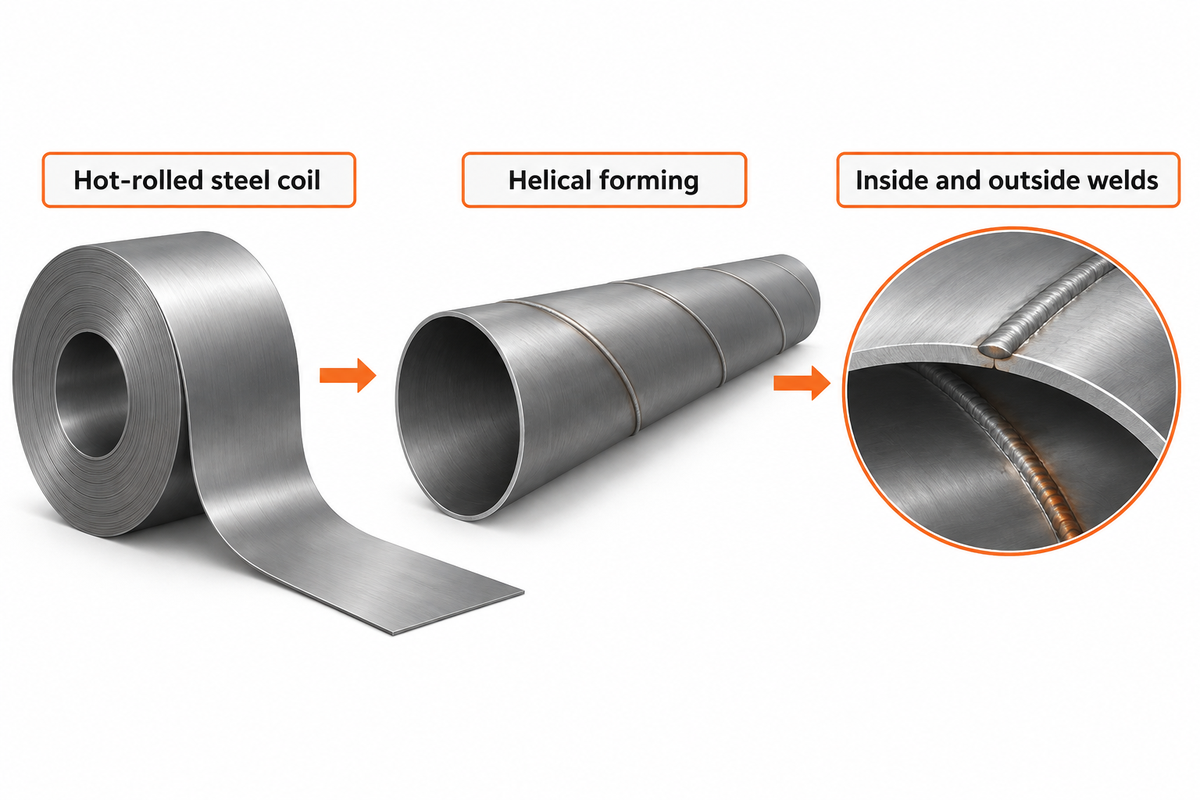
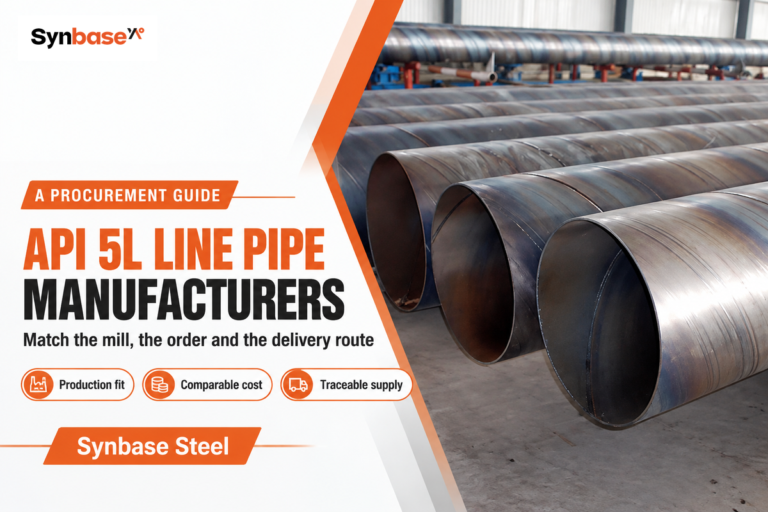
Spiral submerged arc welded pipe is steel pipe made by forming hot-rolled steel coil into a cylinder with a helical weld. The terms SSAW, HSAW pipe and SAWH describe this product family. Mills serve water transmission, structural steel piling and specified pipeline applications with the available grade and finishing scope varying by product line.
Think of wrapping a strip around a cylinder at an angle. In spiral forming, the width of steel strip and forming angle help establish the pipe diameter. The forming process creates a continuous spiral seam. The spiral welding process joins the edges. Double-sided submerged arc welding uses welds on the inside and outside. The mill’s steel pipe manufacturing process also includes preparation, inspection and any ordered finishing.
LSAW steel pipe uses a longitudinal seam commonly formed from steel plate; ERW uses a different welding process, while seamless steel pipe has no welded longitudinal or spiral seam. If your request requires a longitudinal product, assess LSAW pipe options prior to accepting a spiral alternative.
For a more complete look at the manufacturing process and specifications, refer to the spiral welded pipe process and specifications guide. The more appropriate question here is: can the proposed factory produce pipes by the route your project actually allows?
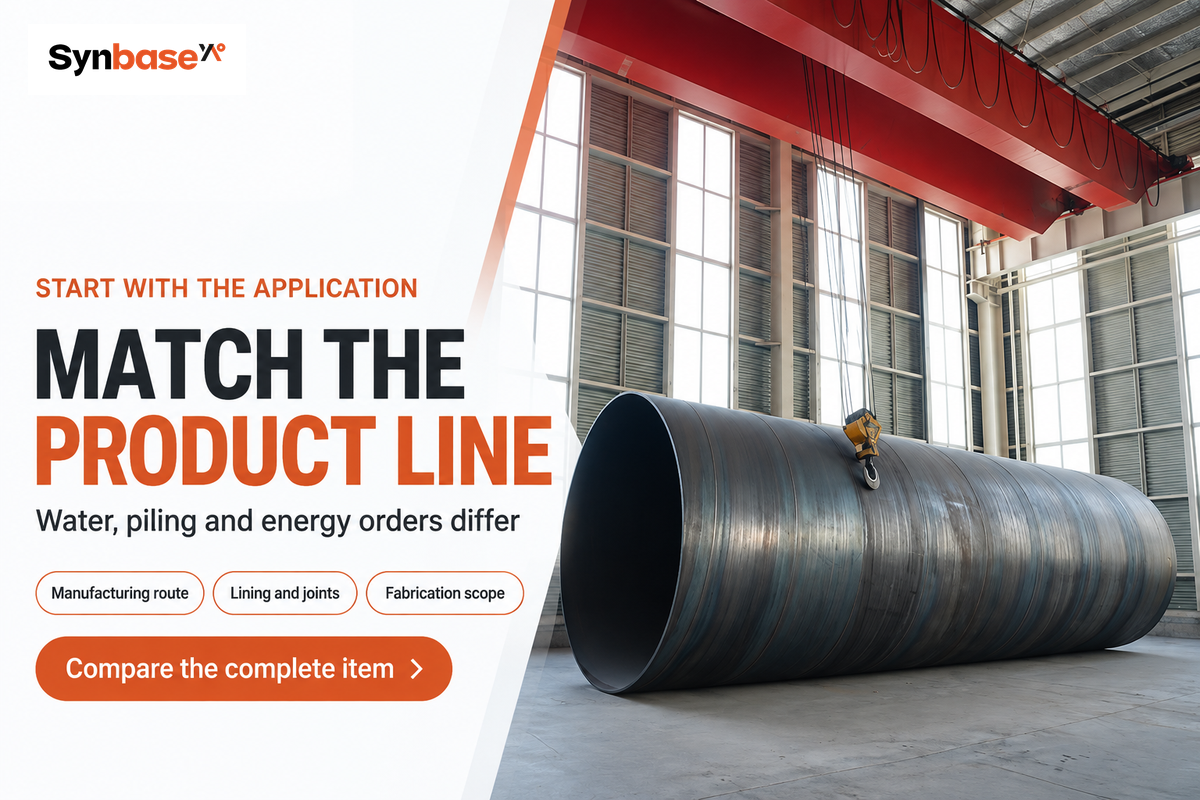
Northwest Pipe Company and AMERICAN SpiralWeld offer steel water pipe, while Nucor Skyline offers spiralweld piling and water transmission pipe. Compare specific product lines offered, as companies may not be treated as interchangeable. The examples don’t qualify or rank factory offerings.
| Manufacturer example | Relevant published offering | What the buyer should compare |
|---|---|---|
| Northwest Pipe | Engineered steel water pipe, including spiralweld and rolled-and-welded products | Lining, joints, fabricated pieces and the manufacturing route assigned to the quotation |
| AMERICAN SpiralWeld | Spiral welded steel pipe for water, wastewater and other listed applications | Its Line Work range: 30–144in diameter and lengths up to 50 ft; match the complete specified item |
| Nucor Skyline | Spiralweld piling plus a separate water-transmission offering | Keep piling dimensions separate from the water-product table, which includes more than one forming route |
A large-diameter water main often requires more than straight pipe. Bids may include engineered joints and special pieces, or list them separately. For piling, the comparison shifts to the prescribed structural product, piece lengths and fabrication work. An inquiry for oil and gas pipelines requires prescribing the grade of pipe and manufacturing route; a simple product listing doesn’t answer this.
NWPX Infrastructure’s 2025 Annual Filing describes an order sequence of approved drawings, raw material, forming and welding, contract-specific inspection and coatings. This sequence explains the difference between a manufacturer’s overall range and a shipment-ready offer.
For a water contractor buying straight lengths and some outlet sections, one mill prices the straight lengths, while the other includes the straight lengths, specials and lining. The first offer may appear cheaper, as fabrication is still sitting outside the quotation. A useful short list records who supplies which piece, where the lining is applied and who owns the drawing revisions. The contractor can then evaluate the package as a whole or purposely buy the work in several lots. Either approach can work; however the unpriced interfaces require an owner before the purchase order is issued.
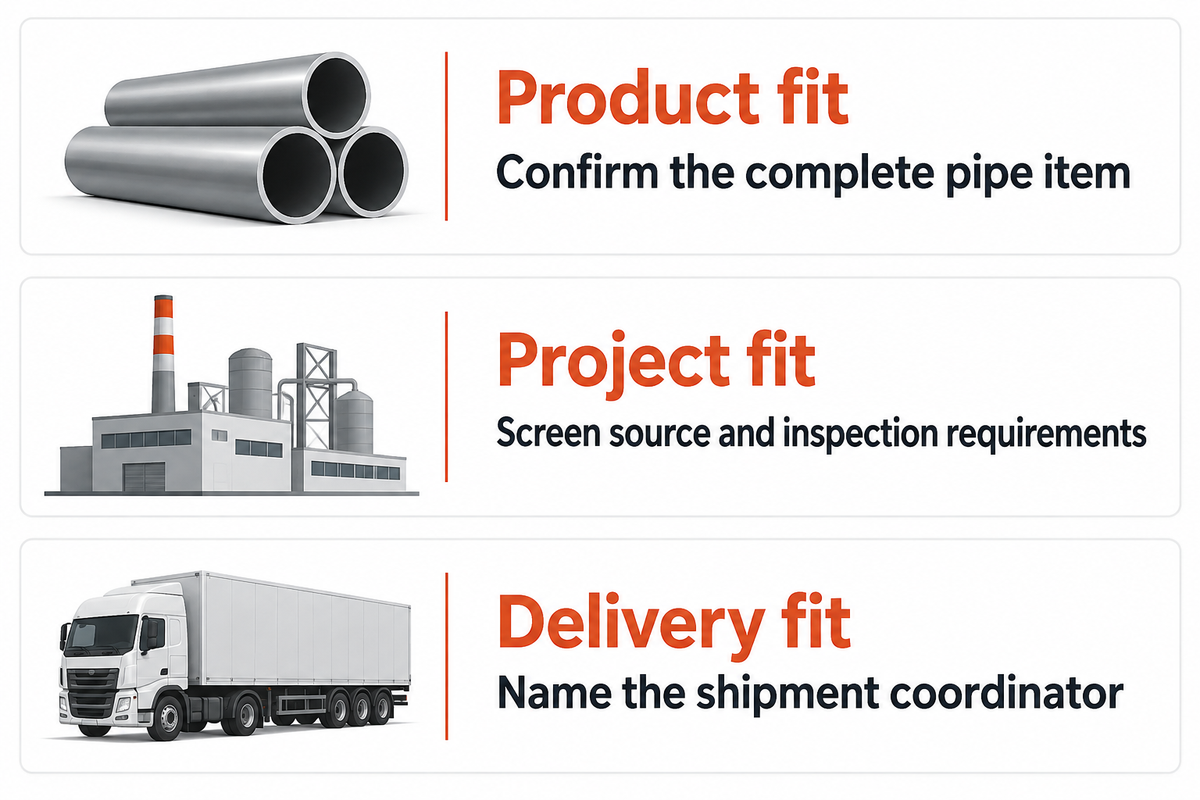
Select a spiral pipe mill against the full diameter, wall, grade, and service requirement. Product fit removes unsuitable manufacturing routes; project fit reviews the specified documentation and approved source requirements; and delivery fit assesses the finishing and shipment plan. The maximum offered in the catalog should guide the inquiry; the short list should be based on the offered combination.
The 3-Fit Mill Selector is a purchasing method that assesses the product and project fit before assessing delivery fit and price.
| Requirement category | Your project condition | Shortlist action |
|---|---|---|
| Product fit | Water transmission with an internal lining | Choose a bidder offering the pipe-and-lining package, including the required joints |
| Product fit | Structural piling with specified piece lengths | Compare the piling product line and fabrication scope |
| Product fit | An energy specification requiring API 5L | Check the specified grade, edition and manufacturing route |
| Product fit | A drawing explicitly requires LSAW | Use the longitudinal route unless the project approves a change |
| Project fit | A diameter and wall near catalogue limits | Obtain one offer confirming both dimensions together with grade and length |
| Project fit | The owner has an approved-source or origin requirement | Screen the proposed factory against that requirement before commercial comparison |
| Project fit | Witness inspection is specified | Place inspection stages and notice periods in the supply scope |
| Delivery fit | Coated pipe with fabricated outlets | Identify the finishing location and protection required during onward transport |
| Delivery fit | A mixed order of pipe and fittings | Name the party coordinating item completion and shipment release |
Spiral pipe capacity extends into very large diameters, but the useful answer is product-specific: Nucor Skyline lists spiralweld piling up to 120 in outside diameter with wall thickness up to 1 in. Its separate water-pipe offering lists 10.75–90in diameter and 0.25–2in wall across spiralweld and rolled-and-welded routes. Those are separate ranges, not one combined capability.
For example, a buyer looking for the largest piling diameter shouldn’t transfer the larger wall from the water-pipe table to the piling specification. The bid should state the requested diameter, wall, grade, and length. The supplier can respond to this directly rather than answering four separate questions about the largest capacity.
A carbon steel pipe offer also requires the actual grade. An alloy steel pipe requirement can’t be satisfied by changing a catalogue label. For an energy project, the API 5L line pipe range provides a separate product starting point.
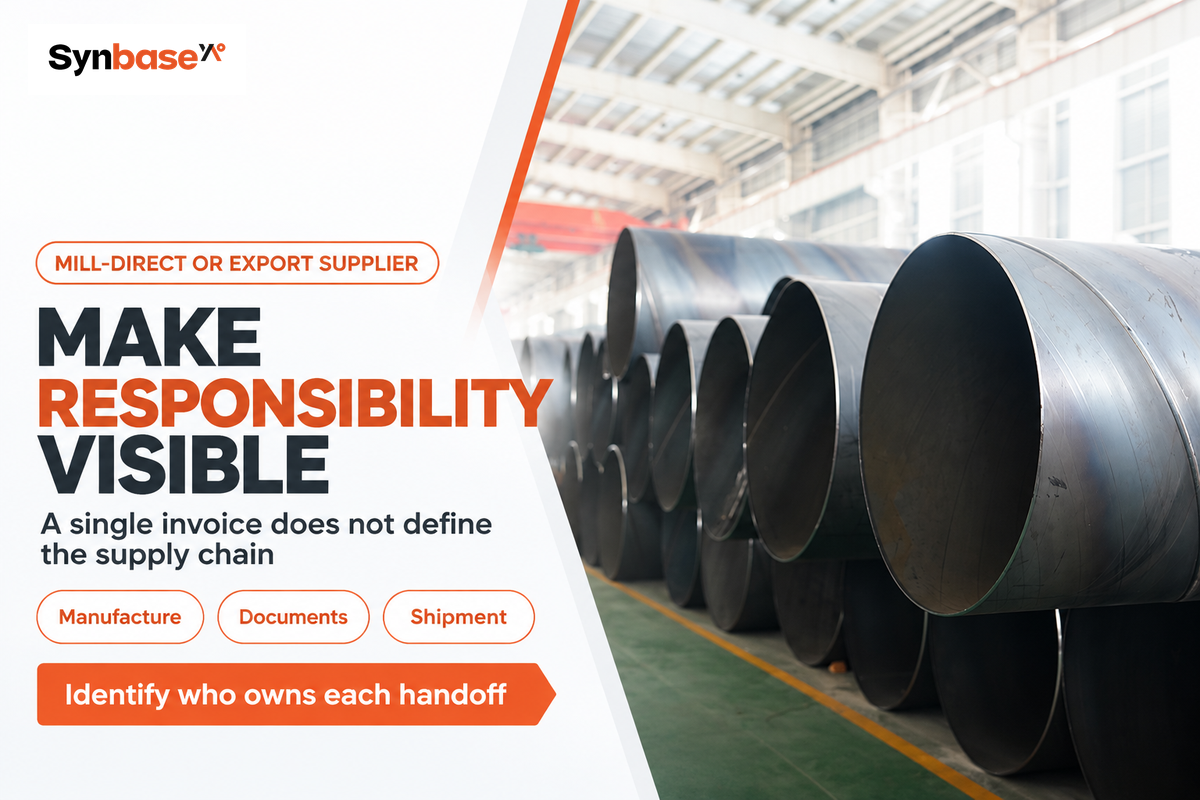
A mill-direct purchase can cover the entire order for products in the scope of a single manufacturer; an export supplier can cover a package of products spanning different product lines. Choose the route based on the work you need done: manufacture, commercial documentation, inspection, and delivery. In both cases, once those responsibilities are considered, there are no automatic price differentials.
The International Trade Administration’s sales-channel guidance distinguishes direct exporting from routes involving agents, distributors and trading companies. Canada’s Trade Commissioner guide, sections 6.5.1 – 6.5.3, separates commission-based agents from distributors that buy and resell. Determine what role your contact actually performs before making the assumption that the mill is owned by them or that they hold stock. Manufacturers and suppliers can both handle an order, but the manufacturing location and commercial contact should be clear.
For a repeat order with one pipe specification, direct contact with the manufacturing plant can shorten the communication path between your engineer and the plant’s production staff. For a package of spiral welded steel pipe and pipe fittings, a coordinating supplier can give procurement a single commercial contact. Such convenience has value only if the offer specifies the manufacturing locations, document responsibilities, and claims contact.
Visualize an order split between large-diameter steel pipes and smaller fittings. A trading contact may send a single invoice, but pipe and fittings may not be available at the same time. The customer wants a single shipment, but the construction contract may require pipe to be available first. Before award, agree on whether partial dispatch is allowed, who pays for storage, and who makes the change to the shipment booking. The manufacturer’s address appears in the technical records, and the export supplier manages the transaction; the export supplier may issue a single invoice to simplify the records.
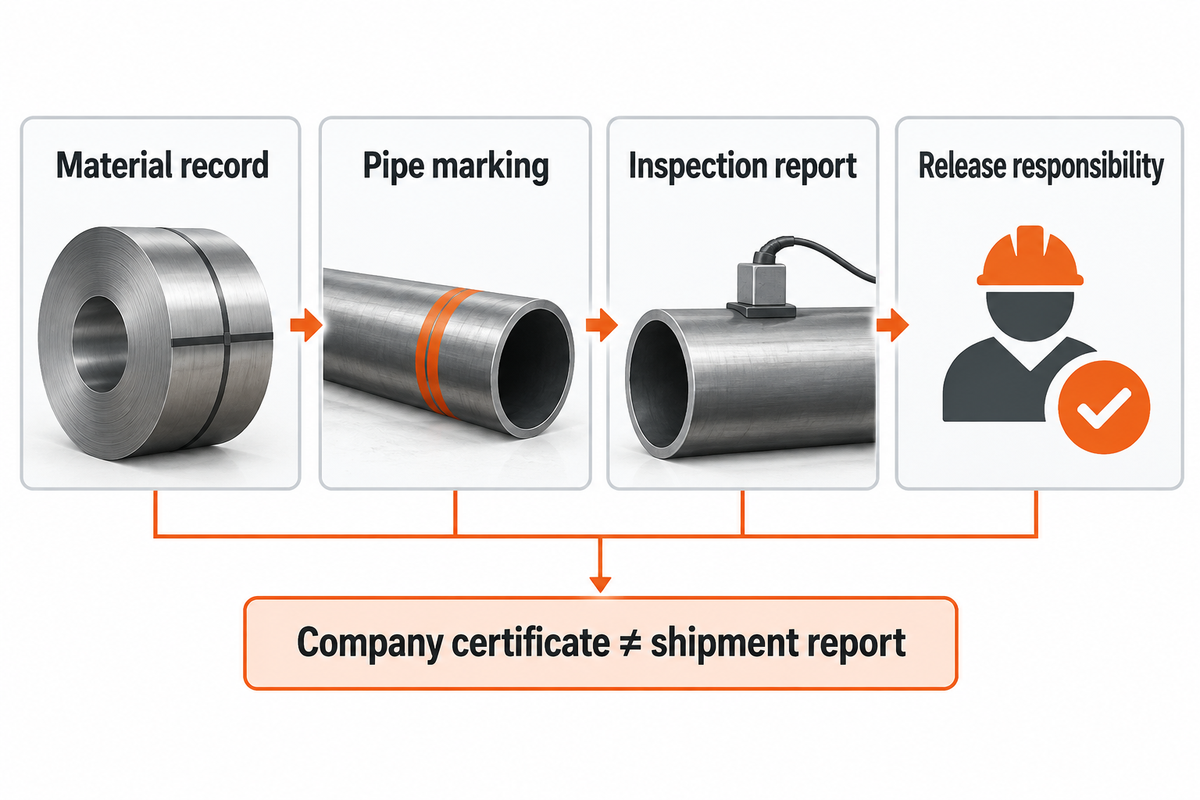
Assess pipe quality via records linked to the ordered material and the stage of its manufacture. The identity of the coils, weld inspection, dimensional checks and the release of the finished pipe should describe the same supply lot. A company certificate answers a different question from a shipment report. The buyer should obtain both the required supplier qualification records and the applicable order records.
The API Monogram program ties its mark to conforming new products made by licensed entities at licensed facilities. Where your project requires that license, check the proposed manufacturing entity and the scope in the official directory. A certificate for another site or product doesn’t fulfill that requirement.
STI/SPFA’s fabricator-certification guidance helps buyers follow the raw material into the pipe body and follow the completed product into its inspection records. A tour of the SSAW workshop may demonstrate the SSAW production process; the order documentation shows what was supplied.
SSAW pipe inspection can include dimensional checks, weld checks, mechanical tests and hydrostatic testing, if and as required by the pipe standard and order. Buyers should check the methods and coverage against their acceptance criteria and the supplier’s inspection plan. Reports should identify the material and pipe covered, rather than present unrelated sample results.
Inspection plans define hold points and release responsibilities. If an inspector must witness a stage before coating and that visit is booked after coating, that creates an unwanted scheduling conflict. Agree on the sequence during offer review to avoid scheduling conflicts during coating. Material and process controls manage product quality, and the final test is part of that sequence.
When the quality lead reviews a dossier, the main objective is to reconcile identities across it: purchase item, material record, pipe marking and inspection report. Procurement can ease this by requiring the document list in the quotation prior to placing the order.
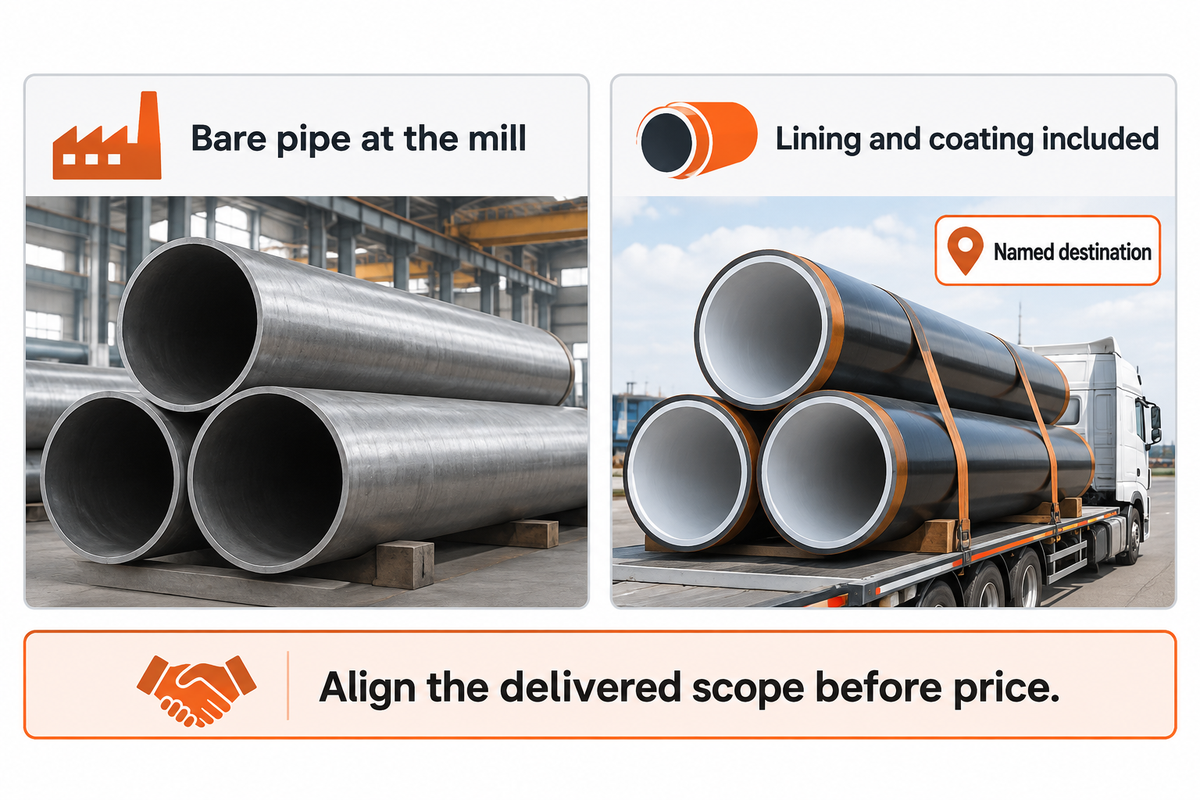
Compare SSAW pipe prices after aligning the product specification, finish, inspection and delivery point. A bare-pipe price at the mill and a coated and lined pipe offer delivered to a specified destination cover different scopes of work. Finance needs the total scope and the remaining allowances; procurement needs to know which party completes the work.
The International Trade Administration’s landed-cost guidance includes freight, insurance, tariffs, taxes and other fees beyond the original product price. Use buyer-confirmed import allowances for the stated manufacturing origin and destination. The ICC explanation of Incoterms 2020 also places costs in the A9/B9 provisions; write the agreed delivery term and named place in full.
| Comparison item | Offer A as received | Offer B as received | Make the bids comparable |
|---|---|---|---|
| Manufacturing route | SSAW stated | Welded pipe stated | Specify the same accepted route |
| Size and grade | Diameter and wall listed | Grade included as well | Use one complete specification line |
| Quantity basis | Price per tonne | Price for scheduled lengths | Reconcile piece count, lengths and quoted mass basis |
| Internal lining | Excluded | Included | Price the same lining system |
| External coating | Bare pipe | Coated steel pipe | Align preparation, coating and inspection scope |
| Special pieces | Straight lengths only | Outlets included | Price identical drawings and item counts |
| Inspection | Mill inspection | Witness visit included | Agree the required inspection plan |
| Transport and origin | Mill collection | Named port delivery | Align destination, freight and buyer-confirmed import charges |
| Schedule endpoint | Production complete | Ready for shipment | Compare the same milestone and its starting condition |
If two suppliers quote equally on pipe terms, and one supplier quotes a lower headline price that excludes lining and transport, the purchasing officer should request the missing prices before recommending the supplier. The engineer checks the lining specification; the quality lead checks its inspection; the finance lead verifies the complete landed scope. If a contractor must arrange the omitted work, the cost of coordinating and managing that work should also be considered in the award decision. Price lining and transport as separate components, and then compare the complete, landed costs.
Production schedules deserve the same discipline. Coil availability, mill slot, finishing, inspection release, and dispatch are all separate events. NWPX Infrastructure states in its 2025 filing:
“It is not unusual for WTS projects to be delayed and rescheduled.”
Write the schedule as a pair of milestones, e.g. approved drawings to shipment release. A date for finished bare pipe is different from a date for inspected and coated pipe loaded for shipment.
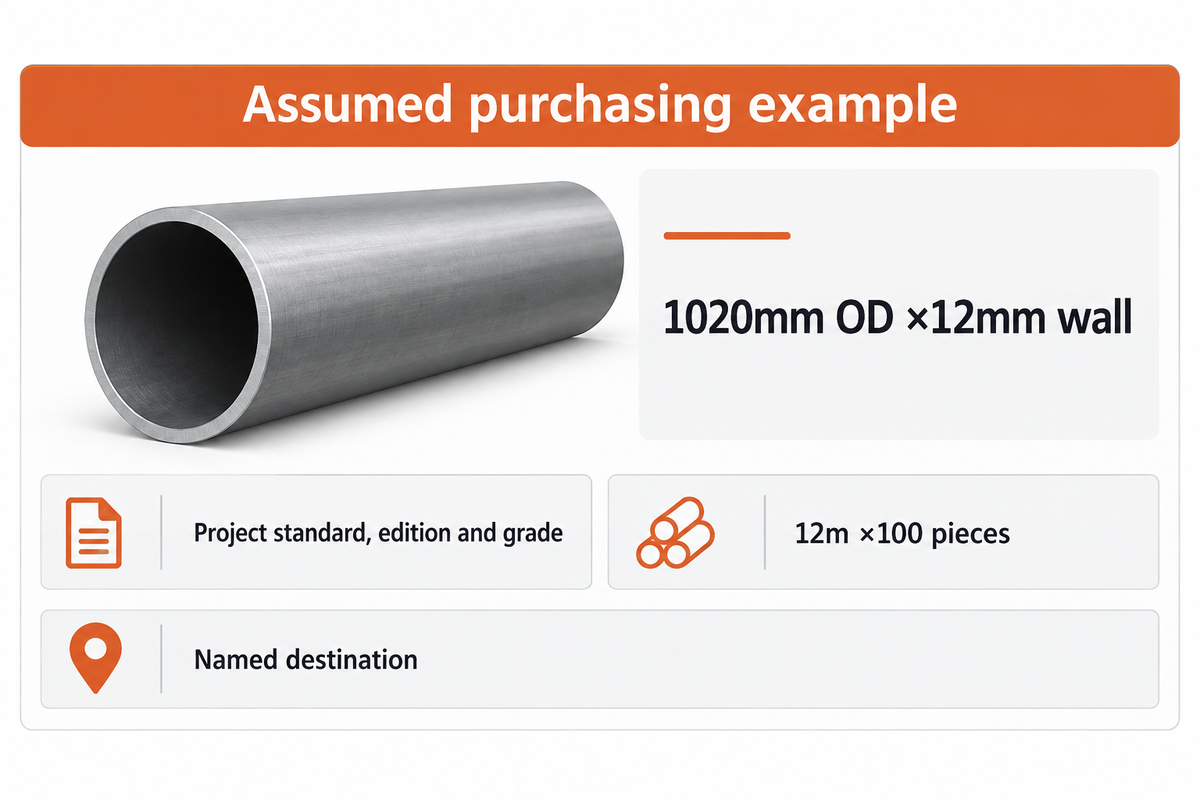
A priceable SSAW inquiry combines the item schedule with the required finish, inspection and destination. For water-pipe orders, STI/SPFA’s purchasing guidance recommends specifying quality and minimum industry standards in contract documents. Send the drawing revision and supply boundaries together, and the mill can provide a price for the item. The starter below uses an assumed purchasing example to show the level of detail; the project’s specified dimensions remain the inputs for your order.
Copy the example fields and modify the values based on your approved schedule.
Inquiry starter: describe one complete pipe item
| Parameter | Example entry | Why it matters | Response to request |
|---|---|---|---|
| Dimensions | 1020mm OD ×12mm wall | One combined item | Confirm the combination |
| Length and quantity | 12m ×100 pieces | Links piece count to transport | State length tolerance and quantity basis |
| Product requirement | Project standard, edition and grade | Sets the manufacturing specification | List deviations separately |
| Finish | Specified internal lining and external coating | Defines work beyond bare pipe | State preparation and test scope |
| Inspection | Project inspection plan and witness stages | Sets release responsibilities | Identify notice and document requirements |
| Delivery | Named destination, required milestone and source eligibility | Connects price to the project | State origin, exclusions and schedule basis |
Agree with the supplier and carrier on large spiral steel pipe supports, separation and restraint before loading. Large spiral steel pipe needs a packing plan suited to its diameter, length and finish. Loading arrangements and the means of support and restraint may vary during transport. Photographs of the loading arrangements may help the receiving team understand if and how the shipment was damaged during transport.
The example inquiry requires the receiving team to plan for 12-meter pieces rather than assume short pieces bundled together. Provide the equipment and tools available for unloading, and any access constraints in the shipment notes. There must be a plan to address coating damage that occurs during handling. Identify who inspects, records and resolves damage at each handoff.
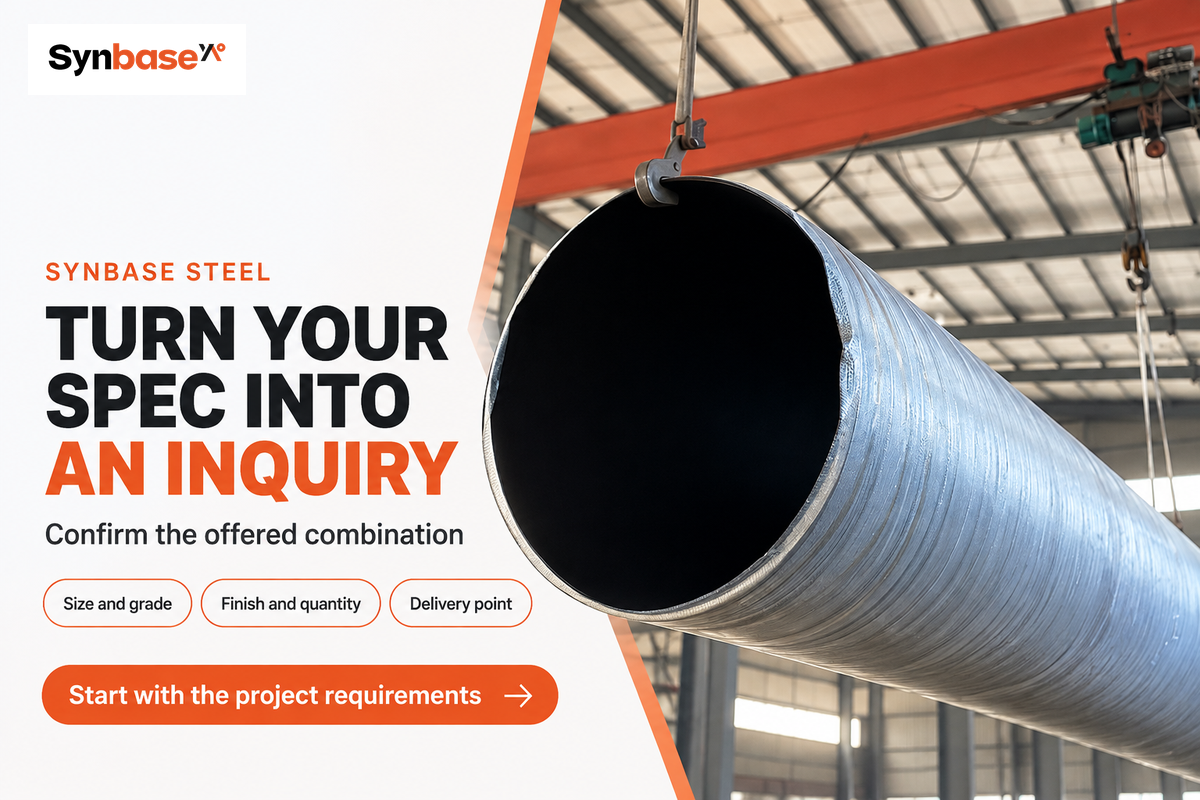
Synbase’s SSAW steel pipe catalogue lists 219-4500mm OD and 5-25mm wall thickness. Use those numbers as a basis for your specific query, then specify your required size, grade, finish and quantity. For SSAW welded steel pipe, the offer defines the supply combination and commercial terms for your project.
We make the same distinction throughout this guide. An available product family starts the discussion, while a complete SSAW pipe item makes an offer comparable. Review the Synbase Steel Company Background and evaluate your sourcing requirements to identify the manufacturing and inspection parties in the quote.
Discuss your requirements for item schedules in the SSAW pipe manufacturing and supply options page. Indicate the project standard and named delivery point to enable the response to address the requirements for the pipe and its finishing scope.
The release of the new API 5L edition makes the edition field in a line-pipe inquiry more useful, not less. API announced the 47th edition on June 2, 2026. Buyers comparing SSAW manufacturers should state the edition required for the project, and require each offer to identify its specified basis for comparison prior to the start of any technical evaluation.
According to the official API announcement, over 15 topics in API Specification 5L have been updated. Some example changes relate to high frequency welding and carbon-dioxide service. These example changes show that not every standard update should be interpreted as an SSAW-specific change. A publication announcement identifies the revised document; the project documents and applicable requirements define what the order must conform to.
For new requests, use the standard designation and edition on the item schedule, then use the same entry on the supplier’s technical offer. For repeats, check if the spec has changed before using the last order. If bidders propose different editions, sort out the difference with the project team before evaluating their test schedules or price.
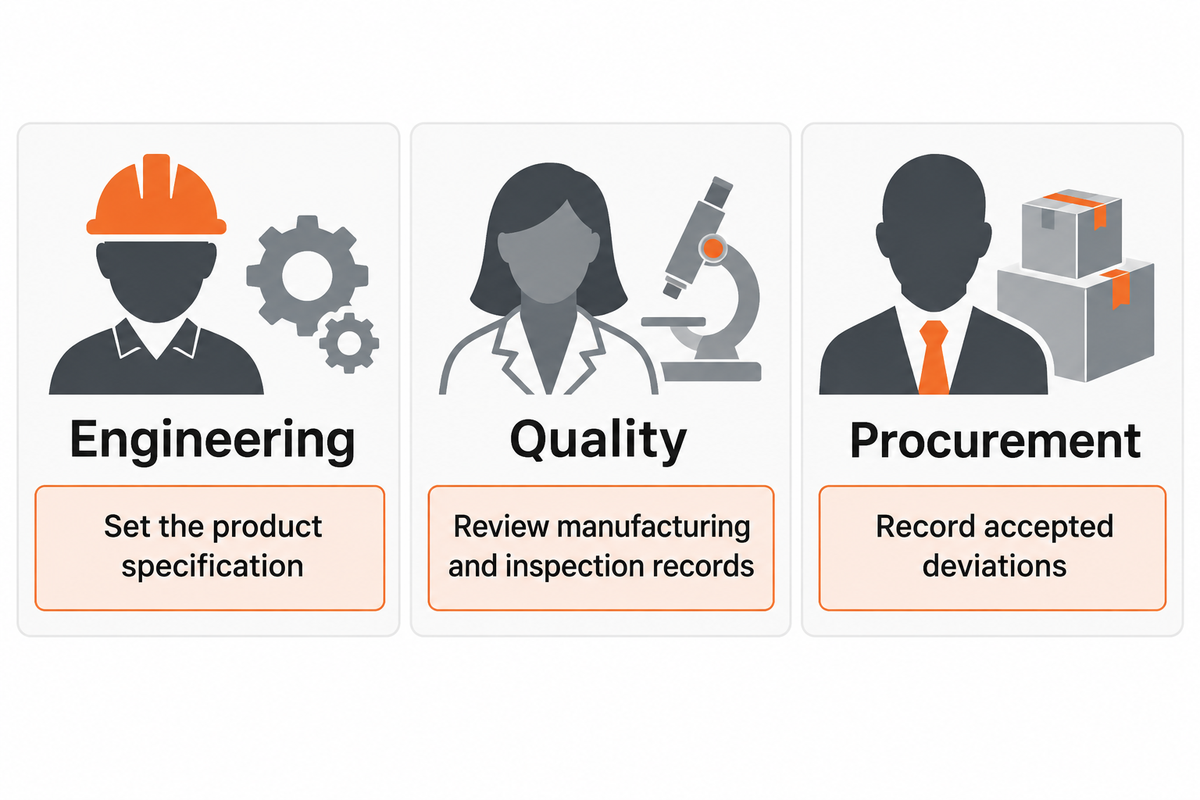
A helpful review meeting separates the questions. Engineering establishes the product specification. Quality reviews the manufacturing and inspection documentation against the spec. Procurement records any accepted deviation in the final offer. If API licensing is a project requirement, the proposed facility and licensed scope are reviewed separately from the edition written on the purchase order.
An updated forecast isn’t needed to act on this change. The important change is to the inquiry and specification revision. A factory’s use of automatic submerged arc welding or a two-stage production layout may explain how it organizes forming and welding, but equipment descriptions don’t define the edition or inspection requirements of your order. Production efficiency and project conformity are separate questions: a two-stage layout separates forming from final welding, while the purchase specification still defines the product to be delivered.
Synbase Steel publishes this guide for buyers comparing spiral welded pipe supply routes. Manufacturer examples describe publicly listed product lines; the selection and quotation tables are purchasing methods developed for this article. They don’t rank factories or report private inspection results. The comparison keeps mill capability, project requirements and delivery responsibility separate so readers can build a more useful supplier shortlist.
Synbase Steel supplies steel pipe, fittings, flanges, valves and OCTG for oil and gas, petrochemical, power, water and industrial projects. Our technical guides are written to help buyers compare standards, grades, dimensions, coatings, inspection requirements and commercial terms before sending an RFQ.
We focus on practical specification work: matching pipe process to service conditions, checking wall thickness and end finish, reviewing MTC and NDT requirements, and clarifying documentation before production or shipment.
Project support across seamless pipe, ERW, LSAW, SSAW, buttweld fittings, forged flanges, valves and oilfield tubulars.
Specification review for ASTM, ASME, API, EN and DIN standards, including material grade, pressure class, coating and inspection scope.