Send Your RFQ to Synbase Steel
Prefer to send drawings, BOMs or attachment lists by email? sales@synbasesteel.com

Updated August 2026
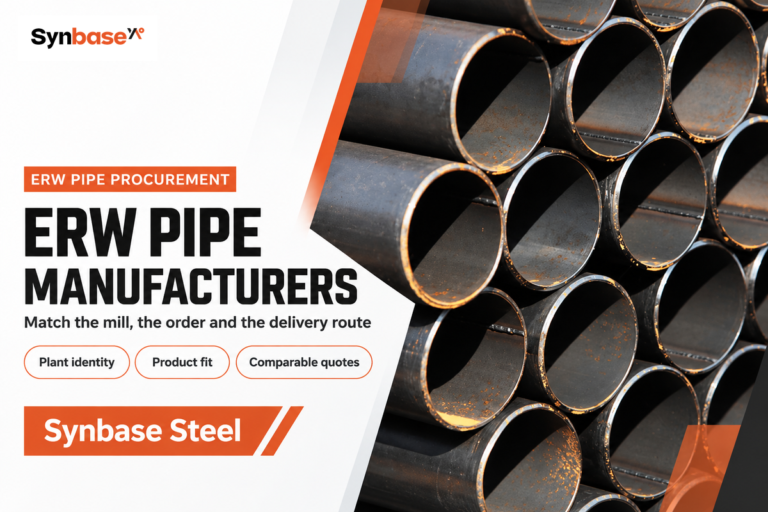
ERW pipe is steel pipe made by forming strip or coil into a cylinder and joining the longitudinal edges with electric-resistance heat and pressure. This process can produce dependable line, utility and structural products, but the letters “ERW” do not specify grade, wall, design pressure, testing or acceptance evidence. Those details belong in the purchase specification.
For a buyer, the practical question is not simply “Is ERW good?” It is whether a defined product, made by a controlled process, satisfies a defined service and arrives with evidence that can be checked. This guide turns that question into an order sequence for engineering, procurement, quality and supplier teams.

ERW pipe is a longitudinally welded steel product made from strip or coil whose edges are heated by electrical resistance and pressed together. Modern mills commonly use a high-frequency process. Its resulting weld seam is only one part of the product definition; base material, thermal processing, geometry, testing and traceability remain equally important.
Those initials describe how the seam is created. They do not identify one chemistry, one strength grade or one end use. ASTM A53/A53M-24, for example, covers Type E electric-resistance-welded pipe in Grades A and B as well as other product types. API Specification 5L covers both welded and SMLS line pipe. A project can therefore require ERW within a named standard, or permit more than one manufacturing route subject to the same service and acceptance criteria.
Terminology needs care. “HFW” usually refers to high-frequency welding, which is a modern form of electric resistance welding. Older low-frequency ERW populations have a different manufacturing history and integrity record. John F. Kiefner’s 2002 ASME conference paper on legacy low-frequency ERW explicitly separates those historical populations from newer high-frequency production. A maintenance assessment of old pipe should not be copied into a new-purchase decision without checking process era, standard, seam thermal processing and inspection.
Synbase publishes a capability range of NPS 1/2 through NPS 24 (21.3 to 610 mm) and API 5L grades B through X70 for its ERW steel pipe products, subject to project confirmation. That is a supplier capability statement, not the dimensional scope of every ERW standard and not an automatic confirmation for a specific order.

Continuous ERW production converts inspected steel strip into pipe through forming, edge joining, seam thermal processing, sizing and verification. Each stage can affect the final result. A useful mill review therefore follows the material and its identification from incoming coil through finished bundle instead of treating the welder as the whole production line.
Electrical resistance welding uses the workpiece resistance to generate heat at the converging edges. Pressure then forms the weld without adding conventional filler metal. Weld quality depends on how the mill controls strip properties, edge preparation, heat input, forging action, seam thermal processing and line speed. A stable control plan matters more than a simplified animation of two hot edges meeting.
As a product-standard anchor, ASTM’s current A53/A53M-24 page identifies Type E as electric-resistance-welded pipe and lists the associated product-test families. The purchase order must still identify the exact Type, Grade, dimensions and supplementary requirements.
Buyers should request the inspection and test plan before production when the order is critical. The plan can identify hold points, witness points, procedure qualifications, calibration status, sample frequency, acceptance criteria and the record attached to each result. This also prevents a common dispute: a supplier may have performed a normal mill test, while the purchase order expected a project-specific examination or third-party witness.
Weld control is only one part of acceptance. Coil laminations, surface discontinuities, dimensional drift, end damage, marking errors and mixed heat numbers can all make a shipment unsuitable even when a seam examination passes. Receiving inspection should therefore reconcile bundle identity, pipe marking, dimensional results, certificate references and physical condition.

Choose the product standard from service and jurisdiction, then name its edition, grade, dimensions and supplementary requirements. ASTM A53, API Specification 5L and ISO 3183 have different scopes and contract structures. Writing only “ERW carbon steel pipe” leaves the mill without a complete basis for chemistry, mechanical properties, testing, marking or documentation.
| Reference | What it can define | Buyer decision | Boundary to preserve |
|---|---|---|---|
| ASTM A53/A53M-24 | Active specification for black and hot-dipped galvanized welded and SMLS steel pipe; Type E covers ERW Grades A and B; scope includes NPS 1/8 through NPS 26 | State Type, Grade, NPS, wall, finish and supplementary requirements | The product specification is not an installed-system pressure design code |
| API Specification 5L, 47th edition | SMLS and welded line pipe with requirements for material, manufacture, inspection, testing, marking and traceability | State edition, grade, product specification level, dimensions, delivery condition and ordered options | Publication date and API Monogram transition date are separate |
| ISO 3183:2019 | Steel pipe for pipeline transportation systems in petroleum and natural gas industries | Confirm the contract’s required edition and any project amendments | Do not assume every API requirement, option or certification automatically transfers |
| Project specification | Service-specific limits, inspection points, coating, end finish, documents and acceptance sequence | Resolve conflicts and establish order of precedence before manufacture | A project document cannot silently waive governing legal or code requirements |
ASTM’s active A53/A53M-24 product page lists tension, bend, flattening, hydrostatic and nondestructive electric tests within its scope and notes purchaser-specified supplementary requirements. That does not mean every test applies identically to every size, Type or ordered condition. Use the standard’s current text and the purchase order, not a generic web table, to establish the required test and acceptance frequency.
API announced the 47th edition of Specification 5L on June 2, 2026. API says the edition updates more than 15 areas, including high-frequency-welded pipe quality; the specification as a whole covers manufacture, inspection, testing, marking and traceability. An RFQ issued in the transition period should state the required edition and whether qualification, monogram or customer approval dates affect delivery. “Latest edition” can be ambiguous once a quotation, purchase order and production window span different dates.
Nominal Pipe Size isn’t the measured outside diameter in every intuitive sense, and schedule isn’t a material grade. For dimensional work, use the ordered outside diameter and wall thickness with the applicable tolerance. Synbase’s ERW pipe weight calculator can support estimating, while the purchase specification and certified measurements control acceptance.

Permit an ERW purchase only when the governing documents allow the route, the required product sits inside the qualified mill range, and seam-specific controls are defined before production. Pause when one of those three conditions is unknown. The purpose of this check is to qualify ERW/HFW supply, not to repeat a general comparison among welded-pipe processes.
This ERW-specific matrix turns service, seam control and evidence into release triggers. A “permit” result still requires normal engineering approval; a “pause” result means the missing evidence must be resolved before the order proceeds.
| ERW control category | Permit trigger | Evidence to request | Pause trigger | Limitations / Not suitable for |
|---|---|---|---|---|
| Code and owner specification | Exact ERW product class is permitted | Code clause, material class and approved project specification | Manufacturing route is omitted, prohibited or unresolved | Not a substitute for system design approval |
| Qualified mill range | Ordered outside diameter, wall, grade and delivery condition are inside the approved range | Current capability statement and project confirmation | Quotation relies on an unqualified size or condition | Published ranges do not guarantee a specific order |
| Seam-process identity | Mill declares the ERW/HFW route and relevant process era | Manufacturing procedure and route card | Supplier cannot distinguish modern HFW from an undefined ERW description | Not evidence of seam quality by itself |
| Coil-to-pipe lineage | Heat and coil identity remain linked through forming, cutting and bundling | Coil map, route record, transfer marks and bundle index | Mixed or missing heat identity | Traceability does not replace physical inspection |
| Edge preparation and forming | Approved controls cover edge condition, presentation and alignment | Procedure, setup record and dimensional checks | Edge damage or alignment drift lacks disposition | Not a guarantee against every base-metal discontinuity |
| Heat input and forging | Key welding variables are monitored against an approved window | Line records for heat input, speed and squeeze conditions | Unrecorded excursion or unexplained process change | Control records require calibrated instruments and review |
| Seam thermal processing | Ordered thermal processing is defined, recorded and linked to the production lot | Procedure, temperature record and lot identity | Required thermal processing is missing or cannot be traced | Only applies where the standard or project requires it |
| Seam examination | Method, calibration, coverage and acceptance criteria are stated | Nondestructive examination procedure and result file | “UT included” appears without scope or acceptance basis | No method detects discontinuities outside its capability |
| Mill pressure test | Test requirement, pressure, duration and pipe identity agree | Hydrostatic record tied to each accepted length or lot | Test result is missing, unlinked or outside the order | Does not establish installed-system operating pressure |
| Deviation and release | Repairs, concessions and third-party findings are closed before shipment | Deviation log, signed disposition and release index | Open concession or revised record without approval history | Release covers only the stated inspection scope |
Use the ERW route decision helper only as a preliminary check, then return to the ERW seam qualification and project documents before release.
These triggers keep the article on its intended ERW specification task. General route selection belongs in the broader welded-steel-pipe guide; this page asks whether a proposed ERW order is permitted, controllable and auditable for the stated service.
Do not buy ERW pipe when the governing code, owner specification or approved material class excludes a longitudinal ERW seam; when the required diameter, wall, grade or delivery condition falls outside the qualified mill range; or when the supplier cannot produce the ordered seam-examination and traceability records. A quoted standard name is not enough if the edition, product type or inspection level is missing.
Avoid forcing ERW into an order whose real requirement is availability of an unusual heavy wall, a process-specific qualification, or a documented SMLS-only design basis. Also pause if historical integrity concerns are being used without identifying the pipe population. Research on legacy low-frequency ERW and flash-welded pipe addresses an older asset-management problem. It does not prove that every new high-frequency welded product has the same defect population. Conversely, the word “modern” does not remove the need to qualify the mill and verify the evidence. Selection should follow the route that is permitted, manufacturable and auditable for the stated service.

ERW pipe has no universal pressure rating based on its manufacturing name. Allowable pressure comes from the governing design code using the ordered outside diameter, wall thickness, material strength, temperature and applicable design, quality or joint factors. Corrosion allowance, tolerances, fabrication and service-specific requirements also have to be addressed.
For one public regulatory example, the 49 CFR 192.105 steel-pipe design formula uses yield strength, outside diameter, wall thickness, a design factor, a longitudinal-joint factor and a temperature derating factor. An ASME Press piping design chapter likewise separates design conditions from product-standard acceptance. Product standards supply material and manufacturing requirements; the governing design code turns applicable inputs into a system design. A mill hydrostatic test checks the manufactured pipe against its specified test condition. It does not, by itself, declare the allowable operating pressure of the installed pipeline, nor does it cover every field joint, fitting, flange, corrosion mechanism or transient.
No correct universal statement says every ERW product must use a 0.85 joint factor or an 18% thicker wall. As a bounded example, current 49 CFR 192.113 assigns a longitudinal joint factor of 1.00 to the listed ASTM A53 and API 5L electric-resistance-welded pipe classes in the U.S. gas-pipeline design framework. Other specifications, classes, jurisdictions and services can use different provisions. Engineers should identify the governing code, find the factor for the exact specification and class, and document that choice.
For a preliminary order check, record six inputs before anyone quotes a pressure: design pressure, design temperature, fluid and corrosion basis, outside diameter, nominal wall with tolerance, and material grade. Then add the governing code and class factors. If one item is unknown, label the result preliminary rather than converting a catalog value into a project rating.
Northline Delta Case (hypothetical): Use the fictional 323.9 mm outside diameter and 9.53 mm wall only to show where design-code inputs enter. The example does not assert an allowable operating pressure.

An ERW order should link each acceptance risk to a test, inspection or record that can actually detect it. Chemistry, strength, seam integrity, dimensions, pressure integrity and traceability are different questions. One material certificate cannot answer all of them, and a passed hydrostatic test cannot prove chemistry or long-term corrosion resistance.
| Evidence item | What it can demonstrate | What it does not prove | Buyer check |
|---|---|---|---|
| Material test report | Reported heat identity, chemistry, mechanical results and referenced specification | That every physical pipe is correctly linked or free of seam defects | Match heat, pipe and bundle markings to the report |
| Coil or heat traceability record | Material lineage through production | That finished geometry and tests passed | Check continuity through cut lengths and rework |
| Visual and dimensional report | Outside diameter, wall, length, end finish, straightness and visible condition as ordered | Subsurface seam integrity or chemistry | Confirm instruments, sample plan and tolerances |
| Nondestructive examination record | Response of the examined volume to the specified method and acceptance criteria | Unexamined volumes or defects outside method capability | Verify method, coverage, calibration reference and disposition |
| Hydrostatic test record | That the pipe withstood the specified mill test condition for the required time | Installed-system allowable pressure or field-joint integrity | Confirm test requirement, pressure, duration and identity |
| Mechanical test results | Specified strength, ductility or flattening performance of sampled material | Properties of every point along every length | Verify sample location, frequency and acceptance basis |
| Coating report | Specified surface preparation, coating system and recorded inspection results | Suitability for an unstated environment | Link coating batch and pipe identity |
| Release note or inspection certificate | That defined review steps were completed by the named party | Any requirement not included in its scope | Read the certificate content, not just its title |
A practical inspection and test plan assigns responsibility as well as method. Use “review,” “witness,” “hold” and “surveillance” consistently. State who may release a hold point, how much notice the mill must provide, what happens after a failed result and whether rework needs a new report. If third-party inspection is required, give the inspector access to the applicable purchase documents and approved revisions before the visit.
The official ASTM A53/A53M-24 scope is a useful reminder that tension, bend, flattening, hydrostatic and nondestructive electric tests are distinct evidence families. Their applicability and frequency come from the ordered standard text and project requirements, not from the certificate title alone.
Synbase reports ultrasonic testing and 3.1 material certificate availability for selected ERW supply. Treat those as quotation items to confirm against the exact standard, size and project. The order should name the required document content and inspection route rather than assuming that “UT” or “3.1” has one universal scope.
Northline Delta Case (hypothetical): Its fictional evidence plan records 100% seam examination, a 12 MPa mill-test entry and a 10 sec hold. The governing standard and project documents decide the real values.

Control ERW seam evidence as a relay: each owner hands the next owner a defined record tied to the same heat, coil, pipe and order revision. The relay stops when identity breaks, a seam-control result is missing, or a concession remains open. This structure is narrower than a generic purchase-order ladder because every handoff includes an ERW-specific seam question.
Six handoffs below connect service permission to the physical identity and seam evidence of every accepted bundle.
This relay exposes different failures from a generic certificate checklist. A valid material report cannot repair a broken coil-to-pipe link. A passed seam examination cannot approve an unrecorded process excursion. A third-party signature cannot cover tests that were outside the inspector’s stated scope.
API describes Specification 5L as covering manufacture, inspection, testing, marking and traceability in its 47th-edition announcement. The six-handoff map converts those evidence categories into project responsibilities; it does not replace the governing specification.
| Relay point | Owner | ERW handoff evidence | ERW-specific stop condition |
|---|---|---|---|
| 1. Service permission | Engineering | Approved ERW product class and seam qualification basis | Code or owner specification does not clearly permit the proposed product |
| 2. Order definition | Procurement with quality | ERW/HFW route, edition, seam thermal processing, examination and document requirements | Quotation changes route or examination without approved clarification |
| 3. Material identity | Mill production control | Heat, coil, strip and route-card linkage | Mixed identity, transferred marks without record, or unexplained rework |
| 4. Seam process | Mill welding team | Recorded welding window and seam-thermal-processing lot | Process excursion lacks engineering disposition |
| 5. Seam acceptance | Mill quality and appointed inspector | Method, calibration, coverage, result and repair status | Failed, missing or unlinked seam result |
| 6. Bundle receipt | Purchaser or warehouse quality | Pipe marks, bundle index, certificate set and physical condition | Delivered identity, quantity or condition differs from released records |
Use the relay identifiers in the final dossier and retain revision history. Split shipments and cut pieces need explicit transfer rules so the heat, coil and seam records remain attached to the delivered identity.

API published Specification 5L, 47th edition, in June 2026. Its directly relevant ERW increment is an update to high-frequency-welded pipe quality. Buyers should separate the edition’s publication date from the later Monogram Program effective date, then identify the ordered edition and transition deliverables in the request for quotation.
API’s announcement says the 47th edition updates more than 15 areas, including high-frequency-welded pipe quality. A separate API advisory sets July 1, 2027 as the Monogram Program effective date for the edition. Publication does not mean every existing order automatically changes that day. The request for quotation should identify the ordered edition, customer approvals and transition deliverables.
Generic customs requirements and carbon-border allocation belong in the broader welded-pipe procurement guide; neither should be treated as an ERW seam specification or undefined mill certificate.

An ERW-specific addendum sits beside the project’s general commercial and dimensional data sheet. It does not repeat Incoterms, total quantity or routine delivery fields. Instead, it freezes the seam-process declaration, coil lineage, welding controls, examination scope and release evidence that make quotations technically comparable.
| # | ERW addendum field | What to state | Why it matters |
|---|---|---|---|
| 1 | ERW/HFW process declaration | Required route, process terminology and any owner approval | Prevents an undefined “welded pipe” substitution |
| 2 | Coil and heat lineage | How heat, coil, strip, cut length and bundle identity will be linked | Preserves traceability through continuous production |
| 3 | Edge preparation and forming | Required procedure, setup verification and dimensional monitoring | Controls seam presentation before welding |
| 4 | Welding-variable records | Which heat-input, line-speed and squeeze variables will be recorded | Makes process excursions visible |
| 5 | Seam thermal processing | Requirement, procedure, monitoring and lot linkage where applicable | Prevents thermal-processing status from becoming an assumption |
| 6 | Seam examination | Method, calibration reference, coverage, frequency and acceptance criteria | Defines what “UT” or another method actually covers |
| 7 | Seam-related mechanical tests | Ordered test, sample location, frequency and disposition route | Links sampled performance to the welded product |
| 8 | Mill pressure-test linkage | Required pressure, duration and pipe or lot identity | Separates mill evidence from system design pressure |
| 9 | Repair and concession rules | Permitted repair route, re-examination and approval authority | Stops unapproved rework from disappearing into the dossier |
| 10 | Seam and product marking | Pipe marks, bundle tags and any seam-orientation requirement | Supports receiving checks and field traceability |
| 11 | Third-party access | Hold points, witness points, notice period and document access | Defines the inspector’s actual scope |
| 12 | Final seam-evidence index | Named files, revision status and linkage to each shipment or bundle | Makes completeness auditable before release |
Northline Delta Case (hypothetical): The fictional entries below demonstrate how an ERW seam-control addendum can bind process identity, production records and release evidence. They are not a design recommendation, mill capability statement or approved order. Replace every value and identifier after engineering and quality review.
| Illustrative ERW field | Fictional entry | Illustrative ERW field | Fictional entry |
|---|---|---|---|
| Process declaration | ERW/HFW | Coil identity | NLD-C017 |
| Weld-variable record | Revision 3 | Record interval | 60 sec |
| Generator window | 180–220 kW | Line-speed window | 18–22 m/min |
| Edge-offset alarm | ±0.25 mm | Weld-apex deviation | ±1.0 mm |
| Seam-thermal-processing window | 880–920 °C | Temperature scan interval | 1 sec |
| Seam examination | 100% coverage | Calibration check | Every 4 hr |
| Indication review | 100% of flagged signals | Re-examination coverage | 100% of dispositioned areas |
| Mill-test entry | 12 MPa | Illustrative hold time | 10 sec |
| Trim-camera coverage | 100% | Image index interval | 1 m |
| Calibration expiry alert | 30 days | Inspection notice | 10 days |
| Production-record retention | 24 months | Concession-response window | 2 days |
| Seam evidence index | 100% linked | Dossier audit sample | 10% |
| Concession status | Zero open | Shipment release | After dossier review |
Vague addendum: “ERW pipe, standard testing, UT included.”
Precise addendum: “Declare the ERW/HFW route; link heat and coil identity to each accepted length; submit the approved seam-control procedure, ordered thermal-processing record, examination method and coverage, mill-test identity, deviation log and final seam-evidence index.” Complete every project-specific field before release.
For related technical checks, review the API 5L line pipe guide, confirm wall terminology with the pipe schedule chart, and use the ERW grade and standard selector as a preliminary aid. Supplier tools help structure a request; engineering approval and the purchase documents remain controlling.
Most ERW questions become easier once manufacturing route, product specification, system design and acceptance evidence are kept separate. Short answers below address the common buying decisions. Each answer still needs to be checked against the project’s current standard editions, jurisdiction and approved material specification.
Steel strip is formed into a cylinder, and the longitudinal edges are heated by electrical resistance and forged together under pressure. Modern line-pipe mills commonly use high-frequency current. ERW describes the seam-making route, not a complete grade, pressure rating or inspection package. The order still has to name the product standard, edition, dimensions, material grade, tests and traceability records.
Practical selection also depends on product standard, size, wall, grade, service, availability and evidence. SMLS removes the longitudinal seam but still requires inspection and control of wall variation, surface condition, thermal processing and material properties. ERW adds seam-specific process control and examination. Either route can be correct when the governing code, owner specification and approved purchase documents permit the exact product.
Use the governing design code, service conditions, material properties, outside diameter, wall thickness and every applicable factor. Do not derive allowable operating pressure from “ERW” alone or from a mill hydrostatic-test value. Confirm that the ordered standard, class, grade, seam process, tolerances and testing satisfy the project. Current 49 CFR 192.113, for example, assigns 1.00 to listed ASTM A53 and API 5L ERW classes within its specific U.S. gas-pipeline framework; another code or class can differ.
Qualified mill ranges may also limit combinations of diameter, wall and grade. Those are manageable procurement variables, not proof of universal inferiority. A buyer should verify seam-process controls, nondestructive examination, traceability and any service-specific qualification.
ASTM A53/A53M-24 includes Type E ERW Grades A and B within a scope of NPS 1/8 through NPS 26. API Specification 5L covers SMLS and welded line pipe for pipeline applications and uses its own grade and product-level framework. State the required document and edition.
Typical items include a material test report, traceability list, dimensional report, ordered nondestructive and hydrostatic test records, coating results where applicable, concession status, packing list and release certificate. Required content matters more than the certificate title.
A defensible ERW purchase begins with service and ends with linked evidence. Confirm the design basis, name the current product standard and edition, define the exact pipe, approve the manufacturing and inspection plan, and make the six relay handoffs agree before release. That sequence is more reliable than choosing a manufacturing route from price, habit or a single comparison claim.
Review Synbase Steel’s ERW product page for its stated mill range, grades and manufacturing route. Use the seam-control addendum above to identify the project details that still need confirmation. After product fit is confirmed, submit the project-specific request through the contact page for quotation review.
Transparency statement: Synbase Steel supplies steel pipe. Standards, regulatory and design statements in this guide were checked against the public sources below in August 2026. Supplier capability statements are attributed and must be confirmed for each project. This article does not replace the governing code, purchased standard or engineer of record.
Synbase Steel supplies steel pipe, fittings, flanges, valves and OCTG for oil and gas, petrochemical, power, water and industrial projects. Our technical guides are written to help buyers compare standards, grades, dimensions, coatings, inspection requirements and commercial terms before sending an RFQ.
We focus on practical specification work: matching pipe process to service conditions, checking wall thickness and end finish, reviewing MTC and NDT requirements, and clarifying documentation before production or shipment.
Project support across seamless pipe, ERW, LSAW, SSAW, buttweld fittings, forged flanges, valves and oilfield tubulars.
Specification review for ASTM, ASME, API, EN and DIN standards, including material grade, pressure class, coating and inspection scope.