Send Your RFQ to Synbase Steel
Prefer to send drawings, BOMs or attachment lists by email? sales@synbasesteel.com

A butt weld elbow is a pipe fitting that changes the direction of flow in a piping system through a full-penetration welded joint, carrying the same pressure rating as the run pipe with no thread, no gasket, and no bore restriction. Specifying one correctly means getting four variables right at once: angle, radius, material grade, and schedule.
Quick Specs: Butt Weld Elbow
- Size range: NPS ½″–48″+
- Angles: 45°, 90°, 180° (wrought); 3D/5D/6D by induction bend
- Radius: Long Radius (1.5D) / Short Radius (1.0D)
- Materials: A234 WPB/WPC (carbon), WP11/WP22 (low-alloy), A420 WPL6 (low-temp), A403 304/316L (stainless)
- Standard: ASME B16.9 (dimensions), ASME B16.25 (weld-bevel end prep)
- Documentation: EN 10204 3.1 mill test certificate (3.2 on request)
Four variables define this fitting family and must be specified together: angle, radius, material grade, and wall schedule. Miss any one of them and the wrong part ship, Synbase’s mill-direct butt weld elbow line covers the full combination across carbon, low-alloy, and stainless grades.
If your RFQ line reads only “6-inch elbow,” expect a supplier to default to a 90° long radius elbow in carbon steel, mill-finish, unpolished — the most common combination, not necessarily the one your line needs. Sanitary-adjacent stainless applications in food and beverage or 3-A dairy processing sometimes call for a lightly polished bore finish and tangent ends instead, distinct from the mirror-polish tube fittings used in pharma manufacturing.
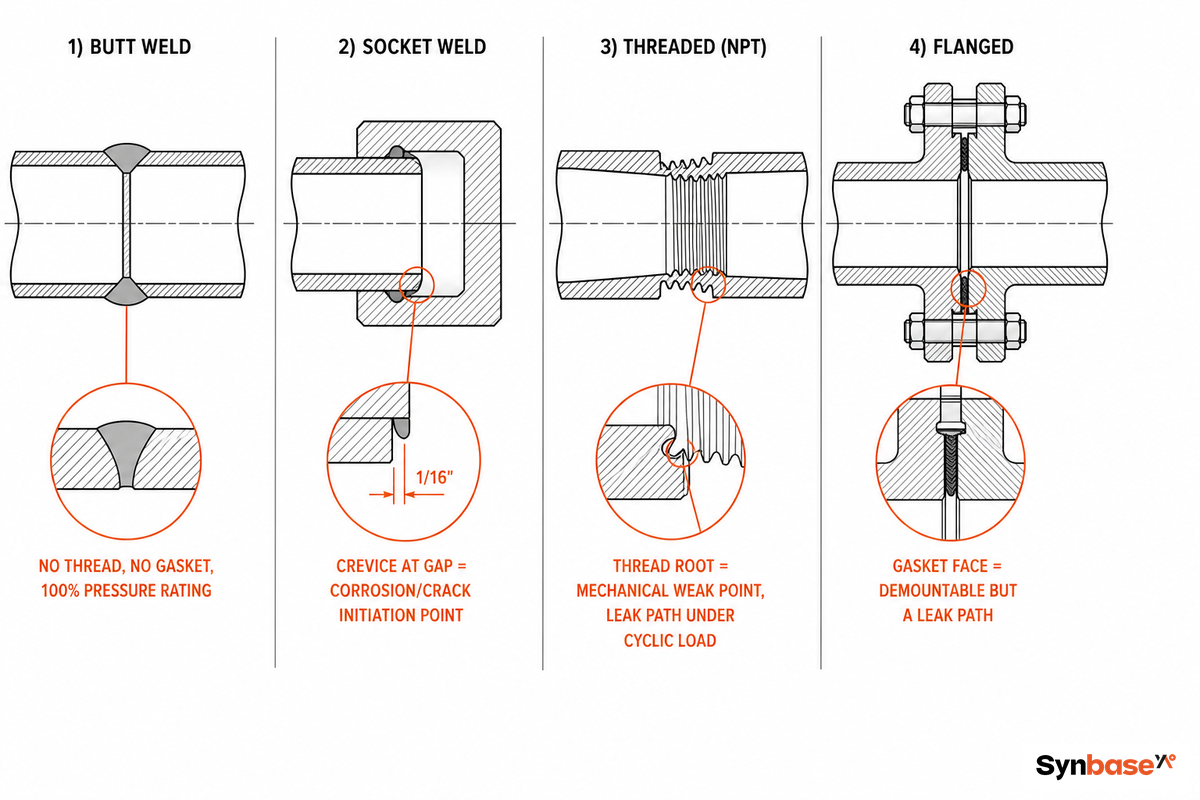
A butt weld elbow holds 100% of the matching pipe’s pressure rating with no leak path, because the weld penetrates the full wall thickness at a beveled joint, forming a permanent connection rather than a demountable one. Socket weld, threaded, and flanged connections all introduce a mechanical discontinuity, a crevice, a thread root, or a gasket face, that becomes the system’s weakest point instead of the pipe itself.
| Connection | Pressure Capacity | Leak Path | Size Range | Weld Inspection |
|---|---|---|---|---|
| Butt weld (B16.9) | 100% of matching pipe | None — full bore | NPS ½″–48″+ | RT / UT, full weld |
| Socket weld (B16.11) | Class 3000/6000/9000 | Annular crevice gap | ≤ NPS 2″–4″ | MT/PT, fillet only |
| Threaded (B16.11) | Reduced by thread cut | Thread-root crevice | ≤ NPS 4″ | Visual only |
| Flanged (B16.5) | Gasket/class-rated | Gasket seal face | All sizes | Visual + bolt torque |
Butt weld is the connection method most resistant to vibration and fatigue, which is why it dominates above NPS 2″ and on any line that will be radiographed, socket weld and threaded fittings simply aren’t rated for that duty at those sizes.
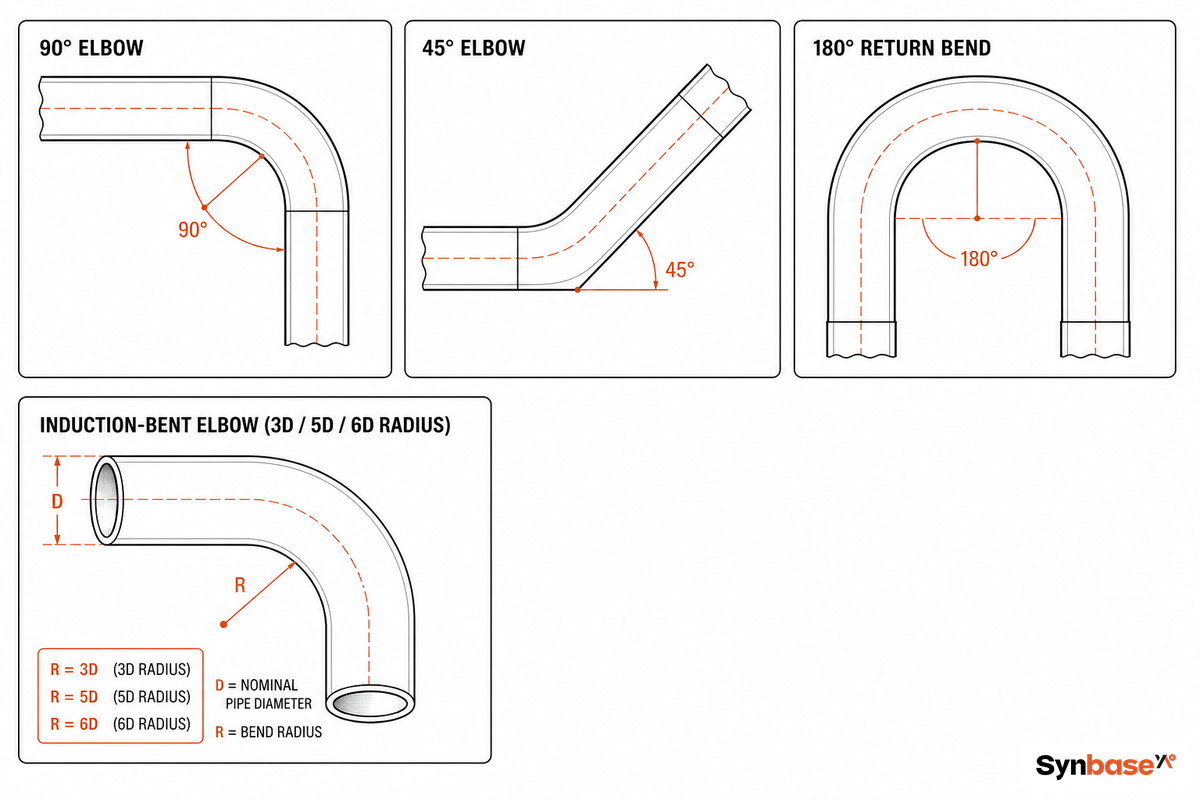
Functionally yes, a 90° elbow and a “quarter bend” both turn the line a quarter-circle. The difference is naming convention: “elbow” is the ASME B16.9 wrought-fitting term, while “quarter bend” shows up more in drainage/plumbing contexts for the same 90° geometry, sometimes in a different material class (cast iron, PVC) outside the scope of this guide.
Wrought steel elbows come standard in three angles: 45°, 90°, and 180°. All three are covered by ASME B16.9 in long radius form; the 90° and 180° are also available short radius under ASME B16.28. Anything tighter or wider, 3D, 5D, 6D bends, falls outside B16.9/B16.28 scope and ships as an induction or pipe bend to ASME B16.49 or MSS-SP-75 instead, a different product category with its own lead times and minimum order quantities.
A recurring buyer mistake is specifying a non-standard turn as if it were a stock wrought elbow: an RFQ line reading “60° elbow, field-adjusted from 45” tells a mill nothing usable, because no wrought B16.9 fitting exists at 60° — that angle only ships as a fabricated miter or induction bend, on a completely different quote and lead time than a stocked 45°/90° elbow. Specify the exact angle and which standard governs it (B16.9, B16.28, or B16.49/MSS-SP-75) on the line itself, not a field-adjustment note for the fabricator to interpret, the same angle logic carries over to the rest of the B16.9 fitting family, including butt weld tees for branch connections.
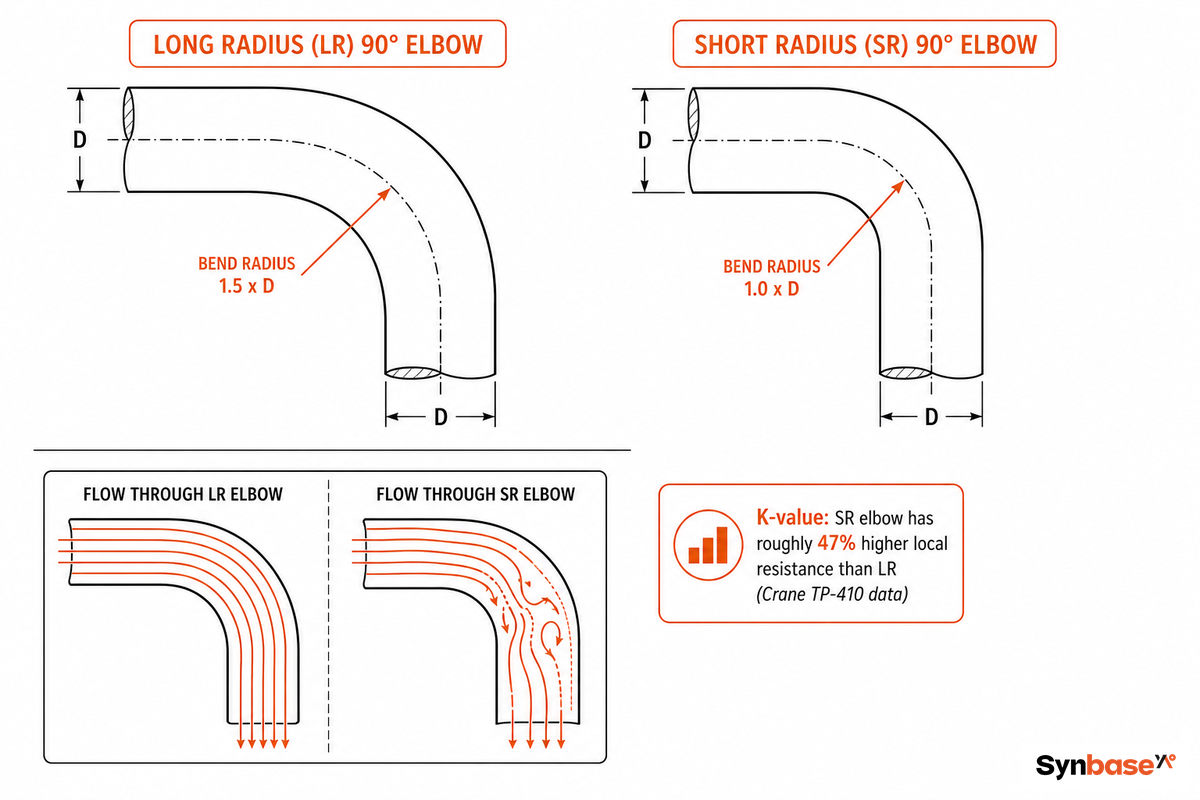
A long radius (LR) elbow has a center-to-end radius of 1.5× the nominal pipe size; a short radius (SR) elbow is 1.0× NPS. That geometry difference translates directly into a flow-resistance difference, and the size of that difference is bigger than most buying guides quote.
| Elbow Type | 2″ | 4″ | 6″ | 12–16″ |
|---|---|---|---|---|
| 90° standard (n=30) | 0.57 | 0.51 | 0.45 | 0.39 |
| 90° long radius (n=16) | 0.30 | 0.27 | 0.24 | 0.21 |
Crane TP-410 expresses K as n × fT, where n is a fixed length-to-diameter ratio (30 for standard 90°, 16 for long-radius 90°) and fT is the fully-turbulent friction factor for the pipe size. For 6-inch clean commercial steel, fT = 0.015. A standard 90° elbow: K = 30 × 0.015 = 0.45. A long-radius 90° elbow: K = 16 × 0.015 = 0.24. That’s a 47% cut in local resistance from the radius change alone, run the same math on your own pipe size and fT before assuming a flat “15-20% better” rule of thumb, which understates the real gap.
A 45° elbow shares the long-radius 90°’s n-value (16), so it carries the same K by pipe size, a detail most spec sheets don’t call out, since the two fittings look unrelated on a drawing but behave identically in a pressure-drop calculation. Long radius isn’t automatically the right call, though: in dilute-phase pneumatic conveying of particulates, published research on bend geometry finds an R/D of 8–14 is often the best compromise between space, product impact, and durability, with some studies reporting no significant pressure-drop difference between short-radius elbows and tee-bends in two-phase flow. Chase the long-radius advantage for gas or clean-liquid lines; accept the SR trade-off for congested-skid particulate service, and run your own numbers through an LR-vs-SR radius selector before locking the spec.
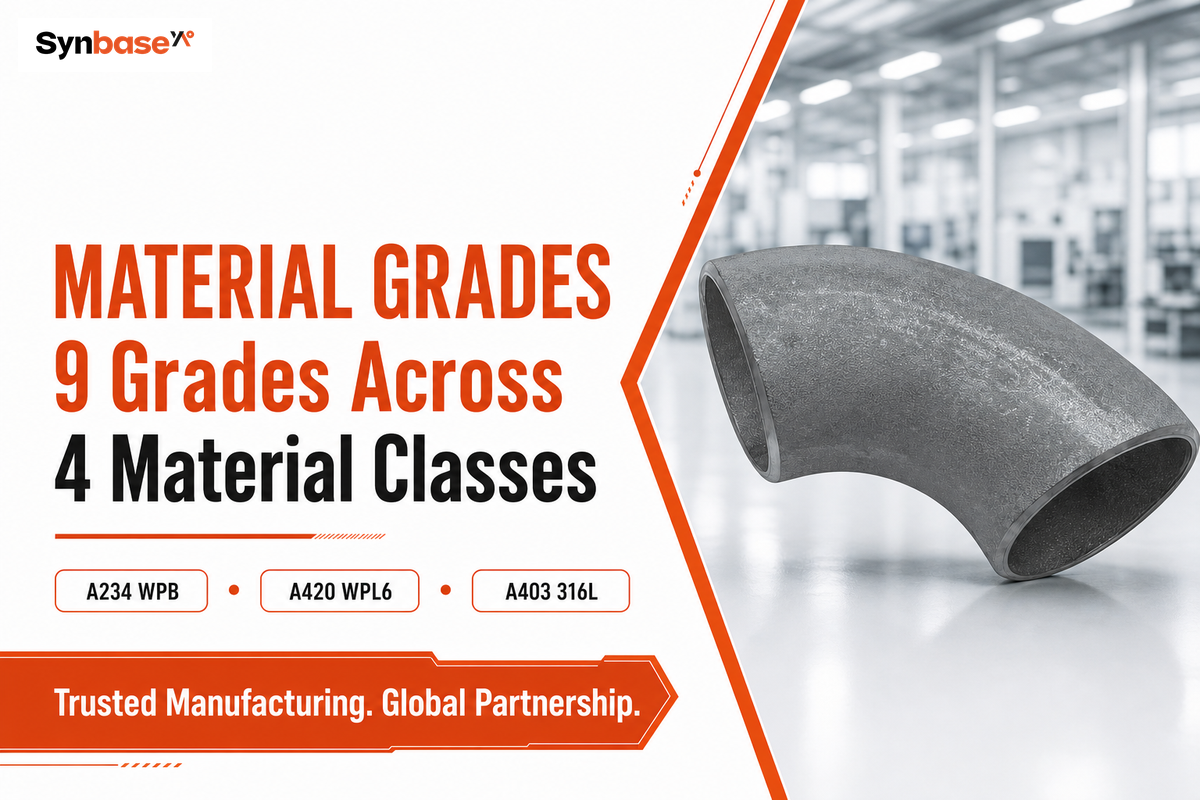
Grade selection comes down to operating temperature and corrosion environment, and one grade in particular is a hard disqualifier rather than a preference. An A234 WPB elbow specified for a line that drops below freezing on a winter shutdown is the classic version of this mistake: the fitting can look identical to the cold-rated grade on a packing slip, and the difference only show up as a brittle fracture risk under load, not as a visible defect at receiving inspection.
| Grade | Material Class | Operating Window | System Fit |
|---|---|---|---|
| A234 WPB | Carbon Steel | Moderate–high temp, non-corrosive | Oil & gas, water, steam, structural |
| A234 WPC | Carbon Steel | Same as WPB, higher tensile band | Same as WPB where higher strength is specified |
| A234 WP11 | Low-Alloy (1Cr-½Mo) | Elevated temp / creep service | Refinery exchanger & boiler circuits |
| A234 WP22 | Low-Alloy (2¼Cr-1Mo) | Higher creep/elevated-temp ceiling than WP11 | Refinery, power generation piping |
| A420 WPL6 | Low-Temperature Carbon | Impact-tested to -46°C | Cold-climate gas & winter-shutdown lines (deeper cryogenic/LNG service below -46°C needs stainless or 9% Ni, not this grade) |
| A403 WP304/304L | Austenitic Stainless | General corrosion resistance | Chemical, food-grade, general utility |
| A403 WP316/316L | Austenitic Stainless (Mo-bearing) | Chloride / pitting resistance | Marine, pharma, sour utility |
| A815 S31803/S32205 | Duplex Stainless | Higher strength + chloride resistance than 316L | Sour service, higher-chloride process lines |
| A815 S32750/S32950 | Super Duplex Stainless | Extreme chloride / sour service | Offshore, high-chloride critical process lines |
In practice, A420 WPL6 is Charpy impact-tested at roughly -46°C, making it the carbon grade that qualifies for cold service, A234 WPB carries no impact-test requirement at that temperature and simply isn’t rated for it. That exact joule threshold varies slightly by edition, so verify the current A420/A420M revision your mill certifies against rather than treating any single quoted number as fixed forever.
A403 304/304L and 316/316L follow their own schedule system (more on that below) and their own corrosion logic, 316/316L for chloride and marine exposure, 304/304L for general service, independent of the carbon-grade temperature ladder above. Duplex and super-duplex grades are available by special order for sour or high-chloride service beyond what 316L tolerates, at longer lead time than the standard grades. For the carbon side specifically, see the full A234 carbon steel buttweld fitting grade-and-tolerance reference.
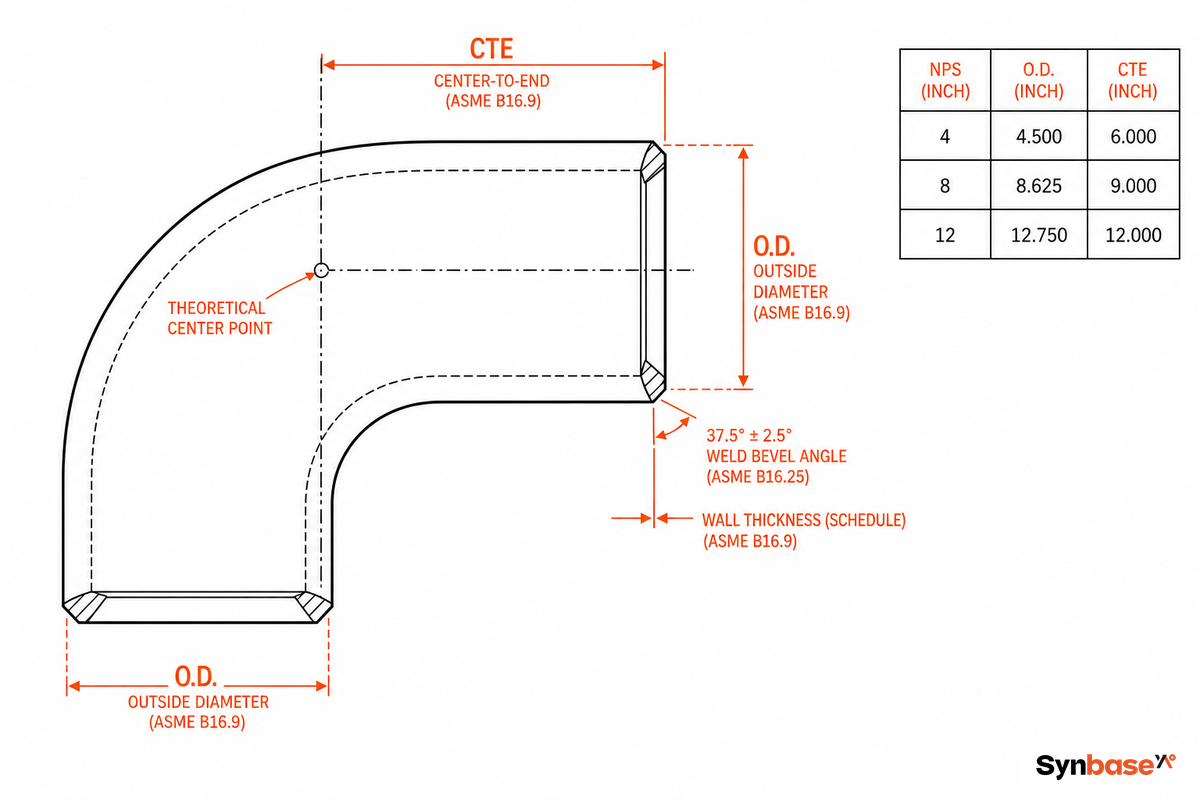
ASME B16.9 governs elbow dimensions and dimensional tolerances; it doesn’t govern the weld-end preparation. That’s a separate standard, ASME B16.25, which specifies the bevel geometry for the joint itself. Buyers who treat B16.9 as the complete specification miss that the bevel prep is a second, independently-controlled variable.
Take-off for a 90° elbow equals the center-to-end dimension, which equals the radius: an NPS 4 long-radius 90° elbow has a 1.5 × 4″ = 6-inch take-off. A 45° elbow’s published center-to-end figure is not the fabrication take-off, the actual cut-back derives from the 45° offset geometry of your specific spool, so reading the table value as a cut length on a 45° elbow produces a wrong-length pipe. Check your own dimensions against a center-to-end take-off calculator before cutting a spool.
| NPS | O.D. (mm) | 90° LR (mm) | 90° SR (mm) | 45° LR (mm) |
|---|---|---|---|---|
| ½″ | 21.3 | 19 | 13 | 16 |
| ¾″ | 26.7 | 29 | 19 | 19 |
| 1″ | 33.4 | 38 | 25 | 22 |
| 1½″ | 48.3 | 57 | 38 | 29 |
| 2″ | 60.3 | 76 | 51 | 35 |
| 3″ | 88.9 | 114 | 76 | 51 |
| 4″ | 114.3 | 152 | 102 | 64 |
| 6″ | 168.3 | 229 | 152 | 95 |
| 8″ | 219.1 | 305 | 203 | 127 |
| 12″ | 323.8 | 457 | 305 | 190 |
| 24″ | 610.0 | 914 | 610 | 381 |
Wall thickness follows the pipe’s schedule, and carbon/stainless use different schedule systems entirely, specify them separately so the elbow wall matches the pipe at the weld.
Import fit-up risk is a documented, recurring buyer complaint, not a hypothetical one: fitting-selection errors on dimension tables cause weld failures, flow restrictions, and costly piping rework, and installation-mistake write-ups repeatedly flag the wrong grade or wrong dimension being substituted at the fit-up stage. Low-cost import supplier spec sheets most commonly get the 3-inch and 4-inch rows transposed, swapping a wall-thickness or center-to-end value, a 152 mm take-off cut to 102 mm leaves a gap no welder can close on-site.
Reconcile every dimension table you’re quoted against the ASME B16.9 current edition before releasing a spool drawing for fabrication — a mismatched cell is the buyer’s problem at fit-up, not the supplier’s.
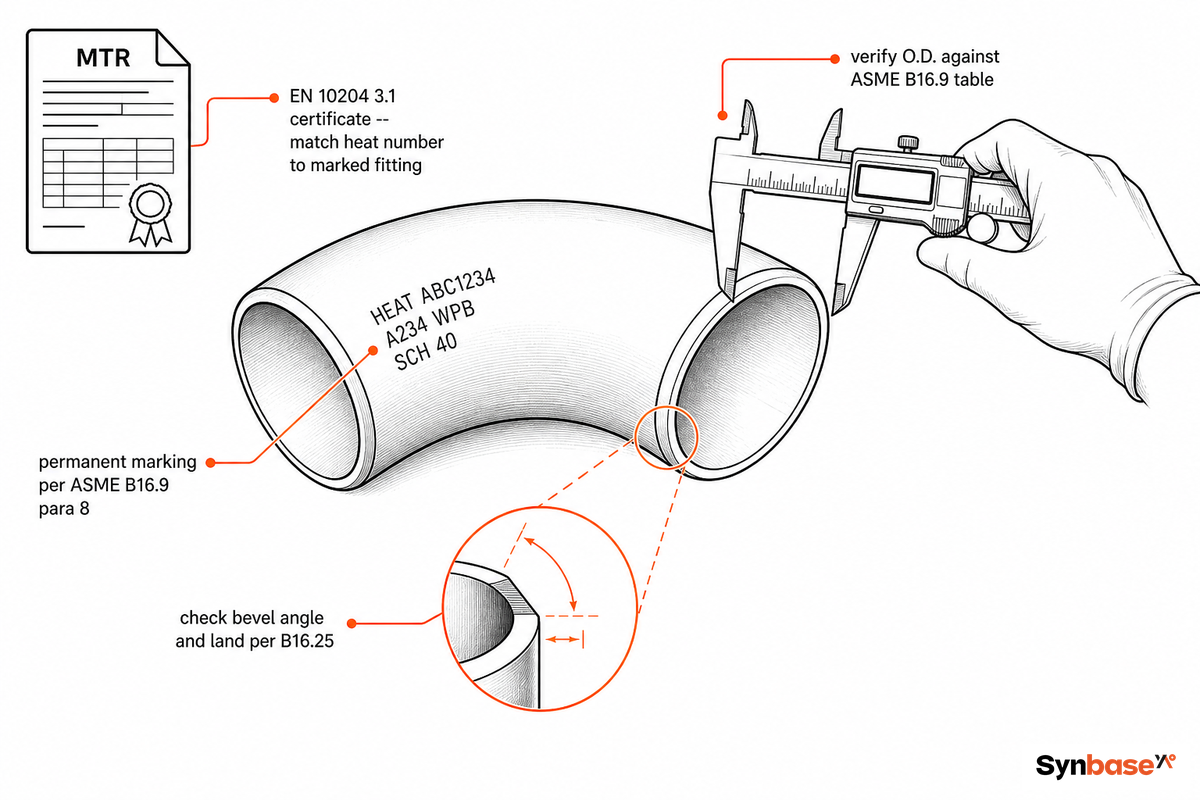
Elbows are hot-formed by mandrel push or hydraulic press from seamless or welded mother pipe, then sized, beveled, and heat-treated to the grade requirement. Forming route affects the finished part directly: mandrel-pushed elbows hold tighter wall control around the extrados (outer bend radius), while hot-pressed elbows suit heavier wall and larger diameter.
“We treat the extrados as the design-limiting wall, not the centerline, because flow-accelerated corrosion removes roughly 0.1–0.5 mm per year on an aggressive carbon-steel line. We size the radius and schedule for the wall that survives ten years at the outer bend, then verify it against the B31.3 minimum, never against a number invented for the fitting.”
Synbase OCTG & Pipe Fittings Engineering Team
On the certification side, EN 10204 defines four distinct tiers, and confusing them is a common ordering mistake:
| Tier | What It Certifies |
|---|---|
| 2.1 | A statement of compliance, no test data |
| 2.2 | The mill’s own report on non-specific batch data |
| 3.1 | Mill-signed, heat-traceable results from the actual material shipped (pressure-piping minimum) |
| 3.2 | A 3.1 co-signed by an independent third-party inspector (SGS, BV, TUV) |
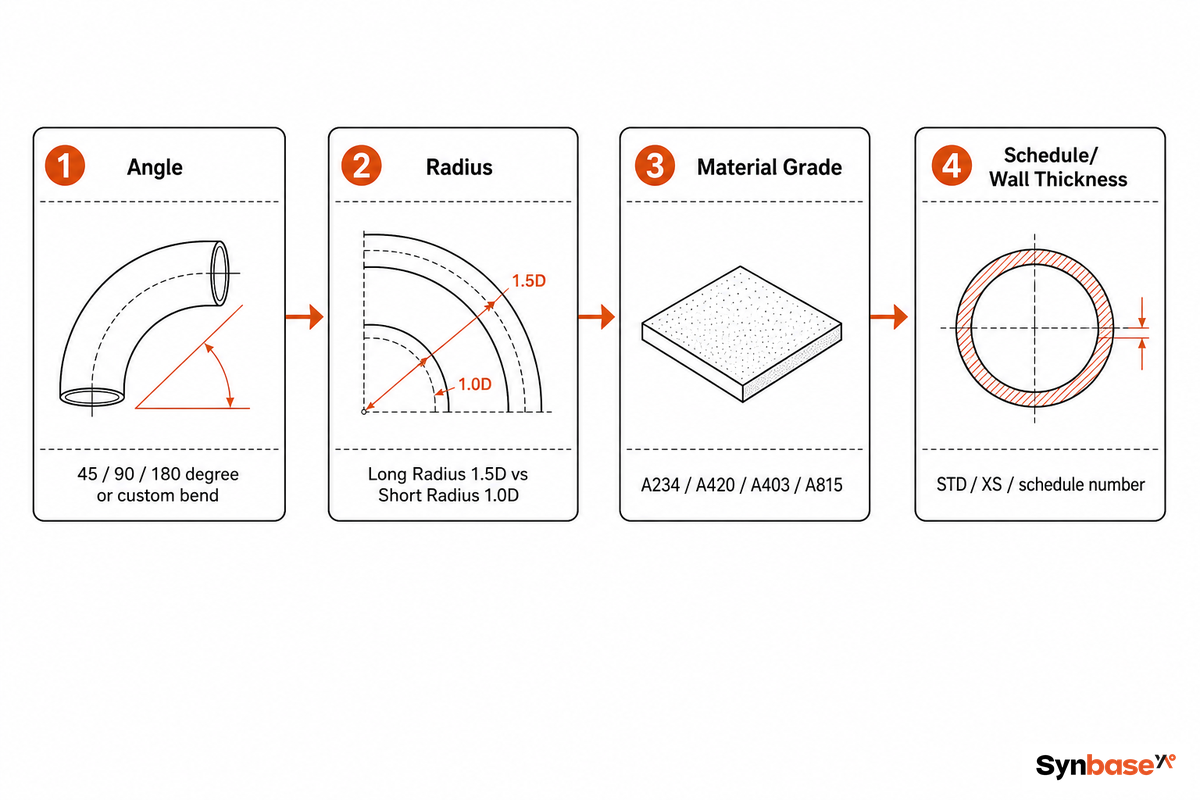
Most wrong-shipment complaints trace back to an RFQ line that specified three of the four required variables and let the supplier default the fourth. Angle, radius, material grade, and schedule all need to be on the line together.
A grade-to-service selector can catch a missing material variable before the RFQ goes out. A customer RFQ line that reads “6-inch A234 elbow,” for example, is still missing two of the four variables, angle and schedule, and will trigger a supplier follow-up call at best, or a wrong-schedule shipment at worst if the supplier defaults instead of asking.
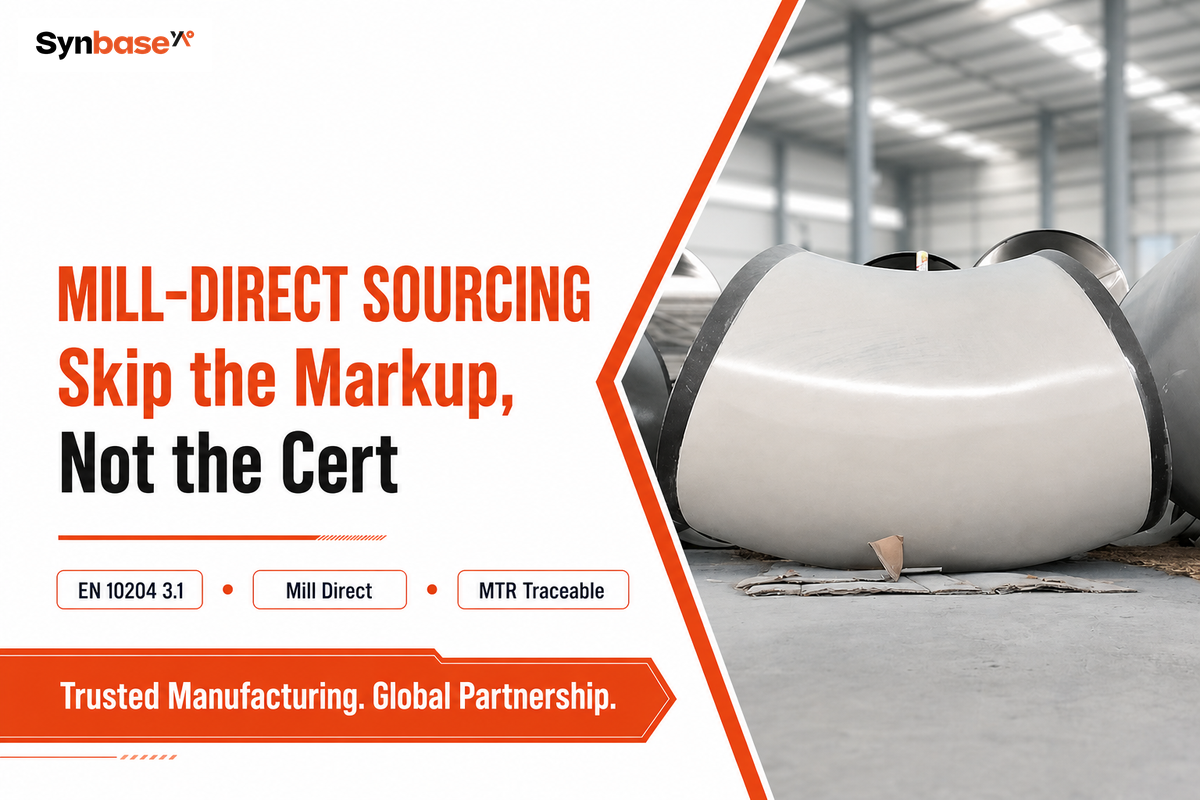
Landed cost is a stack, not a sticker price: mill-direct unit price, minus the distributor margin layer, plus ocean freight, plus import duty (including any antidumping duty), plus customs and last-mile handling.
Score most of those “yes” and mill-direct economics usually win; score mostly “no” — small quantity, urgent, no inspection access, and a domestic distributor is typically the better call despite the margin layer.
US buyers specifically need to check the duty line: an antidumping order covers certain carbon steel butt-weld pipe fittings with an inside diameter under 14 inches, sourced from several countries including China, and it isn’t a blanket rule on all butt-weld elbows or all sizes. That order has stayed active through periodic administrative reviews and anti-circumvention inquiries, including a finding on fittings processed in Vietnam using Chinese-origin rough stock, and a separate, distinct antidumping order covering stainless steel (not carbon steel) butt-weld fittings specifically from Italy was still under active review as of a rescission notice published in 2025. Add the applicable duty into your landed-cost comparison; don’t assume it away.
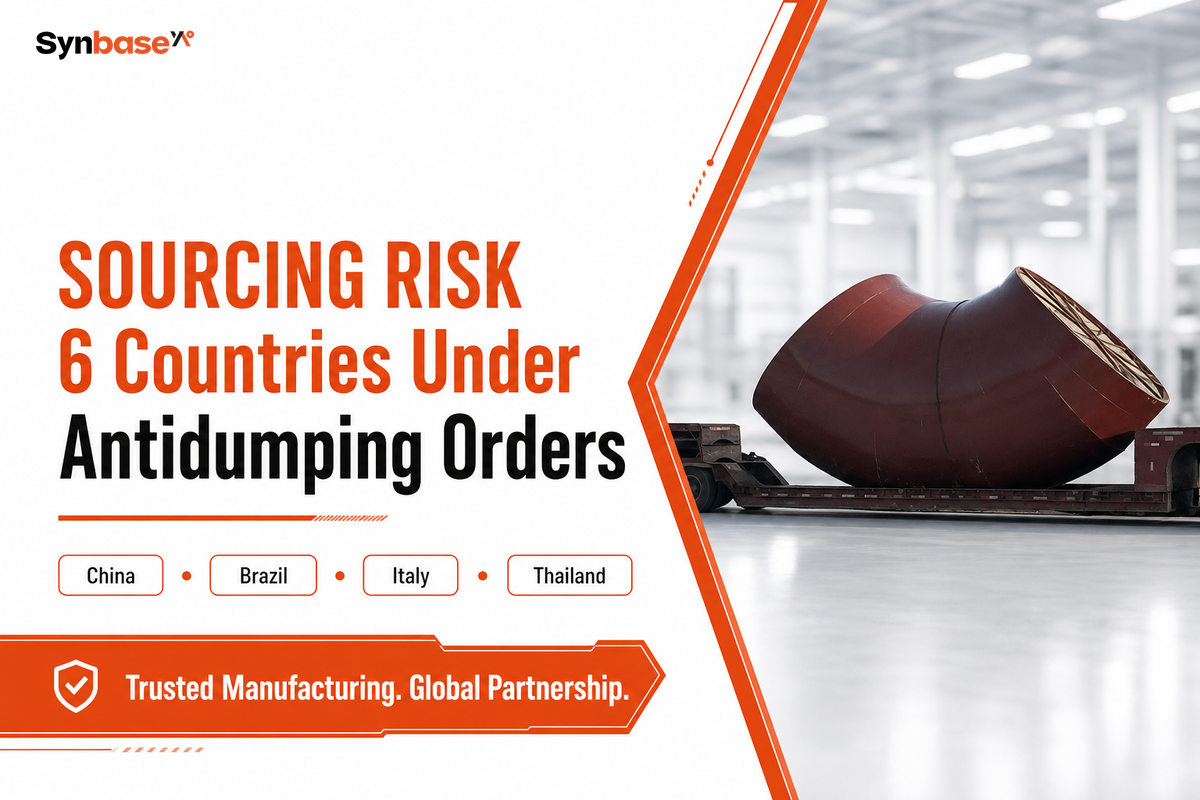
The most concrete change buyers should track over the next 1–2 years isn’t a market-size projection, it’s enforcement. That antidumping/anti-circumvention docket on carbon steel butt-weld pipe fittings has stayed active for years past the original order, with country-of-processing questions (like the Vietnam ruling) still being litigated case by case, and a separate stainless-fittings order from Italy under review into 2025. That pattern, continued scrutiny of transshipment and further-processing routes, is the load-bearing signal for 2026-2027 sourcing decisions, not a CAGR chart.
Before your next import order, ask your supplier directly where the rough fitting stock originated and where the finishing/forming happened — not just where it shipped from. That’s exactly the distinction recent circumvention rulings have turned on.
This guide draws on ASME B16.9/B16.25/B31.3 standard scope, published U.S. Federal Register and USITC antidumping-order documentation, the Crane TP-410 resistance-coefficient method, and Synbase Steel’s own mill-direct fitting engineering practice on extrados wall management and EN 10204 certification tiers. Updated July 2026 — verify standard editions and duty rates against your own current sourcing documents before quoting a project. Questions on a specific grade, size, or duty scenario not covered here are welcome via the quote form above.
Reviewed by the Synbase Steel technical team.
Synbase Steel supplies steel pipe, fittings, flanges, valves and OCTG for oil and gas, petrochemical, power, water and industrial projects. Our technical guides are written to help buyers compare standards, grades, dimensions, coatings, inspection requirements and commercial terms before sending an RFQ.
We focus on practical specification work: matching pipe process to service conditions, checking wall thickness and end finish, reviewing MTC and NDT requirements, and clarifying documentation before production or shipment.
Project support across seamless pipe, ERW, LSAW, SSAW, buttweld fittings, forged flanges, valves and oilfield tubulars.
Specification review for ASTM, ASME, API, EN and DIN standards, including material grade, pressure class, coating and inspection scope.