Send Your RFQ to Synbase Steel
Prefer to send drawings, BOMs or attachment lists by email? sales@synbasesteel.com

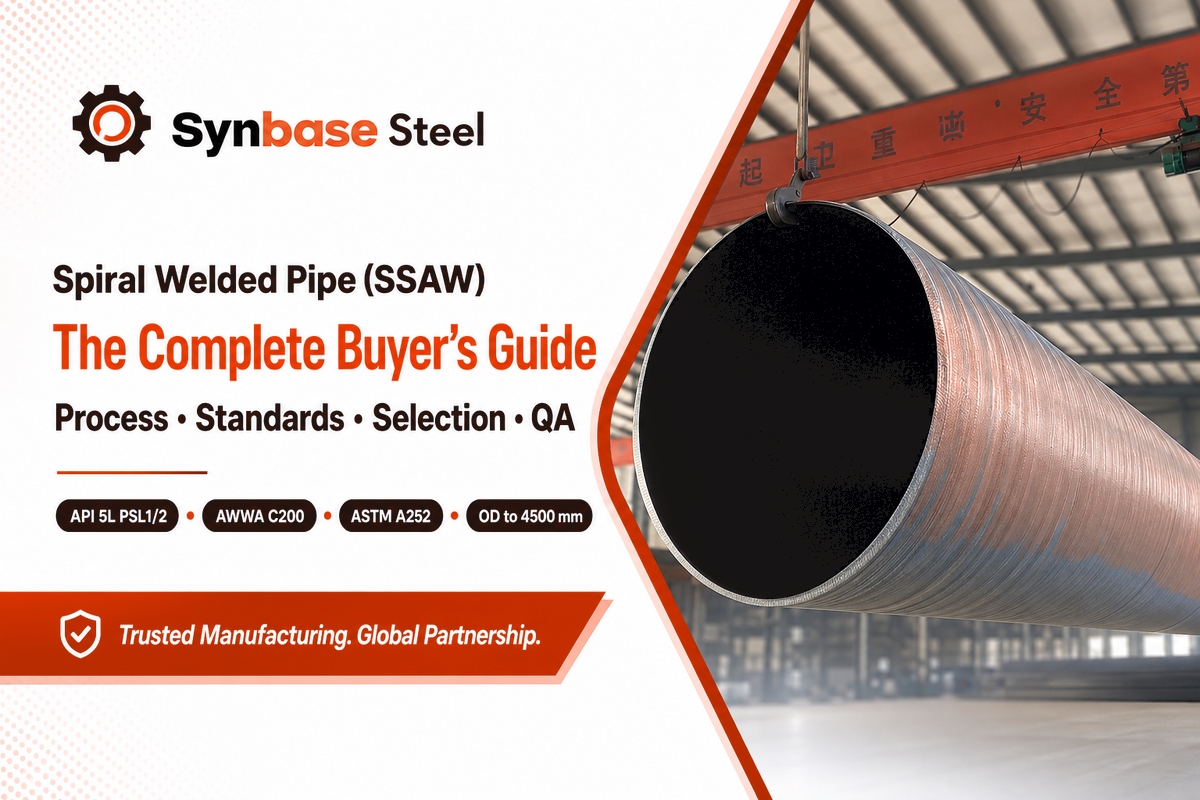
Updated July 2026 · Reviewed by the Synbase Steel technical team.
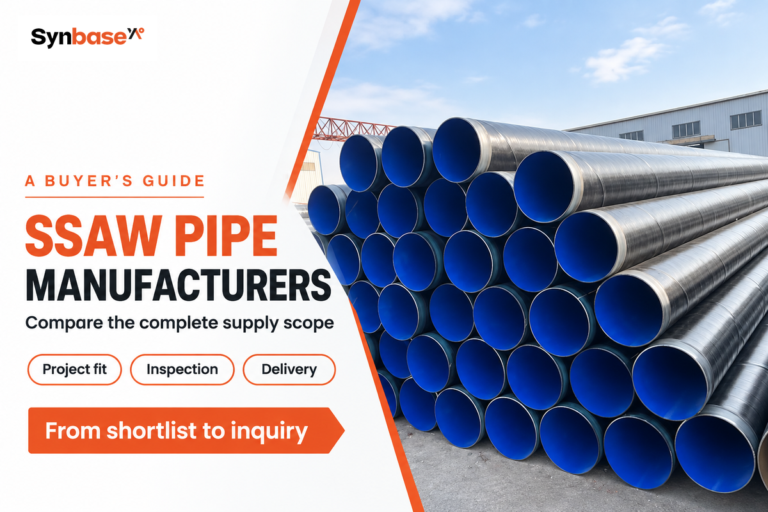
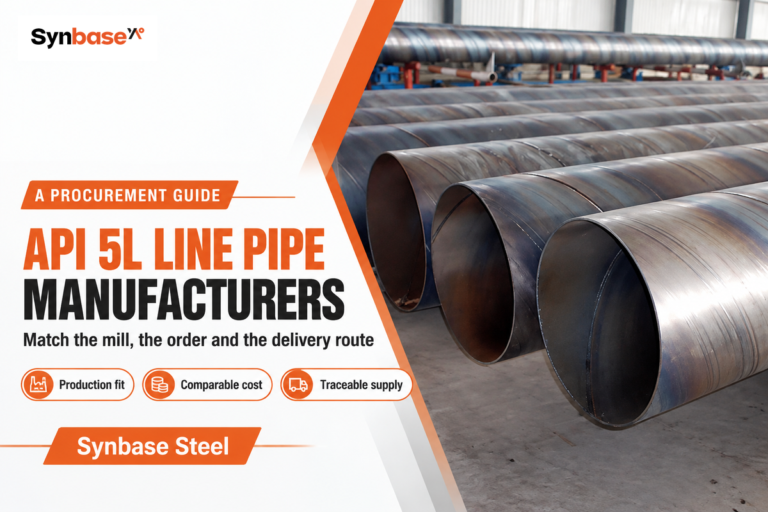
Spiral welded pipe is a steel pipe formed by feeding hot-rolled steel strip in at an angle and joining the resulting helical seam with double-sided submerged arc welding — the product known as SSAW (spiral submerged-arc welded), also written spiralweld pipe or HSAW. That single design choice is the reason one mill can roll a diameter of a few hundred millimetres up to several metres, across wall thicknesses from about 5 to 25 mm, off the same strip width. This guide is written for engineers and buyers who have to specify, compare, and accept spiral welded pipe against a real project spec, not to sell you a particular mill’s product, but to make the standards, the trade-offs, and the acceptance tests legible in one place.
| Also known as | SSAW, HSAW, spiralweld, helical seam pipe, spiral DSAW |
| Weld process | Double submerged arc welding (DSAW), inside + outside pass |
| OD range | ~8 in (219 mm) to 144 in (3,658 mm) at most US/EU mills; up to 4,500 mm at a few large-diameter mills |
| Wall thickness | ~5–25 mm (up to 1 in / 25.4 mm typical ceiling) |
| Key standards | API 5L PSL1/PSL2, AWWA C200, ASTM A139, ASTM A134, ASTM A252 |
| Weld strength | ~90–95% of base metal (vs 98–100% for a longitudinal LSAW weld) |
| Best for | Large diameter at low-to-medium pressure: water transmission, oil & gas gathering/feeder lines, piling and structural |
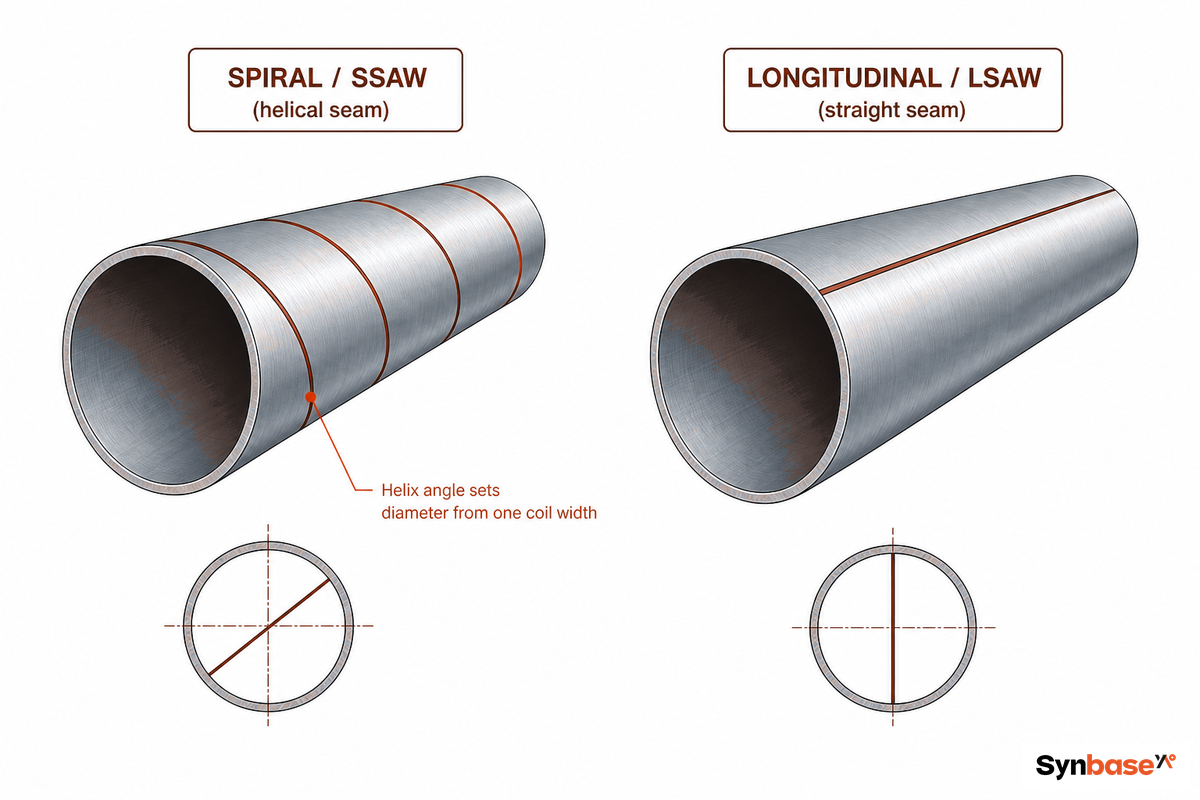
Spiral welded pipe is a steel pipe whose seam runs helically around the body, like the stripe on a barber’s pole, rather than straight down its length. The same product trades under several names: SSAW (spiral submerged-arc welded), HSAW or SAWH (helical submerged-arc welded), spiralweld, or simply spiral steel pipe. All describe one thing, a pipe rolled from coil into a helix and joined by submerged arc welding.
What matters is the contrast with a straight seam. A longitudinal, straight-welded pipe (LSAW) forms a flat steel sheet into a cylinder and runs one weld straight down the length; an ERW pipe fuses a straight seam with high-frequency electric resistance and no filler. The spiral shape gives a seam that’s longer per unit of pipe, but the helical geometry is exactly what lets a single mill cover many diameter pipes from one coil width: changing the helix angle changes the diameter of the pipe without changing the strip. That flexibility, not raw strength, is the core reason spiral exists.
Getting the name right matters before you ever write a spiral welded pipe specification. Write “spiral pipe” on a purchase order without the standard, and you can receive HVAC spiral duct instead of a pressure-rated line pipe, because the two share a search term but nothing else. On one municipal intake project, a contractor who specified “spiral steel pipe, 60-inch” without naming AWWA C200 — the standard that explicitly covers spiral-seam steel water pipe 6 in and larger — had to re-tender after the first quotes came back for lightweight galvanized ducting. Name the product (SSAW / HSAW), the standard, and the grade together, and that ambiguity disappears.
Helix angle and strip width set the finished diameter. A narrower coil fed at a shallower angle yields a larger pipe. Per ScienceDirect’s engineering reference (Structural Mechanics & Design of Metal Pipes, 2023), spiral-welded pipes exceeding 120 in (3 m) are routinely produced for North American water transmission, a diameter a straight-seam line can’t reach economically.
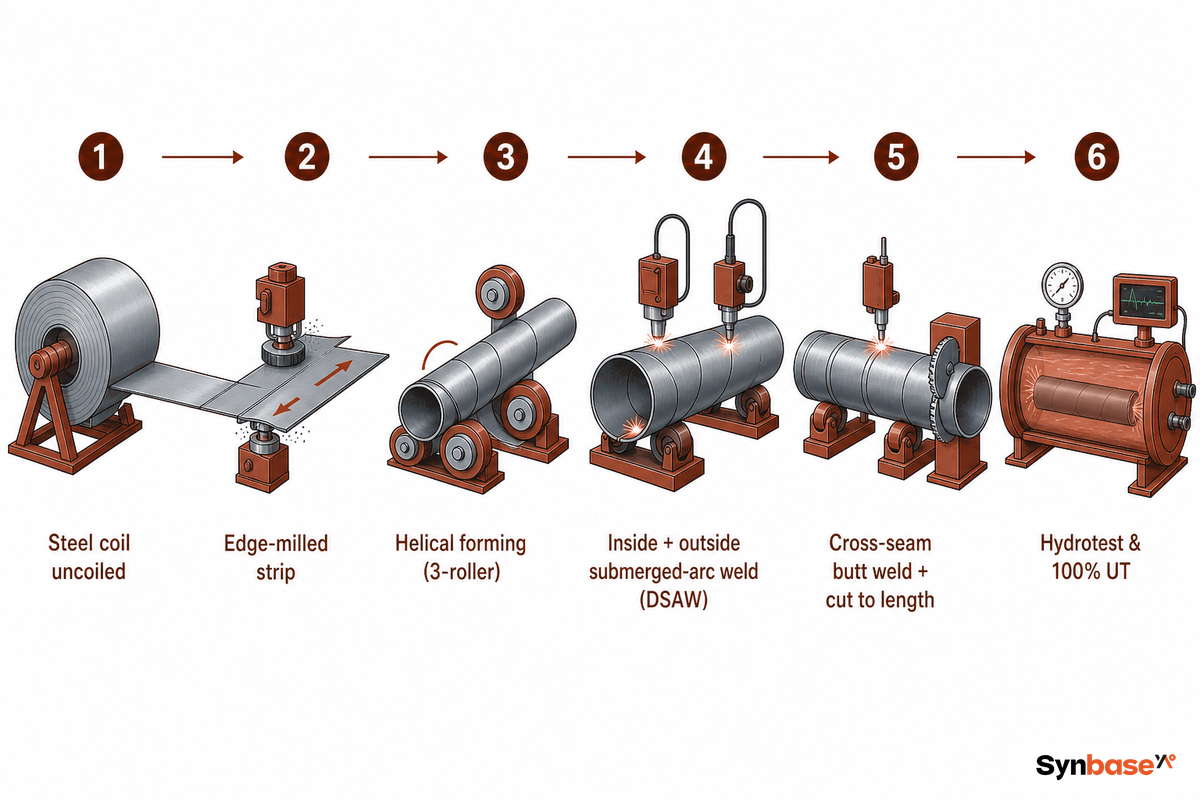
Spiral welded pipe is manufactured from steel coil, not steel plate. Hot-rolled steel strip is uncoiled, levelled, and edge-milled, then fed at a fixed angle into a forming station (typically a three-roller pyramid) that bends it into a continuous helix with a uniform wall. As the helix advances, the seam is joined by the double submerged arc welding (DSAW) process — an inside pass and an outside pass, each under a blanket of granular flux.
This submerged arc welding method is what gives the seam its depth of fusion. When a coil runs out, its trailing edge is butt-welded to the next coil, creating a cross seam, and the tube is cut to the required length with a plasma torch and bevelled for field welding. This continuous production process differs sharply from seamless pipe fabrication, where a solid billet is pierced over a mandrel, and it’s the reason spiral pipe scales to larger diameters so economically.
That continuous fabrication is the welding process that lets one spiral mill produce the full diameter range from a single coil width, a flexibility no straight-seam line shares. The approach is mature enough to be the subject of active patent work: granted methods such as US 4,645,893 (multi-wire submerged-arc, inside and outside passes) and WO 2011/050764 (optimized helical-seam tube geometry) exist specifically to raise weld speed, penetration, and dimensional control on spiral lines.
The naming shifts with the process: a spiral pipe also trades as helical seam pipe or HSAW; a longitudinal pipe run with two SAW passes is a straight seam welded pipe, also called DSAW in its longitudinal form. The “double” in DSAW refers to the two submerged-arc passes, not to the seam orientation, which is why both spiral and longitudinal pipe can carry the DSAW label.
The one spot to watch in this process is the cross seam, where a new coil is butt-welded onto the tail of the last. That transverse weld interrupts the helix, and a cold or under-fused cross seam is a documented leak path in service; it’s why a mill radiographs the cross seams, not just the running helical seam. A buyer who accepts a certificate that reports only helical-seam ultrasonic testing, with nothing on the cross seams, is trusting the weakest joint in the pipe to a test that never looked at it.
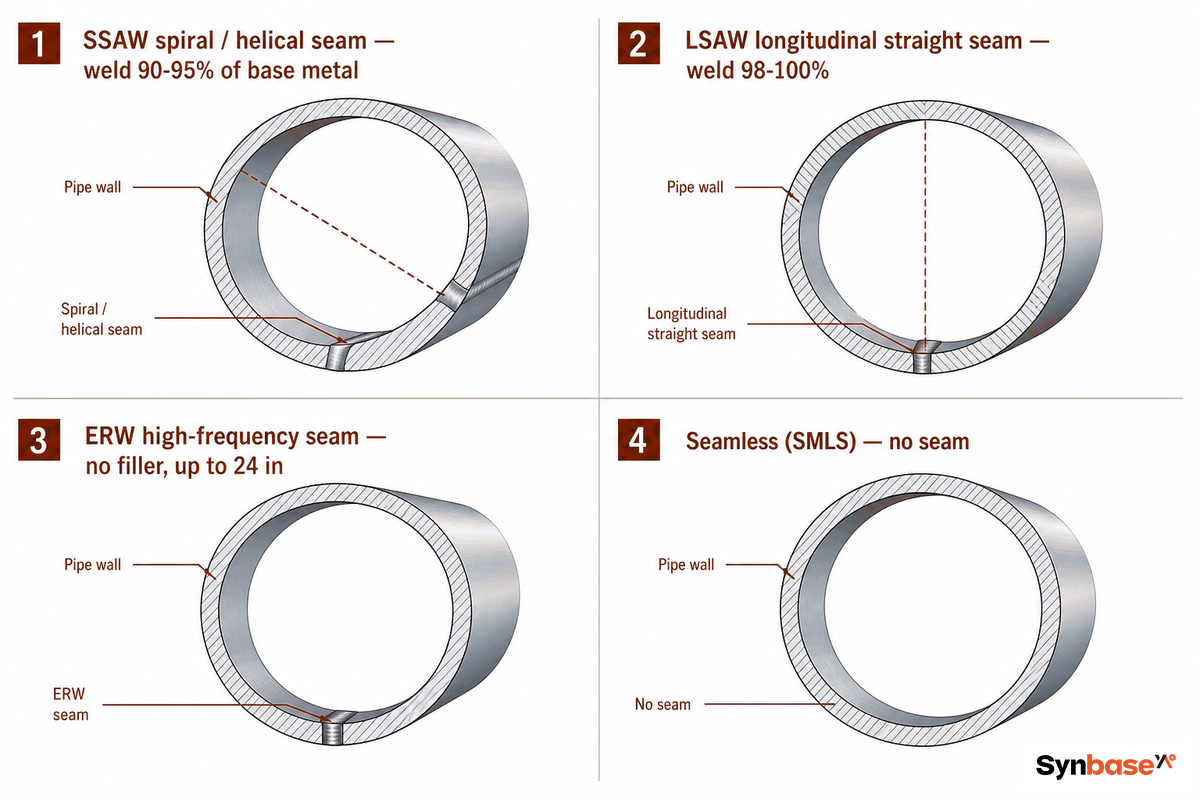
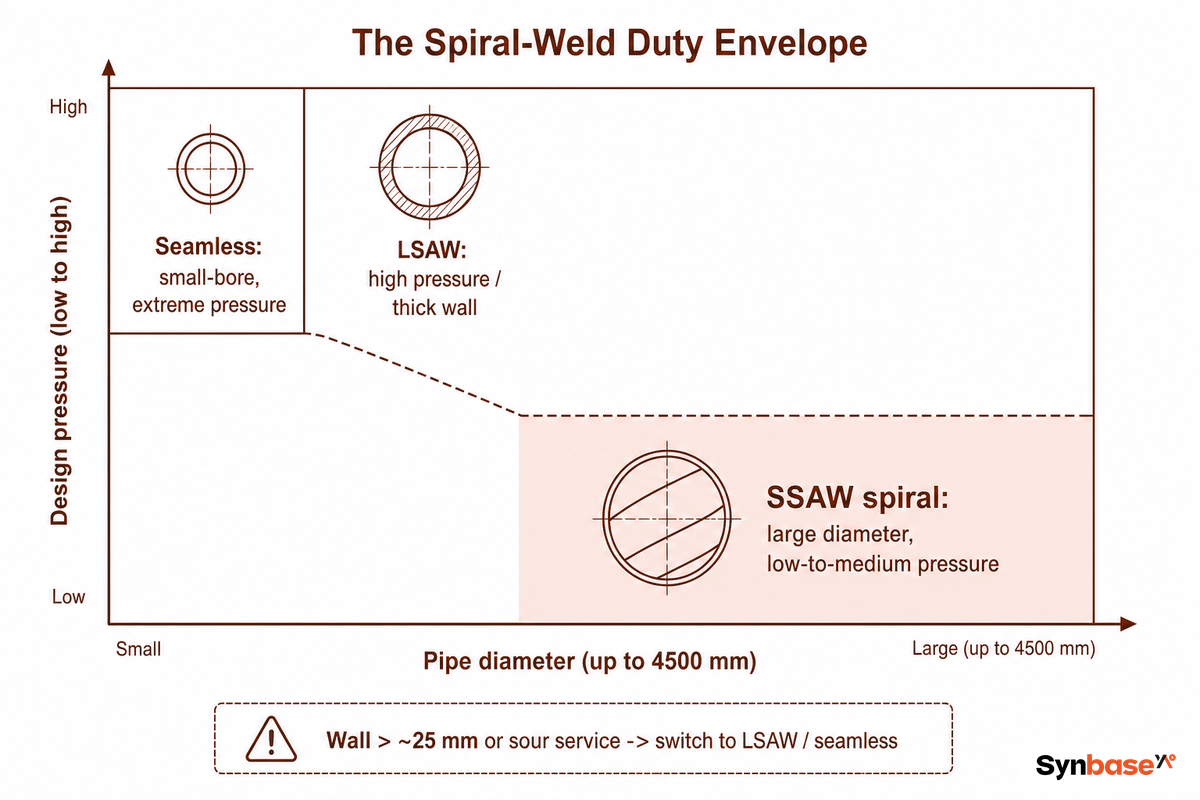
An assumption that “a spiral seam means a weaker pipe” costs buyers money on the wrong projects. Inside its design envelope, large diameter, low-to-medium pressure, water, piling, and structural service, spiral welded pipe is the cost-optimal, standards-compliant choice, and it clears the same API 5L hydrostatic and ultrasonic acceptance as a straight-seam pipe. The honest difference is weld geometry and cost, not pass-or-fail quality.
Framed by numbers: an LSAW weld develops roughly 98–100% of the base-metal (parent metal) strength; a spiral weld runs about 90–95% of the parent metal and carries higher residual stress from continuous forming. Neither is a low-strength product, both reach high-strength API 5L grades. That band is the Spiral-Weld Duty Envelope, where the spiral trade-off is the right one. Read the table top-down; once your wall and design pressure land in the SSAW band, paying the LSAW premium just buys back margin you already specified away.
| Process | OD range | Max wall | Weld vs base | Relative cost | Best for |
|---|---|---|---|---|---|
| ERW | ½”–24″ | ~16 mm | HF fused seam | Lowest | Medium-bore distribution |
| SSAW (spiral) | 8″–177″ (4,500 mm) | ~25 mm | 90–95% | Mid-range | Large dia, low–med pressure, water, piling |
| LSAW | 16″–60″ | ~60 mm | 98–100% | Highest | High-pressure, thick-wall, sour service |
| Seamless (SMLS) | ≤24″–26″ | thick | No seam | High | Critical small-bore, extreme pressure |
Weld-vs-base figures are measured weld strength, not code design factors, 49 CFR 192.113 assigns submerged-arc-welded pipe a longitudinal joint factor of 1.00. Size envelopes from API 5L grade practice and manufacturer data (see References).
ERW (electric resistance welded) pipe fuses a straight longitudinal seam using high-frequency resistance heat and pressure, with no filler metal, and is economical up to about 24 in. Spiral welded pipe joins a helical seam with submerged arc welding and filler, and scales to diameters an ERW line can’t reach.
In practice you choose ERW for medium-bore distribution where cost per foot rules, and SSAW once the diameter climbs past the ERW ceiling and the service is water, piling, or low-to-medium-pressure line pipe. For high-pressure, thick-wall, or sour-service duty, the answer is neither, it’s longitudinal LSAW or seamless.
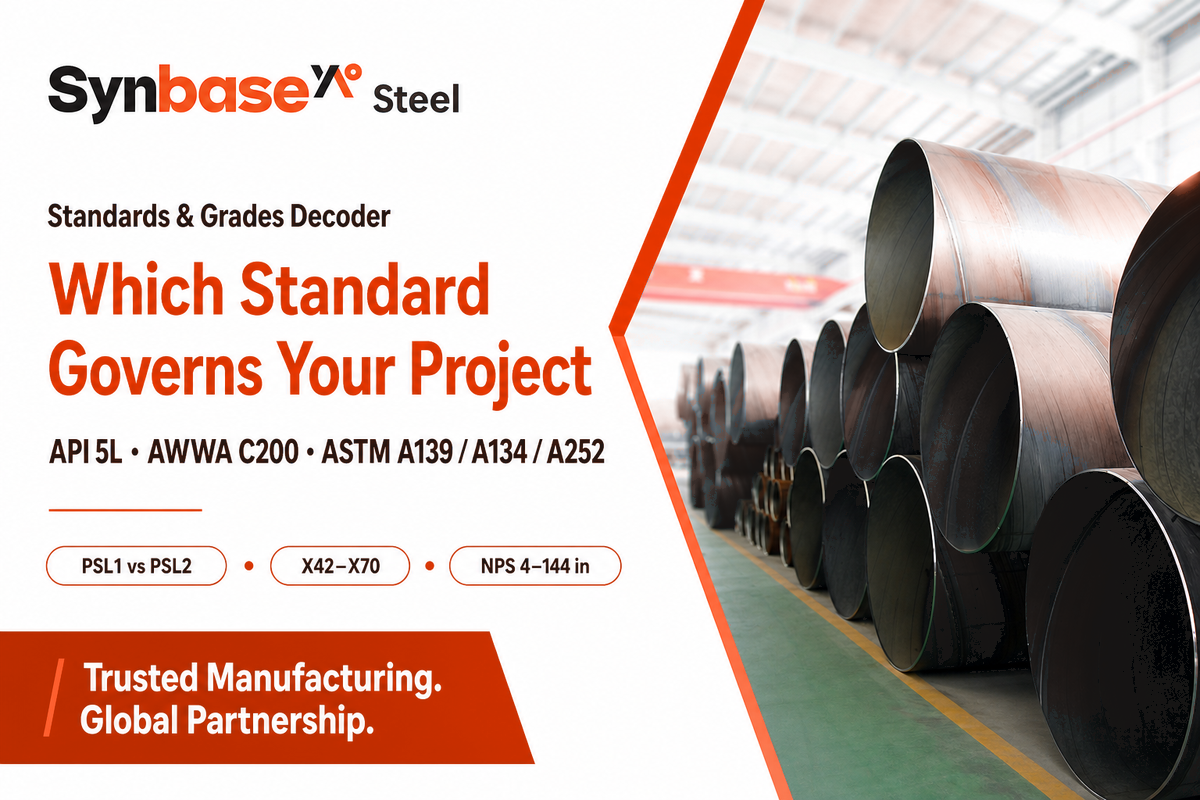
One gap dominates most spiral-pipe content: it never tells a specifier which standard governs their project. Four standard families cover spiral welded pipe, and they don’t overlap by accident, each maps to a duty. This is the Standards Routing Tree: start from the application, and the governing standard, grade window, and test set follow.
| If you specify… | Standard | Scope / diameter | Grade window | Default test set |
|---|---|---|---|---|
| Oil & gas line pipe | API 5L PSL1/PSL2 | Pressure line pipe | X42–X70 | Hydro + 100% UT + Charpy (PSL2) |
| Water transmission | AWWA C200 | 6 in (150 mm) and larger | Gr.B–X52 | Hydro to 75% yield + seam UT |
| Large-diameter structural / water | ASTM A134 | NPS 16 in and over | Plate-grade dependent | Hydro + weld UT |
| General structural / pressure | ASTM A139 | NPS 4 in and over | Gr.A–Gr.E (5 grades) | Hydro + dimensional |
| Pipe pile / casing | ASTM A252 | Driven pile | Gr.2 / Gr.3 | Dimensional + weld UT |
Scopes per ASTM A139/A139M-22 (NPS 4 and over, five grades, wall to ¾ in), ASTM A134/A134M (NPS 16 and over, wall to ¾ in, grade per the ordered material spec), AWWA C200-23 (6 in and larger, straight- or spiral-seam; potable, raw, and reclaimed water plus wastewater), and ASTM A252 pipe piles.
The PSL1 vs PSL2 split is the one that trips buyers on energy work. API 5L PSL2 adds mandatory Charpy V-notch impact testing, tighter chemistry and carbon-equivalent limits, and stricter traceability over PSL1. Where PSL1 sets only minimum yield and tensile, PSL2 also caps the maximum, so the steel is bounded on both ends. If your line-pipe spec names PSL2, every heat must be impact-tested and reported, not assumed. API 5L X-grades map yield and tensile predictably, and the grade you can use is bounded by the wall a spiral mill can roll, not by strength alone. The minimums below let a specifier read grade against service in one place.
| Grade | Standard | Min yield (MPa) | Min tensile (MPa) | Service class |
|---|---|---|---|---|
| Gr.B | API 5L | 245 | 415 | Low-pressure line / water |
| X42 | API 5L | 290 | 415 | Gas / oil feeder |
| X52 | API 5L | 360 | 460 | Transmission |
| X60 | API 5L | 415 | 520 | Higher-pressure trunk |
| X65 | API 5L | 450 | 535 | Trunk / sour-screened |
| X70 | API 5L | 485 | 570 | High-strength transmission |
| Gr.2 | ASTM A252 | 241 | 414 | Driven pipe pile |
| Gr.3 | ASTM A252 | 310 | 455 | Heavy structural pile |
| Gr.B–X52 | AWWA C200 | 245–360 | 415–460 | Water transmission |
API 5L X-grade minimums per PSL2 grade practice; ASTM A252 Gr.2/Gr.3 per the pipe-pile standard (see References).
Spiral welded pipe sizes at US mills run an outer diameter of roughly 24–144 inches (610–3,658 mm), which is why ASTM A134 (NPS 16 and over) and A139 (NPS 4 and over) exist to cover large diameter pipes at the top end; a few mills carry the line out to even larger diameters, 4,500 mm, for intake, outfall, and monopile work. Wall thicknesses typically span 5–25 mm (up to about 1 in).
The practical envelope by diameter of the pipe runs roughly as follows: OD 219–720 mm pairs with 6–16 mm wall for feeder and line-pipe duty; 820–1,420 mm with 8–20 mm for water and gas transmission; and 1,620 mm and up with 10–25 mm for large water mains, penstocks, and piling. A mismatched wall or an unavailable diameter is where a build stalls, re-sourcing a 2,540 mm pile can cost weeks, so confirm the OD/wall combination is actually producible before the coil is cut.
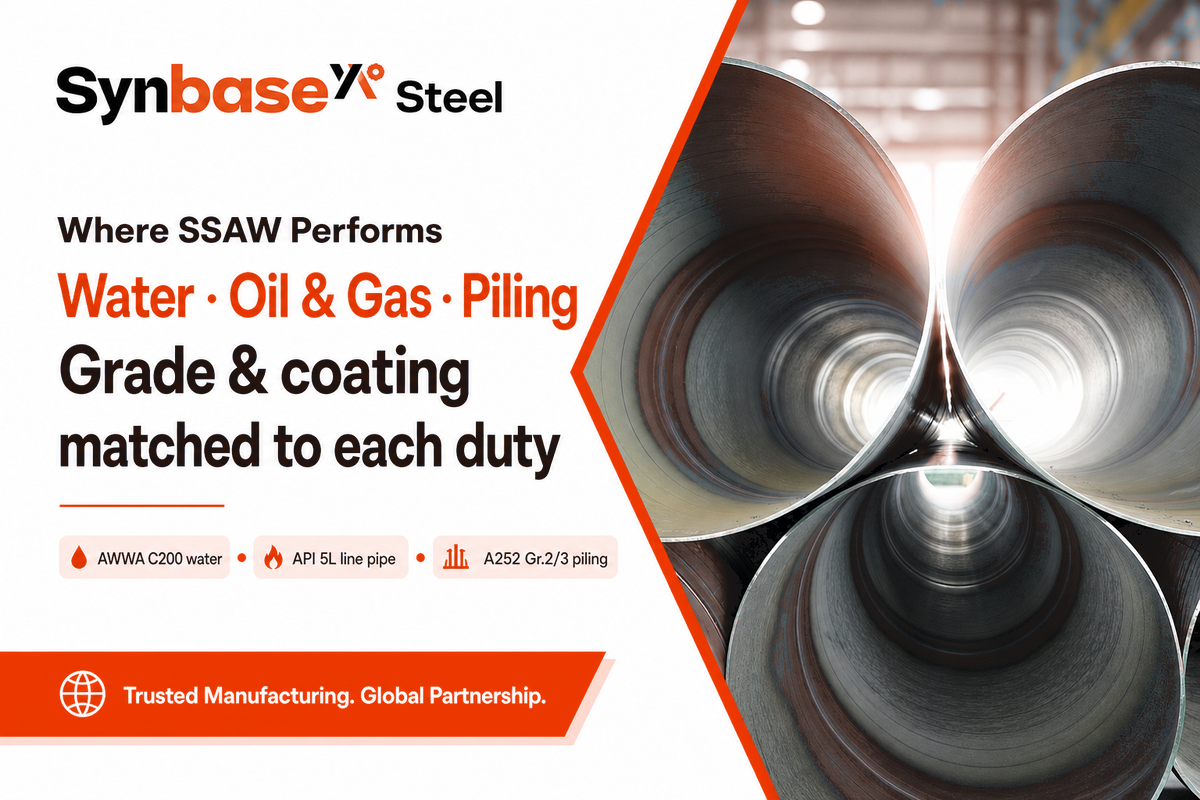
Application risk starts with specifying one pipe for every duty. A water main, a sour-screened gas line, and a marine pile pull in different directions; forcing a single grade onto all three either over-builds cost or under-builds capacity. Nearly all spiral welded pipe is made from carbon steel, so the grade, not the alloy, is the lever, and grade and coating should be matched to each service, not averaged across them.
Real projects show the range. Trenchless microtunneling job logs published by Trenchless Technology record spiral-welded steel casing from 48 in up to 100 in outside diameter driven under roads and rivers, alongside cement-mortar-lined-and-coated steel water transmission mains, the exact large-diameter, buried, structural duty where spiral is chosen precisely because one mill can roll the size from a single coil width.
Consider a municipal utility replacing a 1,500 mm raw-water main under a highway crossing. The engineer specifies ASTM A252 Gr.3 casing for the jacked section, 310 MPa yield to survive driving loads, then transitions to an AWWA C200 spiral main with cement-mortar lining for the buried run. An open-ended pile can plug or stay coring depending on soil; a closed-end pile with an end plate can be filled with concrete for higher capacity. The geometry is confirmed against the geotechnical report before a single length ships. Per IBC §1811.7, structural steel piles to ASTM A252 Gr.3 carry a minimum 15% elongation requirement, a ductility floor that matters more under driving than peak strength does.
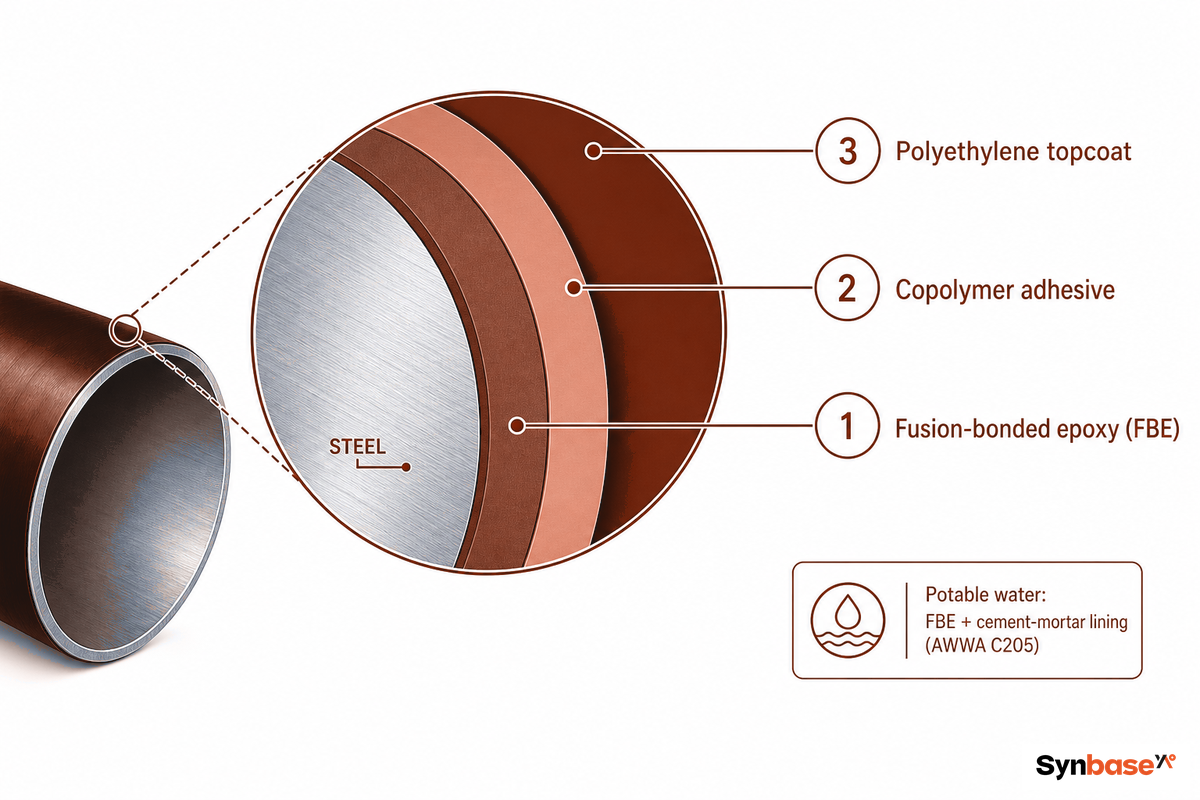
Coating is where spiral welded pipe is matched to its service environment, and it’s decided by what the pipe is buried in and what flows through it, not by preference. That coating provide the corrosion resistance bare carbon steel pipes lack; where high temperature gas service is involved, a 3-layer polypropylene (3LPP) topcoat replaces the polyethylene of a standard 3PE film. Read the table by environment.
| Coating / lining | Standard | Service environment |
|---|---|---|
| FBE (single-layer) | AWWA C213 | Buried water / general |
| 3PE / 3LPE (three-layer PE) | DIN 30670 | Buried oil & gas |
| Cement-mortar lining | AWWA C205 | Potable / raw water ID |
| Liquid epoxy | AWWA C210 | Water lining / coating |
| Hot-dip galvanizing | ASTM A123 | Exposed structural |
On a buried 1,020 mm gas line, 3PE is the default film, fusion-bonded epoxy, an adhesive, and a polyethylene topcoat. A potable water main of the same size runs FBE plus a cement-mortar lining to AWWA C205 instead. Picture a specifier who copies a gas-line coating callout onto a drinking-water intake: the 3PE spec sails through procurement, then fails the AWWA C205 lining requirement at the pre-shipment inspection, and the whole order waits for a re-coat. Keeping the coating on the same order as the pipe means one inspection trail, not split accountability between mill and coater, which matters when a holiday-detection failure has to be traced back to a single heat.
A guide that only sell spiral isn’t worth trusting. Here’s the honest ceiling.
The “60% weakness” myth, corrected. Buyers sometimes see an old joint-efficiency table rate a spiral or “other” weld below seamless and conclude a spiral pipe is only 60% as strong. That’s a misreading twice over. First, a joint efficiency factor is a conservative code design multiplier inside a pressure formula, not a measurement of the weld. Second, and decisively, current US gas-pipeline design doesn’t even assign spiral the low number: under 49 CFR 192.113, API 5L submerged-arc-welded pipe, spiral SSAW included, carries a longitudinal joint factor E = 1.00; only furnace-butt-welded pipe carries 0.60. The physical DSAW weld itself develops roughly 90–95% of base-metal strength with 100% ultrasonic inspection. The “spiral is a 60% pipe” belief conflates furnace-butt pipe with submerged-arc spiral, and it leads engineers to over-reject spiral for jobs it suits, a mistake practitioners debate openly on forums such as Eng-Tips.
The real limitation is residual stress, and it’s process-dependent rather than a fixed penalty: helix angle, heat input, wall thickness, and weld profile all shift how much residual stress the spiral seam lock in, which in turn affects fatigue life and cold-cracking risk. A failure case documented in the Handbook of Materials Failure Analysis measured 82 ksi (566 MPa) of residual stress at the ID weld centerline of an un-stress-relieved 24-in spiral pipe, enough to drive stress-oriented hydrogen-induced cracking (SOHIC) in wet sour gas. The lesson isn’t “avoid spiral”; it’s “match the process to the duty” — steer high-pressure thick-wall and sour-service work to longitudinal or seamless (stress-relieved), and reserve spiral for the large-diameter, low-to-medium-pressure envelope where its economics and standards fit.
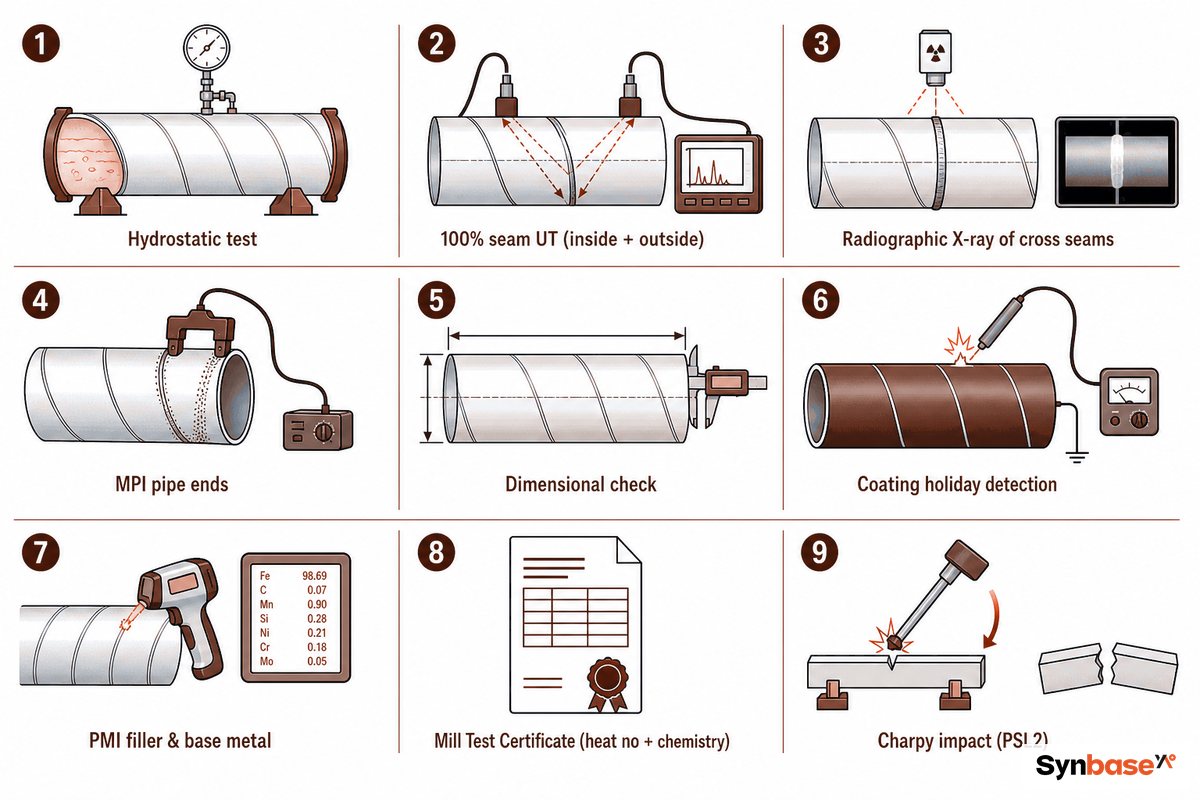
The trust gap on an unfamiliar mill close with documents and tests, not adjectives. Every spiral welded pipe order should pass the same quality control floor before it ships. Each pipe is hydrostatically tested, its seam mechanically inspected end to end, and the results tied to a heat number:
Why PMI (point 7) earns its place: a documented case saw a 48-in × 0.5-in API 5L X60 straight-seam pipe rupture at 1,240 psig during a pre-service hydrotest because the seam had been welded with the wrong 5 wt% chromium filler metal. Seam orientation is incidental here, the same wrong-filler risk lives in any submerged-arc weld, spiral included, but positive material identification would have caught it before the pipe left the line. That’s the difference between paperwork and a real acceptance gate.
On the certificate itself, know the grade of assurance you’re buying. An EN 10204 3.1 certificate carries actual test results signed by the manufacturer’s own independent inspection representative; a 3.2 certificate adds a countersignature from a third-party or purchaser-authorized inspector. For marine and energy work, 3.2 with SGS, BV, or TÜV witnessing is the norm.
“We treat the mill test certificate as the contract, not paperwork. Every heat number on the MTC traces back to its chemistry and its hydrostatic and UT records, and we welcome SGS, BV, or TÜV witnessing the test before the pipe leaves the line.”
Synbase Steel Welded-Pipe Production Base, QA team
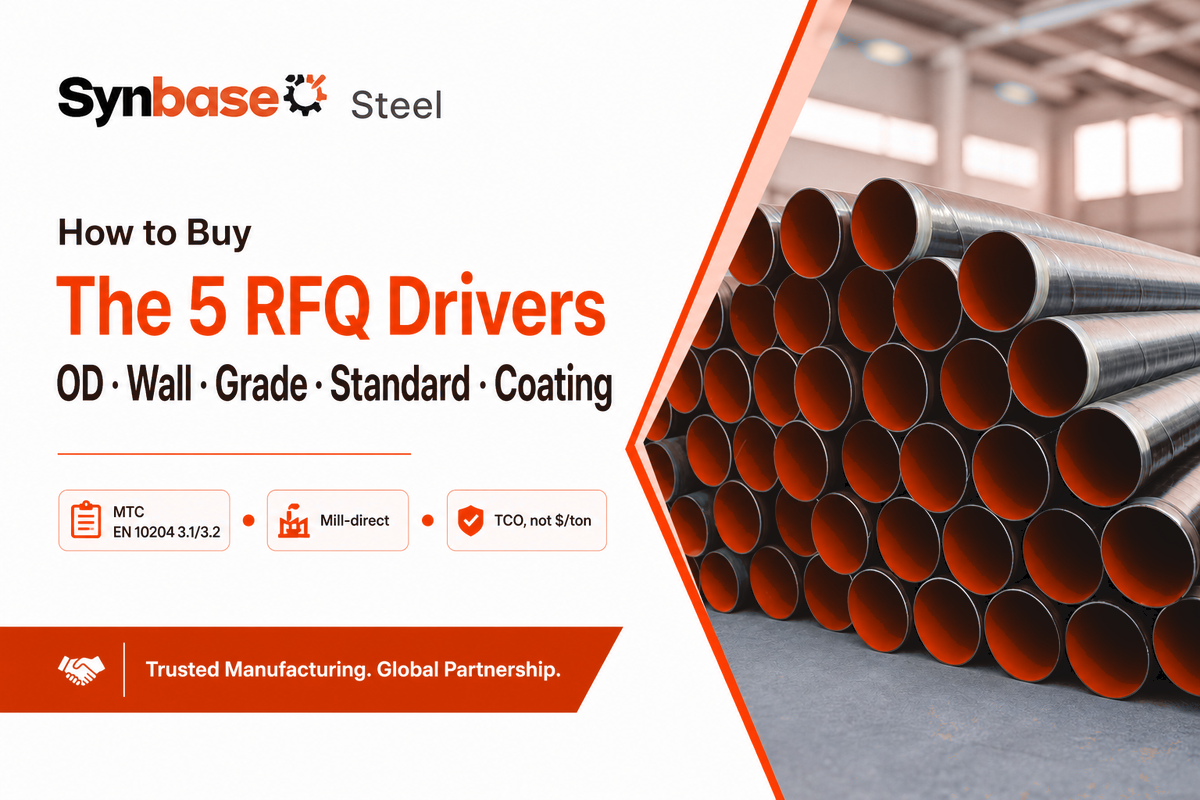
Ask for a spiral welded pipe price and the first number back is almost always per ton, which is the wrong anchor on a pipe order. Total cost of ownership folds in coating, inspection, freight, field welds, and the risk of a non-conforming shipment, which is where a mill-direct supplier change the lifecycle math against a trading house reselling another pipe manufacturer’s steel products. A pipe company that rolls its own spiral can trace every length; a trader can’t. Give a mill five numbers and you get a real quote instead of a generic “contact us.”
Because a fully integrated group can carry the pipe and its matching fittings, flanges, and valves on one inspection trail, a single order can travel under one set of documents rather than several. For an exact figure and a lead-time estimate, send the five drivers above with your port and Incoterm. If you’re sourcing to a firm spec, start from the mill’s SSAW spiral welded pipe production page and request a spec-matched quotation.
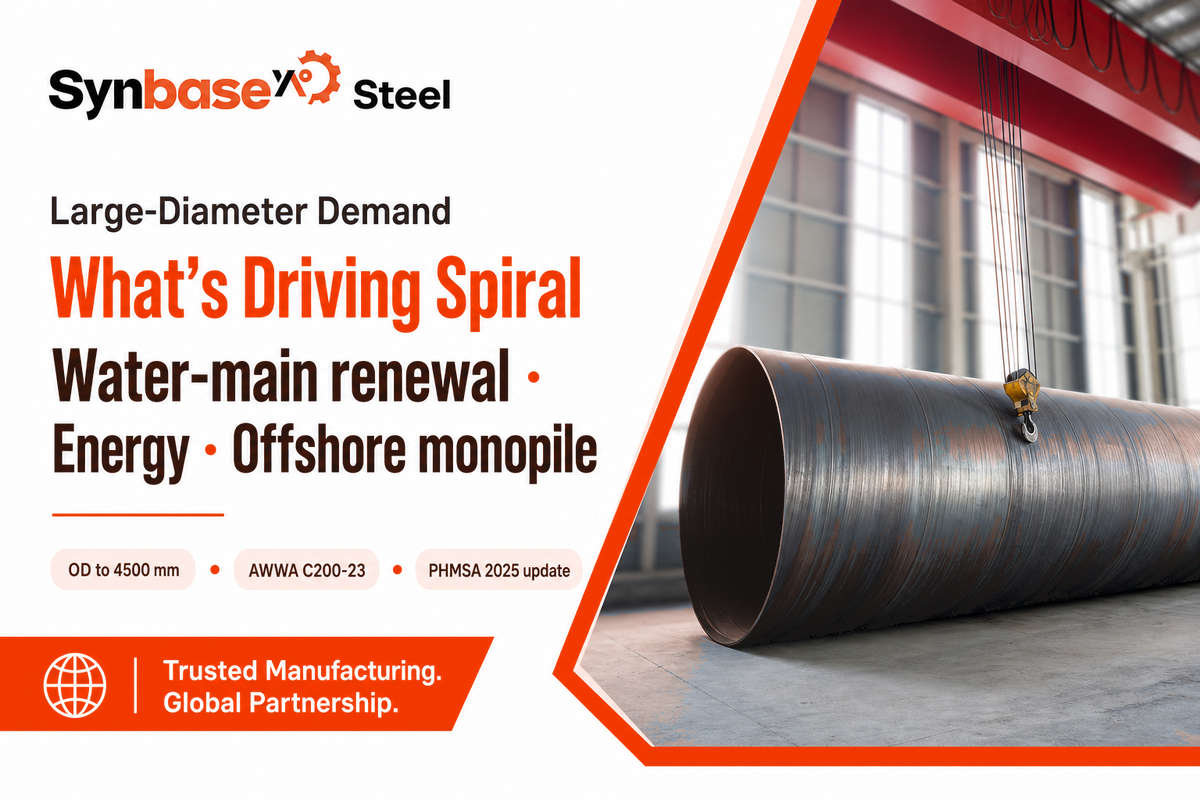
The demand story for spiral welded pipe is not a market-size chart, it is three concrete drivers that change what a buyer should specify now. First, aging large-diameter water transmission mains are due for replacement, and the AWWA-standard spiral pipe that fits those diameters is the natural replacement stock; utilities that lock coating capacity early avoid the queue. Second, energy and water transmission projects keep pushing single-seam diameters upward — the reason a handful of mills now roll to 4,500 mm. Third, offshore and foundation work, monopiles and combi-walls, pulls demand toward the heaviest large-diameter piling, where ASTM A252 Gr.3 ductility and thick-wall spiral meet.
Regulation reinforces the timing: in its 2025 Periodic Standards Update, the US pipeline-safety regulator PHMSA moved to incorporate updated industry standards by reference, a reminder to specify against the current edition (AWWA C200-23, ASTM A139/A139M-22) rather than a legacy revision. When a water authority tenders a 2,000 mm transmission main today but references a 15-year-old AWWA C200 revision, its lowest bidder can quote to a superseded hydrotest and coating regime, a mismatch that surfaces only at mill acceptance and stalls the whole delivery. Market-research houses put the spiral-weld pipe market in the low tens of billions of dollars with mid-single-digit growth through the early 2030s; treat those figures as directional background, not a buying signal. The action for the next 12 months is narrower: confirm your standard’s current edition and lock coating and inspection scope early, because those, not headline market size, are what move on your delivery date.
We wrote this spiral welded pipe guide to reorganize the API 5L, AWWA C200, and ASTM A139/A134/A252 standards around buyer decisions, which one governs your project, what the weld-efficiency numbers actually mean, and how to accept a pipe before it ships. It is written by a mill that rolls SSAW to large diameter with in-house coating, so the standards and acceptance tests reflect what a production base sees, not a distributor’s brochure. Reviewed by the Synbase Steel technical team.
Need spiral welded pipe matched to your standard and coating?
Request an SSAW Quote (OD / Wall / Grade / Standard / Coating) →
Synbase Steel supplies steel pipe, fittings, flanges, valves and OCTG for oil and gas, petrochemical, power, water and industrial projects. Our technical guides are written to help buyers compare standards, grades, dimensions, coatings, inspection requirements and commercial terms before sending an RFQ.
We focus on practical specification work: matching pipe process to service conditions, checking wall thickness and end finish, reviewing MTC and NDT requirements, and clarifying documentation before production or shipment.
Project support across seamless pipe, ERW, LSAW, SSAW, buttweld fittings, forged flanges, valves and oilfield tubulars.
Specification review for ASTM, ASME, API, EN and DIN standards, including material grade, pressure class, coating and inspection scope.