Send Your RFQ to Synbase Steel
Prefer to send drawings, BOMs or attachment lists by email? sales@synbasesteel.com

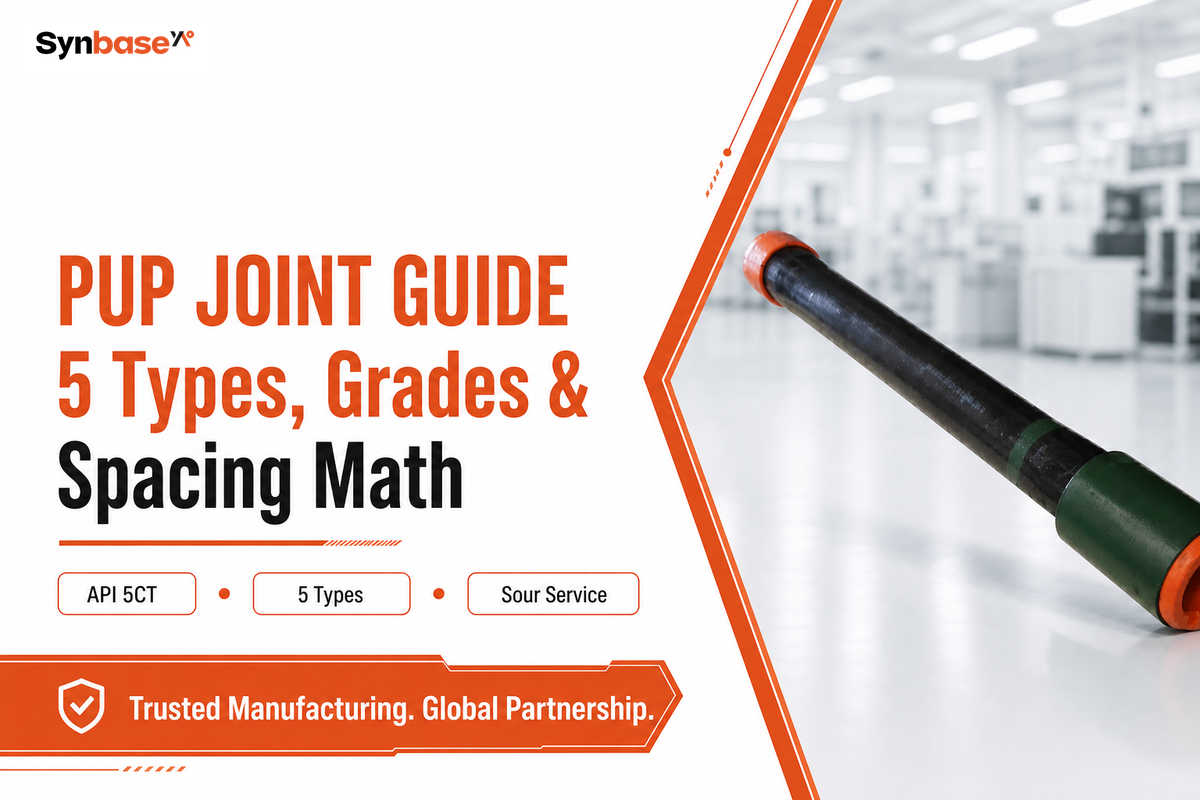
The pup joint is what keeps completion engineers from cutting and re-threading an entire long joint to achieve a landing depth two feet short. These are usually two to twelve foot lengths of tubing, casing, or drill pipe according to API 5CT — the ends are threaded to engage the string on both sides — placed in a string to achieve precise total length needed. Anyone shopping for a pup joint lands here most of the time, but you’ll likely not find some of the other important details on product pages or the brief blogs some vendors use.
| Standard Lengths | 2, 3, 4, 6, 8, 10, 12 ft (API 5CT Table C.27); custom up to 20 ft |
| Tubing OD Range | 2-3/8″ – 4-1/2″, EUE/NUE connections |
| Casing OD Range | 4-1/2″ – 13-3/8″, STC/LTC/BTC connections |
| Common Grades | J55, K55, N80, L80 (sour), P110 |
| Governing Standard | API 5CT / ISO 11960, 11th Edition + 2025 Addendum 1 |
| Flowline/Frac Variant | Hammer union (Fig 1502 up to 15,000 psi; Fig 1002 up to 10,000 psi, rating drops by union size and sour/sweet service) |
Every pup joint used in an OCTG string has the same pipe grade, wall tolerance, and connection type as the long joint it replaces — not a lesser-quality, cut-off piece of pipe. Range 2 tubing and casing joints, which typically run 28 to 32 feet, rarely land a well design’s target depth exactly; a pup joint closes that gap without the extra cost of cutting a full joint.
⚠️ Two Different Parts Share a Name
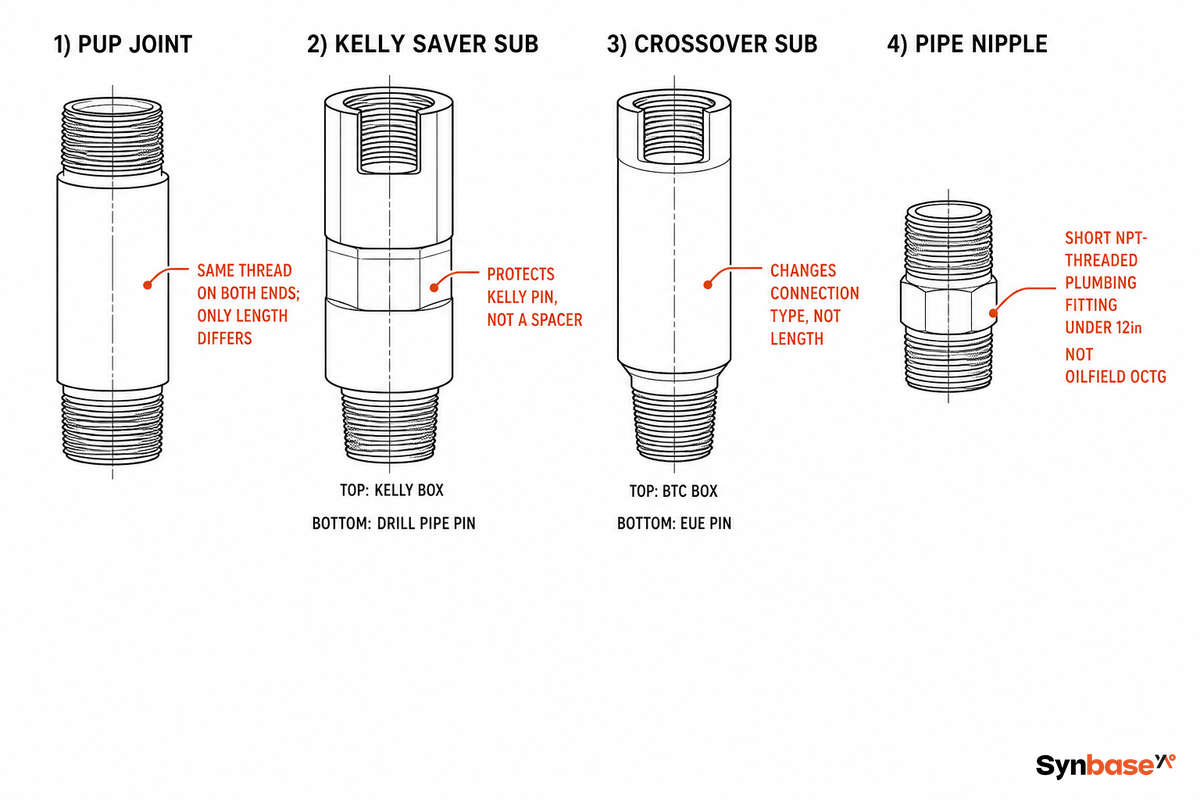
Most vendor pages call a pup joint “also known as a saver sub, spacer, or pup.” Inside an OCTG catalog that loose equivalence is common — but IADC’s own drilling lexicon defines a Kelly Saver Sub, citing API RP 7G and API Spec 7-1, as a short substitute made up below the kelly to protect the kelly pin during make-up — a drill-string wear component, not a length-adjustment spacer. A procurement search for “saver sub” is at least as likely to surface a kelly protector as an OCTG pup joint.
Call it the pup-sub-crossover mixup: this is just the tip of the terminology confusion, since other pieces of OCTG pipe, like a crossover sub, are quite different. While a pup joint will have the same thread on both ends, only the length is modified; a crossover sub’s threads on each end are different, enabling connections such as a BTC box and an EUE pin. This common mix-up frequently causes errors when ordering from multi-well pads because in a picture from a catalog the crossover and pup joint may look the same but are used to address different well bore construction and operation issues.
Pup joints are manufactured according to API spec 5CT using prime API monogrammed mother tubing — the same material as the long joints they replace, not offcuts or scrap. Put simply, pup joints are short sections of pipe — pup joints are also known under several field names — used to adjust the length of a string to the precise length required. Each joint is built, heat-treated, and threaded to the same specification as the pipe it is used to connect to, with the finished length set by the spacing job at hand.
💡 The Shim-Stack Logic
In practice, this is the same logic a machine shop applies to a shim stack: closing a gap under 12 in. with a stock part costs less than cutting a custom length, because a full joint carries the same API 5CT certification either way.
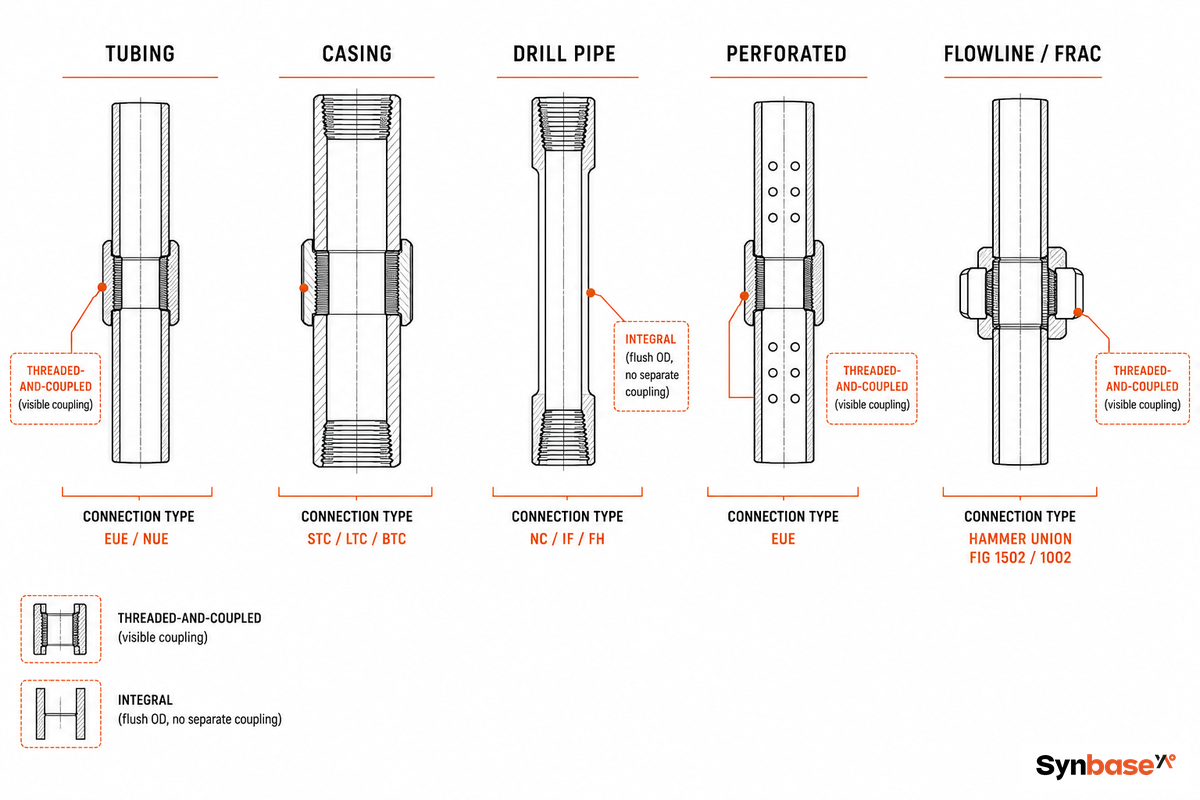
While tubing and casing pup joints will meet the demand of most applications, other versions, including drill pipe, perforated, and flowline/frac variants, can be employed to meet job-specific requirements. What follows is a five-type pup joint field guide comparing all five variants — spanning the full range of sizes this guide covers — by application, and, within each of the three highest-volume types, by construction (standard threaded-and-coupled vs. integral or premium) — not by dimension, since a complete list of OD, wall thickness, and weight dimensions can be found on our pup joint product page.
| Type | OD Range | Grades | Connections | Primary Application |
|---|---|---|---|---|
| Tubing (T&C) | 2-3/8″ (60.3 mm) – 4-1/2″ (114.3 mm) | J55, N80, L80, P110 | EUE, NUE | Production string spacing |
| Tubing (Integral) | 2-3/8″ (60.3 mm) – 4-1/2″ (114.3 mm) | N80, L80, P110 | Flush/semi-flush integral | Clearance-critical completions |
| Tubing (Premium/VAM) | 2-3/8″ (60.3 mm) – 4-1/2″ (114.3 mm) | L80, P110 | VAM premium, gas-tight | Sour / HPHT completions |
| Casing (T&C) | 4-1/2″ (114.3 mm) – 13-3/8″ (339.7 mm) | J55, K55, N80, L80, P110 | STC, LTC, BTC | Casing string adjustment |
| Casing (Integral) | 4-1/2″ (114.3 mm) – 13-3/8″ (339.7 mm) | N80, L80, P110 | Flush/semi-flush integral | Liner strings, restricted-annulus |
| Drill Pipe (T&C) | 2-3/8″ (60.3 mm) – 6-5/8″ (168.3 mm) | E75, X95, G105, S135 | NC, IF, FH | BHA spacing / tool positioning |
| Drill Pipe (Integral) | 2-3/8″ (60.3 mm) – 6-5/8″ (168.3 mm) | X95, G105, S135 | Flush/semi-flush integral | Slimhole / restricted-clearance BHA |
| Perforated | 2-3/8″ (60.3 mm) – 4-1/2″ (114.3 mm) | J55, N80 | EUE | Gas lift, circulation, flow control |
| Flowline / Frac | 2″ (50.8 mm) – 4″ (101.6 mm) (union size) | Alloy steel (4130 or equivalent) | Hammer union (Fig 1502/1002) | Surface high-pressure iron: fracturing, cementing, well testing |
💡 Integral vs. Threaded-and-Coupled
Any of the five types above can be built integral instead of threaded-and-coupled: the connection forms directly into the pipe body rather than relying on a separate coupling, giving a flush or semi-flush OD profile. That matters in clearance-critical wells — liner strings and restricted-annulus completions — where a coupling’s larger OD would not pass. Outside those jobs, standard threaded-and-coupled construction costs less and ships faster.
All pup joints are supplied with threaded connections on both ends, engineered to engage accurately and consistently regardless of size, across a mill’s stock of tubing — from small-diameter tubing pups to large-diameter casing pups with outside diameter sizes up to 13-3/8 inches. Grades are often recorded interchangeably as J-55/P-110 or J55/P110 depending on the manufacturer’s preference, and premium threads such as VAM expand the standard EUE/NUE/STC/LTC/BTC family for high-pressure and gas-tight tubing string requirements. Its manufacturing process follows the same quality assurance path as full-length pipe — material selection, heat treatment, precision threading at every inch of engagement, and hydrostatic pressure testing, with each pup joint undergoing the same inspection as the parent pipe, a production process covered in more detail in the verification section below.
📐 Reading a Pup Joint Specification Sheet
Pup joint specifications typically list stock lengths of 2, 3, 4, 6, 8, 10, and 12 feet. Specific length and overall string length get matched against the well’s spacing requirement, not estimated.
The tubing used and pipe used on most jobs come from the same prime steel pipe stock as full-length joints, never line pipe — a lower-pressure product built for API 5L surface gathering and transmission service, not downhole oilfield conditions. Some suppliers still call a pup joint by another name — it’s also known as saver sub, spacer, or pup — and every joint is made and undergoes the same hydraulic pressure test and thread inspection as the parent pipe before it ships for oil and gas drilling and production operations.
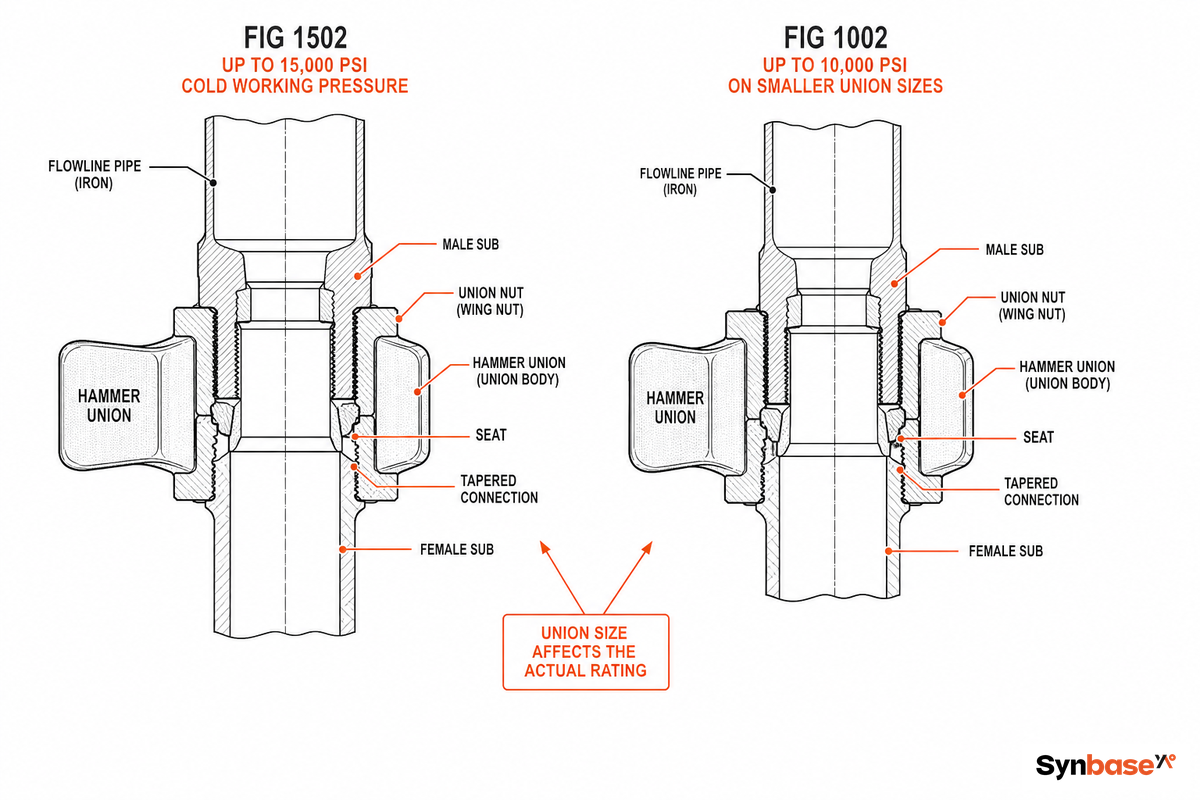
Call this the flowline pup joint blind spot: every competitor site covers tubing, casing, and drill pipe pup joints, then stops — none cover the flowline/frac segment, which uses a different connection family entirely: hammer unions, rated by figure number rather than thread type. Buyers most often encounter Fig 1502 (up to 15,000 psi) and Fig 1002 (up to 10,000 psi on smaller sizes), confirmed across four manufacturers’ spec sheets:
⚠️ The Rating Isn’t One Number
Both figure ratings step down as union size goes up and as service gets more corrosive. A 5 in. Fig 1002 union, for example, is commonly cataloged at 7,500 psi cold working pressure for standard service — and lower still, around 5,000 psi, for sour gas service — well under the headline 10,000 psi some smaller sizes carry. Pull the manufacturer’s size-and-service chart for your specific union before finalizing a spec, not just the family name. OSHA’s own drilling eTool flags this exact mismatch as a known field hazard: Fig 602 and Fig 1502 hammer unions will physically couple together despite the pressure-rating gap, then hold only to the lower rating — a mechanical fit that gives no warning it’s wrong.
Flowline pup joints specified to Fig. 1502 often use 4130 alloy steel or equivalent — a different metallurgy from the J55-P110 grade ladder governing downhole tubing and casing pups, because the service environment differs: surface-exposed high-pressure iron rather than a wellbore environment. Confirm the figure number, union size, and pressure rating before ordering a “pup joint” for a frac spread rather than downhole — a mismatch there is a pressure-integrity problem on the surface, not a spacing inconvenience.
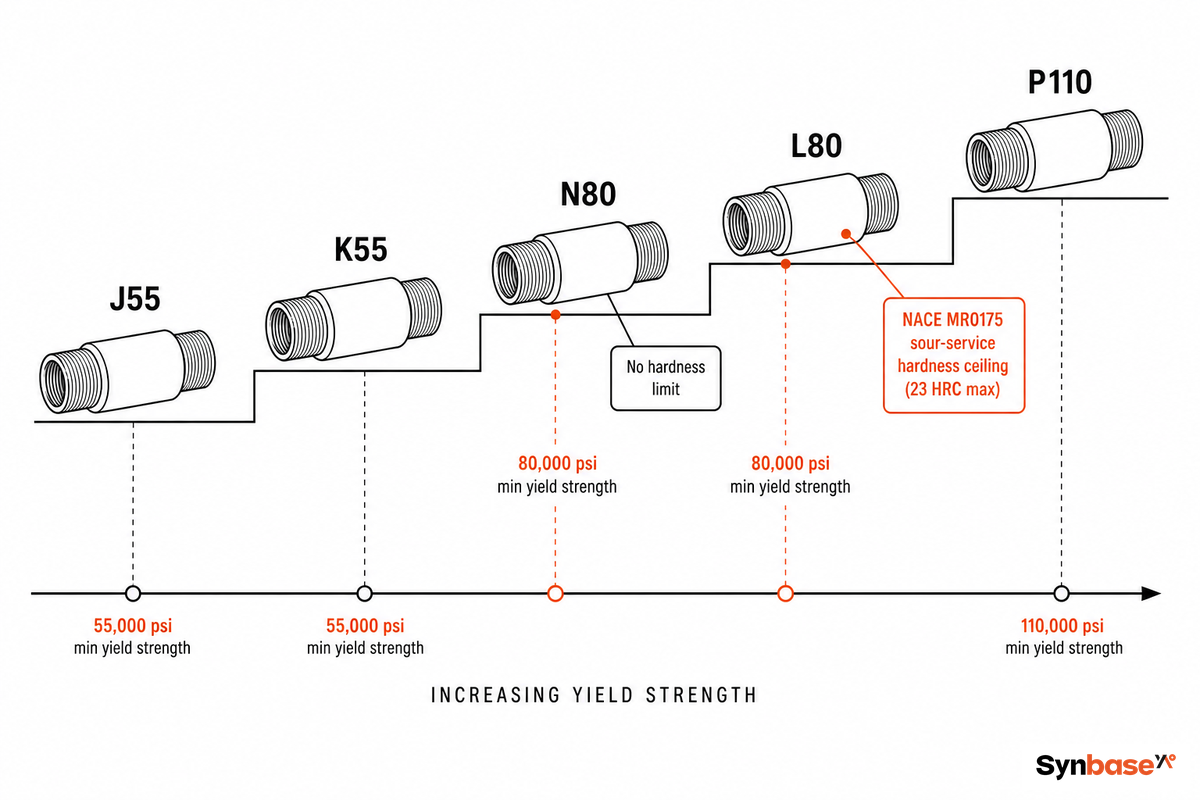
Every pup joint’s grade must equal or exceed the parent string’s grade — never downgrade. Relying on yield strength alone to compare grades is a buyer pitfall.
| Condition | Recommended Grade | Why |
|---|---|---|
| Depth < 8,000 ft, no H₂S | J55 | Lowest cost, normalized carbon steel meets the load case |
| 8,000–12,000 ft, no H₂S | N80 | Quenched-and-tempered, higher yield for deeper hanging weight |
| 8,000–12,000 ft, H₂S present | L80 | NACE MR0175-qualified hardness ceiling, not just yield strength |
| > 12,000 ft or > 10,000 psi | P110 | Highest standard-stock yield for deep, high-pressure wells |
Both N80 and L80 are quoted at an 80,000-psi minimum yield strength, a point of confusion for many. Hardness is the distinction that actually matters in sour service: per API’s own 5CT documentation, L80 must meet a NACE MR0175 maximum-hardness requirement, while N80 places no hardness limitation on its users. Substituting N80 for L80 in an H₂S environment because the yield numbers match is a genuine safety trap, not a paperwork technicality.
📐 Beyond L80
The API Spec 5CT 11th Edition Addendum 1 (May 2025) tightens hardness-retest requirements — mean hardness numbers between 29.0 and 31.0 HRC require retesting — across the whole sour-service grade family, not just L80: C90, T95, and C110 pups fall under the same NACE MR0175/ISO 15156-2-driven scrutiny.
Sour service itself is defined by partial pressure, not a headline percentage. The widely cited gas-phase threshold under NACE MR0175/ISO 15156 is 0.05 psia H₂S partial pressure, so a stream reading “1,000 ppm H₂S” is sour at 100 bar total pressure and may not be at 1 bar — the ppm figure alone never answers the question on its own.
“We hold sour-service pups to the NACE 22 HRC limit, not the API 23 HRC ceiling, because on an export order the project spec usually references both standards, and the lower number governs. We would rather re-temper a heat in-house than ship an L80 that passes API and fails the customer’s NACE clause at the rig.”
— Synbase OCTG Engineering Team
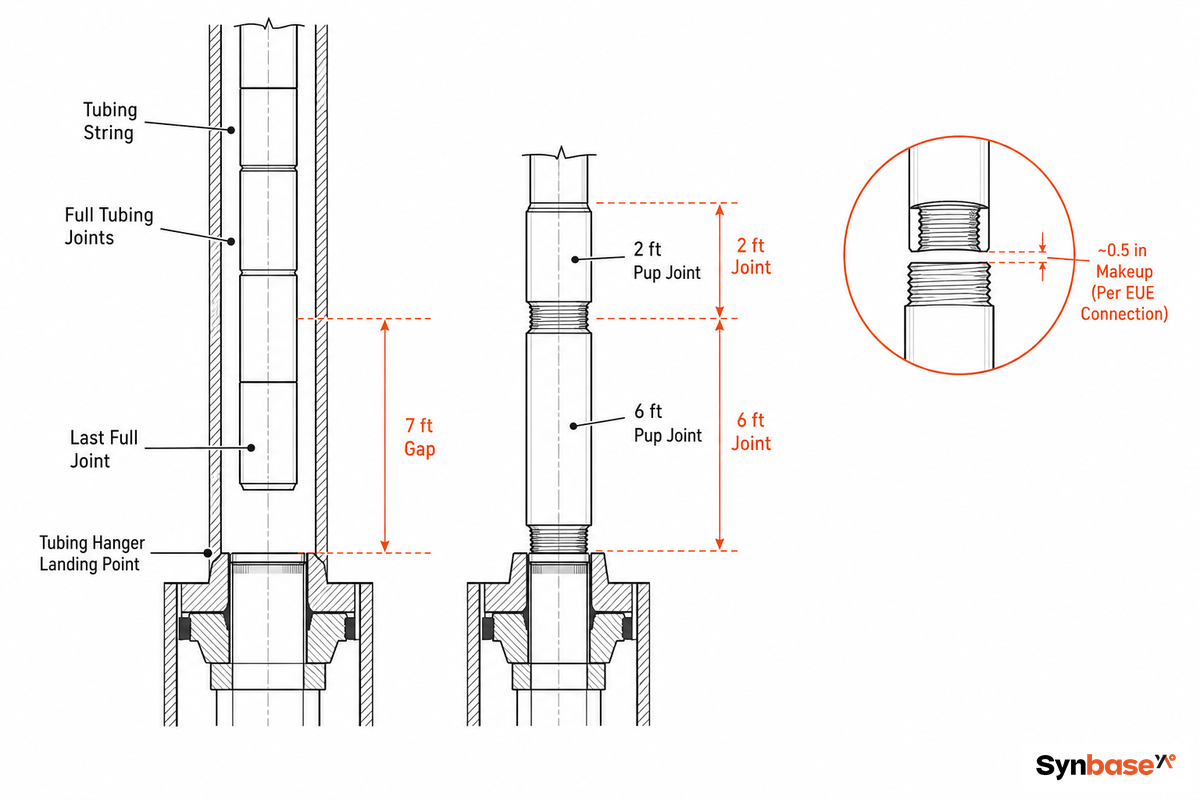
Getting a pup joint’s length wrong causes three real problems, and all three trace back to the same math that most buying guides describe as a formula without ever running the numbers. OSHA’s own glossary defines a pup joint by that same length constraint — shorter than a range-1 joint (18 ft) — precisely because it exists to close a gap a full-length joint cannot.
Here is a worked example. A completion engineer has measured 7 ft gap from last full Range 2 tubing joint to tubing-hanger landing elevation, using 2-7/8″ EUE tubing.
Having a stock set of lengths rather than guessing pays off here: with 2, 3, 4, and 6 ft joints available on location, any gap requirement between 1 and 15 ft can be assembled in single-foot increments without ordering custom size. You may have seen the following example – often with a particular dollar amount added – circulated across several pup joint pages on-line; treat it as a commonly circulated example, not an assurance of what any given well will cost, as the real saving is a rig day-rate multiplied by hours of re-threading avoided.
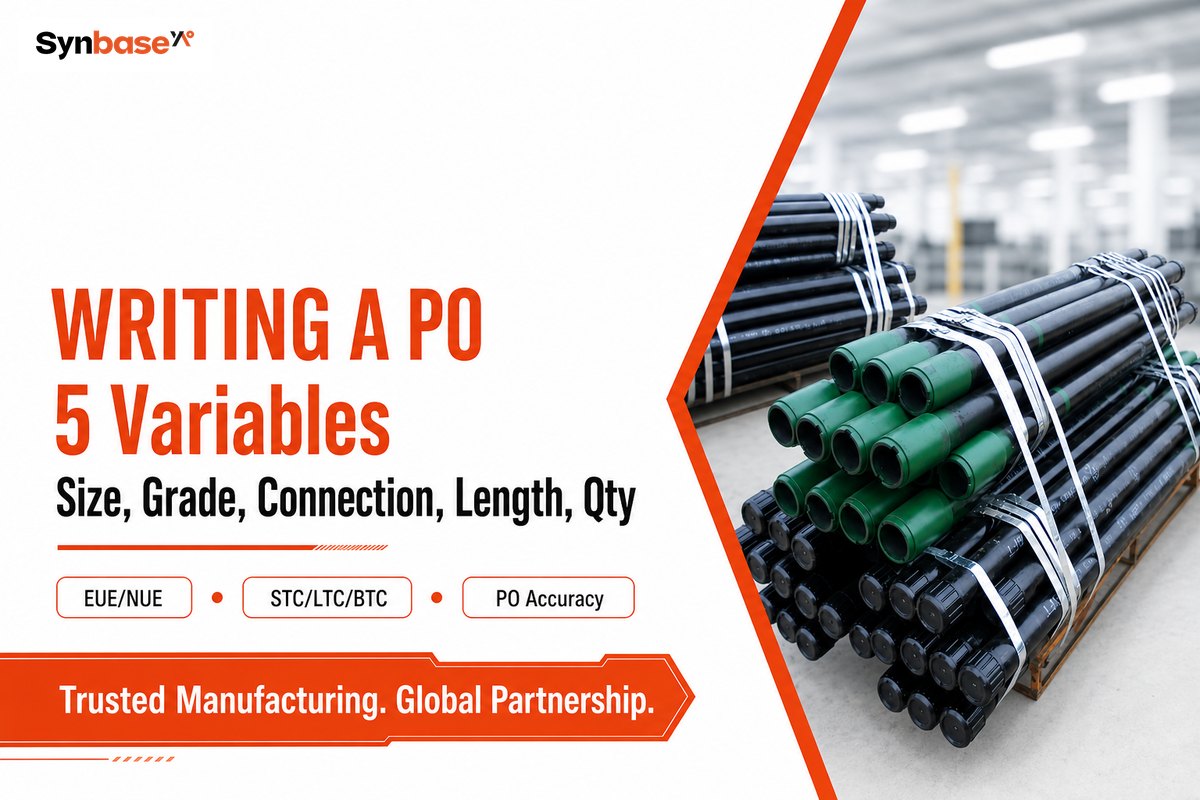
A pup joint purchase order line includes five variables at once, and missing one rarely surfaces until the string is going into the hole — at which point the cost of non-productive time is far higher than the pup joint itself.
A line listing “pup joint, 2-7/8 OD, 6.50 lb/ft, L-80, EUE 8rd, 6 ft, Qty 4” has all five. The single most frequent mis-specification on multi-well pads is always setting the wrong size of tubing-thread pup joint (EUE or NUE) for the casing string, or vice versa – EUE and NUE run on tubing-size OD with interference-fit thread connections, while STC, LTC, and BTC run casing-size OD with a whole different thread pitch and taper. OSHA’s own glossary defines a coupling as the collar that joins two threaded pipe sections — which is exactly why size and thread family have to match on the PO line, not just be “close enough.” On a busy pad managing a range of wells, the mistake is easily made and may only become apparent once a crew begins to make up the connection on the rig floor.
⚠️ Copied-Field Failure Mode
A copied size field is the recurring root cause: a buyer starts from a prior PO for a different string and updates the grade or length but not the OD/thread family, because those two fields look interchangeable at a glance. Catching that before the order ships — cross-checking size and thread family against the well design, not just the PO line — is a five-minute phone call with the supplier’s engineering desk; missing it and finding out in the field is a delay measured in hours, not minutes, on a well where day-rate makes that hour expensive.
⚠️ Never Mix Weights
Running a 6.50 lb/ft pup joint into a 4.70 lb/ft string creates a step change in wall thickness — a stress riser the design never accounted for. Match weight per foot exactly, not just OD.
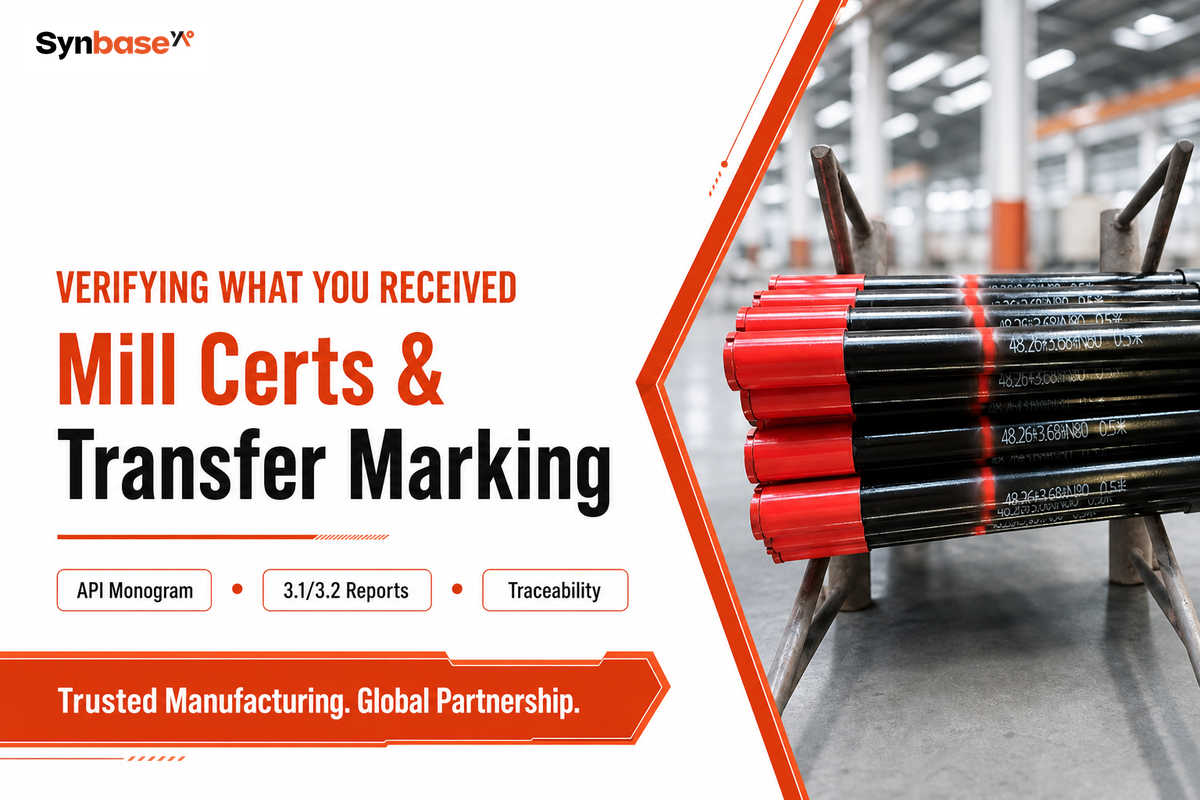
A pup joint that has been stamped API 5CT isn’t the finish line – it’s the starting line. There are more ways to verify that what arrived in the yard matches the paper than there are on the certificate.
This is where the vast majority of real problems start: when a mill cuts a full-length pipe down to pup-joint length, the heat number and grade marking get cut away with the offcut, so the piece has to be re-stamped — a practice called transfer marking.
📐 Engineering Note
Synbase reports that more than half of what comes into its fabrication shop — an estimated 50% — fails inspection on a lost-traceability basis — not a metallurgical defect — because the transfer mark is incomplete or missing, not because the steel itself is out of spec. Ask any supplier directly how they re-stamp heat numbers and grade on cut pieces before assuming the certificate on file matches the joint in your hand.
A meeting-the-baseline case worth remembering: a 2-7/8″ EUE pup joint that passed full API 5CT certification once had its threads gall from crevice corrosion before the pipe body itself ever yielded. Compliance is a starting point for connection selection and traceability, not a finish line.
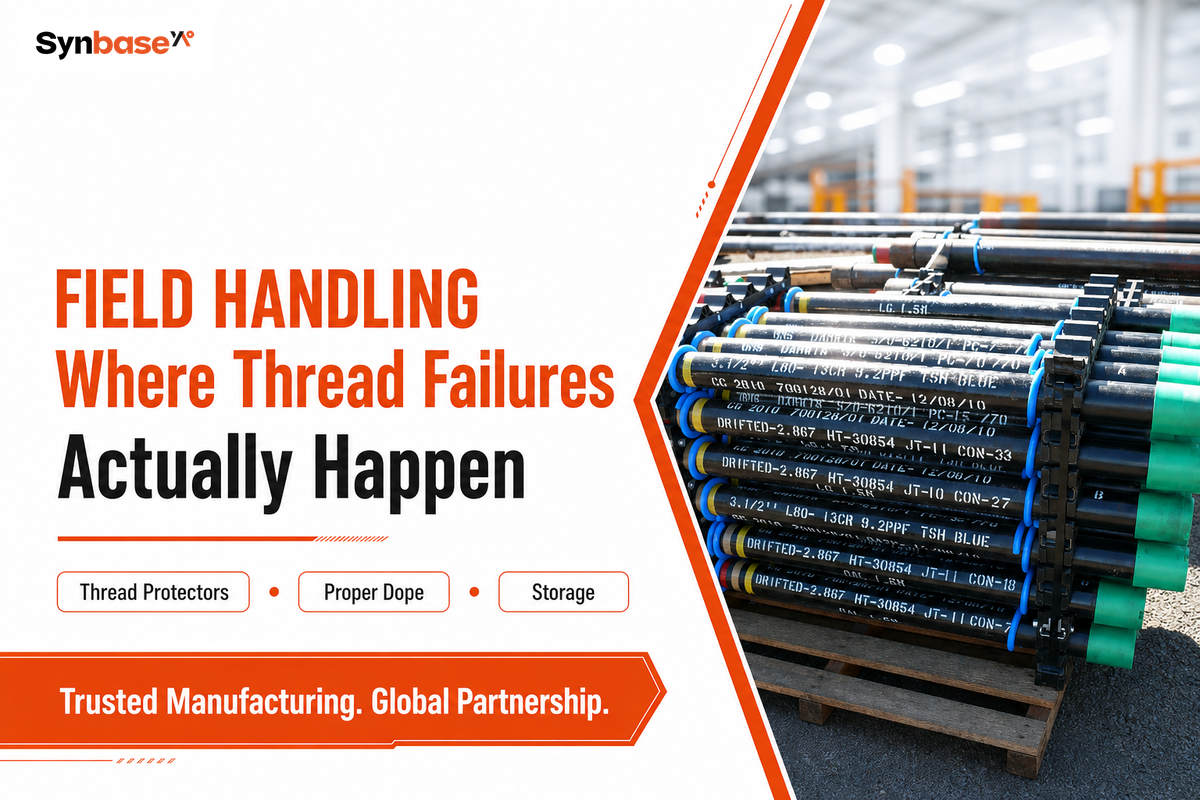
Even if CNC-threaded connection emerges from the mill within exacting gauge tolerances, in-field failure is still possible as most thread damage occurs after the pup joint has been dispatched.
These failure mechanisms explain why, in a public engineering forum, a buyer would ask a manufacturer directly what the actual pressure-test requirement was for a specific 2-7/8” EUE coupled pup joint – a question that should never need asking if those details are plainly stipulated on the certification. The gulf between “API 5CT compliant” and “verified for this particular service” is the birthplace of in-field failures. Federal offshore incident records back this up: a BOEM equipment-failure investigation traces one landing-string failure directly to the crossover-to-pup-joint connection at the top of the stand — the joint, not the pipe body, is where these failures concentrate.
💡 Two Field Habits Worth Borrowing
Some crews thread a pup joint into a casing hanger before it ships to location, specifically to leave enough tong space for machine tongs to operate cleanly during make-up. Separately, machinists in adjacent trades keep a short pup joint with the exact connection on hand to use as a thread gauge when checking dimensions on other tubulars — not the joint’s designed purpose, but a genuinely useful field improvisation.
Apply thread protectors at all handling locations, store joints horizontally in racks and not stacked under load (short lengths can be more prone to bending than full-length tubulars), and lubricate the threads with an API-approved compound up until the final make-up. None of this appears on the spec sheet, but each element determines whether a mill-perfect connection will hold up downhole.
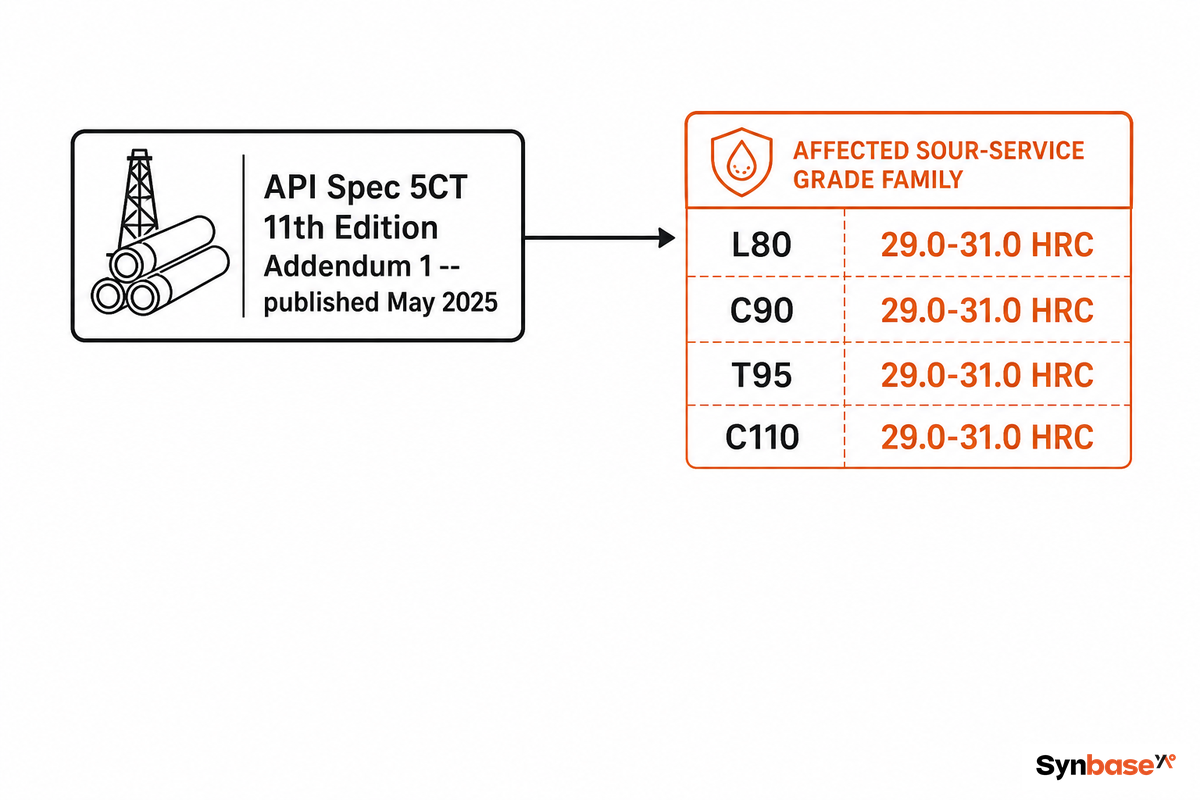
Updated July 2026. The clearest change for pup joint buyers this year is not demand, but a tightening of compliance requirements. API Spec 5CT 11th Edition Addendum 1, published in May 2025, further tightens the manufacturing controls around casing and tubing, adding new hardness re-test bands across the L80/C90/T95/C110 sour-service family.
For procurement teams, that means a mill’s current API monogram license and its most recent surveillance-audit date are worth re-confirming on every 2026 order, not assumed carried over from a prior purchase.
For the overall market size, three independent market-research reports consulted for this guide converge at around $594-$605 million for 2025, with growth rates of around 6.5%-6.7% per annum projected for the first half of the next decade. This should be used as market direction rather than an accurate volume forecast for individual orders.
One additional online estimate claimed a 14.3% growth rate for the tubing pup joint segment specifically — well outside the range of the three independent estimates above, and excluded from this figure as an outlier rather than averaged in.
Practical takeaway for 2026-2027 drilling and completion campaigns: Tighter manufacturing standards combined with continued North American shale development and Middle Eastern drilling activity will drive a trend towards mills favoring certified and traceable supply partners over the spot market. Buyers who don’t adjust face a growing compliance gap, because a mill that was fully monogrammed and audit-current in 2024 is not automatically still current in 2026 — re-verifying costs an email, while an expired license discovered mid-order costs weeks of delay. Prioritizing a mill with a recent and confirmed API monogram license and audit history over the unit price will become increasingly defensible.
Synbase Steel supplies tubing, casing and pup joints to export markets where a discrepancy in the mill test certificate can cause a container to be tied up at port for weeks. This guide reflects the questions our own inspection team fields most — grade matching, transfer marking, and the flowline segment most buying guides skip — not a sales pitch for any single grade or connection. Reviewed by the Synbase Steel technical team.
Synbase Steel supplies steel pipe, fittings, flanges, valves and OCTG for oil and gas, petrochemical, power, water and industrial projects. Our technical guides are written to help buyers compare standards, grades, dimensions, coatings, inspection requirements and commercial terms before sending an RFQ.
We focus on practical specification work: matching pipe process to service conditions, checking wall thickness and end finish, reviewing MTC and NDT requirements, and clarifying documentation before production or shipment.
Project support across seamless pipe, ERW, LSAW, SSAW, buttweld fittings, forged flanges, valves and oilfield tubulars.
Specification review for ASTM, ASME, API, EN and DIN standards, including material grade, pressure class, coating and inspection scope.