Send Your RFQ to Synbase Steel
Prefer to send drawings, BOMs or attachment lists by email? sales@synbasesteel.com


Seamless steel pipe is a length of pipe made without any welded seam, so the grain structure of the steel runs continuously around its whole circumference. That one small fact is reason enough why engineers reach for seamless on high-pressure, high-temperature, sour, and cryogenic service, there’s no seam to inspect, corrode, or de-rate. Here we walk through how seamless pipe is made, how it truly compares against welded, which grades and sizes match which applications, and what to check on what’s actually delivered before you install it.
Updated June 2026 · Reviewed by the Synbase Steel technical team.
| Size range | NPS ⅛ to 30 (hot- and cold-finished) |
| Governing dimensions | ASME B36.10M (carbon & alloy), B36.19M (stainless) |
| Common grades | A106, A53 Type S, API 5L, A312, A790, A335, A333, A519 |
| Weld joint factor (E) | 1.00 (no seam) per ASME B31.3 |
| Certification | EN 10204 3.1 heat-traceable mill test certificate |
The short answer is: no seam. A solid heated billet is pierced and rolled to size for seamless steel pipe, a design that introduces no weld seam anywhere. Since ASME B31.3 grants seamless a weld joint quality factor of 1.00 against the 0.85 of an ERW (electric-resistance-welded) pipe, it carries roughly 20 percent more working pressure at a given wall thickness, and that’s the one reason it’s chosen where no weld will do.
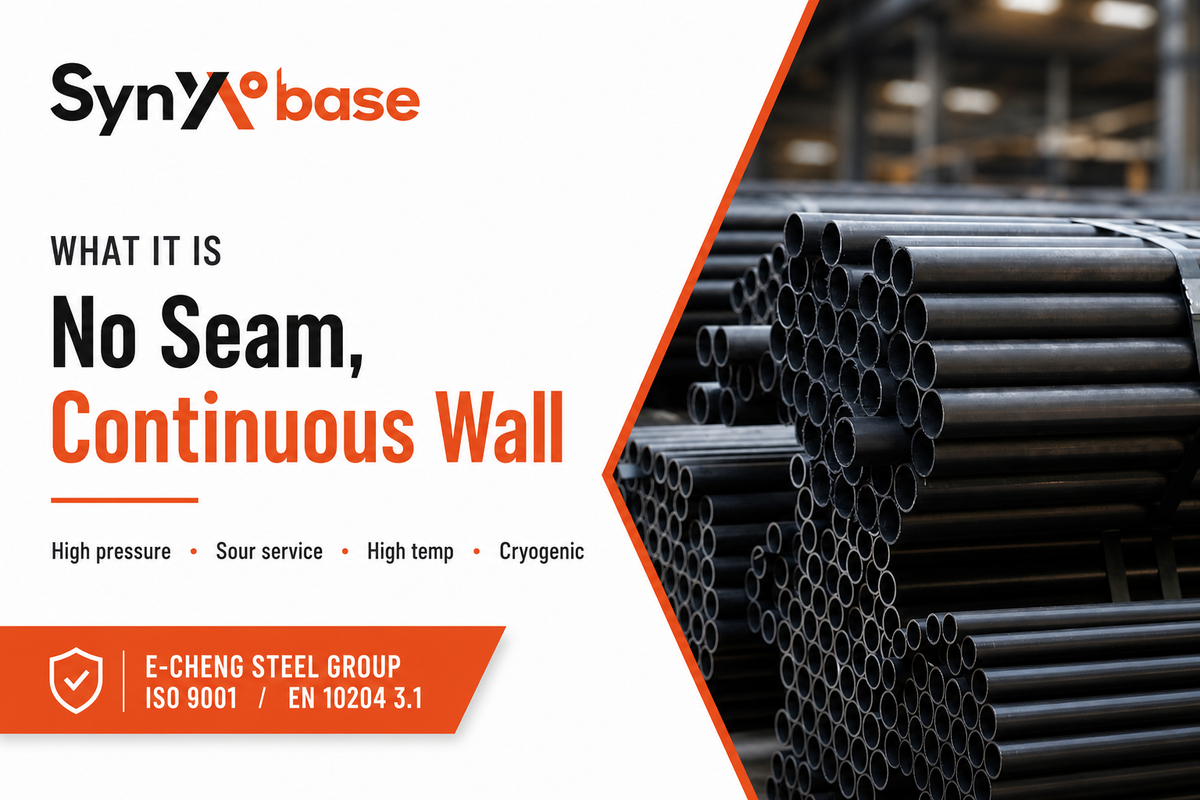
Production of seamless steel pipe begins with a solid round billet that’s heated and pierced through the centre to form a hollow tube, then rolled and drawn to size with both the outside and inside diameter controlled. No seam is ever made, so there’s no weld line to act as an open door for corrosion or as a pressure-rated weak point. Welded pipe instead starts as flat steel that’s shaped into a cylinder and fused along a seam.
Why does that matter? It comes down to service severity. In corrosive duty a weld line is attacked along the bond line faster than the parent metal, cutting a groove down the seam while the rest of the pipe still looks new. That’s why pressure-piping codes such as ASME B31.3, plus owners and plant engineers, demand seamless where high pressure, high temperature, sour service (the presence of H2S), cyclic loading, or cryogenic toughness are in play.
Getting it wrong is expensive either way. Over-specify a costly seamless pipe on a low-pressure water or structural line and you simply waste money, in structural service there’s no measurable performance difference between the two. Under-specify a cheaper welded pipe on sour or cyclic duty and you’ve set up a future failure that will cost far more to replace later. Knowing which side of that line your application sits on is the whole job, and the rest of this guide is built to help you draw it.
No-seam is a means, not the destination. You are buying continuous wall integrity for severe service — and paying for it only when the service actually demands it.
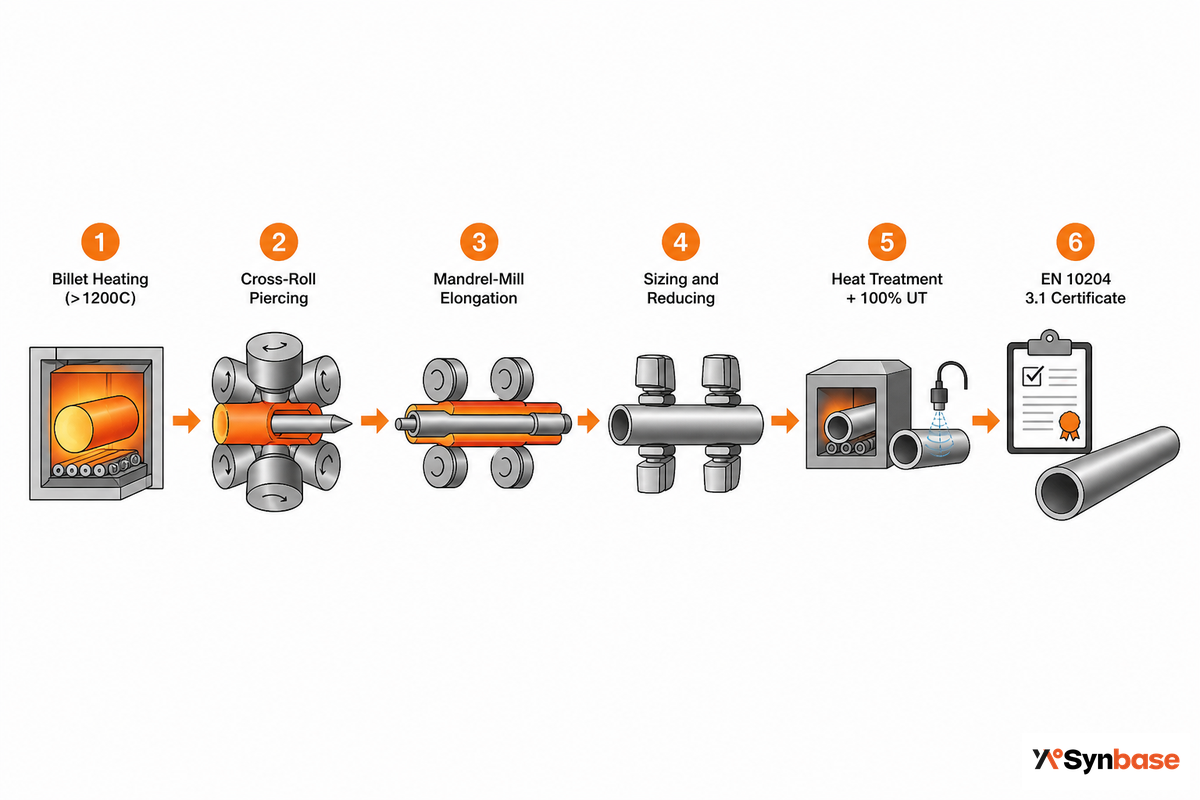
Seamless steel pipe is made by hot-forming a solid billet, cast from an ingot, into a tube through the Mannesmann process, with no welding at any step of the seamless pipe manufacturing process. As the billet is pierced, then rolled and stretched, the pressure rating is engineered in at the pierce, not added at a weld station.
Some grades harden as the pipe is manufactured, while others are heat treated. This continuous-grain seamless steel pipe manufacturing route is backed by the metallurgical literature: work by the U.S. Department of Energy on thermo-mechanical tube processing notes the dimensional flexibility of the Mannesmann piercing mill, while University of Michigan research breaks the manufacturing process, hot forming, into three steps: cross-roll piercing, elongation, and sizing.
A typical mill route looks like this:
Every modern seamless line is built on the Mannesmann pierce-and-mandrel route, and it has long been the subject of process patents such as USPTO US 2006/0174670 (Mannesmann-plug and Mannesmann-mandrel piercing methods). If that sounds complex to a buyer, it boils down to one thing: wall uniformity is built into seamless pipe at the pierce stage, not added later.
“On a seamless line the integrity is built in at the pierce, not bolted on at a weld station. We tie every length back to its heat number on the 3.1 certificate, chemistry, yield, tensile, and the ultrasonic result, because the buyers who specify A106 or A333 audit that document, not our brochure.”
The full Mannesmann route, piercing, heat treatment, ultrasonic testing, and certification, runs in-house inside the Synbase ISO 9001 system across seven dedicated seamless family lines, rather than re-selling other mills’ pipe. Why does the route matter to a buyer? A common trap is assuming every “seamless” length is identical: an A106 line that is rolled correctly but skips the right normalizing step can still under-perform in high-temperature service even though the certificate reads “seamless.” That is exactly why the heat-treatment and ultrasonic steps above belong on the certificate you audit, not just in the brochure.
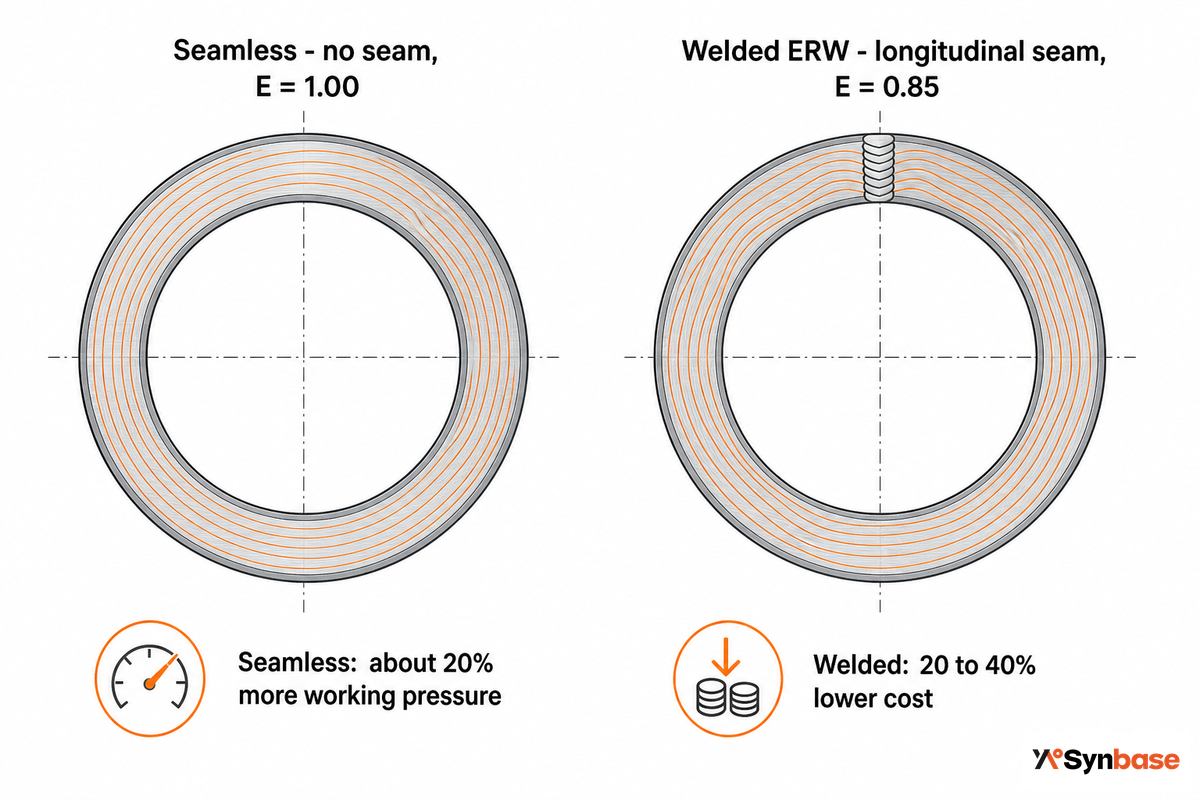
Is seamless steel pipe stronger than welded? On paper it’s, but the more accurate answer is that it carries a different set of defects, it isn’t always inherently stronger. The single most useful tool for the comparison is The 0.85 Factor: the ASME B31.3 longitudinal weld joint quality factor, which is 1.00 for seamless and 0.85 for ERW.
ERW pipe comes from a steel coil that’s rolled and then fused down a longitudinal seam with high-frequency current, whereas seamless pipe is pierced from a solid billet and therefore has no seam. The three practical differences are the ASME joint factor (0.85 versus 1.00), how the seam behaves under corrosion, and cost.
Under the ASME B31.3 Process Piping code, you can’t lift an ERW seam to 1.00 with extra examination, which is why the pressure difference is structural, not procedural — a thinner seamless wall can replace a thicker welded one in critical service.
| Factor | Seamless | Welded (ERW/HFW) |
|---|---|---|
| ASME B31.3 weld joint factor (E) | 1.00 (no seam) | 0.85 (ERW); not creditable to 1.00 by extra exam |
| Relative working pressure, same size & wall | ~20% higher (1.00 / 0.85) | Baseline (seam-limited) |
| Defect / failure path | No seam; continuous grain. Trade-off: more wall-thickness variation, rougher ID | Seam can groove/sensitize; modern HFW often fails in body, not seam |
| Weld NDT requirement | None (no weld) | Seam inspection for critical service |
| Relative acquisition cost | Premium baseline | Typically 20–40% lower, same spec |
| Best for | High pressure, sour, high-temp, cryogenic, corrosive | Water, structural, large-OD, standard distribution |
Weld joint factor per ASME B31.3; the relative pressure follows from 1.00 / 0.85 = 1.176.
Here’s where the honesty has to come in, because field engineers give the same answer again and again. Yes, seamless pipe usually has more variation in wall thickness than ERW, and a rougher inside surface. And in many burst tests, modern high-frequency-induction welded pipe fails through the body of the pipe, not at the seam at all. For standard duty, water service, structural bracing, general distribution, a properly treated welded pipe is reliable and cheaper. What seamless actually buys you is margin where it counts: no seam to de-rate, no bond line to corrode, and a uniform wall for high-temperature and cyclic work.
Treating “seamless equals safer.” Specify it on a low-pressure water header or a structural handrail and you have bought a 0.85-to-1.00 upgrade the service will never use. When your duty sits on the welded side of the line, an ERW welded steel pipe is the right spec — not the cheaper invoice.
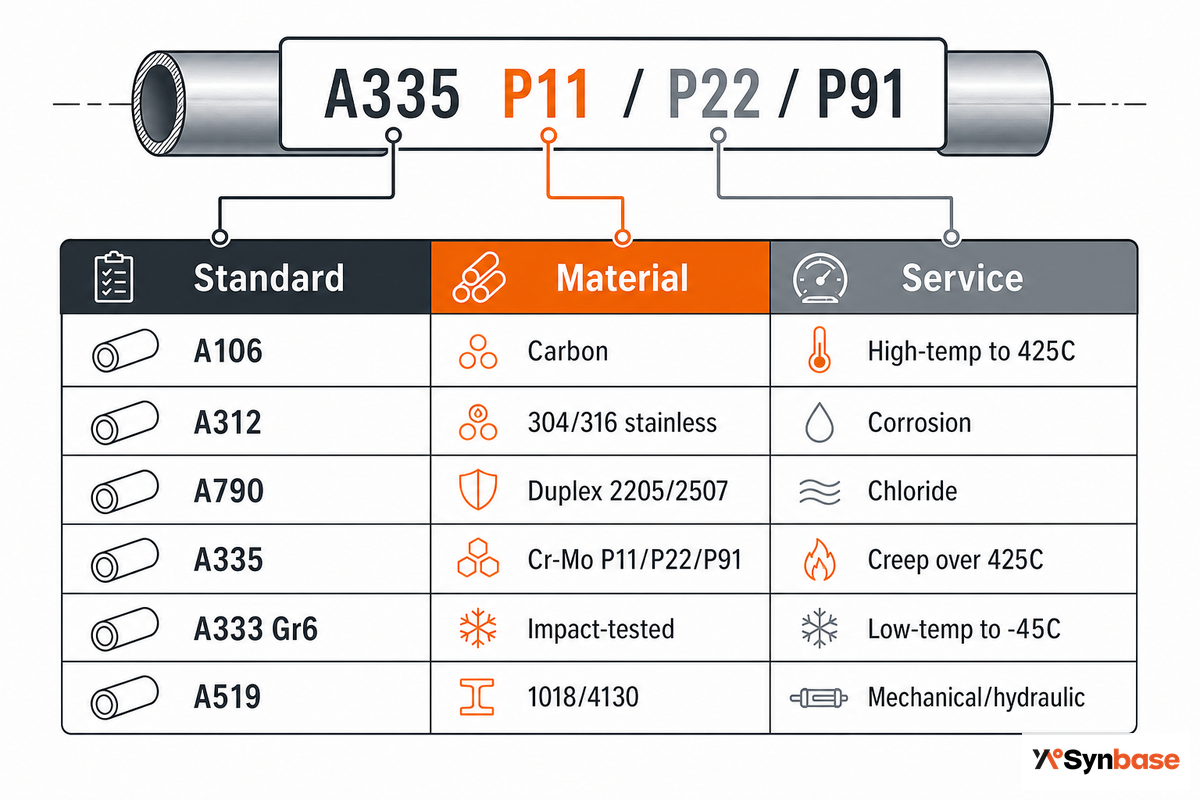
Most buyers arrive with a standard, not a family, an ASTM A312 callout, an A335 P91 line, an A333 cryogenic spec. “Seamless steel pipe” is a category, and the costly error is sizing from the wrong family, because the material system, governing standard, and finish change completely between a power-plant superheater tube and a hydraulic cylinder barrel. The Pipe Spec Callout Decoder below shows how to read a drawing callout straight into a material, a family, and a service window.
| Standard / spec | Material | Service window | Family |
|---|---|---|---|
| ASTM A106 (Gr A/B/C) | Carbon steel | High-temperature to ~425°C; must be seamless | Carbon |
| ASTM A53 Type S | Carbon steel | General & structural (seamless or welded) | Carbon |
| API 5L (seamless) | Carbon, X42–X70 | Oil & gas line pipe | Carbon |
| ASTM A312 | 304/304L, 316/316L stainless | Corrosive, hygienic, marine | Stainless |
| ASTM A790 | Duplex 2205 / 2507 | Chloride / high-strength corrosion | Stainless |
| ASTM A335 (P11/P22/P91) | Cr-Mo alloy | Creep service above 425°C | Alloy (Cr-Mo) |
| ASTM A213 / A179 | Carbon / alloy / stainless | Boiler, superheater, heat-exchanger tube | Boiler / HX tube |
| ASTM A519 | 1018 / 1026 / 4130 | Mechanical, hydraulic, machined parts | Mechanical tubing |
| ASTM A333 Gr 6 | Impact-tested carbon/alloy | Low-temp / cryogenic to −45°C and below | Low-temperature |
Material specifications per ASTM; dimensional classes per ASME B36.10M. Always confirm the current ASTM edition when you procure.
Read it as a single lookup: your engineer specifies and your buyer issues the request for quote from the same row. An “A106 Gr B” callout means seamless carbon steel for high-temperature service; “A312 TP316L” puts you in stainless steel seamless pipe for corrosion duty; “A335 P91” is Cr-Mo alloy seamless pipe for creep above 425°C; and “A333 Gr 6” is low-temperature A333 seamless pipe for cryogenic toughness. Carbon-steel callouts (A106 / A53 / API 5L) live in the seamless carbon steel pipe family. The material jump matters: stainless grades carry at least 10.5% chromium to form their passive film, while duplex 2205 runs around 22% chromium with roughly 5% nickel for chloride and sour service, which is why a 316 substitution on duplex-rated service is a costly downgrade, not a saving.
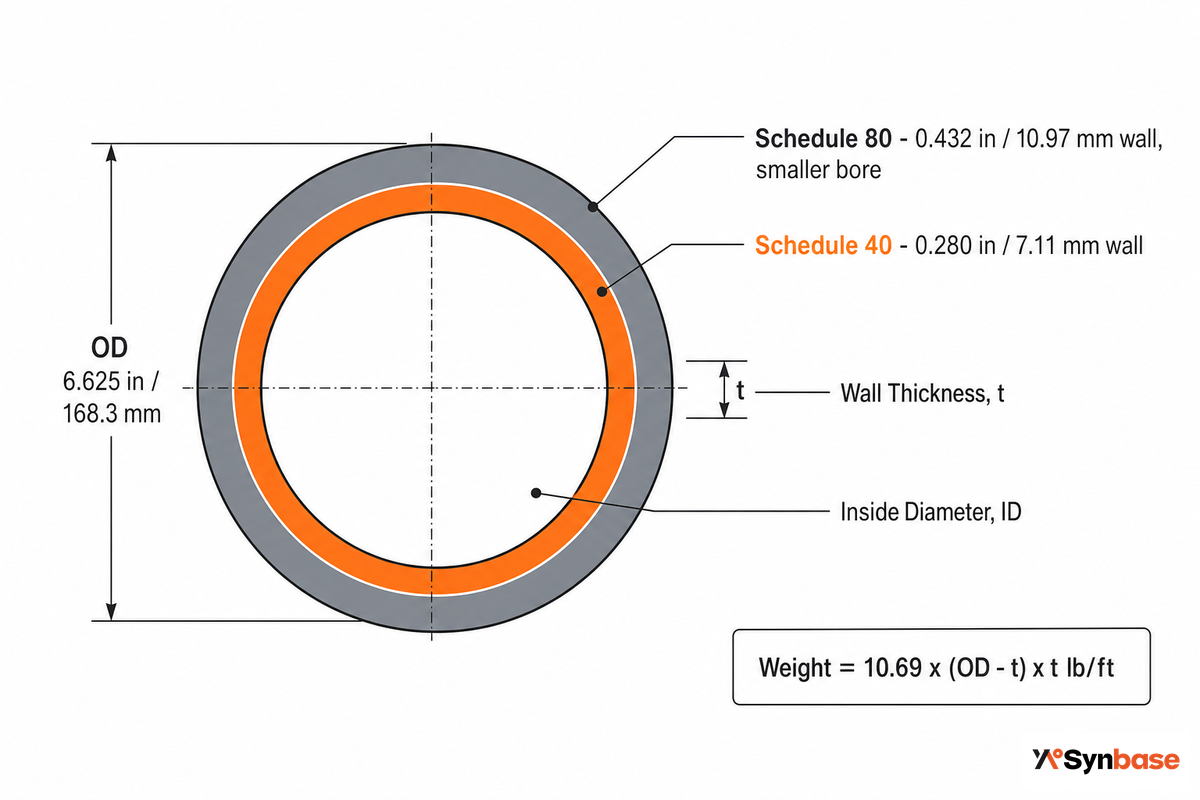
Seamless size comes from a Nominal Pipe Size (NPS) plus a schedule. Through NPS 12, the NPS is only an approximation, an NPS 2 pipe has an inside diameter of about 2.1″, not a literal 2″. Beyond NPS 14, the NPS number roughly matches the outside diameter. The key point: for a given NPS the outside diameter stays constant, and the schedule controls the inside diameter through the wall thickness. Reading seamless steel pipe sizes backwards is a classic ordering mistake — quoting an inside diameter as if it were the OD on a heavy schedule can leave a buyer with pipe that physically won’t fit the flange or fitting it was meant for.
Schedule is the wall-thickness class, 10, 20, 40, 80, 160 and so on; a higher schedule means a thicker wall. An NPS 6 pipe runs a 0.280″ (7.11 mm) wall at Schedule 40 and a 0.432″ (10.97 mm) wall at Schedule 80, the same outside diameter of 6.625″ (168.3 mm), a smaller bore. ASME B36.10M (carbon and alloy) and B36.19M (stainless) carry the tables for every NPS-and-schedule combination.
Plain-end weight (lb/ft) = 10.69 × (OD − t) × t, with OD and wall t in inches. Worked example for NPS 2, Schedule 40 (OD 2.375″ / 60.3 mm, t 0.154″ / 3.91 mm): 10.69 × (2.375 − 0.154) × 0.154 = 10.69 × 2.221 × 0.154 ≈ 3.66 lb/ft (about 5.44 kg/m). Plug in your own OD and wall, or use our seamless pipe weight calculator.
One last practical note on length and tolerance. Seamless mills supply single random lengths (typically 16–24 ft) and double random lengths (32–48 ft), with specific cut lengths costing more because they create scrap. And because the wall is rolled rather than formed from precise sheet, expect more wall-thickness variation than welded pipe within the allowed tolerance, a real consideration on tight-tolerance hydraulic or heat-exchanger work.
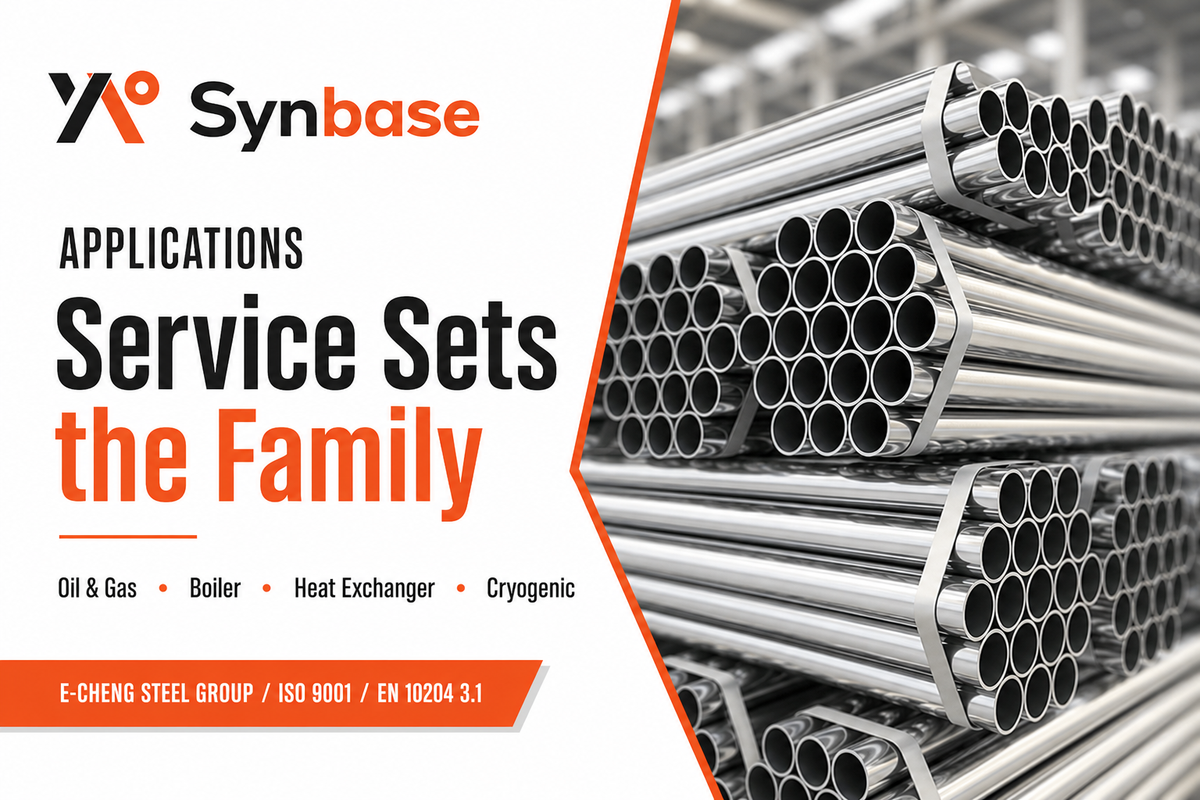
Seamless pipe is used wherever pressure, temperature, or corrosion makes a seam unacceptable — that pattern holds across oil & gas, power generation, refining, and cryogenic service. Understanding what seamless pipe is used for comes down to matching the seamless pipe types below to your service, so here’s a service-to-family guide you can apply directly:
This is also where buyers make the most common mistake. Seamless is the default above NPS 2 in high-pressure or harsh service; below that, or in structural and water duty, welded competes on equal footing and wins on cost. The discipline is matching the family to the medium, temperature, and pressure, not defaulting to seamless everywhere.
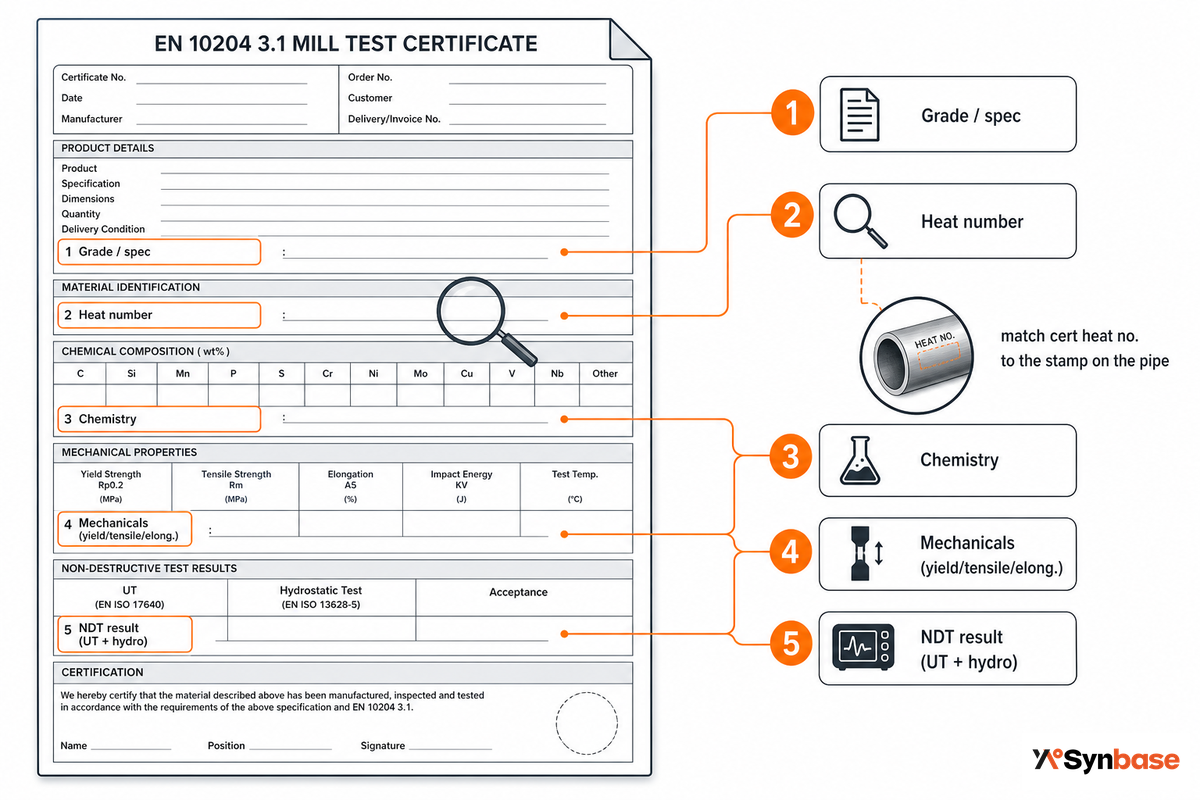
How do you make sure the seamless pipe in your order matches its paperwork? You didn’t buy the documentation as a value-add, a pipe and a certificate that don’t line up means a failed vendor audit or a rejected shipment. The control stays with you, on the EN 10204 mill test certificate. A Type 3.1 certificate carries the actual lot test results, signed off by the manufacturer’s own inspection function; a Type 3.2 adds an independent third party. Run The 5-Field Mill Certificate Audit on every order.
One verification step most buyers skip is also the cheapest: confirm that the heat number printed on the certificate matches the heat number stamped on the pipe itself. That single check links your delivered length back to its melt and defeats most material mix-ups. Any vendor who calls the mill test certificate “optional” has thrown their qualified-supplier status in the bin before the order is even placed, because they’ve just become your most likely cause of a field failure. You can request a sample 3.1 certificate from the Synbase seamless steel pipe mill to see exactly what verification ships with an order.
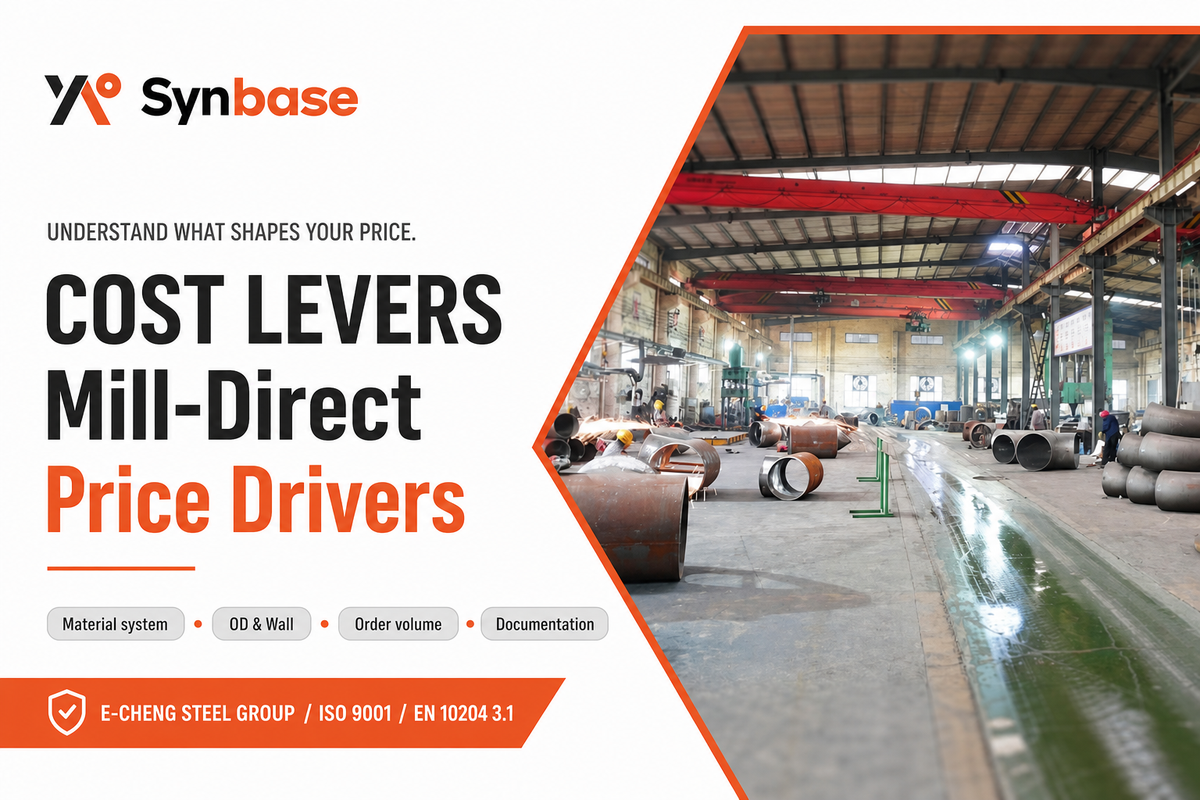
Seamless pipe price is driven mostly by four levers — material system, OD and wall, order volume, and documentation scope — not by a single per-tonne number. Seamless usually costs more per tonne than welded because it starts from a pierced billet rather than steel coil, and that premium is worth it where pressure, sour service, or failure cost demand the 1.00 joint factor.
Rather than chase a single all-in per-tonne price, which swings with the specifics of your order, plan around the levers that genuinely move the number. A direct pipe supplier prices each lever against your spec, and procurement and transport costs shift with order size and destination port.
Going mill-direct changes the math beyond the unit price. A distributor adds a margin layer and ships from blended stock, so the heat behind your pipe can be hard to trace. A direct factory issues the EN 10204 3.1 (or 3.2) certificate itself and quotes against your exact OD, wall, grade, and quantity, so you’re pricing the specification, not a generic tonne. Because raw-material costs move, treat any published per-foot band as directional and price against your real spec.
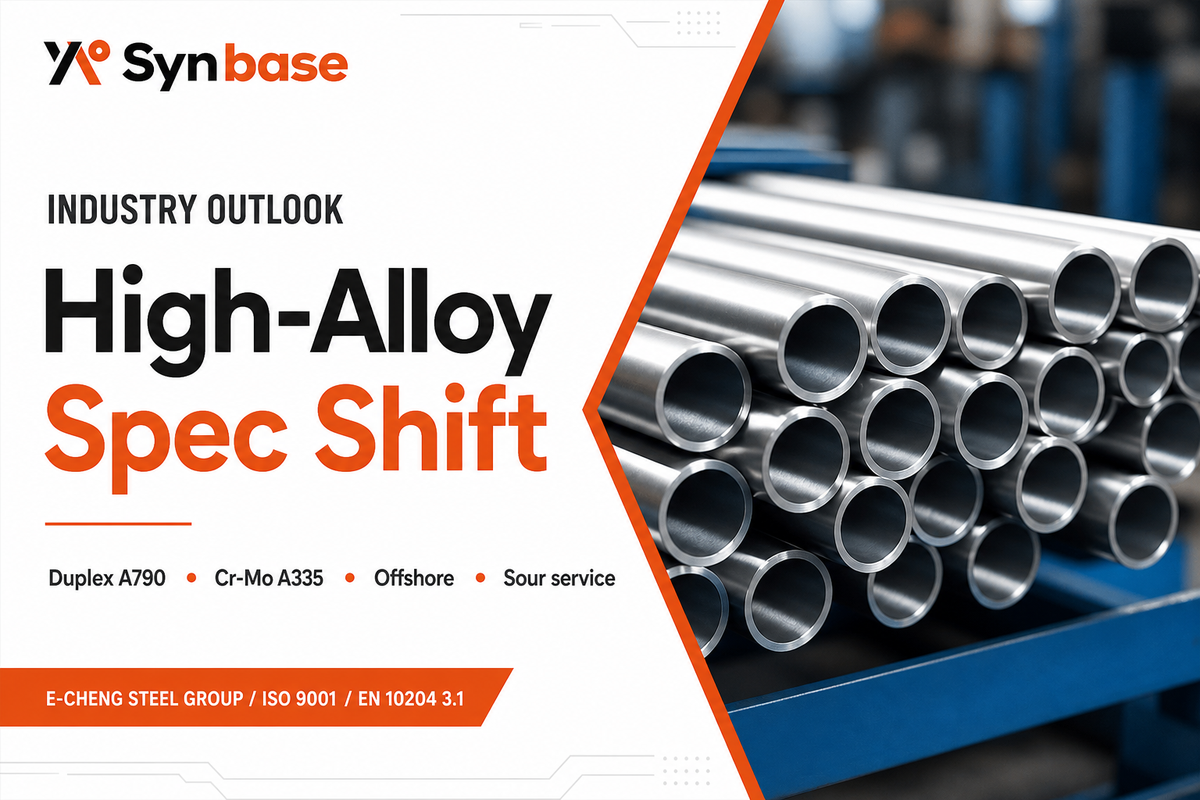
What should shape your spec right now is a material shift, not a market headline: as offshore and sour service expands, design reviews increasingly push buyers off standard 316 and onto corrosion-resistant high-alloy seamless, duplex (A790) and Cr-Mo (A335). Oil and gas is, by industry accounts, the single largest consumer of duplex stainless pipe, a large and growing share of demand, so if your service is chloride-heavy or sour, expect that pull at the next spec review rather than at delivery.
On the code side, ASME B31.3 was updated to its 2024 edition (issued December 2024, replacing the 2022 edition) with a notable fatigue update, but the seamless 1.00 versus ERW 0.85 joint factor that anchors the seamless-vs-welded decision is unchanged. There’s also a clear demand-side signal: interest in “ERW vs seamless” comparisons has climbed year over year, which says buyers are vetting the trade-off earlier in design.
For market context only, independent forecasts put duplex stainless pipe growth at roughly 4–6% per year through the mid-2030s, directional background, not a reason to spec. What does matter for a 2026 project is narrower and more useful: if your service is offshore, sour, or chloride-exposed, price a duplex or Cr-Mo seamless option alongside your carbon or 316 base case now, because that’s where availability and lead times are tightening first.
Send your standard, grade, OD × wall, and quantity. You’ll get a mill-direct quote, a sample EN 10204 3.1 certificate, and a blunt answer on which of the seven seamless families, or welded, fits your service.
This guide is written from the perspective of a seamless pipe mill. The process detail, the 0.85 Factor decision lens, and the 5-Field Mill Certificate Audit reflect what our inspection team checks on every heat across our carbon, stainless, alloy, and low-temperature lines. Standards figures (ASME B31.3, B36.10M, ASTM, EN 10204) are cited to their issuing bodies; we deliberately frame market growth numbers as directional background, not a basis for specification. Reviewed by the Synbase Steel technical team.
Synbase Steel supplies steel pipe, fittings, flanges, valves and OCTG for oil and gas, petrochemical, power, water and industrial projects. Our technical guides are written to help buyers compare standards, grades, dimensions, coatings, inspection requirements and commercial terms before sending an RFQ.
We focus on practical specification work: matching pipe process to service conditions, checking wall thickness and end finish, reviewing MTC and NDT requirements, and clarifying documentation before production or shipment.
Project support across seamless pipe, ERW, LSAW, SSAW, buttweld fittings, forged flanges, valves and oilfield tubulars.
Specification review for ASTM, ASME, API, EN and DIN standards, including material grade, pressure class, coating and inspection scope.