Send Your RFQ to Synbase Steel
Prefer to send drawings, BOMs or attachment lists by email? sales@synbasesteel.com
When comparing ERW pipe manufacturers, the pipe they can supply for your order is critical. You need to determine the production plant, size and grade, required documentation and delivery route. A known quantity in the industry will allow you to form a shortlist. The purchasing decision starts when that name is matched to your material list.
More available stock could be the difference maker in an urgent repair situation. Pipeline orders may require reserved mill campaigns and project-specific tests. This guide compares those buying situations, uses published producer ranges as examples, and gives procurement teams a practical way to compare offers.
Shortlist by manufacturing process and the complete size, wall, grade combination. Compare quotations on the same delivered scope. Before placing an order, agree who produces the pipe, who processes it, and which documents accompany the shipment.
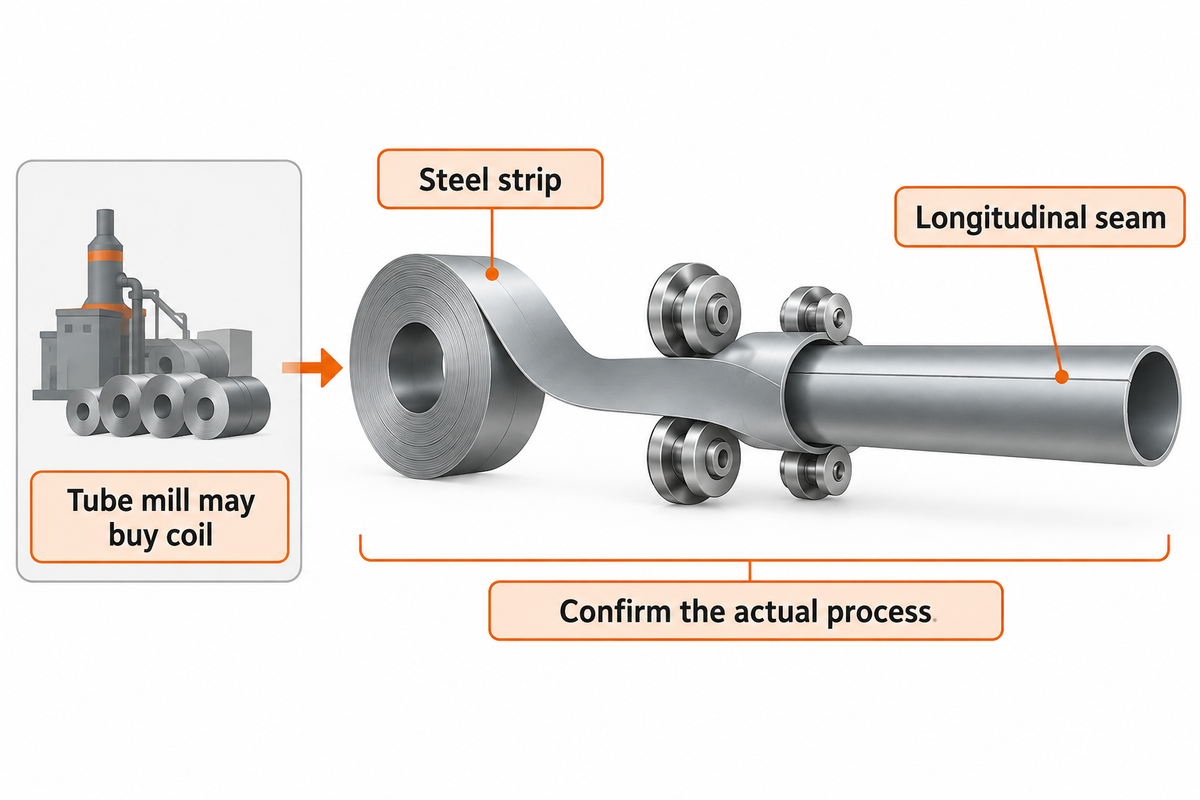
An ERW pipe manufacturer forms steel strip into a tube and joins the longitudinal edges by electric resistance welding. Users also find mills producing structural tubing, standard pipe or line pipe. Those product families can share a process while serving different specifications, so begin with the intended application.
ERW stands for electric resistance welded. Hot rolled steel is the starting material for ERW steel pipe manufacturing, usually in coil form. A flat steel strip passes through forming rolls before its edges are heated and pressed together in the welding process. A longitudinal seam is created and no welding filler material is added at that joint.
The finished product is tubular rather than a flat sheet of steel. ERW manufacturing is one stage downstream of steel manufacturing: a tube mill may buy coil rather than make its own steel. Where induction welding technology is used, the mill should identify that process in its technical response. Treat this short description as a way to ask about welding technology, rather than a substitute for the approved manufacturing procedure.
HFW refers to high-frequency welding within the electric-resistance welding family. ERW describes this more broadly. When comparing suppliers, request the actual process used for the proposed product and the specified standard. A high frequency label on its own doesn’t define a mill’s grade range, inspection scope or suitability for the service.
When API 5L line pipe is called for, the right question to ask is whether the specified plant can supply that order to specification. A structural steel tube catalogue to EN 10219 answers a different question. The same applies to stainless steel pipes: material, seam process and product standard need to match, rather than relying on a general welded pipe label.
Pipe applications also change the enquiry. Oil and gas lines require line-pipe according to specification; a water pipe package may conform to a different standard. Galvanized steel products meet a finishing requirement. For equipment manufacturing, the purchaser may also require cut lengths or dimensional control for assembly. State those conditions before steel suppliers price the order.
Process education should be kept different from supplier selection. Our ERW process and specification guide gives more details on checks for production and technology. For welded steel purchases, the intent is to define the proper pipe supplier route before competitive offers are compared.
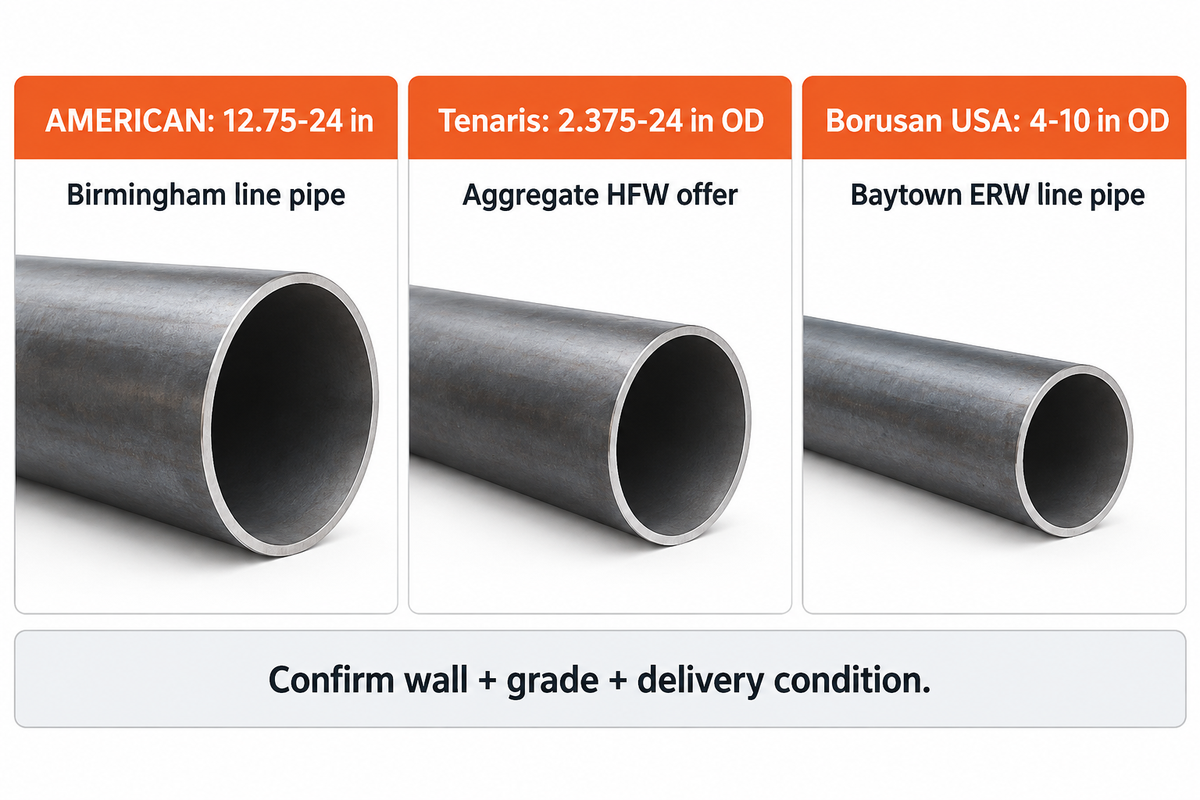
AMERICAN, Tenaris and Borusan show that an ERW shortlist requires product-level detail. Line-pipe pages for the three companies vary in published diameter ranges and production scopes. Use examples below to narrow a request for quotation, and then seek confirmation on the required wall, grade and delivery condition as a single combination.
| Producer and scope | Published diameter | Purchasing implication |
|---|---|---|
| AMERICAN Steel Pipe, Birmingham line pipe | 12.75–24 in | Its product page lists lengths up to 80 ft and onsite fusion-bonded epoxy coating; check the required order combination. |
| Tenaris, aggregate HFW line-pipe offer | 2.375–24 in outside diameter | The corporate range covers several production countries; identify the proposed plant rather than assigning the whole range to each location. |
| Borusan Pipe USA, Baytown ERW line pipe | 4–10 in outside diameter | The US page lists grades up to X70 and 60-ft triple-random lengths; keep this scope separate from its HSAW and SAWL products. |
These are catalogue limits published by the manufacturers themselves from AMERICAN, Tenaris and Borusan Pipe USA. A maximum diameter and a maximum grade listed on the same website don’t form an approved order combination.
Regarding the buyer wanting 20-inch line pipe, both Tenaris’ HFW range and AMERICAN’s line-pipe range include that diameter. Borusan’s cited Baytown ERW page includes a smaller range. A group page advertising large-diameter submerged-arc pipe does not change that comparison. The buyer should send the same wall thickness, grade and inspection requirements to various plants, and not treat the three company names as the same. Deciding on an award isn’t just based on diameter. Consideration for coatings, where the steel is sourced and manufactured, and when, may influence the award.
Steel pipe manufacturing companies tend to publish several product families on the same site. Keep a carbon steel pipe manufacturer comparison separate from an alloy steel enquiry, and check the actual producing plant for either. Company-wide steel pipe production figures tell little about the available campaign for your size.
A broader steel pipe manufacturer overview, e.g. in the case that your package also contains seamless or other welded products, helps greatly. Within an ERW-only package, eliminate unrelated processes and score price.
A production-fit check incorporates confirmation of outside diameter, wall thickness, grade, length, and delivery condition all in one written confirmation. Catalog maxima are poor replacements for this confirmation. Start with the specification and obtain, for each item on the material list, the named manufacturer’s response to the project specification, as well as a response to any deviations proposed.
A53 Type E and API 5L are useful starting distinctions. The ASTM A53/A53M-24 public scope identifies Type E as electric-resistance-welded pipe in Grades A and B. API 5L addresses line pipe; its grade and product specification level belong on the enquiry. A pipe size designation also needs its dimensional basis: nominal size and measured outside diameter are different fields.
“6-in carbon steel pipe” provides little to no help to the supplier in guessing the wall, standard, and service. However, the procurement team can provide the outside diameter in millimeters, nominal wall in millimeters, grade, product specification level, and required lengths in meters. Attach the material list, and ask the mill to mark each line compliant or to identify a deviation. This response helps in performing a technical evaluation to negotiate the best price for the product.
Common sizes for ERW steel pipe are generally acceptable for an initial enquiry, but state the actual dimensions on your Material List. During pipe installation even a nominal size may require an end preparation or cut length. State those details while the pipe is manufactured to order, and do not add them later on the delivery note.
Indicate separate processing locations, also. Coating, threading and end preparation and testing may occur away from the pipe mill. Enquire which party owns those operations and how the pipe identity is maintained. A manufacturer and exporter may coordinate those services well, but its export role does not replace the name of the manufacturing facility.
For specification background, use our API 5L line pipe requirements guide. Where the project requires a Monogram license, check the legal manufacturer, location and relevant scope in the API licensed-company directory. An ISO Management System certificate is a different document from a product license.
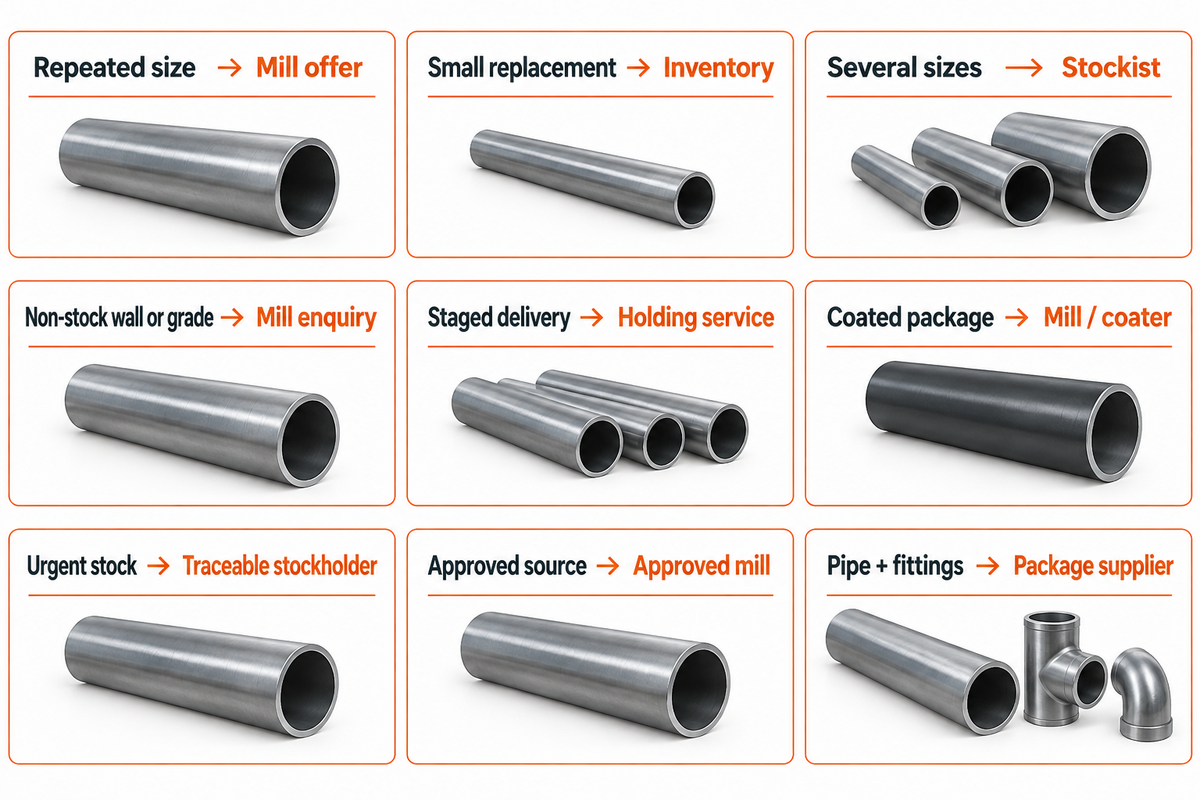
Mill-direct buying suits orders that fit a producer’s campaign, quantity and specification requirements. Distributor buying can fit requirements of available stock, mixed sizes and staged releases. Compare the actual material and responsibilities offered through each route; ownership of a mill isn’t, by itself, a reason to accept or reject an offer.
Buy through a pipe mill for a confirmed production order, a distributor for suitable inventory, or a project supplier coordinating the package. Choose the route which will serve the purpose best. For stock material, obtain the records of the mill and the current balance. For new production, obtain the manufacturing schedules and the named mill.
The INGAA Foundation’s distributor-pipe guideline distinguishes distributor inventory from an order requiring a distributor to place a company mill run. It’s scoped to cover HFW Line pipe, and states limits at 6-in NPS and larger, as well as PSL-2 material. It’s a scoped purchasing guideline, and not a rule to cover every ERW application.
“the applicable Company pipe specification shall apply.”
A pipe distributor may offer a service that a mill campaign doesn’t. United Pipe & Steel illustrates bundle breaking, mixed-product orders, and scheduled deliveries in its published service offer. Those are supplier-specific options. Ask about the minimum and available stock before using them in a project schedule.
| Order situation | Route to investigate first | Condition to settle |
|---|---|---|
| One repeated size for a new project | Mill production offer | Campaign slot and minimum for that size and grade |
| Small replacement quantity | Distributor inventory | Physical quantity, condition and matching mill records |
| Several sizes in one shipment | Stockist or package supplier | Availability by line item and any split shipment |
| Non-stock wall or grade | Qualified mill enquiry | Feasible combination, testing and production minimum |
| Staged site deliveries | Supplier with agreed holding and release service | Storage charges, title and release dates |
| Coated pipe package | Mill/coater or coordinated project offer | Coater identity, transport between sites and final inspection |
| Urgent material already in stock | Stockholder with traceable material | Reservation, inspection release and dispatch date |
| Project-approved manufacturer required | Approved mill, directly or through a supplier | Actual producing facility and substitution controls |
| Mixed pipe and fitting package | Package supplier | Separate manufacturer and documents for each product |
This matrix is to be used as an enquiry sequence. A distributor can arrange a mill run, and a manufacturer may sell stock through distribution. The order status determines which questions come next.
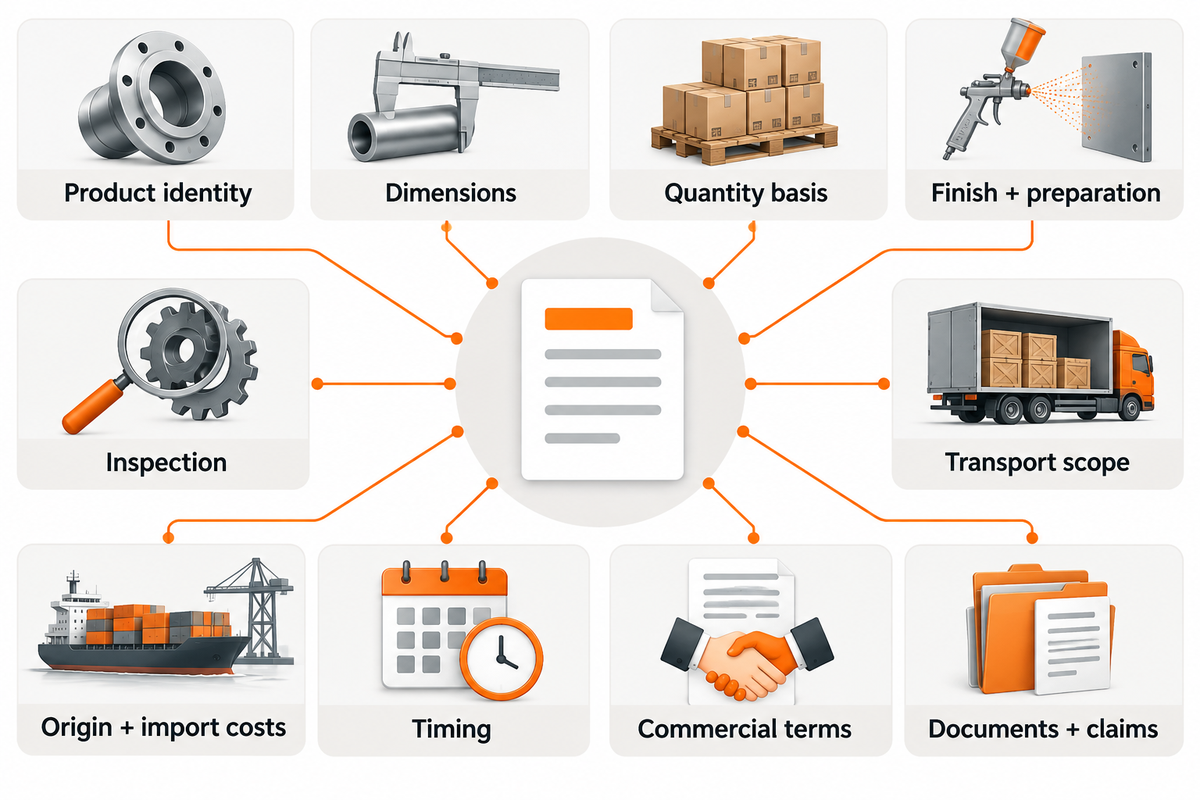
Compare ERW pipe quotations only after normalizing for material, quantity and delivery scope. A lower unit price can purchase a different wall, exclude coating or leave freight with the buyer. Take those differences into account when doing a comparison sheet to see which compliant offer has the lowest delivered cost.
Offers for bare and coated formats must be aligned by finishing costs to be on the same sheet. Procurement requires item-level offers; finance requires payment and currency exposure; receiving requires a shipment they can identify and accept. The Delivered Quote Normalizer below integrates these three functions. It’s a purchasing worksheet, and assumes no market price or universal distributor margin.
| Field | Record for every bidder | Why it changes the comparison |
|---|---|---|
| 1. Product identity | Standard/edition, process, grade, product specification level | Prevents a cheaper substitute entering the same column |
| 2. Dimensions | Outside diameter, nominal wall, length and tolerances | Aligns the pipe actually being purchased |
| 3. Quantity basis | Price per tonne, metre or piece; theoretical or actual weight | Controls the invoicing denominator and quantity tolerance |
| 4. Finish and preparation | Bare or coated formats, coating scope and pipe ends | Reveals processing omitted from a base offer |
| 5. Inspection | Required tests, witnessing and third-party charges | Separates included acceptance work from extras |
| 6. Transport scope | Named delivery term, place, freight, insurance and unloading | Locates costs and handover responsibilities |
| 7. Origin and import costs | Mill country, destination and responsible importer | Allows applicable duties and trade-remedy scope to be checked |
| 8. Timing | Stock reservation or mill slot, release and arrival milestones | Separates dispatch promises from site availability |
| 9. Commercial terms | Currency, payment schedule, validity and price adjustments | Shows financing and price-change exposure |
| 10. Documents and claims | Mill reports, packing list, traceability and shortage procedure | Defines what accompanies and closes the order |
Consider a contractor comparing a coated-pipe offer delivered to a named port to a bare-pipe offer collected at the mill. The second price may look attractive, but the contractor still needs coating, intermediate handling and freight. Include those costs with the bare-pipe offer. If one offer uses theoretical weight and another actual weight, also reconcile the invoiced quantity. The more important result is a scope for the material list that provides for a like-for-like comparison, rather than a scope that provides for a percentage comparison of dissimilar offers.
For imports, decide who determines the classification of the goods under the customs schedule and any origin-related measures. The US Commerce Department’s large-diameter welded-pipe case scope illustrates the need for physical characteristics and exclusions along with tariff codes. Have the responsible importer confirm the treatment to be applied to the shipment before agreeing to a delivered budget.
Request the minimum quantity and schedule for each size and grade combination. Separate the completion of production from dispatch and arrival. Constraints on stock and new production are different. A supplier’s general lead-time statement becomes useful only when it is tied to the reserved material, required processing and agreed delivery location.
For steel requirements, inquire when the steel is secured, when the campaign is planned, and when the release from inspection is expected for pipe. Coating and transport are done according to their own schedules. For stock inquiries, find out where the material is located, whether it’s reserved, and what operations are remaining. A designation of stock doesn’t imply the material is ready to be loaded.
A 2011 Eng-Tips discussion describes a purchasing team postponing an order because it assumed the item was stock, then seeking a manufacturing-process substitution when material couldn’t be found. The lesson for current purchasing is to confirm availability early and route any substitution through engineering approval. The discussion’s old code calculations aren’t a current design basis.
A mill can produce the required specification but has not reserved a campaign. A stockholder offers material for inspection with end preparation still outstanding. The buyer should compare a dated stock reservation and processing release against a dated production commitment. If the replacement is different in grade or seam process, the buyer would seek an engineering decision before making the purchase. A verbal “available” reply from the mill leaves the shutdown team and the buyer without an agreed delivery milestone.
Input the latest acceptable arrival date in the enquiry. Tell bidders to identify a milestone which they can commit to and state if any buyer approvals are required to achieve that milestone.
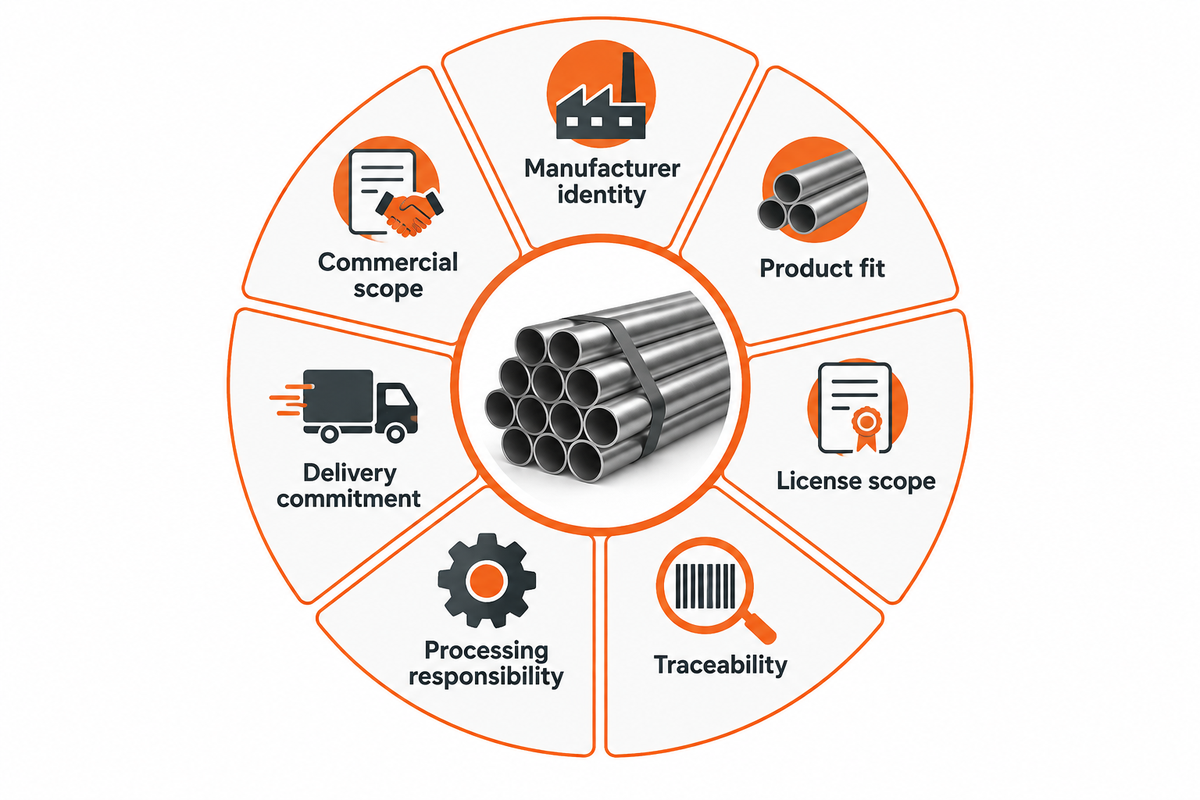
Look for answers for seven questions before shortlisting an offer for negotiation. Use seven checks before reducing the shortlist to price negotiation: manufacturer identity, product fit, license scope where required, traceability, processing responsibility, delivery commitment and commercial scope. A supplier that addresses these aspects will provide the common basis to both purchasing and engineering to accept the offer or resolve a deviation.
Traceability can be very useful in situations where stock changes hands. INGAA’s scoped guideline calls for source-manufacturer material test reports and documentation linked to the specific material offered. Their inventory route is different from assuming that every distributor document establishes the producing mill. Ask for the underlying records while comparing offers, before receiving becomes the first team to discover a mismatch.
For projects with domestic-origin requirements, distinguish the seller’s address from the pipe’s origin. Wheatland’s manufacturer guidance on origin verification says that familiar appearing material could still require origin verification. Put origin requirements, if any, in your order and trace them in the delivery documents.
If Synbase Steel’s published supply range matches the material list in the ERW sourcing enquiry, it can be included in the enquiry. Our ERW offer lists NPS 1/2–24 and API 5L grades B through X70. Include the required combination, quantity and delivery destination in the enquiry to ensure the response is for the correct package.
Use Synbase ERW pipe supply range for product options and Synbase Steel company background for company context. The enquiry must identify any approved-mill restrictions, coating requirements and document schedules. Ask the offer to name the proposed manufacturer and any separate processing party.
Mixed packages may contain standard pipe, coated line pipe and fittings. List these separately so that one general description doesn’t conceal different standards and/or delivery dates. For a time-sensitive order, include the arrival date requested in the first communication.
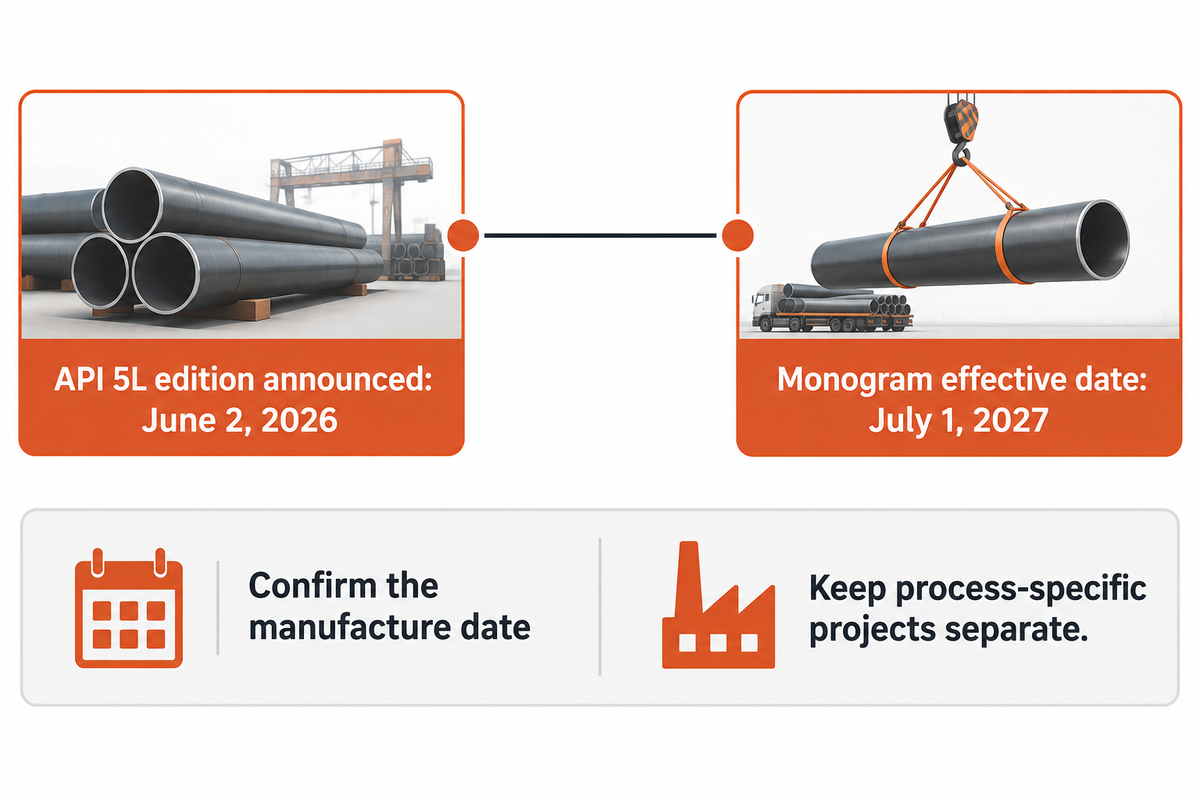
Investments and new standards in the steel pipe industry may change an ERW sourcing decision. Understand how the changes impact different elements of the order. Determine which manufacturing process the expansion covers and when the required standard is applicable. With respect to new projects, confirm the proposed production facility and manufacture date prior to assuming a new announcement is a supply commitment.
API announced the 47th edition of API Specification 5L on June 2, 2026, including updates related to HFW quality. The revision contains new requirements for HFW quality. Its June 18 notification sets July 1, 2027 as the API Monogram Program effective date. In the interim, insert the contract edition into the order and align the proposed manufacturing date to the requirements of the applicable program.
The API program documents state that the marks warrant conformity with the applicable specification in effect at the time of manufacture. A contract’s reference to a previous edition specification doesn’t, in and of itself, validate the right to apply the mark to future production. Address this with the proposed licensed manufacturer prior to ordering across a transitional contract.
Capacity announcements need the same attention to scope. The Arkansas Economic Development Commission’s August 11, 2025 release described a $150 million LSAW mill and coating investment at Welspun’s Little Rock site. It separately referred to the earlier $100 million HFIW upgrade. For purchasing, those are two process-specific projects, not one interchangeable ERW capacity figure.
Similarly, The Fabricator’s report on Atlas Tube is about structural hollow sections. An announcement of a new ERW tube mill should prompt a product scope assessment, prior to considering it for a line-pipe list. Check with the supplier for the product range and an offer to meet your requirements, including any qualification and/or startup constraints.
If you’re considering a new purchase, contact Synbase Steel to request a commercial offer for your proposed purchase based on the material list and accompanying documents, and your shipping destination. This provides a scope for the commercial offer.
It describes a longitudinal welding route used to join the edges of formed steel strip. The abbreviation identifies a manufacturing family, while the order still needs a product standard and grade. Buyers should distinguish that process label from the proposed plant’s product range, the material’s service requirements and the inspection documents supplied with the shipment.
Seamless pipe is produced without that longitudinal welded joint. A seamless steel pipe and an ERW product may both be offered for a project, but substitution needs the applicable specification and engineering acceptance. Compare the exact product requirements first; a supplier’s ability to sell both processes doesn’t make them interchangeable for every installation or service condition.
The correct choice follows the application. Standard pipe and line pipe have different purchasing requirements, and structural tubing may be specified to EN 10219. Record the required edition, grade and any additional project conditions. Then obtain a compliance response for the proposed material rather than selecting a standard because it appears in a broad supplier catalogue.
For inventory, obtain the source mill’s records and identify the material being reserved. For a distributor-arranged mill run, confirm which manufacturer will produce it and whose project specification governs the order. Include processing, inspection release and delivery documents in the agreed scope. An approved-manufacturer restriction still applies to the producing facility even when a distributor handles the sale. The purchasing decision should follow product compliance and order fit, rather than treating the seller’s business model as a substitute for those checks.
Synbase Steel supplies steel pipe, fittings, flanges, valves and OCTG for oil and gas, petrochemical, power, water and industrial projects. Our technical guides are written to help buyers compare standards, grades, dimensions, coatings, inspection requirements and commercial terms before sending an RFQ.
We focus on practical specification work: matching pipe process to service conditions, checking wall thickness and end finish, reviewing MTC and NDT requirements, and clarifying documentation before production or shipment.
Project support across seamless pipe, ERW, LSAW, SSAW, buttweld fittings, forged flanges, valves and oilfield tubulars.
Specification review for ASTM, ASME, API, EN and DIN standards, including material grade, pressure class, coating and inspection scope.