Send Your RFQ to Synbase Steel
Prefer to send drawings, BOMs or attachment lists by email? sales@synbasesteel.com

Updated July 2026 · Reviewed by the Synbase Steel Co., Ltd. technical team
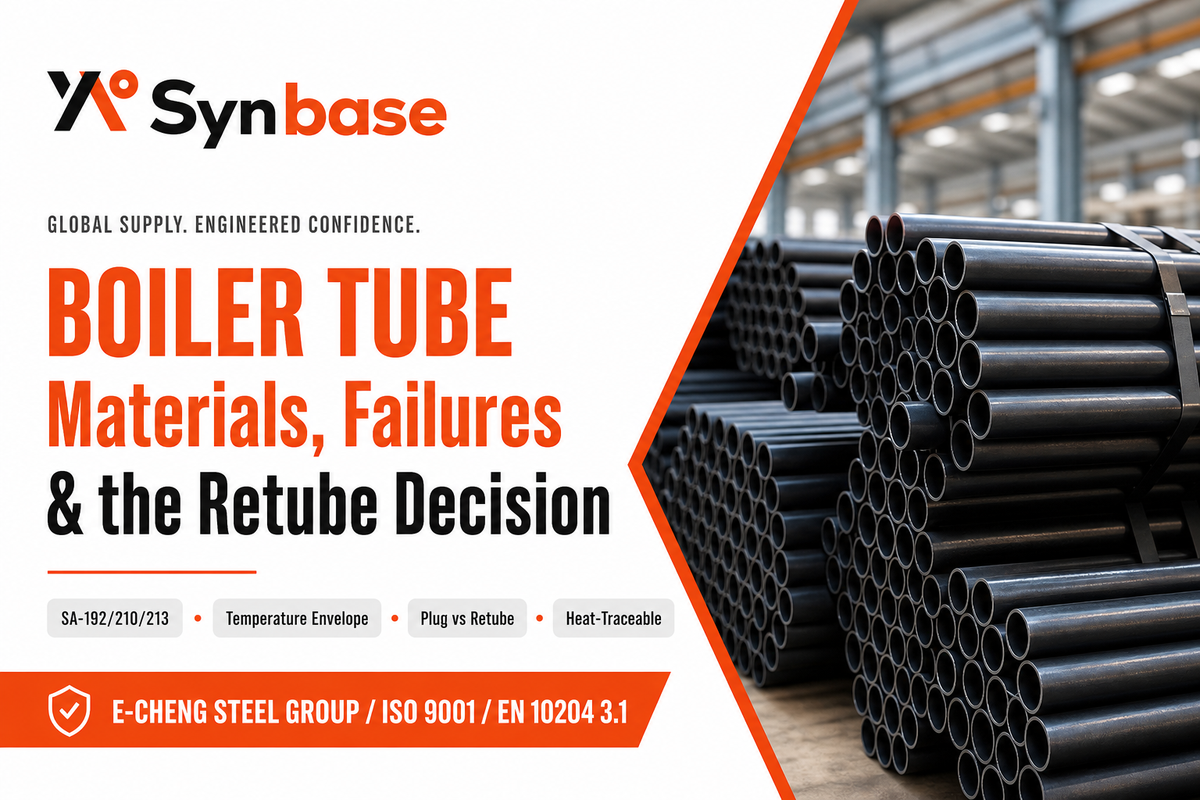
A boiler tube is the working core of every steam-generating boiler – a heat-transfer conduit that has to survive extreme temperature and pressure for years without failing. Most buying guides reduce boiler tube selection to a grade list. That skips the parts that actually decide whether a tube last five years or five months: the service temperature it will see, the specific zone it sits in, and how a supplier proves the material is what the paperwork claims.
A boiler tube is a seamless or welded metal conduit, sized by outer diameter and wall thickness rather than the inside-diameter convention used for pipe, that carries water or steam through a boiler’s pressure parts while resisting service temperatures from roughly 800F for plain carbon steel up to 1,050F and beyond for stainless grades.
| Common standards | ASTM/ASME SA-178 (welded carbon), SA-192 (seamless carbon, high-pressure), SA-210 (seamless carbon), SA-213 (seamless alloy T-grades + stainless TP-grades), SA-209 (carbon-moly) |
| Sizing convention | Outer diameter (OD) + wall thickness — not pipe’s inside-diameter/schedule convention |
| Common OD range | ~1.5″–3″ for commercial/industrial units; larger for utility-scale water-wall panels |
| Materials | Carbon steel, Cr-Mo alloy steel (T11/T22/T91/T92), austenitic stainless (TP304/TP316/TP321), nickel alloys for extreme service |
| Installation | Rolled (mechanically expanded) into the tubesheet, sometimes with a seal weld |
| Governing code | ASME Boiler and Pressure Vessel Code, Section I, plus the corresponding ASTM material specifications |
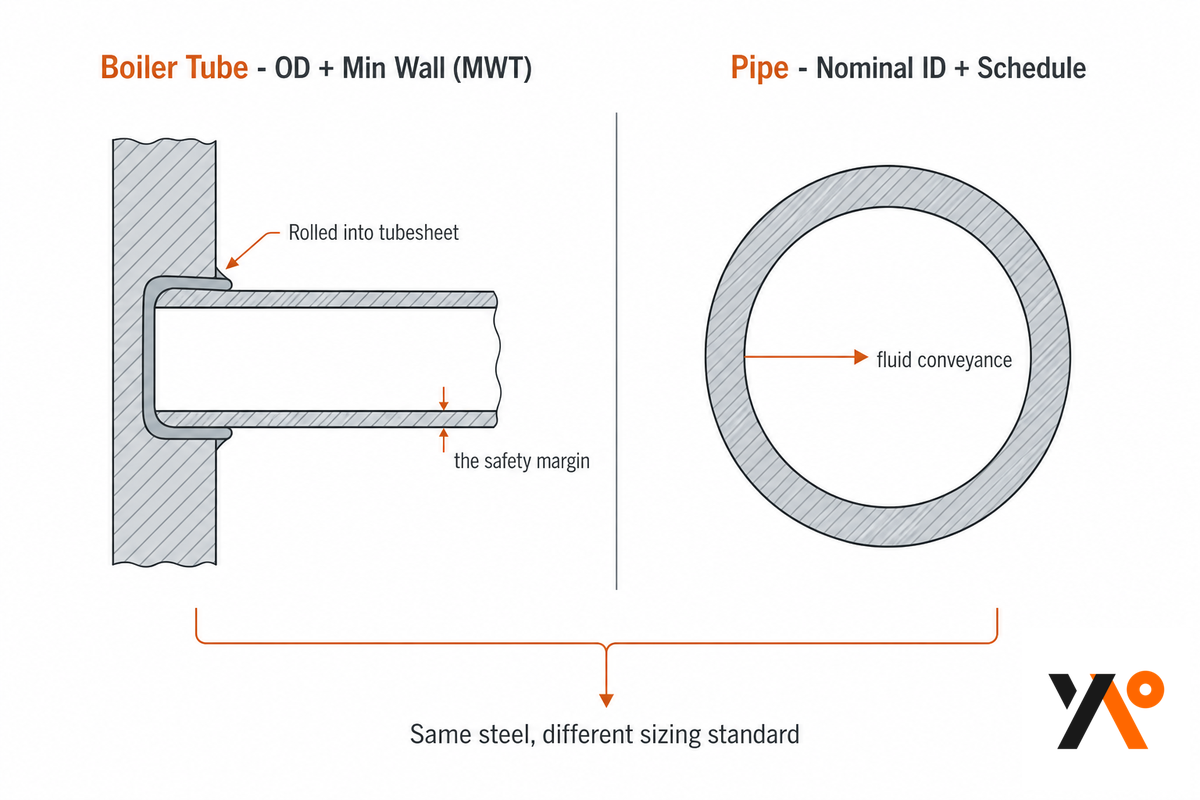
Inside a boiler, hot combustion gas passes across the outside of a bank of tubes while water or steam moves through the inside – or, in a fire-tube design, the reverse. That heat exchange is the tube’s entire job.
By contrast, a pipe’s job is different: moving a fluid volume from one point to another. That difference in purpose is why the two products are specified, sized, and manufactured differently, even when the underlying steel chemistry overlaps.
Which tube you need also depends on the type of boiler it serves: a watertube boiler routes water through the tubes with hot gas around them, while a firetube design does the reverse, and those two boiler systems put very different demands on the same tubing.
The clearest practical difference is sizing convention.
Pipe is specified by nominal size and schedule, which describe its inside diameter and wall thickness relative to a fluid-carrying bore. A boiler tube is specified by outer diameter (OD) and minimum wall thickness (MWT), because the wall itself – not the bore – is the safety margin against internal pressure at temperature, the pressure-part dimension the ASME Boiler and Pressure Vessel Code governs. A typical industrial boiler tube, for example, runs around 2 inches OD with a wall near 0.105 inch, and it is that wall, not the bore, that a boiler inspector tracks in the field with an ultrasonic gauge as ash corrosion and scale slowly thin it over the tube’s service life. That distinction also carries into manufacturing: a tube destined to be rolled into a tubesheet need tighter OD control than a general-purpose pipe standard guarantees, which is the root of a buying mistake covered later in this guide.
Get the sizing convention wrong on a purchase order – specifying by nominal pipe size instead of actual OD – and the fabrication shop either has to reject the shipment or attempt a rolling fit-up the tolerance was never designed for, both of which cost more than getting the spec right the first time.
Which grade you actually need comes down to two questions: what temperature will this tube see, and which zone of the boiler does it sit in?
The next two sections answer those in order.
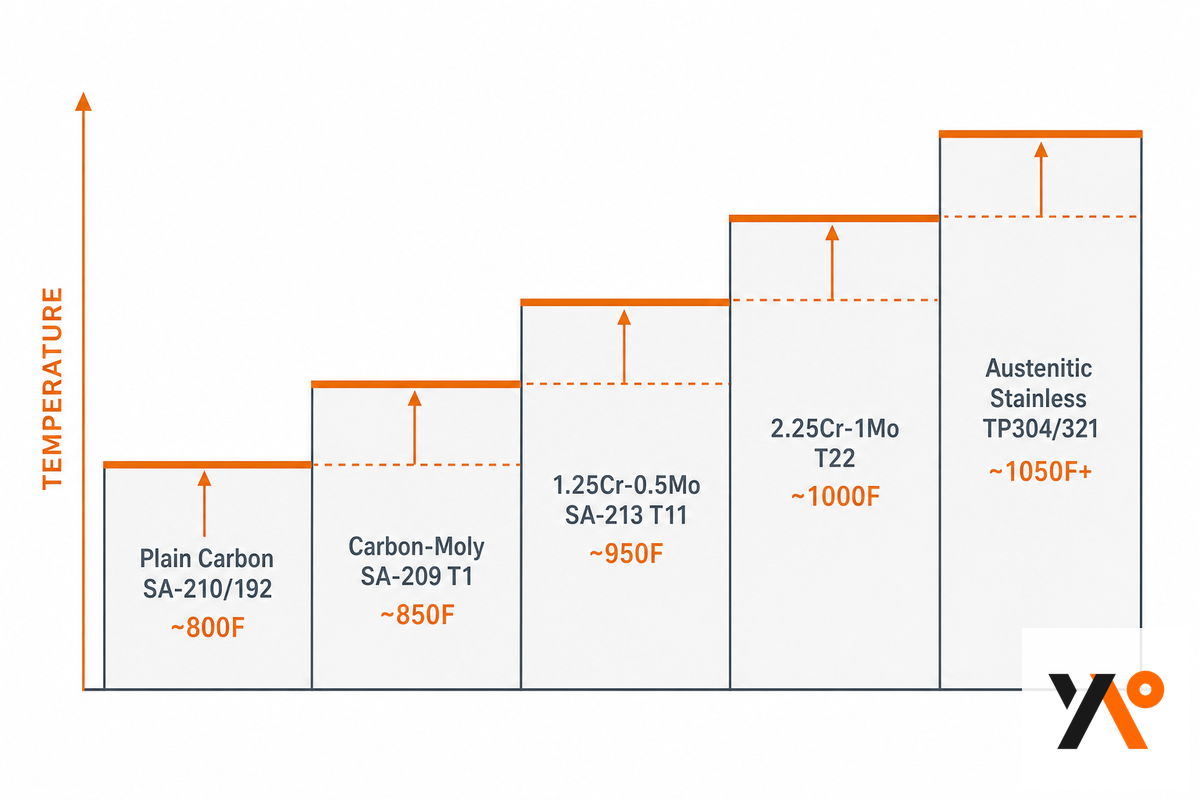
Every boiler tube material has a temperature ceiling – the point where the steel start to creep, meaning it slowly and permanently deforms under constant stress even well below its yield strength. Below that ceiling, material choice is mostly a cost question.
Above it, it becomes a code compliance question, because the ASME Boiler and Pressure Vessel Code sets allowable stress specifically to keep long-term creep deformation under control.
“Creep may be defined as a time-dependent deformation at elevated temperature and constant stress… one of the criteria used in the determination of allowable stresses is 1% creep expansion in 100,000 hours of service.”
Below is the table of the initial creep-onset temperature, broken out by material family, and paired against actual guidance from ASME rather than an competitor’s qualitative “high/medium/low” assessment. These figures are based on the underlying metallurgy, which doesn’t change year-over-year — but ASME periodically updates the exact allowable-stress tables in BPVC Section II-D.
Therefore, use the below figures as a planning-stage guide and verify the exact allowable stress for your application against the current version of the code.
| Material Family | Typical Grade | Initial Creep Onset |
|---|---|---|
| Plain carbon steel | SA-210 / SA-192 | ≈ 800°F (427°C) |
| Carbon + 1/2 Molybdenum | SA-209 T1 | ≈ 850°F (454°C) |
| 1.25Cr-0.5Mo | SA-213 T11 | ≈ 950°F (510°C) |
| 2.25Cr-1Mo | SA-213 T22 | ≈ 1,000°F (538°C) |
| Austenitic stainless | SA-213 TP304/TP321 | ≈ 1,050°F (566°C) and higher |
If your superheater outlet is operating at about 950F metal temp, you can see from the table that’s just about at the high end for 1.25Cr-0.5Mo (T11) service, and definitely beyond the allowable temperature range for SA-210 plain carbon steel (it’s already beyond the 800F creep-onset limit, and there’s no need for further design consideration beyond this point).
That’s not simply a cost decision, either; the National Board points out that 60F additional tube-metal temp (say, 1040F vs. 1100F) can reduce the life to 10% of that at the lower temp; boiler designers don’t run tubes up to the ceiling. More highly alloyed grades like T91/T92 will allow for even higher temperatures, but the added material cost and welding difficulty make it overkill in the 1.25Cr/5Cr range.
Among the carbon-steels alone, we handle pressure separately from temperature; SA-210 is written for general medium-high pressure boiler tube, whereas SA-192 specifically calls out use for seamless carbon-steel tube in high-pressure service, so the two are distinct pressure-duty specifications rather than a low-grade and high-grade version of the same tube.
Higher on the temperature spectrum, we rely on moderate alloy SA-213 T11/T22, high alloy T91/T92 (used in the SC/USC world), and high temp service SA-213 TP-series stainless where a corrosive flue-gas or process-side environment must be endured as well as high temps. Our P11/P22/P91/P92 Cr-Mo alloy pipe grades follow the same chemistry logic in pipe form, and our alloy pipe selection guide covers the T-grade-to-P-grade pairing in more depth.
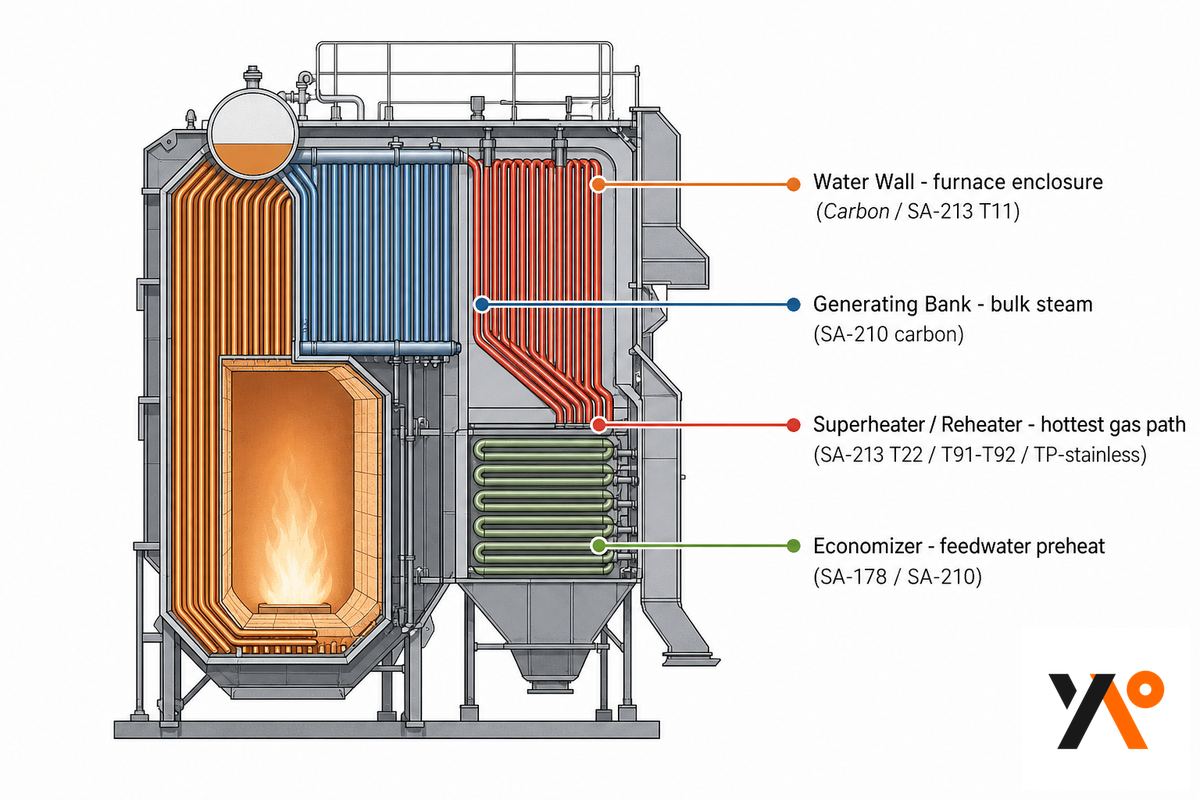
The boiler isn’t a single uniform bundle of tubing — there are a series of individual zones within the bundle, each with its own operating conditions, and frequently, a specific rule to follow. Selecting the incorrect material for a zone – due to temperature variations zone by zone as one proceeds from one section to the next – will result in premature failure.
| Zone | Role | Typical Family |
|---|---|---|
| Water wall | Forms the furnace enclosure itself — separates combustion gas from the outside atmosphere | Carbon steel or low-alloy, SA-210/SA-213 T11 |
| Generating bank | Bulk steam generation, moderate temperature | Carbon steel, SA-210 |
| Superheater / reheater | Raises steam beyond saturation for turbine service — the hottest gas-path exposure | SA-213 T11/T22/T91/T92 or TP-stainless |
| Economizer | Preheats feedwater with residual flue-gas heat before it enters the boiler proper | Carbon steel, SA-178 or SA-210 |
Stay tubes warrant a mention of their own: in some fire-tube applications they carry a structural load holding boiler plates together under internal pressure (in addition to or as opposed to a primary heat transfer duty). Along with headers and drums, tubes in each zone combine as the boiler parts for maintaining the rated pressure of the unit; this is one reason why replacement is governed zone by zone (covered below under inspection). Economizer tubes in particular are often supplied as finned tubing, sometimes spiral fin tubing, to improve the heat-transfer efficiency they pull from the cooler flue gas, while superheater and water-wall tubes usually stay bare. Using generating-bank grade for a water wall tube “because it’s the same carbon steel anyway” is a shortcut that usually works-until a unit operates its water wall hotter than its generating bank; the table at top then becomes exactly the reference needed to spot the mismatch before it becomes a problem in the field. For TP-series boiler tube in corrosion-heavy superheater or heat exchanger service, consult our stainless steel seamless pipe guide for selection logic similar to what’s found here. It’s also worth noting that ASTM SA-213 specifies all boiler, superheater and heat exchanger tubes in a single standard. If your job involves shell-and-tube heat exchangers too, see our heat exchanger tube page for that shared SA-213 family.
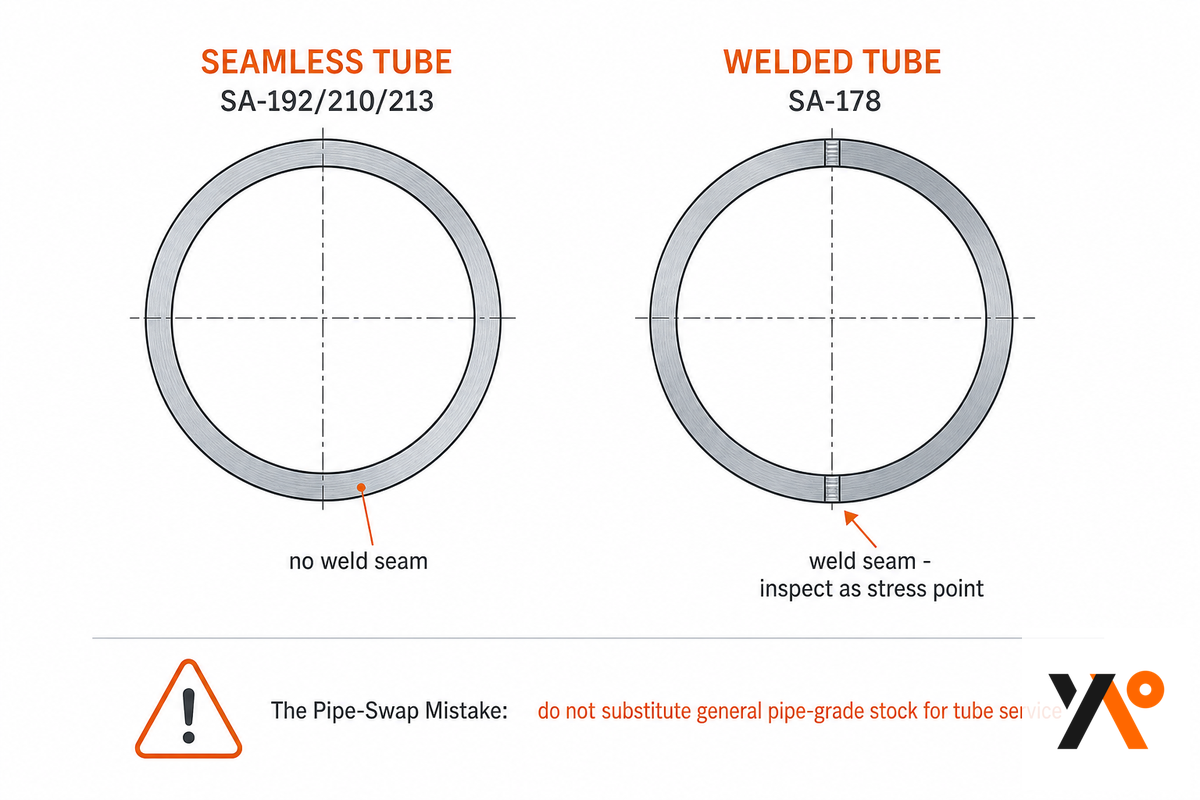
Boiler tubes come in both welded (SA-178) and seamless (SA-192, SA-210, SA-213) types, and – like pipe – seamless isn’t necessarily the better buy. Electric-resistance-welded, properly made SA-178 welded carbon steel tube is a valid boiler tube specification in its own right, not a downgrade from seamless.
The actual mistake in buying tube, as opposed to general pipe grade material (or a pipe standard’s tolerance band), is assuming chemistry alone indicates suitability. Tube and pipe dimensions aren’t interchangeable; tube standards control OD within very narrow tolerances to support reliable tubesheet rolling, while pipe standards are optimized for fluid conveyance, and schedules don’t neatly map to thickness specifications across standards. (If comparing welded vs seamless for your application, see the selector tool on our boiler tube product page, and for an explanation of seamless manufacturing see our seamless steel pipe guide).
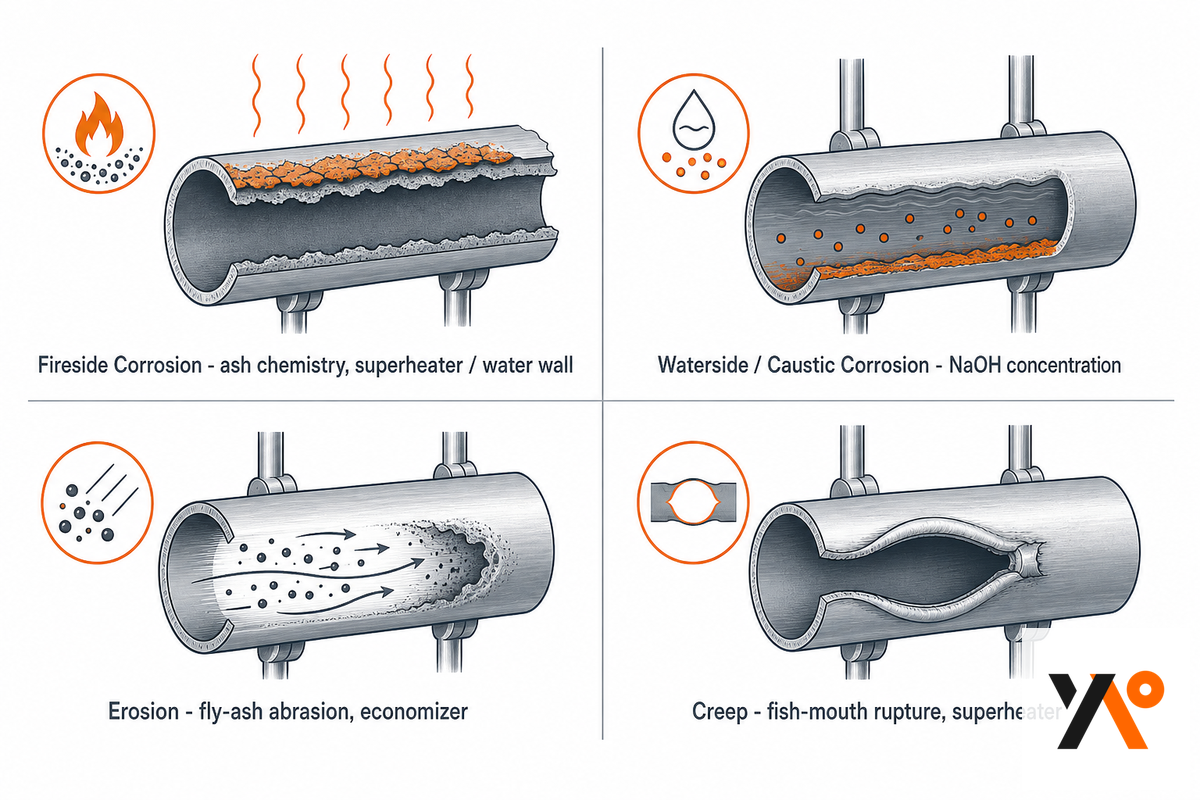
The typical boiler tube failure has very little to do with age and a lot to do with the mechanism driven by the zone it’s in. Corrosion, erosion, and creep each dominate in a different part of the boiler, so the first question in any failure analysis is not how old the tube is, but which zone it sat in and what that zone exposed it to.
| Mechanism | Typical Zone | What It Looks Like |
|---|---|---|
| Fireside corrosion | Superheater / reheater, water wall | Wall-loss rate varies by fuel and ash chemistry — one documented case measured ~15 mils/year (mpy) on a water-wall tube, another measured ~206 mpy on a superheater tube under severe ash-corrosion conditions (case studies below) |
| Waterside / caustic corrosion | Waterwall, generating bank | Corrosion-induced perforation leakage, driven primarily by sodium hydroxide (NaOH) concentration in boiler water chemistry |
| Erosion | Generating bank, economizer (coal/biomass-fired units) | Fly-ash particles abrading the tube outer surface, often concentrated at the gas-flow-facing side |
| Creep | Superheater / reheater | Thick-edged, “fish-mouthed” fracture with little ductility, often following prolonged wall thinning from another mechanism |
Two examples from a metallurgical failure-analysis report demonstrate this range of values rather than suggesting a single universal number: a 2.125-inch OD, 0.290-inch minimum-wall SA-213 T11 superheater tube, which served one year in a boiler unit fired on agricultural waste, experienced creep failure after fireside corrosion attenuated its wall by approximately 206 mils per year for this specific unit – driven by a chlorinated ash which dissolved its oxide scale. In a second case from the same report, a SA-210 A1 water-wall tube that served nine months experienced much lower wastage rates of 15 mils/year from a similar general mechanism with no wall-thickness reading less than minimum. Treat each as case history and not an assumption about your fuel and ash chemistry – an inspection plan is required, not published average data to determine your unit’s true wastage rate.
One case which contradicts intuition: the rate of coal-ash corrosion decreases above approximately 1250F due to breakdown of complex alkali trisulfates, which are the active corrosion compounds. In the worst fireside-corrosion zones, a weld overlay, a corrosion-resistant weld layer applied to the tube’s outer surface, is one common protective measure, though because it raises the tube’s outside temperature it has to be applied with the corrosion trade-off above in mind.
Key takeaway: match the inspection method to the mechanism your zone faces: fireside ultrasonic wall-thickness surveys for superheater and water-wall tubes, water-chemistry monitoring for waterside corrosion, and periodic visual/erosion checks where fly ash is present, rather than one generic inspection routine for the whole boiler.
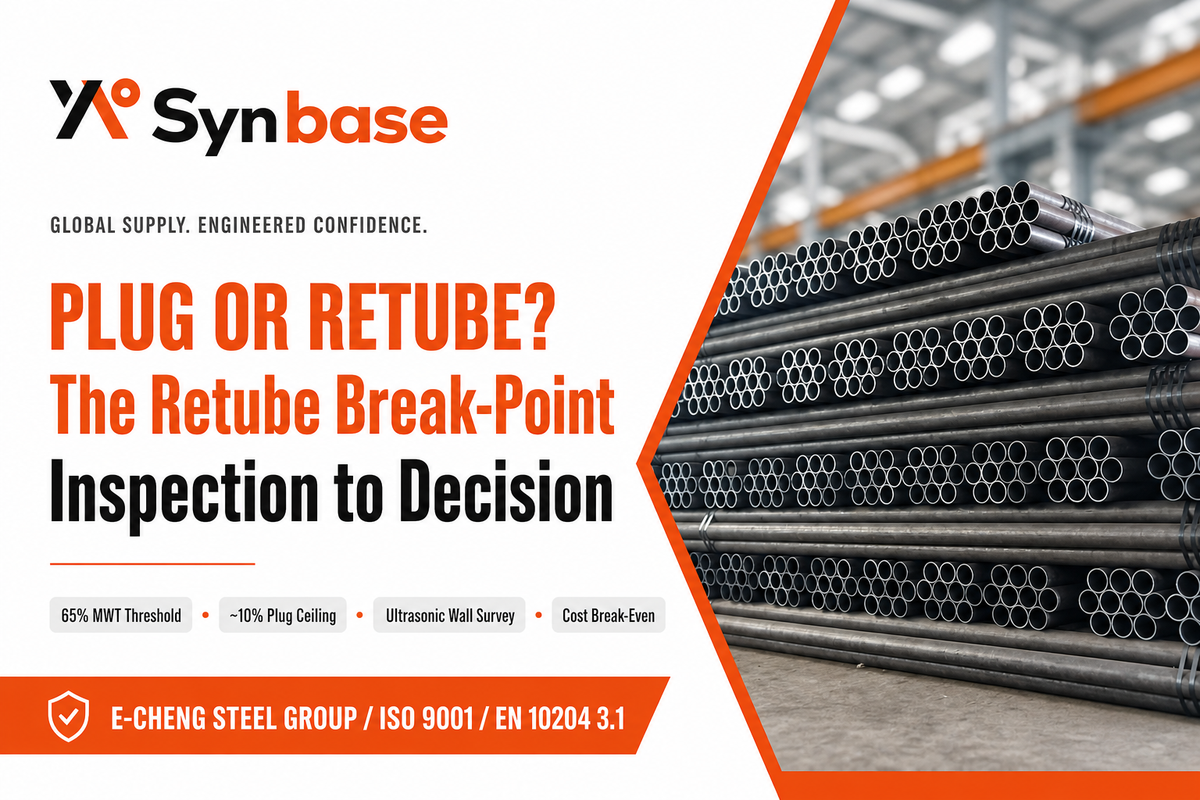
If the tube show some leakage or becoming thin then the choice isn’t immediately “retube the whole boiler”, there’s a known (and depending on zone, detailed) decision tree to follow – however this isn’t as simplistic as the generic “10% rule” you’ll read on the vast majority of boiler pages.
Cost is the other half of the equation. To get a feel for order-of-magnitude numbers, a typical tube repair on a small industrial (firetube-class) unit runs about $1,200-$2,000, according to a major vendor’s published pricing, while a full retube on that same class of unit might be about $15,000-$40,000 depending on size and accessibility (consider these illustrative vendor prices rather than a definitive industry standard, and note they don’t include outage costs). It’s outage cost that really drive the decision; in utility applications, at least, lost-generation and replacement-power costs during an unplanned outage will generally be many times the cost of physical tube repairs. Thus, the call on plugging vs. retubing is best left to an engineer who under stands your plant’s outage exposures, not a generalized percentage or quote.
“Boiler and heat recovery steam generator (HRSG) tube failures have been the primary availability problem for operators of conventional fossil-fueled and combined-cycle power plants for as long as reliable statistics have been kept… equipment availability loss due to boiler tube failures in coal-fired utility power plants above 200 megawatts averages around 3%.”
Keep in mind this is an average fleet-wide number rather than specific to any given unit, and it’s based on long-term averages. In any given year the number may fluctuate somewhat as plants add, retire, or modify equipment – the figure should be taken as a measure of the significance of tube failures as an availability factor rather than a precise prediction of this year’s exposure for your specific unit.
One of the first indicators that a tube may be nearing its limit is a sudden increase in feedwater to the boiler as the system begins to work harder to compensate for water escaping through the developing leak before the symptoms become obvious (a hissing noise or a puddle). Scale deposits are one of the more common underlying causes; these deposits insulate the tube from the cooling effect of the water, causing the tube metal to overheat, thin and rupture. Using Ultrasonic thickness testing during a scheduled outage is the standard practice for predicting and addressing the problem before it reaches the 65% MWT threshold and necessitates an unplanned shutdown.
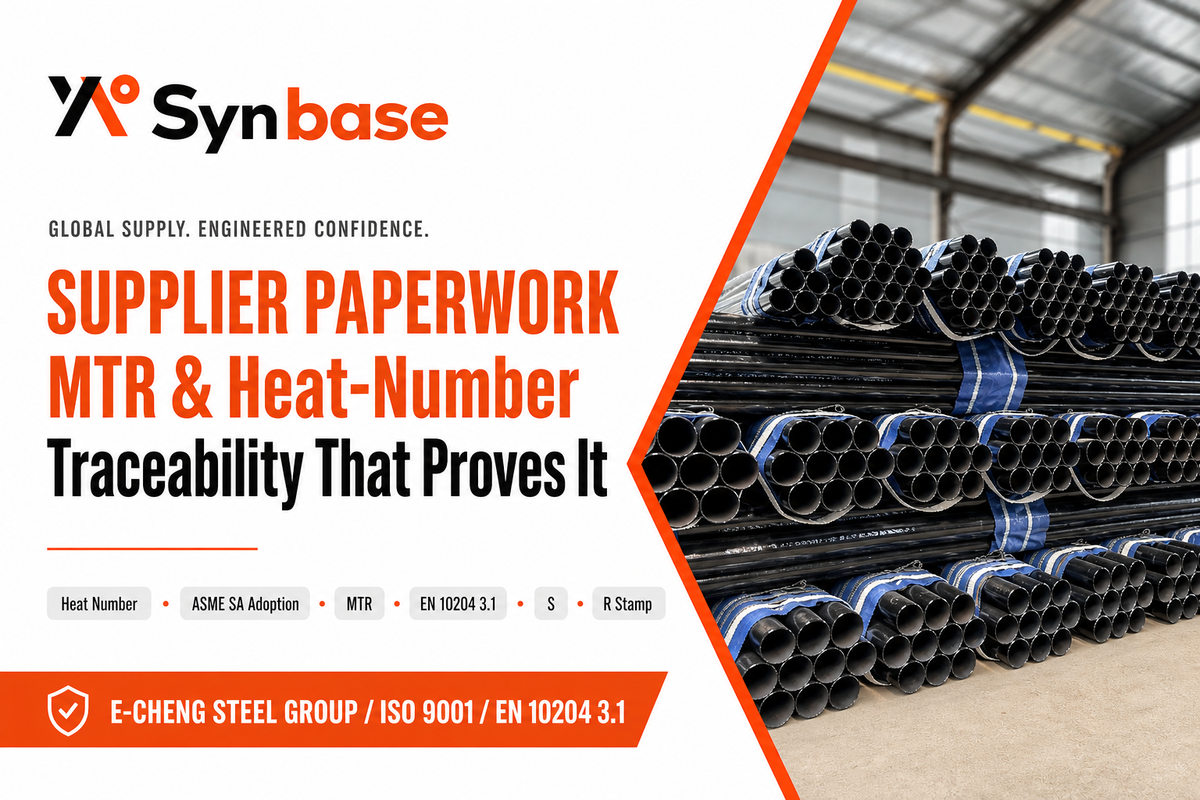
An ASTM designation on the mill certificate is not sufficient on its own; the purchaser must also confirm: 1) the Material Test Report (MTR) can be traced to the heat number and the actual chemical composition and mechanical testing for that heat – not just a generic grade number, and that the traceability can be maintained through delivery to the plant site (which is usually a requirement in boiler-repair codes).
That material traceability, together with the mechanical and chemical material requirements the grade sets, is what lets an inspector confirm the tube meets the project’s quality standards rather than just matching a printed grade name. And 2) is the material adopted by the current edition of the ASME Boiler and Pressure Vessel Code Section II-D for the application in which it will be used? (While an ASTM specification and an ASME “SA” code-adopted specification are similar, they are administratively different and the documentation should cite both.)
ASME “S” stamp (along with the corresponding NBIC-recognized “R” repair-symbol stamp) are your indications that a fabricator is capable of manufacturing or repairing boiler pressure parts to the ASME Code under the guidance of an Authorized Inspector – it’s a real, provable certificate, not some fluff used to sound important, and your supplier ought to readily supply a copy upon demand. What’s it designed to catch?
A heat number on a mill certificate which is different than the number stenciled onto the actual piece of pipe – a quick verification before accepting a delivery and placing the papers in a folder to collect dust. Our boiler tube product page delves deeper into the mill test certificate requirements, third party inspection possibilities and MOQs/lead-times for your particular grade and quantity if certification is what your project requires.
US search demand for “boiler tube” has eased by roughly 19% year over year, a mild replacement-cycle decline rather than a contracting market. The buyer’s risk here is misreading that soft domestic number as a shrinking end-market and under-ordering, a costly sourcing mistake, when demand has largely shifted offshore rather than disappeared, driven by where new steam-generation capacity is actually being built.
This signals a maturing, replacement-driven cycle for an industry in lieu of a contracting one: while the searching associated with a need to under take repairs, such as tube plugging, has held relatively steady, searching around new specification has decreased – indicative of a U.S. domestic installed base that’s aging rather than expanding. The true engine of demand is, more relevantly, for a mill-direct producer which targets international EPC contractors and energy industry customers, for locations in which new boiler capacity is in the process of coming online. Those buyers are typically building or servicing power-generation stations, refineries, and process plants whose boilers run on saturated and superheated steam, which is where new tube demand concentrates.
Such locales, which are geographically concentrated within Southeastern Asia, the Middle East, and other areas of the globe that are nonetheless bringing new power generating facilities online (e.g. fueled by new stream-generating equipment), aren’t necessarily mirrored in the U.S. domestic search trend described.
Materialistically, the push for supercritical and ultra-supercritical efficiency retrofits is continue driving the specification to higher-alloy grades (T91/T92 family) in superheater and reheater applications (where the temperature window described in earlier guide becomes critical). From the inspection standpoint, kernel based and other ML applications in continuous monitoring of boiler tube leaks – an area with heavy patenting activity – are complementary to, and not substituting the baseline annual ultrasonic wall-thickness survey inspection method. Based on global industrial boiler market size research (directional estimates given the discrepancy among sources) we can estimate a low-to-mid single digit annual global market growth through the early 2030’s- this should be thought of as background to a stable growing market and not a claim on which the present guide relies.
We don’t manufacture boilers, and we don’t build boiler equipment. As a direct-to-market producer of seamless and welded steel pipe and tube, Synbase Steel is invested in your selection of the correct boiler tube for a simple reason: a customer that understands the concepts in this guide is prepared to ask informed questions when they request a quote.
Our team has spent a considerable amount of time studying boiler regulations, plant operations, and OEM metallurgical studies – our goal is to help you access and process this information, so we’re not just making this up out of whole cloth. Our knowledge of boiler equipment and processes comes from extensive experience with international EPC buyers – this guide uses industry-accepted parameters as opposed to our own (often unpublished) testing data.
Synbase Steel supplies steel pipe, fittings, flanges, valves and OCTG for oil and gas, petrochemical, power, water and industrial projects. Our technical guides are written to help buyers compare standards, grades, dimensions, coatings, inspection requirements and commercial terms before sending an RFQ.
We focus on practical specification work: matching pipe process to service conditions, checking wall thickness and end finish, reviewing MTC and NDT requirements, and clarifying documentation before production or shipment.
Project support across seamless pipe, ERW, LSAW, SSAW, buttweld fittings, forged flanges, valves and oilfield tubulars.
Specification review for ASTM, ASME, API, EN and DIN standards, including material grade, pressure class, coating and inspection scope.