Send Your RFQ to Synbase Steel
Prefer to send drawings, BOMs or attachment lists by email? sales@synbasesteel.com
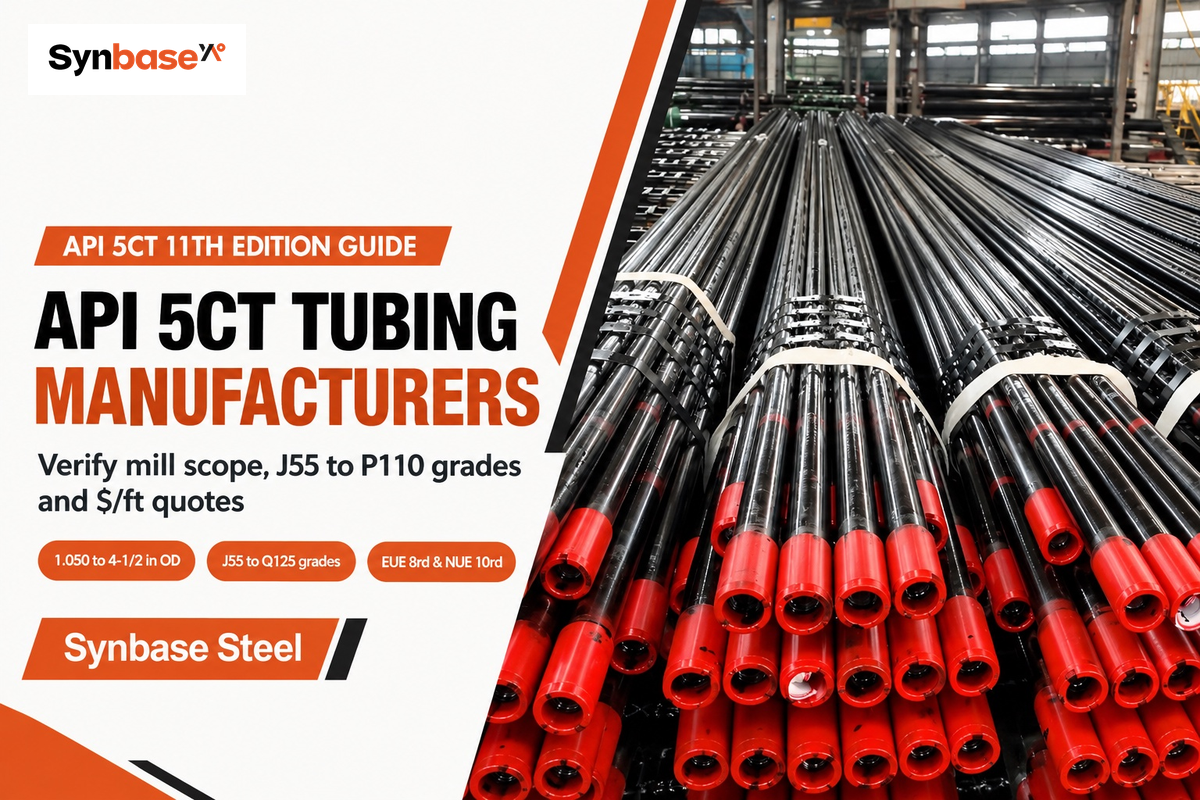
API 5CT tubing manufacturers supply oilfield production tubing under API Specification 5CT through licensed pipe mills, heat-treatment processors, and API Spec 5B threading facilities. Vetting these suppliers requires checking their active Pipe Mill or Processor scope on mycerts.api.org and verifying standalone threading under API Spec 5B. Buyers then match each steel grade to wellbore H2S partial pressure and normalize quotes per usable foot.
Completion engineers and tubular buyers are exposed to several risks during the acquisition process of oil and gas well construction. One risk involves a standalone threading shop or processor quoting plain-end mother pipe products without disclosing the third-party source of the hot rolling. A second risk applies to buyers for wells that require more stringent controls than the base specification. In the oil and gas industry, buyers of oil and gas resources must perform strict verification of tubulars for production of oil and gas. Direct project supplies are available. See our API 5CT tubing specifications and mill-direct supply options. You can also use the engineering audit framework to evaluate global pipe manufacturers.
| Specification Parameter | API Spec 5CT 11th Edition Baseline | Buyer Verification Requirement |
|---|---|---|
| Governing Standard | API Spec 5CT 11th Edition (Addendum 1 published May 20, 2025) | Cite IOGP S-735 or explicit purchase-order clauses to enforce former PSL-2 and PSL-3 testing |
| Tubing Outer Diameter Range | 1.315 in (33.40 mm) to 4-1/2 in (114.30 mm) standard nominal outer diameter | Verify drift mandrel diameter per API Table C.29 and wall thickness tolerance per purchase specification |
| Steel Grade Groups | Group 1 (H40, J55, N80), Group 2 (M65, L80, C90, T95), Group 3 (P110), Group 4 (Q125) | Confirm NACE MR0175 / ISO 15156-2 Table A.3 hardness caps and environmental limits |
| End Types & Threading | Non-Upset (NUE 10rd), External Upset (EUE 8rd), Integral Joint (IJ 10rd), Premium | Check active API Spec 5B license scope and master ring and plug gauge calibration |
| Standard Length Ranges | Range 1 (20–24 ft), Range 2 (28–32 ft), Range 3 (38–42 ft) | Specify target range and pup-joint space-out tally in the purchase order |
| Non-Destructive Examination | Every-length hydrostatic testing, full-length drift test, and grade-dependent UT / EMI inspection | Specify ultrasonic reference notch depth and EN 10204 3.1 or 3.2 witness sign-off in the purchase order |
| License Verification Portal | American Petroleum Institute (API) Composite List at mycerts.api.org | Verify API 5CT Pipe Mill or Processor scope and API Spec 5B threading scope |
| Commercial Invoicing Basis | Theoretical plain-end or threaded-and-coupled weight versus scale weight | Normalize quotes to delivered cost per usable foot including closed-end thread protectors |
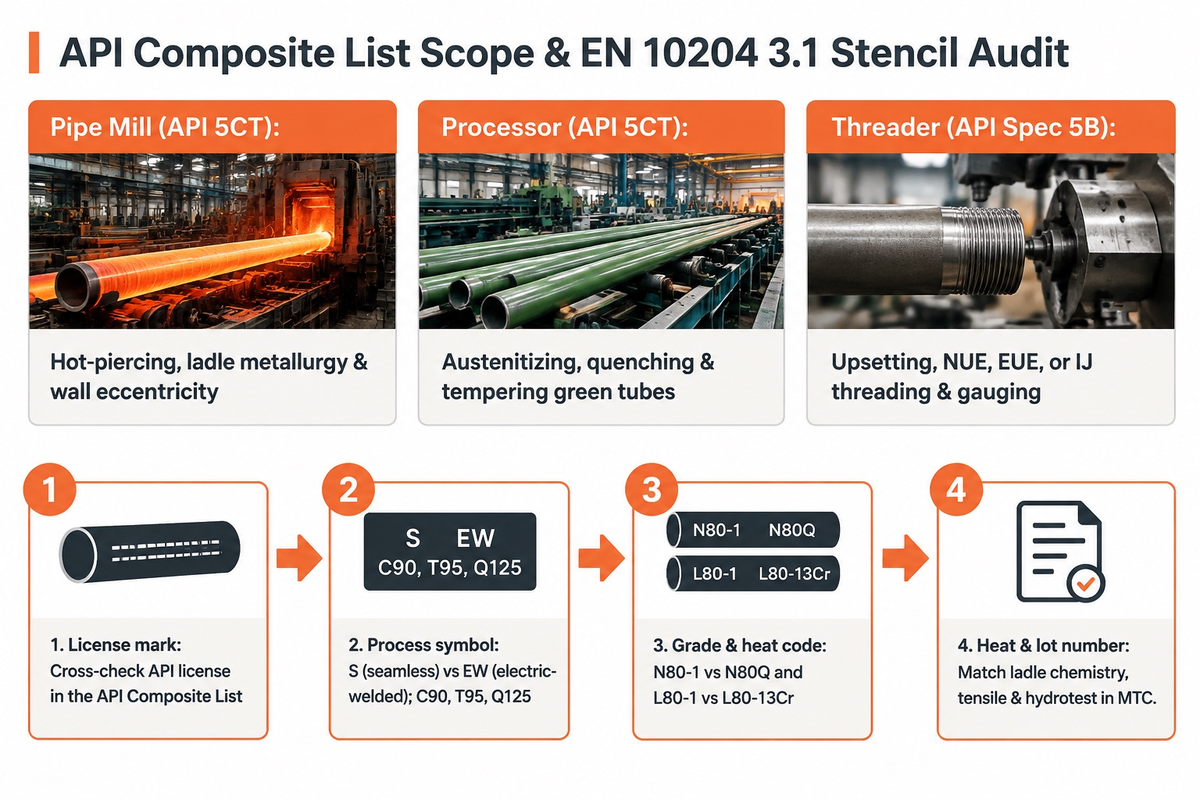
The API Composite List should be checked for three relevant supply scopes across global API 5CT tubing manufacturers. Buyers need to check which authorization appears on the supplier’s certificates prior to awarding oilfield tubing contracts.
While the baseline parameter table above outlines the governing api standard, the physical supply chain determines who controls steel cleanliness. An API 5CT certificate in the pipe manufacturing industry is valid even if the export vendor has no piercing mill. Some casing pipe manufacturers also supply tubing through different threading lines. A 3-tier verification check on the official API Monogram and APIQR Composite List Directory protects your procurement team. It ensures that a processor or threading shop isn’t passing itself off as an integrated seamless steel pipe mill.
Enter a supplier’s license number (5CT-XXXX) on mycerts.api.org to inspect its active registration. The American Petroleum Institute directory displays the exact product and activity scope granted under a rigorous quality management system. Buyers distinguish between an API 5CT Pipe Mill, an API 5CT Processor, and an API Spec 5B threader:
A commercial quotation must disclose if the supplier rolls the mother pipe in house or processes third party green tubes. If a processor supplies sour-service L80 or C90 tubing, the Purchase Order must require dual traceability. This documentation links the processor’s heat treatment lot to the original steelmaking mill’s continuous casting bloom certificate.
Primary integrated steel pipe manufacturers run a network of manufacturing facilities with continuous hot rolling mills. Primary mills focus on scheduled rolling campaigns of single size tubing strings. Their EAF and BOF melt schedules are planned to encompass full furnace heat lots of each grade and outer diameter.
When an operator needs a mixed completion string of 2-7/8 in L80 tubing, 2-3/8 in N80Q tubing, and crossover pup joints, primary mills usually force long rolling waits on a project. Consolidated project suppliers such as Synbase Steel OCTG manufacturing and NDT inspection facilities fill these gaps. They’ve mill-direct production lines and bring ultrasonic testing and third-party witness into their scope. Rolling the mills at the right time with respect to current API 5CT 11th Edition specification requirements avoids customs or rig-site paperwork delays.
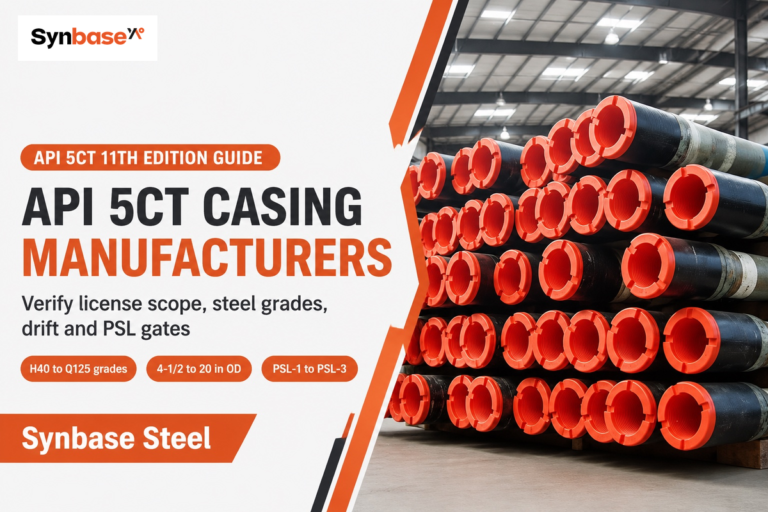
Every joint of API 5CT casing and tubing leaving a licensed facility bears die stamped markings and paint stenciled ID bands. Receiving Inspectors verify the pipe body markings against the EN 10204 3.1 Mill Test Certificate (MTC), license mark, manufacturing process, grade and heat or lot, and traceability.
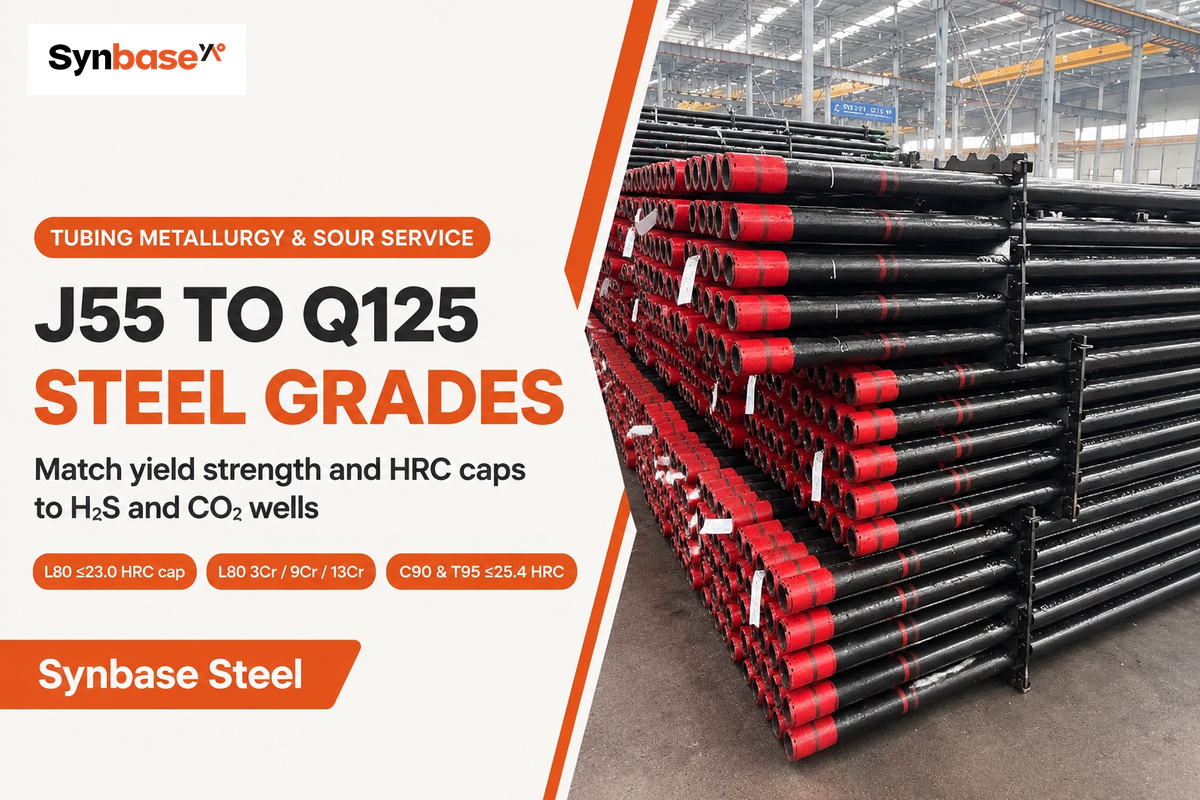
Selecting an API 5CT steel grade for tubing requires matching the specified yield strength and any applicable hardness. Some grades do not have a base API hardness cap. Engineers match the grade’s specified strength and wall thickness to burst and axial loads, while using its alloy system and the well environment to assess H2S or CO2 corrosion resistance. Yield strength alone does not qualify a pipe for sour gas service.
Once a mill holds an active API 5CT license for the specified group, the focus shifts to metallurgy for the downhole environment. Since API 5CT is a standard technical specification for steel pipes, each grade for tubing enforces specific requirements on yield and hardness. A common procurement mistake is treating N80 and L80 as 80 ksi equivalent grades. You can check candidate strings in our Interactive API 5CT tubing steel grade Selector.
Group 1 of API 5CT covers carbon and low-alloy steels for sweet oil and gas well construction. In these wells, H2S partial pressure stays below the NACE MR0175 sour threshold. Within this standard technical specification, grades such as J55 and K55 serve low-to-medium pressure wells. While API 5CT j55 and API 5CT k55 share an identical yield strength window of 55 to 80 ksi (379 to 552 MPa), they differ in ultimate tensile strength. Under the API 5CT technical specification for J55 and K55 mechanical properties, J55 requires a minimum tensile strength of 75 ksi (517 MPa) for production tubing. In contrast, K55 requires 95 ksi (655 MPa) and is predominantly rolled for octg casing strings.
N80-1/N80-Q and L80-1 share an 80 ksi (552 MPa) minimum yield strength, while N80 grades require 100 ksi (689 MPa) minimum tensile strength. N80 Type 1 can be normalized or normalized and tempered. N80Q requires a quenched and tempered heat treatment, and the qualified product’s actual collapse and Charpy performance need to be established from the product’s specified manufacturing and test results.
When a wellbore enters sour or wet-CO2 corrosive environments, unrestricted hardness becomes a failure trigger. Even though N80 and L80 share the same 80 ksi (552 MPa) minimum yield strength, N80 has no maximum hardness cap and a 30 ksi yield span. N80, however, has no hardness cap and a 30 ksi yield span, so its hardness can vary. This can lead to hardness spots that can fail from H2S exposure. Buyers should request hardness tests through the wall, because API 5CT and NACE MR0175 hardness limits impose different metallurgical constraints.
Sour-service suitability is governed by the applicable material and environmental limits in NACE MR0175 / ISO 15156-2, including wellbore temperature and H2S partial pressure:
For high pressure gas well construction, Group 3 P110 provides 110 to 140 ksi (758 to 965 MPa) yield strength and 125 ksi (862 MPa) minimum tensile strength. Group 4 Q125 reaches 125 to 150 ksi (862 to 1,034 MPa) yield strength. Standard P110 has no maximum hardness limit in base API 5CT and is vulnerable to sulfide stress cracking at low downhole temperatures. Any sour-service deployment of high strength P110 or proprietary SSC-resistant grades must satisfy the applicable ISO 15156-2 environmental limits and project-specific NACE TM0177 qualification testing.
| Steel Grade Category | API 5CT Group & Type | Yield Strength (ksi / MPa) | Min Tensile Strength (ksi / MPa) | Max Hardness (HRC / HBW) | Color Band Code (Table C.43) | NACE MR0175 / ISO 15156-2 Sour-Service Window |
|---|---|---|---|---|---|---|
| Low-Pressure Sweet Category | Group 1 — H40 | 40–80 ksi (276–552 MPa) | 60 ksi (414 MPa) | No base cap (≤22 HRC if NACE) | None or 1 Black Band | Requires applicable hardness and environmental qualification |
| Standard Sweet Production Category | Group 1 — J55 | 55–80 ksi (379–552 MPa) | 75 ksi (517 MPa) | No base cap (≤22 HRC if NACE) | 1 Bright Green Band | Subject to ISO 15156-2 hardness and environmental limits |
| High-Tensile Casing Grade Category | Group 1 — K55 | 55–80 ksi (379–552 MPa) | 95 ksi (655 MPa) | No base cap (≤22 HRC if NACE) | 2 Bright Green Bands | Casing grade; sour use subject to ISO 15156-2 conditions |
| Medium-Depth Normalized Category | Group 1 — N80 Type 1 | 80 ksi min (552 MPa min) | 100 ksi (689 MPa) | No base cap | 1 Red Band | Limited by ISO 15156-2 environmental and hardness rules |
| Medium-Depth Q&T Sweet Category | Group 1 — N80Q | 80–110 ksi (552–758 MPa) | 100 ksi (689 MPa) | No cap | 1 Red + 1 Bright Green | Requires material and environmental qualification per ISO 15156-2 |
| Hardness-Controlled Sour Category | Group 2 — L80 Type 1 | 80–95 ksi (552–655 MPa) | 95 ksi (655 MPa) | 23.0 HRC (241 HBW) | 1 Red + 1 Brown Band | Governed by ISO 15156-2 environmental and hardness limits |
| Sweet Wet-CO2 Alloy Category | Group 2 — L80 3Cr (11th Ed.) | 80–95 ksi (552–655 MPa) | 95 ksi (655 MPa) | 23.0 HRC (241 HBW) | 1 Red + 1 White/Yellow | Engineered for sweet CO2 corrosion; restricted in H2S |
| Martensitic CO2 Chrome Category | Group 2 — L80 9Cr / 13Cr | 80–95 ksi (552–655 MPa) | 95 ksi (655 MPa) | 23.0 HRC (241 HBW) | 1 Red + 1 Brown + 2 Yellow (9Cr) / 1 Red + 1 Brown + 1 Yellow (13Cr) | Sweet CO2 service; subject to H2S and pH limits |
| Deep Sour Cr-Mo Q&T Category | Group 2 — C90 / T95 | 90–105 / 95–110 ksi (621–724 / 655–758 MPa) | 100 / 105 ksi (689 / 724 MPa) | 25.4 HRC (255 HBW) | 1 Purple (C90) / 1 Silver (T95) | Must satisfy ISO 15156-2 limits; add TM0177 testing per PO |
| Deep-Well High-Strength Category | Group 3 P110 / Group 4 Q125 | 110–140 / 125–150 ksi (758–965 / 862–1,034 MPa) | 125 / 135 ksi (862 / 931 MPa) | No base cap (unless specified) | 1 White (P110) / 1 Orange (Q125) | Sour use requires qualification against environmental and hardness rules |
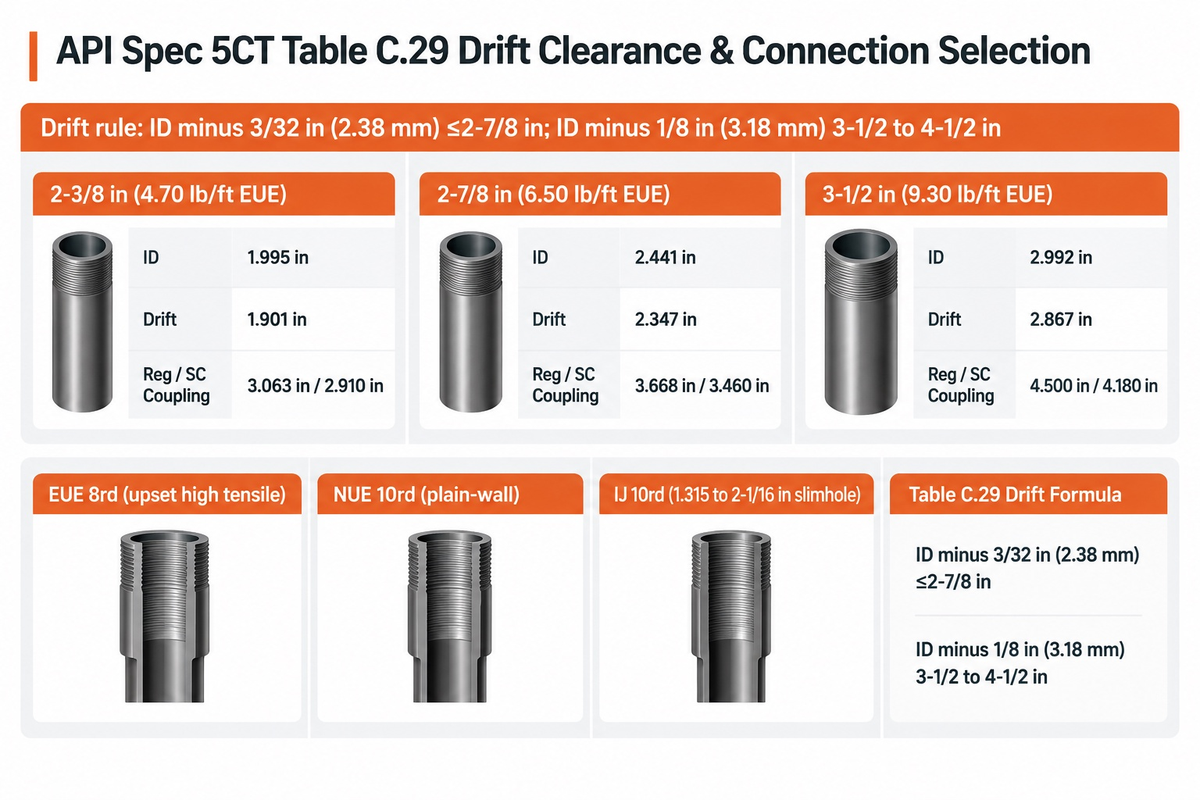
Production tubing under API 5CT is specified by nominal outer diameter (typically 1.315 in to 4-1/2 in) and weight per foot. Meanwhile, internal drift mandrel diameter and end types, External Upset End (EUE 8rd), Non-Upset End (NUE 10rd), or Integral Joint (IJ), govern downhole tool passage and joint tensile efficiency.
Choosing the right steel grade from the sour-service matrix solves only half of the completion design problem. If the pipe body or coupling geometry restricts annular clearance within the production casing, the string cannot run safely. Likewise, if thread roots gall during rig makeup, the connection will leak under pressure. Engineers can confirm exact wall and drift geometries with our API 5CT tubing weight and drift mandrel calculator and companion API 5CT casing pipe strings.
A common field question is whether tubing size refers to inside diameter (ID) or outer diameter (OD). Under the 5ct standard, every 5ct size is defined strictly by its exact outside diameter paired with a nominal linear weight in pounds per foot (lb/ft). Among the standard API 5CT tubing dimensions, 2-3/8 in, 2-7/8 in, and 3-1/2 in serve as the three standard workhorse sizes across global onshore and offshore fields.
As wall thickness increases on a fixed outer diameter, the nominal inside diameter shrinks. However, completion engineers never size electric submersible pumps (ESPs), packers, or wireline plugs against nominal ID. Instead, downhole tools are sized against the API drift diameter. That value is the diameter of a cylindrical mandrel of specified length (42 in / 1,067 mm for tubing ≤2-7/8 in OD) that must pass freely through the joint. Under API Spec 5CT Table C.29, the standard drift diameter equals nominal ID minus 3/32 in (2.38 mm) for tubing up to 2-7/8 in OD. For tubing from 3-1/2 in to 4-1/2 in OD, standard drift equals nominal ID minus 1/8 in (3.18 mm).
| Nominal Size (OD in.) | Nominal Weight (lb/ft) | Wall Thickness (in. / mm) | Nominal ID (in. / mm) | API Drift Diameter (in. / mm) | End Connection & Regular Coupling OD (in.) | Special-Clearance Coupling OD (in.) |
|---|---|---|---|---|---|---|
| 1.050 in (26.67 mm) | 1.14 lb/ft (NUE) / 1.20 (EUE) | 0.113 in (2.87 mm) | 0.824 in (20.93 mm) | 0.730 in (18.54 mm) | NUE 1.313 in / EUE 1.660 in | Not standard (use IJ 1.325 in box) |
| 1.315 in (33.40 mm) | 1.70 lb/ft (NUE) / 1.80 (EUE) | 0.133 in (3.38 mm) | 1.049 in (26.64 mm) | 0.955 in (24.26 mm) | NUE 1.660 in / EUE 1.900 in | IJ Box OD 1.550 in |
| 1.660 in (42.16 mm) | 2.30 lb/ft (NUE) / 2.40 (EUE) | 0.140 in (3.56 mm) | 1.380 in (35.05 mm) | 1.286 in (32.66 mm) | NUE 2.054 in / EUE 2.200 in | IJ Box OD 1.880 in |
| 1.900 in (48.26 mm) | 2.75 lb/ft (NUE) / 2.90 (EUE) | 0.145 in (3.68 mm) | 1.610 in (40.89 mm) | 1.516 in (38.51 mm) | NUE 2.200 in / EUE 2.500 in | IJ Box OD 2.110 in |
| 2-3/8 in (60.32 mm) | 4.60 lb/ft (NUE) / 4.70 (EUE) | 0.190 in (4.83 mm) | 1.995 in (50.67 mm) | 1.901 in (48.29 mm) | NUE 2.875 in / EUE 3.063 in | EUE Special Clearance 2.910 in |
| 2-3/8 in Heavy Wall | 5.80 lb/ft (NUE) / 5.95 (EUE) | 0.254 in (6.45 mm) | 1.867 in (47.42 mm) | 1.773 in (45.03 mm) | NUE 2.875 in / EUE 3.063 in | EUE Special Clearance 2.910 in |
| 2-7/8 in (73.02 mm) | 6.40 lb/ft (NUE) / 6.50 (EUE) | 0.217 in (5.51 mm) | 2.441 in (62.00 mm) | 2.347 in (59.61 mm) | NUE 3.500 in / EUE 3.668 in | EUE Special Clearance 3.460 in |
| 2-7/8 in Heavy Wall | 8.60 lb/ft (NUE) / 8.70 (EUE) | 0.308 in (7.82 mm) | 2.259 in (57.38 mm) | 2.165 in (54.99 mm) | NUE 3.500 in / EUE 3.668 in | EUE Special Clearance 3.460 in |
| 3-1/2 in (88.90 mm) | 9.20 lb/ft (NUE) / 9.30 (EUE) | 0.254 in (6.45 mm) | 2.992 in (76.00 mm) | 2.867 in (72.82 mm) | NUE 4.250 in / EUE 4.500 in | EUE Special Clearance 4.180 in |
| 4-1/2 in (114.30 mm) | 12.60 lb/ft (NUE) / 12.75 (EUE) | 0.271 in (6.88 mm) | 3.958 in (100.53 mm) | 3.833 in (97.36 mm) | NUE 5.200 in / EUE 5.563 in | Verify casing ID clearance before run |
Together, API Spec 5CT and API Spec 5B provide the three standard threaded end types for production tubing pipe, as well as proprietary premium connections. Users can model tensile loads of strings and annular envelopes in our EUE, NUE, and premium tubing connection selector:
When running 2-7/8 in EUE tubing inside heavy-wall 5-1/2 in or 5 in production casing, a standard EUE coupling (3.668 in OD) leaves tight fishing clearance. Specifying factory-machined special-clearance API 5CT tubing and casing couplings reduces the coupling OD to 3.460 in (or 2.910 in on 2-3/8 in EUE). That smaller profile preserves joint strength inside slim annular clearances.
However, standard API 8-round and 10-round threads are non-shouldered interference threads whose crest-to-root helical clearance path relies on API RP 5A3 thread compound to seal fluids. In high-pressure dry gas wells, gas-lift strings, or high-temperature cyclic wells, thread dope can degrade. For these wells, engineering designs such as US Patent US4377302A for gas-leak-tight oil well pipe threaded joints guide connection selection. ISO 13679 and API RP 5C5 testing support upgrading to metal-to-metal radial seal and positive torque-shoulder premium connections. Proper manganese or zinc phosphating, copper plating on CRA grades, and controlled rig makeup torque prevent thread galling during API 5CT coupling installation and thread protection.
Where a purchase specification invokes IOGP S-735, buyers can request product-level, inspection, and traceability requirements of API 5CT tubing in their orders. An IOGP S-735 purchase specification can request reference-notch ultrasonic testing, Charpy V-notch impact testing, and documented inspection by purchaser or his/her representative under EN 10204 3.2.
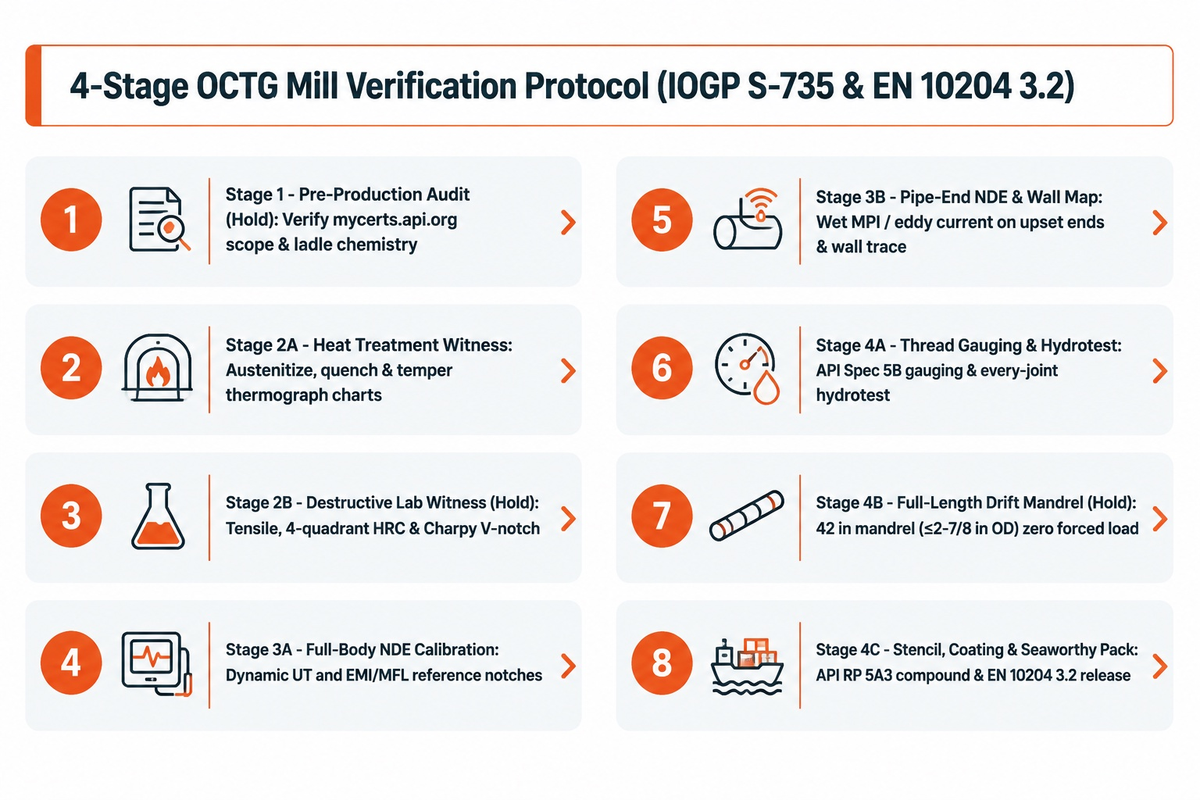
Even an adequately sized EUE or premium connection will fail downhole if the mother pipe contains undetected quench cracks or falsified test certificates. Meeting all chemical requirements and physical requirements for casing and tubing is mandatory prior to shipment. Our quality engineers strictly implement the 4-Stage OCTG Mill Verification Protocol on every export shipment to avert defects during seaworthy bundling.
The 11th Edition of API Spec 5CT removed Annex H in December 2023. Buyers retain enhanced PSL-2 and PSL-3 by including IOGP Specification S-735 or specific Supplementary Requirements (SR) to the purchase order. In May 2025, API released the official API Spec 5CT 11th Edition Addendum 1.
When a purchase order only states “API 5CT PSL-2”, the inspection clauses are left undefined, and the contractual requirements are left ambiguous. These requirements should be tied to explicit supplementary requirements. Specifically, buyers should require full-body NDE coverage for Group 1 pipe and reference notch depths for ultrasonic and flux leakage flaw detection. Purchase specifications should require lot by lot inspection certificates and Charpy V Notch impact tests.
In the baseline API 5CT standards condition, Group 1 J55 and K55 tubing isn’t guaranteed to be examined by full body NDE. In rotary pierced seamless steel pipes, wear on the mandrel can result in eccentric wall thickness and a helical shape. Local thin spots and internal corrosion quickly erode the burst safety factors.
When sourcing Group 2 (L80, C90, T95) and Group 3 (P110) tubing products, buyers should mandate full body NDE on the final heat treatment. The same requirement should be applied when upgrading sweet strings to former PSL-2 or PSL-3 standards. Automated UT, combined with electromagnetic inspection (EMI / MFL) and helical wall-thickness mapping, verifies wall integrity across the full length of API 5CT steel pipes. UT rollers leave uninspected zones at each pipe end. As such, the end of the pipe should be inspected by one of the two following methods: (1) wet MPI or (2) eddy current. Pipe ends composed of ferromagnetic material should always be inspected by (1) above.
Paperwork alone never ensures compliance during OCTG receiving inspections for dimensional and NDE defects. Sr. Metallurgists on Eng-Tips sour-service low-alloy steel forums also point out the need for site visits to verify hardness and batch furnace charts for heat treatment. Buyers can modify their purchase orders to incorporate our 4-Stage OCTG Mill Verification Protocol and request EN 10204 3.2 inspection documents with purchaser/independent inspector witness hold points.
| Audit Stage & Hold Point | Manufacturing Phase | Mandatory Inspection & Test Action | Acceptance Standard & Deliverable |
|---|---|---|---|
| Stage 1 — Pre-Production Audit (Hold) | Billet Receipt & License Check | Verify active mycerts.api.org facility and product scope and grade-specific ladle chemical composition | API Spec 5CT chemical limits; signed raw-material release certificate |
| Stage 2A — Heat Treatment Witness | Austenitize, Quench & Temper | Audit furnace pyrometry uniformity and record quench medium temperature and immersion dwell time | Furnace thermograph strip charts bound to each heat-treatment lot number |
| Stage 2B — Destructive Lab Witness (Hold) | Mechanical & Sour Lab Testing | Witness tensile tests, 4-quadrant through-wall Rockwell C hardness, and Charpy V-notch impact tests | For sour-service orders, specify the applicable hardness, impact, and SSC qualification requirements in the PO |
| Stage 3A — Full-Body NDE Calibration | Post-Heat-Treatment NDE Line | Witness dynamic calibration of UT and EMI/MFL units using the specified reference notches | Verified pass of reference calibration tube before and after production run |
| Stage 3B — Pipe-End NDE & Wall Map | Upset Zones & Plain Ends | Perform end-zone flaw inspection on upset transitions and verify ultrasonic wall-thickness trace | Zero rejectable linear indications; wall thickness compliant with API Spec 5CT tolerance |
| Stage 4A — Thread Gauging & Hydrotest | Threading & Hydrostatic Bench | Verify API Spec 5B thread height, lead, taper, and standoff, plus hydrostatic pressure hold on every joint | Zero pressure drop or weeping at the specified API hydrostatic test pressure |
| Stage 4B — Full-Length Drift Mandrel (Hold) | Final Finishing Table | Pass cylindrical API drift mandrel (42 in long for ≤2-7/8 in OD) through every joint under zero forced load | API Table C.29 drift clearance verified and stamped on the inspection release |
| Stage 4C — Stencil, Coating & Seaworthy Pack | Pre-Shipment Release | Cross-check heat numbers against the mill certificate, apply thread compound, and fit closed-end protectors | Include an EN 10204 3.2 inspection document when the purchase order requires joint manufacturer and purchaser or designated independent-inspector verification |
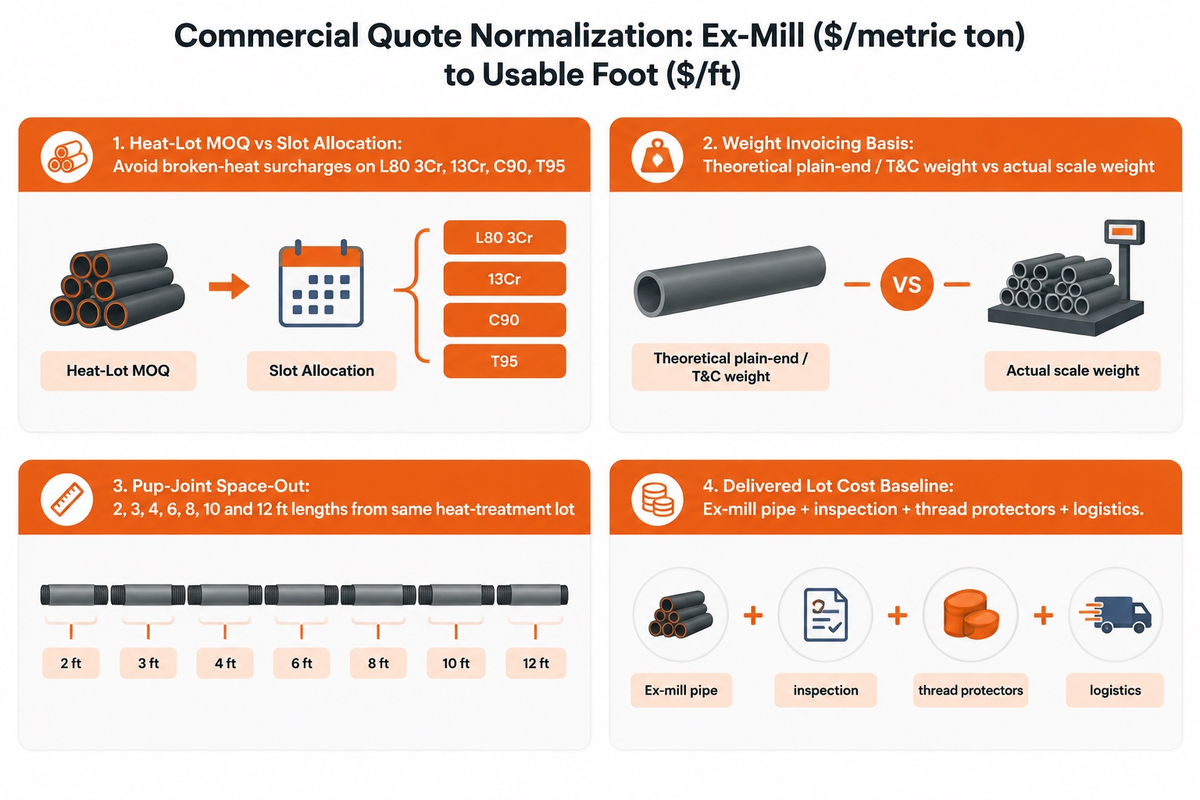
Standardizing commercial quotations for global API 5CT tubing manufacturers requires converting the ex-mill (metric-ton) price to delivered price per usable foot ($/ft). This calculation accounts for Range 2 length tolerances, theoretical versus scale weight invoicing, furnace heat-lot minimum order quantities, third-party inspection fees, and import tariffs.
After technical and inspection hold points are agreed upon via the 4-step process, procurement teams can compare bids on equal financial terms. This means an operator buying drill pipe, casing or production tubing is equally affected by global OCTG market demand and seamless OCTG distributor price indices during mill rolling cycles. Base per-ton prices do not reflect the full story of what is actually paid. The invoiced cost per foot is determined by numerous factors including the weight basis of the shipment, length tolerances, heat-lot surcharges, and inspection fees.
Standard grades such as J55, N80Q, or L80 Type 1 in 2-3/8 in, 2-7/8 in, or 3-1/2 in outer diameters run frequently. Export mills and project consolidators can allocate smaller tonnages from these continuous rolling schedules. Specialty corrosion-resistant or sour grades, such as L80 3Cr, L80 13Cr, C90, or T95 in a non-standard wall thickness, follow different economics. An integrated steel mill often requires a dedicated furnace heat lot for these strings.
If your well program requires a partial lot of a specialty grade, ordering directly from a primary rolling mill can result in a broken-heat surcharge. Smaller orders can be consolidated by an authorized OCTG export supplier who rolls slots (places orders with the mill) for multiple operators and/or holds mill-certified plain ends. This allows smaller batch threading runs and maintains full certificate and stencil traceability to the API Composite List licensed mill. Schedules for rolling mills and delivery lead times are impacted by grade groups, NDE scopes and congestion at ports.
Drilling and completion engineers design wells to target depths measured in feet or meters, not metric tons. Two suppliers quoting the same $/metric ton FOB can deliver different usable lengths due to variability in wall thickness control and invoicing weight:
Procurement teams evaluate bids by summing all charges from the mill (ex-mill charges), inspections, protection and logistics and dividing by the usable length to determine the total cost per foot. Only then do they place an order from our API 5CT tubing specifications and mill direct supply options page:
Delivered Lot Cost combines ex-mill pipe, inspection, protection, and logistics charges into one baseline.
Adjust the required thread protectors, bundle configuration, and any external coating requirements in the purchase specification and base FOB price so packing costs are comparable across bids.
Regular couplings, special clearance couplings, and sour qualified couplings are confirmed through matching of the coupling color bands against the pipe body bands, prior to run-in of the rig. After delivered lot costs are finalized, field teams verify these painted grade bands before rig run-in. The inspectors also confirm replacement bands applied after coating match the original mill test certificate.
API 5L line pipe and ASTM A106 pipe are not API 5CT production tubing and should not be accepted as substitutes. They do not meet the requirements of API 5CT tubing for dimensions, performance, and connection integrity.
All API 5CT pipe joints are hydrostatically tested and drifted, while mechanical properties are tested through specified lot based tests. Collapse and burst capacities are design properties based on tubing dimensions and grade.
Table C.27 of API Spec 5CT defines the Range 1, Range 2, and Range 3 joint-length categories to match drilling rig derrick capacity and elevator handling heights. Range 1 covers 20.0 to 24.0 ft (6.10 to 7.32 m) joints for compact workover rigs. Range 2 is 28.0 to 32.0 ft (8.53 to 9.75 m), while the ordered length tolerance must be applied from the purchase specification. Range 3 covers 38.0 to 42.0 ft (11.58 to 12.80 m) joints.
Mills clean and dry all EUE, NUE, and Premium threads before applying API RP 5A3 storage compound. Then closed-end composite or steel-shell thread protectors (API 5CT Annex I) are installed.
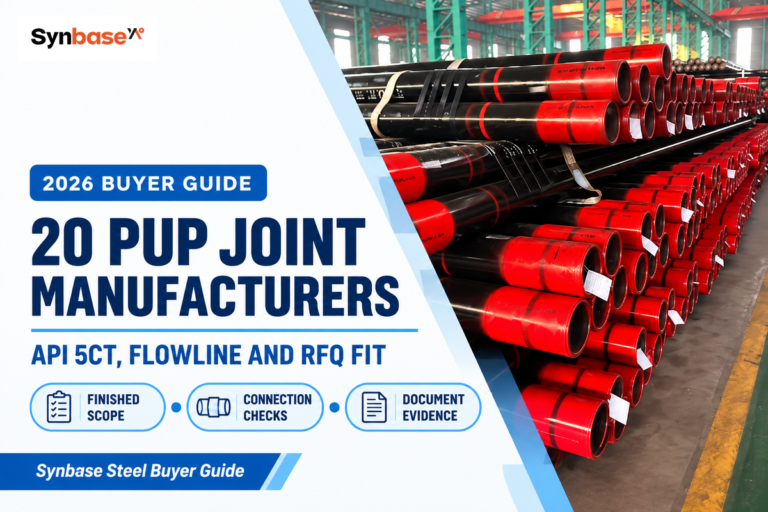
Standard API 5CT pup joints are short tubing sections (2, 3, 4, 6, 8, 10, and 12 ft (0.61 to 3.66 m)), and are used for spacing downhole packers and nipples as well as wellhead trees.
Synbase Steel supplies steel pipe, fittings, flanges, valves and OCTG for oil and gas, petrochemical, power, water and industrial projects. Our technical guides are written to help buyers compare standards, grades, dimensions, coatings, inspection requirements and commercial terms before sending an RFQ.
We focus on practical specification work: matching pipe process to service conditions, checking wall thickness and end finish, reviewing MTC and NDT requirements, and clarifying documentation before production or shipment.
Project support across seamless pipe, ERW, LSAW, SSAW, buttweld fittings, forged flanges, valves and oilfield tubulars.
Specification review for ASTM, ASME, API, EN and DIN standards, including material grade, pressure class, coating and inspection scope.