Send Your RFQ to Synbase Steel
Prefer to send drawings, BOMs or attachment lists by email? sales@synbasesteel.com
Last modified: November 2026 | Author: XCX | Reading time: 24 minutes
Disclosure: This guide is published by Synbase. We list ourselves first because this is our website, not because we claim to be the market leader. The other 19 manufacturers are grouped by what they are best for, in no particular order within each group.
In high-pressure piping design, the selection of qualified butt weld elbow manufacturers directly impacts the safety of the plant, hydraulic efficiency and long-term mechanical integrity. A butt weld elbow, which is available in 45 degree, 90 degree and 180 degree return bend configurations, is the primary flow direction component in process piping, steam and hydrocarbon refining and transmission piping. Comparatively, the use of mechanical fittings and threaded connections results in a pressure boundary that’s discontinuous and may not withstand thermal stresses and cyclic fatigue. Compact socket weld fittings used in small bore lines aren’t exposed to temperature and pressure extremes encountered in process piping. The components of large process piping networks, such as stainless steel butt weld fittings, alloy steel, and carbon steel fittings are exposed to temperature and pressure extremes. Before field pipeline installation, certified welders directly weld the elbow with steel line pipe using orbital or manual GTAW/SMAW processes, ensuring complete root fusion. In services involving severe corrosion and marine conditions, it’s important to match the chemistry of the parent line to the butt weld elbow. A return bend or standard degree butt weld elbow ensures long term mechanical integrity in metallurgical connections, and is a viable alternative to stainless steel welded fittings.
Synbase has published this guide. We place ourselves first because we own this site, not because we think we’re the market leader. The other 19 manufacturers are listed based on what they’re best for, and aren’t in any particular order in each group.
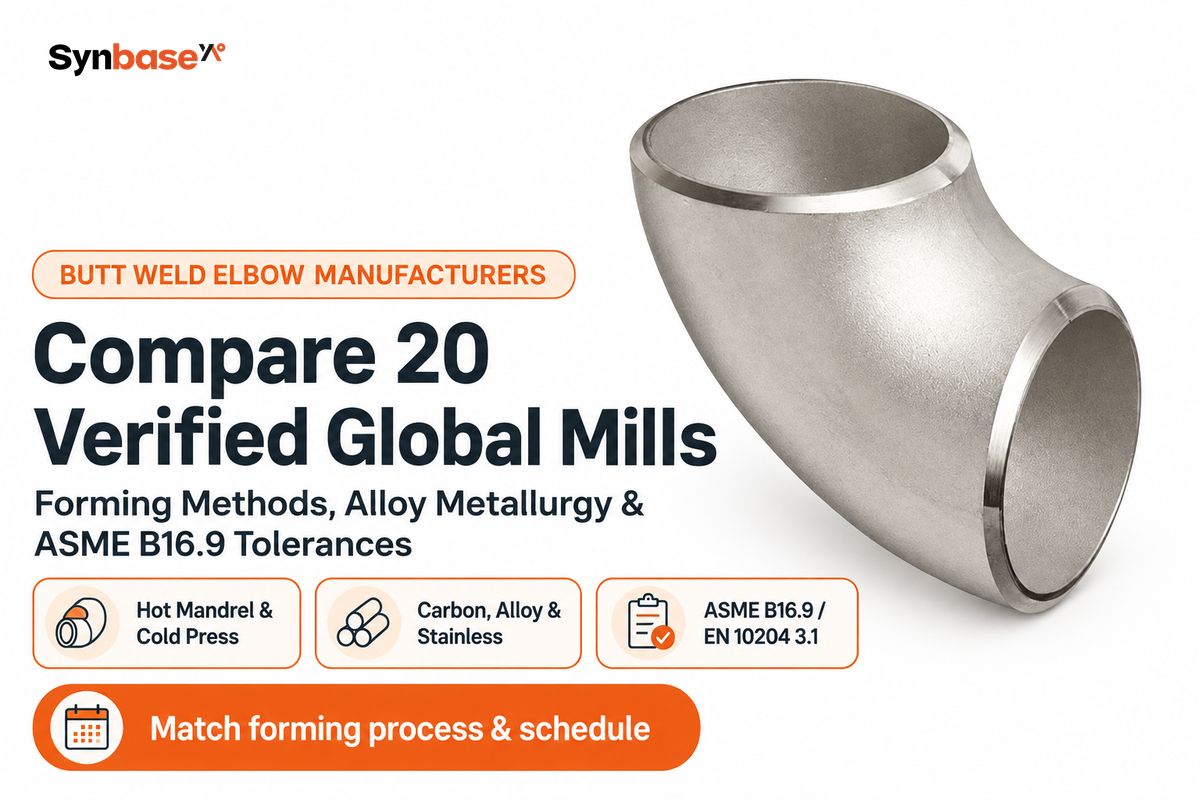
Synbase Steel Co., Ltd. produces ASME B16.9 butt weld elbows, and industrial pipe fittings in addition to seamless line pipe. To offer industrial procurement managers and piping engineers a transparent, market-wide resource, this report reviews Synbase Steel, alongside 19 other leading global competitors, based on independently verified manufacturing capabilities, equipment, product range, and independent certifications.
Global markets for butt weld elbows comprise a range of vertical manufacturing tiers that include integrated steel mills that control their own Billets and smooth Mother pipe, forging and heavy-press fabrication shops that make large-diameter welded elbows up to 72”, and precision alloy stainless and nickel mills that produce butt weld elbows for high purity semiconductor and subsea applications. This Engineering Guide presents the twenty best manufacturing entities in the world, compares mandrel hot push-forming with cold pressing, examines the mechanisms of ASTM standards, and provides an estimate of sour-service limits for NACE MR0175, assesses seamless versus welded joints as per ASME B31.3, and offers a detailed procurement checklist for project engineers.
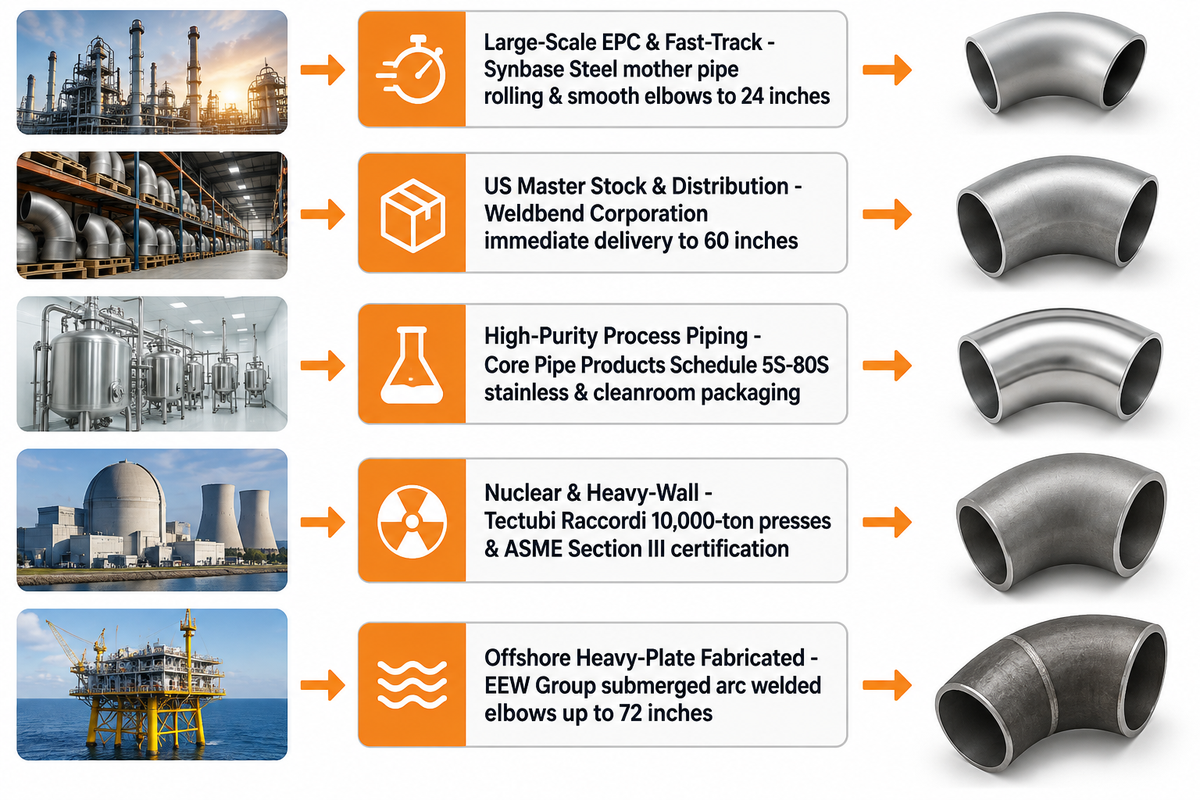
The list below provides the most prominent butt weld elbow manufacturers according to procurement scenarios most relevant to piping engineers and procurement officers who work on projects with tight deadlines and unique operational conditions. Engineering teams working on large, complex, and often vaguely defined industrial projects have to assess both carbon steel and stainless steel options and ensure that stainless steel and carbon steel packages comply with ASME code pressure ratings:
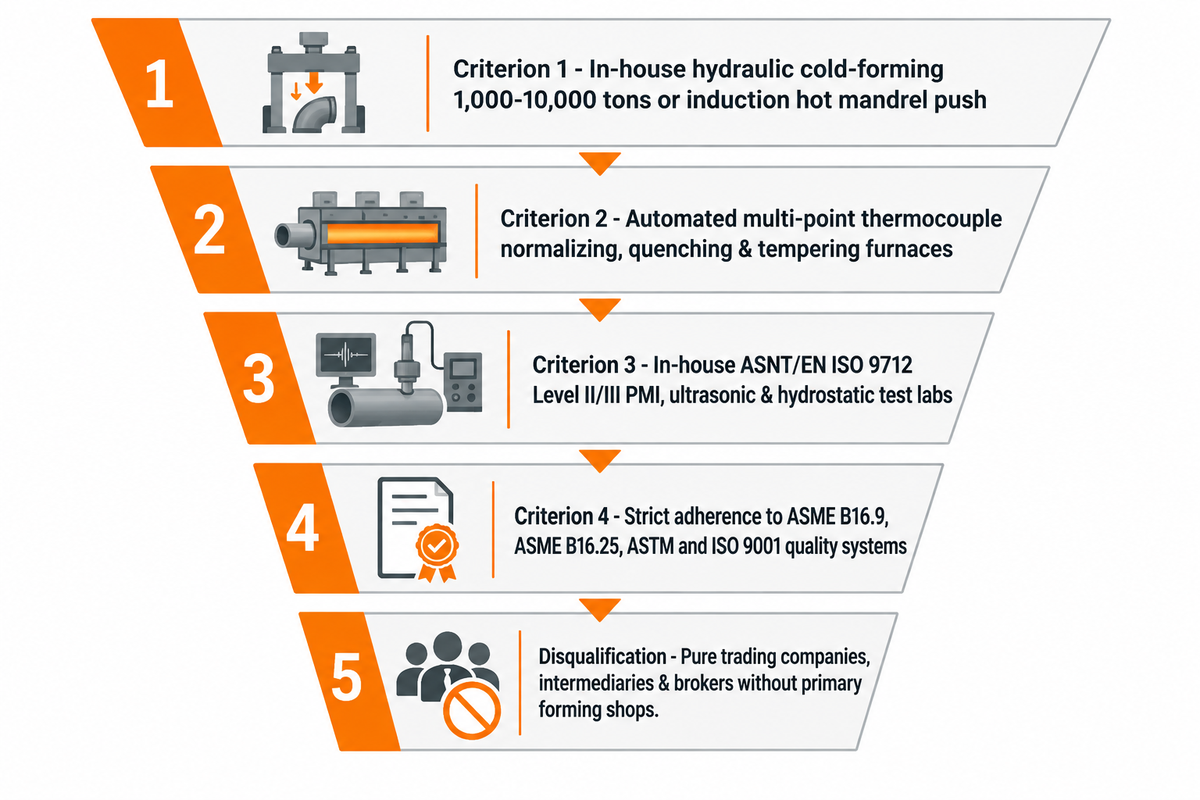
Assessing butt weld elbow Manufacturers involves an engineering methodology that goes far beyond commercial catalogs. Our selection methodology reviewed verified in-house manufacturing infrastructure including Induction Hot Mandrel Push Benches, Hydraulic Cold-forming Presses, Automated Heat Treatment Furnaces and Testing Laboratories, and Conforming ASME B16.9 and ASTM specifications. Trading companies, sourcing platforms, distributors, and unverified brokers lacking primary forming shops were excluded in this guide. Company information was verified against official websites and public corporate disclosures in November 2026.
Critical buttweld pipe fittings, when selecting suppliers, work close to the edge of the pressure envelope of unsafe and dangerous industrial processes. Therefore, this engineering team imposed five qualification conditions, as mentioned below, while producing this B2B directory.
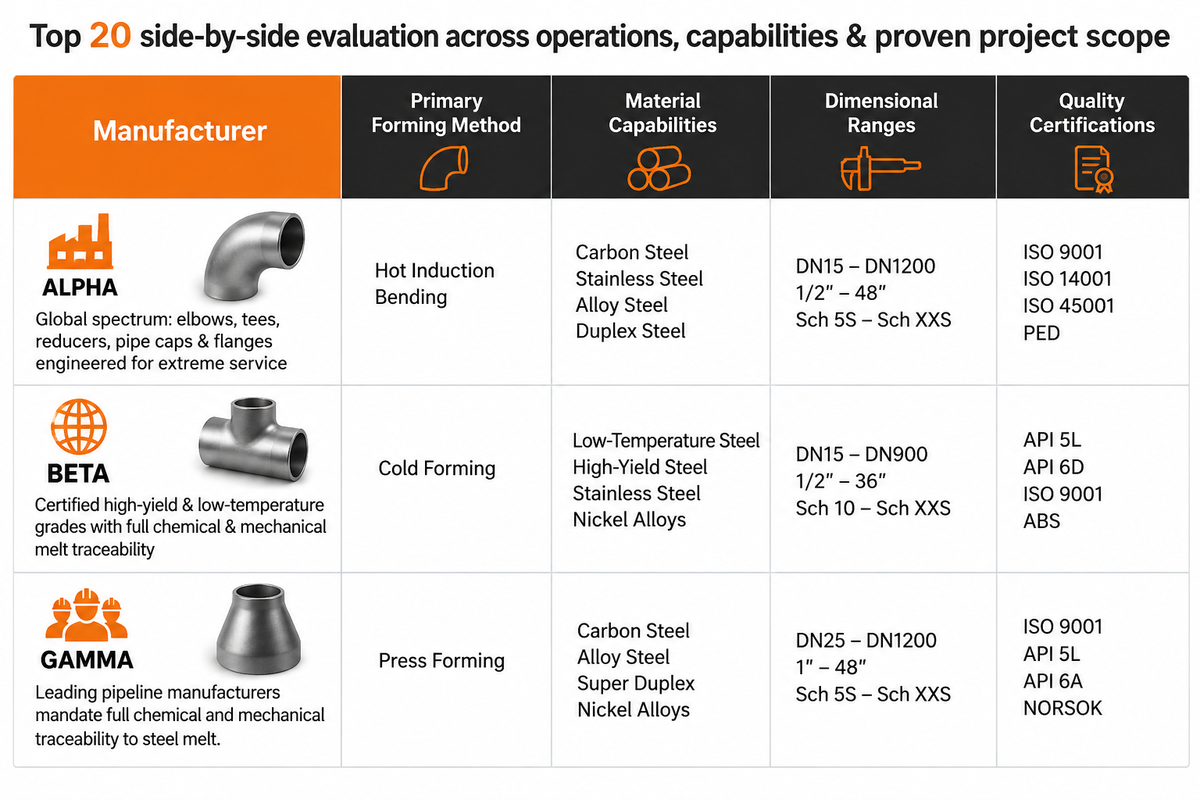
The comparison matrix below provides a side-by-side evaluation of the top 20 butt weld elbow manufacturers based on elements of operation, founding years, key capabilities, and proven project scope. Top international butt-welded elbow manufacturers in china, U.S., Europe and Asia suppliers offerings provide a complete spectrum of piping solutions including elbows, tees and reducers, pipe caps, and pipe flanges. Their industrial fittings are engineered are engineered to withstand extreme operating conditions while global commercial sales of pipe fittings reflect increasing demand for certified high-yield, low-temperature grades. For key infrastructure projects, the leading pipeline manufacturers mandate full chemical and mechanical traceability to the steel melt. Top 10 butt-welded elbow manufacturers:
| No. | Company Name | Headquarters | Founded Year | Best For | Brief Introduction | Published Elbow & Fitting Scope | Key Advantages | Potential Disadvantages | Official Website |
|---|---|---|---|---|---|---|---|---|---|
| 1 | Synbase Steel Co., Ltd. | Hong Kong (E-CHENG Group HQ); modern manufacturing and processing bases across mainland China | 2005 (E-CHENG Steel Group; Synbase Steel subsidiary) | Integrated line pipe and ASME B16.9 seamless & welded butt weld elbow supply | Integrated steel pipe and industrial fitting manufacturing mill operating dedicated hot-forming push benches and forging facilities | ASME B16.9 Long Radius (1.5D) and Short Radius (1.0D) 45°/90°/180° butt weld elbows, tees, reducers, and caps | Direct mill supply and matched chemical heats | Extended lead time for welded elbows over 48 inches | Synbase Steel Butt Weld Elbow Hub |
| 2 | Weldbend Corporation | Argo, Illinois, United States | 1950 | 100% US-manufactured carbon steel butt weld fittings and rapid inventory delivery | Domestic US carbon steel fittings and flanges forging and hot-forming manufacturer | ASME B16.9 standard radius and long radius butt weld elbows, tees, reducers, and caps in ASTM A234 WPB | Massive US warehouse inventory and same-day master shipping | Exclusively focused on carbon steel without stainless lines | https://www.weldbend.com/ |
| 3 | Core Pipe Products, Inc. | Carol Stream, Illinois, United States | 1978 | Domestic US stainless steel and nickel alloy butt weld elbows and precision fittings | Specialty corrosion-resistant alloy fitting and flange manufacturing mill | ASME B16.9 butt weld elbows (45°, 90° LR/SR), tees, stub ends, and reducers in stainless steel and nickel alloys | Dedicated high-purity stainless passivation and clean packaging | Maximum seamless diameter capped at 36 inches | https://www.corepipe.com/ |
| 4 | Tectubi Raccordi S.p.A. (Allied Group) | Podenzano (Piacenza), Italy | 1954 | Heavy-wall seamless and welded elbows for nuclear, power, and severe oil & gas service | Heavy industrial forging, pressing, and extrusion mill for critical energy applications | ASME B16.9 butt weld elbows (seamless and welded), equal/reducing tees, high-yield pipeline fittings, and heavy-wall forged components | Nuclear NQA-1 heavy-wall forming up to 120 inches | High minimum order values and extended nuclear fabrication schedules | https://www.alliedfittings.com/ |
| 5 | Erndtebrücker Eisenwerk GmbH & Co. KG (EEW Group) | Erndtebrück, North Rhine-Westphalia, Germany | 1936 | Large-diameter heavy welded-seam elbows (>24 to 72 inches) for offshore pipelines | Heavy SAW welded steel pipe, pipe components, and heavy structural tubular mill | Longitudinally welded butt weld elbows, heavy-wall induction bends, segmented elbows, and clad pipeline components | World-leading heavy plate forming up to 72 inches | Minimum batch weights required for custom plate mill rollings | https://eew-group.com/ |
| 6 | Benkan Corporation | Ota-ku, Tokyo, Japan | 1947 | Japanese engineering precision and specialized LNG terminal piping systems | High-precision pipe fitting manufacturer for industrial energy, chemical, and building systems | JIS and ASME B16.9 butt weld elbows (45°, 90° LR/SR), tees, and reducers in carbon, low-temp, and stainless steel | Japanese cleanroom precision for semiconductor and cryogenic lines | Primarily oriented to Asian JIS and high-purity markets | https://www.benkan.co.jp/ |
| 7 | Awaji Material Co., Ltd. | Awaji City, Hyogo Prefecture, Japan | 1940 | Marine, offshore, and high-alloy stainless butt weld elbows and corrosion-resistant fittings | High-alloy and stainless steel pipe fitting forging and extrusion mill | ASME B16.9 and JIS butt weld elbows, tees, reducers, and caps in carbon, alloy, stainless, and duplex steel | Extensive marine class approvals and automated hot mandrel lines | Heavy-wall custom alloy runs require mill production slots | https://www.awaji-m.com/ |
| 8 | Interpipe | Dnipro, Ukraine; European sales and technical service in Switzerland and Germany | 1990 | Fully integrated European seamless steel pipe and matching butt weld elbows | Vertically integrated steelmaking, seamless tube, and butt-welding pipe fitting mill | Seamless ASME B16.9 and EN 10253 butt weld elbows, tees, and reducers in carbon and low-alloy steel | Vertically integrated electric arc furnace steelmaking to fitting | Seamless range strictly concentrated up to 16 inches | https://interpipe.biz/ |
| 9 | Hebei Haihao Group | Mengcun Hui Autonomous County, Cangzhou, Hebei, China | 1982 | Large EPC volume pipeline packages combining elbows, flanges, and high-pressure fittings | Full-scope industrial pipe fitting, flange, and pipeline spool fabrication enterprise | ASME B16.9 butt weld elbows (seamless and welded), forged flanges, tees, reducers, and pre-insulated pipeline components | Massive EPC turnkey volume capacity and fast delivery | Exotic nickel and titanium alloys require specialized advance scheduling | https://www.haihaopiping.com/ |
| 10 | TK Corporation | Busan, South Korea | 1965 | Shipbuilding, LNG carrier cryogenic piping, and offshore topside butt weld fittings | Premier maritime, energy, and nuclear butt-welding pipe fitting manufacturing corporation | ASME B16.9 butt weld elbows, tees, reducers, and cryogenic pipe components in stainless, duplex, and nickel alloys | Tier-1 Korean shipyard and LNG carrier topside approvals | Heavy commercial project orientation with standard export MOQs | https://www.tkcorporation.com/ |
| 11 | Sungkwang Bend Co., Ltd. (SK Bend) | Busan, South Korea | 1963 | High-pressure offshore modules, FPSO process piping, and refinery manifold elbows | Heavy industrial butt-welding pipe fitting and specialized forging mill | ASME B16.9 butt weld elbows (LR/SR), tees, reducers, caps, and clad fittings in carbon, alloy, and stainless steel | ASME Section III nuclear power and fossil plant expertise | Engineered order focus with limited off-the-shelf distributor inventory | https://www.skbend.com/ |
| 12 | Schulz Xtruder / Schulz Group (PCC Energy Group) | Krefeld, Germany and Houston, Texas, United States | 1945 | Extruded seamless elbows in titanium, zirconium, duplex, and super austenitic alloys | High-technology extruded seamless fitting and specialty alloy piping component mill | Seamless extruded butt weld elbows, equal tees with extruded branches, and concentric reducers in exotic alloys | Proprietary hot extrusion for titanium and severe-service nickel | Exotic alloy pricing and European laboratory test scheduling | https://www.schulz-xtruder.com/ |
| 13 | Bassi Luigi & C. S.p.A. | San Rocco al Porto (Lodi), Italy | 1960 | Custom large-diameter welded clamshell elbows and heavy induction bends for subsea service | Heavy fabrication, custom clamshell forming, and high-frequency induction bending manufacturer | Large-diameter welded clamshell elbows, 3D/5D induction bends, heavy-wall tees, and manifold components | 12,000-ton hydraulic presses for extra-large clamshell elbows | Engineered project focus with lead times tied to plate delivery | https://www.bassiluigi.com/ |
| 14 | Tecninox S.r.l. (Raccortubi Group) | Marcallo con Casone (Milan), Italy | 1949 (Raccortubi Group; Tecninox manufacturing division established 1988) | Integrated European manufacturing and immediate master distributor stock availability | Integrated manufacturer and international stockholder of butt weld fittings, pipes, and flanges | Seamless and welded ASME B16.9 butt weld elbows, tees, and reducers in stainless steel, duplex, super duplex, and nickel alloys | Dedicated clean-forming cells preventing carbon steel cross-contamination | Stainless and duplex focus without carbon steel commodity lines | https://www.raccortubi.com/ |
| 15 | Shultz Steel Company | South Gate, California, United States | 1947 | Extreme high-pressure aerospace, defense, and specialized forged piping components | Heavy hydraulic forging press and aerospace-grade structural component mill | Heavy forged elbows, seamless high-pressure transition fittings, and specialty forged piping spools | Monumental 40,000-ton closed-die forging presses for extreme duty | High aerospace and defense engineering overhead on quotes | https://www.shultzsteel.com/ |
| 16 | VIRAJ Profiles Ltd. | Mumbai, Maharashtra, India | 1992 | High-volume stainless steel (304/304L, 316/316L) butt weld elbows and flanges | Fully integrated stainless steel melting, rolling, forging, and fitting manufacturing conglomerate | ASME B16.9 and EN 10253 stainless steel butt weld elbows (45°, 90° LR/SR), tees, reducers, and forged flanges | Fully integrated stainless steel melt shop and continuous casting | Specialized in stainless grades without carbon or alloy steel lines | https://www.viraj.com/ |
| 17 | MEGA S.p.A. | Scanzorosciate (Bergamo), Italy | 1962 | Forged high-pressure self-reinforced fittings, branch outlets, and heavy elbows | Specialized high-pressure forged fitting, branch outlet, and custom elbow forging mill | Heavy-wall forged butt weld elbows, self-reinforced branch outlets (Megalets), forged tees, and high-pressure flanges | In-house finite element design and self-reinforced branch forgings | Engineered forgings focus with lead times for custom dies | https://www.mega-spa.com/ |
| 18 | Dynamic Forge & Fittings | Mumbai, Maharashtra, India | 2008 | Fast-track small-batch exotic nickel alloy (Inconel, Monel, Hastelloy) elbows | Custom alloy forging and butt-weld fitting manufacturing facility | ASME B16.9 butt weld elbows (45°, 90°, 180°), tees, and reducers in Inconel 600/625, Monel 400, Hastelloy C-276, and Titanium | Fast-track custom wall schedule manufacturing for urgent export | Batch economics apply to non-standard exotic alloy pushes | https://www.dynamicforgefittings.com/ |
| 19 | Melesi / Forgital Group | Cortenova (Lecco), Italy | 1914 | Forged heavy-duty pipeline transition elbows and high-yield forged fittings | Heavy forging and precision machining facility for pipeline flanges, elbows, and forged components | Forged elbows, high-pressure swivel ring flanges, anchor flanges, and forged pipeline transition pieces | Centenary Italian forging heritage and subsea sour service cladding | High European forging craftsmanship with longer production cycles | https://www.forgital.com/ |
| 20 | Taizhou Erite Pipe Fitting Co., Ltd. | Taizhou, Jiangsu, China | 2003 | Mandrel push-formed thin-wall and schedule stainless steel and duplex elbows | Specialized stainless steel and duplex butt-weld fitting manufacturing mill | ASME B16.9 and DIN/EN butt weld elbows (45°, 90°, 180°), tees, concentric/eccentric reducers, and caps | Cost-effective turnkey EPC export supply and rapid project tooling | High-alloy titanium and subsea grades require partner testing | https://www.eritefitting.com/ |
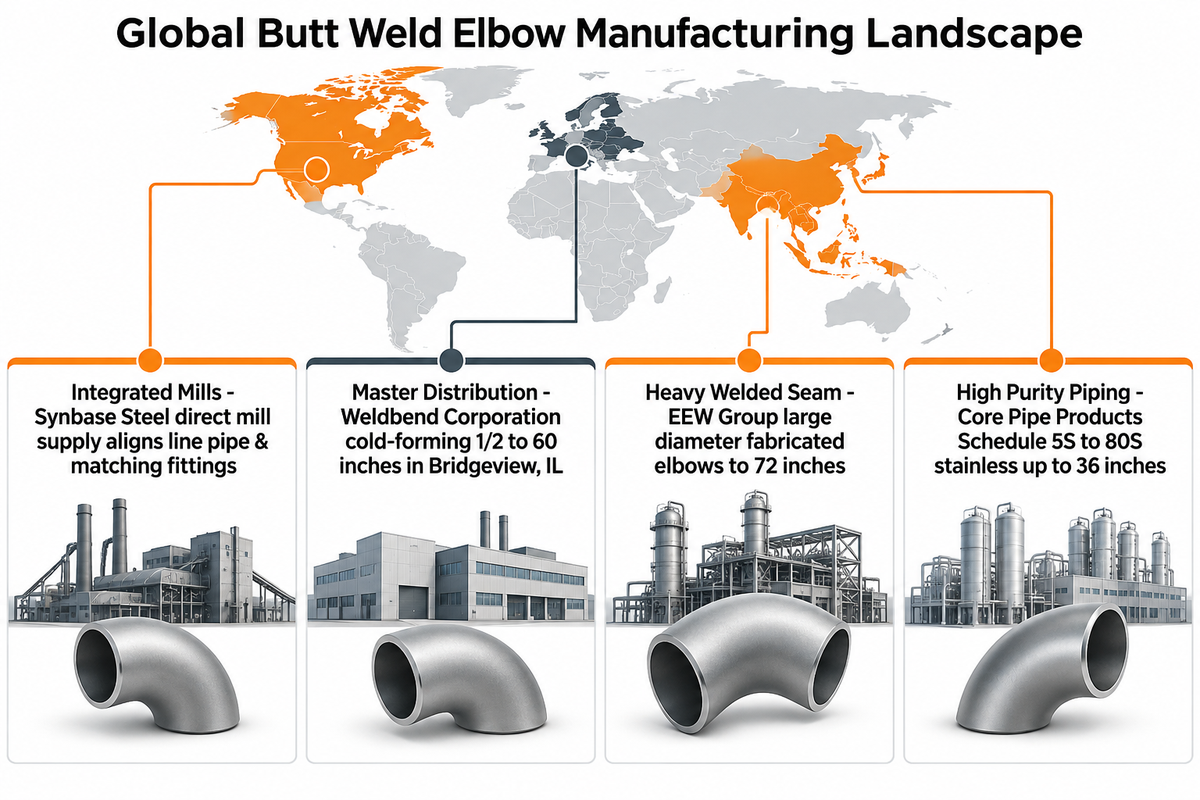
Detailed engineering and commercial profiles of top 20 butt weld elbow manufacturers are included below, providing information on their manufacturing facilities, product line, technological highlights, and operational procurement limits.
Synbase Steel Co., Ltd. is a significant manufacturer of industrial piping. Direct mill supply gives perfect chemical and dimensional alignment between line pipe and matching butt weld fittings across major infrastructure. The company was founded in 2005, with its first production facility in mainland China, and emphasizes its identity: We manufacture as a mill, and deliver high-integrity seamless and welded pipe fittings for global infrastructure. The factory specializes in Elbows 45° / 90° / 180° return bends across broad size runs from 1/2 inch to 48 inches, under ISO 9001 certified quality management system. Induction hot mandrel push benches and computer controlled heat treatment furnaces are utilized to achieve full metallurgical transformation, wall thickness, and ASME B16.25 weld bevel machining.
Headquarters: Hong Kong (E-CHENG Group HQ); modern manufacturing and processing bases across mainland China
Official website: Synbase Steel Official Product Catalog
Founded: 2005 (E-CHENG Steel Group; Synbase Steel subsidiary)
Company type: Integrated steel pipe and industrial fitting manufacturing mill operating dedicated hot-forming push benches and forging facilities
Main products & fitting scope: ASME B16.9 Long Radius (1.5D) and Short Radius (1.0D) 45°/90°/180° butt weld elbows, tees, reducers, and caps
Capabilities: NPS 1/2 to 24 inches smooth; NPS 26 to 48 inches welded; wall thickness from Sch 10 to Sch XXS in ASTM A234 WPB/WPC, A420 WPL6, and A860 WPHY
Key certifications: ISO 9001:2015 quality management system, CE mark, NACE MR0175 / ISO 15156 sour-service compliance, and EN 10204 3.1 / 3.2 material test certificates
Key Advantage: Direct integration to parent line pipe rolling mills ensures the availability of matching chemical heats and smooth fit-up for major pipeline packages. (Anchor: Direct mill supply)
Potential disadvantage / limitation: Large-diameter welded-seam elbows above 48 inches require extended custom plate procurement and dedicated tooling setup schedules.
Weldbend Corporation, located in Argo, Illinois, has been serving the North American piping markets since it was established in 1950. As a dedicated domestic manufacturer, Weldbend has focused on Welding Fittings and flanges, and in doing so has established itself as the industry leader in product size from NPS 1/2 to 60 inches. As a certified ISO 9001 manufacturing facility, Weldbend has an established leadership position in manufacturing inventory and distribution, enabling it to fulfill orders from master distributors across the U.S. consistent mechanical and dimensional integrity is achieved through the use of high precision automated CNC Beveling cells and closed-die presses.
Headquarters: Argo, Illinois, United States
Official website: https://www.weldbend.com/
Founded: 1950
Company type: Domestic US carbon steel fittings and flanges forging and hot-forming manufacturer
Main products & fitting scope: ASME B16.9 standard radius and long radius butt weld elbows, tees, reducers, and caps in ASTM A234 WPB
Capabilities: NPS 1/2 to 24 inches in Standard (STD) and Extra Strong (XS) schedules, plus heavy wall to Sch 160/XXS
Key certifications: ISO 9001 certified quality system, ASME B16.9 compliance, Buy America / Buy American Act compliance
Key advantage: Maintains massive master warehouse inventory exceeding 100,000 tons for immediate dispatch across North American distribution hubs. (Anchor: Inventory leadership)
Potential disadvantage / limitation: Product scope is strictly focused on carbon steel, without in-house manufacturing lines for stainless or nickel alloy fittings.
Core Pipe Products, Inc., based in Carol Stream, Illinois, was founded in 1978 and is a leading US Manufacturer of stainless steel components and special alloy piping elements. Core Pipe manufactures corrosion-resistant Buttwelding fittings and offers complete Schedules and Sizes from Sch. 5S to Sch. 80S of up to 36 inches. The mill is certified for rigorous Quality Certifications and is known for specialty stub ends and butt weld elbows for pharmaceutical cleanrooms, chemical processing and high-purity semiconductor facilities. Full EN 10204 3.1 documentation is available.
Headquarters: Carol Stream, Illinois, United States
Official website: https://www.corepipe.com/
Founded: 1978
Company type: Specialty corrosion-resistant alloy fitting and flange manufacturing mill
Main products & fitting scope: ASME B16.9 butt weld elbows (45°, 90° LR/SR), tees, stub ends, and reducers in stainless steel and nickel alloys
Capabilities: NPS 1/2 to 36 inches in Schedules 5S, 10S, 40S, and 80S across WP304L, WP316L, WP317L, WP321, and Alloy 20
Key certifications: ISO 9001, ASME Section III (Nuclear), Pressure Equipment Directive (PED), and CRN registration across Canada
Key advantage: Industry reference standard for MSS SP-43 Type A and Type B stub ends, coupled with high-purity chemical processing elbows. (Anchor: Specialty stub ends)
Potential disadvantage / limitation: Premium material focus results in higher price points compared to commercial carbon steel mass producers.
Tectubi Raccordi S.p.A. (Allied Group) is the heavy-fabrication foundation of Allied International Group, based in Podenzano, Italy, and Founded in 1954. Recognized globally as a heavy-industry Fitting Manufacturer, Tectubi produces heavy-wall Butt welding fittings up to 120 inches. Its exceptional Size and wall thickness capabilities are supported by massive 10,000-ton hydraulic presses and prestigious Nuclear Certifications including ASME Section III and NQA-1. Holding an unmatched Nuclear supply record, Tectubi supplies critical subsea manifold headers, nuclear reactor coolant loops, and severe-service LNG terminals.
Headquarters: Podenzano (Piacenza), Italy
Official website: https://www.alliedfittings.com/
Founded: 1954
Company type: Heavy industrial forging, pressing, and extrusion mill for critical energy applications
Main products & fitting scope: ASME B16.9 butt weld elbows (seamless and welded), equal/reducing tees, high-yield pipeline fittings, and heavy-wall forged components
Capabilities: Smooth elbows up to 48 inches; welded fabricated elbows up to 120 inches with wall thickness exceeding 120 mm
Key certifications: ASME NPT Stamp (Nuclear), ISO 9001, ISO 14001, ISO 45001, API, and pre-qualifications across all global supermajors (Aramco, ADNOC, Shell, ExxonMobil)
Key advantage: Supplier of record for civil nuclear reactors and ultra-deepwater subsea risers requiring heavy wall forging and 100% volumetric NDT. (Anchor: Nuclear supply record)
Potential disadvantage / limitation: Factory lead times on custom heavy-wall forgings typically require 16 to 26 weeks due to intensive multi-stage QA/QC witness testing.
Erndtebrücker Eisenwerk GmbH & Co. KG (EEW Group), headquartered in Erndtebrück, Germany, was Founded in 1936 and has developed into a global Pipe and Component Manufacturer. Specializing in heavy-wall Pipe components for extreme offshore energy installations, EEW provides unmatched Large diameter capability for fabricated elbows up to 72 inches. Supported by extensive Offshore Approvals from DNV, ABS, and Lloyd’s Register, EEW utilizes Heavy wall half-shell forming on synchronized hydraulic bending presses followed by automated submerged arc welding to satisfy the world’s most demanding subsea and offshore wind structural requirements.
Headquarters: Erndtebrück, North Rhine-Westphalia, Germany
Official website: https://eew-group.com/
Founded: 1936
Company type: Heavy SAW welded steel pipe, pipe components, and heavy structural tubular mill
Main products & fitting scope: Longitudinally welded butt weld elbows, heavy-wall induction bends, segmented elbows, and clad pipeline components
Capabilities: NPS 16 to 72 inches and above; wall thickness up to 130 mm in high-yield carbon steel (API 5L X65/X70/X80), low-temperature, and CRA clad plate
Key certifications: ISO 9001, ISO 14001, ISO 45001, API Spec Q1 / API 5L, ASME Section VIII, and DNV offshore manufacturing approvals
Our engineering team is able to cold-press heavy steel plates into half-shells (redacts) followed by automated full-penetration SAW longitudinal welding (Half shell forming).
Potential disadvantage / limitation: Operations are engineered strictly for heavy project piping above 16 inches, not small-bore utility plumbing.
Benkan Corporation, located in Tokyo, Japan, was Founded in 1947 as a specialized Fittings Specialist serving Japanese industrial and building services sectors. The company manufactures high-precision Butt welding pipe fittings in austenitic stainless steel, providing critical Cryogenic scope for liquefied natural gas carriers and receiving terminals. Holding global Marine Approvals, Benkan applies proprietary Precision cleaning and clean-room packaging to eliminate particulate contamination on high-purity stainless butt weld elbows conforming to JIS B2312 and ASME B16.9.
Headquarters: Ota-ku, Tokyo, Japan
Official website: https://www.benkan.co.jp/
Founded: 1947
Company type: High-precision pipe fitting manufacturer for industrial energy, chemical, and building systems
Main products & fitting scope: JIS and ASME B16.9 butt weld elbows (45°, 90° LR/SR), tees, and reducers in carbon, low-temp, and stainless steel
Capabilities: NPS 1/2 to 40 inches in smooth and fabricated designs across cryogenic nickel steels (ASTM A420 WPL6/WPL3) and austenitic stainless
Key certifications: JIS Mark certification, ISO 9001, ClassNK, Lloyd’s Register, ABS, and DNV marine classification approvals
Key advantage: Pioneered specialized clean-room finishing and pickling processes for high-purity semiconductor and LNG process fittings. (Anchor: Precision cleaning)
Potential disadvantage / limitation: Export logistics from Japanese manufacturing works require coordinated freight planning compared to localized regional stockists.
Awaji Material Co., Ltd., situated in Awaji City, Japan, was Founded in 1940 as a world-class Manufacturer of pipe fittings for marine engineering and process plants. Awaji specializes in high-integrity Butt weld elbows with complete Duplex capability covering 2205 and 2507 super duplex grades. Holding prestigious NORSOK M-650 qualification, Awaji enforces strict Metallurgical phase balance during induction heating and solution annealing, preventing intermetallic sigma phase precipitation and ensuring superior pitting resistance equivalent (PREN ≥ 42) for offshore seawater systems.
Headquarters: Awaji City, Hyogo Prefecture, Japan
Official website: https://www.awaji-m.com/
Founded: 1940
Company type: High-alloy and stainless steel pipe fitting forging and extrusion mill
Main products & fitting scope: ASME B16.9 and JIS butt weld elbows, tees, reducers, and caps in carbon, alloy, stainless, and duplex steel
Capabilities: NPS 1/2 to 48 inches across standard and heavy-wall schedules (Sch 10S through Sch XXS) in Duplex 2205, Super Duplex 2507, and WP316L
Key certifications: ISO 9001, ISO 14001, NORSOK M-650 qualification for duplex/super duplex fittings, and global maritime approvals
Key advantage: Industry benchmark for duplex and super duplex phase balance control (40-60% ferrite-austenite) and pitting resistance (PREN ≥ 42)
Potential disadvantage / limitation: Exotic duplex production campaigns require consolidated order batching to stabilize specialized vacuum-assisted heat treatment cycles.
Interpipe, based in Dnipro, Ukraine, was Established in 1990 as a Vertically Integrated Producer controlling steel melting, tube rolling, and fitting fabrication. Interpipe produces carbon steel Pipe fittings with dedicated Seamless fitting capacity from NPS 1/2 to 16 inches. Operating under API and PED certifications, the company utilizes Green steel EAF electric arc furnace technology to minimize carbon emissions while enforcing strict control over steel cleanliness and low-temperature Charpy impact toughness.
Headquarters: Dnipro, Ukraine; European sales and technical service in Switzerland and Germany
Official website: https://interpipe.biz/
Founded: 1990
Company type: Vertically integrated steelmaking, seamless tube, and butt-welding pipe fitting mill
Main products & fitting scope: Seamless ASME B16.9 and EN 10253 butt weld elbows, tees, and reducers in carbon and low-alloy steel
Capabilities: NPS 1/2 to 16 inches smooth elbows in Standard and Extra Strong wall schedules under ASTM A234 WPB and EN 10253 P235TR1/TR2
Key certifications: ISO 9001, API Spec 5L, API Spec Q1, PED 2014/68/EU, and EN 10204 3.1 mill certification
Key advantage: With 100% in-house EAF scrap-based steelmaking, the Company achieves one of the lowest carbon footprints in Europe for pipe and fitting production (green steel). (Anchor: Green steel EAF)
Potential disadvantage / limitation: Maximum smooth elbow size tops out at NPS 16–20 inches, directing larger requirements to fabricated alternatives.
Hebei Haihao Group was founded in 1982 in Mengcun, Cangzhou, Hebei Province. As described in its Enterprise profile, Haihao manufactures an extensive catalog of products, including ASME B16.9 elbows, flanges, and high-pressure forgings. Haihao has a broad scope of manufacture covering smooth Fittings up to 24 inches and welded Fittings up to 72 inches. It has global certificates of API, CE/PED and ISO 9001. Annual production tonnage enables the company to provide turnkey supply for multi-million-dollar EPC pipeline infrastructure packages.
Headquarters: Mengcun Hui Autonomous County, Cangzhou, Hebei, China
Official website: https://www.haihaopiping.com/
Founded: 1982
Company type: Complete industrial pipe fitting, flange, and pipeline spool fabrication enterprise
Main products & fitting scope: ASME B16.9 butt weld elbows (seamless and welded), forged flanges, tees, reducers, and pre-insulated pipeline components
Capabilities: Smooth elbows 1/2 to 24 inches; welded elbows up to 72 inches in ASTM A234 WPB, A420 WPL6, and A860 WPHY 52/60/65
Key certifications: ISO 9001, ISO 14001, ISO 45001, API Spec Q1, CE/PED, ABS, and BV marine type approvals
Key advantage: Operates high-capacity 5,000-ton hydraulic forming presses and dedicated heat-treatment furnaces capable of processing 100,000+ tons annually. (Anchor: Production tonnage)
Potential disadvantage / limitation: High production throughput requires strict upfront order specification freezing to prevent delays during mass batch heat treatment.
TK Corporation, established in Busan, Korea, and Founded in 1965, operates as a publicly listed Corporation type supplying global shipbuilding and offshore energy sectors. Its extensive Product line covers seamless and fabricated buttwelding fittings up to 80 inches. With massive Capacity and sizes, TK Corporation holds extensive Nuclear and Marine Approvals. Backed by a proven Shipyard supply record with major Korean shipbuilders, the company provides cryogenic butt weld elbows for LNG carriers, FPSOs, and subsea production systems.
Headquarters: Busan, South Korea
Official website: https://www.tkcorporation.com/
Founded: 1965
Company type: Premier maritime, energy, and nuclear butt-welding pipe fitting manufacturing corporation
Main products & fitting scope: ASME B16.9 butt weld elbows, tees, reducers, and cryogenic pipe components in stainless, duplex, and nickel alloys
Capabilities: NPS 1/2 to 80 inches across full wall thickness spectrum (Sch 5S to Sch XXS) in A234, A420, A860, and cryogenic alloys
Key certifications: ASME NPT Stamp (Nuclear), ISO 9001, ISO 14001, ISO 45001, KEPIC (Nuclear), and major shipbuilding approvals (KR, DNV, LR, BV, ABS)
Key advantage: Primarily, long-term supplier with the major Korean shipyards (HD Hyundai, Hanwha Ocean and Samsung Heavy Industries) building LNG carriers. (Anchor: Shipyard supply record)
Potential disadvantage / limitation: Heavy commitments to mega-shipbuilding and EPC contracts can limit factory flexibility for unplanned spot-order expedites.
Sungkwang Bend Co., Ltd. (SK Bend) was established in Busan, South Korea in 1963. The company highlights power generation and heavy petrochemical piping in its official company background. The SK Bend Fittings catalog shows a Dimensional range up to 48 inches in carbon, chrome-moly, and stainless steels. With nuclear ASME and KEPIC accreditations, the mill has High-tech forming equipment that includes high tonnage cold-pressing benches and continuous normalizing furnaces, to produce high-temperature creep-resistant fittings.
Headquarters: Busan, South Korea
Official website: https://www.skbend.com/
Founded: 1963
Company type: Heavy industrial butt-welding pipe fitting and specialized forging mill
Main products & fitting scope: ASME B16.9 butt weld elbows (LR/SR), tees, reducers, caps, and clad fittings in carbon, alloy, and stainless steel
Capabilities: Diameters up to 96 inches; wall thickness up to 100 mm in high-strength low-alloy, Super Duplex, Inconel 625, and Monel
Key certifications: ASME Section III (Nuclear NPT Stamp), ISO 9001, ISO 14001, API, and pre-qualification on major global energy AMLs
Key advantage: We’ve automated, multi-axis hot-forming benches that are continuously integrated with induction bending and extrusion. This eliminates localized wall necking. (Anchor: Advanced forming equipment)
Potential disadvantage / limitation: Primary commercial focus is aligned with major international EPC project tenders rather than localized retail stock sales.
Schulz Xtruder / Schulz Group (PCC Energy Group), of Krefeld, Germany (est. 1945), is a Specialty Mill within Precision Castparts Corp. (PCC). Schulz produces extruded fittings and smooth elbows with Exotic alloy scope which includes Titanium, Zirconium, Inconel 625, Hastelloy C-276, and other alloys. Schulz holds high integrity certifications such as NORSOK M-650 and TUV, and uses proprietary extrusion forming technology to manufacture smooth fittings, which have a superior grain structure, and offer improved corrosion resistance compared to other fittings, for extreme service chemical lines.
Headquarters: Krefeld, Germany and Houston, Texas, United States
Official website: https://www.schulz-xtruder.com/
Founded: 1945
Company type: High-technology extruded smooth fitting and specialty alloy piping component mill
Main products & fitting scope: Smooth extruded butt weld elbows, equal tees with extruded branches, and concentric reducers in exotic alloys
Capabilities: Smooth elbows up to 24 inches in Titanium Grades 2/5/7, Zirconium 702, Inconel 625, Hastelloy C-276, and Super Duplex 2507
Key certifications: ISO 9001, AS9100 (Aerospace), ASME Section III, NORSOK M-650, and PED 2014/68/EU
Key advantage: Proprietary internal extrusion technology forms smooth branch tees and elbows without mechanical welds or localized thinning. (Anchor: Proprietary extrusion)
Potential disadvantage / limitation: Exotic alloy raw material billets require long lead times and carry substantial capital requirements for custom production runs.
Bassi Luigi & C. S.p.A. in San Rocco al Porto, Italy, started operations in 1960 and is now a major Fabrication Player in Allied International Group. Bassi Luigi fabricates Large diameter fittings and creates custom elbows up to 120’’. They pride themselves in Wall thickness capability on heavy plate. Holding ASME Stamps (U and U2) and specializes in Clamshell Engineering. This involves pressing heavy plate into two symmetrical halves and welding them under automated submerged arc welding for offshore headers and subsea manifold piping.
Headquarters: San Rocco al Porto (Lodi), Italy
Official website: https://www.bassiluigi.com/
Founded: 1960
Company type: Heavy fabrication, custom clamshell forming, and high-frequency induction bending manufacturer
Main products & fitting scope: Large-diameter welded clamshell elbows, 3D/5D induction bends, heavy-wall tees, and manifold components
Capabilities: Diameters up to 120 inches; wall thicknesses up to 120 mm in high-yield X70/X80, low-temp nickel steels, and CRA cladded plates
Key certifications: ISO 9001, ISO 14001, ISO 45001, ASME U and U2 stamps, PED, and pre-qualifications across major North Sea and Middle East operators
Key advantage: World leader in large-diameter clamshell elbow manufacturing with precision longitudinal seam placement away from intrados/extrados maximum stress points. (Anchor: Clamshell engineering)
Potential disadvantage / limitation: Engineered purely for heavy engineered project work; small-bore standard commercial inventory isn’t maintained.
Tecninox S.r.l. (Raccortubi Group) was founded in 1949, in the area of Milan, Italy. As part of the Raccortubi Group, Tecninox S.r.l. is an integrated manufacturer and stockholder. The product line covers duplex, super duplex, austenitic stainless steel and nickel alloy butt weld elbows. With the combination of its manufacturing and stock capabilities from NPS 1/2 to 24”, Tecninox has NORSOK and PED accreditations. With a hybrid mill and stock business model, Tecninox is able to provide elbows from European master stock inventory.
Headquarters: Marcallo con Casone (Milan), Italy
Official website: https://www.raccortubi.com/
Founded: 1949 (Raccortubi Group; Tecninox manufacturing division established 1988)
Company type: Integrated manufacturer and international stockholder of butt weld fittings, pipes, and flanges
Main products & fitting scope: Seamless and welded ASME B16.9 butt weld elbows, tees, and reducers in stainless steel, duplex, super duplex, and nickel alloys
Capabilities: NPS 1/2 to 16 inches smooth manufacturing at Tecninox; master warehouse distribution up to 56 inches in austenitic and nickel alloys
Key certifications: ISO 9001, PED 2014/68/EU, NORSOK M-650 qualification for duplex/super duplex alloys, and AD 2000-Merkblatt W0
Key advantage: Unique hybrid business model allows for fulfillment of projects quickly by using ex-stock inventory along with rapid custom mill manufacturing (Anchor: Hybrid mill and stock).
Potential disadvantage / limitation: Internal mill manufacturing focus is centered on stainless and specialty alloys; standard carbon steel is largely stocked rather than hot-formed in-house.
Shultz Steel Company, located in South Gate, CA, was founded in 1947 as a heavy Forging Mill in the Precision Castparts Corp. (PCC). Shultz manufactures high strength forged aerospace and defense components and heavy smooth elbows for severe service energy containment. With its monumental Heavy press capability, Shultz has a 40,000-ton press that forms near net shape forgings with optimal grain flow. As a global supplier for precision manufacturing, Shultz employs aerospace certifications including AS9100 and Nadcap to ensure that extreme mechanical integrity is met.
Headquarters: South Gate, California, United States
Official website: https://www.shultzsteel.com/
Founded: 1947
Company type: Heavy hydraulic forging press and aerospace-grade structural component mill
Main products & fitting scope: Heavy forged elbows, smooth high-pressure transition fittings, and specialty forged piping spools
Capabilities: Heavy-wall smooth forged elbows for pressures exceeding 15,000 PSI in high-strength alloys and nickel superalloys
Key certifications: AS9100, ISO 9001, NADCAP accreditation for heat treating and non-destructive testing
Key advantage: Possesses a 40,000-ton hydraulic forging press that can forge smooth elbow geometries from single solid ingots with zero porosity. (Anchor: 40,000-ton press)
Potential disadvantage / limitation: Specialized defense/aerospace engineering orientation results in premium pricing and strict export control compliance protocols.
VIRAJ Profiles Ltd., headquartered in Mumbai, India, was Founded in 1992 as a fully Integrated stainless mill. VIRAJ manufactures Stainless fittings, flanges, and long products from NPS 1/2 to 24 inches with vast Production capacity. Holding complete global Certifications (ISO 9001, PED, marine class), VIRAJ uses complete Vertical integration, from electric arc furnace melting and continuous casting to extrusion and machining, guaranteeing 100% control over stainless steel chemistry.
Headquarters: Mumbai, Maharashtra, India
Official website: https://www.viraj.com/
Founded: 1992
Company type: Fully integrated stainless steel melting, rolling, forging, and fitting manufacturing conglomerate
Main products & fitting scope: ASME B16.9 and EN 10253 stainless steel butt weld elbows (45°, 90° LR/SR), tees, reducers, and forged flanges
Capabilities: NPS 1/2 to 24 inches in Schedules 5S to 80S, with total corporate production capacity exceeding 500,000 tons of stainless steel annually
Key certifications: ISO 9001, ISO 14001, ISO 45001, PED 2014/68/EU, AD 2000-W0, and marine classification approvals (Lloyd’s, DNV)
Key advantage: Complete vertical integration from in-house raw material melting to final solution annealing delivers exceptional commercial competitiveness on large commercial stainless orders. (Anchor: Vertical integration)
Potential disadvantage / limitation: Portfolio is focused on high-volume commercial stainless grades, with limited domestic production of specialized heavy-wall low-temperature carbon fittings.
MEGA S.p.A., based in Bergamo, Italy, was founded in 1962 as a world-class manufacturer of forged fittings and self-reinforced branch outlets and smooth elbows. MEGA’s technical Product overview covers heavy fittings for offshore and nuclear services. MEGA, with exceptional Heavy wall capability has its Quality System certified to ASME Section III and ISO 9001. MEGA specializes in Self-reinforced engineering, and has the capability to forge custom heavy elbows to withstand fatigue failure.
Headquarters: Scanzorosciate (Bergamo), Italy
Official website: https://www.mega-spa.com/
Founded: 1962
Company type: Specialized high-pressure forged fitting, branch outlet, and custom elbow forging mill
Main products & fitting scope: Heavy-wall forged butt weld elbows, self-reinforced branch outlets (Megalets), forged tees, and high-pressure flanges
Capabilities: Heavy forged smooth elbows up to 24 inches with wall schedules up to Sch XXS in carbon, alloy, duplex, and nickel alloys
Key certifications: ISO 9001, ISO 14001, ISO 45001, PED 2014/68/EU, and approvals across major Middle East and European energy operators
Key advantage: Proprietary design and manufacturing of self-reinforced forged branch outlets integrated directly with heavy-wall manifold elbows. (Anchor: Self-reinforced engineering)
Potential disadvantage / limitation: Oriented toward specialized high-pressure and heavy-wall forged components rather than commodity thin-wall standard elbows.
Dynamic Forge & Fittings, located in Mumbai, India, was Established in 2008 as an agile Manufacturer and exporter of pipe fittings and flanges. Specializing in Nickel alloy fittings and high-yield carbon steel elbows, Dynamic Forge maintains expansive Size capability up to 48 inches. Holding ISO and PED Certifications, the company has earned distinction for Fast-track capability, delivering custom schedule wall thicknesses and specialized small-batch alloy elbows on accelerated project timelines.
Headquarters: Mumbai, Maharashtra, India
Official website: https://www.dynamicforgefittings.com/
Founded: 2008
Company type: Custom alloy forging and butt-weld fitting manufacturing facility
Main products & fitting scope: ASME B16.9 butt weld elbows (45°, 90°, 180°), tees, and reducers in Inconel 600/625, Monel 400, Hastelloy C-276, and Titanium
Capabilities: NPS 1/2 to 12 inches smooth; custom fabricated up to 24 inches in Sch 10S through Sch XXS with full in-house XRF-PMI verification
Key certifications: ISO 9001:2015, PED 2014/68/EU, and EN 10204 3.1 mill test certification with third-party inspection (TUV, DNV, BV)
Key advantage: Specialized in small-batch rapid emergency manufacturing (1 to 2-week dispatch) for offshore shutdown and refinery maintenance requirements. (Anchor: Fast-track capability)
Potential disadvantage / limitation: Total annual manufacturing capacity is tailored for custom high-mix low-volume orders rather than million-unit pipeline construction runs.
Melesi / Forgital Group, based in Cortenova, Italy, was Founded in 1914 as a centenary Forging Specialist, now affiliated with Forgital Group. Producing heavy Forged pipeline products and heavy-wall butt weld elbows, Melesi delivers High yield forging up to 48 inches. Certified to Subsea API certifications (API 6A) and NORSOK, Melesi incorporates advanced Sour service metallurgy with automated robotic weld overlay cladding, providing exceptional resistance to hydrogen-induced cracking in subsea flowlines.
Headquarters: Cortenova (Lecco), Italy
Official website: https://www.forgital.com/
Founded: 1914
Company type: Heavy forging and precision machining facility for pipeline flanges, elbows, and forged components
Main products & fitting scope: Forged elbows, high-pressure swivel ring flanges, anchor flanges, and forged pipeline transition pieces
Capabilities: Forged components up to 60 inches in high-yield pipeline steels (API 5L X52 through X80), ASTM A694, and Duplex alloys
Key certifications: ISO 9001, ISO 14001, ISO 45001, API Spec 6A, API Spec 17D (Subsea), and approvals from Shell, Total, and Eni
Key Advantage: Extensive metallurgical experience in sour gas (resistant to HIC/SSCC) carbon and high yield steels to Shell DEP and NACE MR0175. (Anchor: Sour service metallurgy)
Potential disadvantage / limitation: Custom high-integrity forgings are manufactured strictly to project-specific engineering orders, with lead times of 12 to 20 weeks.
Taizhou Erite Pipe Fitting Co., Ltd., located in Taizhou, Jiangsu, established in 2003, specializes in the production of stainless steel and duplex butt weld fittings. Erite manufactures Butt weld fittings according to customer requirements across schedules and sizes up to 24 inches in ISO 9001 and CE certificates. Passivation treatment is mandatorily done on all stainless steel elbow, eliminating iron and facilitating the formation of passive chromium oxide film, which helps in achieving improved resistance to corrosion.
Headquarters: Taizhou, Jiangsu, China
Official website: https://www.eritefitting.com/
Founded: 2003
Company type: Specialized stainless steel and duplex butt-weld fitting manufacturing mill
Main products & fitting scope: ASME B16.9 and DIN/EN butt weld elbows (45°, 90°, 180°), tees, concentric/eccentric reducers, and caps
Capabilities: NPS 1/2 to 24 inches smooth; up to 48 inches welded in Schedules 5S to 80S across WP304L, WP316L, and S31803
Key certifications: ISO 9001:2015, CE/PED 2014/68/EU certification, and EN 10204 3.1 material test certificates
Key advantage: Automated acid pickling and passivation treatment facility ensures uniform protective chromium oxide passive film and superior corrosion resistance. (Anchor: Passivation treatment)
Potential disadvantage / limitation: Production focus is dedicated to stainless and duplex alloys, without heavy-wall carbon steel forging presses for cross-country line pipe.
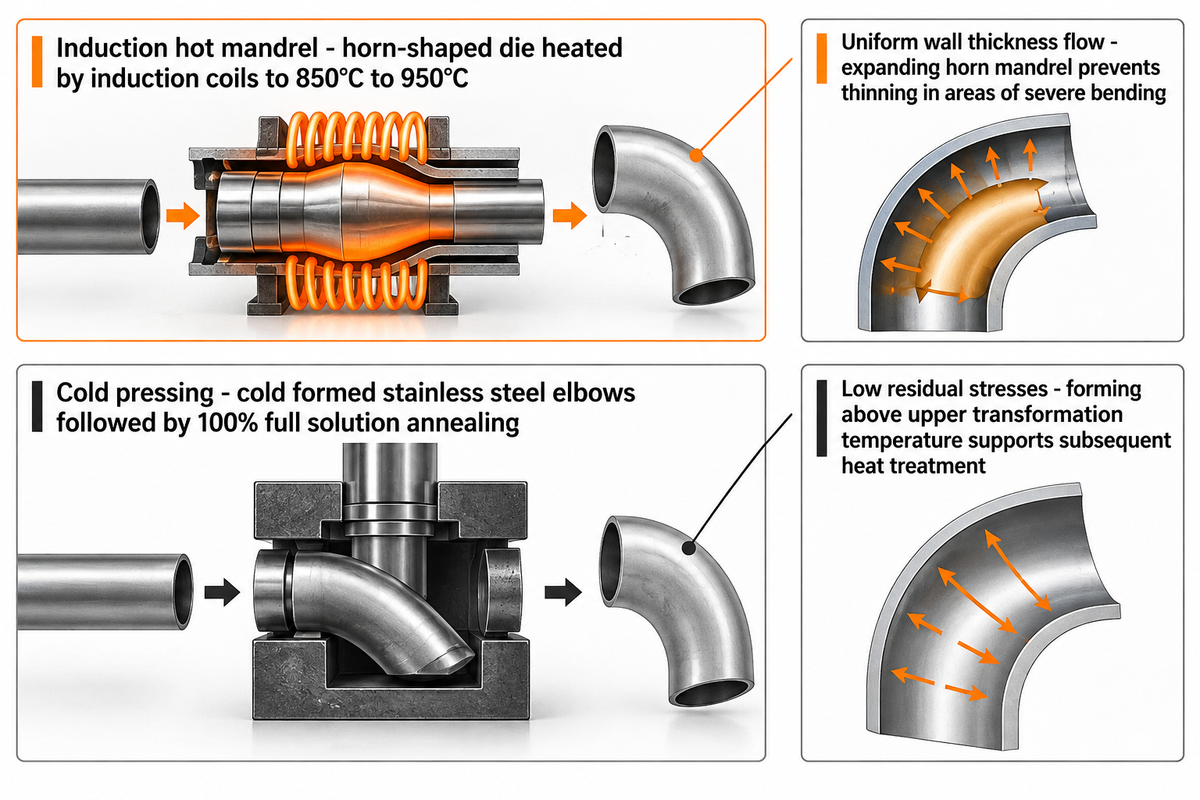
The manufacturing method of butt weld elbow manufacturers dictates the microstructure integrity, dimensional accuracy, and internal stress state of the finished fitting. There are two dominant methods for forming smooth elbows in modern pipe fittings production: the induction hot mandrel push-forming process and the hydraulic cold-pressing process.
The hot mandrel process is used for uniform production of smooth butt weld elbows with consistent wall thickness. A horn-shaped die is used in the mandrel. The die is heated by high frequency induction coils to a temperature of 850°C to 950°C and pushed into a pipe, which is previously cut to the correct length. The die, together with the pipe, expands and bends to the desired radius. A mandrel with an internal diameter of 1.5D is commonly used for Long Radius elbows and Short Radius elbows, in which case the pipe is bent to a radius of 1D.
Because the metal is formed in the austenitic temperature range, the steel flows plastically with minimal resistance. Some benefits of continuous hot plastic deformation are as follow:
There are challenges with processing large diameter piping. Cold pressing is the primary method of forming the stainless steel elbows (NPS 1/2 to 4 inches) and specialty thin-wall architectural fittings. The male die is split and a straight tube is inserted. The desired shape is achieved through the application of hydraulic fluid or mechanical polyurethane plugs. Unlike warm or hot forming, cold forming achieves excellent surface finishes and requires minimal finishing. The plastic strain hardening greatly diminishes the impact toughness and ductility of the stainless steel and alloy elbows. Due to this, cold-formed NPS 1/2 and above piping must be 100% full solution annealed, followed by rapid water quenching to improve the impact toughness and to restore the corrosion resistance of the piping.
In piping systems, hydraulic dynamics show a clear flow head loss comparison: Long Radius (1.5D) elbows maintain K=0.25 vs Short Radius (1.0D) elbows at K=0.45, demonstrating a 44% reduction in pressure drop across industrial process piping. The resistance coefficient (K-factor) is a function of the type of bend as described in Crane Technical Paper 410 (TP-410).
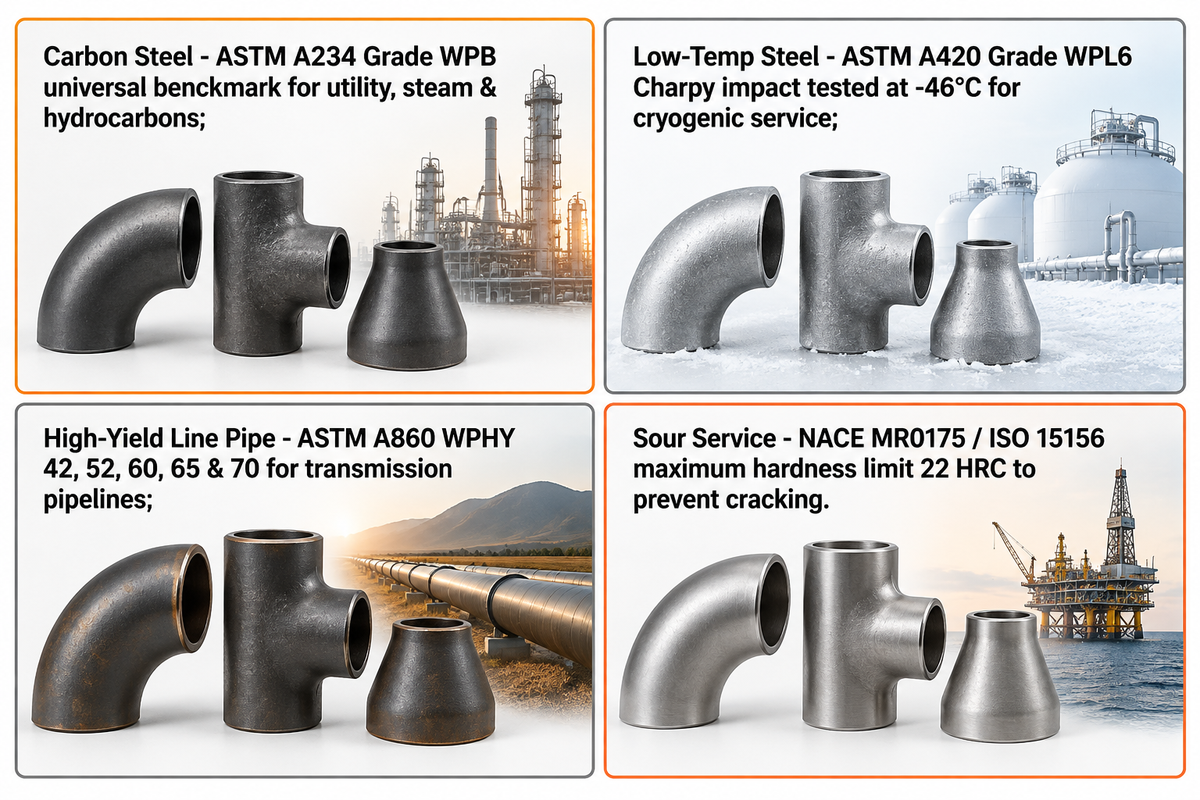
Butt weld elbow manufactures fittings across diverse metallurgical grades to address the requirements of varying service conditions. Each fitting is accompanied by a grade identification number. Matching these numbers with the adjacent straight line diagrams will help define the metallurgical grade of the fitting:
ASTM A234 controls the wrought carbon and low alloy fittings for use in pressure piping:
carbon steels presents a particular risk for catastrophic brittle fracture in liquefied natural gas (LNG) processing, arctic transmission lines, and cryogenic refrigeration systems. ASTM A420 Grade WPL6 is the best low temperature fitting available. All WPL6 butt weld elbows must undergo standardized Charpy V-notch impact testing at -46°C (-50°F) and must absorb a minimum impact energy of 18 Joules (average of 20 J). To achieve this level of cryogenic toughness, special micro-alloying practices must be used in conjunction with normalizing and quench and tempering heat treatments.
High-strength (HS) line pipes of oil and gas are pipelines of high-yield micro-alloyed line pipes (API 5L X52, X60, X65 and X70). High-strength pipelines require fittings of ASTM A860 (Grades WPHY 42, 52, 60, 65 and 70). ASTM A860 elbows have high yield strengths (up to 485 MPa for WPHY 70) and low carbon equivalents (CE_IIW ≤ 0.42%) with proven transverse Charpy V-notch impact toughness down to -20°C or -46°C.
When hydrocarbon fluids containing wet hydrogen sulfide (H2S) are conveyed in butt weld elbows, they become susceptible to sulfide stress cracking (SSC) and hydrogen induced cracking (HIC). To ensure avoiding brittle failures, fittings must comply with NACE MR0175 / ISO 15156:
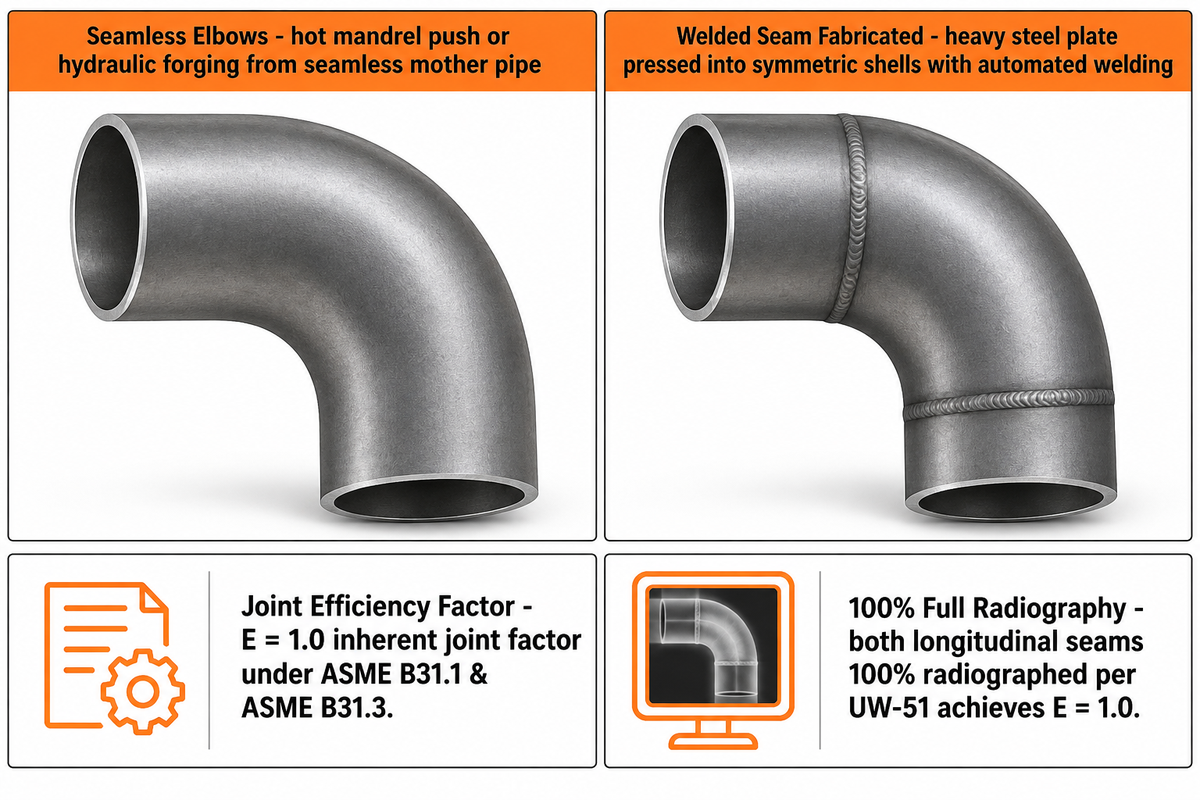
Piping engineers must evaluate the advantages and disadvantages of specifying smooth butt weld elbows or welded seam fabricated elbows, based on the design code, the piping diameter, and the pressure rating.
Manufacturing of smooth elbows is accomplished by the hot mandrel push process or hydraulic forging from the smooth mother pipe. Since the fitting is free of weld seams, it inherently possesses a joint quality factor of 1.0, E = 1.0, in accordance with ASME B31.1 and ASME B31.3. This eliminates the requirement for radiographic testing of the fitting body, ensuring uniform hoop stress and maximizing fatigue resistance to cyclic pressure loads. The physical constraints of the smooth elbows manufacturing process limit the diameter to NPS 24 or 36 inches.
In cases where elbows in the diameter range NPS 26-72 inches (or larger) are required (such as for cooling water and trunkline systems, and large chemical process vessels), the smooth mother pipe isn’t available. Fabricated elbows are manufactured by pressing a heavy steel plate into two symmetric shells and welding the longitudinal seams using an automated process (submerged arc or gas metal arc).
According to ASME B31.3, Table 302.3.4, longitudinal weld seams in fittings are rated for joint efficiency, E = 1, if rigorous non-destructive examination is performed:
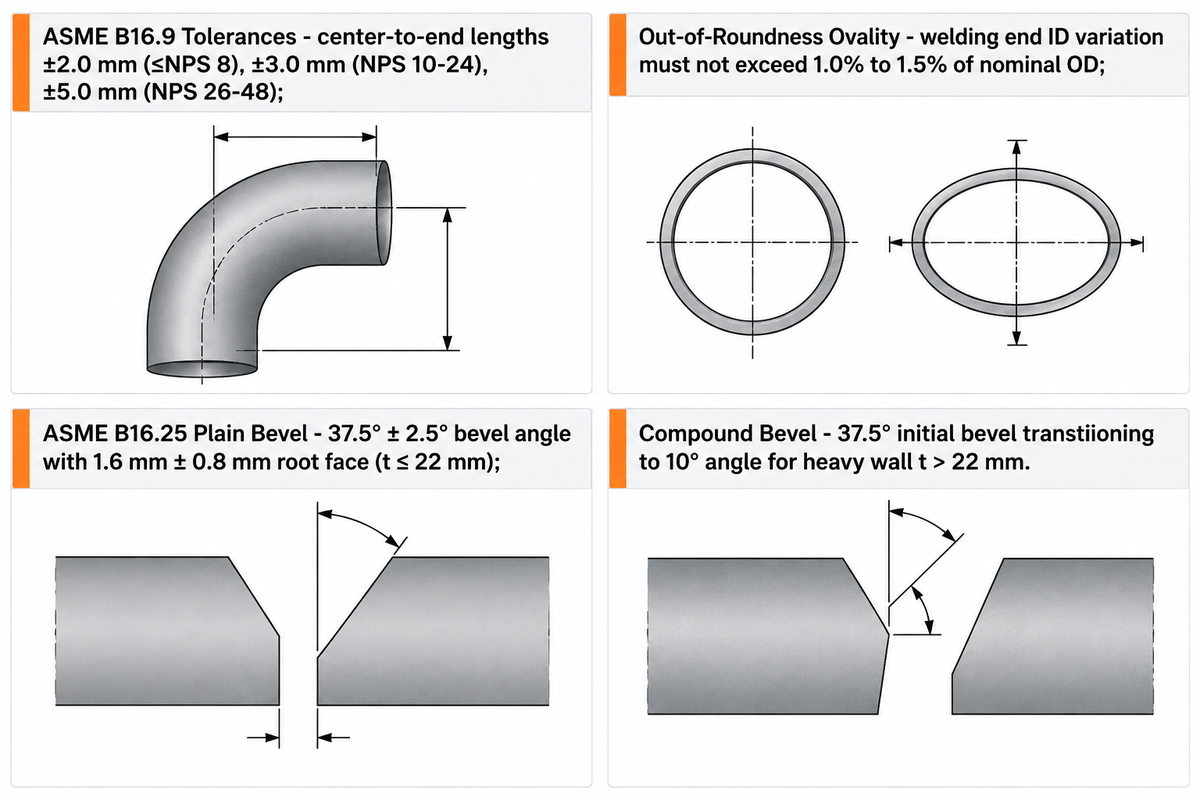
Dimensional compliance affects fit-up speed and weld quality during field pipeline construction. ASME governs buttwelding fitting dimensions through two harmonized standards, ASME B16.9 and ASME B16.25.
ASME B16.9 sets overall dimensions, center-to-end lengths, out-of-roundness (ovality), and wall thickness tolerances for fittings nominal pipe size (NPS) 1/2 to NPS 48.
Buttwelding ends must be precisely prepared to enable full-penetration butt welding per ASME B16.25:
During the elbow forming process, the outer part of the bend becomes the extrados, and the inner part becomes the intrados. As part of fundamental plastic flow behavior, the extrados thins relative to the original mother pipe by 5% to 12%, while the intrados bulges.
ASME B16.9 explicitly accounts for this physical behavior through the 12.5% manufacturing tolerance rule. The standard states that the minimum wall thickness at any point on the finished elbow must never be less than 87.5% of the nominal pipe wall thickness (t_min ≥ 0.875 × t_nom). To meet design pressure requirements, qualified butt weld elbow manufacturers deliberately use mother pipe with positive mill rolling tolerances (+10% to +15%) or thickened mother tubes.
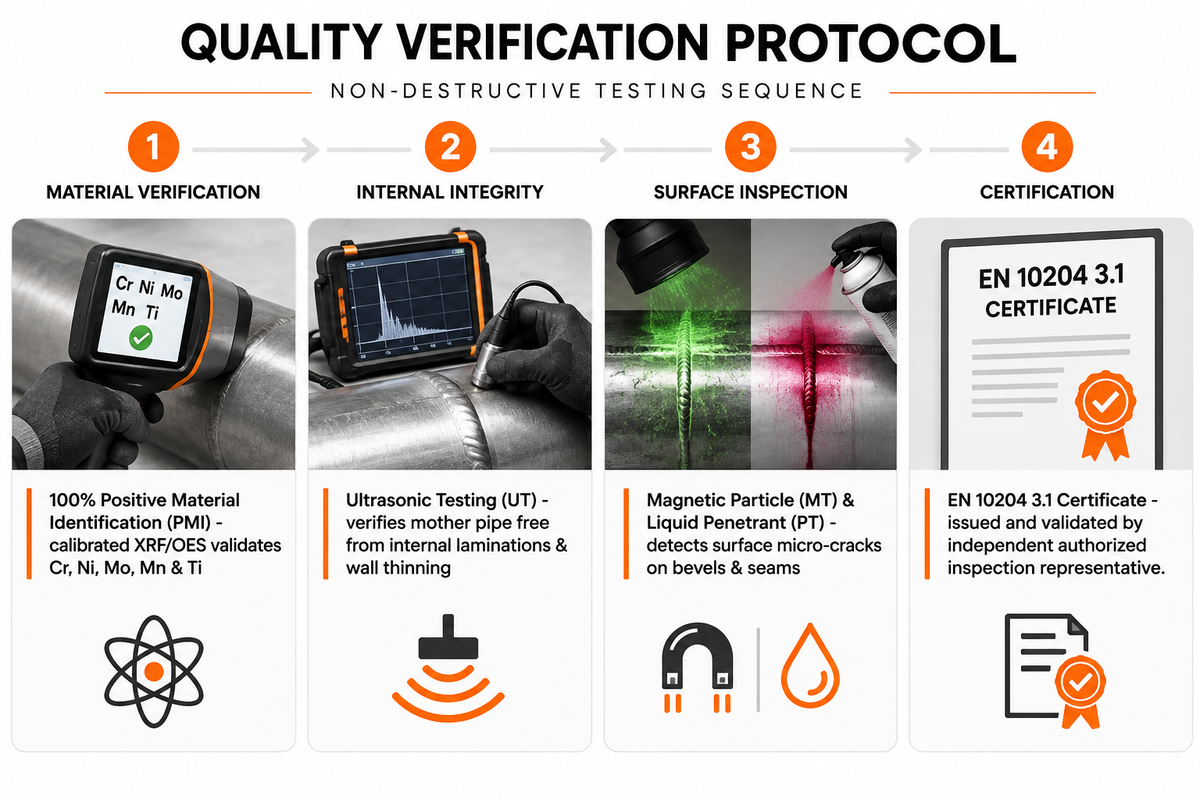
There are many quality assurance procedures in butt weld elbow manufacturing that differentiate top-notch fabricators from substandard mills. Since defective fittings can cause catastrophic pipeline ruptures, top fabricators implement stringent quality control procedures.
European and global engineering specifications require certified material test documentation conforming to EN 10204:
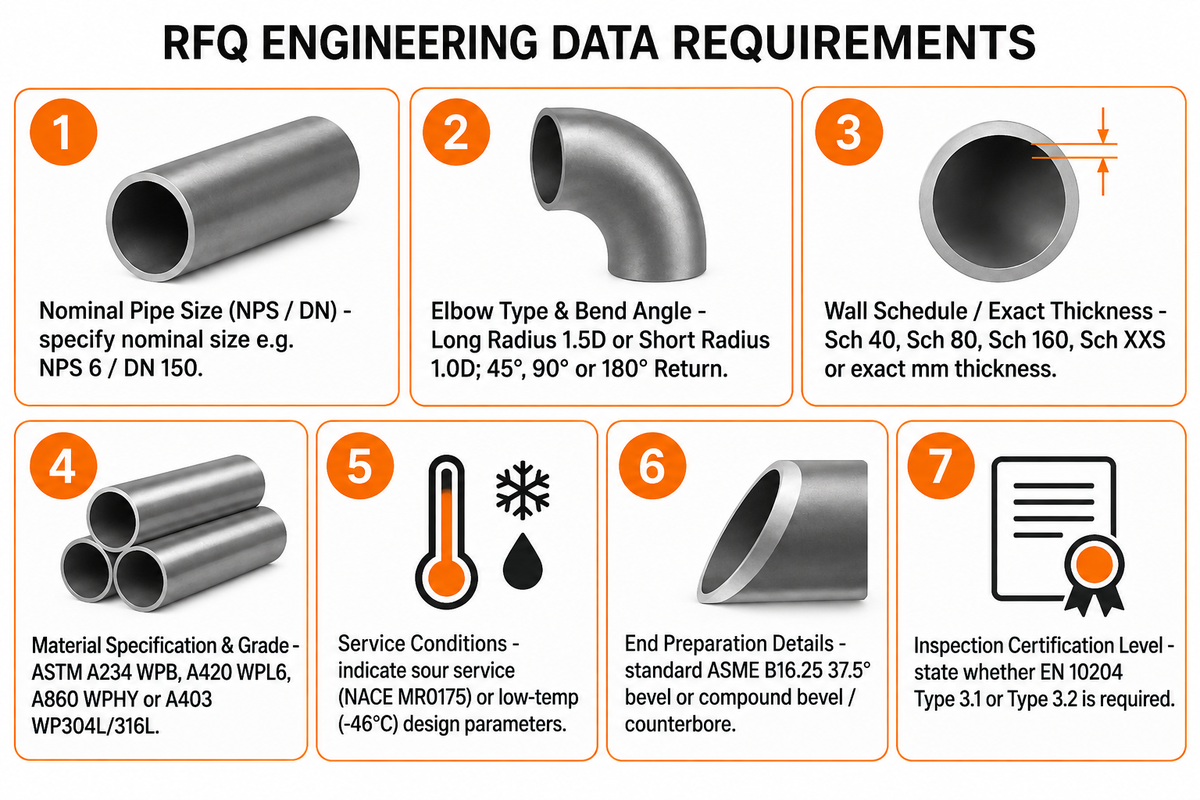
The following checklist is to be followed while preparing a Request For Quotation (RFQ) for butt weld elbow Manufacturers. Procurement managers and piping engineers are recommended to follow this structured checklist to avoid expensive change orders and project delays, or rejecting shipments. As butt weld elbows are available is available in hundreds of schedule and diameter combinations, exact technical definition in the RFQ will prevent change orders. In more complex piping layouts of a plant, piping designers use butt weld elbows in combination with reducing tees and lap joint stub ends along with backing flanges. Every flange transition is to be engineered with a gasket of similar size and a pair of spiral-wound joints to maintain joints tight under thermal cycles:
Inadequate export packaging leads to transit corrosion, bevel denting, and costly field remediation. Manufacturers who are reliable and consistent adhere to strict packaging standards.
Below are the answers to the most common questions related to butt weld elbow specifications, formation methods, code deratings, and main manufacturing standards, from experts in engineering and procurement.
Smooth butt weld elbows are manufactured directly from smooth mother pipe using the induction hot mandrel push process or hydraulic forging, ensuring a continuous metallurgical grain structure with no longitudinal weld seams. This gives smooth elbows an intrinsic joint efficiency factor of E = 1.0 under ASME B31.3 without needing volumetric non-destructive weld examinations. On the other hand, butt weld elbows with welded longitudinal seams, also called welded elbows, are fabricated by pressing two symmetrical heavy steel plates into half-shells and welding them along longitudinal seams using automated submerged arc weldping. Fabricated welded elbows are primarily used in larger size seamless pipes (NPS 24 and above) in place of butt weld elbows. Welded elbows must undergo full radiography (100%) as described in ASME Section VIII UW-51 to achieve E = 1.0. A design pressure derating of 15% must be applied using a joint factor of E = 0.85, in the absence of full radiography.
An LR butt weld elbow has a centerline radius equal to 1.5 times the nominal pipe size (R = 1.5D), whereas an SR elbow has a centerline radius equal to the nominal pipe size (R = 1.0D). The longer, more gradual curvature of an LR elbow results in a fluid flow that has a significant reduction in hydraulic resistance and a K-factor of approximately K ≈ 0.20-0.30 as compared to an SR elbow with a K-factor of approximately K ≈ 0.40-0.50 as stated in Crane TP-410. A reduction of the K-factor of approximately 40% represents a significant reduction in pressure drop across the fluid flow. A reduction in the pressure drop across the fluid flow also can reduce the energy cost and hydraulic turbulence in the system and decrease the rate of internal erosion corrosion caused by high velocity fluids and/or vapors. An SR elbow is generally specified for systems where 1.5D spatial clearances can’t be physically accommodated, e.g., marine engine rooms and offshore skid packages.
The main ASTM standards for carbon and alloy steel butt weld elbows vary with operating temperature and pressure: ASTM A234 covers wrought carbon and alloy steel fittings for moderate and elevated temperature services. Grade WPB is the global standard for industrial process and refinery piping. ASTM A420 is for low-temperature service down to -46°C (-50°F). Grade WPL6 requires Charpy V-Notch impact testing to prevent unacceptable catastrophic brittle fracture in LNG and other cryogenic services. Pipelines, matching API 5L Line pipe, has ASTM A860 for high strength wrought ferritic steel fittings (Grades WPHY 42 through WPHY 70), where thermomechanical control or a quench and temper heat treatment is required to obtain the minimum yield strength.
During the mandrel hot push or hydraulic bending process, the outer curve of the elbow- the extrados- undergoes tensile elongation which naturally thins the pipe wall by 5% to 12% while the inner curve- the intrados- undergoes compressive thickening. ASME B16.9 addresses the plastic deformation behavior of the extrados wall by providing a manufacturing tolerance where the thinned wall must not fall below 87.5% of the nominal wall thickness (t_min ≥ 0.875 × t_nom). Qualified butt weld elbow manufacturers source mother pipe with positive mill rolling tolerances (+10% to +15%) or use heavier schedule starting stock in order to account for the extrados wall wall thickness to satisfy the design code pressure containment calculations.
According to ASME B31.3 (Process Piping) and ASME Section VIII Division 1, full automated ultrasonic examination (UT) or 100% radiographic examination (RT) of all longitudinal and circumferential welded seams is mandatory when the piping design uses a joint quality factor of E = 1.0. Full radiography ensures complete weld penetration and a seam that’s free of any volumetric cracks, lack of fusion and slag. If full 100% radiography isn’t performed and the manufacturer relies on spot radiography or a visual examination, a derating penalty of the joint quality factor to E = 0.85 is enforced. This forces piping designers to increase the specified wall thickness of the elbow by roughly 17.6%, to compensate for the derated joint, resulting in increased weight and material cost for the project.
For commercial and refinery piping projects, purchasing agents should require EN 10204 Type 3.1 inspection certificates. Type 3.1 certificates are legally validated by the independent qualified inspection representative of the manufacturing shop, and validate specific chemical heat analysis, mechanical tensile and yield test results, Charpy impact toughness, hardness measurements and heat treatment furnace charts for the delivered production lot. For high-consequence applications such as offshore subsea pipelines, systems of nuclear power plants, or transport of lethal toxic chemicals, purchasing agents should require EN 10204 Type 3.2 certificates. Type 3.2 certificates require that all mechanical tests and non-destructive examinations be witnessed and co-certified by an independent third-party inspection authority (Lloyd’s Register, DNV, Bureau Veritas, or TUV) or the client’s appointed inspector.
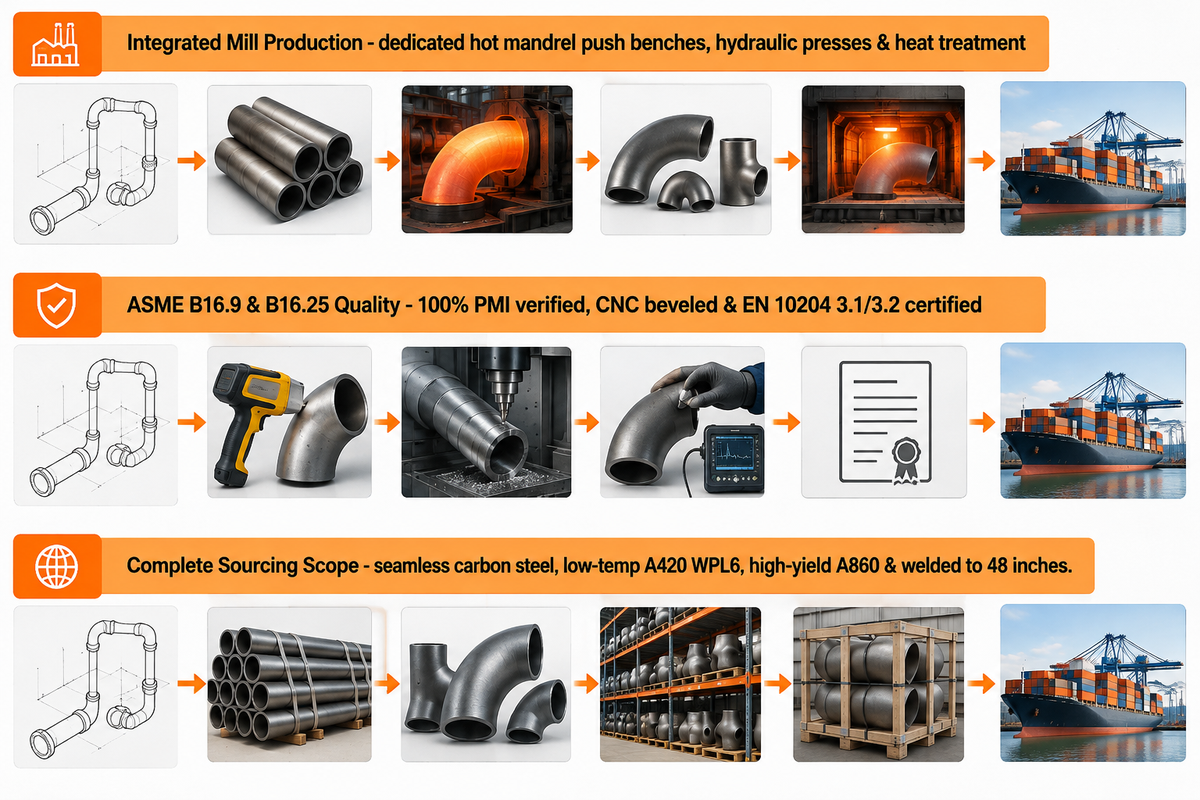
Synbase Steel Co., Ltd. is a integrated Chinese mill with dedicated hot mandrel push benches, heavy hydraulic presses, and advanced heat treatment facilities. Synbase Steel manufactures ASME B16.9 butt weld elbows to the highest international standards of engineering. Synbase Steel, through certified steel materials, ensures full heat traceability in their production. With this, Synbase Steel provides maximum reliability to the projects they supply, be it domestic infrastructure or international energy projects. Be it seamless carbon steel elbows for steam process lines, low temperature ASTM A420 WPL6 elbows for LNG transport, high yield ASTM A860 WPHY elbows for high-pressure pipelines, or large diameter welded elbows (up to 48 inches), Synbase Steel takes pride in manufacturing precision.
All fittings manufactured by Synbase Steel are 100% Positive Material Identification (PMI) verified, CNC beveled as per ASME B16.25, and NDE/PT testing backed with full heat traceability and certified EN 10204 3.1 or 3.2 inspection documents. Integration with the parent line pipe rolling mills ensures chemical compatibility and smooth fit-up across complete pipeline packages.
To discuss your engineering specifications, review mill test reports, or request a firm factory quote, contact our technical export team today:
sales@synbasesteel.com with your complete RFQ data sheet and project delivery schedule.The specifications, tolerance limits, and manufacturing criteria included in this B2B buyer’s guide are based on definitive standards from international standards organizations and verified first-party manufacturer engineering documentation:
Synbase Steel supplies steel pipe, fittings, flanges, valves and OCTG for oil and gas, petrochemical, power, water and industrial projects. Our technical guides are written to help buyers compare standards, grades, dimensions, coatings, inspection requirements and commercial terms before sending an RFQ.
We focus on practical specification work: matching pipe process to service conditions, checking wall thickness and end finish, reviewing MTC and NDT requirements, and clarifying documentation before production or shipment.
Project support across seamless pipe, ERW, LSAW, SSAW, buttweld fittings, forged flanges, valves and oilfield tubulars.
Specification review for ASTM, ASME, API, EN and DIN standards, including material grade, pressure class, coating and inspection scope.