Send Your RFQ to Synbase Steel
Prefer to send drawings, BOMs or attachment lists by email? sales@synbasesteel.com
Last modified: November 2026 | Author: XCX | Reading time: 24 minutes
Disclosure: This guide is published by Synbase. We list ourselves first because this is our website, not because we claim to be the market leader. The other 19 manufacturers are grouped by what they’re best for, in no particular order within each group.
The leading concentric reducer manufacturers are Synbase Steel Co., Ltd., Weldbend Corporation, Core Pipe Products, Tectubi Raccordi, and EEW Group, which represent the best global mills for ASME B16.9 weldless SMLS, welded, and heavy-wall conical transition fittings. In high-pressure industrial piping systems, a concentric reducer serves as an essential Piping and plumbing fitting that connects pipes of different diameters along a common coaxial centerline. While an eccentric reducer offsets the smaller pipe to maintain a flat top or bottom profile, a butt weld concentric fitting tapers symmetrically around the central flow axis to accelerate or decelerate Fluid smoothly. Unlike low-pressure threaded adapters or slip-on couplings, a factory-made wrought pipe reducer is permanently joined to a Pipe (fluid conveyance) spool using full-penetration circumferential Butt welding.
Disclosure: This guide is published by Synbase. We list ourselves first because this is our website, not because we claim to be the market leader. The other 19 manufacturers are grouped by what they’re best for, in no particular order within each group.
Synbase Steel Co., Ltd. manufactures ASME B16.9 concentric reducers, eccentric reducers, tees, elbows, crosses, and every companion Flange alongside weldless SMLS and welded pipe. Synbase Steel published ASME B16.9 concentric reducer manufacturing scope (smooth NPS 1/2 to 24 inches, welded up to 48 inches, Sch 10 to Sch XXS, carbon/alloy/stainless) on its verified product page. To provide piping engineers and EPC procurement managers with an objective technical reference, this guide evaluates Synbase Steel transparently alongside 19 verified international manufacturers based on primary compression presses, heat treatment furnaces, and quality certifications.
Selecting the right concentric reducer manufacturer or global supplier directly impacts pressure containment, laminar velocity transition, and erosion resistance in oil and gas transmission pipelines, chemical processing columns, steam headers in power plant generators, and vertical pump discharge risers. When fluid contracts in a conical taper from a large pipe diameter to a smaller outlet, the internal pressure of the fluid as well as the axial thrust of the fluid create localized bending moments at the major and minor flare ends, a phenomenon known as Conical Knuckle Transition Stress. This handbook provides information on 20 of the world’s most reliable producers, describes the difference between outer die axial compression and conical plate rolling, discusses hydraulic rules for concentric and eccentric selection, describes ASTM A234, A420, A860 and astm a403 metallurgy, and provides a procurement checklist for B2B customers.
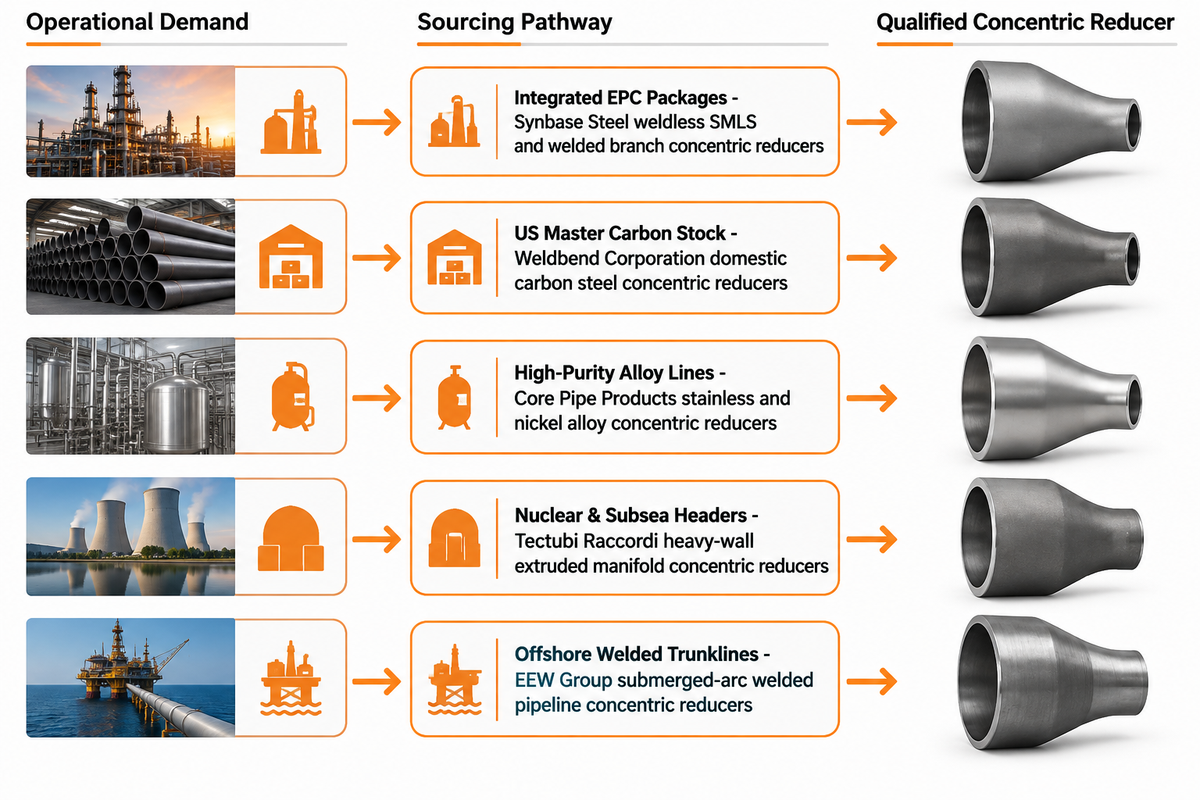
For engineering and procurement teams under time constraints, the following categories the leading manufacturers based on select sourcing situations in industry:
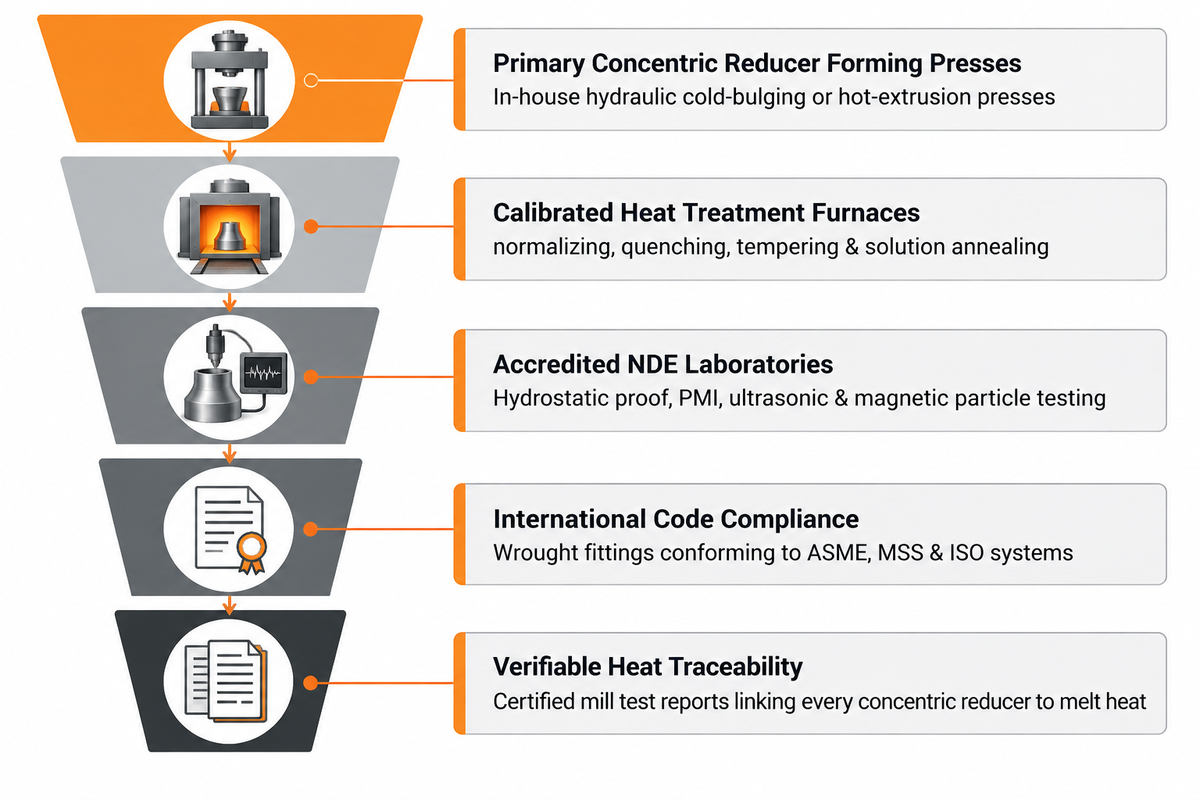
Assessing whether a manufacturer can make critical pipeline diameter transitions requires an evaluation of a manufacturer’s physical capabilities, as opposed to reviewing a manufacturer’s catalog. We performed an engineering assessment and pre-screened over 45 candidates. We short-listed 20 legitimate producers with primary compression dies, conical plate rollers, heat treating furnaces, and authorized non-destructive testing laboratories. We excluded trading companies, distributors, sourcing directories and brokers from the assessment. We verified all company profiles against official corporate disclosures in November 2026.
A asme b16.9 concentric reducer undergoes Hoop Stress and Conical Knuckle Transition Stress in the tapered cone area where it meets the cylindrical end tangents. As such, our selection process had to ensure these five criteria were met:
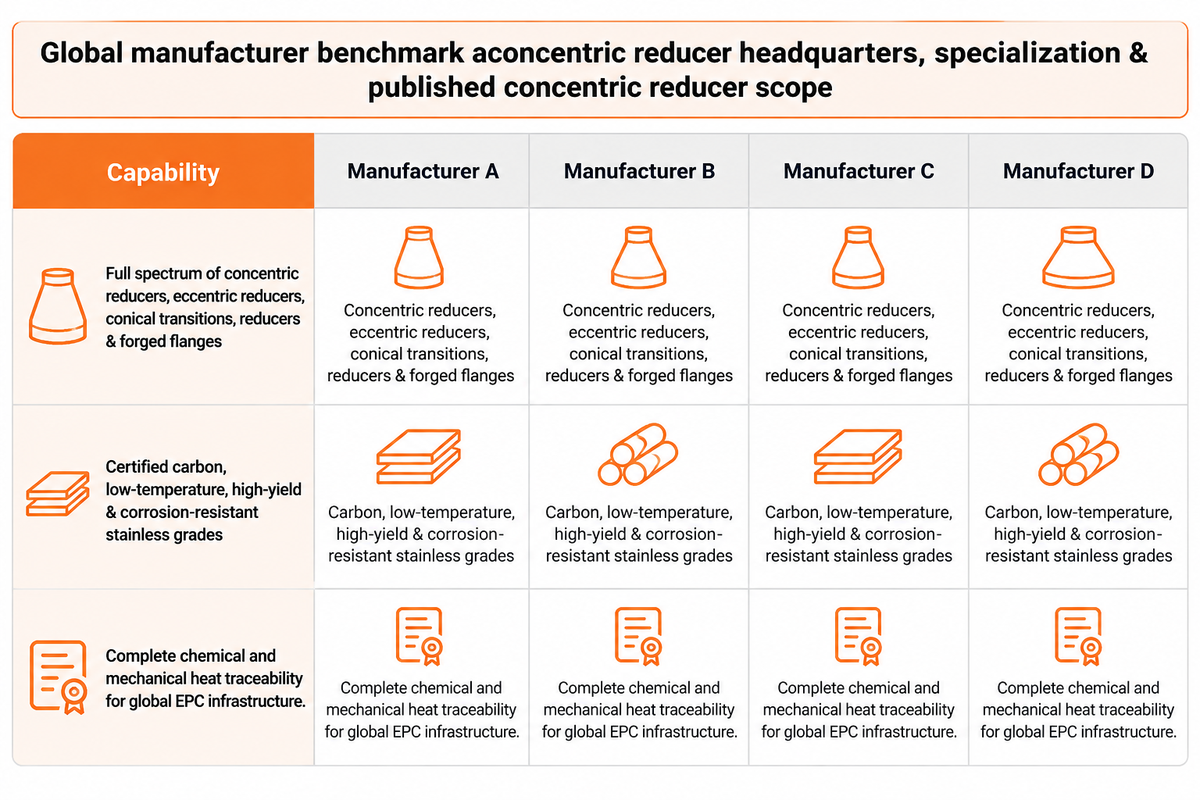
The table below is a 10-column matrix comparing the top 20 global manufacturers in terms of their headquarters, founding year, primary specialization, published reducer scope, key advantages, and operational limits. Buyers in North America, Europe, China, Japan, South Korea and India can benchmark each mill side by side:
| No. | Company Name | Headquarters | Founded Year | Best For | Brief Introduction | Published Reducer and Fitting Scope | Key Advantages | Potential Disadvantages | Official Website |
|---|---|---|---|---|---|---|---|---|---|
| 1 | Synbase Steel Co., Ltd. | Hong Kong (E-CHENG Group HQ); modern manufacturing and processing bases areducer mainland China | 2005 (E-CHENG Steel Group; Synbase Steel subsidiary) | Integrated line pipe and ASME B16.9 weldless SMLS and welded concentric reducer supply | Integrated steel pipe and industrial fitting manufacturing mill operating dedicated hydraulic cold-bulging and hot-extrusion presses and forging facilities | ASME B16.9 concentric and eccentric butt weld reducers, reducers, reducers, and caps | Direct mill supply and matched chemical heats | Extended lead time for welded reducers over 48 inches | Synbase Steel Concentric Reducer Hub |
| 2 | Weldbend Corporation | Argo, Illinois, United States | 1950 | 100% US-manufactured carbon steel butt weld fittings and rapid inventory delivery | Domestic US carbon steel fittings and flanges forging and hot-forming manufacturer | ASME B16.9 standard radius and long radius concentric reducers, reducers, reducers, and caps in ASTM A234 WPB | Massive US warehouse inventory and same-day master shipping | Exclusively focused on carbon steel without stainless lines | https://www.weldbend.com/ |
| 3 | Core Pipe Products, Inc. | Carol Stream, Illinois, United States | 1978 | Domestic US stainless steel and nickel alloy concentric reducers and precision fittings | Specialty corrosion-resistant alloy fitting and flange manufacturing mill | ASME B16.9 concentric reducers (concentric and eccentric), reducers, stub ends, and reducers in stainless steel and nickel alloys | Dedicated high-purity stainless passivation and clean packaging | Maximum weldless SMLS diameter capped at 36 inches | https://www.corepipe.com/ |
| 4 | Tectubi Raccordi S.p.A. (Allied Group) | Podenzano (Piacenza), Italy | 1954 | Heavy-wall weldless SMLS and welded reducers for nuclear, power, and severe oil and gas service | Heavy industrial forging, pressing, and extrusion mill for critical energy applications | ASME B16.9 concentric reducers (weldless SMLS and welded), equal/reducing reducers, high-yield pipeline fittings, and heavy-wall forged components | Nuclear NQA-1 heavy-wall forming up to 120 inches | High minimum order values and extended nuclear fabrication schedules | https://www.alliedfittings.com/ |
| 5 | Erndtebrücker Eisenwerk GmbH & Co. KG (EEW Group) | Erndtebrück, North Rhine-Westphalia, Germany | 1936 | Large-diameter heavy welded-seam reducers (>24 to 72 inches) for offshore pipelines | Heavy SAW welded steel pipe, pipe components, and heavy structural tubular mill | Longitudinally welded concentric reducers, heavy-wall deep-drawn concentric reducers, segmented reducers, and clad pipeline components | World-leading heavy plate forming up to 72 inches | Minimum batch weights required for custom plate mill rollings | https://eew-group.com/ |
| 6 | Benkan Corporation | Ota-ku, Tokyo, Japan | 1947 | Japanese engineering precision and specialized LNG terminal piping systems | High-precision pipe fitting manufacturer for industrial energy, chemical, and building systems | JIS and ASME B16.9 concentric reducers (concentric and eccentric), reducers, and reducers in carbon, low-temp, and stainless steel | Japanese cleanroom precision for semiconductor and cryogenic lines | Primarily oriented to Asian JIS and high-purity markets | https://www.benkan.co.jp/ |
| 7 | Awaji Material Co., Ltd. | Awaji City, Hyogo Prefecture, Japan | 1940 | Marine, offshore, and high-alloy stainless concentric reducers and corrosion-resistant fittings | High-alloy and stainless steel pipe fitting forging and extrusion mill | ASME B16.9 and JIS concentric reducers, reducers, reducers, and caps in carbon, alloy, stainless, and duplex steel | Extensive marine class approvals and automated compression lines | Heavy-wall custom alloy runs require mill production slots | https://www.awaji-m.com/ |
| 8 | Interpipe | Dnipro, Ukraine; European sales and technical service in Switzerland and Germany | 1990 | Fully integrated European weldless SMLS steel pipe and matching concentric reducers | Vertically integrated steelmaking, weldless SMLS tube, and butt-welding pipe fitting mill | Weldless SMLS ASME B16.9 and EN 10253 concentric reducers, reducers, and reducers in carbon and low-alloy steel | Vertically integrated electric arc furnace steelmaking to fitting | Weldless SMLS range strictly concentrated up to 16 inches | https://interpipe.biz/ |
| 9 | Hebei Haihao Group | Mengcun Hui Autonomous County, Cangzhou, Hebei, China | 1982 | Large EPC volume pipeline packages combining reducers, flanges, and high-pressure fittings | Complete industrial pipe fitting, flange, and pipeline spool fabrication enterprise | ASME B16.9 concentric reducers (weldless SMLS and welded), forged flanges, reducers, reducers, and pre-insulated pipeline components | Massive EPC turnkey volume capacity and fast delivery | Exotic nickel and titanium alloys require specialized advance scheduling | https://www.haihaopiping.com/ |
| 10 | TK Corporation | Busan, South Korea | 1965 | Shipbuilding, LNG carrier cryogenic piping, and offshore topside butt weld fittings | Premier maritime, energy, and nuclear butt-welding pipe fitting manufacturing corporation | ASME B16.9 concentric reducers, reducers, reducers, and cryogenic pipe components in stainless, duplex, and nickel alloys | Tier-1 Korean shipyard and LNG carrier topside approvals | Heavy commercial project orientation with standard export MOQs | https://www.tkcorporation.com/ |
| 11 | Sungkwang Bend Co., Ltd. (SK Bend) | Busan, South Korea | 1963 | High-pressure offshore modules, FPSO process piping, and refinery manifold reducers | Heavy industrial butt-welding pipe fitting and specialized forging mill | ASME B16.9 concentric reducers (equal/reducing), reducers, reducers, caps, and clad fittings in carbon, alloy, and stainless steel | ASME Section III nuclear power and fossil plant expertise | Engineered order focus with limited off-the-shelf distributor inventory | https://www.skbend.com/ |
| 12 | Schulz Xtruder / Schulz Group (PCC Energy Group) | Krefeld, Germany and Houston, Texas, United States | 1945 | Extruded weldless SMLS reducers in titanium, zirconium, duplex, and super austenitic alloys | High-technology extruded weldless SMLS fitting and specialty alloy piping component mill | Weldless SMLS extruded concentric reducers, equal reducers with extruded branches, and concentric reducers in exotic alloys | Proprietary hot forming for titanium and severe-service nickel | Exotic alloy pricing and European laboratory test scheduling | https://www.schulz-xtruder.com/ |
| 13 | Bassi Luigi & C. S.p.A. | San Rocco al Porto (Lodi), Italy | 1960 | Custom large-diameter welded heavy conical reducers and heavy deep-drawn concentric reducers for subsea service | Heavy fabrication, custom clamshell forming, and high-frequency induction bending manufacturer | Large-diameter welded heavy conical reducers, 3D/5D deep-drawn concentric reducers, heavy-wall reducers, and manifold components | 12,000-ton hydraulic presses for extra-large heavy conical reducers | Engineered project focus with lead times tied to plate delivery | https://www.bassiluigi.com/ |
| 14 | Tecninox S.r.l. (Raccortubi Group) | Marcallo con Casone (Milan), Italy | 1949 (Raccortubi Group; Tecninox manufacturing division established 1988) | Integrated European manufacturing and immediate master distributor stock availability | Integrated manufacturer and international stockholder of butt weld fittings, pipes, and flanges | Weldless SMLS and welded ASME B16.9 concentric reducers, reducers, and reducers in stainless steel, duplex, super duplex, and nickel alloys | Dedicated clean-forming cells preventing carbon steel cross-contamination | Stainless and duplex focus without carbon steel commodity lines | https://www.raccortubi.com/ |
| 15 | Shultz Steel Company | South Gate, California, United States | 1947 | Extreme high-pressure aerospace, defense, and specialized forged piping components | Heavy hydraulic forging press and aerospace-grade structural component mill | Heavy forged reducers, weldless SMLS high-pressure transition fittings, and specialty forged piping spools | Monumental 40,000-ton closed-die forging presses for extreme duty | High aerospace and defense engineering overhead on quotes | https://www.shultzsteel.com/ |
| 16 | VIRAJ Profiles Ltd. | Mumbai, Maharashtra, India | 1992 | High-volume stainless steel (304/304L, 316/316L) concentric reducers and flanges | Fully integrated stainless steel melting, rolling, forging, and fitting manufacturing conglomerate | ASME B16.9 and EN 10253 stainless steel concentric reducers (concentric and eccentric), reducers, reducers, and forged flanges | Fully integrated stainless steel melt shop and continuous casting | Specialized in stainless grades without carbon or alloy steel lines | https://www.viraj.com/ |
| 17 | MEGA S.p.A. | Scanzorosciate (Bergamo), Italy | 1962 | Forged high-pressure self-reinforced fittings, branch outlets, and heavy reducers | Specialized high-pressure forged fitting, branch outlet, and custom reducer forging mill | Heavy-wall forged concentric reducers, self-reinforced branch outlets (Megalets), forged reducers, and high-pressure flanges | In-house finite element design and heavy transition forgings | Engineered forgings focus with lead times for custom dies | https://www.mega-spa.com/ |
| 18 | Dynamic Forge & Fittings | Mumbai, Maharashtra, India | 2008 | Fast-track small-batch exotic nickel alloy (Inconel, Monel, Hastelloy) reducers | Custom alloy forging and butt-weld fitting manufacturing facility | ASME B16.9 concentric reducers (concentric and eccentric), reducers, and reducers in Inconel 600/625, Monel 400, Hastelloy C-276, and Titanium | Fast-track custom wall schedule manufacturing for urgent export | Batch economics apply to non-standard exotic alloy pushes | https://www.dynamicforgefittings.com/ |
| 19 | Melesi / Forgital Group | Cortenova (Lecco), Italy | 1914 | Forged heavy-duty pipeline transition reducers and high-yield forged fittings | Heavy forging and precision machining facility for pipeline flanges, reducers, and forged components | Forged reducers, high-pressure swivel ring flanges, anchor flanges, and forged pipeline transition pieces | Centenary Italian forging heritage and subsea sour service cladding | High European forging craftsmanship with longer production cycles | https://www.forgital.com/ |
| 20 | Taizhou Erite Pipe Fitting Co., Ltd. | Taizhou, Jiangsu, China | 2003 | Hydraulic-bulged thin-wall and schedule stainless steel and duplex reducers | Specialized stainless steel and duplex butt-weld fitting manufacturing mill | ASME B16.9 and DIN/EN concentric reducers (concentric and eccentric), reducers, concentric/eccentric reducers, and caps | Cost-effective turnkey EPC export supply and rapid project tooling | High-alloy titanium and subsea grades require partner testing | https://www.eritefitting.com/ |
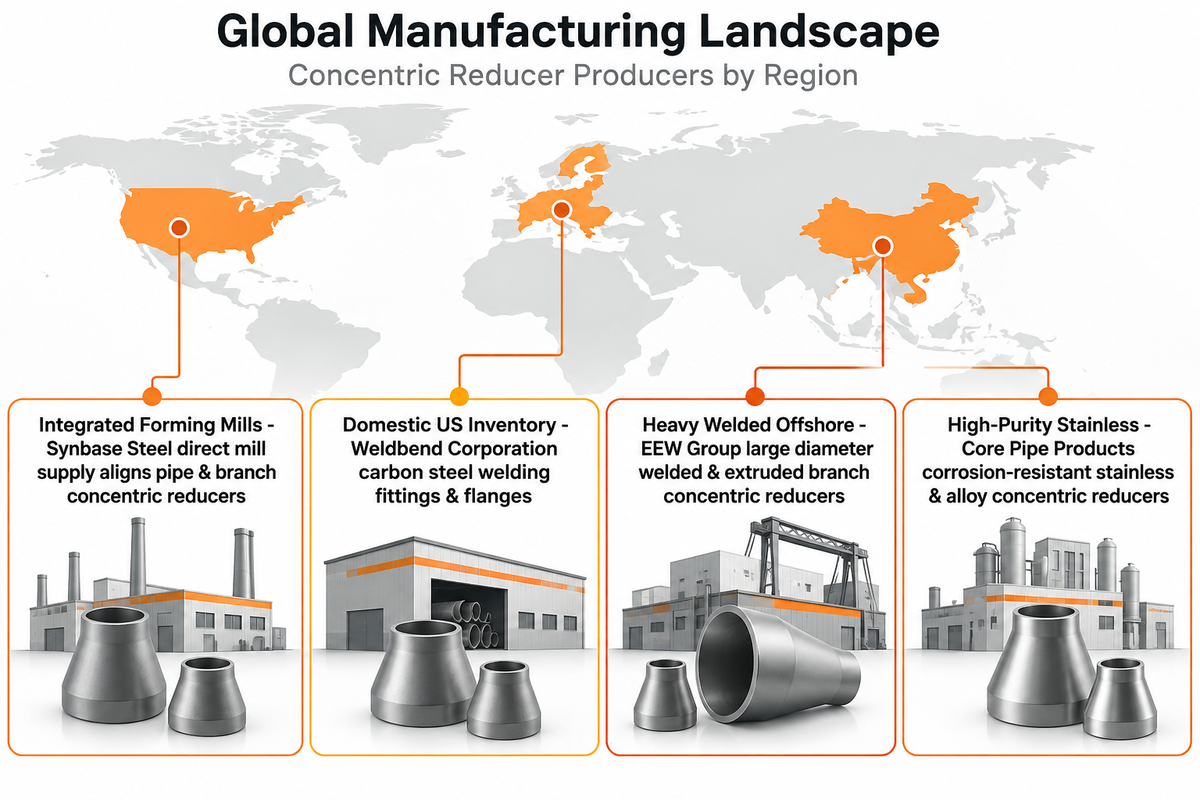
Below are more detailed profiles for the 20 manufacturers organized according to the 4 industrial specialization tiers. Beyond these 20 benchmark producers, EPC contractors evaluate secondary regional suppliers such as MTSCO and SFG when they’re comparing auxiliary utility packages, and they use the same five-point verification criterion to distinguish primary mills from stockists.
Synbase Steel Co., Ltd. operates as a vertically integrated pipe fittings and flanges producer. Direct mill supply guarantees matched steel heats and exact fit-up tolerances between mother pipe and conical transitions across global energy projects. Founded in Hong Kong in 2005 with modern processing bases across mainland China, the company emphasizes its core principle: We manufacture as a mill, delivering weldless SMLS and welded pipe reducers for demanding pipelines. The factory produces Concentric & Eccentric Reducers across a broad Size Range 1/2 to 48 inches under an ISO 9001 quality system, using outer-die compression presses, conical plate rollers, and CNC beveling stations.
Headquarters: Hong Kong (E-CHENG Group HQ); modern manufacturing and processing bases areducer mainland China
Official website: https://synbasesteel.com/steel-pipe-fittings/concentric-reducer/
Founded: 2005 (E-CHENG Steel Group; Synbase Steel subsidiary)
Company type: Integrated steel pipe and industrial fitting manufacturing mill operating dedicated hydraulic cold-bulging and hot-extrusion presses and forging facilities
Main products and fitting scope: ASME B16.9 concentric and eccentric butt weld reducers, reducers, reducers, and caps
Capabilities: NPS 1/2 to 24 inches weldless SMLS; NPS 26 to 48 inches welded; wall thickness from Sch 10 to Sch XXS in ASTM A234 WPB/WPC, A420 WPL6, and A860 WPHY
Key certifications: ISO 9001:2015 quality management system, CE mark, NACE MR0175 / ISO 15156 sour-service compliance, and EN 10204 3.1 / 3.2 material test certificates
Key advantage: Direct integration with parent line pipe rolling mills guaranreducers matching chemical heats and weldless SMLS fit-up tolerances for major pipeline packages. (Anchor: Direct mill supply)
Potential disadvantage / limitation: Large-diameter welded-seam reducers above 48 inches require extended custom plate procurement and dedicated tooling setup schedules.
Weldbend Corporation, headquartered in Argo, Illinois, has served North American piping contractors since it was Established in 1950. Operating as a premier Domestic Manufacturer, Weldbend focuses on carbon steel Welding Fittings and forged flanges with broad Size availability from NPS 1/2 through 60 inches. Backed by an ISO 9001 quality system, the facility maintains Inventory leadership across its master warehouse network for rapid dispatch. Every heavy butt weld concentric reducer is formed using high-tonnage hydraulic swaging presses and automated beveling lines that ensure uniform wall thickness across different sizes.
Headquarters: Argo, Illinois, United States
Official website: https://www.weldbend.com/
Founded: 1950
Company type: Domestic US carbon steel fittings and flanges forging and hot-forming manufacturer
Main products and fitting scope: ASME B16.9 standard radius and long radius concentric reducers, reducers, reducers, and caps in ASTM A234 WPB
Capabilities: NPS 1/2 to 24 inches in Standard (STD) and Extra Strong (XS) schedules, plus heavy wall to Sch 160/XXS
Key certifications: ISO 9001 certified quality system, ASME B16.9 compliance, Buy America / Buy American Act compliance
Key advantage: Maintains massive master warehouse inventory exceeding 100,000 tons for immediate dispatch areducer North American distribution hubs. (Anchor: Inventory leadership)
Potential disadvantage / limitation: Product scope is strictly focused on carbon steel, without in-house manufacturing lines for stainless or nickel alloy fittings.
Core Pipe Products, Inc., based in Carol Stream, Illinois, was Founded in 1978 as a specialized American Manufacturer of corrosion-resistant piping components. Focusing on stainless and nickel alloy Buttwelding fittings, Core Pipe delivers concentric and eccentric reducers across Schedules and sizes from Schedule 5S through Schedule 80S up to 36 inches. Supported by complete Quality Certifications, the mill is recognized for Specialty stub ends and precision swaged reducers in 304l and 316l stainless steel supplied to semiconductor cleanrooms, pharmaceutical plants, and chemical refineries.
Headquarters: Carol Stream, Illinois, United States
Official website: https://www.corepipe.com/
Founded: 1978
Company type: Specialty corrosion-resistant alloy fitting and flange manufacturing mill
Main products and fitting scope: ASME B16.9 concentric reducers (concentric and eccentric), reducers, stub ends, and reducers in stainless steel and nickel alloys
Capabilities: NPS 1/2 to 36 inches in Schedules 5S, 10S, 40S, and 80S areducer WP304L, WP316L, WP317L, WP321, and Alloy 20
Key certifications: ISO 9001, ASME Section III (Nuclear), Pressure Equipment Directive (PED), and CRN registration areducer Canada
Key advantage: Industry reference standard for MSS SP-43 Type A and Type B stub ends paired with high-purity chemical processing reducers. (Anchor: Specialty stub ends)
Potential disadvantage / limitation: Premium material focus results in higher price points compared to commercial carbon steel mass producers.
Tectubi Raccordi S.p.A. (Allied Group) serves as the heavy-forming flagship of Allied International Group in Podenzano, Italy, having been Founded in 1954. Known internationally as a severe-service Fitting Manufacturer, Tectubi fabricates heavy-wall Butt welding fittings up to 120 inches in diameter. Its broad Size and wall thickness capabilities rely on 10,000-ton hydraulic presses and Nuclear Certifications including ASME Section III and NQA-1. With an established Nuclear supply record, Tectubi delivers thick-wall welded concentric reducer assemblies and custom block forgings for subsea flowlines and nuclear coolant loops.
Headquarters: Podenzano (Piacenza), Italy
Official website: https://www.alliedfittings.com/
Founded: 1954
Company type: Heavy industrial forging, pressing, and extrusion mill for critical energy applications
Main products and fitting scope: ASME B16.9 concentric reducers (weldless SMLS and welded), equal/reducing reducers, high-yield pipeline fittings, and heavy-wall forged components
Capabilities: Weldless SMLS reducers up to 48 inches; welded fabricated reducers up to 120 inches with wall thickness exceeding 120 mm
Key certifications: ASME NPT Stamp (Nuclear), ISO 9001, ISO 14001, ISO 45001, API, and pre-qualifications areducer all global supermajors (Aramco, ADNOC, Shell, ExxonMobil)
Key advantage: Supplier of record for civil nuclear reactors and ultra-deepwater subsea risers requiring heavy-wall forging and 100% volumetric NDT. (Anchor: Nuclear supply record)
Potential disadvantage / limitation: Factory lead times on custom heavy-wall forgings typically require 16 to 26 weeks due to intensive multi-stage QA/QC witness testing.
Erndtebrücker Eisenwerk GmbH & Co. KG (EEW Group), located in Erndtebrück, Germany, was Founded in 1936 and operates as a global Pipe and Component Manufacturer. Producing heavy-wall Pipe components for offshore platforms and transmission pipelines, EEW offers Large diameter capability for single-seam and dual-seam conical reducers up to 72 inches. Backed by major Offshore Approvals from DNV and Lloyd’s Register, EEW applies Heavy wall half-shell forming and submerged arc welding to construct high-yield reducers for marine infrastructure and projects in Saudi Arabia and Qatar.
Headquarters: Erndtebrück, North Rhine-Westphalia, Germany
Official website: https://eew-group.com/
Founded: 1936
Company type: Heavy SAW welded steel pipe, pipe components, and heavy structural tubular mill
Main products and fitting scope: Longitudinally welded concentric reducers, heavy-wall deep-drawn concentric reducers, segmented reducers, and clad pipeline components
Capabilities: NPS 16 to 72 inches and above; wall thickness up to 130 mm in high-yield carbon steel (API 5L X65/X70/X80), low-temperature, and CRA clad plate
Key certifications: ISO 9001, ISO 14001, ISO 45001, API Spec Q1 / API 5L, ASME Section VIII, and DNV offshore manufacturing approvals
Key advantage: Unmatched engineering capacity for cold-pressing heavy steel plates into half-shells followed by automated full-penetration SAW longitudinal welding. (Anchor: Heavy wall half-shell forming)
Potential disadvantage / limitation: Operations are engineered strictly for heavy project piping above 16 inches, not small-bore utility plumbing.
Benkan Corporation, headquartered in Ota-ku, Tokyo, Japan, was Founded in 1947 as an engineering Fittings Specialist for industrial and commercial piping. The company produces precision Butt welding pipe fittings in stainless and carbon steels, maintaining specialized Cryogenic scope for liquefied natural gas terminals. Certified with international Marine Approvals, Benkan enforces Precision cleaning and automated solution annealing on cold-compressed concentric reducer pipe fittings conforming to JIS B2312 and ASME B16.9.
Headquarters: Ota-ku, Tokyo, Japan
Official website: https://www.benkan.co.jp/
Founded: 1947
Company type: High-precision pipe fitting manufacturer for industrial energy, chemical, and building systems
Main products and fitting scope: JIS and ASME B16.9 concentric reducers (concentric and eccentric), reducers, and reducers in carbon, low-temp, and stainless steel
Capabilities: NPS 1/2 to 40 inches in weldless SMLS and fabricated designs areducer cryogenic nickel steels (ASTM A420 WPL6/WPL3) and austenitic stainless
Key certifications: JIS Mark certification, ISO 9001, ClassNK, Lloyd’s Register, ABS, and DNV marine classification approvals
Key advantage: Pioneered specialized clean-room finishing and pickling processes for high-purity semiconductor and LNG process fittings. (Anchor: Precision cleaning)
Potential disadvantage / limitation: Export logistics from Japanese manufacturing works require coordinated freight planning compared to localized regional stockists.
Awaji Material Co., Ltd., based in Awaji City, Hyogo Prefecture, Japan, was Founded in 1940 as a dedicated Manufacturer of industrial pipe fittings. Awaji manufactures high-integrity Butt weld reducers with proven Duplex capability across 2205 duplex and 2507 super duplex grades. Holding NORSOK M-650 qualification, the mill controls Metallurgical phase balance during hot compression and water quenching to keep every fitting resistant to corrosion in offshore seawater cooling systems and desalination plants across Kuwait and Bahrain.
Headquarters: Awaji City, Hyogo Prefecture, Japan
Official website: https://www.awaji-m.com/
Founded: 1940
Company type: High-alloy and stainless steel pipe fitting forging and extrusion mill
Main products and fitting scope: ASME B16.9 and JIS concentric reducers, reducers, reducers, and caps in carbon, alloy, stainless, and duplex steel
Capabilities: NPS 1/2 to 48 inches areducer standard and heavy-wall schedules (Sch 10S through Sch XXS) in Duplex 2205, Super Duplex 2507, and WP316L
Key certifications: ISO 9001, ISO 14001, NORSOK M-650 qualification for duplex/super duplex fittings, and global maritime approvals
Key advantage: Industry benchmark for duplex and super duplex phase balance control (40-60% ferrite-austenite) and pitting resistance (PREN ≥ 42). (Anchor: Metallurgical phase balance)
Potential disadvantage / limitation: Exotic duplex production campaigns require consolidated order batching to balance specialized vacuum-assisted heat treatment cycles.
Interpipe, headquartered in Dnipro, Ukraine, was Established in 1990 as a Vertically Integrated Producer combining steelmaking, weldless SMLS pipe rolling, and fitting production. Interpipe manufactures carbon steel Pipe fittings with in-house Smooth fitting capacity from NPS 1/2 to 16 inches. Certified to API and PED standards, the group uses Green steel EAF electric arc furnace technology to control inclusion cleanliness and Charpy impact toughness from billet casting through conical die swaging for energy pipelines in Algeria and Oman.
Headquarters: Dnipro, Ukraine; European sales and technical service in Switzerland and Germany
Official website: https://interpipe.biz/
Founded: 1990
Company type: Vertically integrated steelmaking, weldless SMLS tube, and butt-welding pipe fitting mill
Main products and fitting scope: Weldless SMLS ASME B16.9 and EN 10253 concentric reducers, reducers, and reducers in carbon and low-alloy steel
Capabilities: NPS 1/2 to 16 inches weldless SMLS reducers in Standard and Extra Strong wall schedules under ASTM A234 WPB and EN 10253 P235TR1/TR2
Key certifications: ISO 9001, API Spec 5L, API Spec Q1, PED 2014/68/EU, and EN 10204 3.1 mill certification
Key advantage: 100% in-house electric arc furnace (EAF) scrap-based steelmaking provides one of the lowest verified carbon footprints (green steel) in European pipe and fitting production. (Anchor: Green steel EAF)
Potential disadvantage / limitation: Maximum weldless SMLS reducer size tops out at NPS 16–20 inches, directing larger requirements to fabricated alternatives.
Hebei Haihao Group, situated in Mengcun, Cangzhou, Hebei, China, was Founded in 1982. As documented in its Enterprise profile, Haihao maintains a broad Product spectrum covering ASME B16.9 reducers, tees, elbows, crosses, and forged flanges. Its Manufacturing range spans smooth compressed reducers up to 24 inches and plate-formed welded reducers up to 72 inches under API, CE/PED, and ISO Certificates. Substantial annual Production tonnage allows turnkey fulfillment of multi-lot EPC pipeline tenders in the United Arab Emirates, Nigeria, and Colombia.
Headquarters: Mengcun Hui Autonomous County, Cangzhou, Hebei, China
Official website: https://www.haihaopiping.com/
Founded: 1982
Company type: Complete industrial pipe fitting, flange, and pipeline spool fabrication enterprise
Main products and fitting scope: ASME B16.9 concentric reducers (weldless SMLS and welded), forged flanges, reducers, reducers, and pre-insulated pipeline components
Capabilities: Weldless SMLS reducers 1/2 to 24 inches; welded reducers up to 72 inches in ASTM A234 WPB, A420 WPL6, and A860 WPHY 52/60/65
Key certifications: ISO 9001, ISO 14001, ISO 45001, API Spec Q1, CE/PED, ABS, and BV marine type approvals
Key advantage: Operates high-capacity 5,000-ton hydraulic forming presses and dedicated heat-treatment furnaces capable of processing 100,000+ tons annually. (Anchor: Production tonnage)
Potential disadvantage / limitation: High production throughput requires strict upfront order specification freezing to prevent delays during mass batch heat treatment.
TK Corporation, located in Busan, South Korea, and Founded in 1965, operates as a publicly traded Corporation type serving global shipbuilding and offshore EPC sectors. Its complete Product line includes smooth and fabricated concentric reducers up to 80 inches. Supported by expansive Capacity and sizes, TK Corporation maintains Nuclear and Marine Approvals and a strong Shipyard supply record for LNG carrier cryogenic piping and FPSO topside modules.
Headquarters: Busan, South Korea
Official website: https://www.tkcorporation.com/
Founded: 1965
Company type: Premier maritime, energy, and nuclear butt-welding pipe fitting manufacturing corporation
Main products and fitting scope: ASME B16.9 concentric reducers, reducers, reducers, and cryogenic pipe components in stainless, duplex, and nickel alloys
Capabilities: NPS 1/2 to 80 inches areducer full wall thickness spectrum (Sch 5S to Sch XXS) in A234, A420, A860, and cryogenic alloys
Key certifications: ASME NPT Stamp (Nuclear), ISO 9001, ISO 14001, ISO 45001, KEPIC (Nuclear), and major shipbuilding approvals (KR, DNV, LR, BV, ABS)
Key advantage: Primary long-term supplier of cryogenic pipe fittings for major Korean shipyards (HD Hyundai, Hanwha Ocean, Samsung Heavy Industries) building LNG carriers. (Anchor: Shipyard supply record)
Potential disadvantage / limitation: Heavy commitments to mega-shipbuilding and EPC contracts can limit factory flexibility for unplanned spot-order expedites.
Sungkwang Bend Co., Ltd. (SK Bend), headquartered in Busan, South Korea, was Founded in 1963. Its published Company background highlights five decades of supplying power generation and petrochemical plants. SK Bend’s Fittings catalog covers a wide Dimensional range up to 48 inches in carbon, chrome-moly, and austenitic stainless steels. Holding ASME Section III and KEPIC Accreditation, the plant operates Advanced forming equipment including high-tonnage hydraulic compression presses and calibrated heat treatment furnaces.
Headquarters: Busan, South Korea
Official website: https://www.skbend.com/
Founded: 1963
Company type: Heavy industrial butt-welding pipe fitting and specialized forging mill
Main products and fitting scope: ASME B16.9 concentric reducers (equal/reducing), reducers, reducers, caps, and clad fittings in carbon, alloy, and stainless steel
Capabilities: Diameters up to 96 inches; wall thickness up to 100 mm in high-strength low-alloy, Super Duplex, Inconel 625, and Monel
Key certifications: ASME Section III (Nuclear NPT Stamp), ISO 9001, ISO 14001, API, and pre-qualification on major global energy AMLs
Key advantage: Equipped with automated multi-axis hot-forming benches capable of continuous induction bending and extrusion without localized wall necking. (Anchor: Advanced forming equipment)
Potential disadvantage / limitation: Primary commercial focus is aligned with major international EPC project tenders rather than localized retail stock sales.
Schulz Xtruder / Schulz Group (PCC Energy Group), based in Krefeld, Germany, and Founded in 1945, operates as a specialized Specialty Mill within Precision Castparts Corp. (PCC). Schulz manufactures Extruded fittings and smooth concentric reducers with an extensive Exotic alloy scope covering titanium, zirconium, Inconel 625, and hastelloy c 276. Certified with High integrity certifications including NORSOK M-650, Schulz applies Proprietary extrusion forming to produce smooth heavy-wall transitions with uniform grain flow along the conical shell.
Headquarters: Krefeld, Germany and Houston, Texas, United States
Official website: https://www.schulz-xtruder.com/
Founded: 1945
Company type: High-technology extruded weldless SMLS fitting and specialty alloy piping component mill
Main products and fitting scope: Weldless SMLS extruded concentric reducers, equal reducers with extruded branches, and concentric reducers in exotic alloys
Capabilities: Weldless SMLS reducers up to 24 inches in Titanium Grades 2/5/7, Zirconium 702, Inconel 625, Hastelloy C-276, and Super Duplex 2507
Key certifications: ISO 9001, AS9100 (Aerospace), ASME Section III, NORSOK M-650, and PED 2014/68/EU
Key advantage: Proprietary internal extrusion technology forms weldless SMLS branch reducers and reducers without mechanical welds or localized thinning. (Anchor: Proprietary extrusion)
Potential disadvantage / limitation: Exotic alloy raw material billets require long lead times and carry substantial capital requirements for custom production runs.
Bassi Luigi & C. S.p.A., situated in San Rocco al Porto, Italy, was Founded in 1960 and serves as a heavy Fabrication Leader within Allied International Group. Bassi Luigi produces Large diameter fittings and custom conical reducers up to 120 inches with exceptional Wall thickness capability. Holding ASME Stamps (U and U2), the facility excels in Clamshell engineering and hot die pressing for high-pressure subsea manifolds and compressor station headers.
Headquarters: San Rocco al Porto (Lodi), Italy
Official website: https://www.bassiluigi.com/
Founded: 1960
Company type: Heavy fabrication, custom clamshell forming, and high-frequency induction bending manufacturer
Main products and fitting scope: Large-diameter welded heavy conical reducers, 3D/5D deep-drawn concentric reducers, heavy-wall reducers, and manifold components
Capabilities: Diameters up to 120 inches; wall thicknesses up to 120 mm in high-yield X70/X80, low-temp nickel steels, and CRA cladded plates
Key certifications: ISO 9001, ISO 14001, ISO 45001, ASME U and U2 stamps, PED, and pre-qualifications areducer major North Sea and Middle East operators
Key advantage: World leader in large-diameter clamshell reducer manufacturing with precision longitudinal seam placement away from intrados/extrados maximum stress points. (Anchor: Clamshell engineering)
Potential disadvantage / limitation: Engineered purely for heavy engineered project work; small-bore standard commercial inventory isn’t maintained.
Tecninox S.r.l. (Raccortubi Group), located near Milan, Italy, was Established in 1949 as an Integrated manufacturer and stockholder within Raccortubi Group. Its Product line covers duplex, super duplex, austenitic stainless, and nickel alloy concentric reducer fittings. Combining Manufacturing and stock scope from NPS 1/2 to 24 inches under NORSOK and PED accreditations, Tecninox operates a Hybrid mill and stock model that shortens delivery schedules for offshore and chemical plant turnarounds.
Headquarters: Marcallo con Casone (Milan), Italy
Official website: https://www.raccortubi.com/
Founded: 1949 (Raccortubi Group; Tecninox manufacturing division established 1988)
Company type: Integrated manufacturer and international stockholder of butt weld fittings, pipes, and flanges
Main products and fitting scope: Weldless SMLS and welded ASME B16.9 concentric reducers, reducers, and reducers in stainless steel, duplex, super duplex, and nickel alloys
Capabilities: NPS 1/2 to 16 inches weldless SMLS manufacturing at Tecninox; master warehouse distribution up to 56 inches in austenitic and nickel alloys
Key certifications: ISO 9001, PED 2014/68/EU, NORSOK M-650 qualification for duplex/super duplex alloys, and AD 2000-Merkblatt W0
Key advantage: Unique hybrid business model allows fast-track project fulfillment by combining ex-stock inventory with rapid custom mill manufacturing. (Anchor: Hybrid mill and stock)
Potential disadvantage / limitation: Internal mill manufacturing focus is centered on stainless and specialty alloys; standard carbon steel is largely stocked rather than hot-formed in-house.
Shultz Steel Company, based in South Gate, California, was Founded in 1947 as a heavy Forging Mill within Precision Castparts Corp. (PCC). Shultz produces high-integrity Forged components and heavy-wall smooth reducers for aerospace, defense, and high-pressure power piping. Its monumental Heavy press capability includes a 40,000-ton closed-die forging press that refines metallic grain structure across thick conical transitions, backed by Aerospace Certifications including AS9100 and Nadcap.
Headquarters: South Gate, California, United States
Official website: https://www.shultzsteel.com/
Founded: 1947
Company type: Heavy hydraulic forging press and aerospace-grade structural component mill
Main products and fitting scope: Heavy forged reducers, weldless SMLS high-pressure transition fittings, and specialty forged piping spools
Capabilities: Heavy-wall weldless SMLS forged reducers for pressures exceeding 15,000 PSI in high-strength alloys and nickel superalloys
Key certifications: AS9100, ISO 9001, NADCAP accreditation for heat treating and non-destructive testing
Key advantage: Operates a 40,000-ton hydraulic forging press capable of forging weldless SMLS reducer geometries from single solid ingots with zero porosity. (Anchor: 40,000-ton press)
Potential disadvantage / limitation: Specialized defense/aerospace engineering orientation results in premium pricing and strict export control compliance protocols.
VIRAJ Profiles Ltd., headquartered in Mumbai, India, was Founded in 1992 as a fully Integrated stainless mill. VIRAJ produces Stainless fittings, concentric and eccentric reducers, and flanges from NPS 1/2 to 24 inches with high-volume Production capacity. Holding international Certifications (ISO 9001, PED, marine class), VIRAJ relies on complete Vertical integration, from electric arc furnace melting and AOD refining to weldless SMLS tube rolling and hydraulic reducer swaging. Its distribution network serves industrial buyers across Pune, Indore, and Sri Lanka, while its export division ships worldwide.
Headquarters: Mumbai, Maharashtra, India
Official website: https://www.viraj.com/
Founded: 1992
Company type: Fully integrated stainless steel melting, rolling, forging, and fitting manufacturing conglomerate
Main products and fitting scope: ASME B16.9 and EN 10253 stainless steel concentric reducers (concentric and eccentric), reducers, reducers, and forged flanges
Capabilities: NPS 1/2 to 24 inches in Schedules 5S to 80S, with total corporate production capacity exceeding 500,000 tons of stainless steel annually
Key certifications: ISO 9001, ISO 14001, ISO 45001, PED 2014/68/EU, AD 2000-W0, and marine classification approvals (Lloyd’s, DNV)
Key advantage: Complete vertical integration from in-house raw material melting to final solution annealing delivers exceptional commercial competitiveness on large commercial stainless orders. (Anchor: Vertical integration)
Potential disadvantage / limitation: Portfolio is focused on high-volume commercial stainless grades, with limited domestic production of specialized heavy-wall low-temperature carbon fittings.
MEGA S.p.A., located in Scanzorosciate, Bergamo, Italy, was Founded in 1962 as an engineering Manufacturer of forged fittings, branch outlets, and heavy smooth concentric reducers. Its technical Product overview highlights high-pressure components for nuclear and upstream oil and gas service. With specialized Heavy wall capability and an ASME Section III Quality system, MEGA applies Self-reinforced engineering to produce thick-wall transition reducers that resist cyclic thermal and pressure fatigue.
Headquarters: Scanzorosciate (Bergamo), Italy
Official website: https://www.mega-spa.com/
Founded: 1962
Company type: Specialized high-pressure forged fitting, branch outlet, and custom reducer forging mill
Main products and fitting scope: Heavy-wall forged concentric reducers, self-reinforced branch outlets (Megalets), forged reducers, and high-pressure flanges
Capabilities: Heavy forged weldless SMLS reducers up to 24 inches with wall schedules up to Sch XXS in carbon, alloy, duplex, and nickel alloys
Key certifications: ISO 9001, ISO 14001, ISO 45001, PED 2014/68/EU, and approvals areducer major Middle East and European energy operators
Key advantage: Proprietary design and manufacturing of self-reinforced forged branch outlets integrated directly with heavy-wall manifold reducers. (Anchor: Self-reinforced engineering)
Potential disadvantage / limitation: Oriented toward specialized high-pressure and heavy-wall forged components rather than commodity thin-wall standard reducers.
Dynamic Forge & Fittings, based in Mumbai, India, was Established in 2008 as a specialized Manufacturer and exporter of industrial pipe fittings, also known in trade registries as Dynamic Forge & Fittings. Focusing on Nickel alloy fittings and carbon steel concentric reducers, Dynamic Forge offers broad Size capability up to 48 inches under ISO 9001 and PED Certifications. The plant is structured for Fast-track capability, manufacturing small-batch Incoloy 825, Monel, and Hastelloy reducers for urgent refinery shutdowns across Bhopal and Visakhapatnam.
Headquarters: Mumbai, Maharashtra, India
Official website: https://www.dynamicforgefittings.com/
Founded: 2008
Company type: Custom alloy forging and butt-weld fitting manufacturing facility
Main products and fitting scope: ASME B16.9 concentric reducers (concentric and eccentric), reducers, and reducers in Inconel 600/625, Monel 400, Hastelloy C-276, and Titanium
Capabilities: NPS 1/2 to 12 inches weldless SMLS; custom fabricated up to 24 inches in Sch 10S through Sch XXS with full in-house XRF-PMI verification
Key certifications: ISO 9001:2015, PED 2014/68/EU, and EN 10204 3.1 mill test certification with third-party inspection (TUV, DNV, BV)
Key advantage: Specialized in small-batch rapid emergency manufacturing (1 to 2-week dispatch) for offshore shutdown and refinery maintenance requirements. (Anchor: Fast-track capability)
Potential disadvantage / limitation: Total annual manufacturing capacity is tailored for custom high-mix low-volume orders rather than million-unit pipeline construction runs.
Melesi / Forgital Group, located in Cortenova, Lecco, Italy, was Founded in 1914 as a historic Forging Specialist within Forgital Group. Manufacturing heavy Forged pipeline products and thick-wall transition reducers, Melesi provides High yield forging up to 60 inches. Certified with Subsea API certifications (API 6A and 17D), Melesi combines Sour service metallurgy with automated weld overlay cladding to protect reducer bores against wet H2S corrosion.
Headquarters: Cortenova (Lecco), Italy
Official website: https://www.forgital.com/
Founded: 1914
Company type: Heavy forging and precision machining facility for pipeline flanges, reducers, and forged components
Main products and fitting scope: Forged reducers, high-pressure swivel ring flanges, anchor flanges, and forged pipeline transition pieces
Capabilities: Forged components up to 60 inches in high-yield pipeline steels (API 5L X52 through X80), ASTM A694, and Duplex alloys
Key certifications: ISO 9001, ISO 14001, ISO 45001, API Spec 6A, API Spec 17D (Subsea), and approvals from Shell, Total, and Eni
Key advantage: Deep metallurgical expertise in sour gas (HIC/SSCC resistant) carbon and high-yield steels conforming strictly to Shell DEP and NACE MR0175. (Anchor: Sour service metallurgy)
Potential disadvantage / limitation: Custom high-integrity forgings are manufactured strictly to project-specific engineering orders, with lead times of 12 to 20 weeks.
Taizhou Erite Pipe Fitting Co., Ltd., situated in Taizhou, Jiangsu, China, was Established in 2003 as a dedicated Manufacturer of stainless and duplex steel pipe fittings. Erite produces ASME B16.9 Butt weld fittings across standard Schedules and sizes up to 48 inches under ISO 9001 and CE Certificates. Every stainless steel concentric reducer undergoes automated Passivation treatment and acid pickling to establish a uniform chromium oxide passive film.
Headquarters: Taizhou, Jiangsu, China
Official website: https://www.eritefitting.com/
Founded: 2003
Company type: Specialized stainless steel and duplex butt-weld fitting manufacturing mill
Main products and fitting scope: ASME B16.9 and DIN/EN concentric reducers (concentric and eccentric), reducers, concentric/eccentric reducers, and caps
Capabilities: NPS 1/2 to 24 inches weldless SMLS; up to 48 inches welded in Schedules 5S to 80S areducer WP304L, WP316L, and S31803
Key certifications: ISO 9001:2015, CE/PED 2014/68/EU certification, and EN 10204 3.1 material test certificates
Key advantage: Automated acid pickling and passivation treatment facility ensures uniform protective chromium oxide passive film and superior corrosion resistance. (Anchor: Passivation treatment)
Potential disadvantage / limitation: Production focus is dedicated to stainless and duplex alloys, without heavy-wall carbon steel forging presses for reducer-country line pipe.
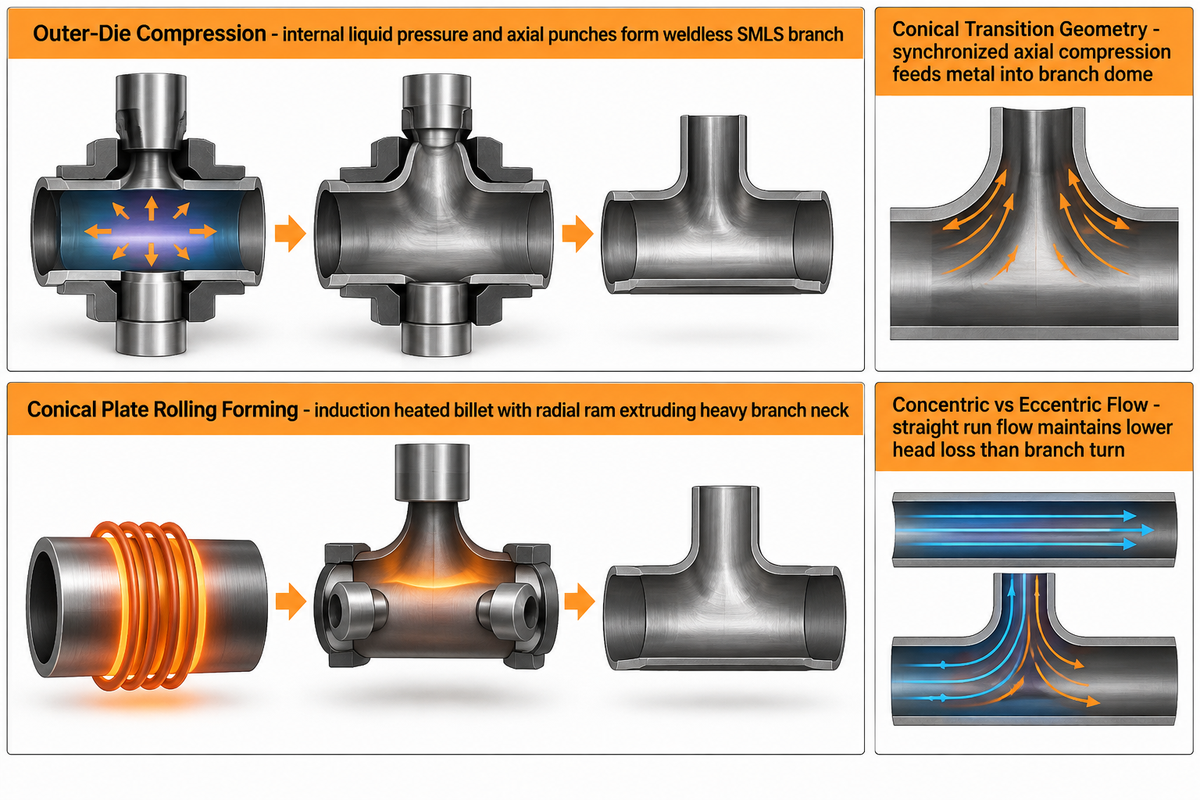
The forming route taken to manufacture a butt weld concentric reducer governs its axial wall distribution, inner bore smoothness, and its resistance to Conical Knuckle Transition Stress. It’s also critical for piping engineers to implement hydraulic boundary conditions between Rudheid and eccentric reducers to avoid pump cavitation and two-phase slugging.
Outer-die axial compression, or die swaging, is the primary method of manufacturing weldless SMLS and welded concentric reducers in nominal sizes NPS 1/2 through NPS 24. A segment of weldless SMLS pipe or welded pipe is heated or lubricated and placed in a tapered female conical die. A high-tonnage hydraulic press drives the pipe billet axially into the conical die, compressing the minor end to the target smaller diameter.
When the diameter reduction ratio between major and minor ends is large (for example 12” by 6” reduction), multi-stage compression is performed across successive intermediate dies with inter-stage stress relief annealing. Shearing forces in the reduction process cause the wall thickness to increase at the minor end. Key engineering characteristics include:
When nominal pipe size exceeds 24 inches, or when ultra-heavy wall thickness (e.g. Sch 160 or xxs) exceeds smooth mother pipe, mills fabricate welded concentric reducers from certified steel plate. Flat plate is CNC plasma or laser cut into calculated trapezoidal sector developments, and then cold-rolled or hot-pressed at 880 °C to 980 °C into a single conical shell (single-seam) or two symmetrical conical half-shells (dual-seam). After full-penetration submerged arc welding, the reducer is re-rounded in a sizing press, heat treated, and 100% radiographically inspected to ensure dimensional compliance with ASME B16.9.
Detailed conical hydraulic transition comparison: Head loss for gradual conical contraction (K=0.04-0.18) is less than for sudden contraction (K=0.40-0.50). Hot plate rolling (880°-980°C) offers similar process constraints as outer-die axial compression. According to Crane Technical Paper No. 410 and Hydraulic Institute pump intake standards, the choice between a concentric reducer and a eccentric reducer is dependent upon pipeline orientation and the fluid phase.
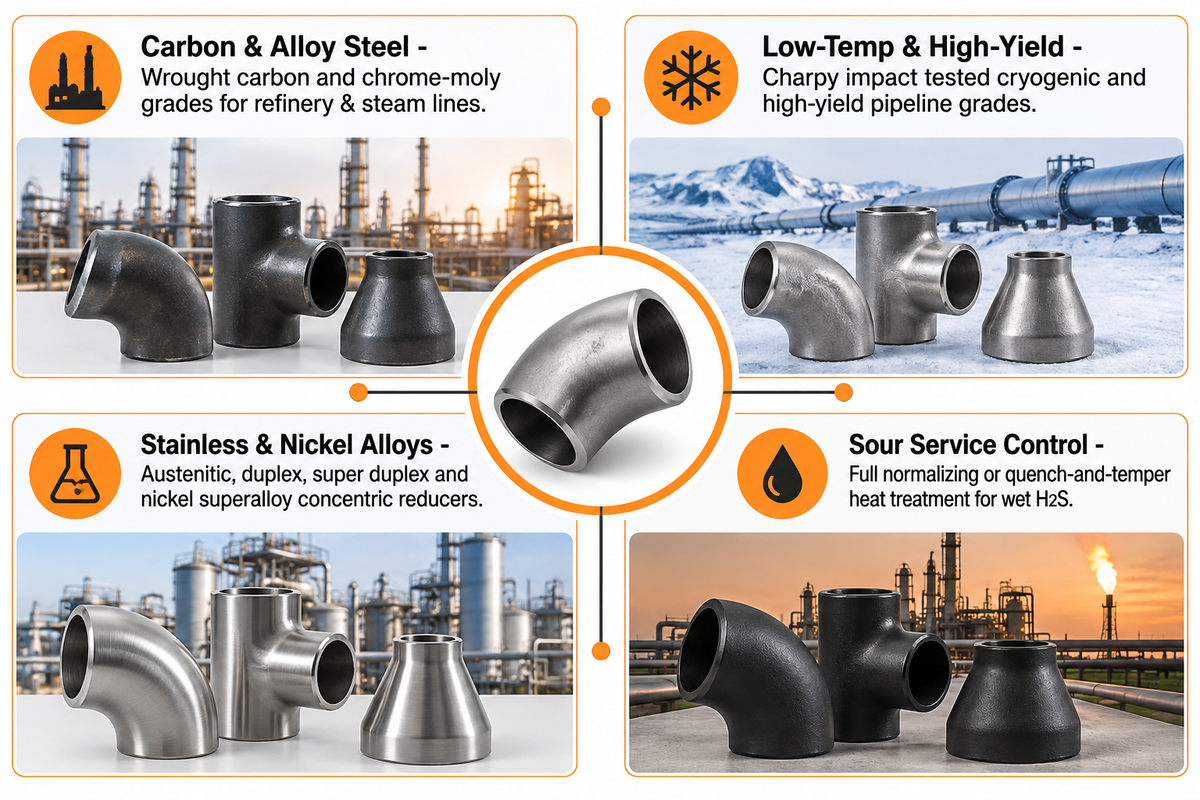
Selecting the correct metallurgical specification, published by ASTM International and the American Society of Mechanical Engineers, ensures that every butt weld pipe transition matches the mechanical strength, Welding compatibility, and Corrosion resistance of the connecting pipeline system:
ASTM A234 is the primary specification for wrought Carbon steel and Alloy steel pipe fittings in moderate and elevated temperature service:
For temperatures as low as -46°C (-50°F), ASTM A420 Grade WPL6 requires heat lots of refrigerated gas processing plants to undergo Charpy V-notch impact testing to avoid brittle cleavage fracture. For cross-country high-pressure pipelines built to API 5L X52 to X70 line pipe, mss SP-75 and ASTM A860 (Grades WPHY 42, 52, 60, 65, and 70) control high-yield ferritic concentric reducers with a minimum yield strength of 485 MPa.
In chemical plants and food-grade systems, Stainless steel and nickel alloys avoid pitting and stress corrosion cracking. ASTM A403 regulates wrought austenitic stainless reducers including low-carbon 304l (European equivalent din1.4306) and SAE 316L stainless steel (WP316L) which are often combined with forged flanges manufactured to astm a182 (such as astm a182 f316l).
Asthmatic a815 covers ferritic-austenitic duplex (UNS S31803 / S32205) and super duplex (UNS S32750) concentric reducers. For the most onerous acidic and sour environments, specialty mills form reducers in nickel alloys (ASTM B366), including Incoloy 825 (UNS N08825), Inconel 625 and Molybdenum-Tungsten hastelloy c 276.
Outer-die compression severely work-hardens the minor-diameter conical transition and small end tangent of unannealed reducers, resulting in susceptibility to SSCC in wet H2S sour service. NACE MR0175/ISO 15156, in unison with United Nations Dangerous Goods Transport Safety Standards, mandates post-forming full normalizing or quench-and-temper heat treatment, resulting in a maximum case hardness of 22 HRC (237 HBW) in the major end, conical body, minor end and weld seams.
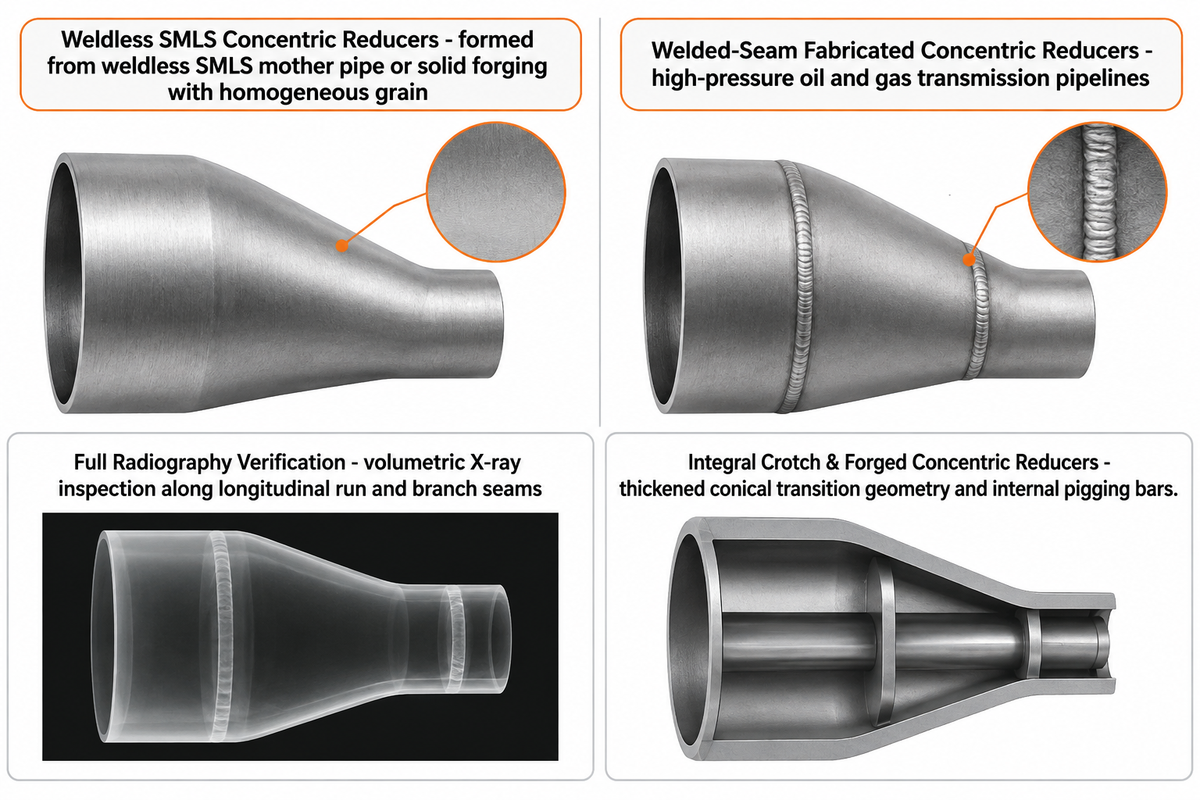
When considering diameter transitions from small bore instrument lines up to 72-inch cooling water headers, engineers analyze the structural and economical trade-offs between weldless SMLS and welded construction.
Smooth concentric reducers are forged from smooth mother pipe billets to produce a continuous circumference. This provides an intrinsic joint quality factor of E = 1.0 as defined in ASME B31.3. As most global weldless SMLS tube mills restrict the production of mother pipe to NPS 24 (with specialized heavy-wall forging up to NPS 36), reducers over 24 inches are typically manufactured as single-seam conical rolled reducers or dual-seam (two pressed half-shells welded 180 degrees apart) welded concentric reducer fittings.
In order to manage membrane stress overload at conical flare junctions, strict geometric and non-destructive testing requirements are established by ASME B31.3 paragraph 304.6 and ASME B16.9.
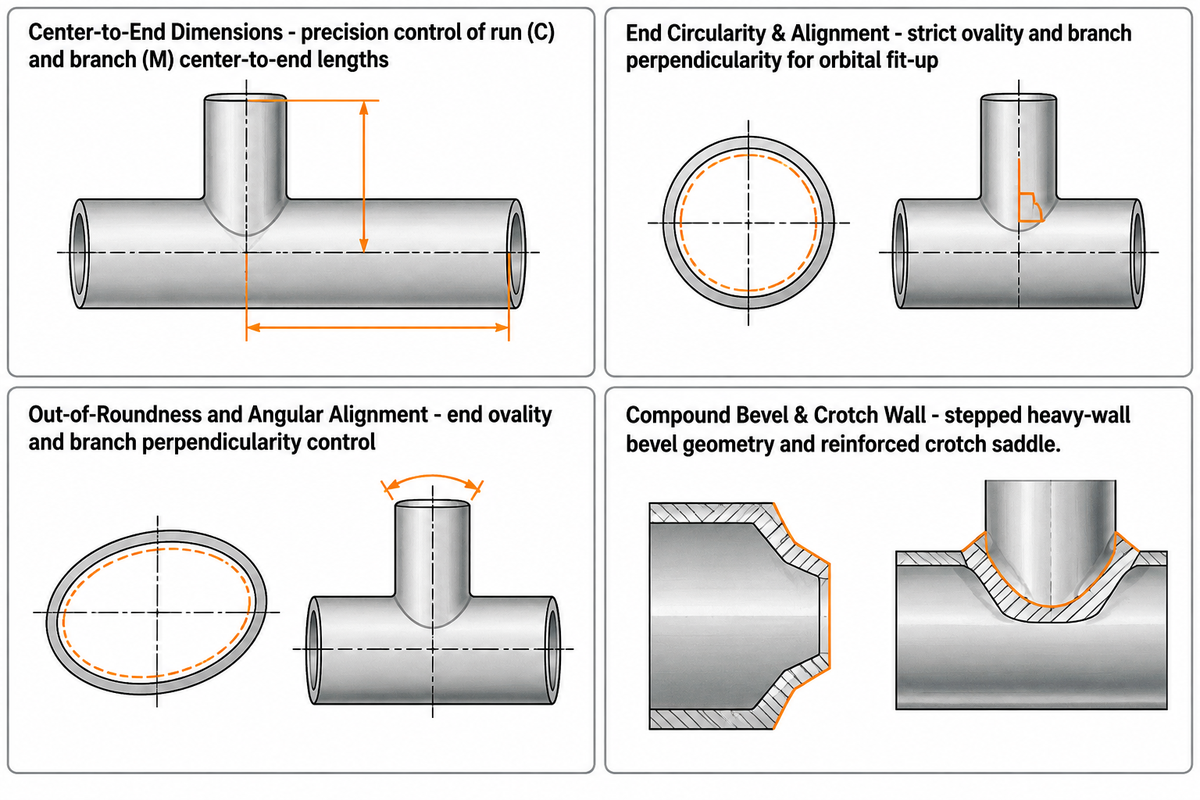
Exact dimensional control over both welding ends of a concentric reducer is critical to prevent mismatch and flow-accelerated erosion during the assembly of pipelines.
Under ASME B16.9 (part of the ASME B16 standards series), concentric and eccentric reducers share identical overall end-to-end length (H) dimensions for a given major-by-minor NPS combination:
Both ends of a butt weld concentric reducer are CNC machined per ASME B16.25: wall thicknesses up to 22 mm receive a standard 37.5° ± 2.5° bevel with a 1.6 mm ± 0.8 mm root face; walls of heavier sections get a compound 37.5°/10° bevel. Because axial die compression of the small end thickens the wall; and since buyers often connect different pipe schedules at the major and minor ends, reputable mills CNC counterbore the minor end wall with a smooth 1:3 (18.4° max.) cone, ensuring that the wall thickness of the minor end, at no point, falls below 87.5% of the nominal wall schedule.
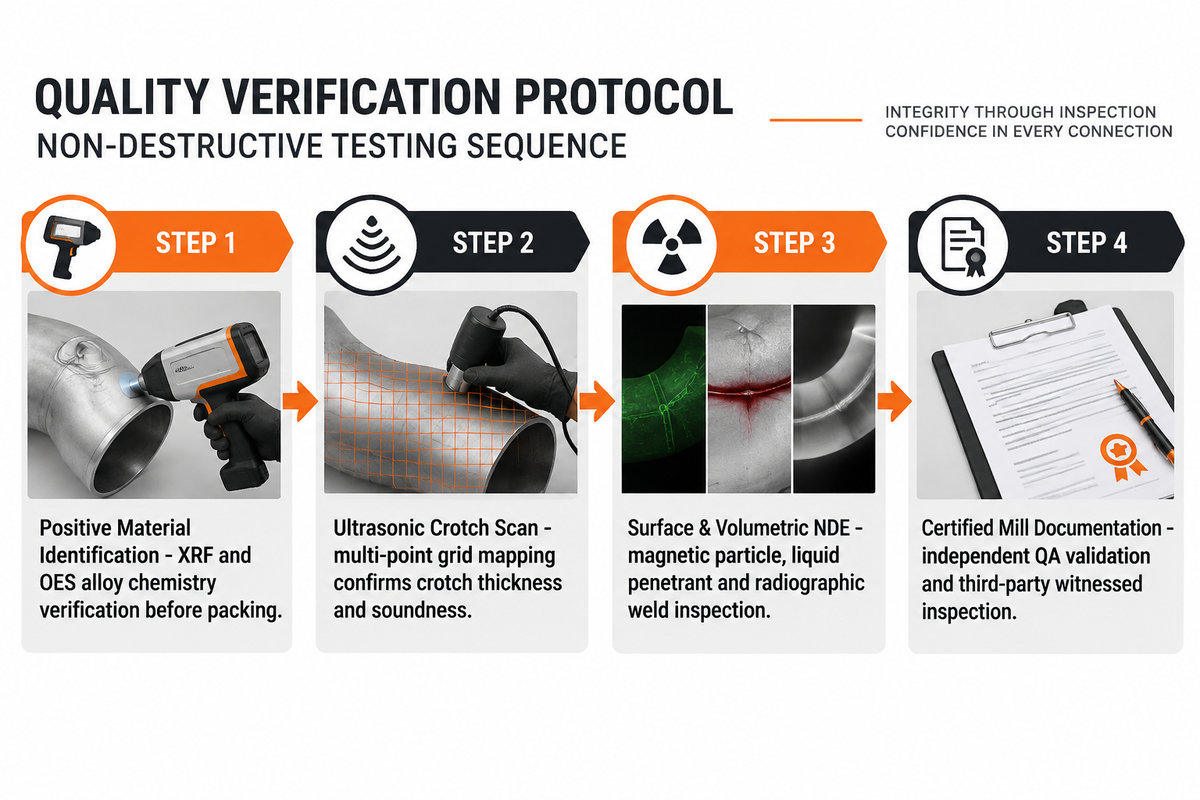
Quality assurance, inspection, and control procedures protect EPC contractors from uncertified segmented miter reducers, hidden compression laps, and alloy mix-ups.
Every industrial shipment must include certified documentation under EN 10204: an EN 10204 Type 3.1 certificate is issued by the manufacturer’s independent QA department documenting heat chemical analysis, tensile/yield results, hardness across the compressed small end, and heat treatment furnace charts; an EN 10204 Type 3.2 certificate adds direct physical test witnessing and counter-signature by an independent third-party inspection agency (DNV, Lloyd’s Register, Bureau Veritas, or TÜV) for critical offshore, nuclear, and sour gas pipelines.
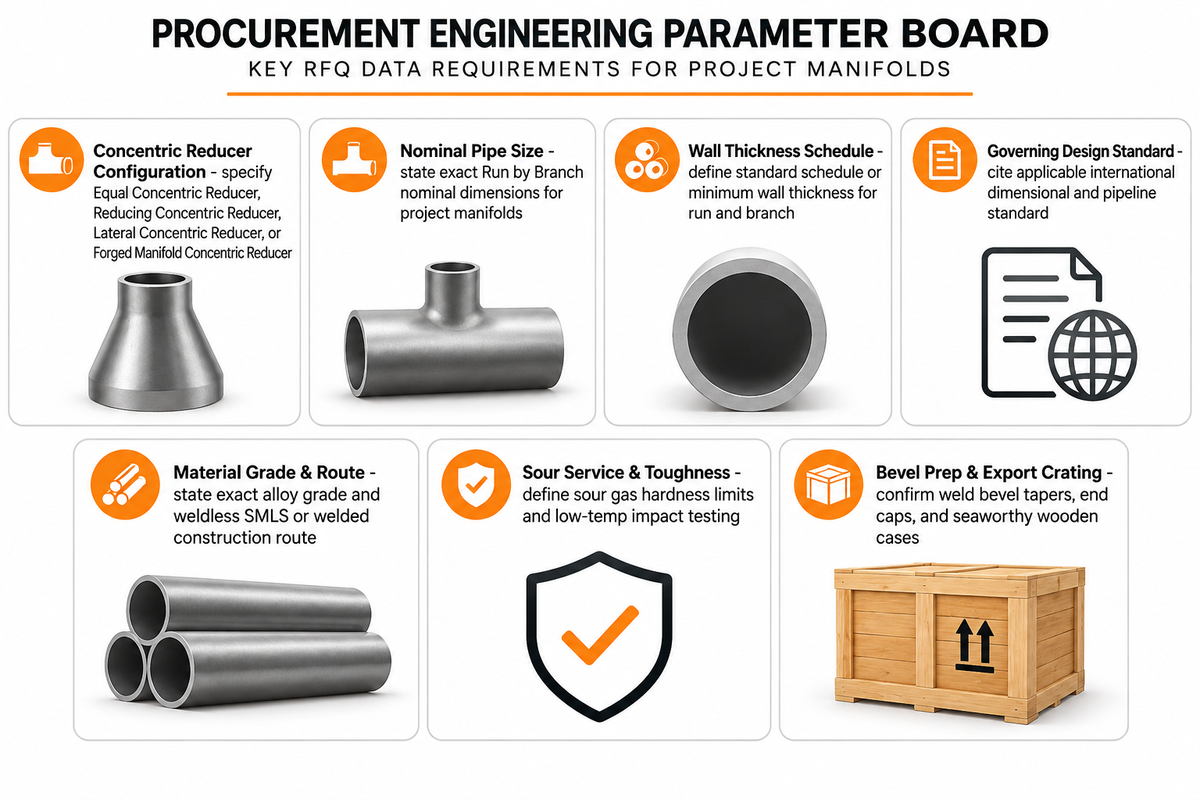
Issuing a clear, unambiguous Request for Quotation (RFQ) prevents delays in providing technical clarifications and results in accurate mill pricing for standard and custom schedules of cross:
5. ASTM Material Grade and Weldless SMLS vs Welded Route: Indicate exact grade (e.g. ASTM A234 WPB smooth, ASTM A420 WPL6, ASTM A860 WPHY 65 or ASTM A403 WP316L) and state smooth die-compressed or 100% RT welded construction.
The following provides detailed engineering answers to the most frequent procurement questions regarding the application of concentric reducer standards, forming methods, and application limits of hydraulics.
A concentric reducer has a symmetrical cone that shares a common centerline with a large-diameter inlet and a small-diameter outlet, which serves use in vertical pipelines, pump discharge risers and gas headers. An eccentric reducer, on the other hand, has an offset cone with one side parallel to the pipe wall, and thus can be used for horizontal pump suction lines to prevent air pocket formation or for complete drainage of liquid in a pipe rack.
Piping engineers place top-flat eccentric reducer valves in horizontal suction lines, and prefer not to place concentric reducers on horizontal suction lines, because the upward-sloping top wall of a symmetrical cone creates a dead zone, and any dissolved air or hydrocarbon vapors in the pump suction line accumulate in that dead zone. With an increase in flow velocity, the vapor pocket detaches and enters the pump eye, causing severe cavitation, pressure pulsations and impeller erosion. To avoid this situation, engineers specify a top-flat eccentric reducer if the suction line falls from above, and a bottom-flat eccentric reducer if the suction line rises from below, so that vapors are always vented into the pump casing.
Outer-die axial compression (swaging) reduces up to 24” by pressing a cut mother pipe segment into a tapered female die under high hydraulic tonnage, which naturally thickens the small end wall prior to CNC counterboring. Conical plate rolling bends trapezoidal steel plates into single- and dual-seam cones up to 72” and larger, followed by full-penetration submerged arc welding and 100% radiography.
As per ASME B16.9 and MSS SP-25 marking rules, each concentric reducer must be equipped with low-stress die stamps or stenciled marks showing manufacturer’s trademark, ASTM material grade (like WP316L or WPB), major and minor nominal pipe sizes, wall schedule, B16.9 standard designation, and traceable melt heat number.
Yes, single-seam and dual-seam welded concentric reducers are commonly found in high-pressure oil and gas transmission pipelines, compressor stations, and petrochemical headers, especially in sizes 24 inches and larger where smooth mother pipe feedstock isn’t available. To achieve a full joint efficiency factor of E = 1.0 in accordance with the design codes ASME B31.3, B31.4, and B31.8, all longitudinal seam welds must be ground flush, and 100% of the weld must be tested by either radiographic testing (RT) or automated ultrasonic testing (AUT) in accordance with the ASME Section VIII Division 1 UW-51 acceptance criteria, and followed by full post-weld heat treatment.
A EN 10204 Type 3.1 Mill Test Certificate is issued and validated by the fitting manufacturer’s independent quality assurance department by means of actual heat lot test results. A EN 10204 Type 3.2 certificate mandates a counter signature and direct physical test witnessing by an independent third-party inspection agency like DNV, Lloyd’s Register, or TÜV.
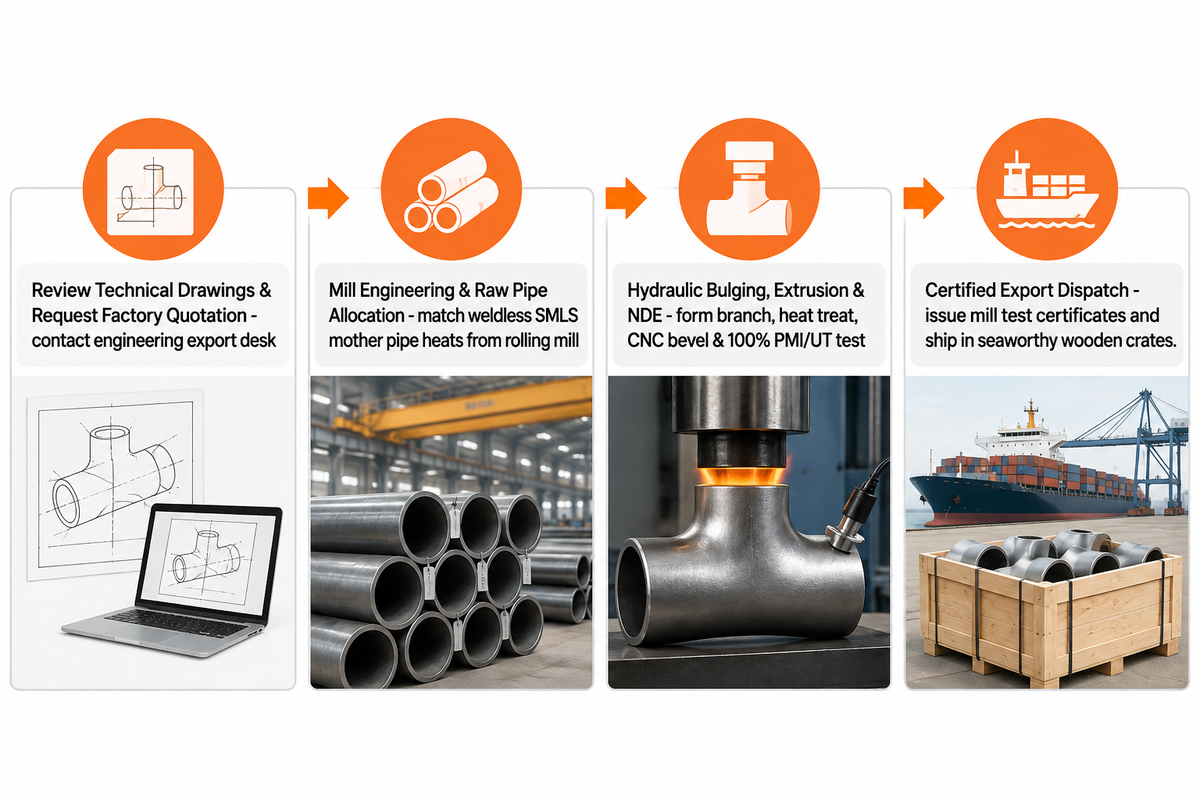
As an integrated manufacturing mill operating hydraulic outer-die compression presses, conical plate-rolling lines, and calibrated heat treatment furnaces, Synbase Steel Co., Ltd. supplies ASME B16.9 and MSS SP-75 concentric reducers engineered for global energy, petrochemical, and marine infrastructure. Using certified steel billets and mother pipe from our own rolling mills, we deliver smooth concentric and eccentric reducers from NPS 1/2 to 24 inches and welded conical reducers up to 48 inches across Sch 10 through Sch XXS.
Every concentric reducer shipped by Synbase Steel undergoes 100% Positive Material Identification (PMI), ultrasonic conical wall verification, and CNC beveling and counterboring per ASME B16.25, backed by full heat traceability and EN 10204 3.1 or 3.2 certification. Contact our engineering export desk to review technical drawings or request a rapid factory quotation:
sales@synbasesteel.com.The information on engineering rules and dimensional tolerances, and the capabilities of manufacturers, contained in this buyers’ guide, have been validated against official copies of the relevant standards and first-party corporate technical publications, respectively:
Synbase Steel supplies steel pipe, fittings, flanges, valves and OCTG for oil and gas, petrochemical, power, water and industrial projects. Our technical guides are written to help buyers compare standards, grades, dimensions, coatings, inspection requirements and commercial terms before sending an RFQ.
We focus on practical specification work: matching pipe process to service conditions, checking wall thickness and end finish, reviewing MTC and NDT requirements, and clarifying documentation before production or shipment.
Project support across seamless pipe, ERW, LSAW, SSAW, buttweld fittings, forged flanges, valves and oilfield tubulars.
Specification review for ASTM, ASME, API, EN and DIN standards, including material grade, pressure class, coating and inspection scope.