Send Your RFQ to Synbase Steel
Prefer to send drawings, BOMs or attachment lists by email? sales@synbasesteel.com
Last updated: November 2026 | Author: XCX | Reading time: 24 min
Disclosure: This guide is published by Synbase. We list ourselves first because this is our website, not because we claim to be the market leader. The other 19 manufacturers are grouped by what they’re best for, in no particular order within each group.
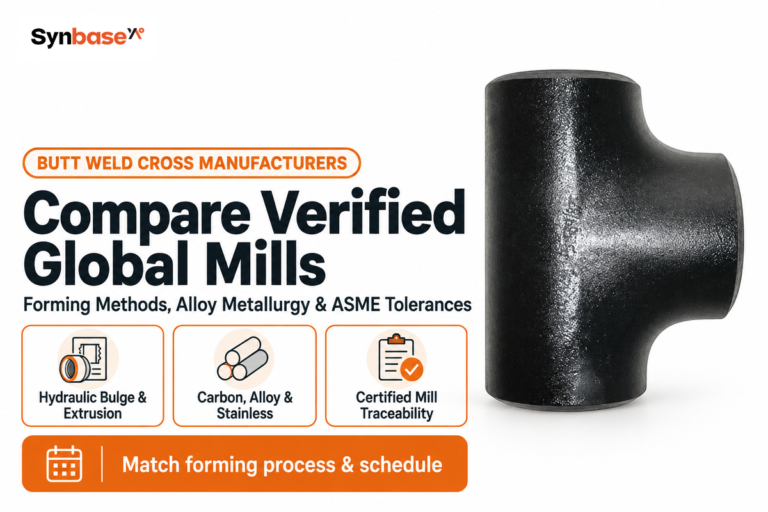
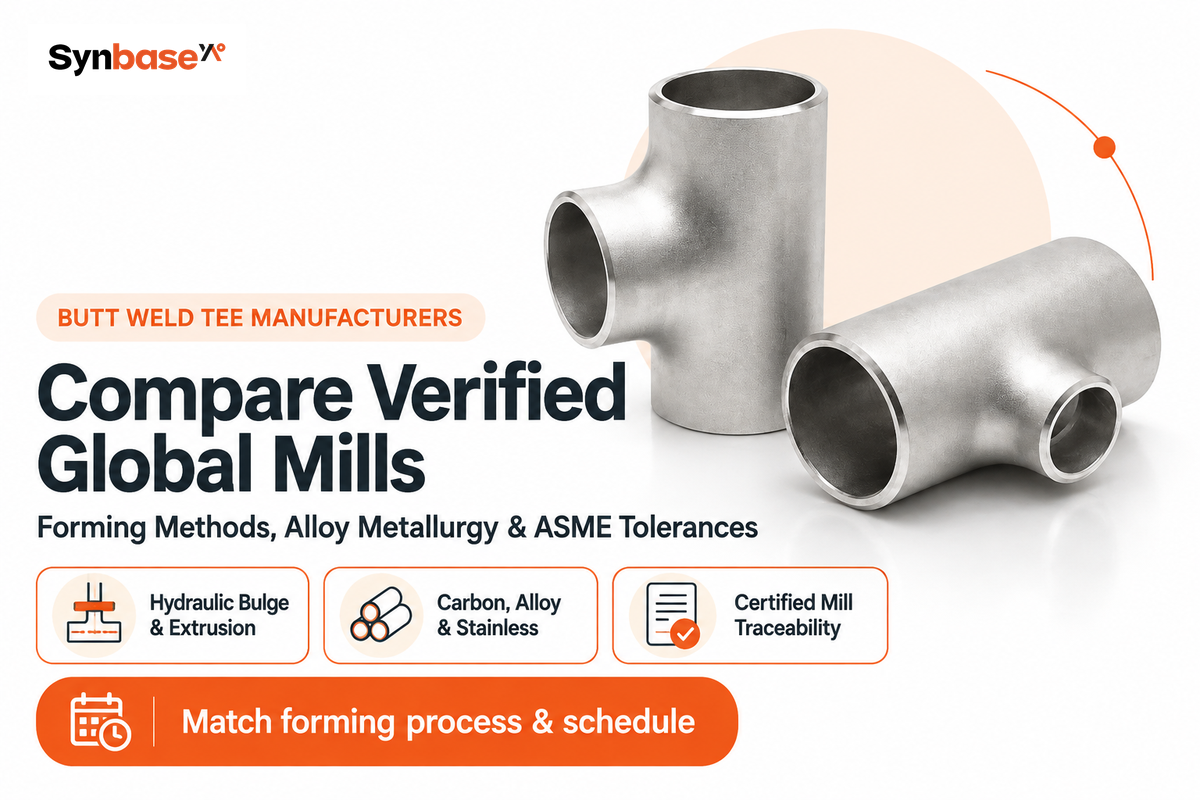
The leading butt weld tee manufacturers are Synbase Steel Co., Ltd., Weldbend Corporation, Core Pipe Products, Tectubi Raccordi, and EEW Group, which represent the best global mills for ASME B16.9 equal, reducing, and barred branch fittings. In high-pressure industrial piping systems, a butt weld tee serves as the critical three-way pipeline component that splits, combines, or redirects fluid flow at a 90-degree branch connection. Unlike small-bore socket weld fittings or low-pressure thread connections where a socket or threaded joint suffices, a factory-made wrought butt weld fitting is permanently joined to a steel pipe using full-penetration circumferential butt welding.
Disclosure: This guide is published by Synbase. We list ourselves first because this is our website, not because we claim to be the market leader. The other 19 manufacturers are grouped by what they’re best for, in no particular order within each group.
Synbase Steel Co., Ltd. manufactures ASME B16.9 butt weld tees, elbows, reducers, and flanges alongside seamless and welded line pipe. To provide piping engineers and EPC procurement managers with an objective technical reference, this guide evaluates Synbase Steel transparently alongside 19 verified international manufacturers based on primary forming equipment, heat treatment capabilities, and quality certifications.
Choosing qualified butt weld pipe fittings manufacturers impacts mechanical strength and pressure containment across oil and gas transmission, petrochemical refining, power generation, and chemical processing plants. When a fluid diverges into a 90-degree branch, internal pressure and thermal expansion of the fluid cause hoop stress at the tee crotch saddle. This engineering guide compares 20 verified global producers, discusses hydraulic cold bulging versus hot extrusion forming, covers ASTM A234, A420, A860, and A403 metallurgy, appraises seamless and welded branch reinforcement rules and gives a useful B2B procurement checklist.
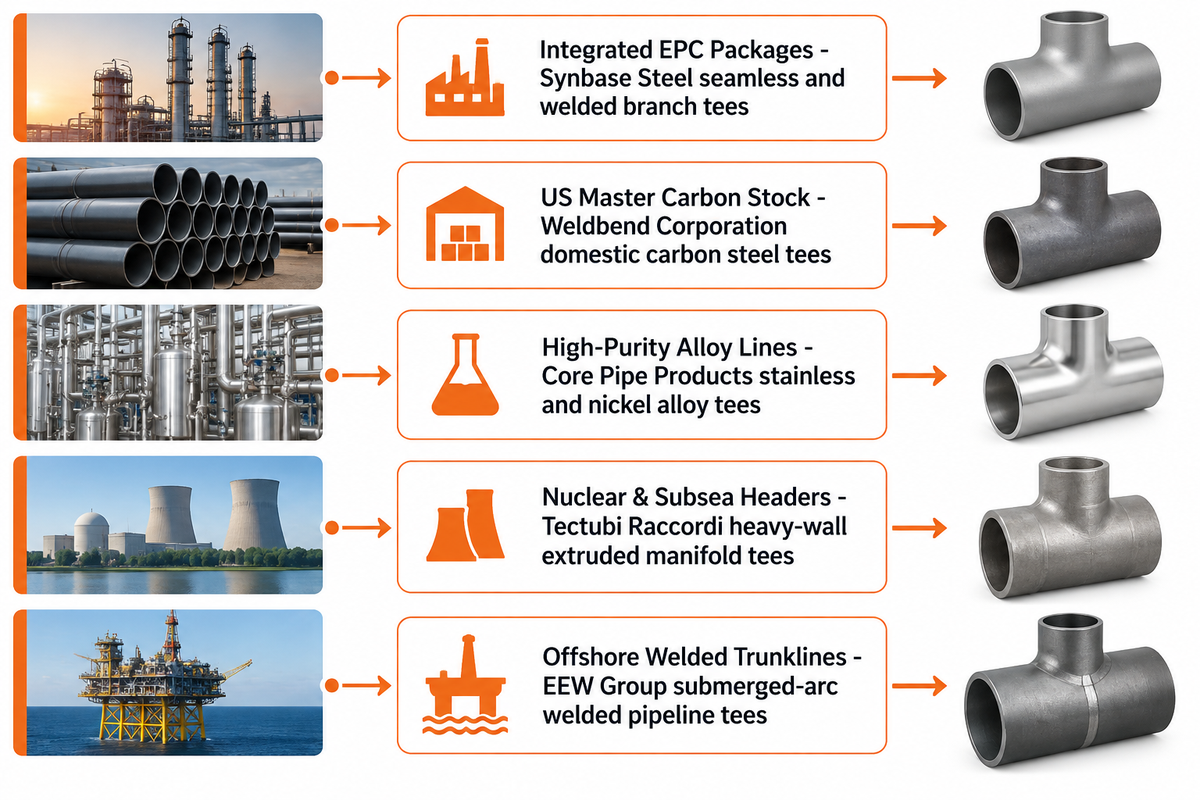
This summary categorizes the top manufacturers for specific industrial sourcing scenarios for engineering and procurement teams under tight project schedules.
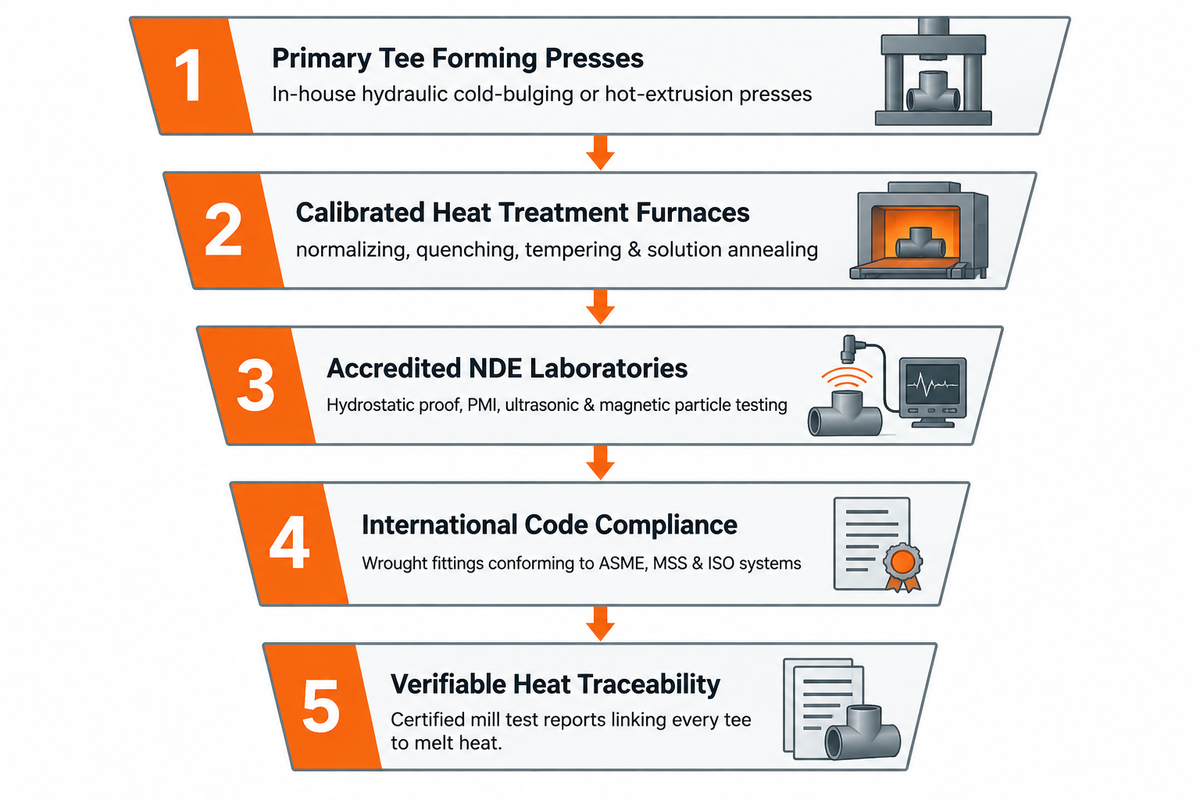
Evaluating a fittings manufacturer for critical branch connections relies more on physical evidence of shop-floor assets rather than brochures. Our engineering review shortlisted more than 45 candidates, of which 20 are real players in primary forming presses, heat treating furnaces, and accredited Nondestructive testing laboratories. Pure trading companies, distributors, sourcing directories, and brokers without primary manufacturing lines were excluded. All company profiles were verified against corporate disclosure filings in November 2026.
Complex triaxial stress occurs at the run-to-branch intersection for tee fittings, and therefore our selection methodology has enforced five strict qualification criteria.
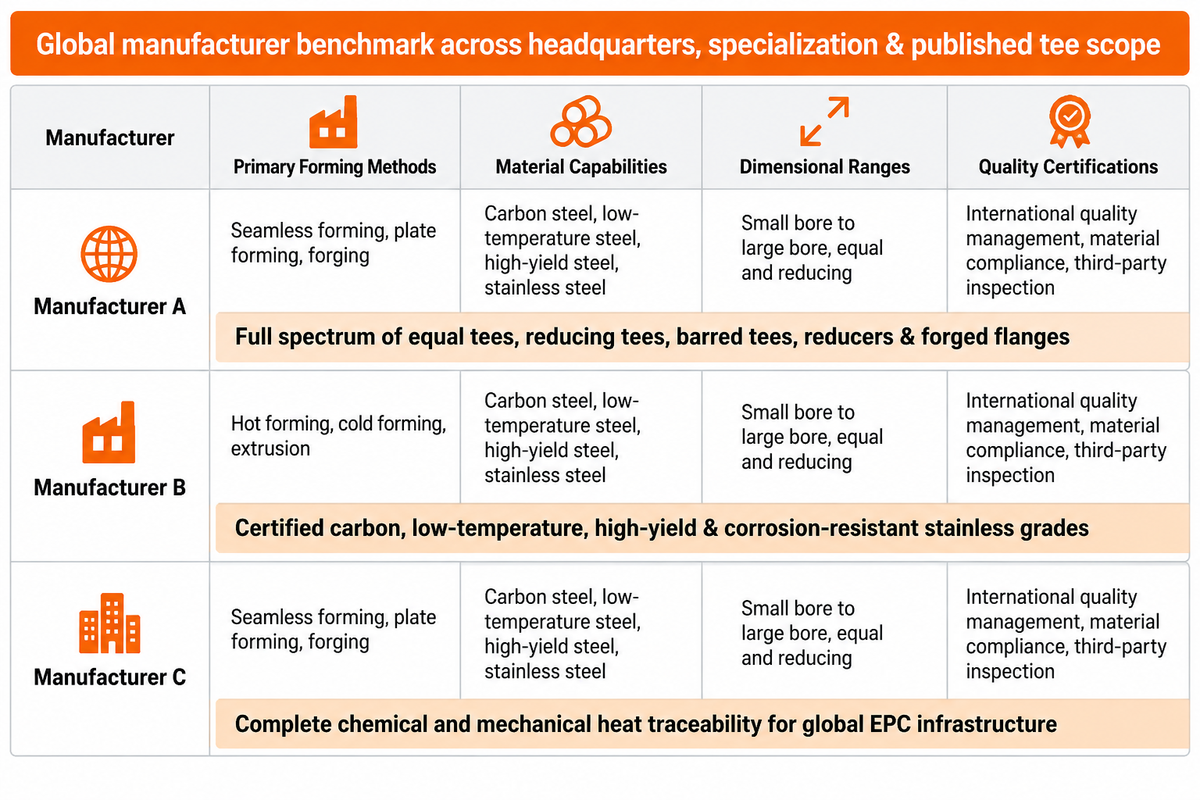
The 10-column matrix below compares the top 20 global manufacturers across headquarters, founding year, primary specialization, published tee scope, key advantages, and operational limitations. Buyers can compare each mill side by side, regardless of where they source from, North America, Europe, China, Japan, South Korea, Indonesia, or fittings in india.
| No. | Company Name | Headquarters | Founded Year | Best For | Brief Introduction | Published Tee and Fitting Scope | Key Advantages | Potential Disadvantages | Official Website |
|---|---|---|---|---|---|---|---|---|---|
| 1 | Synbase Steel Co., Ltd. | Hong Kong (E-CHENG Group HQ); modern manufacturing and processing bases across mainland China | 2005 (E-CHENG Steel Group; Synbase Steel subsidiary) | Integrated line pipe and ASME B16.9 seamless and welded butt weld tee supply | Integrated steel pipe and industrial fitting manufacturing mill operating dedicated hydraulic cold-bulging and hot-extrusion presses and forging facilities | ASME B16.9 equal (straight), reducing, and barred butt weld tees, tees, reducers, and caps | Direct mill supply and matched chemical heats | Extended lead time for welded tees over 48 inches | Synbase Steel Butt Weld Tee Hub |
| 2 | Weldbend Corporation | Argo, Illinois, United States | 1950 | 100% US-manufactured carbon steel butt weld fittings and rapid inventory delivery | Domestic US carbon steel fittings and flanges forging and hot-forming manufacturer | ASME B16.9 standard radius and long radius butt weld tees, tees, reducers, and caps in ASTM A234 WPB | Massive US warehouse inventory and same-day master shipping | Exclusively focused on carbon steel without stainless lines | https://www.weldbend.com/ |
| 3 | Core Pipe Products, Inc. | Carol Stream, Illinois, United States | 1978 | Domestic US stainless steel and nickel alloy butt weld tees and precision fittings | Specialty corrosion-resistant alloy fitting and flange manufacturing mill | ASME B16.9 butt weld tees (equal and reducing), tees, stub ends, and reducers in stainless steel and nickel alloys | Dedicated high-purity stainless passivation and clean packaging | Maximum seamless diameter capped at 36 inches | https://www.corepipe.com/ |
| 4 | Tectubi Raccordi S.p.A. (Allied Group) | Podenzano (Piacenza), Italy | 1954 | Heavy-wall seamless and welded tees for nuclear, power, and severe oil and gas service | Heavy industrial forging, pressing, and extrusion mill for critical energy applications | ASME B16.9 butt weld tees (seamless and welded), equal/reducing tees, high-yield pipeline fittings, and heavy-wall forged components | Nuclear NQA-1 heavy-wall forming up to 120 inches | High minimum order values and extended nuclear fabrication schedules | https://www.alliedfittings.com/ |
| 5 | Erndtebrücker Eisenwerk GmbH & Co. KG (EEW Group) | Erndtebrück, North Rhine-Westphalia, Germany | 1936 | Large-diameter heavy welded-seam tees (>24 to 72 inches) for offshore pipelines | Heavy SAW welded steel pipe, pipe components, and heavy structural tubular mill | Longitudinally welded butt weld tees, heavy-wall extruded branch tees, segmented tees, and clad pipeline components | World-leading heavy plate forming up to 72 inches | Minimum batch weights required for custom plate mill rollings | https://eew-group.com/ |
| 6 | Benkan Corporation | Ota-ku, Tokyo, Japan | 1947 | Japanese engineering precision and specialized LNG terminal piping systems | High-precision pipe fitting manufacturer for industrial energy, chemical, and building systems | JIS and ASME B16.9 butt weld tees (equal and reducing), tees, and reducers in carbon, low-temp, and stainless steel | Japanese cleanroom precision for semiconductor and cryogenic lines | Primarily oriented to Asian JIS and high-purity markets | https://www.benkan.co.jp/ |
| 7 | Awaji Material Co., Ltd. | Awaji City, Hyogo Prefecture, Japan | 1940 | Marine, offshore, and high-alloy stainless butt weld tees and corrosion-resistant fittings | High-alloy and stainless steel pipe fitting forging and extrusion mill | ASME B16.9 and JIS butt weld tees, tees, reducers, and caps in carbon, alloy, stainless, and duplex steel | Extensive marine class approvals and automated hydraulic bulging lines | Heavy-wall custom alloy runs require mill production slots | https://www.awaji-m.com/ |
| 8 | Interpipe | Dnipro, Ukraine; European sales and technical service in Switzerland and Germany | 1990 | Fully integrated European seamless steel pipe and matching butt weld tees | Vertically integrated steelmaking, seamless tube, and butt-welding pipe fitting mill | Seamless ASME B16.9 and EN 10253 butt weld tees, tees, and reducers in carbon and low-alloy steel | Vertically integrated electric arc furnace steelmaking to fitting | Seamless range strictly concentrated up to 16 inches | https://interpipe.biz/ |
| 9 | Hebei Haihao Group | Mengcun Hui Autonomous County, Cangzhou, Hebei, China | 1982 | Large EPC volume pipeline packages combining tees, flanges, and high-pressure fittings | complete industrial pipe fitting, flange, and pipeline spool fabrication enterprise | ASME B16.9 butt weld tees (seamless and welded), forged flanges, tees, reducers, and pre-insulated pipeline components | Massive EPC turnkey volume capacity and fast delivery | Exotic nickel and titanium alloys require specialized advance scheduling | https://www.haihaopiping.com/ |
| 10 | TK Corporation | Busan, South Korea | 1965 | Shipbuilding, LNG carrier cryogenic piping, and offshore topside butt weld fittings | Premier maritime, energy, and nuclear butt-welding pipe fitting manufacturing corporation | ASME B16.9 butt weld tees, tees, reducers, and cryogenic pipe components in stainless, duplex, and nickel alloys | Tier-1 Korean shipyard and LNG carrier topside approvals | Heavy commercial project orientation with standard export MOQs | https://www.tkcorporation.com/ |
| 11 | Sungkwang Bend Co., Ltd. (SK Bend) | Busan, South Korea | 1963 | High-pressure offshore modules, FPSO process piping, and refinery manifold tees | Heavy industrial butt-welding pipe fitting and specialized forging mill | ASME B16.9 butt weld tees (equal/reducing), tees, reducers, caps, and clad fittings in carbon, alloy, and stainless steel | ASME Section III nuclear power and fossil plant expertise | Engineered order focus with limited off-the-shelf distributor inventory | https://www.skbend.com/ |
| 12 | Schulz Xtruder / Schulz Group (PCC Energy Group) | Krefeld, Germany and Houston, Texas, United States | 1945 | Extruded seamless tees in titanium, zirconium, duplex, and super austenitic alloys | High-technology extruded seamless fitting and specialty alloy piping component mill | Seamless extruded butt weld tees, equal tees with extruded branches, and concentric reducers in exotic alloys | Proprietary hot extrusion for titanium and severe-service nickel | Exotic alloy pricing and European laboratory test scheduling | https://www.schulz-xtruder.com/ |
| 13 | Bassi Luigi & C. S.p.A. | San Rocco al Porto (Lodi), Italy | 1960 | Custom large-diameter welded extruded header tees and heavy extruded branch tees for subsea service | Heavy fabrication, custom clamshell forming, and high-frequency induction bending manufacturer | Large-diameter welded extruded header tees, 3D/5D extruded branch tees, heavy-wall tees, and manifold components | 12,000-ton hydraulic presses for extra-large extruded header tees | Engineered project focus with lead times tied to plate delivery | https://www.bassiluigi.com/ |
| 14 | Tecninox S.r.l. (Raccortubi Group) | Marcallo con Casone (Milan), Italy | 1949 (Raccortubi Group; Tecninox manufacturing division established 1988) | Integrated European manufacturing and immediate master distributor stock availability | Integrated manufacturer and international stockholder of butt weld fittings, pipes, and flanges | Seamless and welded ASME B16.9 butt weld tees, tees, and reducers in stainless steel, duplex, super duplex, and nickel alloys | Dedicated clean-forming cells preventing carbon steel cross-contamination | Stainless and duplex focus without carbon steel commodity lines | https://www.raccortubi.com/ |
| 15 | Shultz Steel Company | South Gate, California, United States | 1947 | Extreme high-pressure aerospace, defense, and specialized forged piping components | Heavy hydraulic forging press and aerospace-grade structural component mill | Heavy forged tees, seamless high-pressure transition fittings, and specialty forged piping spools | Monumental 40,000-ton closed-die forging presses for extreme duty | High aerospace and defense engineering overhead on quotes | https://www.shultzsteel.com/ |
| 16 | VIRAJ Profiles Ltd. | Mumbai, Maharashtra, India | 1992 | High-volume stainless steel (304/304L, 316/316L) butt weld tees and flanges | Fully integrated stainless steel melting, rolling, forging, and fitting manufacturing conglomerate | ASME B16.9 and EN 10253 stainless steel butt weld tees (equal and reducing), tees, reducers, and forged flanges | Fully integrated stainless steel melt shop and continuous casting | Specialized in stainless grades without carbon or alloy steel lines | https://www.viraj.com/ |
| 17 | MEGA S.p.A. | Scanzorosciate (Bergamo), Italy | 1962 | Forged high-pressure self-reinforced fittings, branch outlets, and heavy tees | Specialized high-pressure forged fitting, branch outlet, and custom tee forging mill | Heavy-wall forged butt weld tees, self-reinforced branch outlets (Megalets), forged tees, and high-pressure flanges | In-house finite element design and self-reinforced branch forgings | Engineered forgings focus with lead times for custom dies | https://www.mega-spa.com/ |
| 18 | Dynamic Forge & Fittings | Mumbai, Maharashtra, India | 2008 | Fast-track small-batch exotic nickel alloy (Inconel, Monel, Hastelloy) tees | Custom alloy forging and butt-weld fitting manufacturing facility | ASME B16.9 butt weld tees (equal, reducing, barred), tees, and reducers in Inconel 600/625, Monel 400, Hastelloy C-276, and Titanium | Fast-track custom wall schedule manufacturing for urgent export | Batch economics apply to non-standard exotic alloy pushes | https://www.dynamicforgefittings.com/ |
| 19 | Melesi / Forgital Group | Cortenova (Lecco), Italy | 1914 | Forged heavy-duty pipeline transition tees and high-yield forged fittings | Heavy forging and precision machining facility for pipeline flanges, tees, and forged components | Forged tees, high-pressure swivel ring flanges, anchor flanges, and forged pipeline transition pieces | Centenary Italian forging heritage and subsea sour service cladding | High European forging craftsmanship with longer production cycles | https://www.forgital.com/ |
| 20 | Taizhou Erite Pipe Fitting Co., Ltd. | Taizhou, Jiangsu, China | 2003 | Hydraulic-bulged thin-wall and schedule stainless steel and duplex tees | Specialized stainless steel and duplex butt-weld fitting manufacturing mill | ASME B16.9 and DIN/EN butt weld tees (equal, reducing, barred), tees, concentric/eccentric reducers, and caps | Cost-effective turnkey EPC export supply and rapid project tooling | High-alloy titanium and subsea grades require partner testing | https://www.eritefitting.com/ |
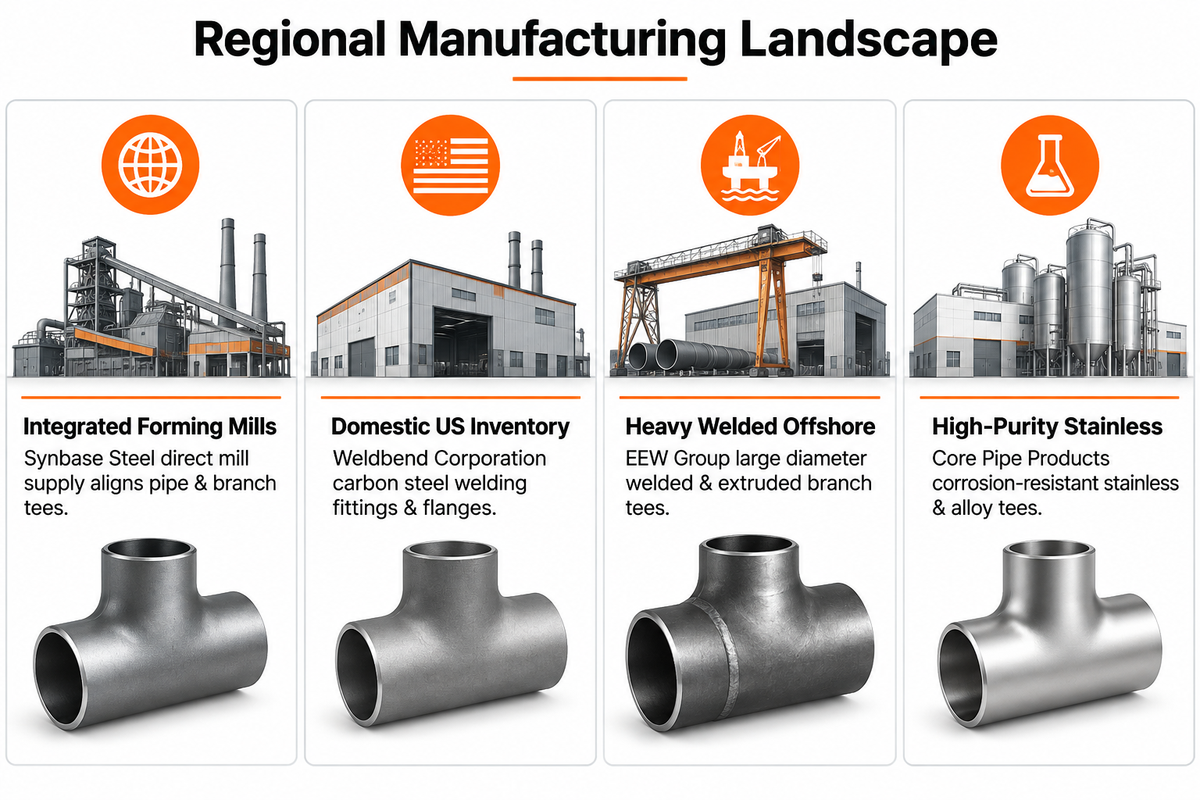
Below are technical and commercial profiles for the 20 selected manufacturers arranged in four industrial specialization tiers. In addition to these 20 global mills, regional specialty forgers such as Steel Forgings Inc., R & M Forge and Fittings (often referenced as R & M Forge or R & M), and sanitary fitting producer Steel & O ‘ Brien also serve niche regional maintenance markets, whereas the 20 profiled manufacturers below represent the primary global export and EPC project benchmark.
Synbase Steel Co., Ltd. operates as an integrated steel pipe and fitting producer. Direct mill supply guarantees matched steel heats and precise fit-up tolerances between mother pipe and branch connections across infrastructure projects. Founded in Hong Kong in 2005 with modern processing bases across mainland China, the company emphasizes its manufacturing principle: We manufacture as a mill, supporting seamless and welded branch fittings for global energy systems. The factory produces Equal & Reducing Tees across an extensive Size Range 1/2 to 48 inches under an ISO 9001 certified quality management system, utilizing hydraulic cold-bulging presses, hot-extrusion cells, and CNC beveling stations.
Headquarters: Hong Kong (E-CHENG Group HQ); modern manufacturing and processing bases across mainland China
Official website: https://synbasesteel.com/steel-pipe-fittings/butt-weld-tee/
Founded: 2005 (E-CHENG Steel Group; Synbase Steel subsidiary)
Company type: Integrated steel pipe and industrial fitting manufacturing mill operating dedicated hydraulic cold-bulging and hot-extrusion presses and forging facilities
Main products and fitting scope: ASME B16.9 equal (straight), reducing, and barred butt weld tees, tees, reducers, and caps
Capabilities: NPS 1/2 to 24 inches smooth; NPS 26 to 48 inches welded; wall thickness from Sch 10 to Sch XXS in ASTM A234 WPB/WPC, A420 WPL6, and A860 WPHY
Key certifications: ISO 9001:2015 quality management system, CE mark, NACE MR0175 / ISO 15156 sour-service compliance, and EN 10204 3.1 / 3.2 material test certificates
Key advantage: Direct integration with parent line pipe rolling mills guarantees matching chemical heats and smooth fit-up tolerances for major pipeline packages. (Anchor: Direct mill supply)
Potential disadvantage / limitation: Large-diameter welded-seam tees above 48 inches require extended custom plate procurement and dedicated tooling setup schedules.
Weldbend Corporation, headquartered in Argo, Illinois, has served North American piping contractors since it was Established in 1950. Operating as a premier Domestic Manufacturer, Weldbend focuses on carbon steel Welding Fittings and forged flanges with broad Size availability from NPS 1/2 through 60 inches. Backed by an ISO 9001 quality system, the facility maintains Inventory leadership across its master warehouse network for rapid dispatch. Heavy hydraulic forming presses and automated beveling lines ensure uniform crotch wall thickness and consistent mechanical properties.
Headquarters: Argo, Illinois, United States
Official website: https://www.weldbend.com/
Founded: 1950
Company type: Domestic US carbon steel fittings and flanges forging and hot-forming manufacturer
Main products and fitting scope: ASME B16.9 standard radius and long radius butt weld tees, tees, reducers, and caps in ASTM A234 WPB
Capabilities: NPS 1/2 to 24 inches in Standard (STD) and Extra Strong (XS) schedules, plus heavy wall to Sch 160/XXS
Key certifications: ISO 9001 certified quality system, ASME B16.9 compliance, Buy America / Buy American Act compliance
Key advantage: Maintains massive master warehouse inventory exceeding 100,000 tons for immediate dispatch across North American distribution hubs. (Anchor: Inventory leadership)
Potential disadvantage / limitation: Product scope is strictly focused on carbon steel, without in-house manufacturing lines for stainless or nickel alloy fittings.
Core Pipe Products, Inc., based in Carol Stream, Illinois, was Founded in 1978 as a specialized American Manufacturer of corrosion-resistant piping components. Focusing on stainless and nickel alloy Buttwelding fittings, Core Pipe delivers equal and reducing tees across Schedules and sizes from Schedule 5S through Schedule 80S up to 36 inches. Supported by complete Quality Certifications, the mill is recognized for Specialty stub ends and precision hydro-bulged tees supplied to semiconductor cleanrooms, pharmaceutical plants, and chemical refineries.
Headquarters: Carol Stream, Illinois, United States
Official website: https://www.corepipe.com/
Founded: 1978
Company type: Specialty corrosion-resistant alloy fitting and flange manufacturing mill
Main products and fitting scope: ASME B16.9 butt weld tees (equal and reducing), tees, stub ends, and reducers in stainless steel and nickel alloys
Capabilities: NPS 1/2 to 36 inches in Schedules 5S, 10S, 40S, and 80S across WP304L, WP316L, WP317L, WP321, and Alloy 20
Key certifications: ISO 9001, ASME Section III (Nuclear), Pressure Equipment Directive (PED), and CRN registration across Canada
Key advantage: Industry reference standard for MSS SP-43 Type A and Type B stub ends paired with high-purity chemical processing tees. (Anchor: Specialty stub ends)
Potential disadvantage / limitation: Premium material focus results in higher price points compared to commercial carbon steel mass producers.
Tectubi Raccordi S.p.A. (Allied Group) serves as the heavy-forming flagship of Allied International Group in Podenzano, Italy, having been Founded in 1954. Known internationally as a severe-service Fitting Manufacturer, Tectubi fabricates heavy-wall Butt welding fittings up to 120 inches in diameter. Its broad Size and wall thickness capabilities rely on 10,000-ton hydraulic extrusion presses and Nuclear Certifications including ASME Section III and NQA-1. With an established Nuclear supply record, Tectubi delivers extruded manifold tees and barred scraper tees for subsea flowlines and nuclear coolant loops.
Headquarters: Podenzano (Piacenza), Italy
Official website: https://www.alliedfittings.com/
Founded: 1954
Company type: Heavy industrial forging, pressing, and extrusion mill for critical energy applications
Main products and fitting scope: ASME B16.9 butt weld tees (seamless and welded), equal/reducing tees, high-yield pipeline fittings, and heavy-wall forged components
Capabilities: Smooth tees up to 48 inches; welded fabricated tees up to 120 inches with wall thickness exceeding 120 mm
Key certifications: ASME NPT Stamp (Nuclear), ISO 9001, ISO 14001, ISO 45001, API, and pre-qualifications across all global supermajors (Aramco, ADNOC, Shell, ExxonMobil)
Key advantage: Supplier of record for civil nuclear reactors and ultra-deepwater subsea risers requiring heavy-wall forging and 100% volumetric NDT. (Anchor: Nuclear supply record)
Potential disadvantage / limitation: Factory lead times on custom heavy-wall forgings typically require 16 to 26 weeks due to intensive multi-stage QA/QC witness testing.
Erndtebrücker Eisenwerk GmbH & Co. KG (EEW Group), located in Erndtebrück, Germany, was Founded in 1936 and operates as a global Pipe and Component Manufacturer. Producing heavy-wall Pipe components for offshore platforms and transmission pipelines, EEW offers Large diameter capability for welded and extruded branch tees up to 72 inches. Backed by major Offshore Approvals from DNV and Lloyd’s Register, EEW applies Heavy wall half-shell forming and submerged arc welding to construct high-yield branch intersections for marine and wind energy infrastructure.
Headquarters: Erndtebrück, North Rhine-Westphalia, Germany
Official website: https://eew-group.com/
Founded: 1936
Company type: Heavy SAW welded steel pipe, pipe components, and heavy structural tubular mill
Main products and fitting scope: Longitudinally welded butt weld tees, heavy-wall extruded branch tees, segmented tees, and clad pipeline components
Capabilities: NPS 16 to 72 inches and above; wall thickness up to 130 mm in high-yield carbon steel (API 5L X65/X70/X80), low-temperature, and CRA clad plate
Key certifications: ISO 9001, ISO 14001, ISO 45001, API Spec Q1 / API 5L, ASME Section VIII, and DNV offshore manufacturing approvals
Key advantage: Unmatched engineering capacity for cold-pressing heavy steel plates into half-shells followed by automated full-penetration SAW longitudinal welding. (Anchor: Heavy wall half-shell forming)
Potential disadvantage / limitation: Operations are engineered strictly for heavy project piping above 16 inches, not small-bore utility plumbing.
Benkan Corporation, headquartered in Ota-ku, Tokyo, Japan, was Founded in 1947 as an engineering Fittings Specialist for industrial and commercial piping. The company produces precision Butt welding pipe fittings in stainless and carbon steels, maintaining specialized Cryogenic scope for liquefied natural gas terminals. Certified with international Marine Approvals, Benkan enforces Precision cleaning and automated solution annealing on hydraulic-bulged equal and reducing tees conforming to JIS B2312 and ASME B16.9.
Headquarters: Ota-ku, Tokyo, Japan
Official website: https://www.benkan.co.jp/
Founded: 1947
Company type: High-precision pipe fitting manufacturer for industrial energy, chemical, and building systems
Main products and fitting scope: JIS and ASME B16.9 butt weld tees (equal and reducing), tees, and reducers in carbon, low-temp, and stainless steel
Capabilities: NPS 1/2 to 40 inches in smooth and fabricated designs across cryogenic nickel steels (ASTM A420 WPL6/WPL3) and austenitic stainless
Key certifications: JIS Mark certification, ISO 9001, ClassNK, Lloyd’s Register, ABS, and DNV marine classification approvals
Key advantage: Pioneered specialized clean-room finishing and pickling processes for high-purity semiconductor and LNG process fittings. (Anchor: Precision cleaning)
Potential disadvantage / limitation: Export logistics from Japanese manufacturing works require coordinated freight planning compared to localized regional stockists.
Awaji Material Co., Ltd., based in Awaji City, Hyogo Prefecture, Japan, was Founded in 1940 as a dedicated Manufacturer of industrial pipe fittings. Awaji manufactures high-integrity Butt weld tees with proven Duplex capability across 2205 and 2507 super duplex grades. Holding NORSOK M-650 qualification, the mill controls Metallurgical phase balance during hot forming and water quenching to prevent sigma phase embrittlement in offshore seawater cooling manifolds.
Headquarters: Awaji City, Hyogo Prefecture, Japan
Official website: https://www.awaji-m.com/
Founded: 1940
Company type: High-alloy and stainless steel pipe fitting forging and extrusion mill
Main products and fitting scope: ASME B16.9 and JIS butt weld tees, tees, reducers, and caps in carbon, alloy, stainless, and duplex steel
Capabilities: NPS 1/2 to 48 inches across standard and heavy-wall schedules (Sch 10S through Sch XXS) in Duplex 2205, Super Duplex 2507, and WP316L
Key certifications: ISO 9001, ISO 14001, NORSOK M-650 qualification for duplex/super duplex fittings, and global maritime approvals
Key advantage: Industry benchmark for duplex and super duplex phase balance control (40-60% ferrite-austenite) and pitting resistance (PREN ≥ 42). (Anchor: Metallurgical phase balance)
Potential disadvantage / limitation: Exotic duplex production campaigns require consolidated order batching to stabilize specialized vacuum-assisted heat treatment cycles.
Interpipe, headquartered in Dnipro, Ukraine, was Established in 1990 as a Vertically Integrated Producer combining steelmaking, seamless pipe rolling, and fitting production. Interpipe manufactures carbon steel Pipe fittings with in-house Smooth fitting capacity from NPS 1/2 to 16 inches. Certified to API and PED standards, the group uses Green steel EAF electric arc furnace technology to control inclusion cleanliness and Charpy impact toughness from billet casting through tee bulging.
Headquarters: Dnipro, Ukraine; European sales and technical service in Switzerland and Germany
Official website: https://interpipe.biz/
Founded: 1990
Company type: Vertically integrated steelmaking, seamless tube, and butt-welding pipe fitting mill
Main products and fitting scope: Seamless ASME B16.9 and EN 10253 butt weld tees, tees, and reducers in carbon and low-alloy steel
Capabilities: NPS 1/2 to 16 inches smooth tees in Standard and Extra Strong wall schedules under ASTM A234 WPB and EN 10253 P235TR1/TR2
Key certifications: ISO 9001, API Spec 5L, API Spec Q1, PED 2014/68/EU, and EN 10204 3.1 mill certification
Key advantage: 100% in-house electric arc furnace (EAF) scrap-based steelmaking provides one of the lowest verified carbon footprints (green steel) in European pipe and fitting production. (Anchor: Green steel EAF)
Potential disadvantage / limitation: Maximum smooth tee size tops out at NPS 16–20 inches, directing larger requirements to fabricated alternatives.
Hebei Haihao Group, situated in Mengcun, Cangzhou, Hebei, China, was Founded in 1982. As documented in its Enterprise profile, Haihao maintains a broad Product spectrum covering ASME B16.9 tees, elbows, reducers, and forged flanges. Its Manufacturing range spans smooth hydro-bulged tees up to 24 inches and hot-extruded or welded tees up to 72 inches under API, CE/PED, and ISO Certificates. Substantial annual Production tonnage allows turnkey fulfillment of multi-lot EPC pipeline tenders.
Headquarters: Mengcun Hui Autonomous County, Cangzhou, Hebei, China
Official website: https://www.haihaopiping.com/
Founded: 1982
Company type: complete industrial pipe fitting, flange, and pipeline spool fabrication enterprise
Main products and fitting scope: ASME B16.9 butt weld tees (seamless and welded), forged flanges, tees, reducers, and pre-insulated pipeline components
Capabilities: Smooth tees 1/2 to 24 inches; welded tees up to 72 inches in ASTM A234 WPB, A420 WPL6, and A860 WPHY 52/60/65
Key certifications: ISO 9001, ISO 14001, ISO 45001, API Spec Q1, CE/PED, ABS, and BV marine type approvals
Key advantage: Operates high-capacity 5,000-ton hydraulic forming presses and dedicated heat-treatment furnaces capable of processing 100,000+ tons annually. (Anchor: Production tonnage)
Potential disadvantage / limitation: High production throughput requires strict upfront order specification freezing to prevent delays during mass batch heat treatment.
TK Corporation, located in Busan, South Korea, and Founded in 1965, operates as a publicly traded Corporation type serving global shipbuilding and offshore EPC sectors. Its complete Product line includes smooth and fabricated butt weld tees up to 80 inches. Supported by expansive Capacity and sizes, TK Corporation maintains Nuclear and Marine Approvals and a strong Shipyard supply record for LNG carrier cryogenic manifolds and FPSO topside modules.
Headquarters: Busan, South Korea
Official website: https://www.tkcorporation.com/
Founded: 1965
Company type: Premier maritime, energy, and nuclear butt-welding pipe fitting manufacturing corporation
Main products and fitting scope: ASME B16.9 butt weld tees, tees, reducers, and cryogenic pipe components in stainless, duplex, and nickel alloys
Capabilities: NPS 1/2 to 80 inches across full wall thickness spectrum (Sch 5S to Sch XXS) in A234, A420, A860, and cryogenic alloys
Key certifications: ASME NPT Stamp (Nuclear), ISO 9001, ISO 14001, ISO 45001, KEPIC (Nuclear), and major shipbuilding approvals (KR, DNV, LR, BV, ABS)
Key advantage: Primary long-term supplier of cryogenic pipe fittings for major Korean shipyards (HD Hyundai, Hanwha Ocean, Samsung Heavy Industries) building LNG carriers. (Anchor: Shipyard supply record)
Potential disadvantage / limitation: Heavy commitments to mega-shipbuilding and EPC contracts can limit factory flexibility for unplanned spot-order expedites.
Sungkwang Bend Co., Ltd. (SK Bend), headquartered in Busan, South Korea, was Founded in 1963. Its published Company background highlights five decades of supplying thermal power and petrochemical plants. SK Bend’s Fittings catalog covers a wide Dimensional range up to 48 inches in carbon, chrome-moly, and austenitic stainless steels. Holding ASME Section III and KEPIC Accreditation, the plant operates Advanced forming equipment including high-tonnage hydraulic bulging presses and calibrated heat treatment furnaces.
Headquarters: Busan, South Korea
Official website: https://www.skbend.com/
Founded: 1963
Company type: Heavy industrial butt-welding pipe fitting and specialized forging mill
Main products and fitting scope: ASME B16.9 butt weld tees (equal/reducing), tees, reducers, caps, and clad fittings in carbon, alloy, and stainless steel
Capabilities: Diameters up to 96 inches; wall thickness up to 100 mm in high-strength low-alloy, Super Duplex, Inconel 625, and Monel
Key certifications: ASME Section III (Nuclear NPT Stamp), ISO 9001, ISO 14001, API, and pre-qualification on major global energy AMLs
Key advantage: Equipped with automated multi-axis hot-forming benches capable of continuous induction bending and extrusion without localized wall necking. (Anchor: Advanced forming equipment)
Potential disadvantage / limitation: Primary commercial focus is aligned with major international EPC project tenders rather than localized retail stock sales.
Schulz Xtruder / Schulz Group (PCC Energy Group), based in Krefeld, Germany, and Founded in 1945, operates as a specialized Specialty Mill within Precision Castparts Corp. (PCC). Schulz manufactures Extruded fittings and smooth branch tees with an extensive Exotic alloy scope covering titanium, zirconium, Inconel 625, and Hastelloy C-276. Certified with High integrity certifications including NORSOK M-650, Schulz applies Proprietary extrusion forming to produce smooth heavy-wall tees with superior grain flow at the crotch radius.
Headquarters: Krefeld, Germany and Houston, Texas, United States
Official website: https://www.schulz-xtruder.com/
Founded: 1945
Company type: High-technology extruded smooth fitting and specialty alloy piping component mill
Main products and fitting scope: Smooth extruded butt weld tees, equal tees with extruded branches, and concentric reducers in exotic alloys
Capabilities: Smooth tees up to 24 inches in Titanium Grades 2/5/7, Zirconium 702, Inconel 625, Hastelloy C-276, and Super Duplex 2507
Key certifications: ISO 9001, AS9100 (Aerospace), ASME Section III, NORSOK M-650, and PED 2014/68/EU
Key advantage: Proprietary internal extrusion technology forms smooth branch tees and tees without mechanical welds or localized thinning. (Anchor: Proprietary extrusion)
Potential disadvantage / limitation: Exotic alloy raw material billets require long lead times and carry substantial capital requirements for custom production runs.
Bassi Luigi & C. S.p.A., situated in San Rocco al Porto, Italy, was Founded in 1960 and serves as a heavy Fabrication Leader within Allied International Group. Bassi Luigi produces Large diameter fittings and custom extruded header tees up to 120 inches with exceptional Wall thickness capability. Holding ASME Stamps (U and U2), the facility excels in Clamshell engineering and hot branch extrusion for high-pressure subsea manifolds, piggable barred tees, and compressor station headers.
Headquarters: San Rocco al Porto (Lodi), Italy
Official website: https://www.bassiluigi.com/
Founded: 1960
Company type: Heavy fabrication, custom clamshell forming, and high-frequency induction bending manufacturer
Main products and fitting scope: Large-diameter welded extruded header tees, 3D/5D extruded branch tees, heavy-wall tees, and manifold components
Capabilities: Diameters up to 120 inches; wall thicknesses up to 120 mm in high-yield X70/X80, low-temp nickel steels, and CRA cladded plates
Key certifications: ISO 9001, ISO 14001, ISO 45001, ASME U and U2 stamps, PED, and pre-qualifications across major North Sea and Middle East operators
Key advantage: World leader in large-diameter clamshell tee manufacturing with precision longitudinal seam placement away from intrados/extrados maximum stress points. (Anchor: Clamshell engineering)
Potential disadvantage / limitation: Engineered purely for heavy engineered project work; small-bore standard commercial inventory isn’t maintained.
Tecninox S.r.l. (Raccortubi Group), located near Milan, Italy, was Established in 1949 as an Integrated manufacturer and stockholder within Raccortubi Group. Its Product line covers duplex, super duplex, austenitic stainless, and nickel alloy butt weld tees. Combining Manufacturing and stock scope from NPS 1/2 to 24 inches under NORSOK and PED accreditations, Tecninox operates a Hybrid mill and stock model that shortens delivery schedules for offshore and chemical plant turnarounds.
Headquarters: Marcallo con Casone (Milan), Italy
Official website: https://www.raccortubi.com/
Founded: 1949 (Raccortubi Group; Tecninox manufacturing division established 1988)
Company type: Integrated manufacturer and international stockholder of butt weld fittings, pipes, and flanges
Main products and fitting scope: Seamless and welded ASME B16.9 butt weld tees, tees, and reducers in stainless steel, duplex, super duplex, and nickel alloys
Capabilities: NPS 1/2 to 16 inches smooth manufacturing at Tecninox; master warehouse distribution up to 56 inches in austenitic and nickel alloys
Key certifications: ISO 9001, PED 2014/68/EU, NORSOK M-650 qualification for duplex/super duplex alloys, and AD 2000-Merkblatt W0
Key advantage: Unique hybrid business model allows fast-track project fulfillment by combining ex-stock inventory with rapid custom mill manufacturing. (Anchor: Hybrid mill and stock)
Potential disadvantage / limitation: Internal mill manufacturing focus is centered on stainless and specialty alloys; standard carbon steel is largely stocked rather than hot-formed in-house.
Shultz Steel Company, based in South Gate, California, was Founded in 1947 as a heavy Forging Mill within Precision Castparts Corp. (PCC). Shultz produces high-integrity Forged components and heavy-wall smooth tees for aerospace, defense, and high-pressure power piping. Its monumental Heavy press capability includes a 40,000-ton closed-die forging press that refines metallic grain structure across thick crotch sections, backed by Aerospace Certifications including AS9100 and Nadcap.
Headquarters: South Gate, California, United States
Official website: https://www.shultzsteel.com/
Founded: 1947
Company type: Heavy hydraulic forging press and aerospace-grade structural component mill
Main products and fitting scope: Heavy forged tees, smooth high-pressure transition fittings, and specialty forged piping spools
Capabilities: Heavy-wall smooth forged tees for pressures exceeding 15,000 PSI in high-strength alloys and nickel superalloys
Key certifications: AS9100, ISO 9001, NADCAP accreditation for heat treating and non-destructive testing
Key advantage: Operates a 40,000-ton hydraulic forging press capable of forging smooth tee geometries from single solid ingots with zero porosity. (Anchor: 40,000-ton press)
Potential disadvantage / limitation: Specialized defense/aerospace engineering orientation results in premium pricing and strict export control compliance protocols.
VIRAJ Profiles Ltd., headquartered in Mumbai, India, was Founded in 1992 as a fully Integrated stainless mill. VIRAJ produces Stainless fittings, equal and reducing tees, and flanges from NPS 1/2 to 24 inches with high-volume Production capacity. Holding international Certifications (ISO 9001, PED, marine class), VIRAJ relies on complete Vertical integration, from electric arc furnace melting and AOD refining to seamless tube rolling and hydraulic tee bulging.
Headquarters: Mumbai, Maharashtra, India
Official website: https://www.viraj.com/
Founded: 1992
Company type: Fully integrated stainless steel melting, rolling, forging, and fitting manufacturing conglomerate
Main products and fitting scope: ASME B16.9 and EN 10253 stainless steel butt weld tees (equal and reducing), tees, reducers, and forged flanges
Capabilities: NPS 1/2 to 24 inches in Schedules 5S to 80S, with total corporate production capacity exceeding 500,000 tons of stainless steel annually
Key certifications: ISO 9001, ISO 14001, ISO 45001, PED 2014/68/EU, AD 2000-W0, and marine classification approvals (Lloyd’s, DNV)
Key advantage: Complete vertical integration from in-house raw material melting to final solution annealing delivers exceptional commercial competitiveness on large commercial stainless orders. (Anchor: Vertical integration)
Potential disadvantage / limitation: Portfolio is focused on high-volume commercial stainless grades, with limited domestic production of specialized heavy-wall low-temperature carbon fittings.
MEGA S.p.A., located in Scanzorosciate, Bergamo, Italy, was Founded in 1962 as an engineering Manufacturer of forged fittings, branch outlets, and heavy smooth tees. Its technical Product overview highlights high-pressure components for nuclear and upstream oil and gas service. With specialized Heavy wall capability and an ASME Section III Quality system, MEGA applies Self-reinforced engineering to produce thick-crotch forged tees that resist cyclic thermal and pressure fatigue.
Headquarters: Scanzorosciate (Bergamo), Italy
Official website: https://www.mega-spa.com/
Founded: 1962
Company type: Specialized high-pressure forged fitting, branch outlet, and custom tee forging mill
Main products and fitting scope: Heavy-wall forged butt weld tees, self-reinforced branch outlets (Megalets), forged tees, and high-pressure flanges
Capabilities: Heavy forged smooth tees up to 24 inches with wall schedules up to Sch XXS in carbon, alloy, duplex, and nickel alloys
Key certifications: ISO 9001, ISO 14001, ISO 45001, PED 2014/68/EU, and approvals across major Middle East and European energy operators
Key advantage: Proprietary design and manufacturing of self-reinforced forged branch outlets integrated directly with heavy-wall manifold tees. (Anchor: Self-reinforced engineering)
Potential disadvantage / limitation: Oriented toward specialized high-pressure and heavy-wall forged components rather than commodity thin-wall standard tees.
Dynamic Forge & Fittings, based in Mumbai, India, was Established in 2008 as a specialized Manufacturer and exporter of industrial pipe fittings. Focusing on Nickel alloy fittings and carbon steel butt weld tees, Dynamic Forge offers broad Size capability up to 48 inches under ISO 9001 and PED Certifications. The plant is structured for Fast-track capability, manufacturing small-batch Inconel, Monel, and Hastelloy reducing tees for urgent refinery maintenance shutdowns.
Headquarters: Mumbai, Maharashtra, India
Official website: https://www.dynamicforgefittings.com/
Founded: 2008
Company type: Custom alloy forging and butt-weld fitting manufacturing facility
Main products and fitting scope: ASME B16.9 butt weld tees (equal, reducing, barred), tees, and reducers in Inconel 600/625, Monel 400, Hastelloy C-276, and Titanium
Capabilities: NPS 1/2 to 12 inches smooth; custom fabricated up to 24 inches in Sch 10S through Sch XXS with full in-house XRF-PMI verification
Key certifications: ISO 9001:2015, PED 2014/68/EU, and EN 10204 3.1 mill test certification with third-party inspection (TUV, DNV, BV)
Key advantage: Specialized in small-batch rapid emergency manufacturing (1 to 2-week dispatch) for offshore shutdown and refinery maintenance requirements. (Anchor: Fast-track capability)
Potential disadvantage / limitation: Total annual manufacturing capacity is tailored for custom high-mix low-volume orders rather than million-unit pipeline construction runs.
Melesi / Forgital Group, located in Cortenova, Lecco, Italy, was Founded in 1914 as a historic Forging Specialist within Forgital Group. Manufacturing heavy Forged pipeline products and thick-wall extruded tees, Melesi provides High yield forging up to 60 inches. Certified with Subsea API certifications (API 6A and 17D), Melesi combines Sour service metallurgy with automated weld overlay cladding to protect tee crotch and run bores against wet H2S corrosion.
Headquarters: Cortenova (Lecco), Italy
Official website: https://www.forgital.com/
Founded: 1914
Company type: Heavy forging and precision machining facility for pipeline flanges, tees, and forged components
Main products and fitting scope: Forged tees, high-pressure swivel ring flanges, anchor flanges, and forged pipeline transition pieces
Capabilities: Forged components up to 60 inches in high-yield pipeline steels (API 5L X52 through X80), ASTM A694, and Duplex alloys
Key certifications: ISO 9001, ISO 14001, ISO 45001, API Spec 6A, API Spec 17D (Subsea), and approvals from Shell, Total, and Eni
Key advantage: Deep metallurgical expertise in sour gas (HIC/SSCC resistant) carbon and high-yield steels conforming strictly to Shell DEP and NACE MR0175. (Anchor: Sour service metallurgy)
Potential disadvantage / limitation: Custom high-integrity forgings are manufactured strictly to project-specific engineering orders, with lead times of 12 to 20 weeks.
Taizhou Erite Pipe Fitting Co., Ltd., situated in Taizhou, Jiangsu, China, was Established in 2003 as a dedicated Manufacturer of stainless and duplex steel pipe fittings. Erite produces ASME B16.9 Butt weld fittings across standard Schedules and sizes up to 48 inches under ISO 9001 and CE Certificates. Every stainless equal and reducing tee undergoes automated Passivation treatment and acid pickling to establish a uniform chromium oxide passive film.
Headquarters: Taizhou, Jiangsu, China
Official website: https://www.eritefitting.com/
Founded: 2003
Company type: Specialized stainless steel and duplex butt-weld fitting manufacturing mill
Main products and fitting scope: ASME B16.9 and DIN/EN butt weld tees (equal, reducing, barred), tees, concentric/eccentric reducers, and caps
Capabilities: NPS 1/2 to 24 inches smooth; up to 48 inches welded in Schedules 5S to 80S across WP304L, WP316L, and S31803
Key certifications: ISO 9001:2015, CE/PED 2014/68/EU certification, and EN 10204 3.1 material test certificates
Key advantage: Automated acid pickling and passivation treatment facility ensures uniform protective chromium oxide passive film and superior corrosion resistance. (Anchor: Passivation treatment)
Potential disadvantage / limitation: Production focus is dedicated to stainless and duplex alloys, without heavy-wall carbon steel forging presses for cross-country line pipe.
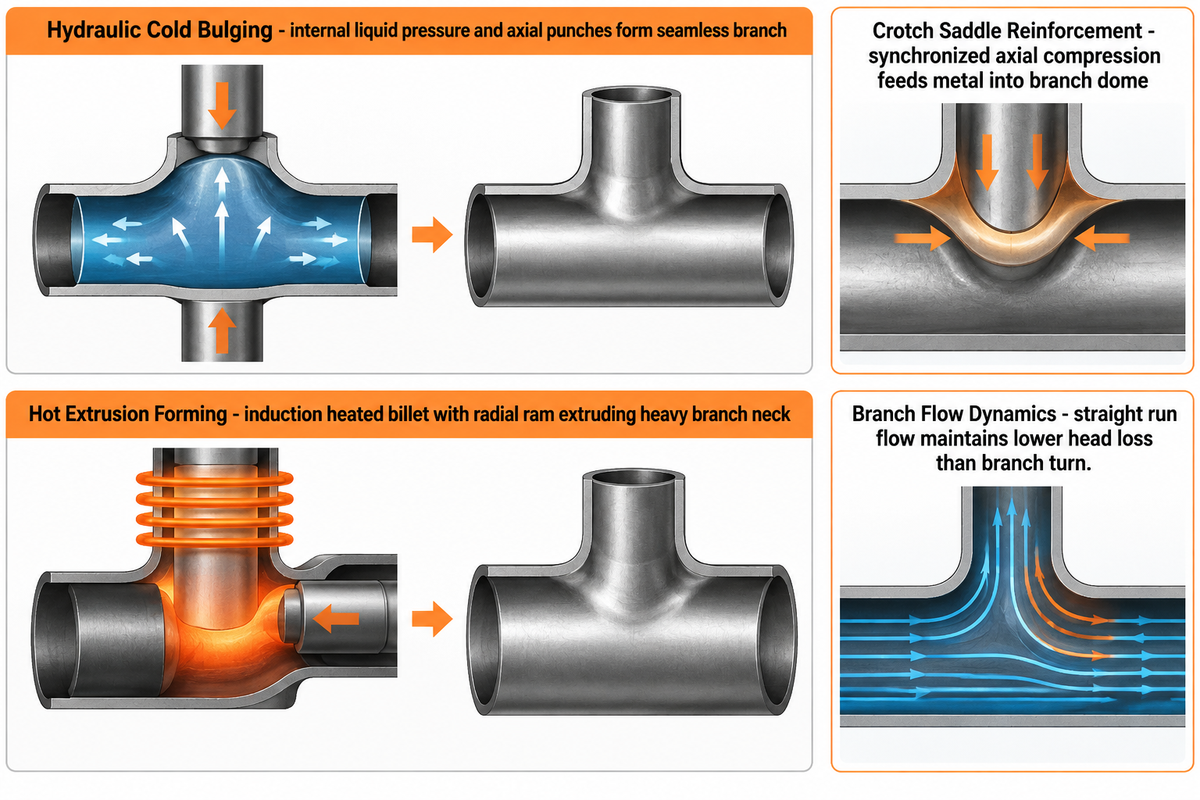
The method of manufacture to produce a butt weld tee determines the crotch wall thickness, the continuity of the grain flow and the pressure rating. A simple pipe elbow or a concentric reducer requires the metal to be displaced radially inward. With a tee, the metal must be displaced radially outward at 90° from the buttweld pipe wall. The branch wall must not be crowded and the run bore must not collapse.
Hydraulic cold bulging is the best option to manufacture seamless and welded equal tees and butt weld reducing tees in standard sizes from NPS 1/2 to NPS 24. A cut section of seamless pipe or welded pipe is placed in a two-piece female die, split along the axis and containing a branch cavity in the perpendicular direction. The female die is closed on both sides by two opposed hydraulic axial punches. The internal cavity of the female die contains a water-soluble hydraulic liquid or an elastomeric medium. Bulging of the billet occurs by the application of a low external pressure at a constant temperature.
At pressures of 150-400 MPa, axial punches begin to push inward and compress the length of the mother pipe. This synchronous axial compression pushes plastic metal into the rising branch dome and eliminates the possibility of tensile rupture. It also naturally enhances the thickness of the saddle zone of the crotch. Important engineering advantages of this technology are:
When nominal pipe size exceeds 24 inches, or when heavy wall schedules (Sch 160, Sch XXS) exceed the tonnage capacity of cold-bulging dies, the hot extrusion process is employed. A thick-walled mother pipe billet, pre-machined with a pilot hole, is heated in an induction coil or gas furnace to the forging temperature window of 880°C to 980°C to achieve austenite. The heated billet is clamped in a heavy saddle die and a conical extrusion ram is driven radially outward from the pipe bore through the pilot opening.
Hot extrusion shapes thick-wall branch necks with generous crotch radii capable of handling extreme internal pressures in high-temperature applications, power generation headers, and subsea manifolds. After hot extrusion, the tee crown is trimmed, the run and branch bores are CNC machined, and the entire fitting undergoes full normalizing or quench-and-temper heat treating so that ovality and dimensions stay within ASME B16.9 limits.
In industrial piping hydraulics, fluid passing through a tee experiences two different regimes of resistance, per Crane Technical Paper No. 410:
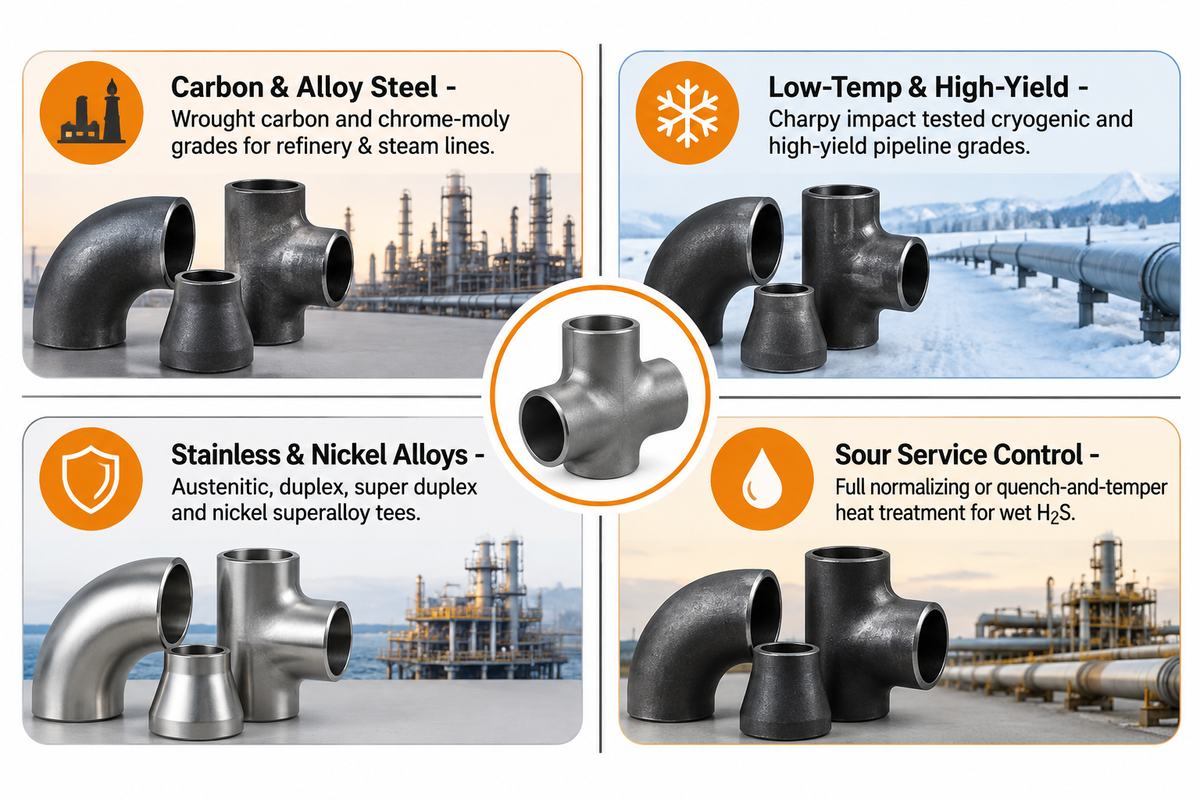
buttweld pipe fittings matches mechanical strength, weldability and corrosion resistance of connecting pipeline components for various industrial applications:
ASTM A234 is the primary specification governing wrought carbon steel fittings and alloy steel fittings for moderate and high temperatures:
For temperatures as low as -46°C (-50°F) ASTM A420 Grade WPL6 requires Charpy V-notch impact testing for each heat lot to prevent brittle fracture in LNG and Arctic gas plants. For API 5L X52 through X70 pipelines, MSS SP-75 and ASTM A860 (Grades WPHY 42, 52, 60, 65 and 70) provide high-yield ferritic butt weld tees with minimum yield strengths of 485 MPa.
In desalination and marine environments, corrosion resistant alloys are mandatory. ASTM a403 covers wrought austenitic stainless steel fittings (WP304/304L, WP316/316L, WP321, WP347), while ASTM A815 covers ferritic-austenitic duplex (UNS S31803 / S32205) and super duplex (S32750) tees. For extreme acid or sour chloride streams, manufacturers form tees under ASTM B366 from Special Metals Corporation and Haynes International alloys including inconel (such as Inconel 625), incoloy (Incoloy 800/825), monel (Monel 400), and hastelloy (Hastelloy C-276).
Because hydraulic cold bulging induces high plastic strain at the tee crotch, unannealed tees are susceptible to sulfide stress cracking in wet H2S sour gas. NACE MR0175 / ISO 15156 mandates full normalizing or quench-and-temper heat treatment so that bulk hardness across the run, branch, and crotch saddle never exceeds 22 HRC (237 HBW).
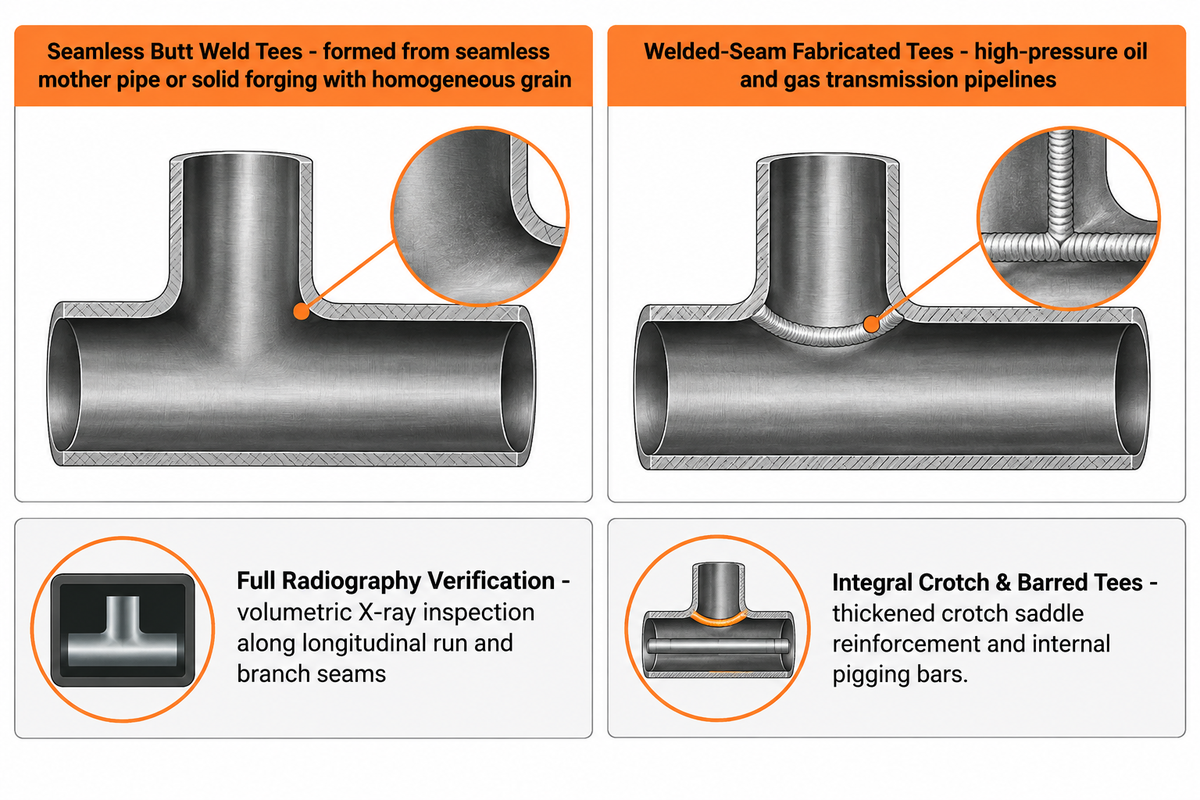
When specifying pipe sizes from small-bore utility lines up to 72-inch transmission headers, engineers must evaluate the structural and commercial trade-offs between seamless and welded construction.
Smooth butt weld tees are formed directly from smooth mother pipe or bored from a solid piece forging (for ultra-heavy pressure vessel manifolds), providing a homogeneous microstructure with an intrinsic joint efficiency factor of E = 1.0 under ASME B31.3. Because global seamless tube mills generally cap production at NPS 24 (with limited heavy-wall extrusion up to NPS 36), tees above 24 inches are predominantly fabricated as welded fittings from rolled plate or two pressed half-shells joined by longitudinal submerged arc welding.
To prevent rupture at the 90-degree branch opening, ASME B31.3 paragraph 304.3 and ASME B16.9 enforce strict crotch reinforcement and weld examination rules:
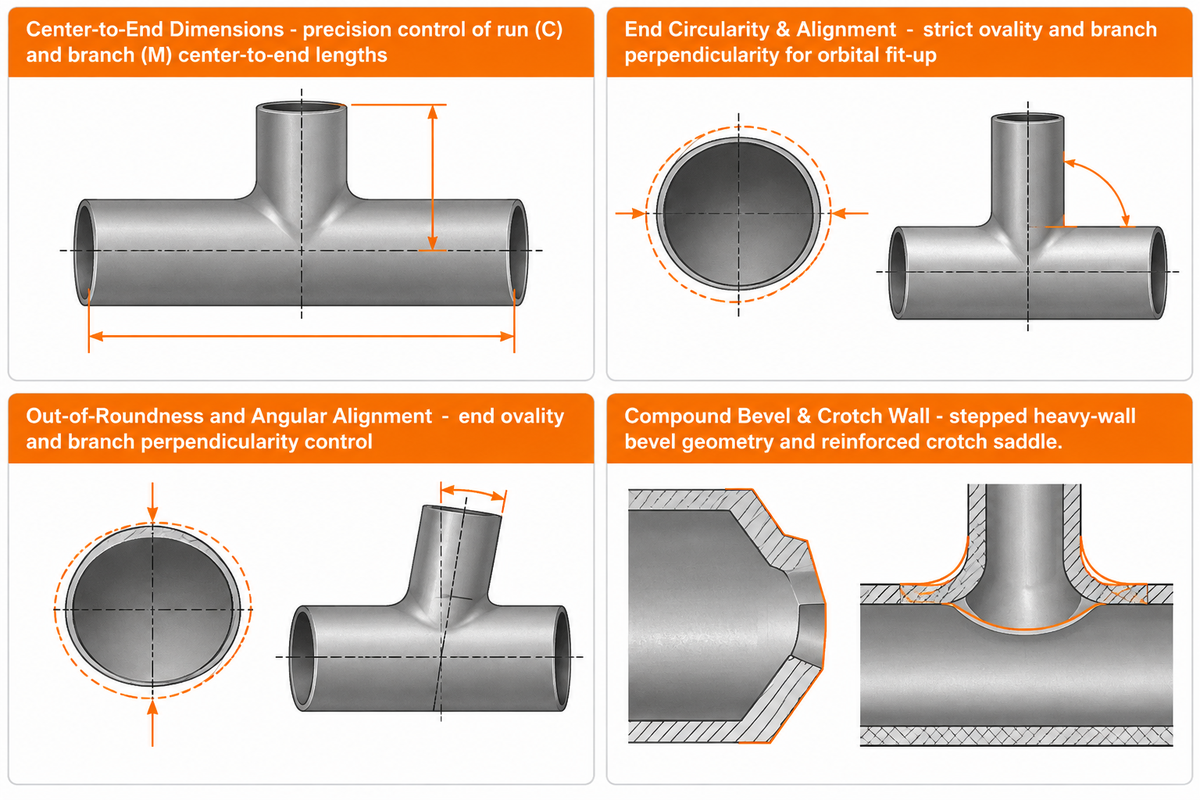
Precise welding is important for automated orbital welding and for field alignment.
Under ASME B16.9 (part of the broader ASME B16 standards series published by the American Society of Mechanical Engineers), equal tees define a single center-to-end dimension (C) for both run and branch, whereas reducing tees define center-to-run (C) and center-to-branch (M) dimensions:
All three ends of a butt weld tee are CNC machined per ASME B16.25: walls up to 22 mm receive a plain 37.5° ± 2.5° bevel with a 1.6 mm ± 0.8 mm root face, while walls exceeding 22 mm receive a compound 37.5°/10° bevel to minimize weld metal volume and heat distortion. At the high-stress crotch radius, reputable mills maintain wall thickness at 1.25 to 1.50 times the nominal run wall thickness, while guaranteeing that the minimum wall at any point never falls below 87.5% of nominal wall thickness.
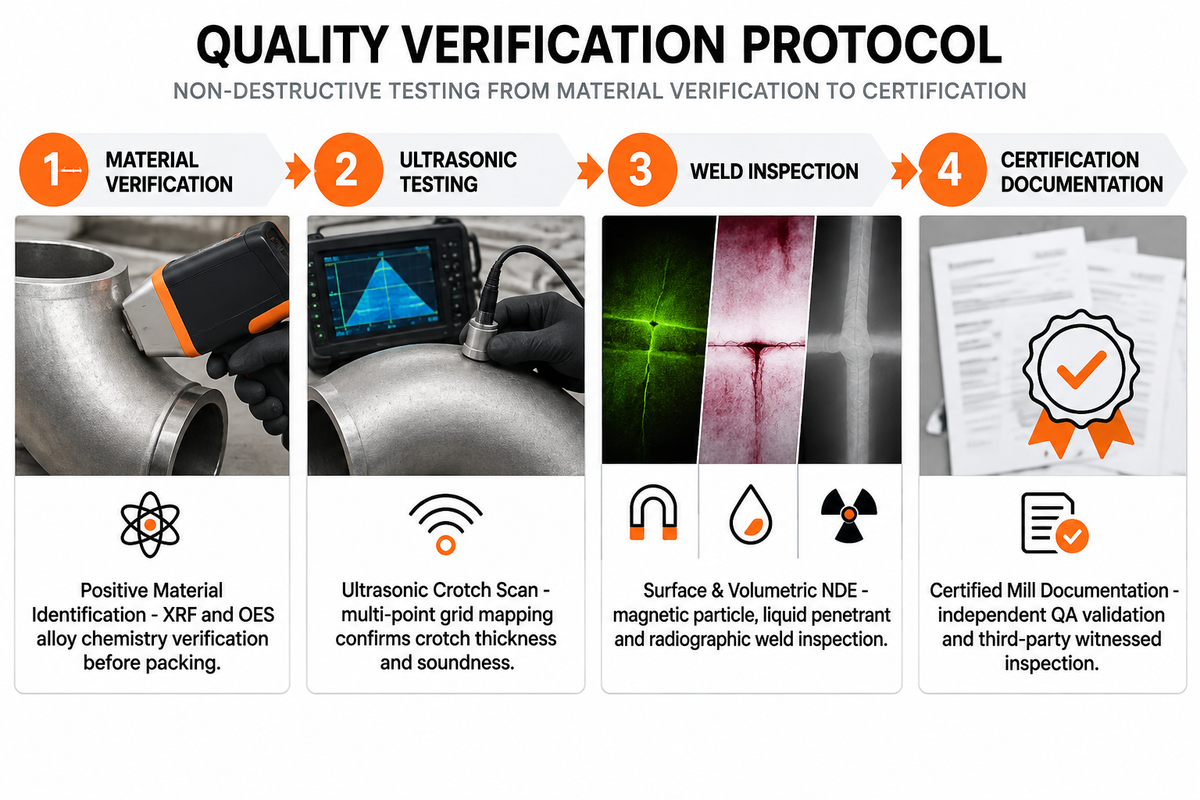
complete quality management and multiple inspections protect EPC contractors from fittings, uncertified pipe stub-ins, and metallurgical mix-ups across different materials.
Every industrial shipment must include certified documentation under EN 10204: an EN 10204 Type 3.1 certificate is issued by the manufacturer’s independent QA department documenting heat chemical analysis, tensile/yield results, hardness, and furnace charts; an EN 10204 Type 3.2 certificate adds direct test witnessing and counter-signature by an independent third-party inspection authority (DNV, Lloyd’s Register, Bureau Veritas, or TÜV) for critical offshore, nuclear, and sour gas service.
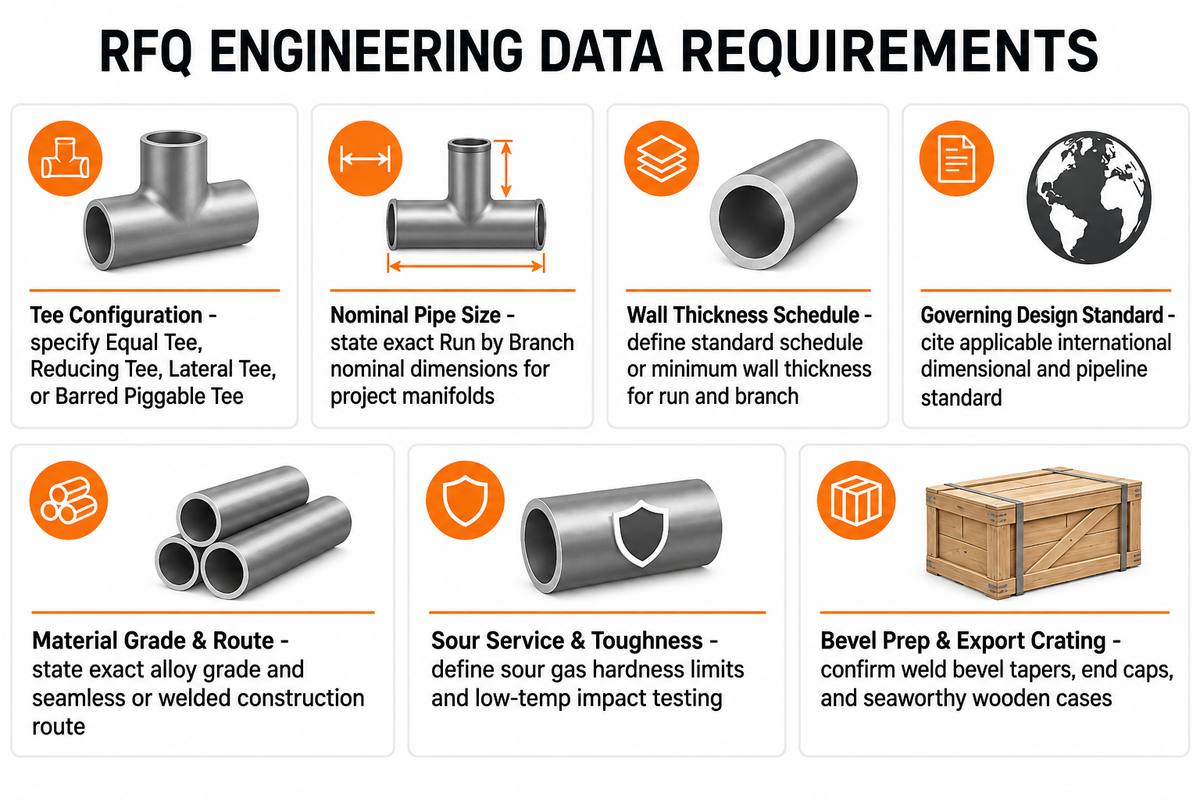
Issuing a complete and clear Request for Quotation (RFQ) eliminates delays to process technical clarifications and ensures the mill receives an accurate price for standard sizes and variety of sizes. Industrial pipe fittings, unlike consumer goods or firearm catalog stock items, require an exact definition by eight (8) parameters:
Below are detailed engineering answers to the most common procurement questions regarding butt weld tees, forming methods, and inspection requirements:
An equal tee, or straight tee, has three openings of the same nominal pipe size (NPS), allowing a 90 degree branch to remain of the same diameter. A reducing butt weld tee has a smaller branch pipe, allowing a step down of branch line sizing at the junction, as opposed to using a separate concentric reducer and butt weld.
Pipeline engineers must specify a barred tee (also called a piggable tee) when the main transmission line undergoes periodic inline inspection (ILI) smart pigging or mechanical cleaning scraper operations, especially if the branch outlet diameter is greater than 30% to 50% of the main line diameter. Welded internal guide bars that are contoured to the internal bore of the run pipe, allow inspection pigs, foam spheres, or MFL tools to flow through the main line, and prevent them from being deflected into the branch line, becoming jammed at the tee crotch, and/or suffering mechanical sensor damage during high velocity pipeline flow.
Cold bulging forms tees up to 24 inches by means of ultra-high-pressure fluid (400 MPa) in a seamless pipe billet. Axial punches compress the pipe ends and branch out into a split die. For heavy wall and large diameter billets, the billet is heated to 880°C to 980°C and an internal ram pushes through the side wall to extrude the branch neck.
Per ASME B16.9 and MSS SP-25 marking rules, every butt weld tee must carry permanent low-stress die stamps or stenciled markings showing the manufacturer’s trademark, ASTM material grade (such as WP316L or WPB), run and branch nominal pipe sizes, wall schedule, B16.9 standard designation, and the traceable melt heat number.
Yes, welded-seam fabricated tees and extruded-header manifold tees are widely deployed in high-pressure oil and gas transmission lines, particularly in nominal sizes above 24 inches where smooth mother pipe feedstock is unavailable or cost-prohibitive. To achieve a full joint efficiency factor of E = 1.0 under ASME B31.3, B31.4, and B31.8 design codes, all longitudinal run seams must be positioned away from the high-stress crotch saddle zone, and 100% of the weld length must pass radiographic testing (RT) or automated ultrasonic testing (AUT) in strict accordance with ASME Section VIII Division 1 UW-51 acceptance criteria, followed by full post-weld heat treatment.
A EN 10204 Type 3.1 Mill Test Certificate is issued and validated by the fitting manufacturer’s independent quality assurance department by means of actual heat lot test results. A EN 10204 Type 3.2 certificate mandates a counter signature and direct physical test witnessing by an independent third-party inspection agency like DNV, Lloyd’s Register, or TÜV.
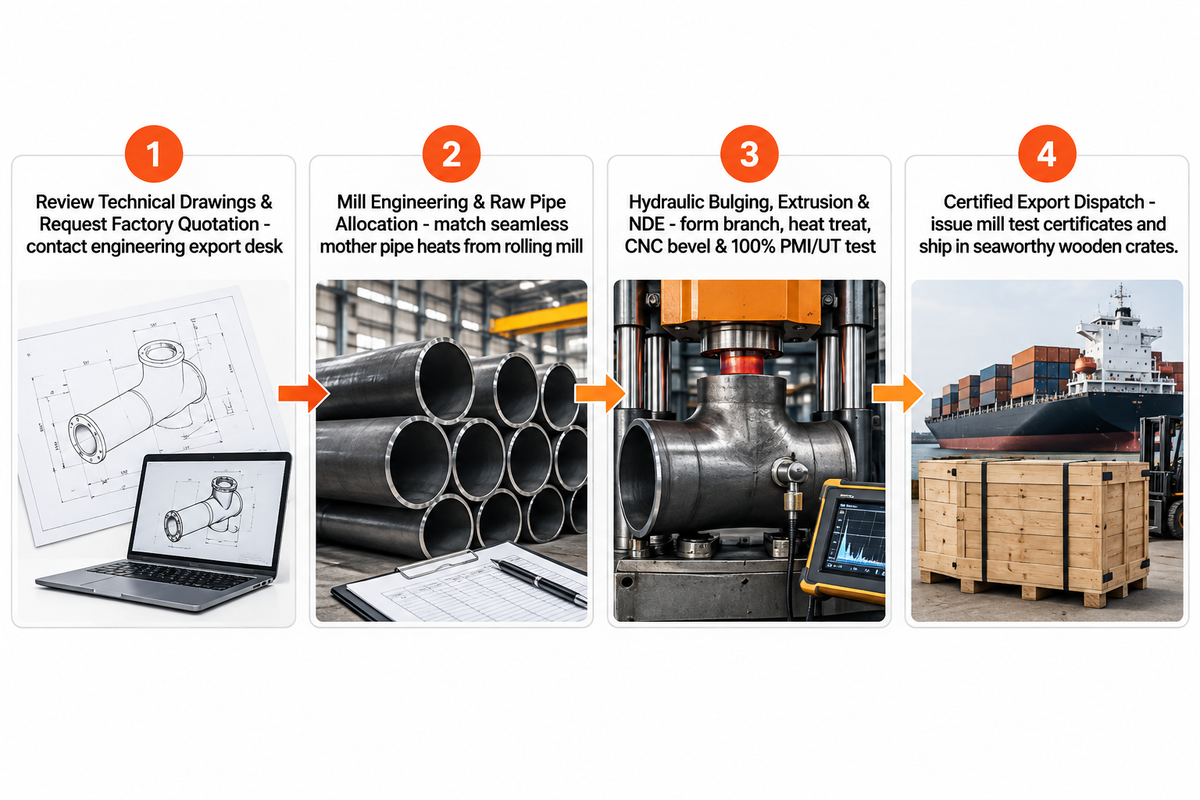
As an integrated manufacturing mill operating hydraulic cold-bulging presses, hot-extrusion lines, and calibrated heat treatment furnaces, Synbase Steel Co., Ltd. supplies ASME B16.9 and MSS SP-75 butt weld tees engineered for global energy, petrochemical, and marine infrastructure. Utilizing certified steel billets and mother pipe from our own rolling mills, we deliver smooth equal and reducing tees from NPS 1/2 to 24 inches and welded or extruded tees up to 48 inches across Sch 10 through Sch XXS.
Every butt weld tee shipped by Synbase Steel undergoes 100% Positive Material Identification (PMI), ultrasonic crotch wall verification, and CNC beveling per ASME B16.25, backed by full heat traceability and EN 10204 3.1 or 3.2 certification. Contact our engineering export desk to review technical drawings or request a rapid factory quotation:
sales@synbasesteel.com.The information on engineering rules and dimensional tolerances, and the capabilities of manufacturers, contained in this buyers’ guide, have been validated against official copies of the relevant standards and first-party corporate technical publications, respectively:
Synbase Steel supplies steel pipe, fittings, flanges, valves and OCTG for oil and gas, petrochemical, power, water and industrial projects. Our technical guides are written to help buyers compare standards, grades, dimensions, coatings, inspection requirements and commercial terms before sending an RFQ.
We focus on practical specification work: matching pipe process to service conditions, checking wall thickness and end finish, reviewing MTC and NDT requirements, and clarifying documentation before production or shipment.
Project support across seamless pipe, ERW, LSAW, SSAW, buttweld fittings, forged flanges, valves and oilfield tubulars.
Specification review for ASTM, ASME, API, EN and DIN standards, including material grade, pressure class, coating and inspection scope.