Send Your RFQ to Synbase Steel
Prefer to send drawings, BOMs or attachment lists by email? sales@synbasesteel.com
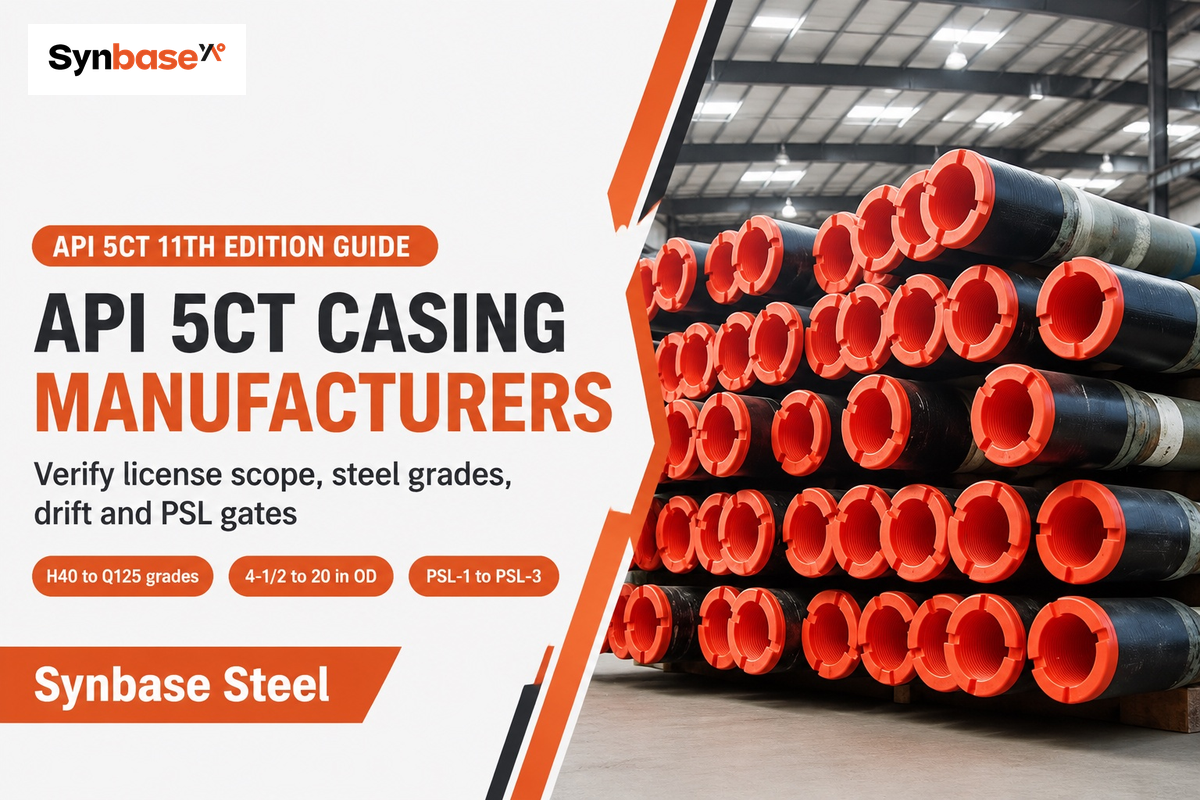
Manufacturers of API 5CT casing produce seamless and electric-welded steel pipes that line oil and gas wells. Standard outside diameters range from 4-1/2 inch to 20 inch. Qualified mills control yield strength from H40 to Q125 (276 to 1,034 MPa), chemical composition, and drift mandrel clearance under the 11th Edition standard. It is recommended that the customer verify that the supplier has an active API 5CT manufacturer or processor license, or an API 5B license covering the required threading scope, prior to order placement.
“The changes in the 11th edition of API 5CT reinforce the role of casing and tubing as primary and secondary barriers.” – American Petroleum Institute (API), API Standard 5CT 11th Edition Announcement
Quick Engineering & Procurement Reference:
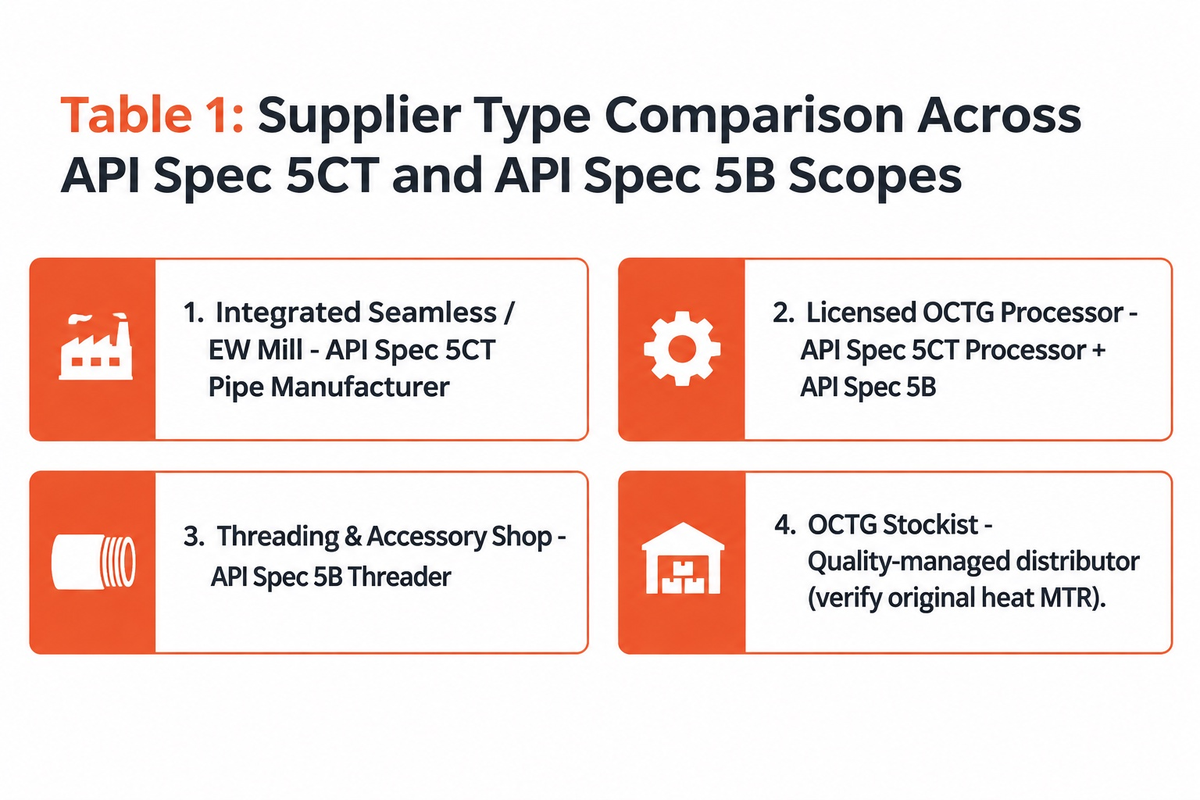
When selecting an oilfield tubular partner, the first step is to check the API Monogram Program Licensing Documents. Across the global oil and gas industry, distinct commercial entities bid on API casing tenders. Each supplier category has a different license boundary and heat-lot traceability obligation. Knowledge of these boundaries lessens procurement risk for oil and gas applications.
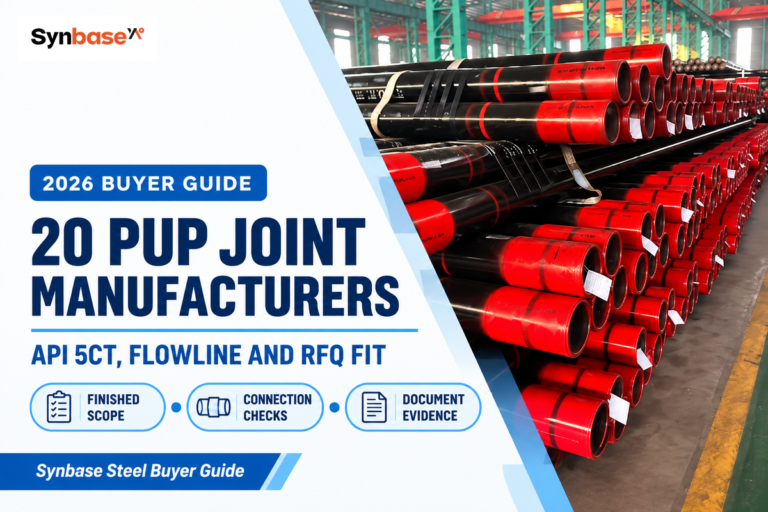
An integrated pipe manufacturer melts steel, pierces billets for seamless pipe or forms coil for ERW pipe, then completes the applicable forming, heat-treatment, inspection, and finishing steps. This route produces API 5CT pipe with records traceable from the steel heat through forming, treatment, inspection, and finishing; threading and assembly into a casing string may be performed under separate licensed scopes. A processor that buys green pipe performs quench-and-temper heat treatment and non-destructive testing on API 5CT OCTG. A threading shop machines end connections and a stockist, who holds finished inventory, dispatches it. Their certificates and traceability records cover the work performed by each.
On October 7, 2026, the American Petroleum Institute published the 17th Edition of API Specification 5B for pipe threading. That release confirms that API Spec 5B is the primary Monogram specification for casing, tubing, and line pipe threading activities. Over 550 licensed organizations worldwide operate under this threading standard. An API 5B license authorizes the licensee to apply the API Monogram to the threading activities within its licensed scope; it is not a general legal authorization for all thread machining or coupling work. Moreover, that shop cannot monogram plain-end pipe or perform grade-converting heat treatment under API 5CT.
Licensed API 5CT casing manufacturers produce components including seamless and welded casing pipe and production tubing pipe, pup joints, coupling stock, coupling material and accessory material. In accordance with the 11th Edition scope, authorized mills manufacture these tubular components for oil and gas well construction. In field service, they stabilize drilled formations, isolate pressure zones, and convey reservoir fluids safely to the surface.
Beyond regular casing strings, full-spectrum manufacturers provide factory-installed API 5CT casing and tubing couplings and cross-over accessories. API marking follows the method described for the product and license scope, and identifiers link the pipe to its heat and test records. If your procurement team is assembling a vendor pre-qualification list, compare the supplier-category and license-scope table given below with our OCTG manufacturer evaluation guide.
| Supplier Category | API Monogram License Scope | Core Manufacturing Activity | MTC / MTR Traceability Chain | Best Fit Order Profile |
|---|---|---|---|---|
| Integrated Seamless / EW Mill | API Spec 5CT Pipe Manufacturer (and API Spec 5B where applicable) | Steelmaking or billet/coil processing, piercing or ERW forming, grade-specific heat treatment, NDE, and threading when included in the licensed scope | Separate or consolidated mill, heat-treatment, inspection, and threading records traceable to melt heat | Large multi-well casing programs, sour grades, or custom collapse specs |
| Licensed OCTG Processor | API Spec 5CT Processor + API Spec 5B | Quench-and-temper heat treatment, straightening, NDE, and upsetting of green tubes | Dual chain: green-tube mill heat report plus processor heat-treatment lot report | Mid-sized L80, N80Q, or P110 orders needing rapid regional heat treatment |
| Threading & Accessory Shop | API Spec 5B Threader (within licensed Monogram scope) | CNC end threading, coupling buck-on, pup joint machining, and gauge inspection | Threading inspection report linked back to the parent mill’s base pipe MTR | Premium connection crossovers, pup joints, and local repair re-cuts |
| OCTG Stockist | Quality-managed distributor (ISO 9001 alone does not establish API 5CT or API 5B licensing) | Depot storage, tally bundling, thread protector maintenance, and dispatch | Supplied mill test certificates remain traceable to the original heat number | Urgent well spud requirements with prompt stockyard dispatch |
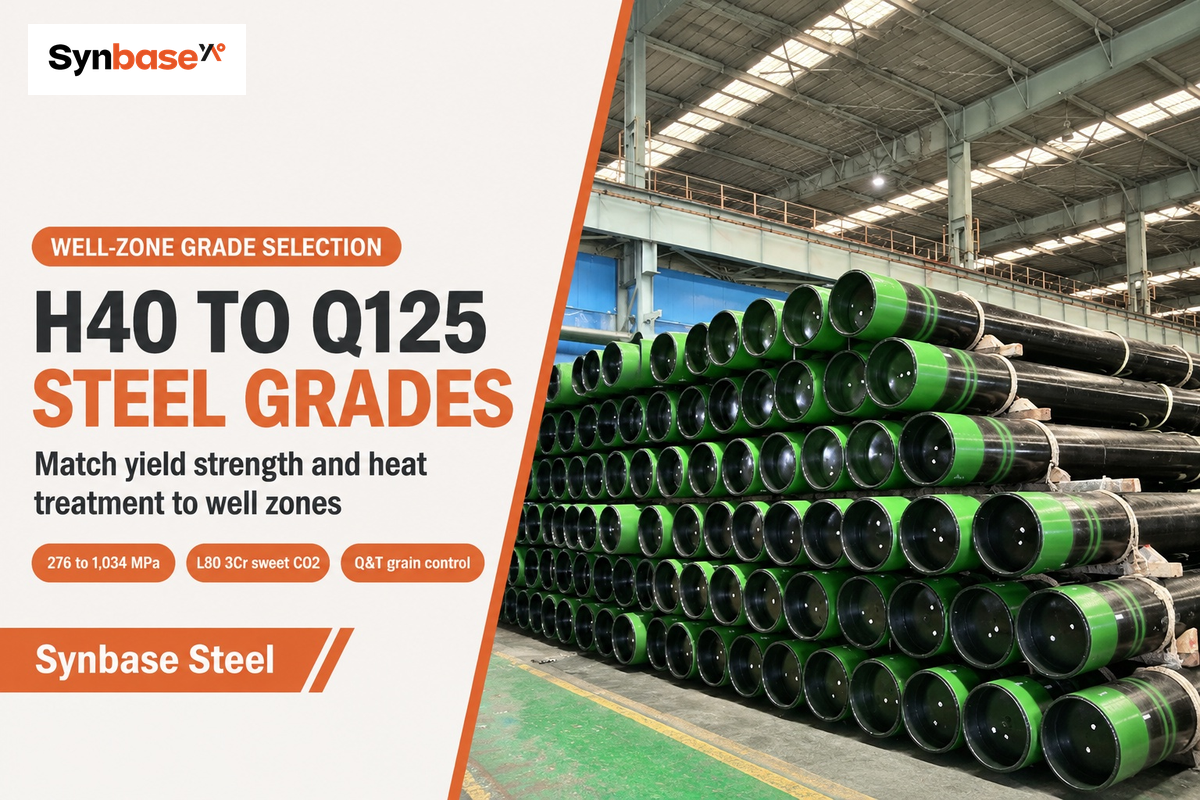
API 5CT is a member of the standard technical specification, a classification system for oil country tubular goods (OCTG) based on yield strength, metallurgy, and the service environment. In the grade code, the letter is a steel category and heat treatment family identifier. Meanwhile, the two- or three-digit number refers to the yield strength in thousands of pounds per square inch (ksi). Matching steel grades in API 5CT to wellbore depth prevents shallow over-specification and deep zone tensile failure.
As mentioned in the U.S. Department of Energy OSTI Well Design Report SAND2024-11124R, well casing is steel pipe that serves as the primary barrier to allow formations to confine wellbore fluids. Surface strings primarily protect shallow freshwater aquifers and support wellhead loads. Intermediate and production strings require higher tensile strength. These strings are also designed to withstand the severe formation collapse and internal burst pressures during oil and gas operations.
Strength thresholds and heat treatment define grades within Groups 1 and 2. Grade L80 has a minimum yield strength of 552 MPa (80 ksi) and a minimum tensile strength of 655 MPa (95 ksi), whereas API 5CT J55 and K55 serve lower-pressure shallow strings. Lower pressure, shallow-string drill-pipe grades API 5CT J55 and K55 serve other applications. Meanwhile, J55 remains a popular shallow grade for tubing. Within Group 1, N80 Type 1 allows normalized delivery, whereas N80Q and R95 require full-body quench-and-temper heat treatment for finer grain uniformity.
The 11th Edition of the API 5CT specification includes Grade L80 3Cr. This new chromium-bearing steel grade delivers enhanced corrosion resistance in sweet CO 2 wells. It bridges the cost gap between carbon-steel L80 Type 1 and expensive L80 13Cr martensitic stainless steel.
Drilling Engineers employ the Well-Zone-to-Grade Selection Ladder to correlate the range of steel grades (H40 to Q125) to each casing string.
| Pipe Grade | API Group | Min–Max Yield Strength MPa (ksi) | Min Tensile Strength MPa (ksi) | Max Hardness (HRC / HBW) | Mandatory Heat Treatment | API Coupling Color Band |
|---|---|---|---|---|---|---|
| H40 | Group 1 | 276–552 (40–80) | 414 (60) | No max limit | None (as-rolled or normalized) | None or 1 black band |
| J55 | Group 1 | 379–552 (55–80) | 517 (75) | No max limit | None (full-length normalized for EW) | 1 bright green band |
| K55 | Group 1 | 379–552 (55–80) | 655 (95) | No max limit | None (full-length normalized for EW) | 2 bright green bands |
| N80 Type 1 | Group 1 | 552–758 (80–110) | 689 (100) | No max limit | Normalized or normalized & tempered | 1 red band |
| N80Q | Group 1 | 552–758 (80–110) | 689 (100) | No max limit | Quenched and tempered (Q&T) | 1 red + 1 bright green band |
| R95 | Group 1 | 655–758 (95–110) | 724 (105) | No max limit | Quenched and tempered (Q&T) | 1 brown band |
| M65 | Group 2 | 448–586 (65–85) | 586 (85) | 22.0 HRC (235 HBW) | Full-body normalized&T or Q&T | 1 bright green + 1 blue band |
| L80 Type 1 | Group 2 | 552–655 (80–95) | 655 (95) | 23.0 HRC (241 HBW) | Quenched and tempered (Q&T) | 1 red + 1 brown band |
| L80 3Cr / 9Cr / 13Cr | Group 2 | 552–655 (80–95) | 655 (95) | 22.0–23.0 HRC | Quenched and tempered (Q&T) | 1 red + brown / yellow bands |
| C90 Type 1 | Group 2 | 621–724 (90–105) | 689 (100) | 25.4 HRC (255 HBW) | Quenched and tempered (oil/water Q&T) | 1 purple band |
| T95 Type 1 | Group 2 | 655–758 (95–110) | 724 (105) | 25.4 HRC (255 HBW) | Quenched and tempered (oil/water Q&T) | 1 silver band |
| C110 | Group 2 | 758–828 (110–120) | 793 (115) | 30.0 HRC (286 HBW) | Quenched and tempered (seamless only) | 1 white + 2 brown bands |
| P110 | Group 3 | 758–965 (110–140) | 862 (125) | No max limit | Quenched and tempered (Q&T) | 1 white band |
| Q125 Type 1 | Group 4 | 862–1,034 (125–150) | 931 (135) | No max ceiling (variation cap) | Quenched and tempered (Q&T) | 1 orange band |
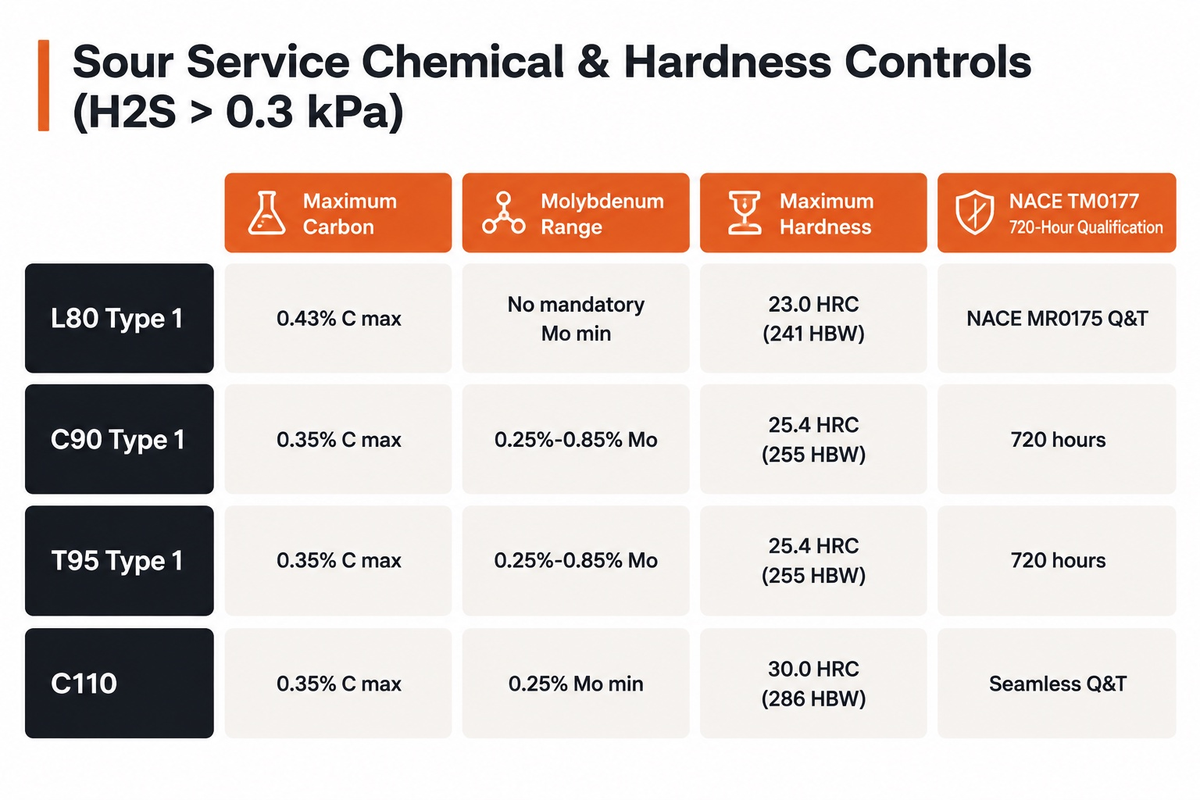
In oil and gas wells, with H2S partial pressure of 0.3 kPa (0.05 psia), per NACE MR0175, higher strengths do not ensure safety. Standard grade P110 contains no maximum hardness ceiling and has the open chemical requirements of Group 3. In the presence of wet H2S, hard martensitic zones with a hardness above 25 HRC, can absorb atomic hydrogen. Those hard zones can experience sudden brittle sulfide stress cracking (SSC) under tension.
To avoid string parting in corrosive sour reservoirs, API 5CT Group 2 imposes strict limits on chemical requirements and through-wall hardness. According to the standard’s footnotes in Table C.4, the carbon content for L80 may be increased to a maximum of 0.45% if the product is oil-quenched. Otherwise, L80 Type 1 carbon is capped at 0.43% carbon per the standard. In addition, the phosphorus content shall not exceed the Table C.4 impurity ceiling in L80 Type 1, C90, and T95.
For deep wells requiring higher collapse ratings, buyers specify Grade C90 Type 1, T95 Type 1, or C110. Per the standard, the molybdenum content for Grade C90 Type 1 and T95 Type 1 is held between 0.25% Mo and 0.85% Mo by weight. However, standard footnotes state that the molybdenum content for T95 Type 1 may be reduced to 0.15% Mo minimum, if the wall thickness is less than 17.78 mm. Likewise, the carbon content for Grade C90 Type 1 is restricted to a maximum of 0.35% to enable uniform tempered martensite, as per the standard.
C90, T95, and C110 qualification uses SSC testing under the applicable product and sour-service requirements; API 5CT does not require every heat to pass a Method A test. When NACE TM0177 Method A tensile testing is specified, specimens are stressed for 720 hours to failure. As stated in the USPTO Patent Application US20180265960A1 on induction quench-and-temper pipe processing, rapid induction austenitizing and controlled tempering keep through-wall hardness variation within a 3.0 to 4.0 HRC band.
| Sour Grade | Max Carbon (% C) | Molybdenum Range (% Mo) | Impurity & Grain Control | Max Through-Wall Hardness | NACE TM0177 Method A Qualification |
|---|---|---|---|---|---|
| L80 Type 1 | 0.43% C (0.45% C if oil-quenched per the standard) | No mandatory Mo min | Table C.4 low P & S cap; full-body Q&T | 23.0 HRC (241 HBW) | NACE MR0175 hardness & Q&T control |
| C90 Type 1 | 0.35% C per the standard | 0.25% Mo to 0.85% Mo per the standard | Restricted P & S cap; fine austenitic grain | 25.4 HRC (255 HBW) | Solution A tensile test (720 hours) |
| T95 Type 1 | 0.35% C per the standard | 0.25% Mo to 0.85% Mo (may be 0.15% Mo min if t < 17.78 mm per the standard) | Restricted P & S cap; fine austenitic grain | 25.4 HRC (255 HBW) | Solution A tensile test (720 hours) |
| C110 | 0.35% C per the standard | Cr-Mo alloyed per Table C.4 (0.25% Mo min per the standard) | Ultra-low P & S cap; seamless Q&T only | 30.0 HRC (286 HBW) | Solution A tensile test (720 hours) |
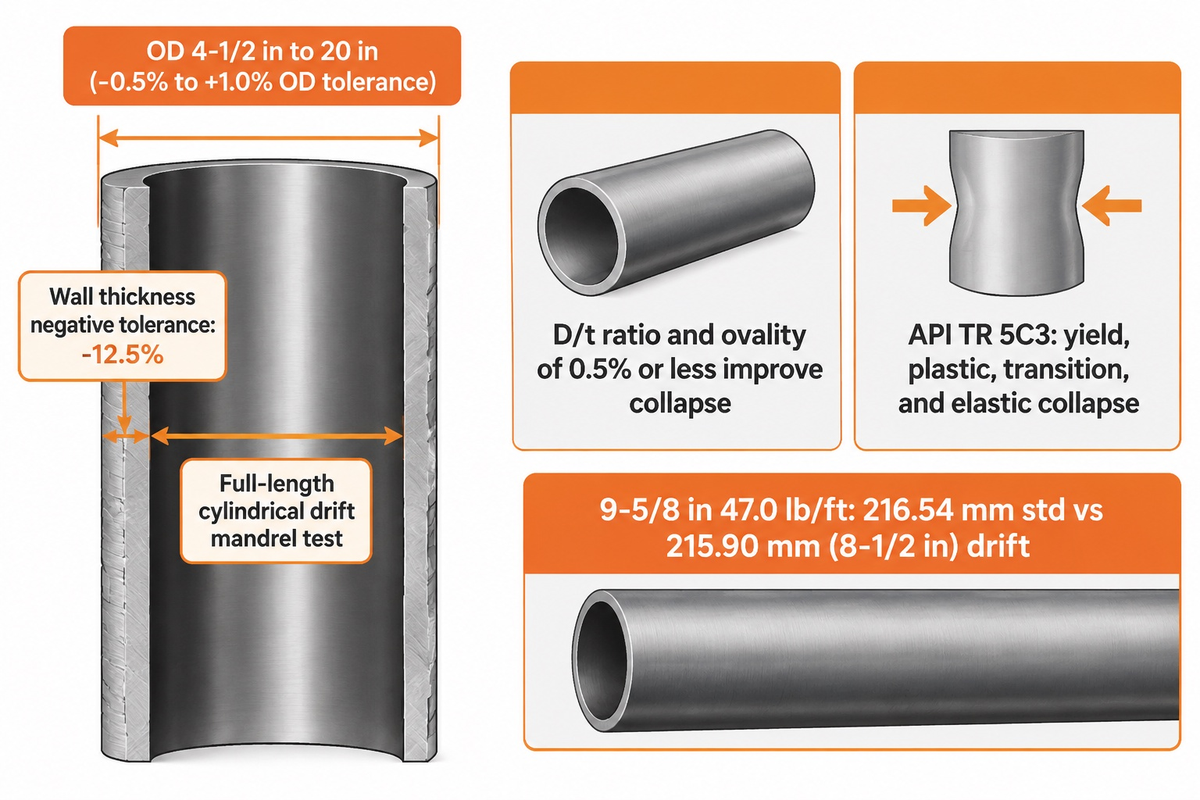
Controlling dimensional tolerances is essential when running long casing strings into deviated wellbores. Under API 5CT, standard casing outside diameter (OD) tolerance for sizes 4-1/2 inch and larger is -0.5% to +1.0%. Single-joint weight tolerance is +6.5% / -3.5%, while carload lot weight tolerance is -1.75%. Most importantly, the standard allows a wall thickness negative tolerance of -12.5%.
Wall eccentricity and ovality reduce internal clearance; therefore, completion engineers never design drill-bit or packer passage around the nominal inside diameter (ID). Instead, all casing pipe must pass a cylindrical drift mandrel test over its entire length. As stated in an Oil & Gas Journal analysis of pipe collapse economics, strict control of the D/t ratio and ovality of 0.5% or less improves collapse ratings. High collapse (HC) casing can withstand deep salt formations without stepping up to a heavier wall that sacrifices drift clearance.
Under API TR 5C3 (ISO 10400), external collapse resistance is governed by four physical regimes based on the D/t ratio. These are: yield collapse, plastic collapse, transition collapse, and elastic collapse. Intermediate-string orders from API 5CT casing manufacturers specify standard API drift or special drift. For example, operators frequently order 9-5/8 inch 47.0 lb/ft casing with a special 8-1/2 inch drift mandrel.
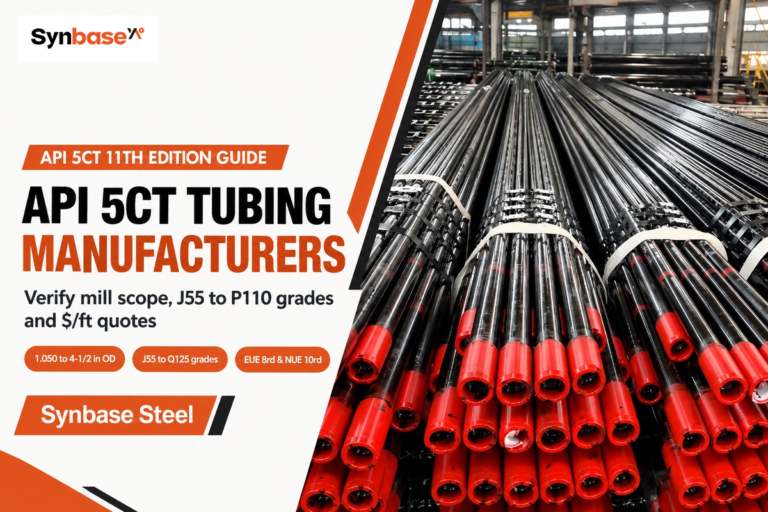
Casing is large-diameter structural steel pipe (4-1/2 inch to 20 inch OD) permanently cemented to protect the wellbore, while tubing is smaller-diameter removable pipe (1.050 inch to 4-1/2 inch tubing size) installed inside casing to flow hydrocarbons to the surface. Both products are governed by API 5CT, but serve different structural roles in well construction. Casing isolates formations and supports wellhead equipment, while tubing is installed inside the casing and provides replaceable flow during production.
Casing joints are often supplied in the Range 3 lengths (34 to 48 feet or 10.36 to 14.63 meters). Longer lengths of joints reduce the connection time on the rig floor during the running of casing. However, tubing pipe is often ordered in the Range 2 lengths (25 to 32 feet) with External Upset Ends (EUE) or Non-Upset Ends (NUE). Unlike drill pipe—which transmits rotary torque to the drill bit—both casing and tubing remain stationary during production.
| Outside Diameter (in / mm) | Nominal Weight (lb/ft) | Wall Thickness (in / mm) | Nominal Inside Diameter (mm) | Standard API Drift Mandrel (mm) | Special Drift Option (mm / bit in) |
|---|---|---|---|---|---|
| 4-1/2 in (114.3 mm) | 11.60 | 0.250 in (6.35 mm) | 101.60 | 98.42 | N/A (standard completion drift) |
| 5-1/2 in (139.7 mm) | 17.00 | 0.304 in (7.72 mm) | 124.26 | 121.08 | 120.65 (4-3/4 in bit clearance) |
| 5-1/2 in (139.7 mm) | 20.00 | 0.361 in (9.17 mm) | 121.36 | 118.19 | N/A (high-pressure frac liner) |
| 7 in (177.8 mm) | 26.00 | 0.362 in (9.19 mm) | 159.42 | 156.24 | 158.75 (6-1/4 in bit clearance) |
| 7 in (177.8 mm) | 29.00 | 0.408 in (10.36 mm) | 157.08 | 153.90 | 155.58 (6-1/8 in bit clearance) |
| 9-5/8 in (244.5 mm) | 40.00 | 0.395 in (10.03 mm) | 224.44 | 220.47 | 222.25 (8-3/4 in bit clearance) |
| 9-5/8 in (244.5 mm) | 47.00 | 0.472 in (11.99 mm) | 220.52 | 216.54 | 215.90 (8-1/2 in alternate drift) |
| 9-5/8 in (244.5 mm) | 53.50 | 0.545 in (13.84 mm) | 216.82 | 212.85 | 215.90 (8-1/2 in special drift) |
| 13-3/8 in (339.7 mm) | 54.50 | 0.380 in (9.65 mm) | 320.40 | 316.43 | N/A (intermediate string) |
| 13-3/8 in (339.7 mm) | 68.00 | 0.480 in (12.19 mm) | 315.32 | 311.35 | 311.15 (12-1/4 in alternate drift) |
| 20 in (508.0 mm) | 94.00 | 0.438 in (11.13 mm) | 485.74 | 480.97 | N/A (surface / conductor string) |
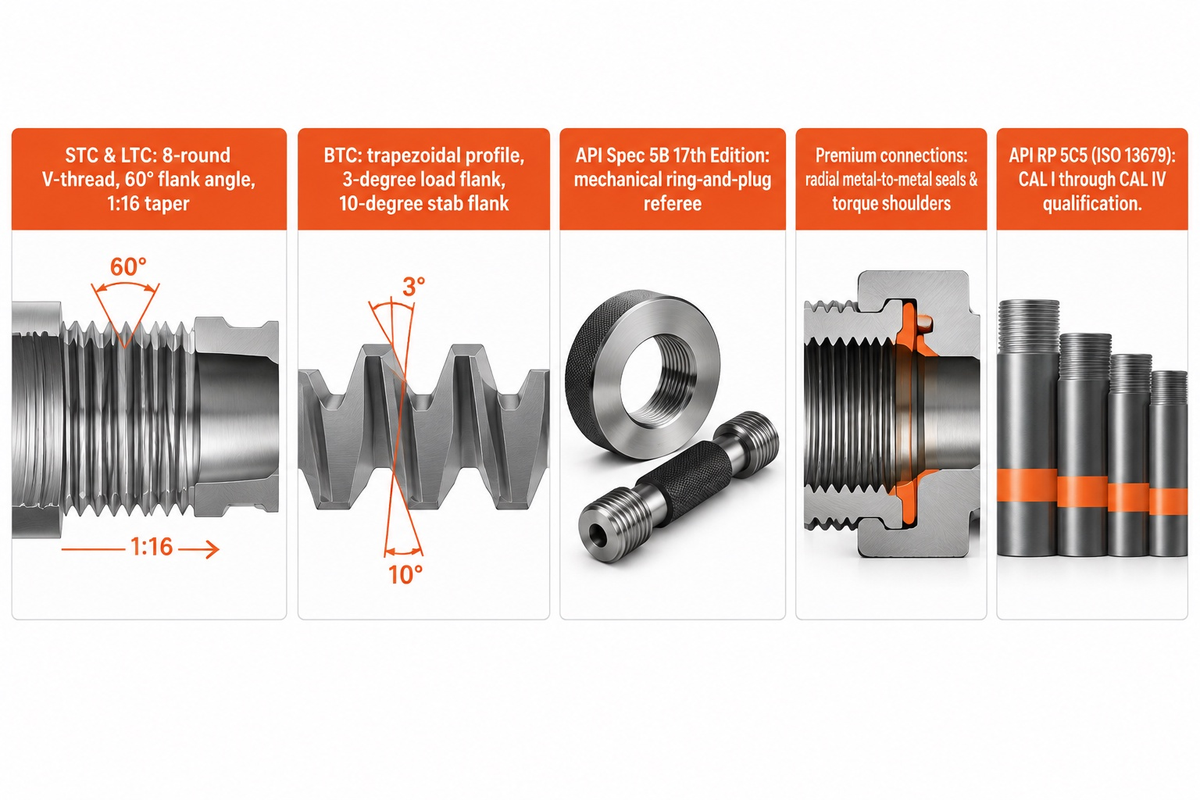
Threaded connections are the most mechanically stressed element in any OCTG casing string. Standard API Spec 5B defines three casing thread profiles: Short Round Thread Casing (STC), Long Round Thread Casing (LTC), and Buttress Thread Casing (BTC). STC and LTC employ an 8-round V-shaped thread profile with a 60° included flank angle and a 1:16 taper. They rely on API Modified thread compound to fill root-to-crest clearance gaps and seal against liquid pressure.
Buttress Thread Casing (BTC) uses a trapezoidal buttress profile with the specified thread pitch for the casing size. It has a 3-degree load flank and a 10-degree stab flank. Since BTC almost completely engages the full pipe body cross-section, it has higher joint tensile efficiency than STC and LTC Round threads. Additionally, USPTO Patent US5212885A on buttress casing make-up control demonstrates that multi-turn make-up, to a great extent, increases BTC gas sealing capability.
According to World Oil on the October 2026 API Spec 5B 17th Edition update, the new threading standard provides validation rules for optical and laser thread inspection systems, and also modifies the BTC tooth thickness tolerances. The 17th Edition states that traditional mechanical ring-and-plug gauging remains the referee standard in cases of dispute over non-contact optical data. For coupling dimensions, refer to our OCTG coupling specification and dimension guide.
Yes, leading API 5CT casing manufacturers and licensed threading centers supply proprietary and interchangeable premium connections in addition to standard API 5B threads. Standard STC, LTC, and BTC threads use thread dope to block fluid paths. High pressure gas wells, thermal wells, and horizontal shale strings require radial metal-to-metal seals and positive torque shoulders.
Premium connections—such as VAM TOP, NEW VAM, Hydril Series, and TPCQ gas-tight designs—are qualified under API RP 5C5 (ISO 13679). Qualification spans Connection Application Levels CAL I through CAL IV. A CAL IV connection passes combined internal gas pressure, thermal cycling, bending, and axial tension-compression envelopes. Recent deepwater awards, such as the IADC Drilling Contractor report on 47,000 tons of offshore OCTG supply, confirm that operators mandate factory-bucked premium connections to prevent field galling.
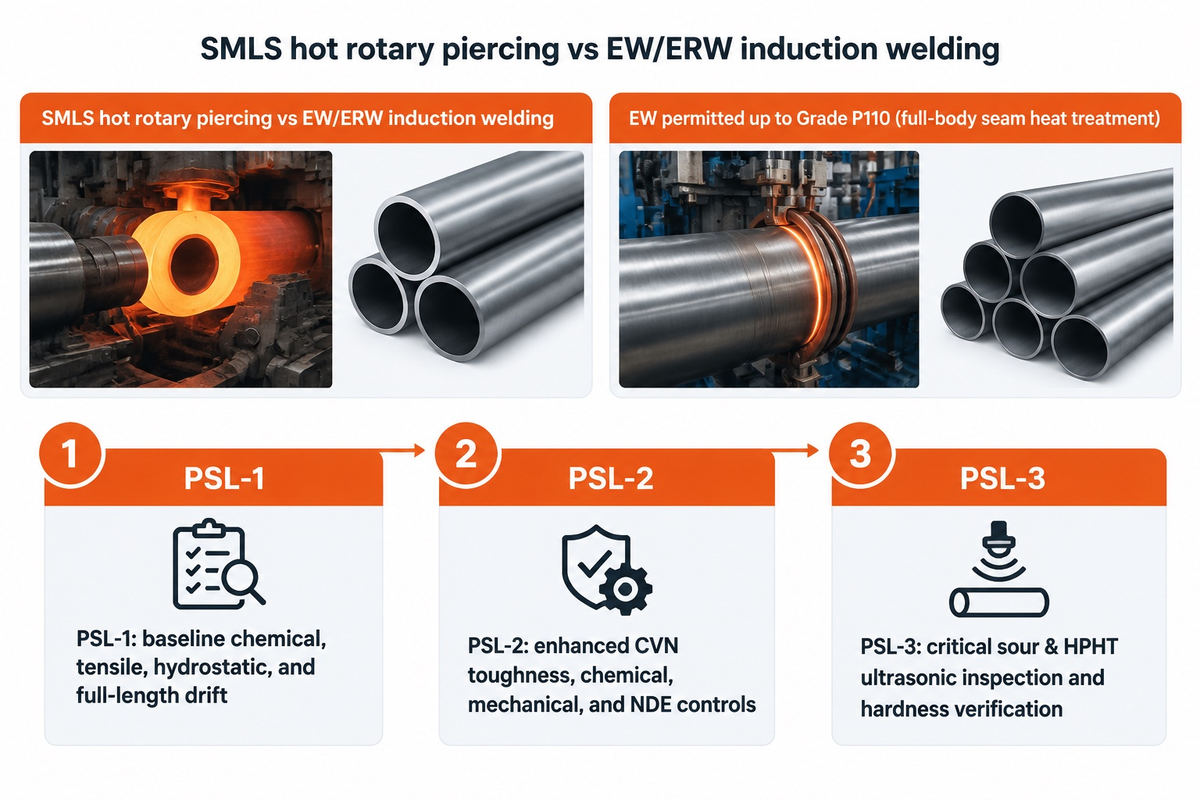
API 5CT permits two primary pipe manufacturing routes: Seamless (SMLS) hot rotary piercing, and Electric-Welded (EW/ERW) high frequency induction welding. Permitting of electric-welded casing is only given for grades and product forms listed in the applicable edition of API 5CT, for example, electric-welded pipe used up to EW Grade P110; Q125 type 1 should not be permitted as a blanket electric-welded allowable. Where electric-welded casing is permitted, the weld seam is subjected to full body normalizing or quench and tempering to remove all untempered martensite.
Because ERW pipe is produced using precision hot-rolled coil, it frequently shows tighter circumferential wall concentricity than rotary-pierced seamless pipe. This results in a more competitive geometric collapse resistance of intermediate sweet wells. Group 2 sour-service grades C90, T95 and C110 are restricted to seamless manufacturing to ensure a uniform-grain structure in the presence of H2S. You may compare both the mill processes in our article on seamless versus welded steel pipe manufacturing.
To correlate inspection rigor to wellbore risk, API 5CT defines three Product Specification Levels (PSLs): PSL-1, PSL-2 and PSL-3. The 11th Edition streamlined these PSL requirements to match modern operator standards. It also updated automatic pipe straightness measurement and calibration and Charpy V-notch (CVN) impact energy rules for heavy wall pipe.
The primary driver for total landed cost for a single well is the mill heat-lot minimum order quantity (MOQ). As indicated by the U.S. Bureau of Labor Statistics Producer Price Index for NAICS 331210 Steel Pipe and Tube Manufacturing, tubular mill gate pricing generally corresponds with trends in hot-rolled steel coil, billet feedstock, and energy prices. However, for single-well tenders, the cost of a custom furnace batch often outweighs the differences in base ex-works prices.
Primary seamless rolling mills cast and roll steel by the furnace heat or rolling campaign. That furnace batch sets a mill MOQ of 100 metric tons per outside diameter, weight, and grade. Suppose your drilling program requires only 50 metric tons of 9-5/8 inch L80 casing, and a mill enforces a 100-ton heat-lot minimum.
Production schedules differ by grade group and testing scope. Standard J55, K55, N80Q, and P110 orders ship faster from active rolling campaigns, whereas sour-service C90, T95, and C110 orders often require project-specific NACE TM0177 Method A qualification. That 720-hour mandatory sulfide stress cracking soak test adds a month of testing time before mill dispatch.
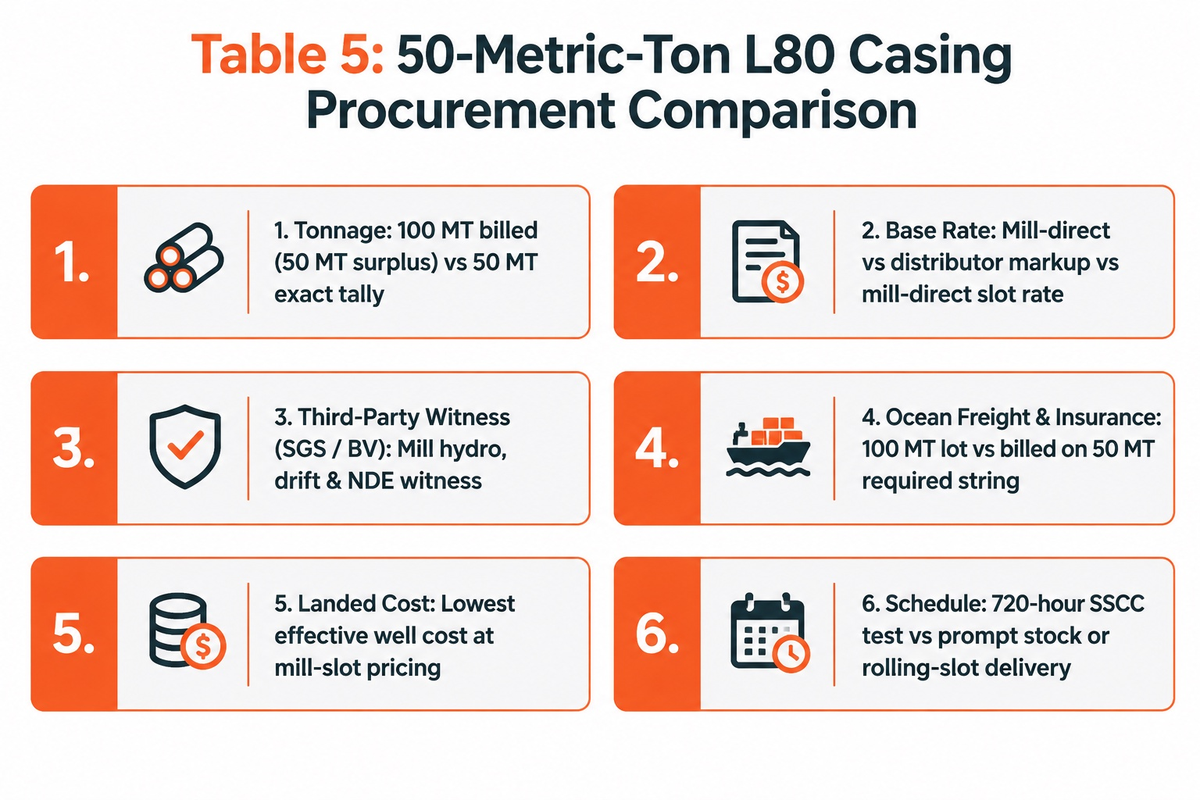
The 50-Ton Casing String Cost Breakdown below shows a procurement example. It shows an operator needing 50 metric tons (~715 meters) of 9 5/8 inch, 47.0 lb/ft, L80 Type 1 BTC seamless casing delivered CIF port:
| Cost & Schedule Element | Option A: Mill Rolling With 100-Ton Heat MOQ | Option B: Regional Retail Stockyard (50 Tons) | Option C: Synbase Rolling-Slot & Stock Allocation (50 Tons) |
|---|---|---|---|
| Ordered Tonnage vs Needed Tonnage | 100 MT billed (50 MT needed + 50 MT surplus) | 50 MT exact tally | 50 MT exact tally (consolidated rolling slot) |
| Unit Ex-Works / Depot Base Price | Mill-direct base rate (varies by billet index; request quote) | Retail stockist rate (includes distributor yard markup; request quote) | Mill-direct slot rate without surplus tonnage penalty (request quote) |
| Third-Party Witness Inspection (SGS / BV) | Multi-day mill witness fee (quoted per inspection scope) | Stockyard visual & MTR review fee (quoted per lot) | Consolidated mill hydro, drift & NDE witness (quoted per order) |
| Ocean Freight, Port Handling & Insurance | Billed across full 100 MT heat lot | Local drayage from depot to wellsite | Billed only on the 50 MT required string |
| Effective Landed Cost Structure | Doubled tonnage outlay due to 50 MT unallocated surplus pipe | No surplus pipe, but higher unit distributor price | Lowest effective well cost (50 MT exact tally at mill-slot pricing) |
| Dispatch & Production Schedule | Full furnace rolling campaign + 720-hour SSCC test if applicable | Immediate dispatch upon stock tally verification | Prompt stock allocation or scheduled rolling-slot delivery |
Before posting a deposit, perform a five step audit of the supplier’s quality credentials:
Synbase Steel Co., Ltd. is the international OCTG and line pipe supply platform for E-CHENG Steel Group. Our manufacturing base is backed by 1.3 million metric tons per year of seamless steel pipe capacity across 5 hot-rolling lines and 1 cold-drawing line. We supply API 5CT 11th Edition casing from 4-1/2 inch to 20 inch OD across grades J55, K55, N80, L80, C90, T95, P110, and Q125 with STC, LTC, BTC, and premium connections.
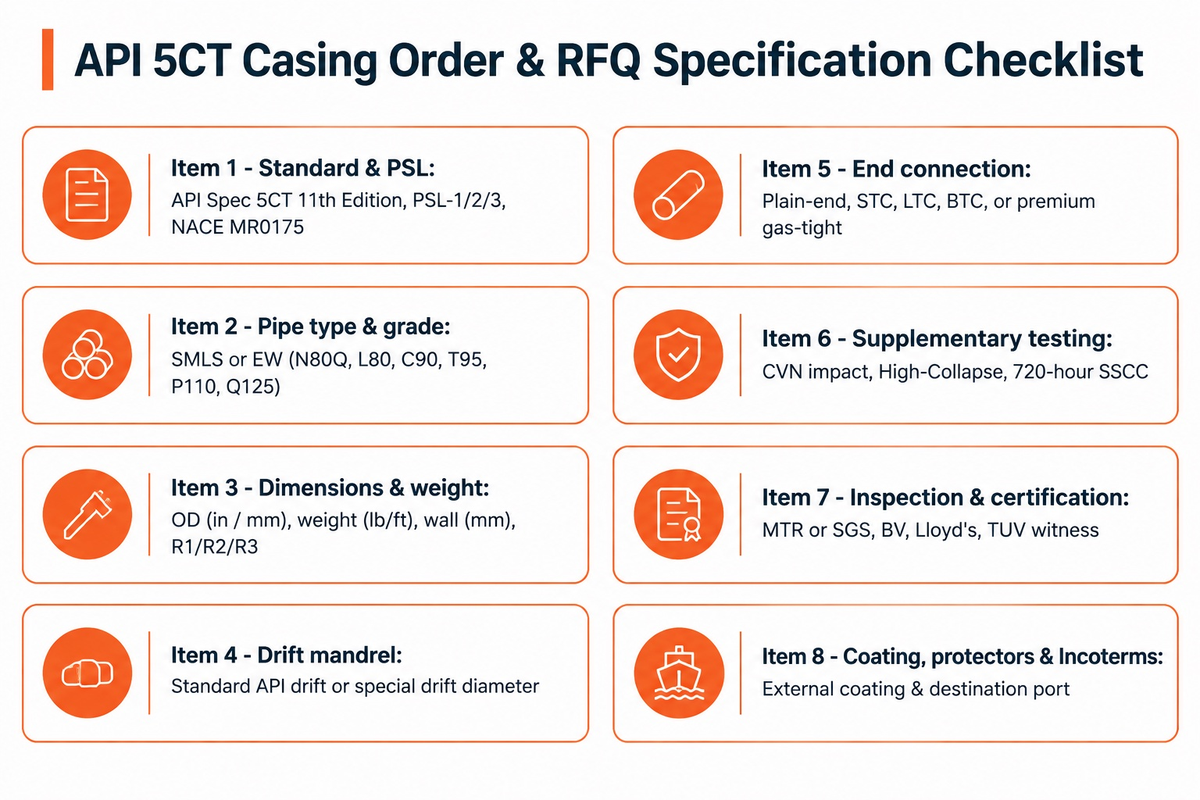
Copy the 8 mandatory engineering fields below into your tender package to eliminate mill quote delays and prevent grade mismatches:
API 5CT is the primary international standard published by the American Petroleum Institute for seamless and electric-welded steel casing and tubing pipes. These pipes are used in oil and gas wells worldwide. The specification defines four steel grade groups from H40 to Q125, mechanical properties, chemical limits, dimensional tolerances and three Product Specification Levels (PSL-1, PSL-2, PSL-3).
There are four principal types of oilfield casing strings, namely, conductor, surface, intermediate and production. Many deep wells also run a production liner. Conductor and surface strings stabilize shallow soil and freshwater aquifer sections. Intermediate and production strings withstand high pore pressures, corrosive sour fluids, and completion loads at depth.
API 5CT assigns OCTG grades to four product groups. Group 1 covers H40, J55, K55, N80 Type 1, N80Q, and R95. Group 2 covers M65, L80 Type 1, L80 3Cr, L80 9Cr, L80 13Cr, C90, T95, and C110. Group 3 covers P110, and Group 4 covers Q125.
Shipments include the required mill test documentation based on the purchase order and specification. Third-party witness certificates are provided when requested. This traceability package connects pipe heat numbers with ladle analysis, tensile and impact tests and hardness maps, as well as hydrostatic and drift tests. It includes NDE reports and joint length tallies.
For stock sizes and grades such as J55, K55, N80, L80 and P110, distributors and integrated suppliers can quickly ship smaller quantities from their yard inventory. After tally verification, they dispatch the shipment promptly. For orders requiring special mill rolling or special wall thicknesses, primary seamless mills require a full furnace heat-lot commitment (i.e., a 100-metric ton rolling batch for that size).
New mill rolling schedules for Group 1 and Group 3 casing depend on active furnace campaign slots and inspection scopes. Restricted sour-service grades (C90, T95, C110) and 13Cr corrosion-resistant alloys require additional delivery time. That schedule covers specialized quench-and-temper heat treatment, full-body ultrasonic inspection, and 720-hour NACE TM0177 sulfide stress cracking (SSC) qualification tests.
Synbase Steel supplies steel pipe, fittings, flanges, valves and OCTG for oil and gas, petrochemical, power, water and industrial projects. Our technical guides are written to help buyers compare standards, grades, dimensions, coatings, inspection requirements and commercial terms before sending an RFQ.
We focus on practical specification work: matching pipe process to service conditions, checking wall thickness and end finish, reviewing MTC and NDT requirements, and clarifying documentation before production or shipment.
Project support across seamless pipe, ERW, LSAW, SSAW, buttweld fittings, forged flanges, valves and oilfield tubulars.
Specification review for ASTM, ASME, API, EN and DIN standards, including material grade, pressure class, coating and inspection scope.