Send Your RFQ to Synbase Steel
Prefer to send drawings, BOMs or attachment lists by email? sales@synbasesteel.com
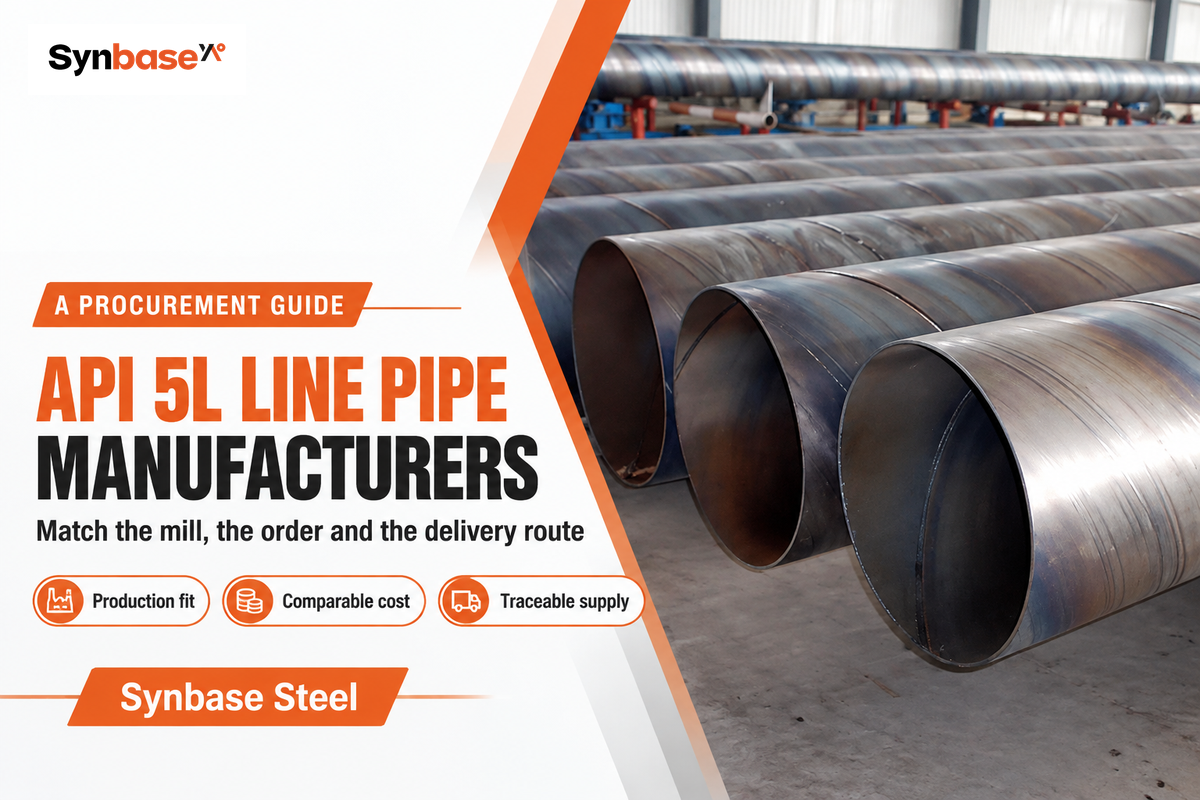
API 5L line pipe manufacturers suit different orders. Long mill production runs may favor repeat pipeline packages, while stockists may suit smaller replacement packages. Start with the approved pipe specification, required quantity and arrival date, and evaluate the total order cost.
Updated October 2026 · By CYH
This API line pipe guide compares sourcing routes and manufacturing capabilities. It illustrates the risks associated with surplus material and what to put in a request for quotation before selecting a supplier.
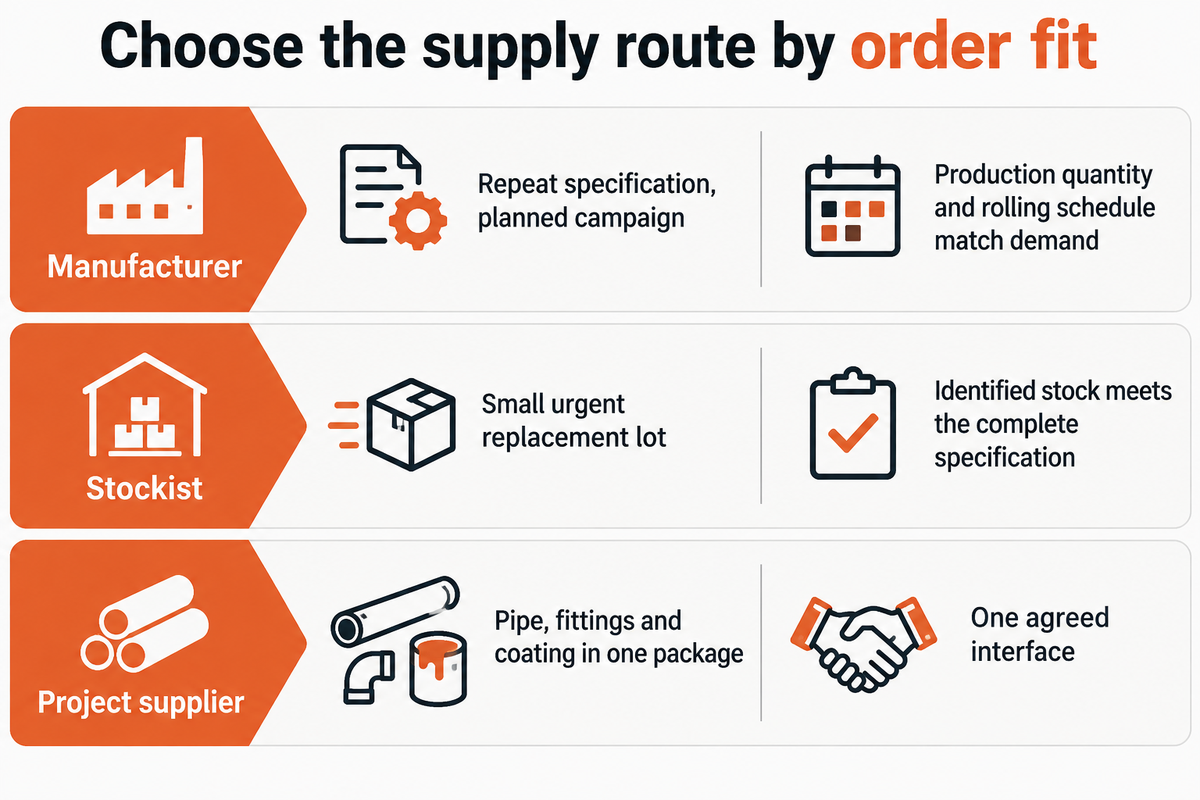
A project supplier coordinates purchasing and a stockist supplies inventory. These roles may be fulfilled by the same business. Choose the route that best fits your quantity and schedule with required documentation. Buying directly from a mill is most effective when the mill’s production offer aligns with the order.
Pipe may be produced by a seamless or welded route. Post-production activities include the specified finishing, inspection, testing and marking. A supplier of API 5L pipe may buy material, store it, and arrange the cutting and coating. INGAA’s small order and distributor pipe guide separates manufacturing responsibility from distribution, and provides material documentation checks for the defined scope.
Obtaining an available quantity satisfies Procurement’s needs. Finance needs to know what happens to extra pipe purchased. Engineering needs the specified product. The following matrix presents these concerns for a given sourcing decision.
| Order condition | Route to examine first | What makes the route work |
|---|---|---|
| Repeat specification, planned campaign | Manufacturer | Production quantity and rolling schedule match demand |
| Small urgent replacement lot | Stockist | Identified stock meets the complete specification |
| Mixed sizes with low quantities per size | Stockist or project supplier | Separate lots can be assembled without excess mill orders |
| Project-specific testing before release | Manufacturer | Inspection stages can be included in the production plan |
| Pipe, pipe fittings and coating in one package | Project supplier | One agreed interface controls the different purchase items |
| Long repeat deliveries | Manufacturer or project supplier | Call-off quantities match storage and installation |
| Available pipe needs cutting | Stockist | Processing preserves identification and required end condition |
| Several approved producing mills | Project supplier | Each supplied lot retains its own origin and test records |
| Unresolved technical deviation | Engineering decision before purchase | Written acceptance settles the deviation before commitment |
Request the stock location and release conditions. Some stock may still require coating, inspection or transport.
Suppose a maintenance buyer needs some short replacement lengths before a shutdown. A mill offers a new production lot while a distributor offers pipe already in its yard. If the offered material meets the approved grade, dimensional and service requirements, and records identify the actual pieces, the buyer checks whether cutting, inspection and transport fit the shutdown schedule. If stock in the yard is offered and an unapproved material substitution is required, its availability doesn’t satisfy the order. Engineering must first accept the change; otherwise Buyer must find an alternative.
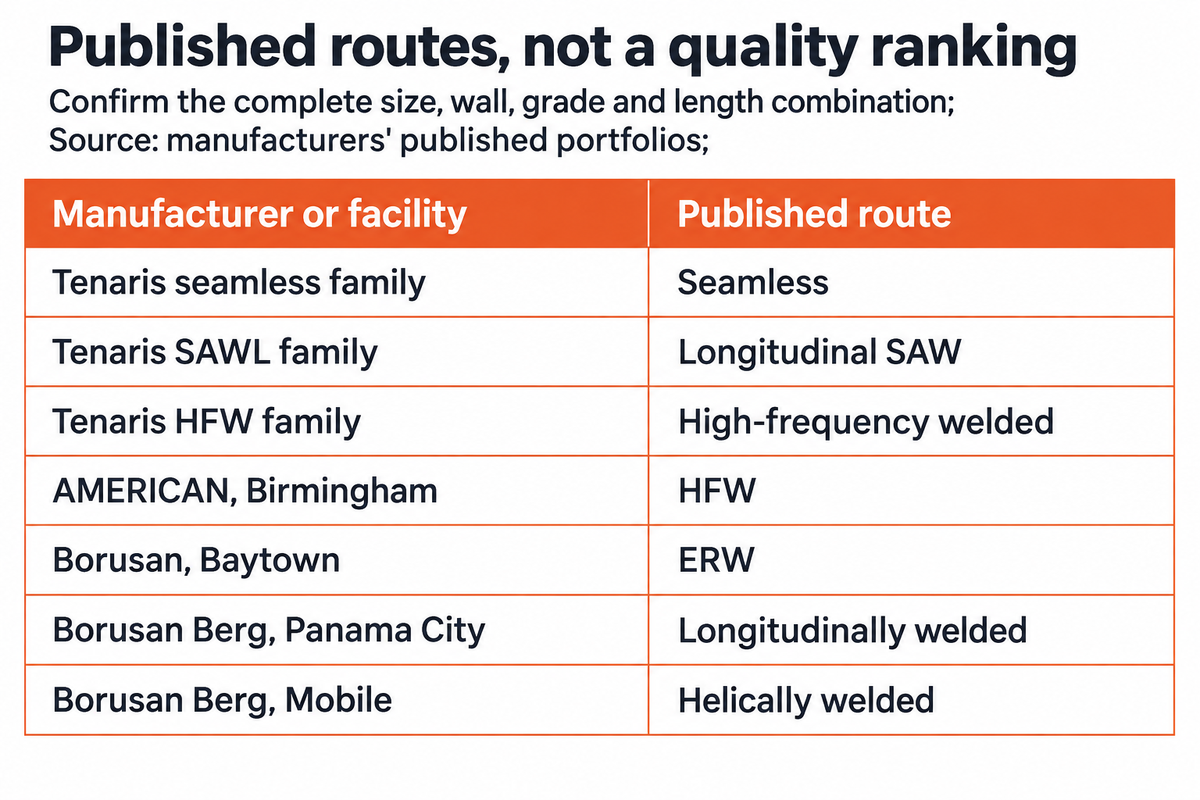
Tenaris, AMERICAN Steel Pipe and Borusan offer good examples of different line-pipe production portfolios. Tenaris publishes the seamless and welded families; AMERICAN describes a Birmingham HFW offering; Borusan describes different ERW, longitudinal and spiral facilities. Use the table to identify potential production routes and assess them against your order. Then compare those routes with a mill-specific offer.
| Manufacturer or facility | Published route | Published outside diameter | Location or order detail |
|---|---|---|---|
| Tenaris seamless pipe family | Seamless line pipe | 1.3–28 in | Production lines in Italy, Mexico and Argentina; wall up to 60 mm |
| Tenaris SAWL family | Longitudinal submerged arc welded | 12.750–48 in | SAWL mills in Brazil and Argentina; wall up to 40 mm |
| Tenaris HFW family | High-frequency welded | 2.375–24 in | Lines in several countries, including the United States and Canada |
| AMERICAN, Birmingham | HFW line pipe | 12.75–24 in | Line-pipe lengths up to 80 ft; wall up to 0.562 in at larger diameters; onsite epoxy coating |
| Borusan, Baytown | ERW line pipe | 4–10 in | Published grades up to X70 and lengths up to 60 ft |
| Borusan Berg, Panama City | Longitudinally welded | 24–60 in | Published wall thickness up to 1.5 in; lengths up to 80 ft (double jointing) |
| Borusan Berg, Mobile | Helically welded | 24–56 in | Published wall thickness up to 0.79 in |
Sources: manufacturers’ Tenaris portfolio, AMERICAN line-pipe page, Borusan facility descriptions and Berg product ranges reviewed in October 2026. Catalogue endpoints describe product families; quoted diameter, wall, grade and length must be available together.
Tenaris lists seamless pipe production lines in Italy in its onshore line-pipe group. This provides a documented European production example. The SAWL pipe facilities listed in the same group are in Argentina and Brazil; therefore, a European group presence shouldn’t indicate a European manufacturing origin for all products.
The AMERICAN group also lists structural and dredge products separately. Keep the line-pipe row separate when comparing wall thicknesses: a larger structural pipe maximum isn’t a published line-pipe maximum. Similarly, a Borusan offer should name Baytown, Mobile or Panama City, rather than relying on the combined group range.
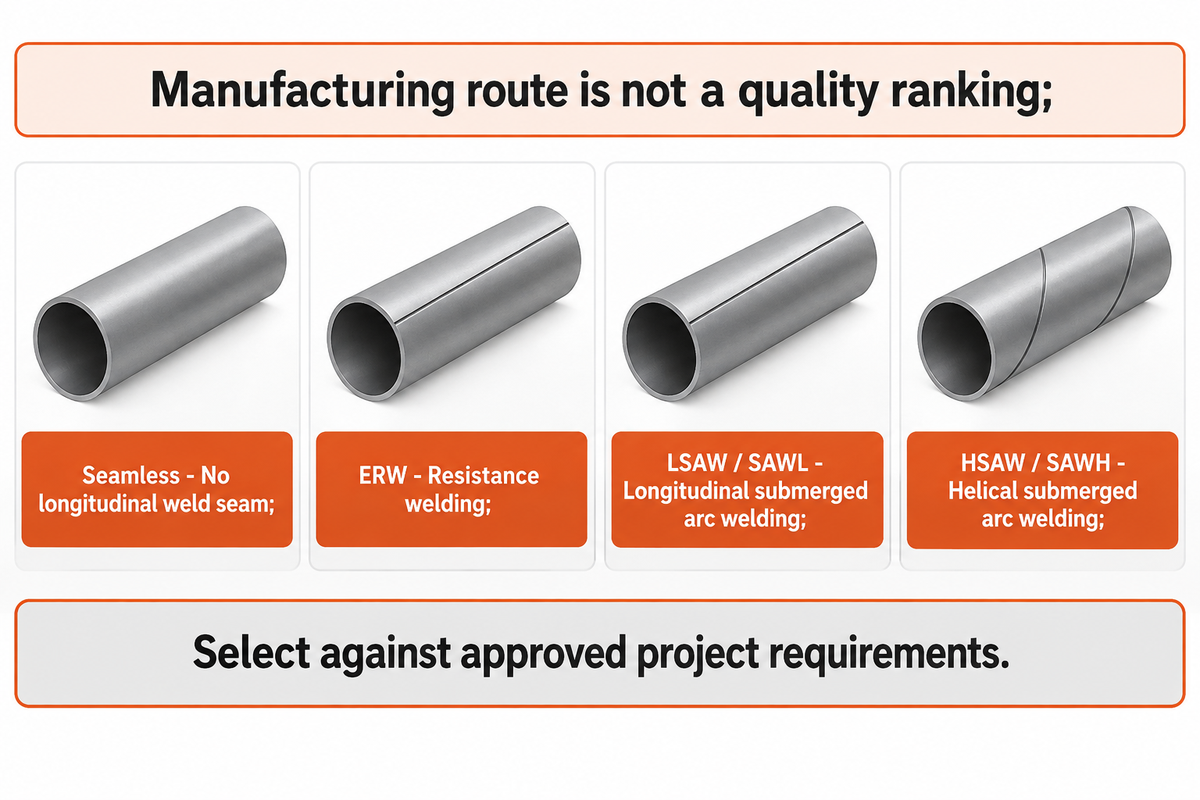
Seamless, ERW and LSAW pipe may have overlapping diameter ranges, so diameter alone may not determine the production route. Start with the process allowed by project specification and compare wall thickness, grade, service conditions and availability. The examples of manufacturers provided above demonstrate why a universal size cutoff would exclude relevant options.
Consider the manufacturing route as a means of producing the specified pipe rather than a quality ranking. Seamless steel pipe doesn’t contain a longitudinal weld seam. ERW pipe uses resistance welding; HFW describes the high frequency process provided by a few mills. LSAW pipe uses longitudinal submerged arc welding, also known as SAWL. Helical submerged arc welding is HSAW or SAWH, in supplier descriptions.
For oil and gas service, approved design and purchase requirements govern the selection. Seamless API 5L pipe still needs the specified sour-service properties and toughness. For high pressure steel pipe, allowable pressure comes from the approved design and material requirements. Compare actual test and material requirements, including those for the weld, if any, against requirements. Our seamless versus welded pipe guide explains the process differences in more detail.
A historical order illustrates the overlap. The Oil & Gas Journal (September 2020) reported the award of the Colibri project for 93 km of 16″ pipe, with both HFW and longitudinal SAW production. The report described the awarded scope and didn’t confirm if and when the delivery was completed. Its procurement lesson is specific: even for one diameter, a project can use more than one approved welded route.
Price comparisons for alternate routes should occur only after engineering approves a deviation from a specification that permits a single process. For multiple permitted processes, each mill should be requested to quote for the same finished pipe with the required inspection. The API 5L grades and PSL levels guide addresses the technical specification separately.
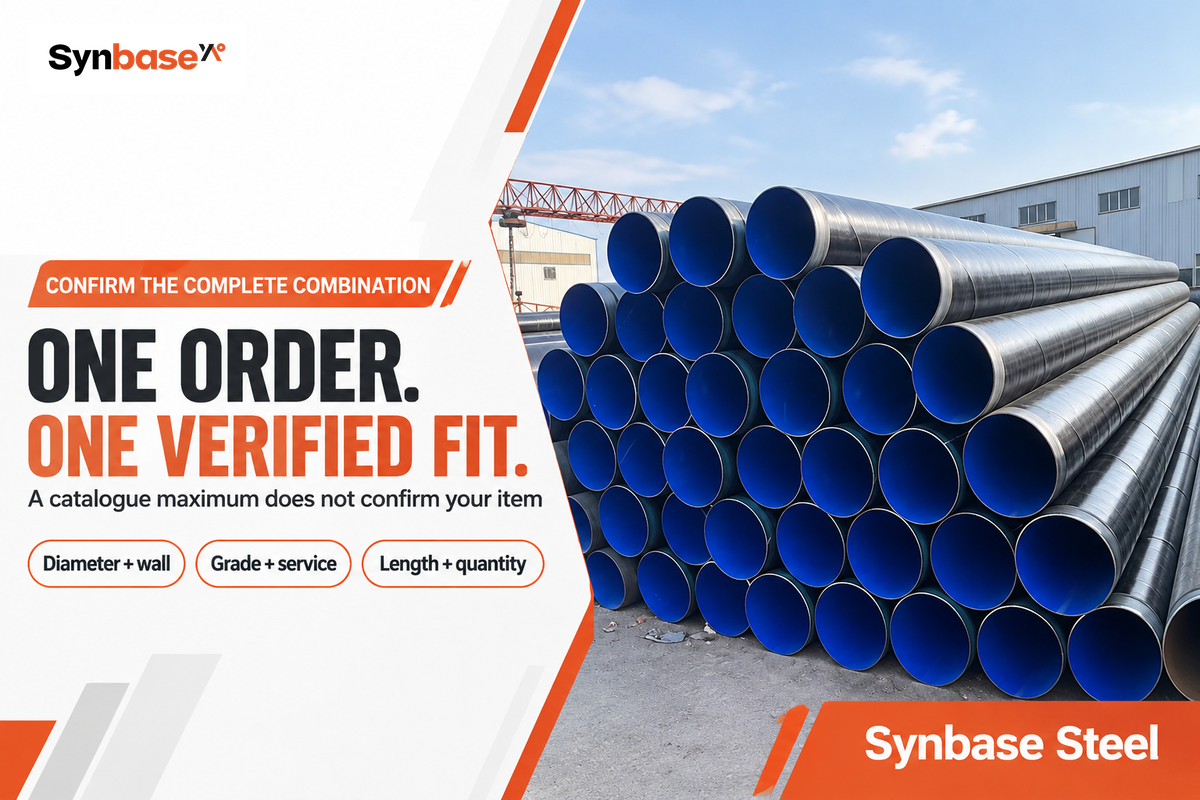
A mill meets the order when it’s capable of providing the required diameter, wall thickness and grade while meeting the product specification level and service conditions. A catalog may show the highest grade and largest diameter for different products. Comparing the exact combination is required before assuming API 5L Grade B, X52 or X65 availability meets the complete order requirement.
Line pipes are manufactured against a specified product standard and order requirements. API 5L Grade B pipe and higher-strength X grades are separate purchasing choices. An enquiry for API 5L X52 pipe should retain its full designation and delivery condition; an API 5L X65 offer isn’t automatically an acceptable upgrade. The same discipline applies to API 5L X42, API 5L X46 pipe and API 5L X60. Strength, chemistry, weldability and the project’s acceptance requirements need to remain aligned.
Specify actual outside diameter and wall thickness in the agreed units. A pipe size or schedule label alone creates ambiguity across quotations. For API 5L schedule 40, provide the dimension associated with the schedule designation. A request for sour service line pipe requires project-specific testing and acceptance requirements. Pipe produced to this grade also needs to meet the agreed service conditions. With carbon steel seamless pipes, grade and delivery condition should remain separate fields in the enquiry.
Consider a hypothetical package containing small-bore branch pipe and large diameter main line pipe. Procurement wants one purchase order. The bidder’s catalog merges several mills. A useful response is a proposal line-by-line, naming the facility and process for each item. This gives engineering the opportunity to assess the exact grade and wall thickness combination for each item, while logistics determines if separate lots can be delivered in the required sequence. A single commercial contact can integrate the package. The problem occurs when the supplier states that the mill producing the largest diameter item in the package also makes all the smaller items. The technical evaluation must be split by item and the commercial total combined.
A small-quantity discussion in Eng-Tips about X52Q and X52QS illustrates the importance of the above. Participants considered a stock substitution against a specified sour-service designation. This illustrates a purchasing issue and shouldn’t be viewed as an opportunity for material recertification. Any proposed substitution should be part of the project’s formal, written deviation process.
The LSAW pipe product page gives the product route for an enquiry for longitudinally welded pipe.
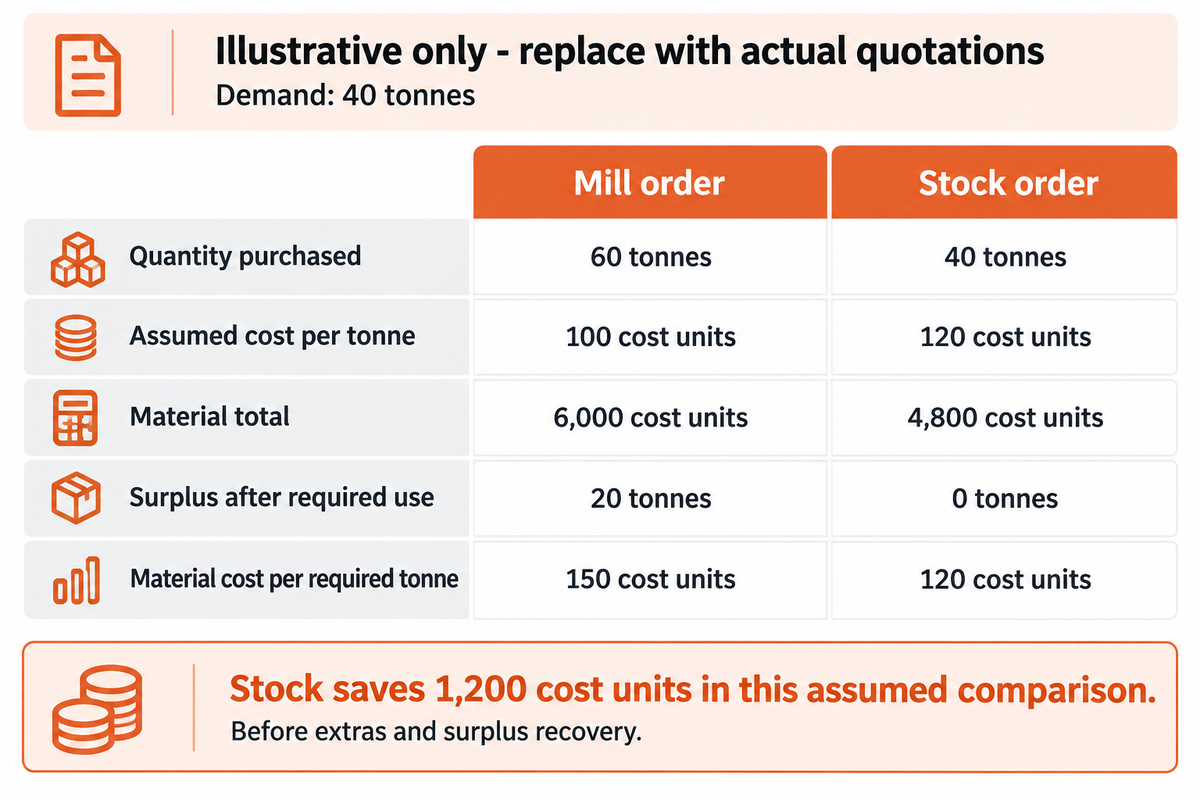
A stock order may cost less overall when a mill minimum requires you to purchase surplus pipe. Consider the full quantity purchased, processing, inspection, freight and recoverable surplus value for a given agreed destination. Lower prices per tonne of pipe may be attractive, but those costs may eliminate their advantage.
The International Trade Administration’s landed cost guidance includes product price, insurance, freight, tariffs, taxes, and other costs. For pipe, identify the agreed coating and end preparation as well as the inspection scope. Keep taxes recoverable by the buyer separate from permanent costs when finance prepares the comparison.
Use the following assumed inputs to test the mechanism: 40 tonnes required, 60-tonne mill minimum, normalized unit costs of 100 for the mill and 120 for stock. Cost units are a comparison scale, not currency. Initially assume no additional costs and no recovery of surplus material.
| Input or result | Mill order | Stock order |
|---|---|---|
| Quantity purchased | 60 tonnes | 40 tonnes |
| Assumed cost per tonne | 100 cost units | 120 cost units |
| Material total | 60 × 100 = 6,000 cost units | 40 × 120 = 4,800 cost units |
| Surplus after required use | 20 tonnes | 0 tonnes |
| Material cost per required tonne | 150 cost units | 120 cost units |
It’s assumed that finance compares 6,000 cost units assigned to the mill with 4,800 units assigned to stock. Stock savings of 1,200 cost units occur before extras, and the unit cost of stock is higher. Now, assume the surplus can generate a net recovery of 1,500 cost units after storage and resale costs. The adjusted mill cost becomes 4,500, reversing the situation. If no recovery or extras are available, the stock break-even price is 6,000/40 or 150 cost units per tonne. That’s a 50% premium over the assumed mill unit cost. Replace all assumptions with actual quotations before using the calculation for a purchase.
Order comparison formula: purchased quantity × unit price + order-specific extras – net surplus recovery. Compare the result for the same usable quantity. Surplus that has no identified reuse or buyer shouldn’t be valued at its purchase price by default.
| Hidden constraint | Compare in the offer | Responsible buyer role |
|---|---|---|
| Minimum production quantity | Purchased tonnes versus required tonnes | Procurement |
| Surplus inventory | Net recovery after handling and storage | Finance |
| Extra testing | Included tests and inspection hold points | Quality |
| Coating queue | Application and release dates | Project engineer |
| Cutting and end preparation | Finished lengths and end condition | Fabrication |
| Freight and insurance | Same destination and responsibility | Logistics |
| Import charges | Applicable duties, taxes and fees | Finance |
| Document release | Material-linked records before acceptance | Quality |
| Site receiving limits | Unloading, storage and delivery sequence | Site manager |
Ask bidders for dated milestones: completion of production and inspection; completion of coating; dispatch and arrival. For stock, confirm if the arrival date includes the processing that’s still required.
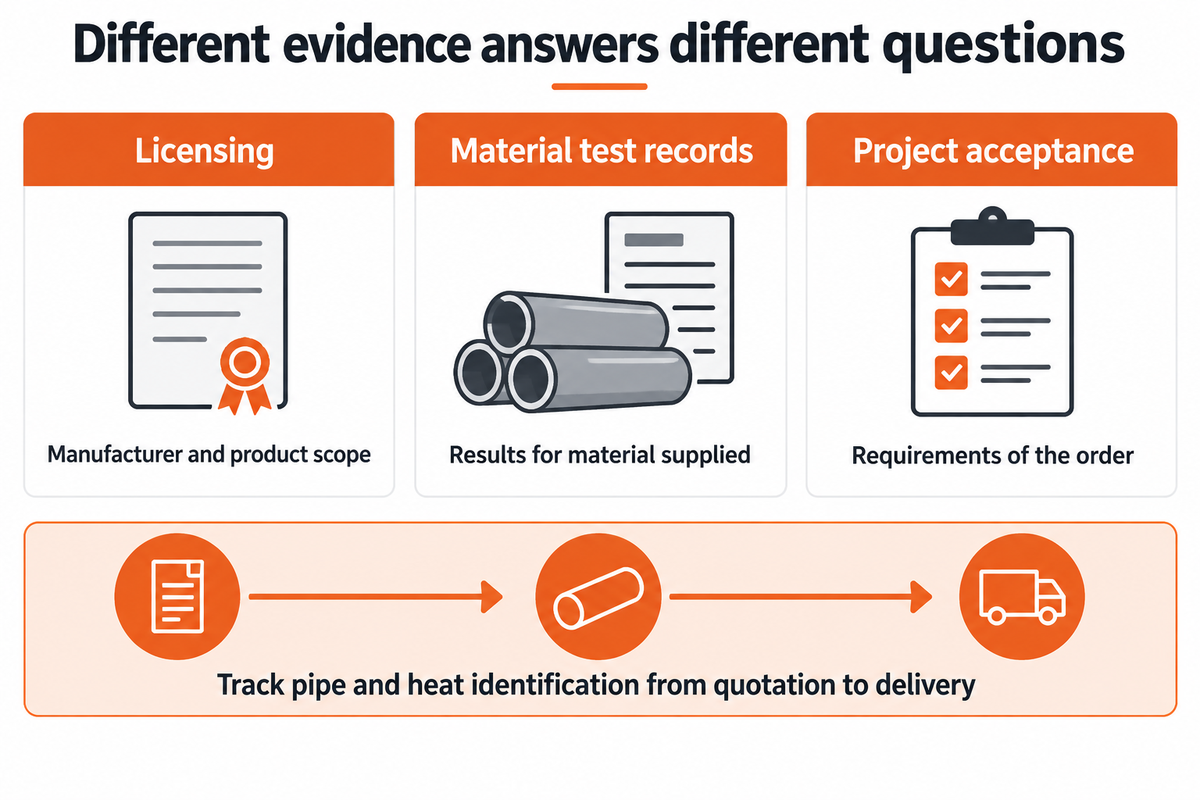
Licensing, material test records and project acceptance answer different questions. The manufacturer and product scope concern licensing; test records identify results for material supplied; acceptance applies to the requirements of the order. To maintain traceability from quotation to delivery, particularly with stock, outsourced work and multiple facilities, track the pipe and its heat identification.
“All documentation provided shall match and be traceable to the specific material considered for supply”
The INGAA Guideline defines a small-order and a distributor-pipe scope that includes specified PSL2 line pipe at NPS 6 and above. The guidance is useful early in the process: review material-specific documentation at the quotation stage to confirm the offered pipe and heat identification, and to maintain the connection between the offered pipe and delivered records. Don’t wait until unloading to find out the certificates describe a different lot.
API’s program documents define the scope of product licensing and the responsibilities of the mark holders. If the project requires a Monogram license, API should be approached to verify the proposed manufacturer and scope. A company brochure and material test report serve different functions.
Production responsibility can span across organizations. An API published clarification states that outsourcing of SAWL milling, forming and tack welding is allowed in the described arrangement where the remaining processes take place at the licensed facility, except if the product specification says otherwise. Maintain records to show where those operations occur and who remains responsible for the finished product.
Some projects also add upstream requirements. For steel pipe using alternative maximum allowable operating pressure, 49 CFR 192.112(c)(1) deals with quality management of relevant steel, plate, coil, skelp and rolling mills. The rule has a restricted, specific scope and isn’t a broad, blanket requirement for all API 5L purchases.
The combination of physical and documentary checks is required based on past experience. In 2009, PHMSA issued an advisory involving generally X70-and-higher microalloyed pipe that didn’t meet the then-applicable requirements, even though the documentation indicated compliance. Use the project inspection and acceptance plan to determine what must be checked prior to release.
A comparable request for quotation gives all bidders the same finished-pipe requirements and asks them to specify a producing facility, complete scope, schedule and delivery requirements. Address deviations prior to comparison of commercial offers. A more specific, item-based schedule is more useful than asking each supplier for the entire scope of its range of API 5L products.
Duplicate this checklist in the enquiry, replacing project-specific information with requirements approved by the owner. Specify dimensions, quantities and dates from the material take-off and purchase specification.
RFQ checklist — copy these into your quote request:
| Parameter | Recommended range | Why it matters | How to verify |
|---|---|---|---|
| Specification | Approved edition, grade and PSL | Sets the product requirements | Written offer against purchase specification |
| Dimensions | Project OD and wall in mm or in | Defines the actual size combination | Mill-confirmed dimension schedule |
| Quantity and length | Required tonnes, metres and joint lengths | Exposes excess quantity and cutting needs | Itemized quantity and length proposal |
| Service and testing | Approved service conditions and test scope | Aligns quality requirements | Inspection and test plan |
| Finishing | Specified coating and end condition | Defines the ready-to-use product | Finishing scope and acceptance records |
| Production identity | Named mill, process and required origin | Connects the offer to the producing route | Facility details and material traceability |
| Commercial delivery | Named destination and required arrival date | Creates a common cost and schedule basis | Priced inclusions, exclusions and milestones |
State origin requirements in the enquiry when the project has them. For federally assisted U.S. infrastructure projects, 2 CFR Part 184 defines the production of iron and steel to include operations from initial melting through coatings, to the extent covered by its provisions and waivers. A general “made in” statement may not address the project requirements.
An Eng-Tips buyer’s 2015 seam count discussion illustrates the cost of keeping drawings and purchase descriptions separate. If the arrangement of seams relative to one another is important to fabrication, it should be defined in an agreed order requirement before the item is manufactured.
Synbase Steel says it’s the pipeline subsidiary of E-CHENG STEEL GROUP. Send the item schedule and delivery destination through Synbase API 5L line pipe supply to discuss a supply proposal. If there’s a mixed-size package or a technical deviation, mention it in your first enquiry to make sure the supply proposal addresses that.
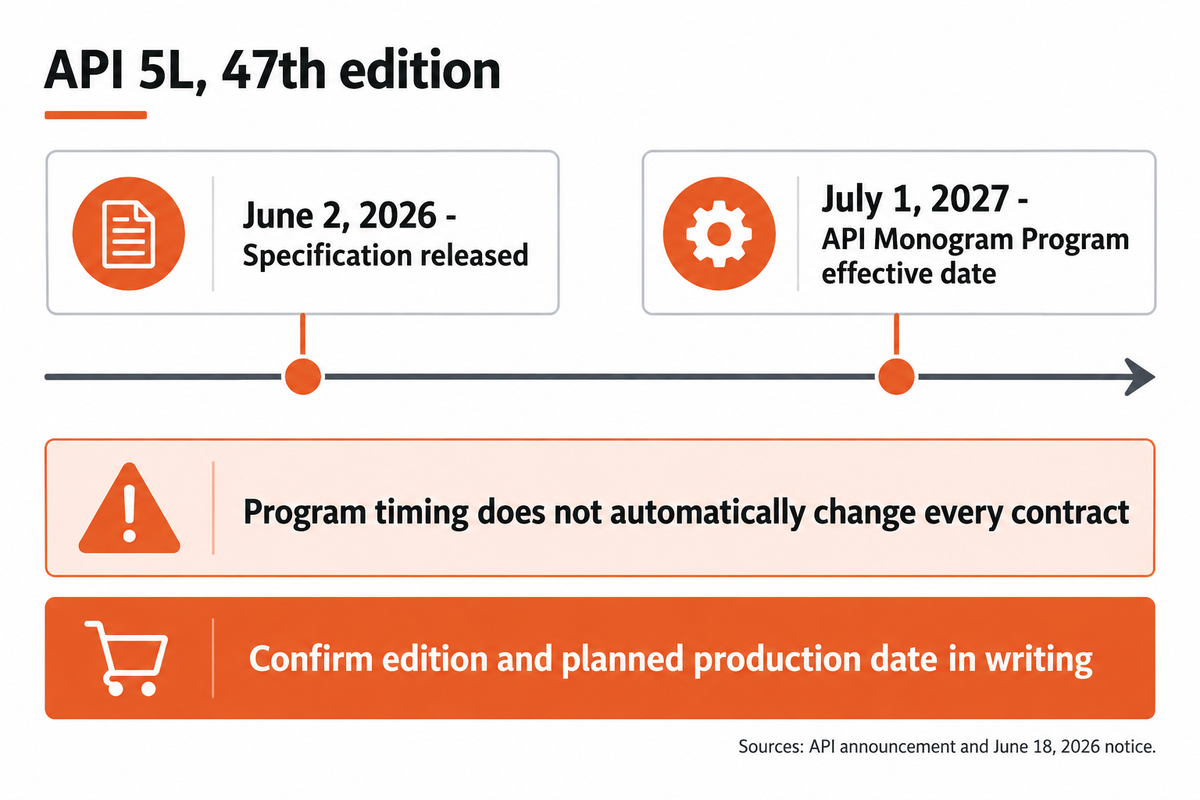
The API 5L edition change makes the specified edition and production timing active purchasing questions. During the transition period, buyers need to settle both in the contract and inspection plan. The publication of a new edition and its effective date under the API Monogram Program are separate events and may have different purchasing impacts.
API released the 47th edition of API Specification 5L on June 2, 2026. The separate communication dated June 18, 2026 indicates that the effective date of the change for the API Monogram Program will be on July 1, 2027. This communication is addressed to licensees and applicants as well as auditors. It doesn’t affect every contract or purchasing requirement of each adopting jurisdiction.
The API announcement identifies changes relating to high frequency weld quality, impact toughness, sour service, inspection and CO2 transmission. Each of these is relevant when defining the intended service and evidence to be provided by the producing mill. The purchaser should have the technical personnel identify relevant changes instead of relying on ‘latest edition’ to describe the requirements.
For orders involving production or delivery across the transition, ask bidders to identify the edition offered and the planned production date. Adjust the purchase specification, inspection documents, and required marking as necessary. If the planned delivery schedule changes, evaluate if that change affects the agreed-to edition or program requirements, prior to authorizing production. Document the resolution on the order, rather than rely on an informal sales email.
Stocked items require the same clarification regarding the edition under which they were manufactured and the requirements of their intended project. A new standard, on its own, doesn’t determine if a particular stocked lot is acceptable. The Buyer’s Engineering team must assess that material against the applicable purchase requirements and the design requirements.
Use the dated API transition notice when drafting the enquiry. Add an edition field to each bid comparison, and require a written response if the offered edition doesn’t align with the requested edition.
For example, assume one bidder promises production completion in six weeks and another offers warehouse delivery in eight weeks. The first offer isn’t necessarily faster because finishing and transit may follow production. Have both bidders provide the same milestone sequence, identify committed dates and explain remaining dependencies. If the site can’t receive the full shipment at once, include unloading and storage restrictions in the agreed schedule.
This Synbase guide uses published manufacturer portfolios and industry or regulatory sources to explain line-pipe sourcing decisions. The company examples describe their stated capabilities, while the cost comparison uses disclosed assumptions rather than customer quotations. CYH is the article’s byline. Synbase has a commercial interest in pipe supply; the comparison is intended to help buyers prepare a clearer, more comparable enquiry.
Synbase Steel supplies steel pipe, fittings, flanges, valves and OCTG for oil and gas, petrochemical, power, water and industrial projects. Our technical guides are written to help buyers compare standards, grades, dimensions, coatings, inspection requirements and commercial terms before sending an RFQ.
We focus on practical specification work: matching pipe process to service conditions, checking wall thickness and end finish, reviewing MTC and NDT requirements, and clarifying documentation before production or shipment.
Project support across seamless pipe, ERW, LSAW, SSAW, buttweld fittings, forged flanges, valves and oilfield tubulars.
Specification review for ASTM, ASME, API, EN and DIN standards, including material grade, pressure class, coating and inspection scope.