Send Your RFQ to Synbase Steel
Prefer to send drawings, BOMs or attachment lists by email? sales@synbasesteel.com

Updated July 2026 · Reviewed by the Synbase Steel Co., Ltd. technical team.
Carbon steel seamless pipe is one made by piercing a solid steel billet and drawing it into a hollow tube with no welded seam – this, naturally, is why buyers specify it for high-pressure, high-temperature service. But “seamless” is no panacea, and choosing one depends less on the word itself and more on selecting the right grade, wall thickness and corrosion management plan for the intended service. This guide will cover the three grades most commonly ordered (A106, A53 and API 5L), sizing schedules for pressure, reasons for corrosion and methods for combating it, and how to verify your shipment.
| Common grades | ASTM A106 Gr B/C · ASTM A53 Gr B · API 5L Gr B / X42–X70 |
| Seamless size range | Carbon steel seamless pipe sizes run NPS 1/8″–26″ OD (OD 13.1–660 mm); larger diameters go welded |
| Schedules | S5 through XXH (Sch 40 and Sch 80 most common) |
| How it is made | Pierced solid billet → mandrel / plug mill elongation (no weld seam) |
| Typical service | High-pressure / high-temperature fluids and gas, oil & gas, power, petrochemical |
| Key standards | ASTM A106 / A53 · API 5L · ASME B31.1 / B31.3 · EN 10204 3.1 (MTR) |
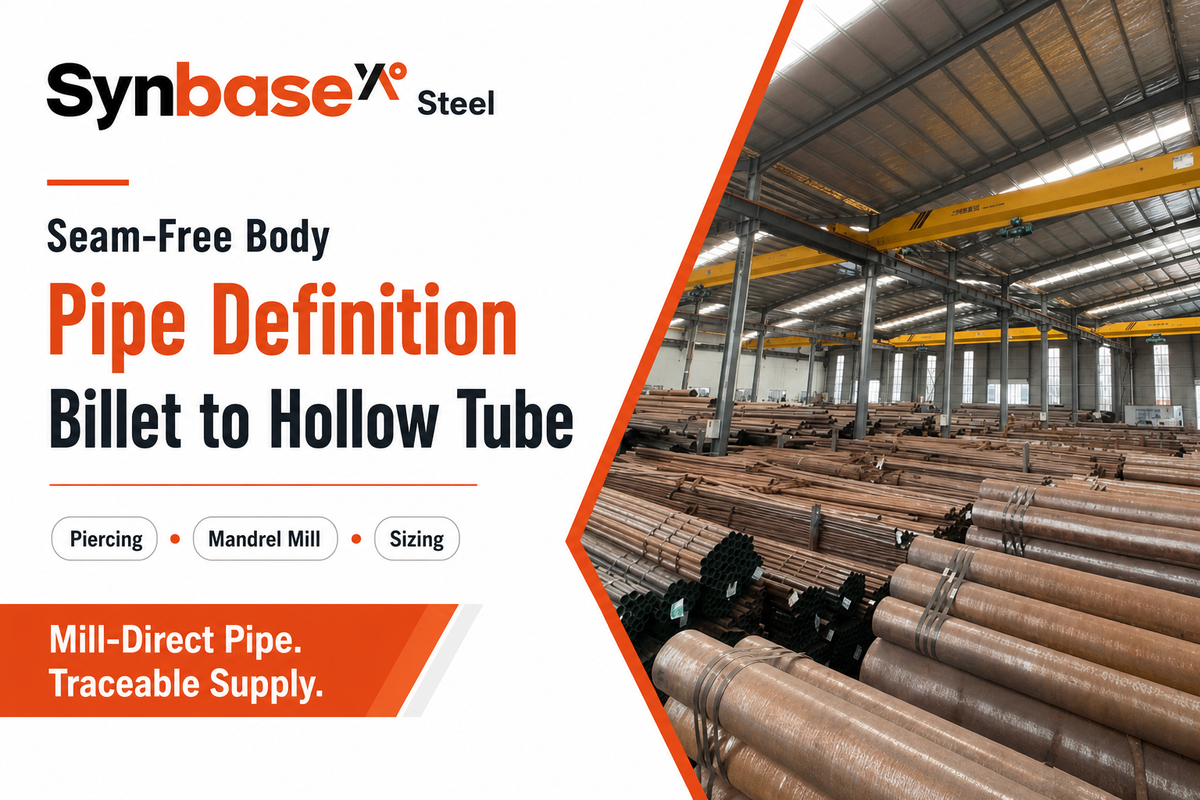
A carbon steel seamless pipe is any length of pipe made without a weld seam: from a solid billet that’s heated, pierced and then drawn out to form a hollow tube. There are no weld seams through which cracks, fatigue or corrosion may preferentially travel. That one single characteristic make seamless carbon steel pipe the go-to material for high-pressure and high-temperature service, from power plants to industrial applications where the pipe is used under mechanical and pressure loads.
This manufacturing process is easy to describe and challenging to execute to a high standard. First, a billet of standard carbon steel is heated to its optimal forming temperature in a reheat furnace and pierced into a thick-walled hollow shell in the classic Mannesmann rotary-piercing step-this initial operation involve heating the billet, inserting a piercing tool, and creating a hole through the center-before passing it through an elongating mandrel mill-consisting of typically five to eight stands-that gradually reduce the wall thickness while stretching the shell into a pipe, following the procedures detailed in USPTO patent US7506526B2. Then, a sizing mill bring the outside diameter and wall thickness into exact specification. After this hot-finished pipe is manufactured, it may subsequently undergo cold drawing to achieve tighter tolerances and a smoother finish.
Carbon steel is fundamentally iron alloyed with carefully controlled quantities of carbon-typically between 0.05% and 0.30% for most pipe applications-which provides the essential mechanical strength and ease of welding. Its inherent composition provide strength and durability, enabling it to withstand significant internal pressures without the added expense associated with alloy materials like stainless steel. As will be seen in subsequent sections, it lacks the corrosion resistance properties of stainless steels. Everything that follows is concerned with selecting and applying the plain, strong, seam-free pipe to a specific job.
Imagine two pipes side-by-side on a high-pressure steam header: one welded and one seamless. Subject them both to thousands of thermal expansion and contraction cycles, and cracks begin to initiate and propagate preferentially in the heat-affected zone surrounding the weld of the welded pipe. The buyer who has had to pull a line due to fatigue cracks extending along the weld seam will need no convincing that this is why seam-free body is required. That’s precisely why carbon steel pipework in genuinely severe service is written seamless in the specification, rather than allowing it to be substituted for welded pipe at the counter.
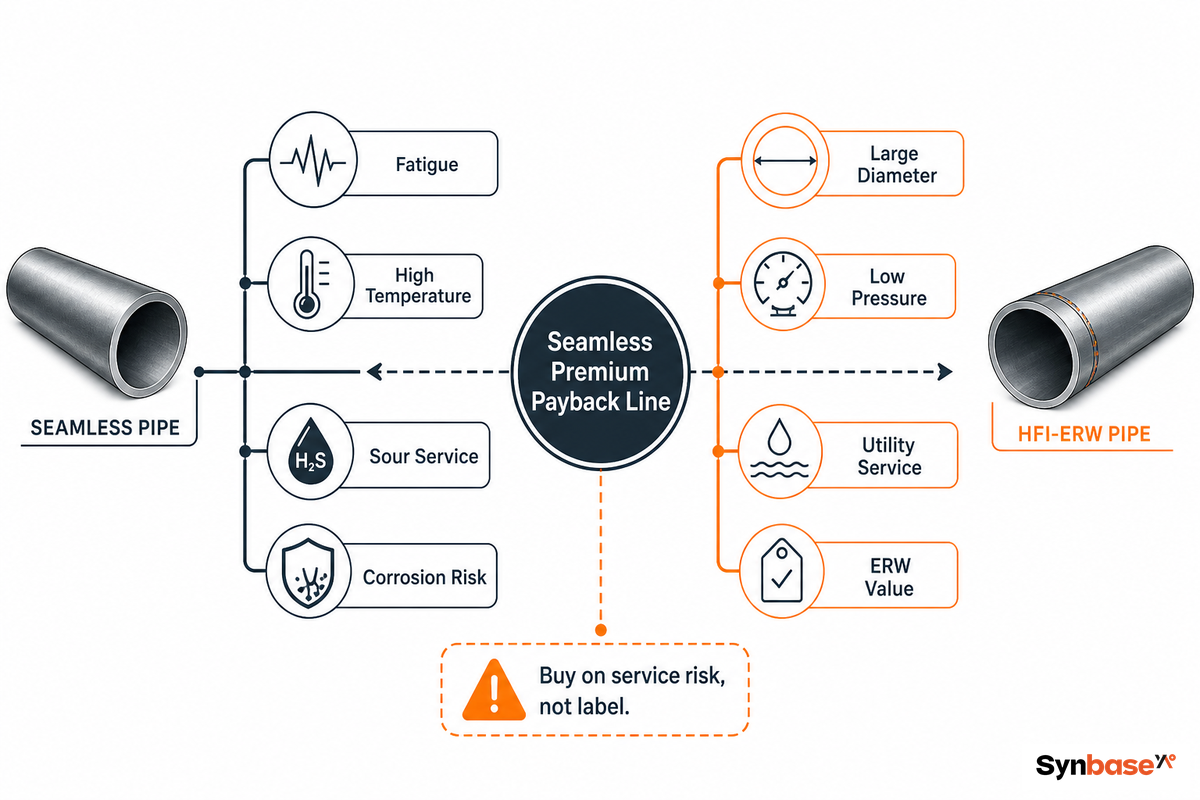
Here’s the most costly assumption you can make in pipe procurement: that a pipe without a weld seam is always better than one with a weld seam. It’s not always the case. A modern high-frequency-induction ERW pipe (HFW), given 100% ultrasonic testing of the weld, can be code-rated for 100% joint efficiency – and in burst tests it fails on the body, never at the weld. Buy on the service risk, not the catchphrase.
“We see buyers pay the seamless premium out of habit on lines that a UT-tested ERW pipe would carry to code. The seam is not the risk on those services, over-specifying is. We tell them to spend the premium where it buys something: high temperature, fatigue, and sour service.”
Synbase Steel Co., Ltd. technical team
A real-world example make the point. A contractor building a plant cooling water circuit at 90 psi and ambient temperature had specified A106 Gr B seamless throughout, out of caution. The service saw no high temperature, cyclic loading, or sour fluid – an A53 Gr B pipe, seamless or ERW, met the code with margin to spare. Shifting the non-critical run out of the seamless budget cut the pipe budget by about a third with zero loss of integrity, and the saved margin went into better coating. This is the payback line working in reverse: knowing when not to pay for seamless.
So when does the seamless premium – typically 25-40% more per ton than ERW – actually pay for itself? That’s what the payback line below is for.
Pay for seamless when the service crosses one of these thresholds – otherwise a code-tested ERW pipe is the usually the wise purchase:
| Factor | Seamless (SMLS) | HFI-ERW |
|---|---|---|
| Weld seam | None | Longitudinal, 100% UT-tested |
| Cost index (per ton) | ~1.25–1.40× | Baseline (lowest) |
| Practical OD ceiling | ~16–20″ economically | To ~26″ (660 mm) |
| Wall uniformity | Greater eccentricity possible | Tight, plate-controlled |
| Best-fit service | HP/HT, cyclic, sour, thick-wall | Water, gas, structural, lower-pressure line pipe |
Cost and OD ranges reflect present manufacturer practice; check against your mill quote.
Not necessarily. For the same grade and wall, a seamless pipe and a fully UT-tested HFI-ERW pipe can carry the same code stress allowance. Seamless matters most when fatigue, high temperature, sour service, or corrosion could turn a weld seam into the weak point. Compared to welded pipes, the seamless and welded choice is a risk premium, not automatic extra capacity.
For sour (H₂S) service the relevant factor is metallurgical, not the seam itself: NACE MR0175 / ISO 15156 hardness and HIC-resistance parameters, usually achieved with API 5L PSL 2 pipe. Seamless is the usual option as a weld seam is a preferential corrosion path unless associated with post-weld heat treatment and an HIC-resistant specification – but “seamless” alone does not qualify a pipe sour-service capable. The certified condition does.
If your large diameter or lower pressure application suggests otherwise, our welded steel pipe range covers ERW, LSAW and SSAW where each process gains.
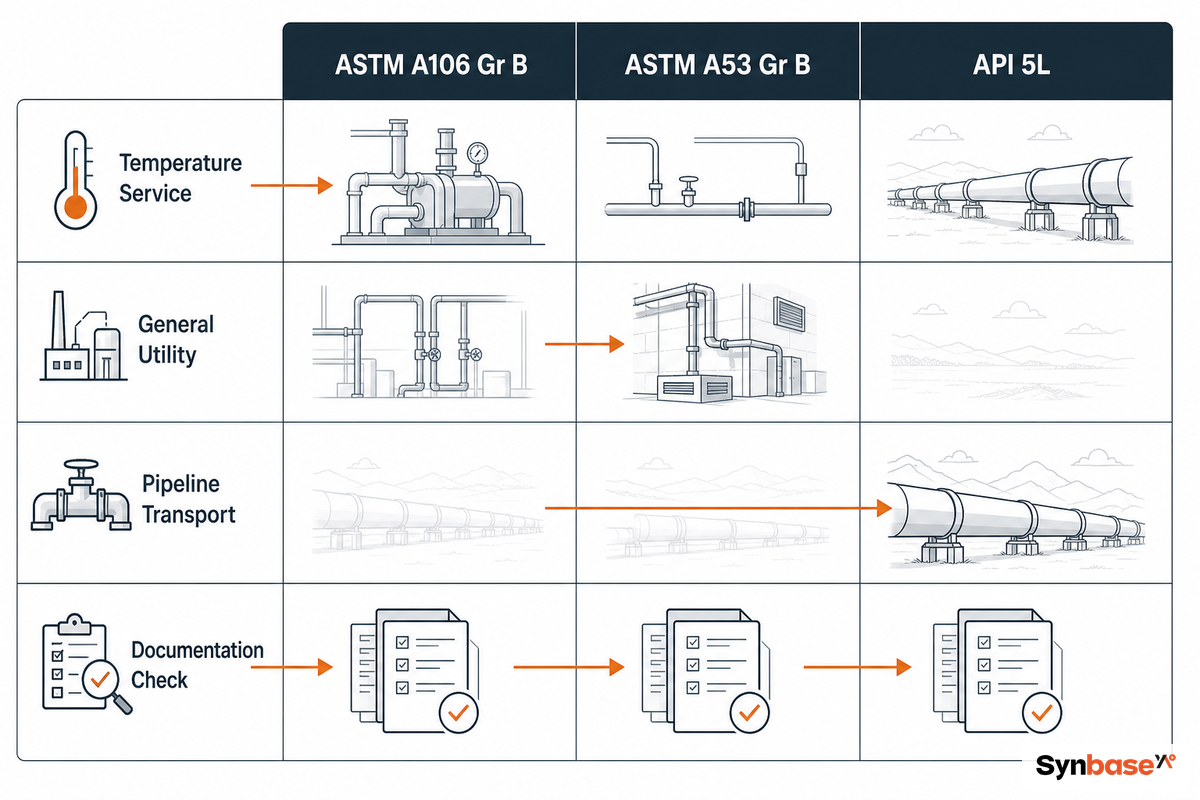
When you read carbon steel pipe specifications, three grades cover the large majority of orders: A106 Gr B, A53 Gr B, and API 5L. If you’re asking what separates A53 Gr B from A106 Gr B, here it’s: the practical difference between A106 and A53 Grade B is service, not strength.
| Grade | Min yield / tensile | Form & steel | Intended service |
|---|---|---|---|
| ASTM A106 Gr B | 240 / 415 MPa (35 / 60 ksi) | Seamless only, killed steel (Si ≥ 0.10%) | High-temperature pressure service (boilers, refinery, power) |
| ASTM A53 Gr B | 240 / 415 MPa (35 / 60 ksi) | Welded or seamless | General water, steam, air, structural — not rated for high temperature |
| API 5L Gr B / X42+ | 245 MPa (35.5 ksi) B; X42 = 290 MPa | Seamless or welded, PSL 1 / PSL 2 | Pipeline transport of oil, gas, water |
Per ASTM A106 / A53 and API 5L minimums. Tensile, Yield, and Elongation are equal for A106 and A53 Gr B seamless.
Two things confuse buyers. First, “killed” steel, meaning that the molten steel had all of the oxygen and impurity content driven out prior to casting, yields A106’s clean, homogenous structure for its intended high-temperature use, an A53 pipe is certainly not a direct replacement above its upper-temperature limit. Second, API 5L isn’t one grade but a specification family split by product specification level: basic PSL 1 and the stricter PSL 2. PSL 2 carries tighter chemistry, carbon-equivalent limits, mandatory Charpy toughness, and pipe-by-pipe NDT, essential for transmission pipe lines and sour service. Because that distinction drive real cost and compliance, we cover it in depth in our API 5L line pipe guide.
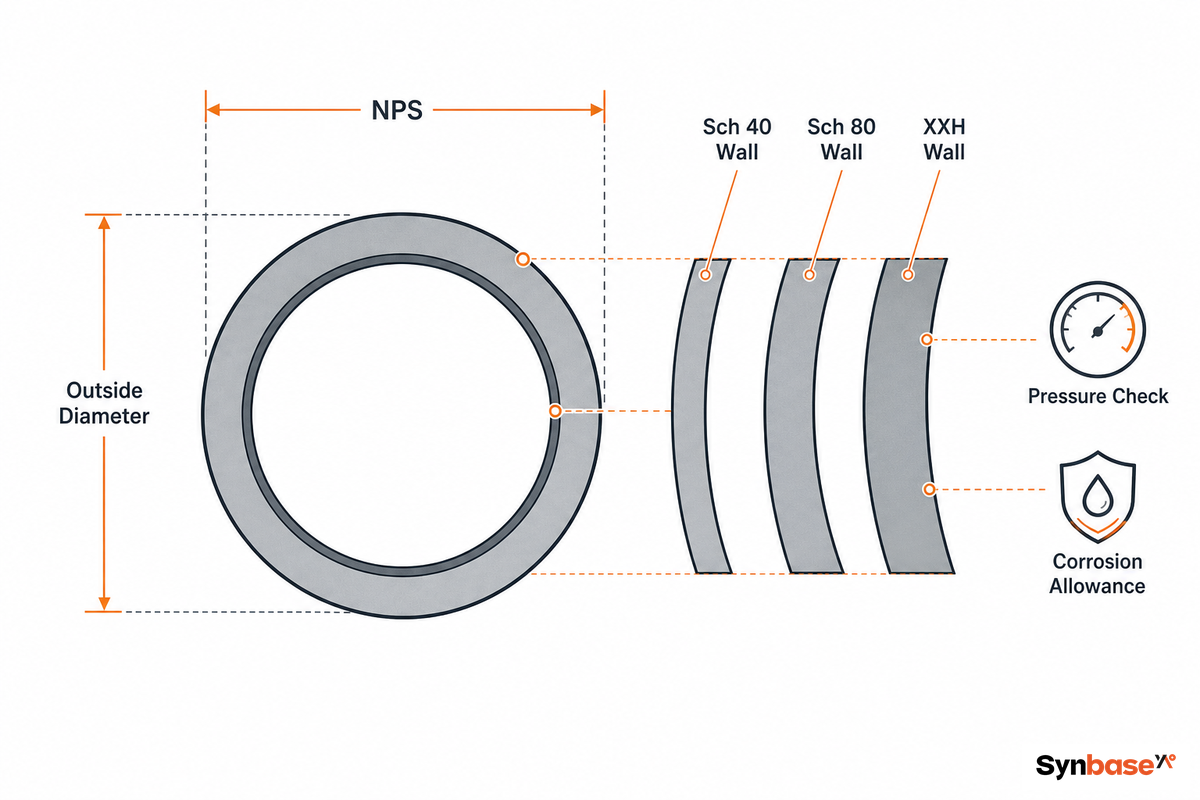
Pipe is specified by its nominal pipe size (NPS) and schedule – a number that determines wall thickness. (Tubing works differently: by outside diameter and wall; pressure pipe uses the NPS-and-schedule concept.) The NPS designation isn’t the true OD – NPS 6 pipe is actually 6.625″ OD – and schedule (Sch 40, Sch 80, XXH) increases wall thickness inward as the OD remains constant, so flanges and fittings still match. Your schedule selection is based on pressure.
The minimum wall thickness formula per Barlow for process pipe is t = P·D / (2·S·E) where P is design pressure, D is outside diameter, S is allowable stress, and E is the longitudinal joint factor (E = 1.0 for seamless pipe and less than 1.0 for some welded pipe, one reason seamless is easier to figure). For an example, say an NPS 6 A106 Gr B (D = 6.625″) with P = 1,000 psi. For this pipe and temperature, per ASME B31.3, basic allowable stress (S) is about 20,000 psi (one-third of the 60 ksi tensile). So the minimum wall is t = (1,000 × 6.625) / (2 × 20,000 × 1.0) = 0.166″. An NPS 6 Sch 40 has a 0.280″ wall, plenty of room over the 0.166″ minimum plus a corrosion allowance, with no reason to step up to a more expensive Sch 80 (0.432″) here. A carbon steel pipe schedule chart makes the comparison quick once you know your minimum wall.
| Size class — NPS (OD) | Sch 40 | Sch 80 | XXH |
|---|---|---|---|
| ½” (0.840″) | 0.109″ | 0.147″ | 0.294″ |
| 1″ (1.315″) | 0.133″ | 0.179″ | 0.358″ |
| 1½” (1.900″) | 0.145″ | 0.200″ | 0.400″ |
| 2″ (2.375″) | 0.154″ | 0.218″ | 0.436″ |
| 3″ (3.500″) | 0.216″ | 0.300″ | 0.600″ |
| 4″ (4.500″) | 0.237″ | 0.337″ | 0.674″ |
| 6″ (6.625″) | 0.280″ | 0.432″ | 0.864″ |
| 8″ (8.625″) | 0.322″ | 0.500″ | 0.875″ |
| 10″ (10.750″) | 0.365″ | 0.500″ | — (XXH n/a >8″) |
| 12″ (12.750″) | 0.406″ | 0.688″ | — (XXH n/a >8″) |
(Dimensions per ASME B36.10M. Always consult the standard for your particular material and application.)
One small clarification for this analysis – while Barlow + corrosion allowance is appropriate for ASME B31.3 process piping, regulated pipeline (e.g., gas transmission) is another animal entirely.
Per 49 CFR 192.112, high pressure gas pipelines require meeting API 5L PSL 2 specifications and have additional requirements regarding fracture toughness and seam UT. Barlow is used to determine wall size for gas pipeline but isn’t the whole design picture.
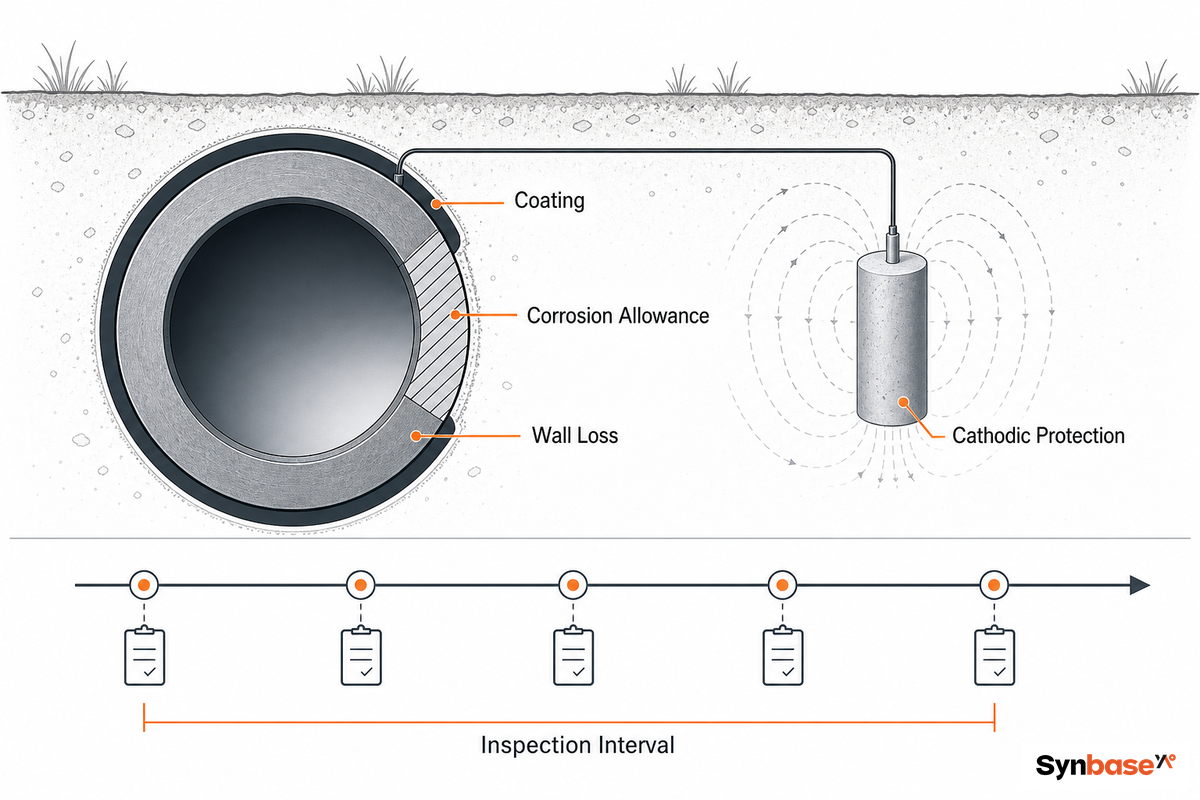
Yes, a carbon steel seamless pipe can be buried or run in wet service, but only with a corrosion allowance plus external coating and, underground, cathodic protection. Carbon steel doesn’t have intrinsic corrosion resistance – any “durability” is a design decision, not a material property. Factor it out and it’ll serve you for decades; ignore it and it’ll waste away from the outside in.
At one plant, the maintenance lead described pulling a 6″ buried A106 header after eight years and finding the wall down from 0.280″ to under 0.180″ on the soil-facing side — no corrosion allowance had been added, the coating had holidays, and there was no cathodic protection. It had held pressure the whole time, so nobody had looked; it was one bad winter from a rupture. Sizing 3 mm of allowance and specifying CP at the design stage would have cost a rounding error against the emergency shutdown it nearly caused. Corrosion on carbon steel is a schedule you pay on time or all at once.
How much wall loss is expected? It depends entirely on the service conditions. The U.S. NRC guidance on buried-pipe corrosion applies ASME Code Case N-806 fitness-for-service rules to metal-loss rates, which is the right way to think about underground carbon steel service: define the corrosion allowance, coating, cathodic protection, and inspection interval instead of assuming the pipe is inherently corrosion-resistant.
Do not treat carbon steel as resistant to corrosion; the coating, cathodic protection, inspection interval, and allowance create the service life.
A practical problem, not a theoretical one: a 3 mm allowance can be the difference between a planned inspection and a shutdown risk, because the resolution starts with a factory QA file that records wall tolerance before coating and cathodic-protection requirements go into production.
| Environment | Typical rate | Protection | Allowance to add |
|---|---|---|---|
| Dry indoor / inert fluid | < 0.025 mm/yr (< 1 mpy) | Bare or painted | Nominal (0.5 mm) |
| General refinery / process | ~0.25 mm/yr (~10 mpy) | Coating + inspection | 1.5–3 mm |
| Aggressive buried soil | ~0.5 mm/yr (~20 mpy) | Coating + cathodic protection | 3 mm + CP |
| Seawater / splash zone | 0.1–0.2 mm/yr | Coating + CP or upgrade | Reassess material |
(Rates shown are representative values and will vary significantly depending on the soil characteristics, moisture content, and chemistry.
They should be treated as guide lines.)
Practitioners on engineering forums often mention working to about 10 mpy on general refinery services and adding corrosion allowance to achieve a desired design life (say 10 or 20 years). For genuinely corrosive services, the better solution is to simply move to another material — alloy steel, or alloy and stainless steel grades that resist the medium rather than tolerate it, where a plain seamless carbon pipe would keep thinning. Our stainless steel seamless pipe was created for such applications.
Service dictates the grade. For refinery superheated-steam service near 700F, the usual choice is A106 Gr B, the same killed grade used in carbon steel boiler tube service. Buried gathering lines point to API 5L, often PSL 2 when the fluid is sour. Plant utility loops such as cooling water, low-pressure steam, and plant air usually fit inexpensive A53.
Getting this mapping wrong is expensive in a way that rarely show itself until commissioning. One fabricator supplied an A53 Gr B line for the outlet of a process heater which sees sustained 480F service; the pipe holds pressure on hydrotest, but is outside the operating envelope of A53 and code check during pre-startup identified the mismatch and required the pipe to be replaced in A106 after insulation installation. lesson for buyers: Match the grade to peak sustained temperature rather than the ambient pressure which might happen to be seen on test day. It’s possible to buy a pipe that passes the hydrotest but is the wrong specification.
For application planning, the same pipe stock can appear in petroleum skids, ship building auxiliary lines, drill-related maintenance fixtures, and other pressure applications, but grade still follows pressure, temperature, and mechanical properties.
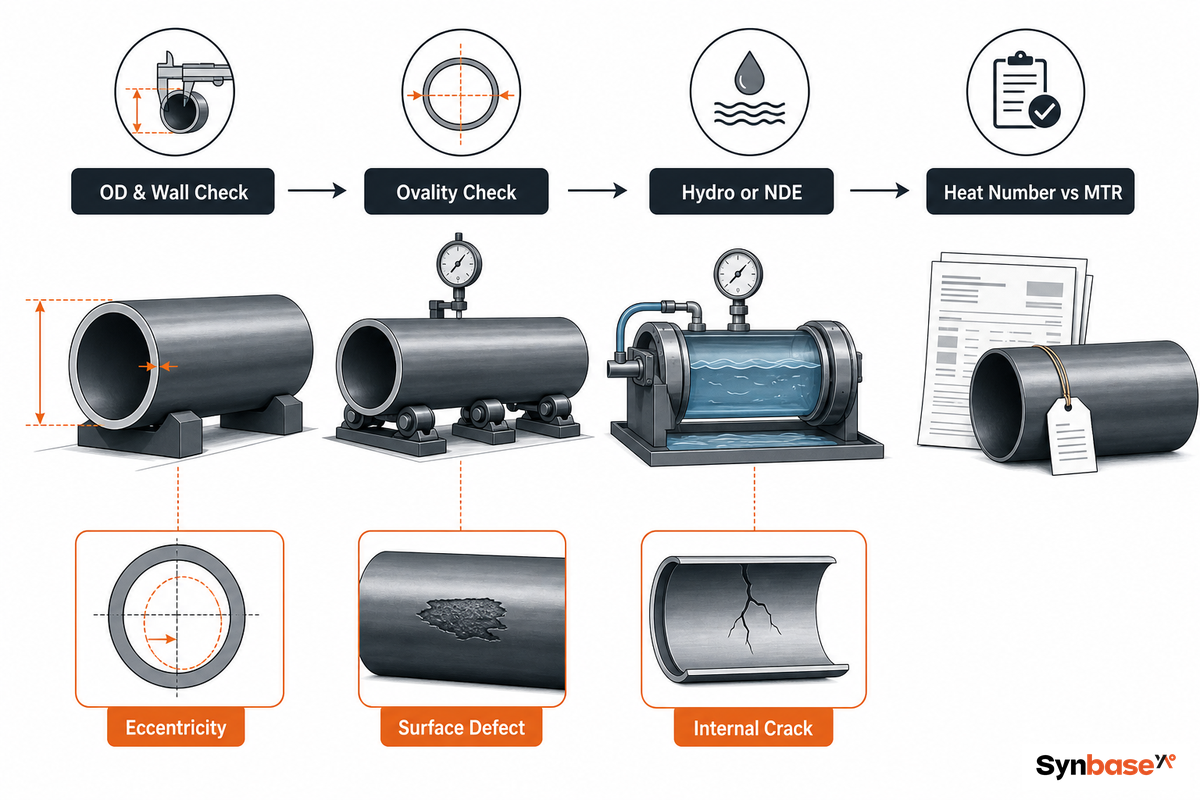
Seamless isn’t defect-free. Seamless pipes and tubes produced by the piercing and rolling process — the mandrel-mill route described in USPTO patent US8166792B2 — can carry defects from these steps that reduce the load-bearing capacity; they aren’t merely cosmetic. Knowing the main issues allow a proper incoming-inspection check list to be produced:
Most problems are stopped by four checks: outside diameter, wall size and thickness at several clock positions, ovality versus ASME B36.10M, and the mill’s hydrotest or permitted NDE route. Then verify the heat number printed on the pipe stencil against the EN 10204 3.1 mill test report. Ask for the examination method, acceptance standard, test scope, and chemical and physical properties before the shipment leaves the mill.
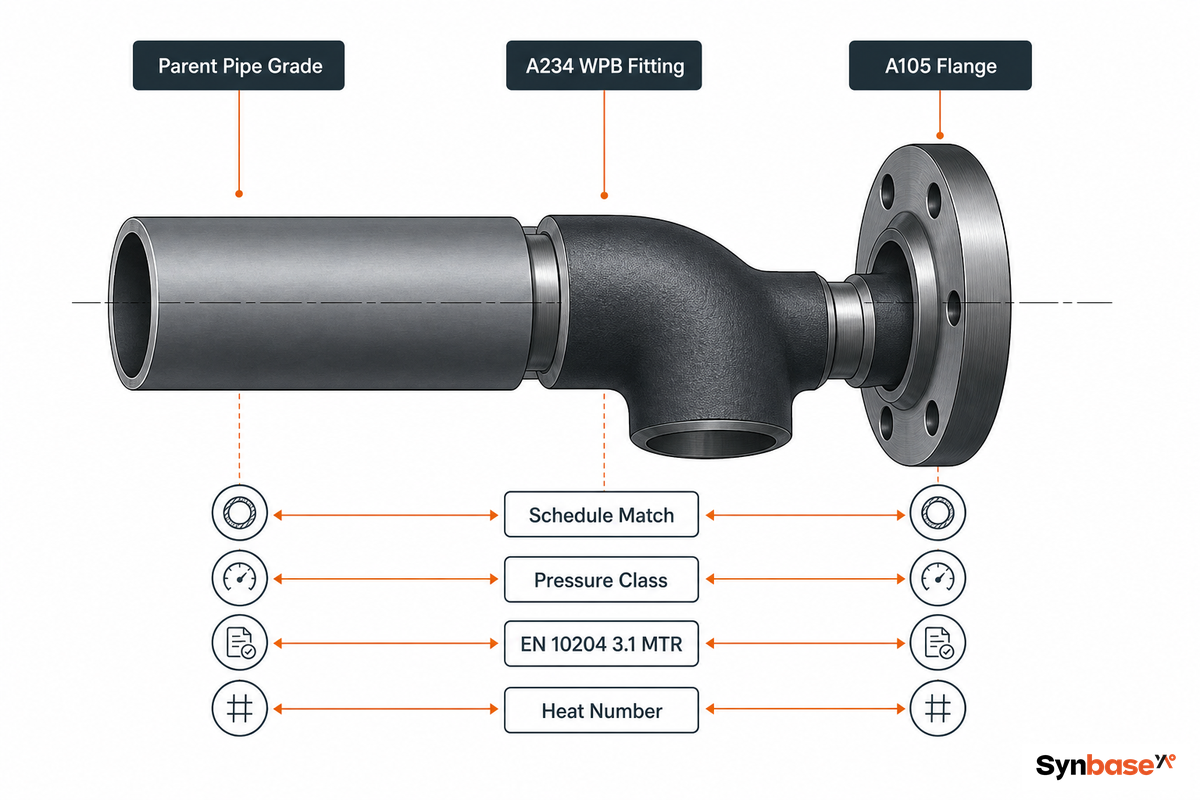
A pipe isn’t an order in and of itself; the fittings and flanges connected to the parent pipe must be in the same grade and schedule as the parent pipe. Failure to do so ensures that the weakest connection defines the entire system’s rating. Typically, this translates into a standard A234 WPB butt-weld fittings for a carbon steel seamless pipe, using B16.9 / B16.11 standards. Flanges should be in the Class 150 (285 psig @ 100°F), 300, or 600 design pressure class appropriate to the operating conditions. Be aware of Class pressure derating at elevated temperatures. A ½-inch-wall A106 header, for example, should connect to a compatible A105 flange in Class 300, not 150.
Two common but poorly attended inspection points include matching not only the fittings’ and flanges’ dimensions to the pipe’s, but also their metallurgies. As trade coverage of ASME test requirements for pipes, fittings and flanges notes, A234 WPB fittings and A105 flanges carry separate acceptance tests, and a carbon-equivalent (CE) check on the heat may prompt the need for a qualified preheat procedure during fabrication. If this step is overlooked, the result might be a field-welded joint cracking at hydrostatic test, after all hands have been demobilized. A second overlooked aspect is traceability to the heat number: the EN 10204 3.1 MTR should reference not just the mill’s standard and its physical/chemical tests but the actual melt’s number. Avoid pass-through certificates retyped by middlemen.
Ask the supplier or distributor to state the value-added services attached to the order, such as cutting, beveling, coating coordination, packing marks, and MTR review.
Ordering pipe, fittings, and flanges from three separate vendors based on price is the mistake we see most frequently. Unfortunately, during installation, you may discover that the “carbon steel” elbow you ordered is an inferior import that lacks the joint strength of the A106 run in which it sits. If all components – pipe, A234 WPB fittings, and flanges – are in matching grades and schedules, you get a reliable, rated system, not just a collection of pieces. This traceability, which the inspectors always look for, is the only difference between a reliable manufacturer and a reseller.
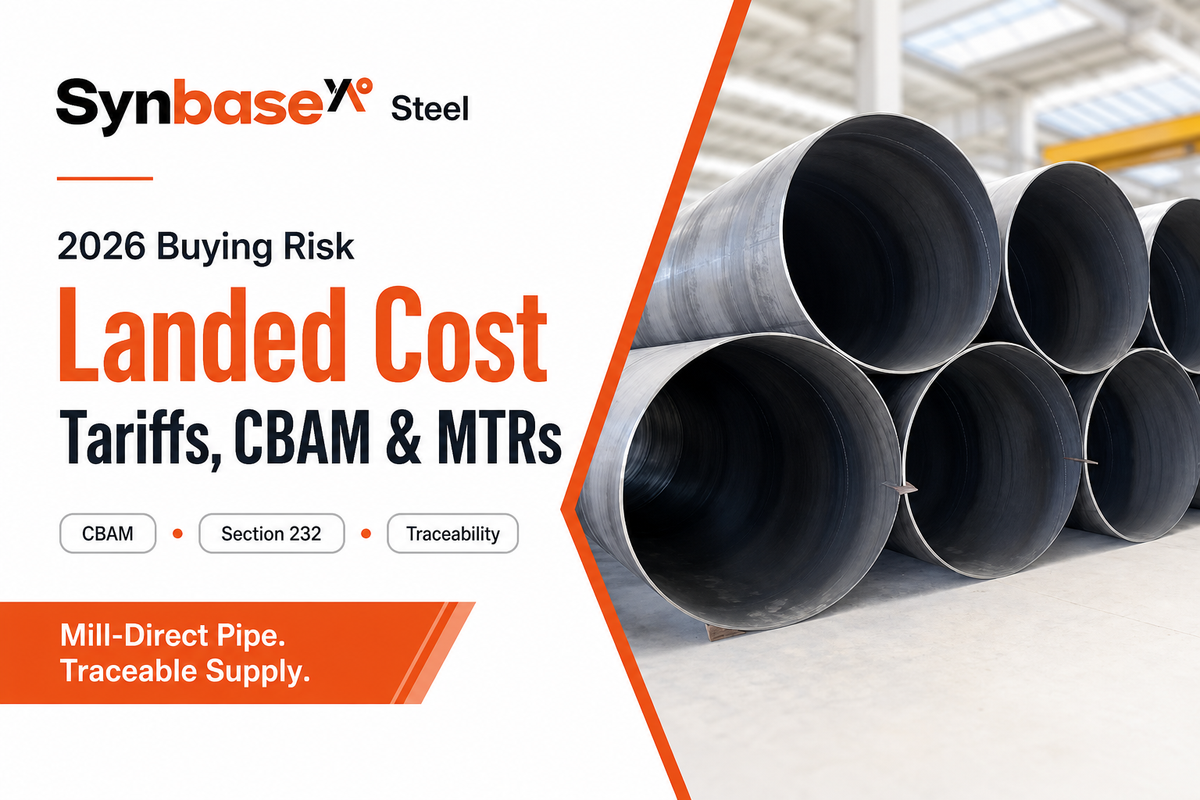
In 2026, the story for carbon steel seamless pipe isn’t demand, it’s regulation reshaping landed cost and paperwork. “Regulation is overtaking demand as the primary driver of steel prices in 2026,” as S&P Global put it heading into the year. Two regulations now land on a buyer’s cost of imported pipe directly.
First, the EU Carbon Border Adjustment Mechanism moves to its definitive period on 1 January 2026, levying a carbon cost on steel imports. CBAM is thresholded, not a flat fee: EU importers above a 50-tonne CBAM-goods threshold must hold authorised declarant status, report embedded emissions, and surrender CBAM certificates on deadlines phasing in beyond the start date. Second, U.S. Section 232 tariffs on steel articles (50 percent on most steel) are a hard number that shows up on an invoice no matter how cheap the pipe is. Carbon steel remains the workhorse, at about 75 percent of steel pipe demand.
In this case for the 2026 buyer, what you’ve to do is price on the landed cost, not on the unit cost, and then to fix traceable, standard-conformant sourcing before the customs issues start to kick in. A mill that can actually put your customs broker’s hands on an EN 10204 3.1 MTR – with the appropriate carbon steel seamless pipe HS code, and, when applicable, embedded-emissions information – will ultimately be worth a good deal more than a banner headline price.
For 2026 buyers, the problem is not only a 50% tariff; the risk is production delay, because the resolution is to buy from a factory that can issue a certification packet with heat-number traceability, HS code, and embedded-emissions data before the order ships.
This risk is not hypothetical. One importer we spoke with took a 12% cheaper unit price from a trader, then watched a 40-tonne order sit at the port for three weeks because the mill certificate could not be tied to a heat number and the CBAM embedded-emissions data was missing — demurrage and a rushed re-test erased the saving twice over. A buyer who has been through that reads a clean, traceable mill certificate as the real price, and the headline number as bait. Match the paperwork to the pipe before the container ships, not after the customs officer opens the file.
Need carbon steel seamless pipe that matches your grade, schedule, and service – and that has a mill test report that will actually get opened by your inspector?
A welded seam can become a failure point in these demanding applications.
A53 Grade B is a general service pipe, both welded and seamless for water, air, steam, and structural use and not for high temperature code service.
Beyond that, welded is usually the cost-effective, sensible alternative.
In most cases it is an artifact of the forming process: eccentric wall thickness, out of roundness (ovality), surface damage such as scratches or laminations and internally stressed cracks. Carbon steel does corrode too so loss of external wall thickness from this process can also become an operational issue. Any of these can be caught by measurements of wall thickness, ultrasonic and hydrostatic testing, and comparing heat number on the mill test report to the stencil on the pipe.
Add a corrosion allowance and pick the next highest standard schedule. For most lower pressure service lines, Schedule 40 will do; a higher operating pressure or an aggressive environment may necessitate using Schedule 80 or greater.
Synbase Steel is a steel pipe manufacturer and carbon steel pipe supplier that makes high-quality carbon steel, stainless, and alloy seamless pipe as a mill, not a stockholder. We wrote this guide from buyer questions our engineering and quality teams handle every week: ERW payback, A106/A53 service limits, corrosion allowance, and mill-cert traceability. It is meant to be useful whether or not you buy from us. Reviewed by the Synbase Steel Co., Ltd. technical team.
Synbase Steel supplies steel pipe, fittings, flanges, valves and OCTG for oil and gas, petrochemical, power, water and industrial projects. Our technical guides are written to help buyers compare standards, grades, dimensions, coatings, inspection requirements and commercial terms before sending an RFQ.
We focus on practical specification work: matching pipe process to service conditions, checking wall thickness and end finish, reviewing MTC and NDT requirements, and clarifying documentation before production or shipment.
Project support across seamless pipe, ERW, LSAW, SSAW, buttweld fittings, forged flanges, valves and oilfield tubulars.
Specification review for ASTM, ASME, API, EN and DIN standards, including material grade, pressure class, coating and inspection scope.