Send Your RFQ to Synbase Steel
Prefer to send drawings, BOMs or attachment lists by email? sales@synbasesteel.com

Updated July 2026 · Reviewed by the Synbase Steel technical team.
API 5L line pipe is the steel pipe most oil, gas, water, and now carbon-dioxide pipelines are built from, but the specification behind it’s easy to mis-read, and a single wrong line in a purchase order can put non-conforming pipe on your right-of-way. This guide is written for the engineer or buyer who has to specify, size, and verify API 5L line pipe correctly, not just buy it. We cover what the standard actually controls, how to decode grades and product specification levels, how to size wall thickness from design pressure, and what genuinely changed in the newly published 47th edition.
In one paragraph: API 5L line pipe is steel pipe made to American Petroleum Institute Specification 5L (equivalent to ISO 3183) for pipeline transportation of oil, gas, and water. It comes in two product specification levels, PSL1 and PSL2, across grades from B (L245) to X80 (L555), in seamless and welded steel forms. The specification sets material, manufacturing, and testing requirements; it does not, by itself, size the wall, ASME B31.4/B31.8 and 49 CFR do that.
| Newest published edition | 47th (June 2, 2026) |
| Edition US regulators require | 46th, April 2018 (per 49 CFR 192.7) |
| Grades | B / X42–X80 (ISO L245–L555) |
| Product specification levels | PSL1 and PSL2 |
| Product forms | SMLS, LSAW, SSAW, ERW/HFW |
| ISO equivalent | ISO 3183 |
| Scope | Line pipe for petroleum, natural gas, water & CO₂ transport |
API 5L is the American Petroleum Institute specification for the manufacture of seamless and welded steel line pipe used in pipeline transportation systems for the petroleum and natural gas industries. Its formal title is API Specification 5L, Specification for Line Pipe, and this specific standard covers seamless and welded steel pipes intended as pipe for pipeline transportation systems.
When a project cites the full API 5L specification, it is pointing at this document, the API 5L standard that governs the steel, not the pipeline design. First published in 1924 as API’s very first standard, the current document draws on subject-matter experts from more than a dozen countries and is technically equivalent to ISO 3183.
Read the scope carefully, because it defines what the standard does, and, just as importantly, what it leaves to other codes. The API 5L pipe specifications set requirements for material composition, manufacturing process, inspection, testing, marking, and heat traceability. Conforming line pipe may carry the API Monogram only if the maker is licensed under the API Monogram/APIQR program. What the 5L specification does not do is tell you how thick the wall has to be. Wall thickness and maximum allowable operating pressure are governed by the pipeline design codes, ASME B31.8 for gas transmission, B31.4 for hazardous liquids, and the federal rules in 49 CFR 192.105 (Part 192) and Part 195. The specification also excludes cast pipe entirely.
This split shows up the moment you ask for a pressure rating. A specification that names “API 5L X60” but leaves the wall to the reader gets a price, not a design, because the standard fixes the steel while the design code fixes how hard you’re allowed to run it. Engineers who miss that boundary end up with conforming pipe that still fails the pressure calculation, then blame the mill for a gap the purchase order created.
Treating API 5L as a pressure-design code is the single most common conceptual error. The grade you buy sets the minimum yield strength; the design code and location decide how much of that strength you are allowed to use. Keep the two layers separate and most downstream mistakes disappear.
The current published edition of API Spec 5L is the 47th, released on June 2, 2026. Here’s the distinction almost every vendor page gets wrong: the newest published edition and the edition your regulator legally requires aren’t the same document. Sorting out those two layers is the difference between an RFQ that survives a design review and one that doesn’t.
The 47th-Edition Change Log is our plain-language read of what API added across more than fifteen topic areas in the 2026 revision, the requirements a specifier needs to know about, not the editorial cleanup.
| Topic area updated in the 47th | What it means for a buyer |
|---|---|
| Carbon-dioxide transmission pipeline requirements | The standard now explicitly addresses CO₂ service — the headline change for carbon-capture projects. |
| High-frequency weld (HFW) line quality | Tighter quality rules for HFW pipe — welded line pipe is being held to a higher, more explicit bar. |
| Sulfide stress cracking (SSC) & sour-service requirements | Expanded sour-service and SSC testing language for H₂S lines. |
| Impact toughness & lamination control | Reinforced fracture-control and plate-quality controls. |
| Chemical element ranges | Adjusted composition limits — confirm chemistry against the edition you are ordering to. |
| Testing & records: NDE personnel certification, magnetic particle testing, hydrotest gauge calibration, tensile-test flattening, records retention | More prescriptive quality-assurance and documentation duties on the mill. |
Source: API announcement of the 47th edition of API Specification 5L, June 2, 2026.
A page that calls the 46th edition “current” — and some still cite the older API 5L 45th edition, isn’t simply out of date. As of the 2026 electronic Code of Federal Regulations, 49 CFR 192.7 still incorporates by reference “API Specification 5L, Line Pipe, 46th edition, April 2018, including Errata 1” for U.S. gas-pipeline use, and the hazardous-liquid rule in 49 CFR Part 195 does the same. So for a U.S.-regulated pipeline, the 46th is the edition the law requires today, even though the 47th has been published.
In practice, cite the edition and know both numbers. Reference the 47th where your project or client contract calls for the newest published standard; reference the 46th where you fall under PHMSA jurisdiction until the incorporation-by-reference is updated. Don’t assume the news release changed the law overnight, that update is a separate future rulemaking. So when a datasheet or a colleague refers to the API 5L latest edition, read it as the 47th, but confirm which edition your contract and regulator actually require before it goes on the drawing.
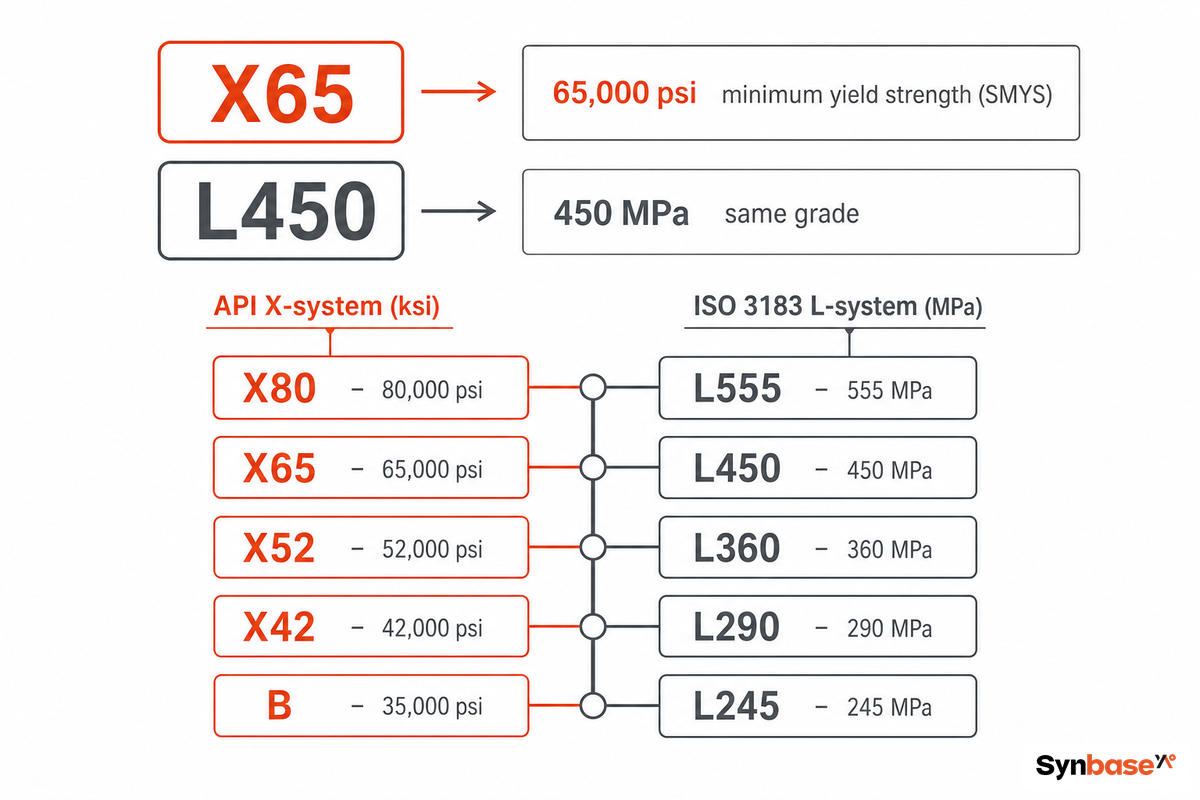
An API 5L grade name encodes exactly one thing directly: minimum yield strength. In the X-system, the number is the specified minimum yield strength in thousands of psi, rounded down, X65 means 65,000 psi minimum yield. In the ISO 3183 L-system, the number is the same minimum yield strength expressed in MPa, L450. That is why X65 and L450 are the same grade. Everything else about the grade, wall, weight, and pressure rating, comes from the design, not the name. Under 49 CFR 192.107, that specified minimum yield strength is the exact value the wall-sizing formula is allowed to use.
| Grade (API) | ISO 3183 | Min yield (SMYS) | Min tensile (UTS) |
|---|---|---|---|
| B | L245 | 245 MPa (35,500 psi) | 415 MPa (60,200 psi) |
| X42 | L290 | 290 MPa (42,100 psi) | 415 MPa (60,200 psi) |
| X46 | L320 | 320 MPa (46,400 psi) | 435 MPa (63,100 psi) |
| X52 | L360 | 360 MPa (52,200 psi) | 460 MPa (66,700 psi) |
| X56 | L390 | 390 MPa (56,600 psi) | 490 MPa (71,100 psi) |
| X60 | L415 | 415 MPa (60,200 psi) | 520 MPa (75,400 psi) |
| X65 | L450 | 450 MPa (65,300 psi) | 535 MPa (77,600 psi) |
| X70 | L485 | 485 MPa (70,300 psi) | 570 MPa (82,700 psi) |
| X80 | L555 | 555 MPa (80,500 psi) | 625 MPa (90,600 psi) |
Values per the API 5L / ISO 3183 grade tables. PSL1 lists minimum yield and minimum tensile strength only; PSL 2 also caps the maximum yield and tensile strength, the specified minimum tensile strength climbs from 415 MPa at Grade B to 625 MPa at X80.
The letter suffix on a PSL2 grade tells you the delivery condition, how the pipe was rolled or heat-treated, and it changes weldability as much as the grade does:
So X65MS and X65N are the same 450 MPa minimum yield strength but different steels to weld: the “M” is a low-carbon thermomechanical route, the “N” is normalized, the “Q” is normalized and tempered, and the “S” flags sour service. Specify the letter, or you’ve left the metallurgy to the mill. Each property is determined for the pipe body and verified over the length of the pipe; a PSL 2 pipe body shall also meet the impact and hardness values that the delivery condition is chosen to deliver.
PSL1 and PSL2 look like two flavors of the same pipe, but they’re two different quality contracts. PSL1 gives you minimum mechanical properties and leaves several tests at the purchaser’s option. PSL2 adds a mandatory testing and traceability layer on top, and that layer is where the cost, lead time, and (for critical lines) the safety live.
The PSL1-to-PSL2 Escalation Path is the short list of conditions that turn PSL2 from a nice-to-have into a requirement, use it to decide the level before you price the pipe.
| Requirement | PSL1 | PSL2 |
|---|---|---|
| Charpy V-notch (CVN) impact test | Not required | Required — min avg 27 J transverse / 41 J longitudinal at 0 °C (per Table 14) |
| Non-destructive examination (weld & body) | Purchaser’s option | Mandatory |
| Maximum yield / tensile | Not specified | Capped (yield-to-tensile ratio ≤ 0.93) |
| Carbon-equivalent control | Above C 0.12% only | CEₓₓ₷ ≤ 0.43 / CEₚ₋ₘ ≤ 0.25 |
| Traceability | Heat-level | Each length to a test unit with recorded results |
The escalation reaches across many PSL2 pipe sizes and grades, from Grade B to X80, so those PSL2 pipe sizes and grades are held to both a minimum and a maximum, not just a floor. When does the escalation become non-negotiable? Specify PSL2 whenever any of these apply: the line carries sour (H₂S) or CO₂ product; it runs in offshore service (Annex J) or in a high-consequence area; you need a defined fracture-control (toughness) property; or your design demands a controlled maximum yield, not just a minimum. If none of those apply, a low-pressure water or gathering line at Grade B, PSL1 is a legitimate, cheaper choice. A common error is defaulting to PSL2 “to be safe” on a line that never needed the impact testing, or, far worse, writing PSL1 on a sour line that legally needs the PSL2 sour-service annex.
The single most overlooked PSL difference is non-destructive examination. For PSL2 the mill must perform NDE of the weld seam and pipe body; for PSL1 it’s only done if you ask. If your specification is silent and you buy PSL1, you may receive line pipe whose weld seam was never volumetrically inspected. Field engineers report this as one of the most frequent gaps found in an incoming inspection. It’s no accident that the alternative-MAOP rules in 49 CFR 192.112 lean on exactly these PSL2 fracture-control and quality attributes.
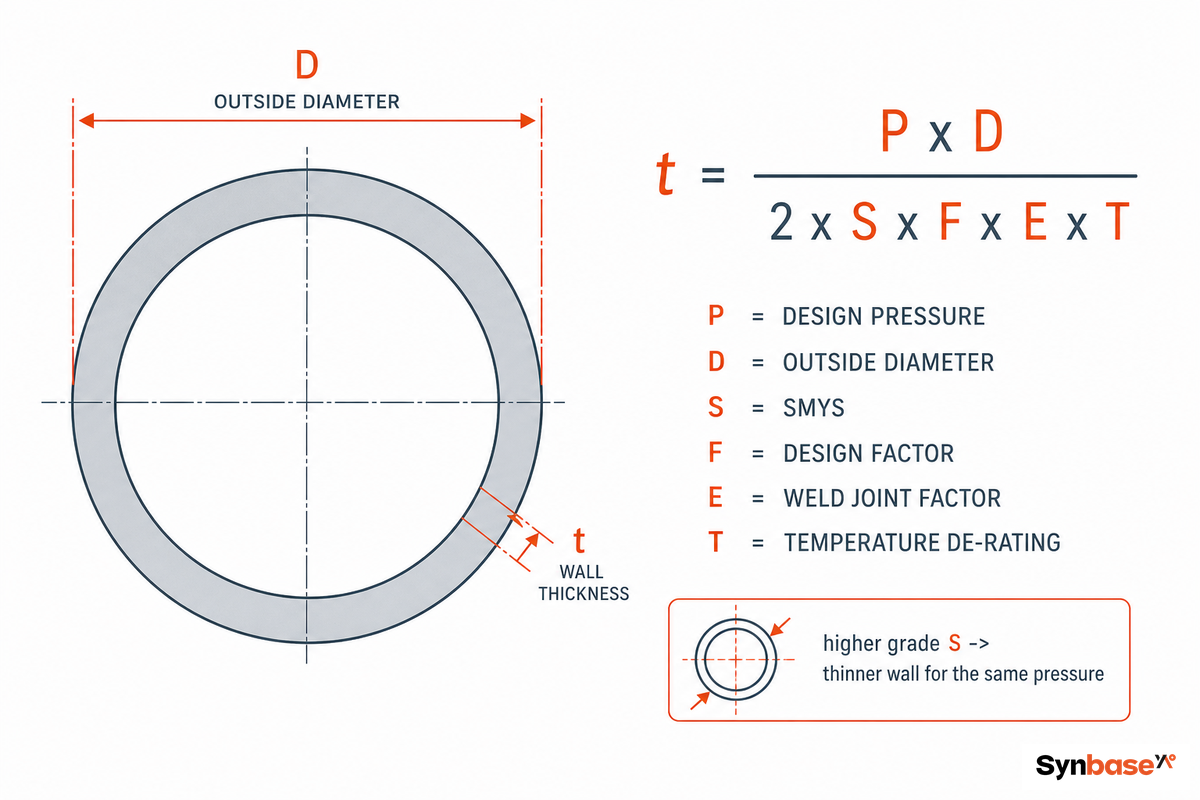
Wall thickness is where the grade you chose finally does work. That job belongs to Barlow’s formula, which relates internal pressure to hoop stress in a thin-wall pipe. For sizing a minimum wall you rearrange it, and for a regulated line you multiply the steel’s yield strength by three derating factors before you use it.
The Grade-to-Pressure Sizing Walkthrough takes one line, a diameter, a design pressure, and a grade, and runs it through Barlow with the regulatory design factors so you can repeat it with your own numbers.
Minimum wall from design pressure: t = P D / (2 S F E T), using the outside diameter D (the conservative convention in 49 CFR 192.105), where P = design pressure, S = specified minimum yield strength, F = design (location) factor, E = longitudinal joint factor, T = temperature-derating factor.
Worked example. A 24-in (610 mm) outside-diameter X65 gas-transmission line, Class 1 location (F = 0.72), seamless or SAW (E = 1.00), ambient temperature (T = 1.00), design pressure 1,440 psig:
t = (1,440 × 24) / (2 × 65,300 × 0.72 × 1.00 × 1.00) = 34,560 / 94,032 = 0.368 in (9.3 mm) minimum wall.
Change the grade to X52 and the same line needs about 0.462 in; that’s the wall-and-tonnage penalty of specifying a lower grade, or the saving of a higher one. Plug in your own D, P, grade, and class factor to size any line the same way.
Two cautions before you trust the number. First, that example is a gas transmission line under 49 CFR Part 192, where the design factor F steps down with the location class, 0.72 in Class 1, 0.60 in Class 2, 0.50 in Class 3, 0.40 in Class 4, and drops further at road crossings, fabricated assemblies, compressor stations, and platform risers. A hazardous-liquid or carbon-dioxide line is governed by 49 CFR Part 195 instead, which applies a flat 0.72 design factor (with offshore and cold-expansion exceptions) rather than location classes. Get the wrong Part and your F is wrong.
Second, Barlow gives you the minimum wall for hoop stress; it isn’t the whole maximum-allowable-operating-pressure calculation. The full MAOP also depends on the temperature-derating factor of 49 CFR 192.105 and the additional design conditions in 192.112, fracture control, mill and seam quality assurance, coating, and records. Barlow sizes the steel; the code decides how hard you may push it. Once you’ve a minimum wall, round up to the nearest standard schedule, SCH 40, 80, or 160 from an API 5L pipe thickness chart, and confirm the resulting API 5L line pipe sizes against your line list before you release the order.
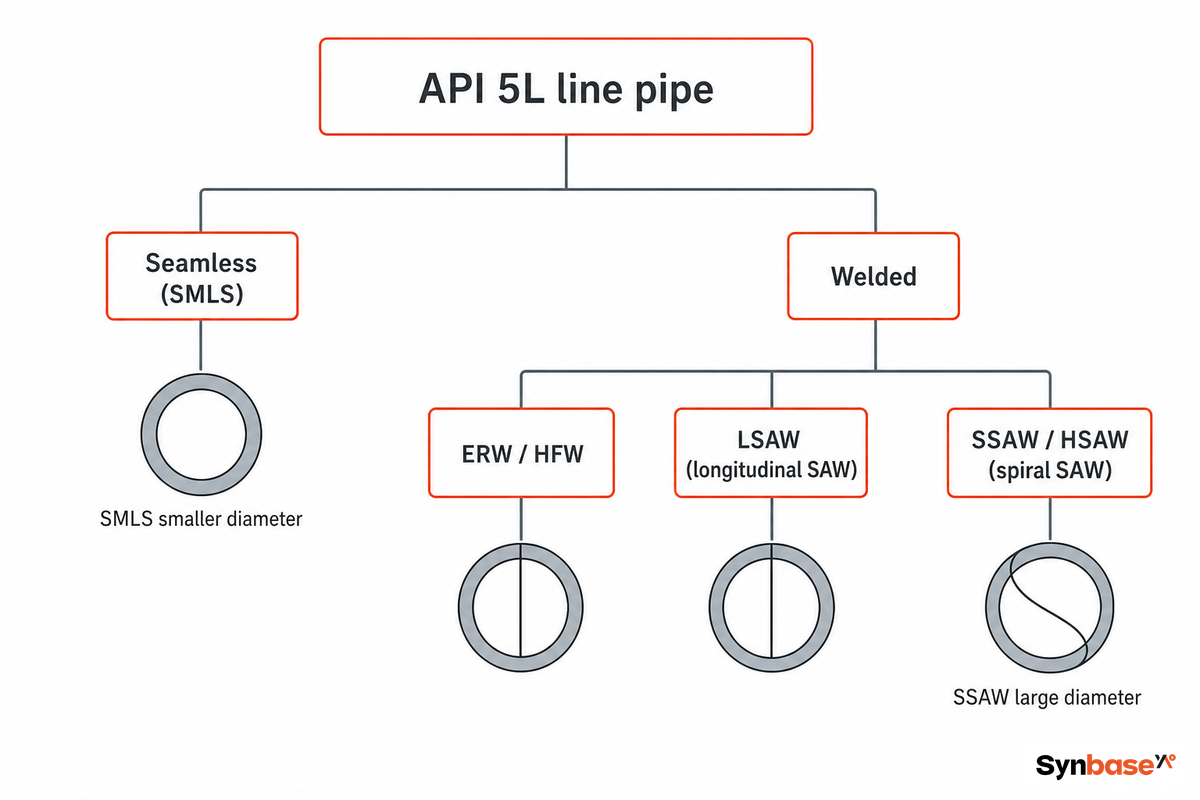
Is seamless pipe safer than welded? For most of the modern line-pipe range, no, and the belief that it’s has quietly inflated project budgets for decades. Under the U.S. gas-transmission rules the two are treated as equals: 49 CFR 192.113 assigns a longitudinal joint factor E of 1.00 to seamless, electric-resistance-welded (ERW), electric-flash-welded, and submerged-arc-welded pipe, including double submerged-arc-welded (DSAW) line pipe, alike. Only continuous furnace-butt-welded pipe is derated, to 0.60.
Here’s the nuance most guides miss: the “ERW gets 0.85” number you may have seen is real, but it belongs to a different code. ASME B31.3 process piping penalizes ERW relative to seamless; ASME B31.8 and 49 CFR 192 gas transmission don’t. So whether welded steel pipe carries a joint-factor penalty is code-dependent, not a universal property of the weld seam. In practice this matters at the spec desk, because the same X65 line can be built in ERW under a gas code with no wall penalty, yet require a roughly 15% heavier wall under B31.3, a difference driven by which code governs, not by any flaw in the weld.
“Once quality improved after the mid-1980s, above six inches ERW line pipe was considered equal to or better than any seamless made in the world. The real risk isn’t the process, it’s an unaudited distributor truckload that might be someone else’s rejects.”
Field records back this up in surprising ways. Seamless steel pipe actually has a rougher inside surface and looser dimensional tolerances than welded pipe; welded line pipe offers tighter concentricity, thinner nominal wall, and longer lengths. Most microbiologically influenced corrosion failures on ERW gathering lines are an installation problem, not a pipe flaw, they cluster in the heat-affected zone of the long seam when the weld sits at the bottom of the pipe in a standing-water sag, and they’re avoided by clocking the seam off the bottom, roughly 60° per joint. And a recent JFE Steel patent (EP4484047A1, 2025) on high-frequency-weld quality control shows how actively the welded-pipe process is still being improved.
Picture a buyer who writes “seamless only” into a 36-in mainline specification to feel safe. That clause rules out the LSAW pipe the diameter is actually built from, forcing a costlier, slower seamless order for no measurable reliability gain, a classic case of a spec that fights the way the pipe is made. Match the route to the service, not to reflex, that’s the honest rule. In an API 5L seamless pipe there’s no weld to check; in a welded route the tensile strength for the weld matters as much as the body, so submerged arc welding of a formed steel plate is qualified to prove the strength for the weld seam. Small-bore, very-high-pressure, or sour gas favors seamless. Large-diameter mainline runs on longitudinal submerged-arc-welded (LSAW) pipe; very large diameter, lower-pressure water and piling lines run on spiral submerged-arc-welded (SSAW) pipe. And there’s a hard supply-side limit worth knowing: LSAW below about 16 in is impractical to source, so a well-meant “use LSAW everywhere” clause simply forces vendors back to seamless or ERW. For the process detail on each welded route, see our LSAW pipe guide and spiral welded pipe guide.
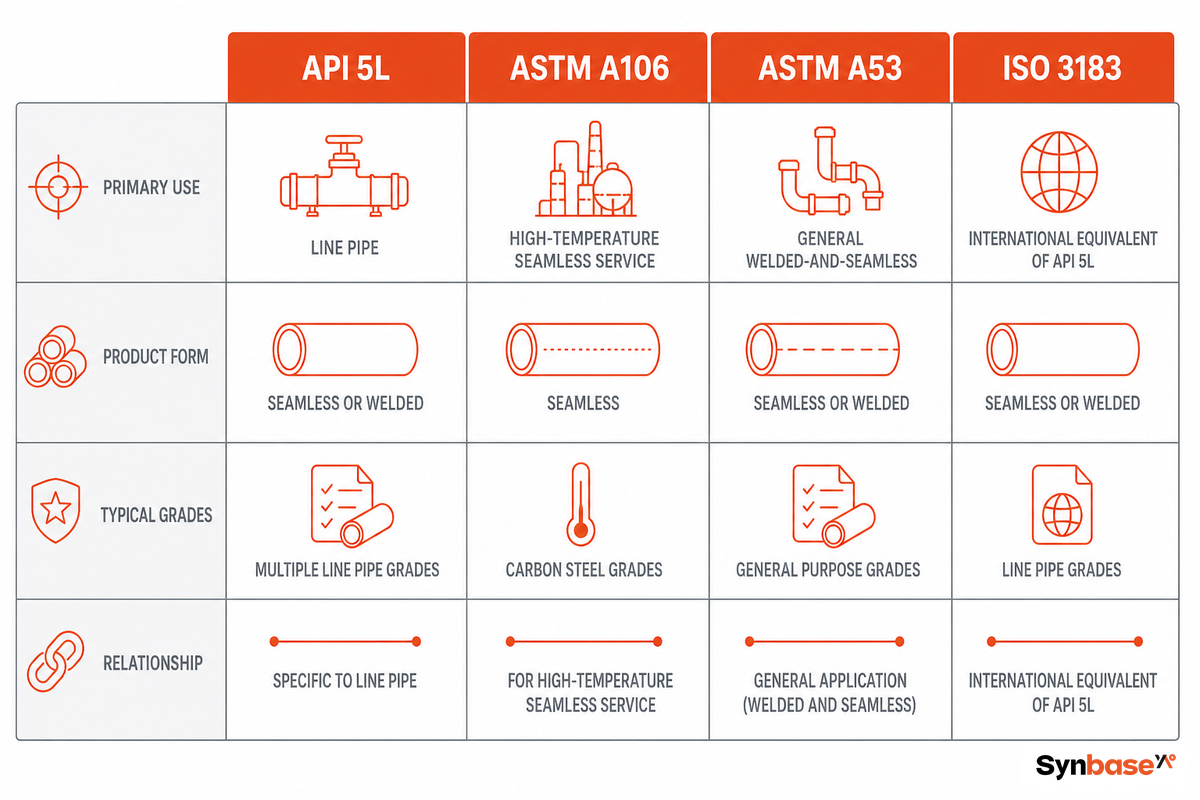
API 5L Grade B, ASTM A106 Grade B, and ASTM A53 Grade B share the same 245 MPa minimum yield strength, which is why they are often called interchangeable at the low end. For general pressure service that is broadly true. But “commercially interchangeable” and “the right standard” are two different questions, and the answer splits by purpose.
API 5L is a line-pipe specification: it carries the PSL1/PSL2 framework with its toughness, non-destructive examination, and traceability rules built for pipeline transportation. ASTM A106 is a seamless spec for high-temperature pressure service with no line-pipe PSL layer at all; A53 is a welded-and-seamless spec for lower-demand service. All three are recognized in the federal joint-factor table49 CFR 192.7 incorporates A53/A53M-22, A106/A106M-19A, and A333/A333M-18 alongside API 5L for use in 192.113, so any of them can be eligible. What differs is the pipeline role: only API 5L brings the PSL2 fracture-control and heat-traceability package a transmission line usually needs.
Mapping to ISO 3183 is direct and worth keeping on hand: L245 = B, L360 = X52, L450 = X65, up to L555 = X80. Watch the high grades, though. There is no ASTM line-pipe equivalent to X52 and above, so substituting “a similar A106 grade” for an X-grade quietly drops the PSL2 toughness and traceability your design review is counting on. Above Grade B, specify by the API 5L grade and PSL, not by an approximate ASTM cousin.
A concrete example makes the trap obvious. An engineer who writes “ASTM A106 Grade B” on a 30-in X52 gas mainline runs into a problem at design review: A106 has no X52 grade at all, and none of the PSL2 impact and fracture-control testing that a 30-in transmission line needs. The purchase order has to be re-issued to the correct API 5L X52 PSL2 callout, costing a procurement cycle. The rule that avoids it: when the job is line-pipe transport, start from the current API 5L edition; reach for A106 or A53 only for the seamless pressure-service or lower-demand cases those specs were actually written for.
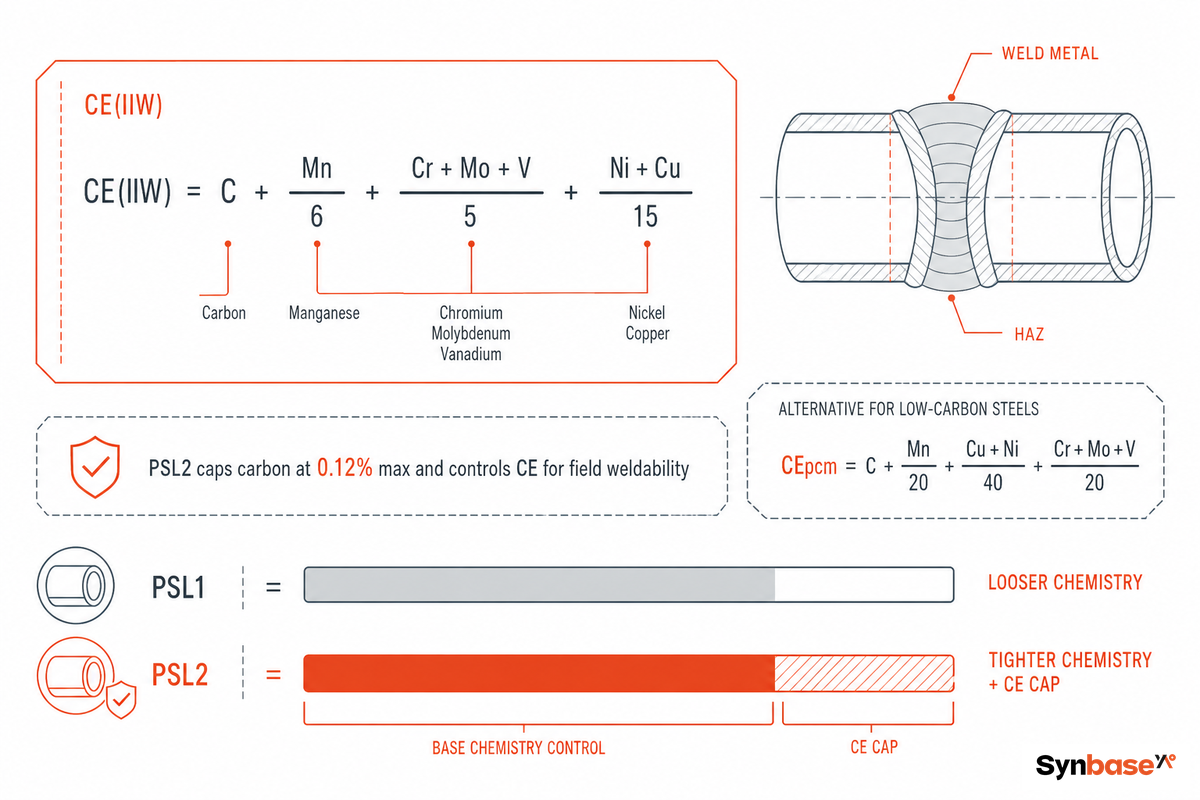
Carbon equivalent is the most consequential number on a PSL2 mill certificate that most buyers never check. Carbon equivalent (CE) rolls the alloy content into a single figure that predicts how hard the heat-affected zone will get when you weld the pipe, and a hard, brittle heat-affected zone is where hydrogen-assisted cracking starts. That’s why the PSL2 mechanical-properties layer exists in the first place.
API 5L PSL2 caps carbon equivalent two ways, and which cap applies depends on the carbon content. For steels above 0.12% carbon, the limit is CEₓₓ₷ ≤ 0.43. For low-carbon steels at or below 0.12% — the thermomechanical grades that make modern X70 and X80 possible, the limit is CEₚ₋ₘ ≤ 0.25, computed as CE(Pcm) = C + Si/30 + Mn/20 + Cu/20 + Ni/60 + Cr/20 + Mo/15 + V/10 + 5B. The payoff is field weldability: a low-carbon, low-CE X70 can be welded with less preheat and lower cracking risk than an old high-carbon steel of much lower strength.
Two service environments push the chemistry further. For sour (H₂S) lines, Annex H of API 5L invokes NACE MR0175 / ISO 15156 with hydrogen-induced-cracking and sulfide-stress-cracking testing and hardness limits, the sour-service testing that the 47th edition expanded. For offshore lines, Annex J of API 5L layers on added toughness and dimensional control on top of the same grade. For carbon-dioxide transport, the metallurgy has become a named target: a 2022 U.S. Department of Energy carbon-capture supply-chain report identifies the steel for CO₂ transport pipelines as “similar to (or the same as) API 5L X65, a low-carbon pipeline steel” tying the grade you order to the corrosion and embrittlement demands of carbon-capture service. A separate JFE Steel patent (WO2024071352A1, 2024) on hydrogen-embrittlement-resistant line-pipe steel shows the same pressure on chemistry from the hydrogen side.
This is why carbon equivalent belongs on the incoming-inspection checklist, not just the mill’s file. A mill certificate showing CE(Pcm) of 0.24 on an X70 line, for example, tells a welding engineer the pipe can be joined with modest preheat; a value creeping toward the 0.25 ceiling flags a cracking risk that changes the field weld procedure. Reading that one number before the pipe reaches the right-of-way is the difference between a routine weld and a rework problem discovered during construction.
A conforming pipe still fails you if the purchase specification is wrong. These are the six errors that most often turn up when engineers audit line-pipe callouts, each with the fix.
| Mistake | Why it fails | The fix |
|---|---|---|
| Omitting the edition (or citing a wrong one) | Chemistry and test rules vary by edition; “API 5L X52” alone is ambiguous. | State the edition + errata + PSL — the 46th for PHMSA work, the 47th where the newest standard is required. |
| Over-specifying the grade | X70 where X52 fits pays a welding and preheat penalty for no reliability gain. | Size the grade from the design pressure; move up only when wall or weight demands it. |
| “Seamless only” reflex | Excludes fully compliant welded PSL2 pipe and inflates cost on large lines. | Allow the welded route that suits the service; reserve seamless for small-bore or sour duty. |
| Leaving out the delivery condition | X52 vs X52M vs X52N are different steels to weld. | Add the R/N/Q/M (and S for sour) suffix explicitly. |
| Forgetting Annex H for sour service | A plain PSL2 order has no HIC/SSC testing or hardness limit. | Call out Annex H sour service to NACE MR0175 / ISO 15156. |
| Substituting A106 for an X-grade | No ASTM line-pipe equivalent exists above Grade B; PSL2 toughness is lost. | Specify by the API 5L grade and PSL for X42 and up. |
One pattern runs under all six: a line-pipe callout is only as good as the parameters you write down. State the edition, the grade, the PSL, the delivery condition, and the service annex, then back the order with a documented inspection-and-test plan, witness points, and mill-test-certificate acceptance. That’s the difference between a specification a mill can quietly interpret in its favor and one it can’t.
Specifying API 5L line pipe for a project?
Synbase Steel rolls API 5L line pipe on its own seamless, LSAW, and SSAW lines and issues EN 10204 3.2 mill test certificates traceable to the heat. Send your grade, PSL, size, and service and get a line-itemized quote with a sample certificate to review, engineered piping solutions from the mill that melted the steel.
This guide was written to separate the three layers that most often trip up an API 5L purchase, the newest published edition (47th), the edition your regulator legally incorporates (46th, per 49 CFR 192.7), and the design code that actually sizes the wall. Synbase Steel is the pipeline enterprise of E-CHENG STEEL GROUP, rolling API 5L line pipe on its own seamless, LSAW, and SSAW lines; the specification reading here’s vendor-neutral, drawn from the API standard, the U.S. Code of Federal Regulations, and field engineering practice. Reviewed by the Synbase Steel technical team.
Synbase Steel supplies steel pipe, fittings, flanges, valves and OCTG for oil and gas, petrochemical, power, water and industrial projects. Our technical guides are written to help buyers compare standards, grades, dimensions, coatings, inspection requirements and commercial terms before sending an RFQ.
We focus on practical specification work: matching pipe process to service conditions, checking wall thickness and end finish, reviewing MTC and NDT requirements, and clarifying documentation before production or shipment.
Project support across seamless pipe, ERW, LSAW, SSAW, buttweld fittings, forged flanges, valves and oilfield tubulars.
Specification review for ASTM, ASME, API, EN and DIN standards, including material grade, pressure class, coating and inspection scope.