Send Your RFQ to Synbase Steel
Prefer to send drawings, BOMs or attachment lists by email? sales@synbasesteel.com

Revised July 2026. A Vendor-Neutral Engineering and Procurement Guide.
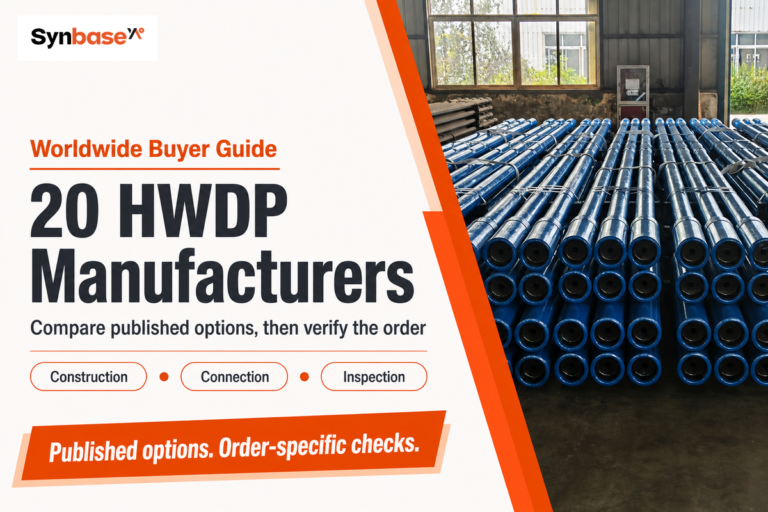
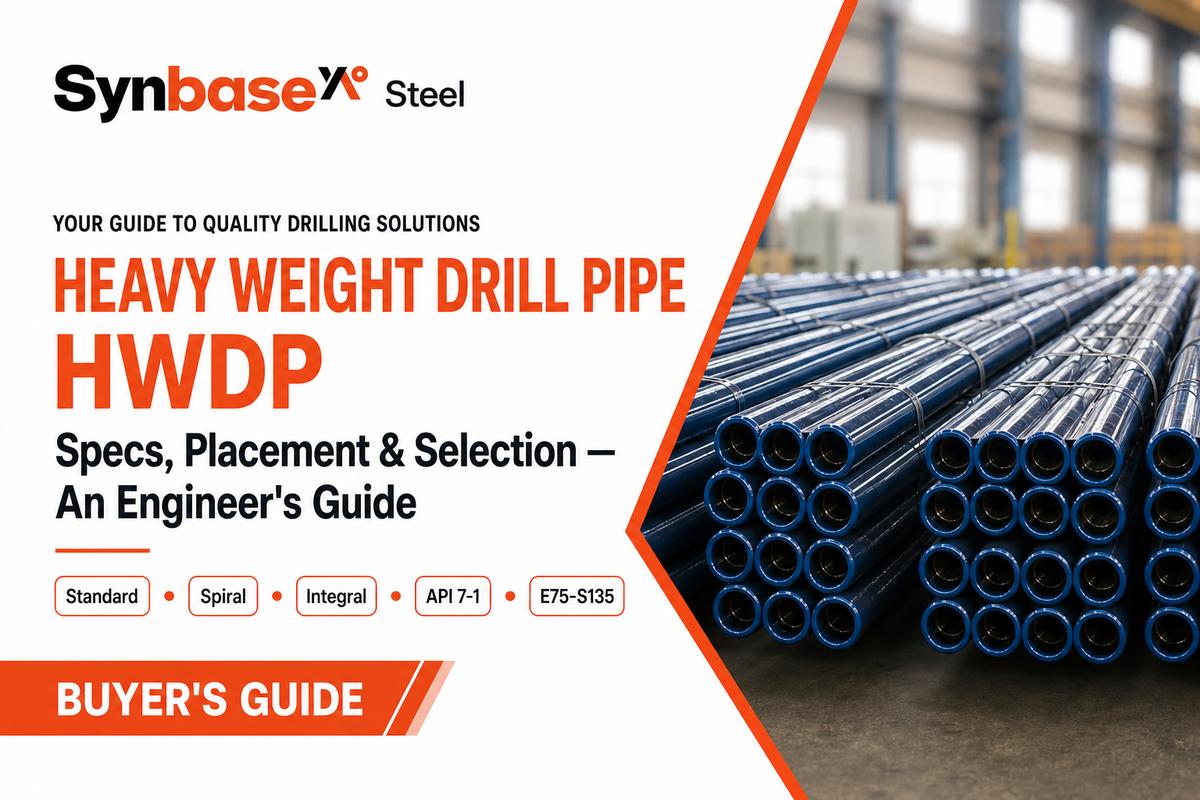
Heavy weight drill pipe is a thick-walled tubular (HWDP) that sits between your flexible drill pipe and your stiff drill collars, and getting it right is the difference between a smooth trip and a fishing job. This guide explains what HWDP does, how the three build types differ, how to read a spec sheet and grade designation, how many joints to run and where, and how to verify quality before you buy – with the calculations and standards references most product pages leave out.
In short: Heavy weight drill pipe is an intermediate-stiffness drill-string member – thicker-walled and longer-jointed than standard drill pipe – run in the transition zone to spread the stiffness change across many joints and absorb the cyclic bending that otherwise cracks pipe just above the bottom-hole assembly. It’s defined under API Spec 7-1, built in Standard, Spiral, and Integral forms, and sized by grade (E75-S135) and connection rather than by weight alone.
| Tube body OD range | 2-7/8″ – 6-5/8″ |
| Body grades (API 5DP / ISO 11961) | E75 · X95 · G105 · S135 (75k–135k psi min yield) |
| Assembly weight band | ~17 – 78 lb/ft (size & build dependent) |
| Build types | Standard (welded) · Spiral / Tri-Spiral · Integral |
| Governing standard | API Spec 7-1 (rotary drill-stem elements) |
| Sour-service basis | NACE / AMPP MR0175 — 22 HRC max hardness |
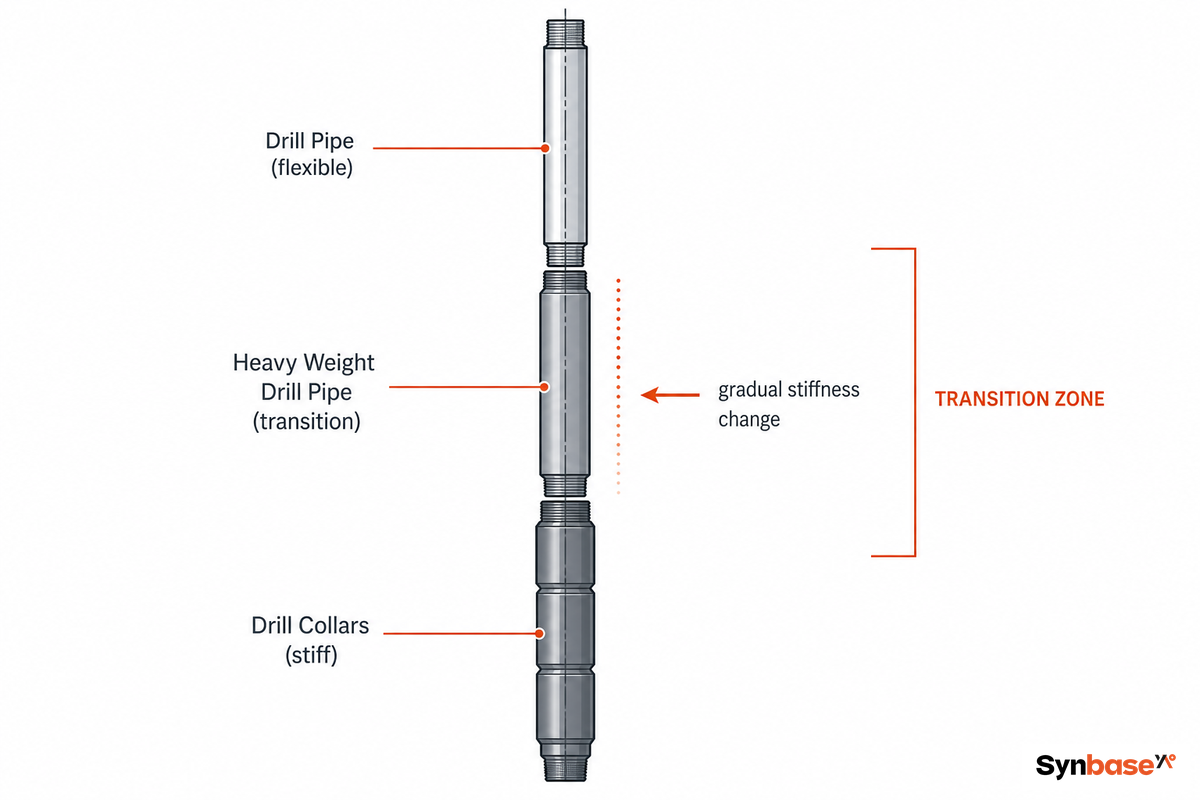
Heavy weight drill pipe is a drill-string tubular whose walls are thicker and whose tool joints are longer than conventional drill pipe, giving it higher tensile strength and stiffness while keeping the same external handling dimensions. The SLB Energy Glossary defines it as a member run to add support to a long drill string; in practice it lives in one specific place – the transition zone. The dimensions and grades of these members are set under ISO 11961.
Every drill string steps from very stiff drill collars at the bottom to comparatively flexible drill pipe above. Make that step in a single joint and cyclic bending concentrates on a handful of connections every time the string rotates through a slightly crooked hole. That concentrated, repeated flexing is where fatigue cracks start. Heavy weight drill pipe spreads the stiffness change over 15 or more joints so no single connection carries the whole jump – which is why the transition zone, not the bit, is where most avoidable drill-string fatigue failures are designed out.
HWDP can be run in compression like a drill collar (subject to buckling limits), which standard drill pipe can’t. That single property – carrying compressive load without buckling into the wellbore wall – is what lets it act as a stiffness buffer rather than just “heavier pipe.”
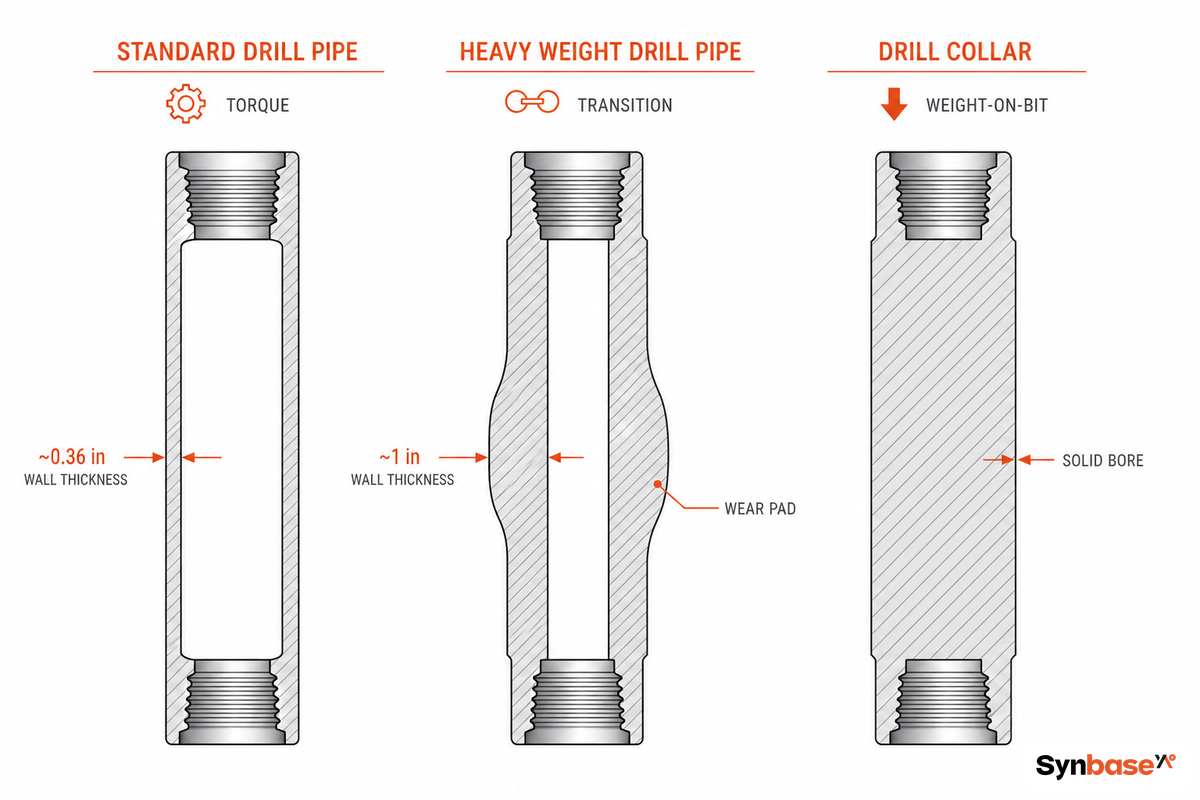
These three members aren’t interchangeable, and choosing the wrong one as your weight source is exactly what feeds the transition-zone failures above. Each provides weight differently, and the right choice depends on the application – so here’s the difference in numbers, not adjectives. The published drill-stem dimensional data behind these weights sits in ISO 11961.
| Property | Standard drill pipe | Heavy weight drill pipe | Drill collar |
|---|---|---|---|
| Wall thickness (5″) | ~0.36 in | up to ~1.0 in | solid bore |
| Assembly weight (5″) | ~19.5 lb/ft | ~50–58 lb/ft | ~70–100+ lb/ft |
| Primary job | Transmit torque & circulate fluid | Transition stiffness + bit weight | Concentrated weight-on-bit |
| Behavior in doglegs | Flexible | Intermediate (bends, controllable) | Rigid (fatigues connections) |
| Wall contact / sticking risk | Low | Reduced (~6 ft/joint) | High (full-length body) |
Representative figures compiled from published API Spec 7-1 dimensional data and industry drilling references; exact values are connection- and design-specific.
What separates them is bore and how each applies weight. A drill collar is a solid-bore member that applies concentrated weight directly above the bit and touches the wellbore along its entire length. Heavy weight drill pipe carries a thick wall but a through bore and-because it touches the wellbore wall only at its tool joints and center wear pad-typically about six feet per joint-it applies a softer, distributed weight than a collar does.
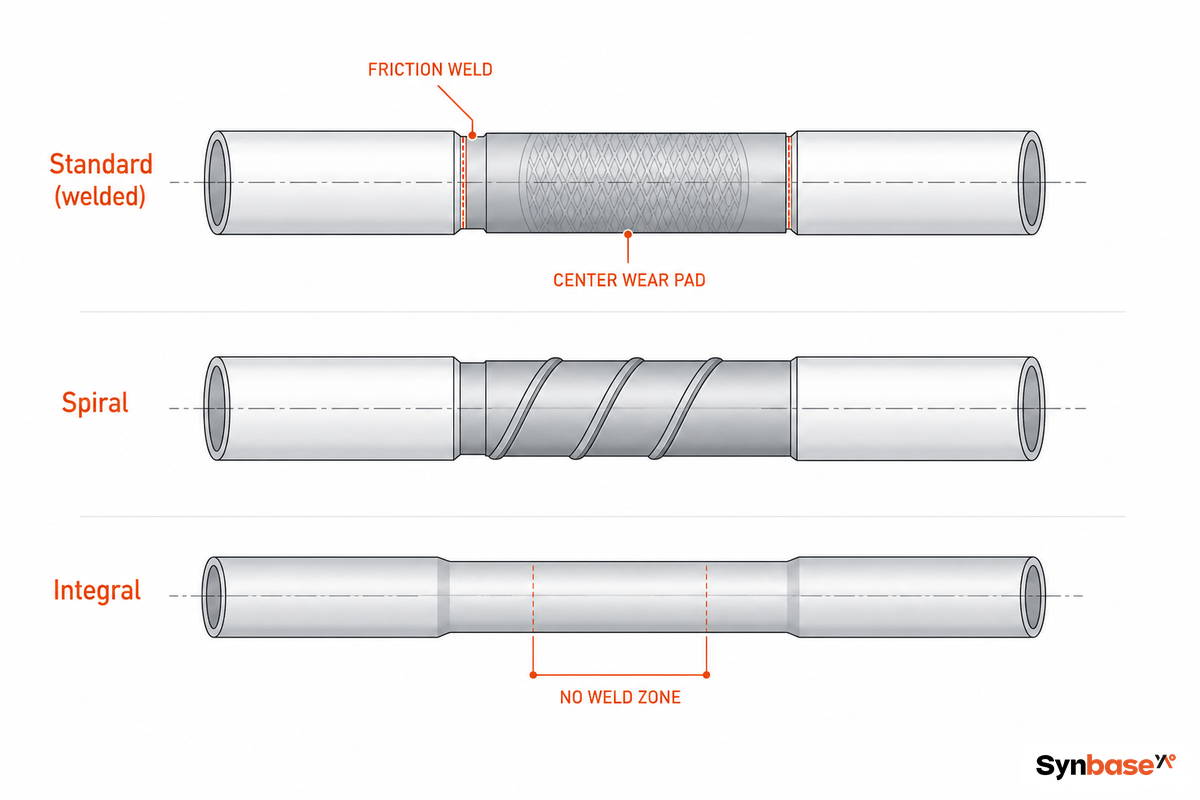
HWDP can be manufactured three ways, with resulting variations in torsional capacity, sour-gas resistance, lead times, and costs; these aren’t cosmetic distinctions. Connection-integrity advances in these builds appear in filings such as US 12,196,345 B1.
Material selections are dependent on the build. Typically, welded builds are manufactured using an AISI 1340 tube with 4140HM-class tool joints. Body material for integral builds is generally derived from an AISI 4145H (4145H-Mod) forging. Tool joint hardbanding protects the outside diameter from excessive wear, and can be reapplied throughout the service life of the connection. Each heavy-weight drill pipe carries a center upset or wear pad that holds the tube body off the wall, with tool-joint torsional yield usually in the 95–120 ksi class. Integral bodies are machined from a single bar for uniform toughness, while welded builds add a stress relief groove at the pin in accordance with API practice. Hardbanding is applied to the tool joints as a wear-resistant layer — brands such as Arnco are common — for wear-rate protection of the drillstring, which measurably improves fatigue resistance and helps extend the life of a contact surface that would otherwise abrade against casing. Industry standard for connections on heavy weight pipe continues to be API’s single-shoulder, with most modern drilling programs employing proprietary double-shoulder configurations that provide increased torque capacity over same-dimension single-shoulder designs (Drilling Contractor, 2023). These figures are often published as a heavy weight drill pipe weight chart or a short HWDP specs sheet, but grade and connection are what actually govern selection.
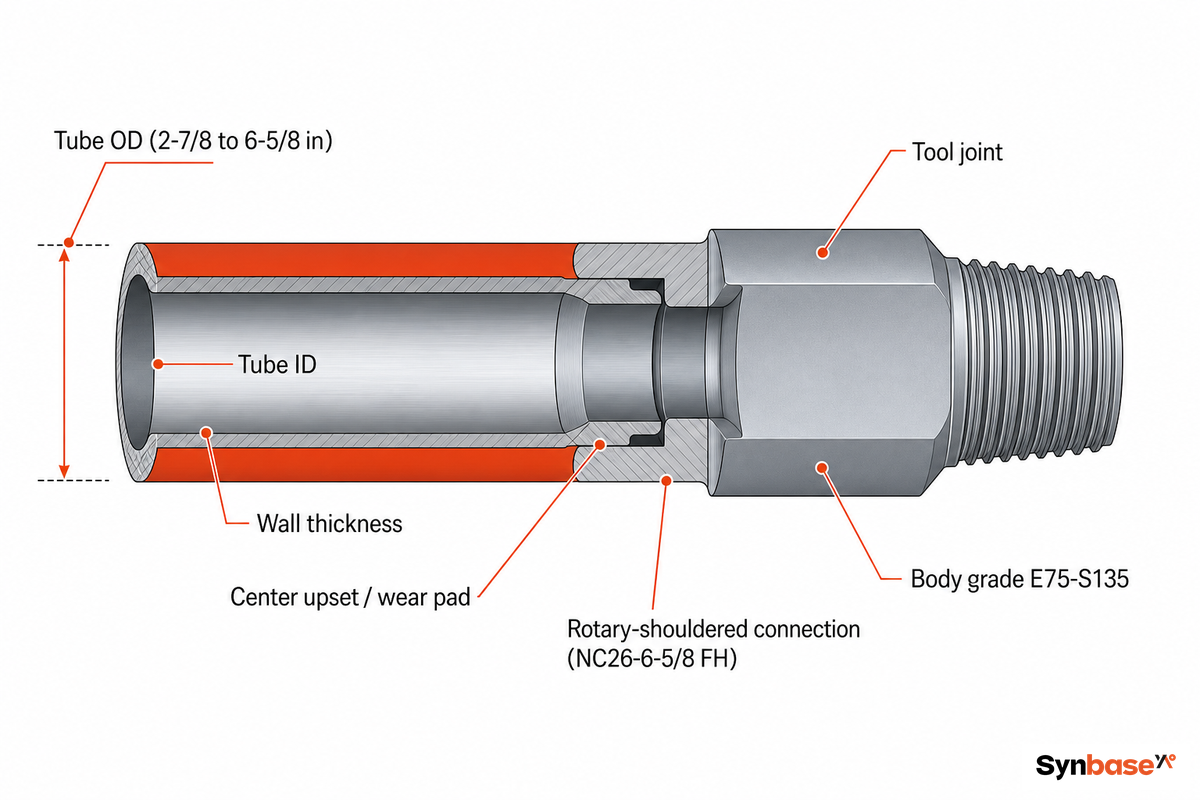
Five pieces of information are packed into the spec line for heavy weight drill pipe: tube outside diameter (OD), adjusted weight per foot, the connection, the body grade, and the length range. Once you learn to read these items from left to right, the questions most of us ask are automatically answered. The E75–S135 grade yields are defined by API 5DP and ISO 11961.
Heavy weight drill pipe can be sourced with any tube OD between 2-7/8 in. and 6-5/8 in., with an adjusted weight per foot that spans roughly 17 to 78 lb/ft depending on size and build. Connections are specified from API’s NC26 up through 6-5/8 FH (full hole), and also available in a range of double-shoulder configurations. Body grades range from E75 to S135, with the API length ranges as well.
Physical characteristics of the drill string geometry and rod body are outlined in API Specification 7-1. The drill-pipe body steel adheres to the grades outlined in API 5DP / ISO 11961.
| Grade | Min yield (psi) | Typical use band |
|---|---|---|
| E75 | 75,000 | Shallow / medium, routine |
| X95 | 95,000 | Deeper, higher-torque |
| G105 | 105,000 | Deep, high-torque |
| S135 | 135,000 | Premium / demanding |
Because make-up torque varies by size and construction method, there isn’t a single value applicable to all joints. Instead, a well-executed drill pipe mill will stamp the proper make-up torque for each individual joint on the mill paperwork-instead of deferring to a generic table-and that’s a worth while detail to verify since most connection failures are caused by under-torque, not over-torque.
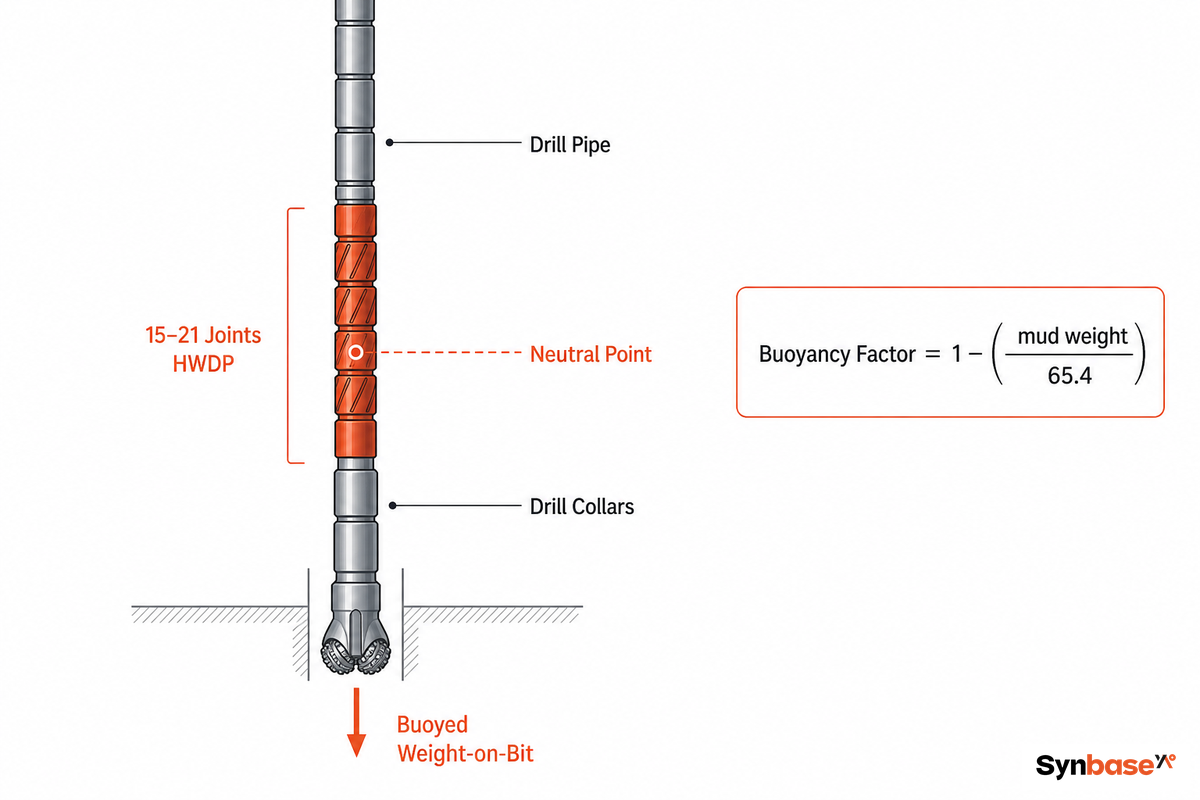
Field practice sets a generally accepted practice is 15 to 21 joints of heavy wall drill pipe between the drill collars and the drill string. At its core, the governing concept, however, is the neutral point: the point at which the drill string changes from compressive mode to tensile mode. As a working rule for practice is to ensure the neutral point stays within the HWDP and the drill collars – never in the regular drill pipe – because applying weight on the drill string causes the neutral point to rise. Nominal assembly weights used in this math follow ISO 11961 drill-stem data.
But weight is only after buoyancy. A 32,000 lb string in air doesn’t carry 32,000 lb on the bit in mud – the heavier the mud, the less effective weight makes it all the way. A buoyancy factor reflects that.
A buoyancy factor uses steel’s density of 65.4 lb/gal:
Buoyancy Factor (BF) = 1 (mud weight 65.4)
Working example: 20 joints 31 ft 51.6 lb/ft 31,990 lb in air. in 8.3-ppg mud 31,990 0.873 27,930 lb buoyed weight in 20-ppg mud 31,990 0.694 22,200 lb same steel, some 20% less available weight on bit in heavy mud–why a joint count that’s fine on one well may fall short on another. On a 10,000-ft vertical hole, a crew running 18 joints of 5-inch HWDP watched the neutral point creep up into the plain drill pipe as weight-on-bit climbed past 25,000 lb; adding six more joints pulled the neutral point back into the heavy-weight section and the connection-fatigue flags eased. Joint count is not a fixed recipe — it moves with the weight-on-bit and mud weight you actually run.
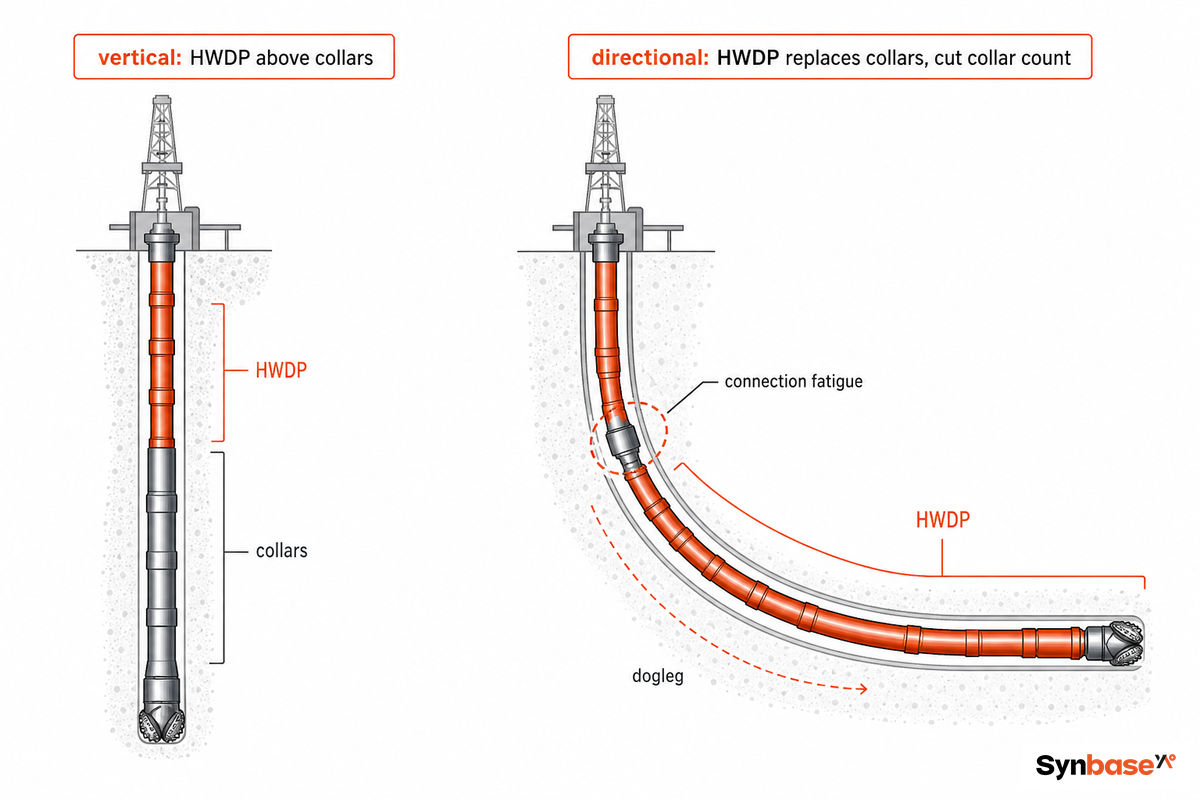
The placement rule reverses in directional and horizontal wells. Heavy weight drill pipe becomes the primary weight source and drill collars are cut back, because rigid collars fatigue their own connections as they bend through each dogleg. Shifting weight into more flexible HWDP lowers torque and drag and cuts differential-sticking risk, which is why long laterals run HWDP-heavy strings instead of stacking collars above the bit.
Weight for directional and horizontal wells largely comes from heavy weight drill pipe rather than drill collars – opposite of what’s the norm in vertical well practices. Logic behind this change: stiff drill collars forced to negotiate a dogleg develop a higher frequency stress on their own connections.
To lower the drag, reduce differential sticking and increase how far a string can reach before drag prevents additional advancement, many operators substitute a good portion of the rigid collar run with flexible hwdp. Torque-and-drag hardware for exactly this problem is documented in US 12,006,778 B2.
It’s also the only time the book “rule” that “drill pipe must never be run in compression” is bent. This pipe is on the low side in a horizontal or highly angled well, and the low side of the wellbore provides support against buckling. So weight is put on the bit by a push of pipe which is already supported. Picture a 3,000-ft lateral where a crew stacked rigid drill collars in the build section: connection wash-outs showed up within two bit runs because the collars fatigued every time they bent through the curve. Swapping most of those collars for HWDP cut the torque-and-drag signature and the wash-outs stopped — the same mass, carried by a more forgiving member. A piece designed to be run in compression is the best choice: long, stiff collars would fatigue out more quickly.
“The governing criterion is not maximum weight but a gradual stiffness transition. Practitioners target a stiffness ratio below about 5.5 between adjacent sections for routine drilling, and below roughly 3.5 in severe or high-failure areas, matching stiffness, not stacking mass.”
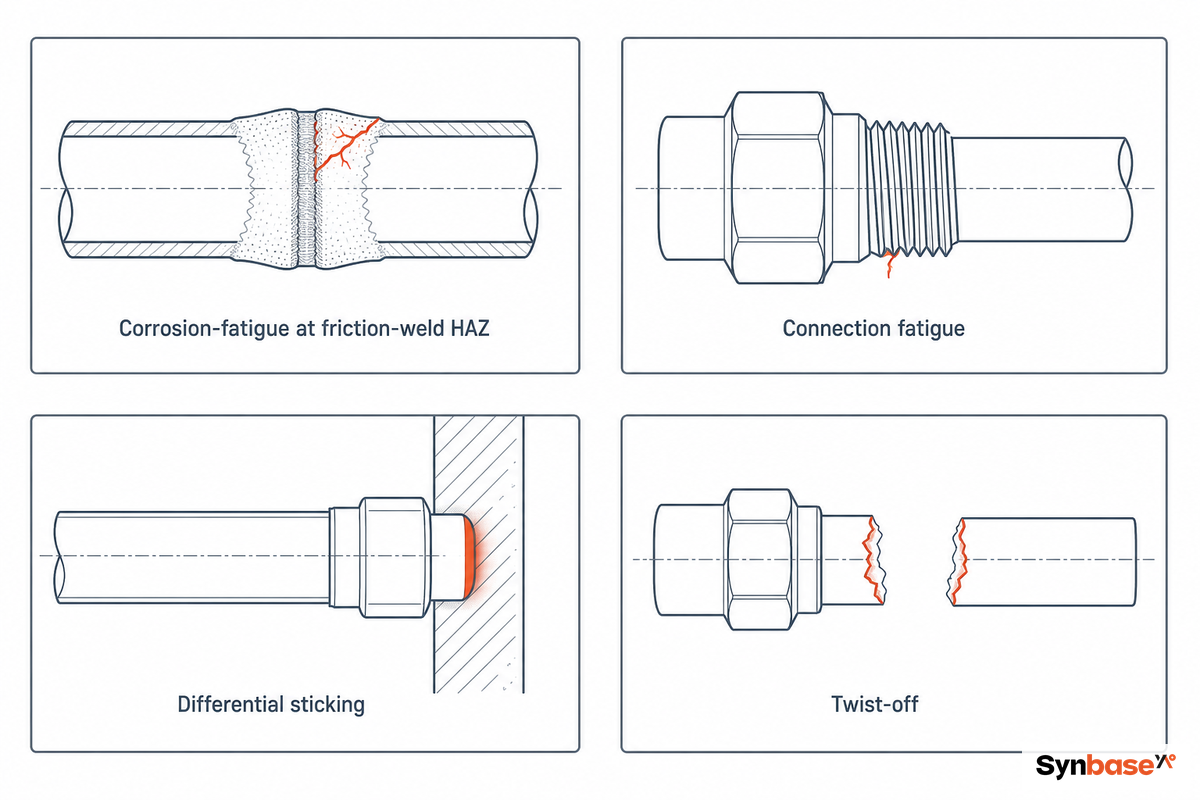
Functionally, the role of Heavy Weight Drill Pipe: heavy weight drill pipe was originally invented to prevent a certain type of family failure. Knowing the genesis of this failure means knowing what to look for and what to purchase. The sour-service hardness limits that govern crack resistance are set by NACE MR0175 / ISO 15156.
| Failure mode | Mechanism | Control |
|---|---|---|
| Corrosion-fatigue at the weld HAZ | Cyclic bending + H2S attack initiating at the friction-weld heat-affected zone | Integral build (no HAZ); sour-service grade; stress relief |
| Connection fatigue | Thread-root peak stress under downhole bending | Large root radius, cold-rolled threads, correct make-up torque |
| Differential sticking | Pressure pins the body against a permeable wall (contact-area driven) | Spiral build; reduced ~6 ft/joint contact area |
| Twist-off | Torsional overload, often the end stage of a washout or fatigue crack | Full-length NDT; retire on wall loss; avoid rotating stuck pipe |
Two field points are useful to keep in mind. Firstly, differential sticking is a pressure-and-contact phenomenon, not a mechanical bind – hence why some crews are able to unstick a string with a time-limited oil-based spotting bath instead of brute force, and why HWDP’s small contact area resists it in the first place. Secondly, twist-offs are often the conclusion to a story that started as a washout or a fatigue crack in the HAZ; by the time the pipe parts, the damage has often been building for hours. A typical sequence runs like this: a hairline fatigue crack opens at the friction-weld HAZ, drilling fluid begins to wash through and enlarges it over several hours, the small drop in standpipe pressure goes unnoticed on a busy floor, and the joint finally parts when the crew rotates to work a tight spot — leaving a fishing job worth far more than the joint. Catching that wash-out early, on a pressure trend, is what separates a planned trip from a fishing operation.
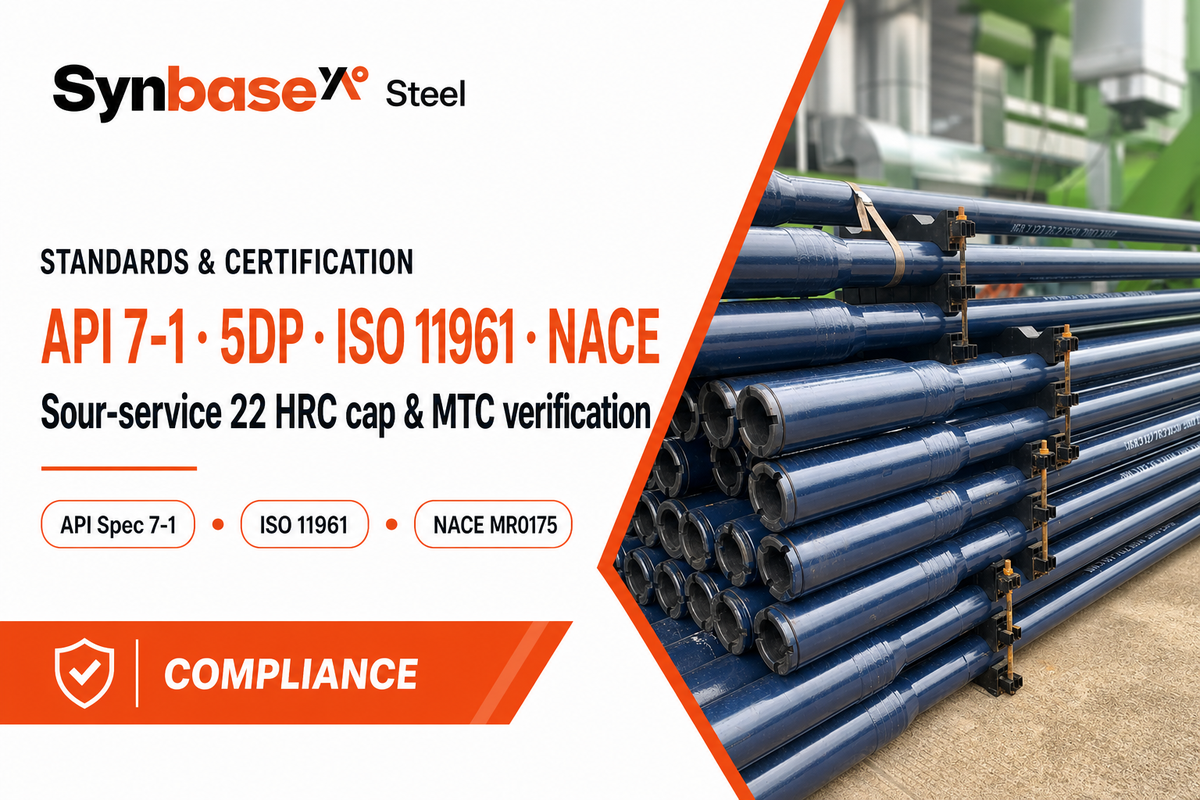
Four documents govern much of what matters when you specify heavy weight drill pipe:
The sour-service point deserves emphasis because it’s where buyers get caught. In H2S environments, tubes and tool joints are often held to separate hardness and toughness criteria, and the 22 HRC cap is a hard ceiling for these grades -not a target to negotiate. Sour demand has grown enough that at least one major manufacturer now offers a commercialized 135,000-psi, NACE Region 1 HWDP for mild-sour service, according to Drilling Contractor.
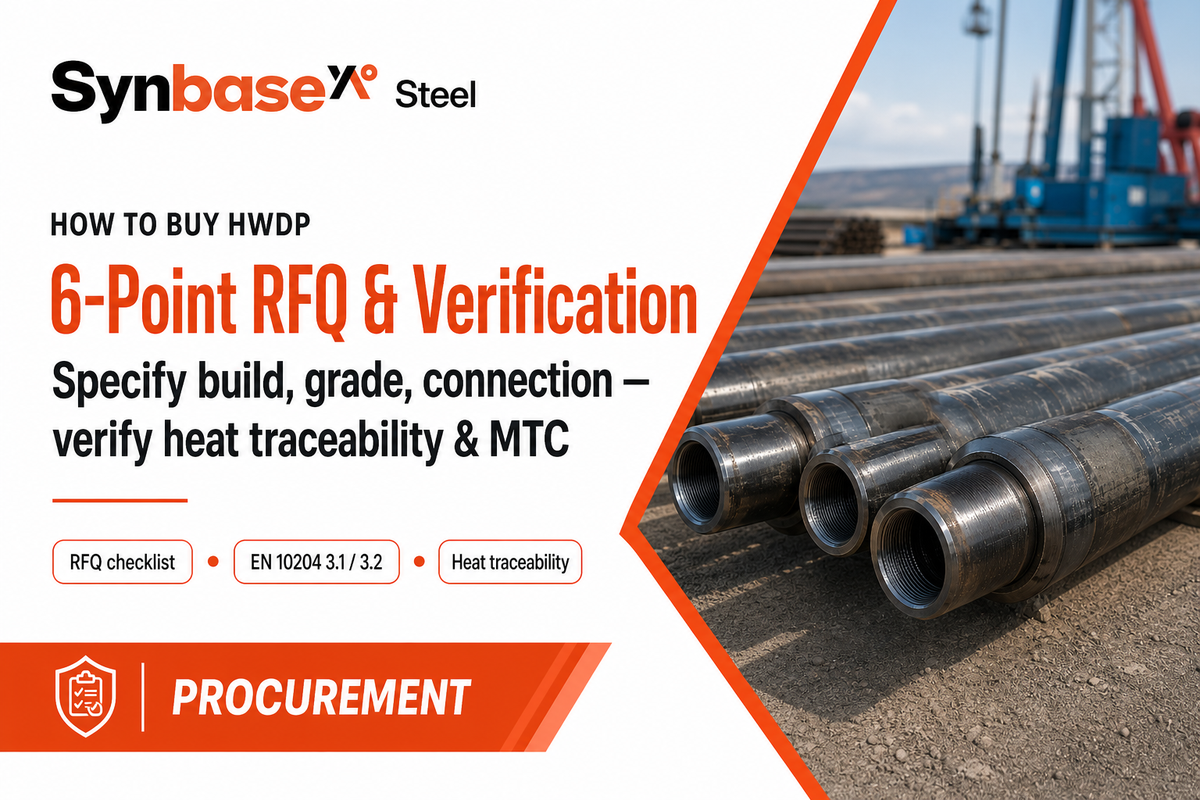
Heavy weight drill pipe is often the next-largest capital line on a rig after the rig itself, so a vague inquiry invites a re-quote and a costly re-machining delay. Six parameters turn a fuzzy request into a firm, comparable quote. Landed-cost planning should weigh the trade measures documented by the U.S. International Trade Commission.
On the verification side, three things separate a mill from a trader. Ask for heat-number traceability so each joint tracks back to its production heat; require 100% non-destructive testing (ultrasonic, magnetic particle, and visual) on welds and body; and decide your MTC level. An EN 10204 3.1 certificate is validated by the manufacturer’s own authorized inspection representative; a 3.2 certificate adds an independent third party – typically SGS, Bureau Veritas, or TV – witnessing the tests, which usually adds a few weeks of lead time but gives you an outside signature. If you can’t get a sample MTC and confirm heat traceability before you commit, you’re buying on trust rather than evidence. The use of heavy weight drill pipe on a program is ultimately a supply decision as much as an engineering one: matching build, grade, and connection to the well is the solution that delivers downhole performance, and the benefit of specifying it correctly up front is a firm, comparable quote rather than a re-machining delay.
For readers scoping an actual purchase, Synbase Steel publishes its heavy weight drill pipe specifications and build options and a set of engineering tools -including a weight-buoyancy calculator and a build-grade selector -that map directly onto the RFQ parameters above.
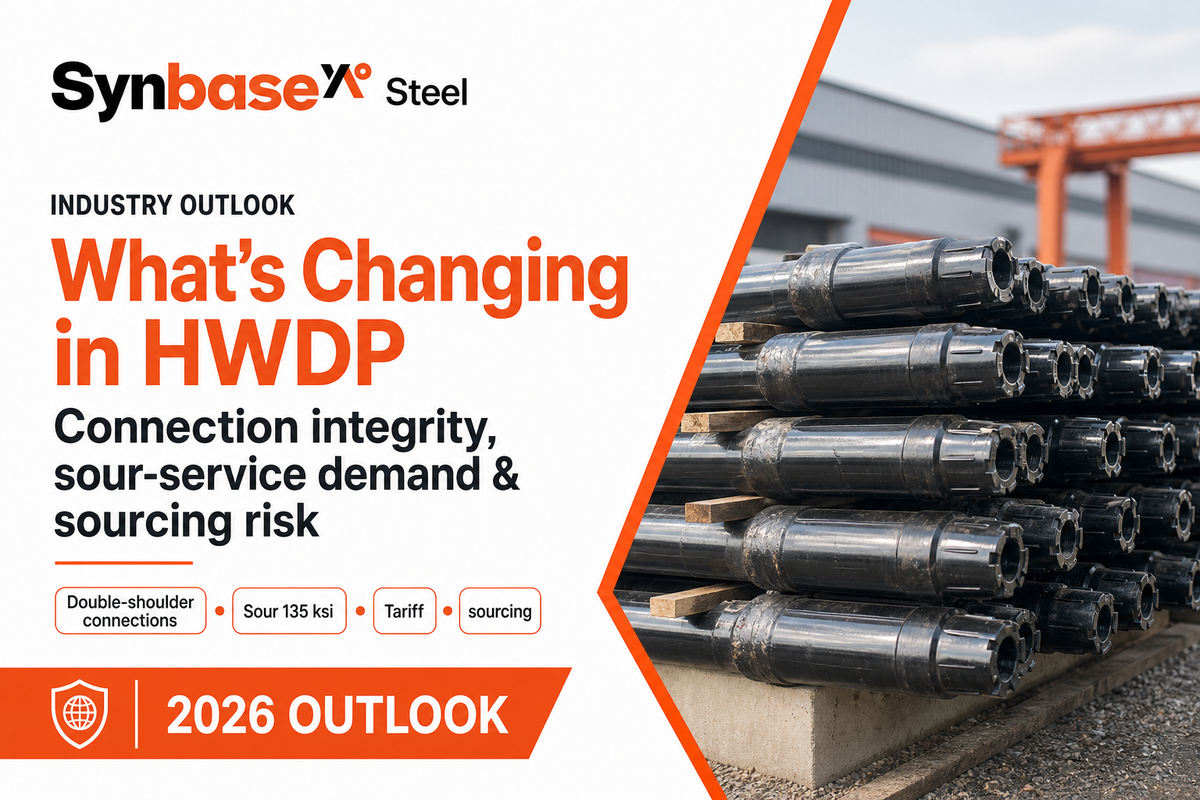
Three forces should shape how buyers specify heavy weight drill pipe over the next couple of years, and none of them is “the market is growing.”
Engineering focus First is connection integrity. Average well length measured depth (MD) has surpassed 20,000 feet, with a number in the 30s. Double-shoulder proprietary connections have gone from a special feature to a common feature, since API single-shoulder profiles can’t handle the torques for these wells. We see this history in patents: A patent granted in 2025 (US 12,196,345 B1) describes a high-torque rotary-shouldered connection with a load flank features for reduced galling when make-up and break-out occurs. Another from 2024 (US 12,006,778 B2) describes a non-rotating pipe protector to mitigate tool joint wear and reduce torque-drag. If you’re buying equipment to work long lateral wells, connections and wear-not pure weight-is the spec that will last.
Third, the shift from ” sour is an exception” to “sour is the new standard” is accelerating in certain regions, and this is driving the NACE grade to be required to the 135ksi strength level. If your program can possibly be exposed to sour (H2S), ensure the RFQ has the sour requirement listed from the outset so you don’t have to qualify later.
Third, your sourcing comes with tariff and trade risk. The U.S. International Trade Commission concluded Section 232 steel measures dropped related imports by nearly 25 percent and boosted domestic prices; in 2025 for shipments headed to the United States, tariff rates on metal of non-U.S. origin are set to rise. Include duties in the comparison of your landed cost before you ink your contract – not after the purchase order is issued. (There’s a market-size outlook that says something along the lines of 4-6 percent annual growth available, but view it as background not as a buy indicator.)
Ordering heavy weight drill pipe for an active drilling program? Ensure you select a build type, grade, and connection appropriate for the target well, ideally before you submit the RFQ.
This HWDP selection guide was compiled based on information in API and ISO drill-stem specifications, NACE/AMPP guidelines for sour-service environments, information published in industry and trade publications, and anecdotes shared by industry practitioners, with all data checked against available specifications. Information provided is intended to be vendors-neutral – the principles behind the buoyancy calculation, the tables listing various grades, and descriptions of failure modes are applicable regardless of the manufacturer’s mill. Reviewed by the technical staff of Synbase Steel, which manufactures OCTG products, including HWDP, that meet the specifications outlined in API Spec 7-1.
Synbase Steel supplies steel pipe, fittings, flanges, valves and OCTG for oil and gas, petrochemical, power, water and industrial projects. Our technical guides are written to help buyers compare standards, grades, dimensions, coatings, inspection requirements and commercial terms before sending an RFQ.
We focus on practical specification work: matching pipe process to service conditions, checking wall thickness and end finish, reviewing MTC and NDT requirements, and clarifying documentation before production or shipment.
Project support across seamless pipe, ERW, LSAW, SSAW, buttweld fittings, forged flanges, valves and oilfield tubulars.
Specification review for ASTM, ASME, API, EN and DIN standards, including material grade, pressure class, coating and inspection scope.