Send Your RFQ to Synbase Steel
Prefer to send drawings, BOMs or attachment lists by email? sales@synbasesteel.com

Introduce a drill string into a 3000 metre directional well and the first point of fatigue cracks will be found in the transition zone above your bottom-hole assembly (BHA). Our heavy weight drill pipe places a graded-stiffness section right where it counts – in Standard, Spiral, and Integral builds, OD 2-7/8″ to 6-5/8″ to API Spec 7-1.
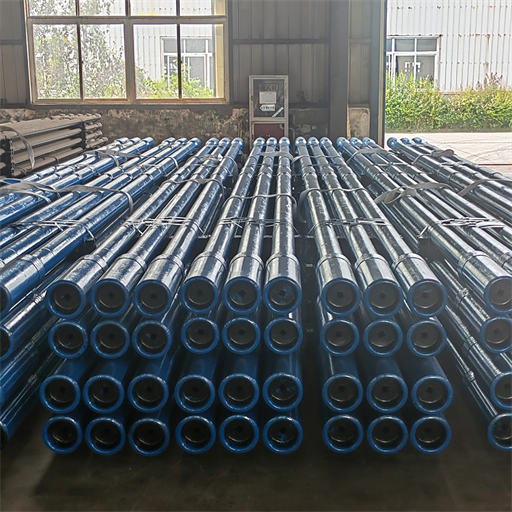
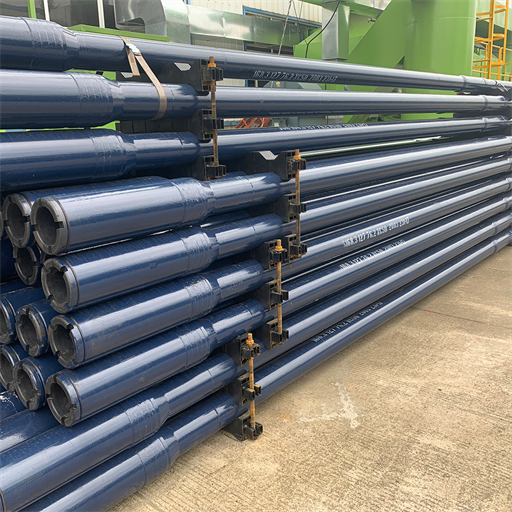
Drill-tool fatigue doesn’t strike randomly. It occurs at the interface where rigid drill collars meet flexible drill pipe. The abrupt transition and higher stiffness pushes the bending stress to localize in just one short segment.
A drill string comprises:
They’ve different jobs in the drilling process: the drill pipe transmits torque and circulates drilling mud; the drill collars provide weight on bit (WOB); and the heavy weight drill pipe introduces a transition.
A 2020 peer-reviewed failure analysis traced a twisted-off heavy weight drill pipe to corrosion-fatigue cracking at the externally-upset pin tool-joint transition, driven by cyclic drillstring vibration and low toughness in the friction-weld heat-affected zone. That fish was lost at 1,240 metres.
Loading 15 to 30 joints of heavy weight drill pipe between the drill collars and the drill pipe extends the stiffness change over many joints rather than one. Its increased wall thickness of up to three times the thickness of a standard drill pipe added weight at the bit, while the thickened center upset kept the tube body clear of borehole walls. Recent tool-joint wear-protection patents target this same casing-contact interface.
Most buyers underestimate that risk. Fishing jobs after a downhole twist-off – one of the worst kinds of drilling accident – run the rig clock into seven-figure sums, so operators weigh reliability well before they weigh sticker price.
This single factor explains the importance of HWDP in the transition zone. Without a graded section, the loads the string must withstand fall on a handful of joints, and that stress accumulation makes the drill pipe in the transition zone the weak link in a high-value oil and gas industry operation.
What most selection guides overlook (a counter-intuitive rule): in directional, horizontal, and extended-reach drilling wells the standard rule reverses. Bending stiff drill collars as they turn through doglegs cause connection-fatigue failures and increase torque and drag, so heavy weight drill pipe – not collars – becomes the second most desirable weight source.
Instead of a generic catalogue listing, Synbase custom engineers the transition-zone pipe to match the features of the specific well, providing a spec sheet and a joint count prediction that aligns with your well’s dogleg severity and mud weight.
We manufacture heavy weight drill pipe in three designs – each one built to solve a particular problem in the drilling operation. It is not a cosmetic call – it changes torsional strength, sour-gas performance, lead times, and cost.
Since we manufacture the entire bottomhole assembly as an OCTG producer to the oilfield sector, we are placed to meet your drilling needs for all components from drill pipe, drill collars and pups through to API casing and tubing, so you don’t have to re-issue your specification for each part. One constraint most buyers run into is keeping joints and grades compatible across the downhole assembly. Purchasing from one producer nullifies this problem for you.
Integral construction eliminates the friction-weld heat affected zone the failure analysis showed to be an initiation point of cracks, which is the reason operators pull this string on wells they can’t afford to miss even if that does extend lead times considerably.
Larger integral sizes are the odd ones out and take a bit longer, so it makes sense to flag the stock-vs-build position up front. The honest trade-off is plain: in return for extra torsional strength you pay a higher integral price – give Synbase a size and grade and we generate an integral-specific data sheet, not a brochure.
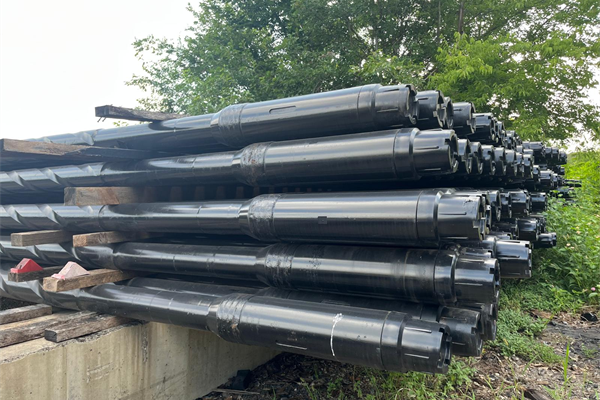
A spiral heavy weight drill pipe build adds three grooves to the center section, trading a small weight gain for reduced surface-contact area where sticking risk is high. Heavy weight drill pipe specifications below cover the conventional dimensional envelope our welded and integral builds share.
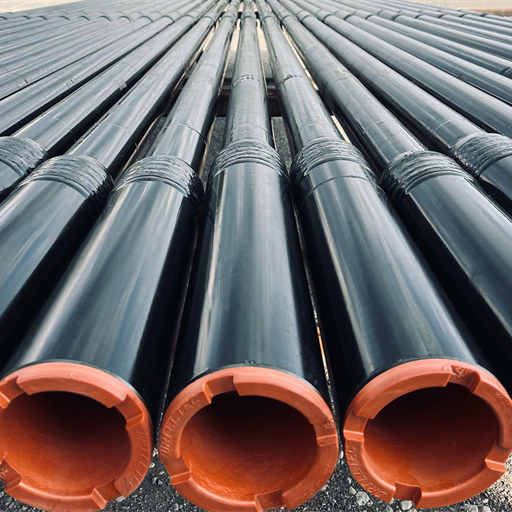
| Tube OD (in) | Tube ID (in) | Wall (in) | Connection | Assembly wt (lb/ft) | Make-up torque (ft-lbs) |
|---|---|---|---|---|---|
| 2-7/8 | 1-1/2 | 0.688 | NC26 | 17.4 | 3,800–4,100 |
| 3-1/2 | 2-1/16 | 0.719 | NC38 | 26.8 | 11,500 |
| 4 | 2-9/16 | 0.719 | NC40 / 4 FH | 30.7 | 13,900–16,600 |
| 4-1/2 | 2-3/4 | 0.875 | NC46 | 42.7 | 21,800–23,200 |
| 5 | 3 | 1.000 | NC50 | 51.6 | 28,900–34,500 |
| 5-1/2 | 3-1/4 | 1.125 | 5-1/2 FH | 63.1 | 39,400 |
| 6-5/8 | 4-1/2 | 1.063 | 6-5/8 FH | 74.4 | 43,900–52,700 |
The dimensional band reflects published API Spec 7-1 / RP 7G industry data, cross-checked across several data charts; the underlying connection geometry is also covered by patents such as US 12,196,345 B1. Internal-upset options of IU, EU and IEU can be applied. Lengths are typically Range 1 (18-22 ft), Range 2 (27-31 ft) and Range 3 (38-45 ft).
The three components in a drillstring aren’t all interchangeable, and selection of the wrong weight source provides nutrition for the transition zone failures above. Here’s the difference in numbers, not adjectives.
| Property | Standard drill pipe | Heavy weight drill pipe | Drill collar |
|---|---|---|---|
| Wall thickness (5″ size) | ~0.362 in | ~1.000 in | Solid bore |
| Weight (5″ size) | ~19.5 lb/ft | ~51.6 lb/ft | ~70–100+ lb/ft |
| Primary job | Transmit torque & circulate fluid | Transition stiffness + bit weight | Concentrated weight-on-bit |
| Stiffness in doglegs | Flexible | Intermediate (bends, controllable) | Rigid (fatigues connections) |
| Wall contact / sticking risk | Low | Reduced (center upset) | High (full-gauge body) |
The common assumption that the heaviest string is the best string is not always true.
The heavier drillpipe isn’t going to save you drill collars. Drill collars exist to bring concentrated weight right above the bit – HWDP can transition weight and stiffness but it’s nowhere near able to take the place of this. Even wear-resistant drill-pipe patents concede the pipe still weighs less than a heavy weight drill pipe.
The weight of a collar in air isn’t your weight-on-the-bit! Your weight on the bottom is significantly decreased by buoyancy once your collar gets into your drilling mud. Here’s a fun comparison of corrections for weight of collars for different mud weights. You would use a factor of 0.873 for 8.3 lb/gal up to 0.694 for 20 lb/gal.
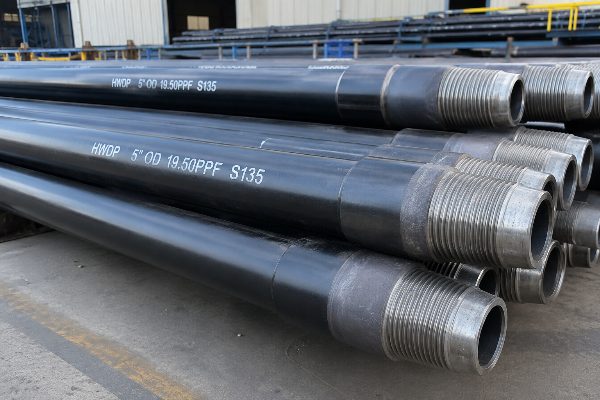
Without enough stabilising weight in the transition zone, the upper string can buckle under compression, while a pipe body parked against a permeable wall under differential pressure is what gets you stuck.
A gradual transition in stiffness – rather than an abrupt jump in increased stiffness placed between the drill pipe and drill collars – is the whole point.
Heavy weight drill pipe flexes across collars, which not only makes it easier to control the direction of the drill bore but also allows for higher RPM, and is why the drill pipe has quietly become the workhorse for extended-reach drilling programmes.
There are two governing practical numbers. First is the extra weight a string puts on the hole every foot, which sets how much working weight-on-bit (WOB) you reach once buoyancy is subtracted. Second is the drilling torque that build can withstand as the string rotates and is dragged through the doglegs.
Heavy weight drill pipe runs and racks just like drill pipe on a trip, and pulls through the elevators without the special treatment drill collars require, allowing less trip time, less wall contact, and less sticking than drill collars present in a permeable shale zone.
Hardly a catch-all string then? Well application-specific – simply upload your well profile to your local Synbase engineer, who will size the HWDP-to-collar split, based on your buoyancy-corrected weight-on-bit and, give you a specific recommendations back.
Our top failure analysis at the top of this page suggests an elegant engineering solution; Control the weld zone, control the threads, and certify the steel. This is where our manufacturing process is structured to provide an auditable and documented history.
Grades of steels: tool joints from AISI 4137H / 4145H-MOD treated modified alloys, standard tube material AISI 1340 (or equal), integral bodies milled out from one single Forged Bar.
In-depth fatigue features include: cold-rolled thread roots (compressional residual stress combats cyclic crack growth), API stress-relieve groove on pin, API bore-back box, and phosphate coating for the connections.
The hardfacing come casing friendly: bands applied on tool joints and two 3-inch bands on the center upset under a controlled environment.
Behind these parts lies the group’s upstream capability. Synbase Steel is the pipe-equipment core of E-CHENG STEEL GROUP, whose hot-rolled tube base spans 200,000 m² with 1.3 million tonnes of annual output and steel supply from Baosteel and TPCO.
Why this matters to a drill-stem buyer: two joints of the same outer diameter and grade from different manufacturers can still behave very differently downhole, because the heat treatment and the upset that set fatigue life live in the billet and the thread, not on the spec sheet.
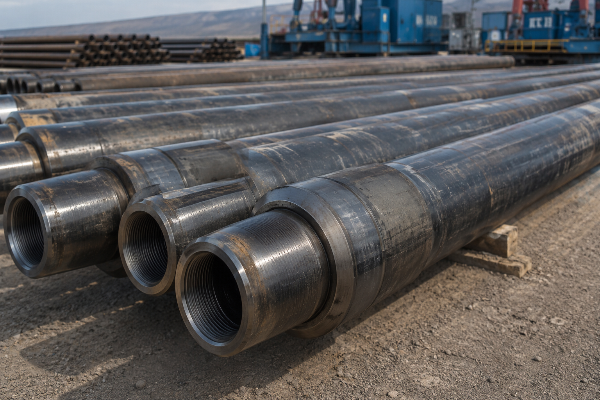
Heavy Weight Drill Pipe Welded requires 100% NDT on the welds, as they can’t be reworked in the field. Our lines employ eddy current, ultrasonic, magnetic flux leakage, hydrostatic and pipe-end magnetic particle inspection as well as a CNAS certified laboratory for spectrometer, metallographic, impact, hardness and high temperature tensile tests.
Sour wells destroy inferior steel in the most sneaky of ways by way of sulfide stress cracking until an attachment give way, an unfortunate and critical incident; selecting the correct grade for this type of service is of critical safety importance, not a matter of preference.
| Service Condition | Body Grade (SMYS) | Sour-Service Basis | Build Recommendation |
|---|---|---|---|
| Shallow / medium, flexible | E-75 (75,000 psi) | Standard | Welded |
| Deep, high-torque | X-95 / G-105 (95k / 105k) | Standard | Welded or integral |
| Premium / challenging | S-135 (135,000 psi) | Controlled hardness | Integral preferred |
| Mild-to-severe H2S | 65–105 KSI, C.Yield | NACE MR-0175 / TM-0177 Method A at 65–85% SMYS, max 22 HRC | Integral (uniform heat-treat) |
In the context of sour service, integral heavy weight drill pipe presents a clear metallurgic advantage: the entire length of the steel is treated at a uniform temperature and, as there are no welds, no heat affected zone remains to serve as a sulfide stress crack starting point. Given that both welds and their adjacent heat-affected zones are more susceptible to this type of failure, some operators flatly prohibit all welded heavy-weight drill pipe from use in sour environments for this specific reason.
Recent patents granted reflect what are the points of critical pressure that we focus on avoiding in our designs, which include high-torque rotary-shouldered connections with enhanced break-in (US 12,196,345 B1, 2025) and non-rotating tool-joint wear mitigation (US 12,006,778 B2, 2024) – all indicative that our focus is squarely on connection integrity and casing wear minimization to ensure successful operation under severe duty drilling conditions.
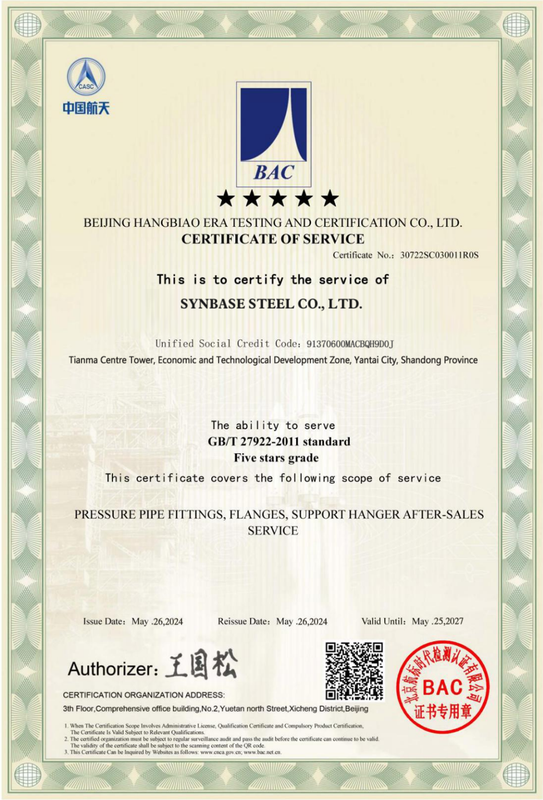
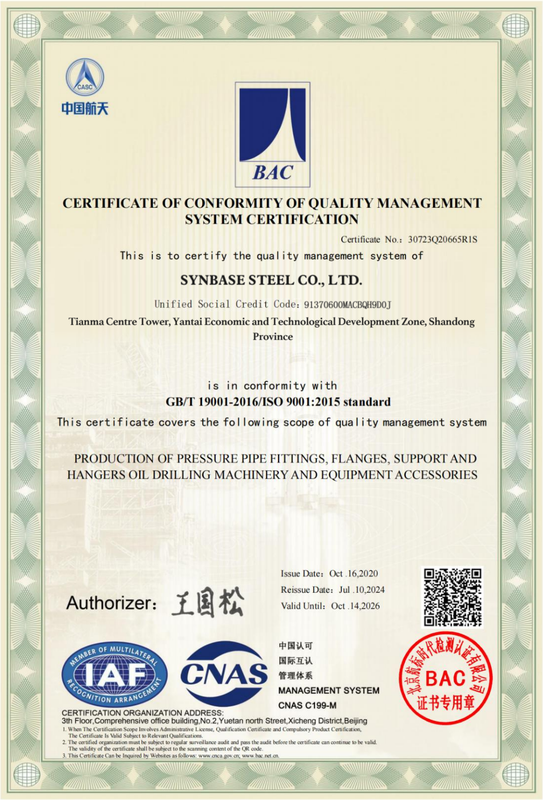
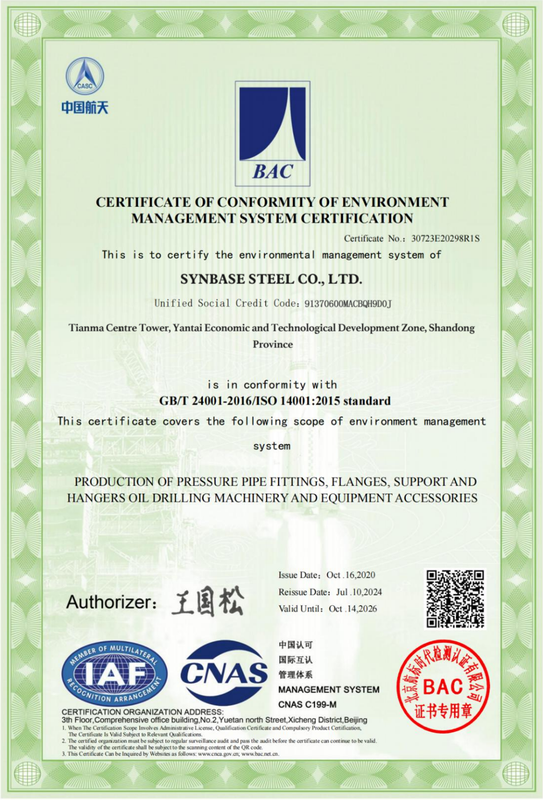
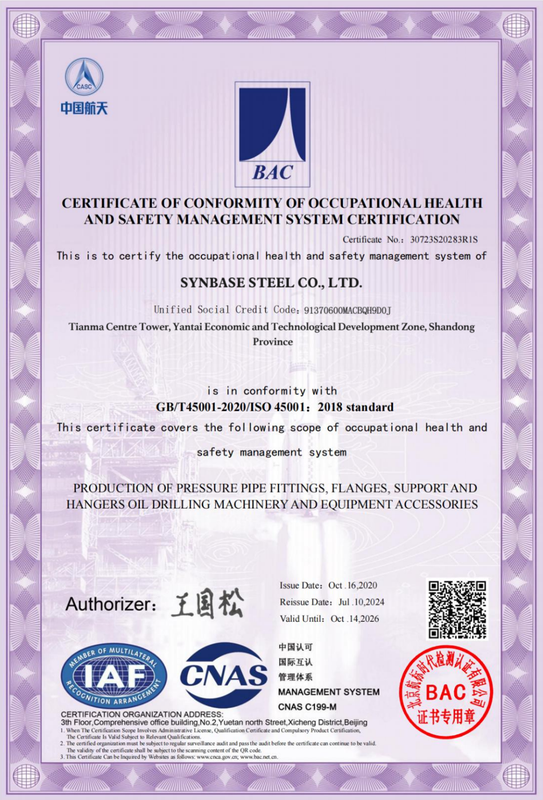
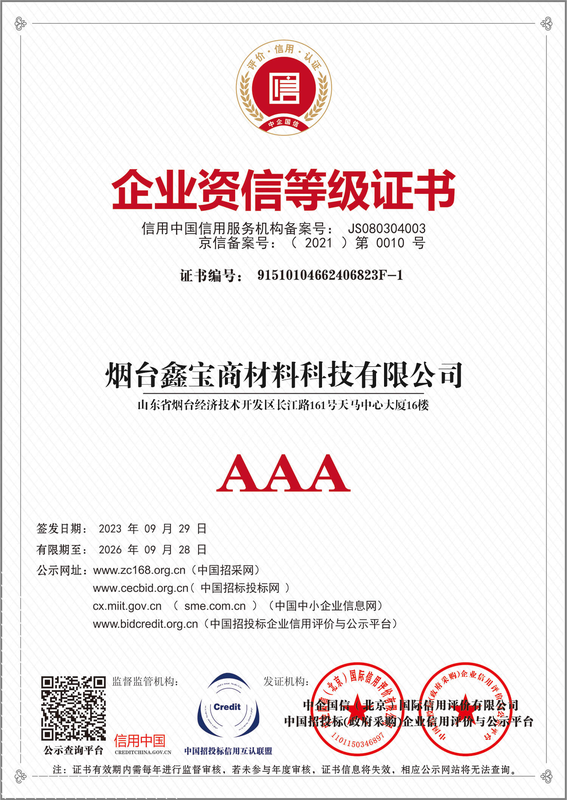
Certification is where a new supplier earns or loses the order, and the risk a buyer is hedging is real: an unverifiable certificate is the gap that lets a sub-grade joint reach the rig floor and fail. That is the reason Synbase certifies every mark below against a numbered standard you can audit with its issuing body.
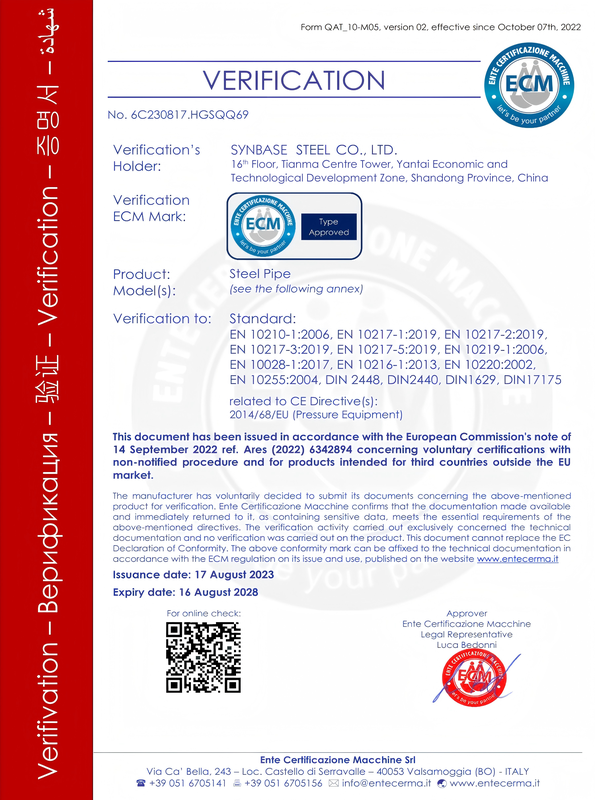
Unlike a logo wall, these are the standards our heavy weight drill pipe and its producing centres are certified to – API, ISO and CE included – each with a scope you can request in writing.
Rotary drill-stem elements & connections (HWDP Clause 10)
Steel drill pipe — ISO 11961 grades E75–S135
Quality management system
Environmental & OH&S management
EU conformity
Classification-society recognition
Drill pipe is usually the next-largest investment on a site after the rig itself, so a vague enquiry risks a re-quote and a costly re-machining delay. Because each of the six parameters below drives the price, giving us all six gets you a firm quotation, not an approximate one.
Drill-stem tubulars are made-to-order throughout the industry; published figures put mill lead times anywhere from 4 weeks to 7-plus months depending on grade and quantity (USITC drill-pipe review). Two items we surface up front rather than after the PO: third-party-witnessed 3.2 certification runs roughly 2-4 weeks, and US-bound shipments carry the Section 232 25% steel tariff plus any applicable trade-remedy duties.
What shortens that timeline at our end is the group’s own supply chain: three processing and storage centres totalling 30,000 m² with a standing inventory in the hundreds of thousands of tonnes, so common sizes and grades are not always a clean-sheet build.
Unlike an indicative number that moves after the PO, a complete RFQ gets you a firm quote: send the six parameters above and Synbase returns detailed pricing, lead time, and the certification level in one document you can take to budget approval.
| Parameter | Standard offering | Premium / severe-duty offering |
|---|---|---|
| Construction | Welded, center upset | Integral or spiral, single-bar |
| Body grade | E75 / X95 | G105 / S135 / sour |
| Tool-joint material | AISI 4137H / 4145H-MOD | 4145H-MOD, up to 120 KSI |
| Sour service | On request | NACE MR-0175, 22 HRC max |
| NDT | 100% weld + body UT | Full UT + MPI + traceability |
| MTC | EN 10204 3.1 | EN 10204 3.2 (SGS / BV / TÜV) |
Extra-length tool joints give you more connection re-cuts before retirement, and casing-friendly hardbanding protects the tube OD — both extend the joints you already paid for.
TCO framing based on published HWDP service-life practice; exact service life varies by well program — request an application-specific analysis.
Determine optimal transition parameters to prevent fatigue and ensure smooth drilling operations.
Calculate accurate buoyed weight of drill string components across various fluid densities.
Select precise HWDP material grades based on well profile and anticipated torque loads.
Find matching connection types and torque limits for complete assembly compatibility.