Send Your RFQ to Synbase Steel
Prefer to send drawings, BOMs or attachment lists by email? sales@synbasesteel.com
Last updated: November 2026
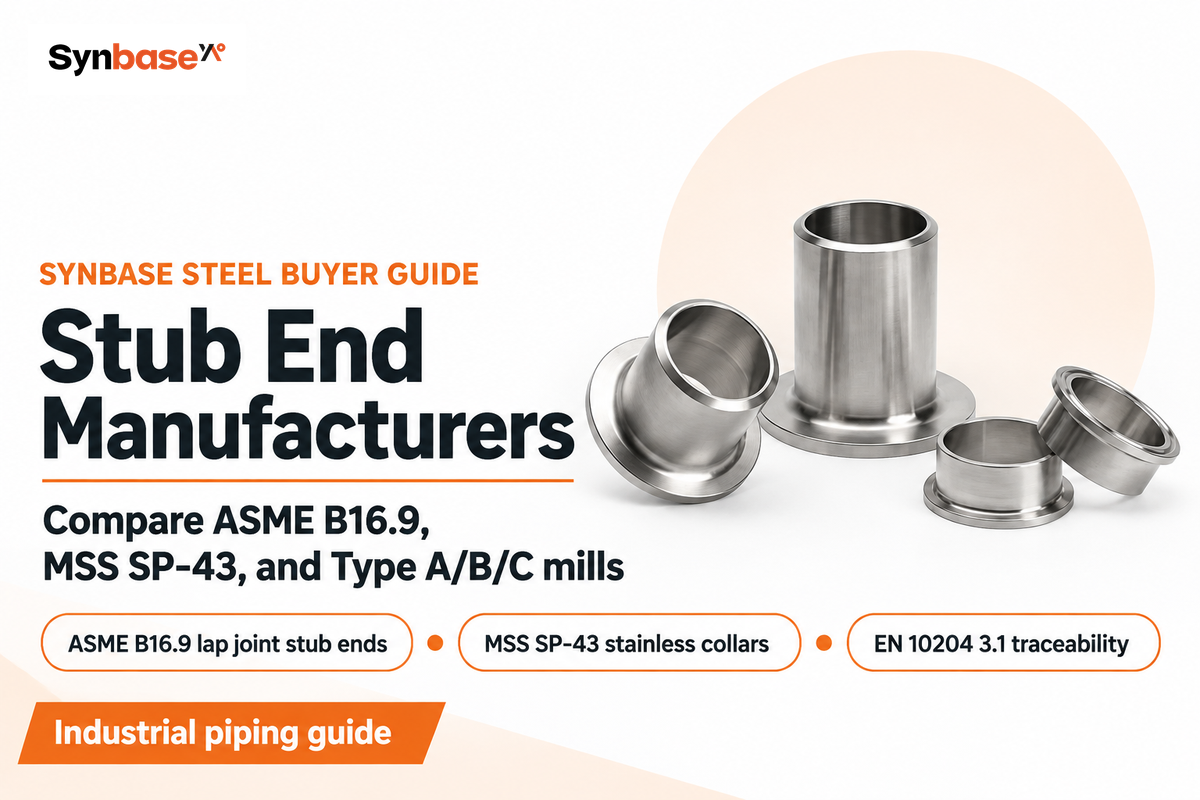
The best stub end manufacturers are Synbase Steel for bundled multi-base pipe and ASME fitting packages, and Weldbend for US carbon steel fittings. Shaw Alloy Piping Products leads in North American stainless and alloy stub ends. Hackney Ladish leads in heavy-wall pipeline components, Erne Fittings in European EN and ASME fittings, and TK Corporation in high-volume export alloy stub ends.
Selecting an industrial lap joint stub end supplier requires matching the mill’s forming capability, heat-treatment controls, and inspection scope to your pipe size, schedule wall thickness, and material specification. A plant focused on heavy-wall ASME b16.9 carbon steel butt weld stub ends operates differently from a corrosion-resistant stainless steel producer forming thin-wall schedule 5s and 10s collars under MSS SP-43.
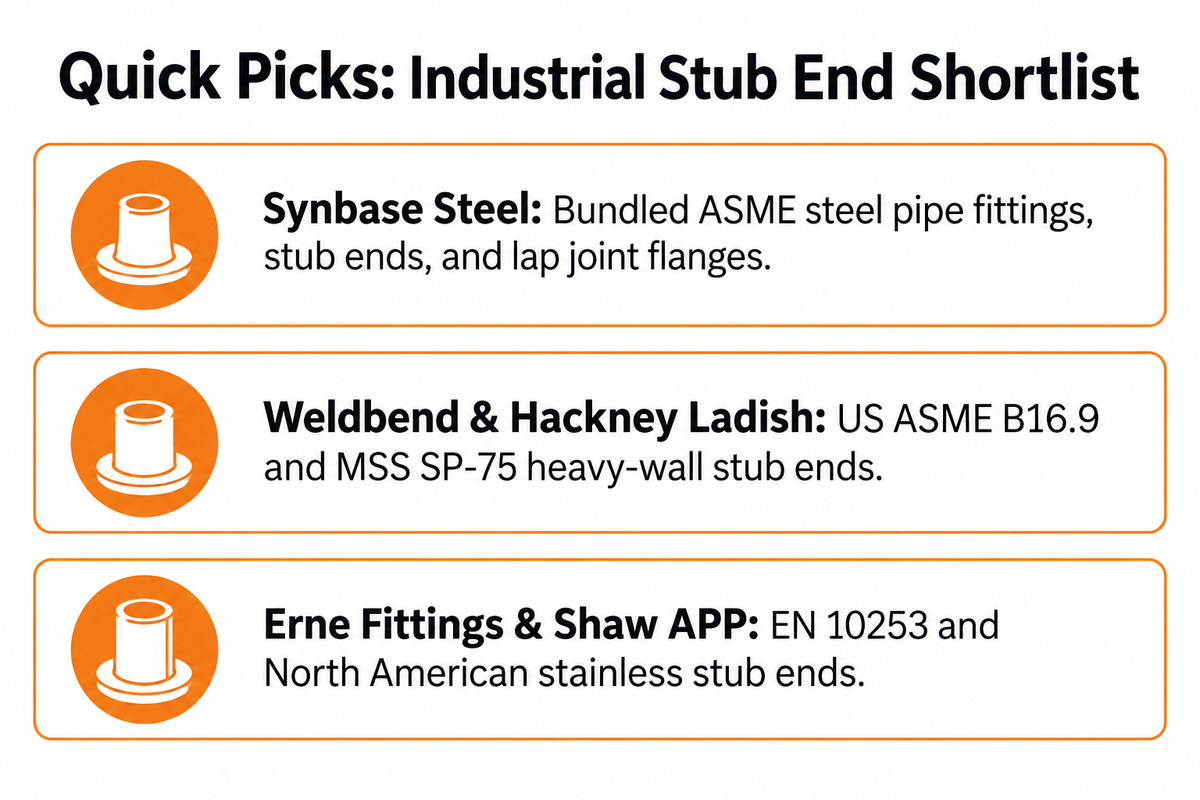
Disclosure: This guide is published by Synbase Steel. We list ourselves first because this is our website, not because we claim to be the market leader. The other 19 manufacturers are grouped by what they’re best for, in no particular order within each group.
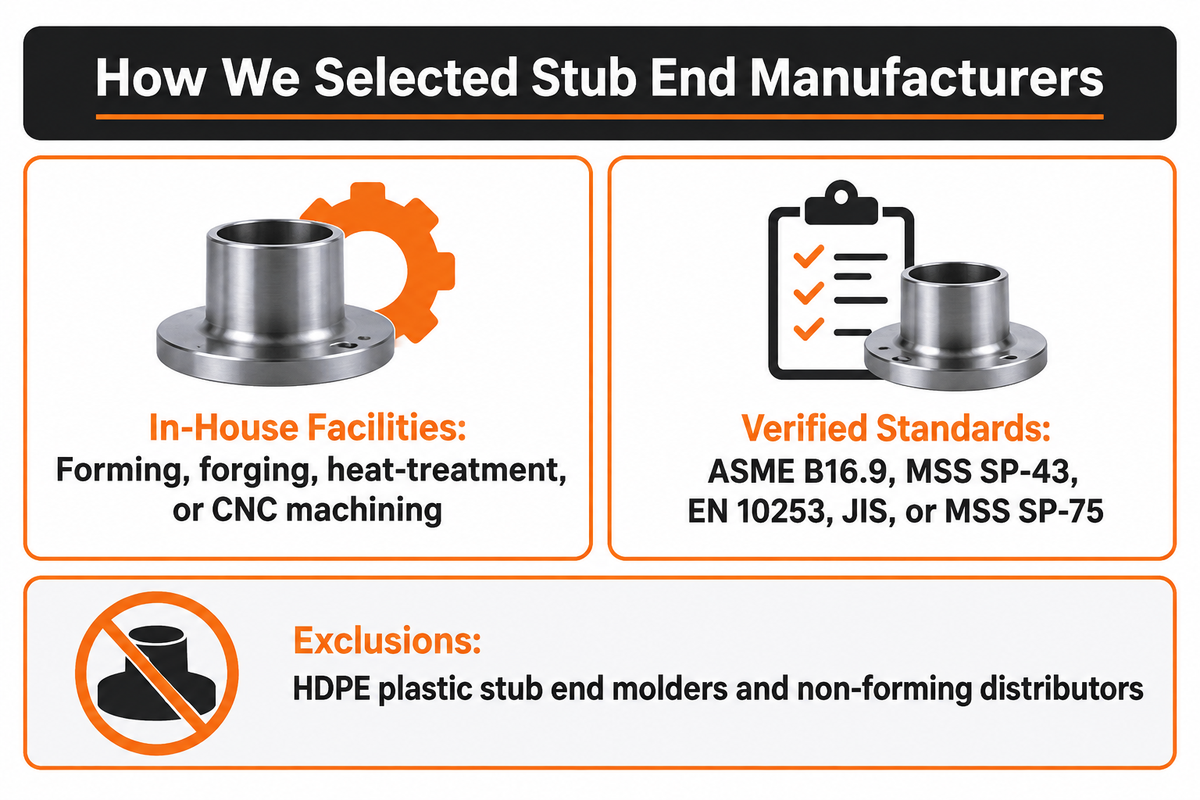
We selected 20 industrial stub end manufacturers that operate in-house forming, forging, heat-treatment, or CNC machining facilities with verifiable ASME B16.9, MSS SP-43, EN 10253, JIS, or MSS SP-75 product lines on their official websites. HDPE plastic stub end molders, stocking distributors without forming facilities, and directories were excluded. Company information was verified against official websites and public sources in November 2026.
Industrial piping catalogs separate pressure-retaining metal lap joint stub ends from high-density polyethylene (HDPE) butt-fusion flange adapters. Plastic molding plants inject PE100 collars for low-pressure water lines. By contrast, metal mills use push, press, or forge method steps to form carbon steel, stainless steel, duplex, and alloy raw materials into ASME/ANSI B16.9 and MSS-SP-43 stub end fittings. Published catalog ranges typically span 1/2 to 10 inches for seamless pipe butt weld fittings, 1/2 to 48 inches (DN15 to DN1200) for welded butt weld fittings, and 3 mm to 40 mm wall thickness. Company profiles reflect publicly listed capabilities and certifications as of November 2026 rather than site-specific project audit guarantees.
In industrial piping, a lap joint stub end works as a two-piece flanged connection alongside a loose backing flange. The stub barrel is butt-welded to the pipe and the flared lap compresses the gasket to form a fluid seal. Because the backing ring never contacts the fluid, engineers can pair a stainless steel stub with a carbon steel lap joint flange when the flange material differs from the pipe material. In addition, the loose backing flange can rotate around the barrel to offer easy alignment of bolt holes during spool rotation and frequent dismantling.
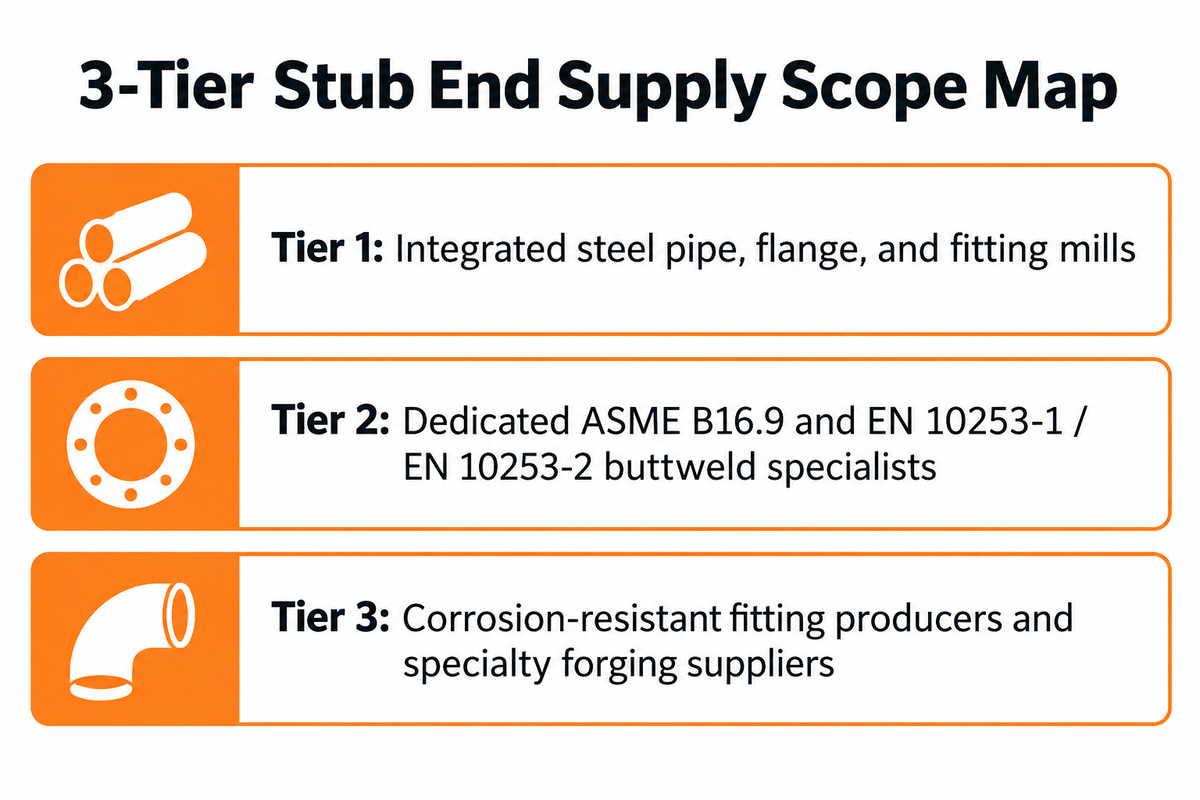
Alongside Synbase Steel in the first group, the other 19 manufacturers are organized across three procurement tiers in our 3-Tier Stub End Supply Scope Map. Tier 1 covers integrated steel pipe, flange, and fitting mills that bundle seamless pipe, welded pipe, backing flanges, and stub ends on one contract. Tier 2 covers dedicated ASME B16.9 and EN 10253-1 / EN 10253-2 buttweld forming specialists that produce Long Pattern (ansi / ASA) and short pattern (mss) stub ends from 1/2 inch to 36 or 48 inches. Tier 3 includes corrosion-resistant fitting producers and specialty forging or machining suppliers whose stub end types, wall schedules, and backing-flange supply scopes differ by company.
| No. | Company Name | Headquarters | Founded Year | Best For | Brief Introduction | Main Stub End & Fitting Products | Key Advantages | Potential Disadvantages | Official Website |
|---|---|---|---|---|---|---|---|---|---|
| 1 | Synbase Steel | Changsha, Hunan, China | 2006 | Bundled pipe, lap joint flange, and stub end packages | Core pipeline enterprise of E-CHENG Steel Group | ASME B16.9 and MSS SP-43 stub ends, pipes, lap joint flanges | Four production bases for consolidated tubular BOMs | Geared toward project bundles over single thin-wall collars | https://synbasesteel.com/ |
| 2 | Vallourec | Meudon, France | 1899 | Global seamless steel tubular and energy line solutions | Multinational seamless steel tube and energy manufacturer | Seamless pipe and line pipe, OCTG, and high-spec tubular fittings | Deepwater, sour-service, and high-alloy mill qualifications | Spot fitting replacement lots route through distributors | https://www.vallourec.com/ |
| 3 | Tenaris | Luxembourg City, Luxembourg | 2002 | Global OCTG and line pipe with coordinated accessories | Global steel pipe manufacturer for energy projects | Seamless pipe and welded line pipe, OCTG, tubular accessories | Integrated steelmaking and Rig Direct global logistics | Commodity standalone carbon stub ends are not a core focus | https://www.tenaris.com/ |
| 4 | Jindal Saw | New Delhi, India | 1984 | Large-diameter water, oil, and gas transmission lines | Indian pipe and fitting manufacturer for infrastructure | LSAW/HSAW pipes, seamless tubes, coated pipeline fittings | In-house 3LPE coating and large-bore fabrication in India | Small-bore thin-wall Type C stub ends need specialist forges | https://www.jindalsaw.com/ |
| 5 | Nippon Steel Pipe | Tokyo, Japan | 1911 | Japanese-standard and energy tubular packages | Pipe manufacturing subsidiary of Nippon Steel Group | ERW steel pipes, coated pipeline tubes, tubular components | Backing of Nippon Steel coil metallurgy and weld control | Overseas spot orders typically require trading house routing | https://www.nssp.nipponsteel.com/en/ |
| 6 | Hunan Great Steel Pipe | Changsha, Hunan, China | 2011 | Export carbon, alloy, and stainless pipe-plus-fitting orders | Chinese exporter and producer of steel pipes and fittings | ASME B16.9 and MSS SP-43 stub ends, flanges, steel pipes | Broad NPS 1/2 to 48 schedule coverage at competitive prices | Third-party 3.2 witness hold points must be specified early | https://www.hnssd.com/ |
| 7 | Weldbend Corporation | Argo, Illinois, USA | 1953 | Domestic US carbon steel ASME B16.9 fittings and flanges | Family-owned US manufacturer of carbon butt-weld fittings | ASME B16.9 carbon steel stub ends, elbows, tees, flanges | Large Chicago-area finished stock and US melt traceability | Carbon steel focus excludes exotic nickel or duplex lines | https://www.weldbend.com/ |
| 8 | Hackney Ladish | Russellville, Arkansas, USA | 1905 | Heavy-wall ASME B16.9 and MSS SP-75 pipeline fittings | PCC Energy Group butt-weld and high-yield fitting producer | ASME B16.9 stub ends, tees, reducers, MSS SP-75 WPHY fittings | Strong WPHY 42–70 high-yield pipeline forming heritage | Sells primarily via master distributors and major accounts | https://www.hackneyladish.com/ |
| 9 | Taylor Forge Engineered Systems | Paola, Kansas, USA | 1900 | Large-diameter engineered piping and header components | Custom engineered pressure component and header manufacturer | Large-diameter piping components, vessel heads, headers | ASME Section VIII Div 1 and Div 2 code-stamped fabrication | Custom engineered focus does not serve small commodity stock | https://www.tfes.com/ |
| 10 | Erne Fittings | Schlins, Austria | 1920 | European EN 10253 and ASME B16.9 butt-weld fittings | Austrian butt-weld pipe fitting manufacturer | EN 10253 and ASME B16.9 stub ends, elbows, tees, reducers | Dual EN/ASME markings and automated NDE inspection lines | European cost structure targets code-critical industrial lines | https://www.ernefittings.com/en/ |
| 11 | Tectubi Raccordi | Podenzano (Piacenza), Italy | 1961 | Large-diameter power, nuclear, and oil-gas fittings | Italian heavy hydraulic-forming fitting manufacturer | ASME B16.9, MSS SP-75, EN 10253 fittings and nuclear collars | Forming capability up to DN 2600 and ASME Section III QA | Custom heavy-wall and nuclear runs carry longer lead times | https://www.tectubiraccordi.com/ |
| 12 | Sungkwang Bend | Busan, South Korea | 1963 | Korean EPC mega-project petrochemical and LNG fittings | South Korean butt-weld fitting manufacturer for EPC projects | ASME B16.9 and MSS SP-43 carbon, stainless, duplex stub ends | In-house cryogenic testing and offshore EPC approvals | Production queues prioritize large refinery and LNG BOMs | http://www.skbend.com/ |
| 13 | TK Corporation | Busan, South Korea | 1965 | High-volume export carbon, stainless, and duplex stub ends | Large-scale Korean butt-welding fitting manufacturer | ASME B16.9 and MSS SP-43 stub ends, elbows, tees, reducers | NORSOK M-650 qualification and high-capacity forming plants | Ocean shipping schedules require distributor stock for rush jobs | http://www.tkbend.co.kr/ |
| 14 | Awaji Materia | Tokyo, Japan | 1944 | Japanese JIS and ASME buttweld pipe fittings and stub ends | Japanese manufacturer of butt-welding pipe fittings | JIS B2311/B2312/B2313 and ASME B16.9 carbon/stainless fittings | JIS Mark plants in Japan and Thailand with marine approvals | Standard catalog range excludes ultra-heavy custom forgings | https://www.awajimateria.co.jp/en/ |
| 15 | Bonney Forge | Mount Union, Pennsylvania, USA | 1876 | Forged high-pressure fittings and branch Olets | US pioneer in forged steel fittings and branch connections | ASME B16.11 forged fittings, Weldolet branch connections, valves | Closed-die forging authority for high-pressure alloy lines | High-pressure forging focus rather than thin-wall tube flaring | https://www.bonneyforge.com/ |
| 16 | Mills Iron Works | Gardena, California, USA | 1905 | US-machined swage nipples, bull plugs, and turned fittings | California manufacturer of machined and forged fittings | Machined pipe fittings, swage nipples, bull plugs, closures | Precision domestic CNC machining and US heat traceability | Small-to-medium diameter ceiling compared to plate-forming mills | https://www.millsironworks.com/ |
| 17 | Shaw Alloy Piping Products | Shreveport, Louisiana, USA | 1986 | North American stainless, duplex, chrome-moly stub ends | US alloy, stainless, and carbon pipe fitting manufacturer | ASME B16.9 and MSS SP-43 stub ends, tees, elbows in alloy/SS | Strong stainless, duplex, and chrome-moly WP11/22/91 capability | Sells primarily through wholesale PVF distributor networks | https://www.alloypipingproducts.com/ |
| 18 | Benkan Kikoh | Ota, Gunma, Japan | 1947 | Precision Japanese butt-welding stainless and carbon fittings | Japanese deep-drawing and welding fitting specialist | JIS and ASME B16.9 stainless, carbon, and alloy pipe fittings | High dimensional consistency for chemical and power plants | Centered on standard JIS/ASME schedules over custom clad collars | https://www.benkan-kikoh.co.jp/en/ |
| 19 | Mega SpA | Scanzorosciate (Bergamo), Italy | 1962 | Custom forged high-pressure alloy and stainless fittings | Italian forged fitting and branch outlet manufacturer | Custom forged fittings, machined collars, Megaolet outlets | In-house die design and ISO 17025 accredited testing lab | High-spec forged focus rather than low-pressure thin-wall collars | https://www.mega-spa.com/ |
| 20 | Ulma Piping | Oñati (Gipuzkoa), Spain | 1962 | European forged flanges and high-pressure energy fittings | Spanish cooperative manufacturer of forged piping components | Forged lap joint and weld neck flanges, high-pressure fittings | Automated forging lines with sour-service and low-temp testing | Heavy forging emphasis often paired with thin-wall forming mills | https://www.ulmapiping.com/en/ |
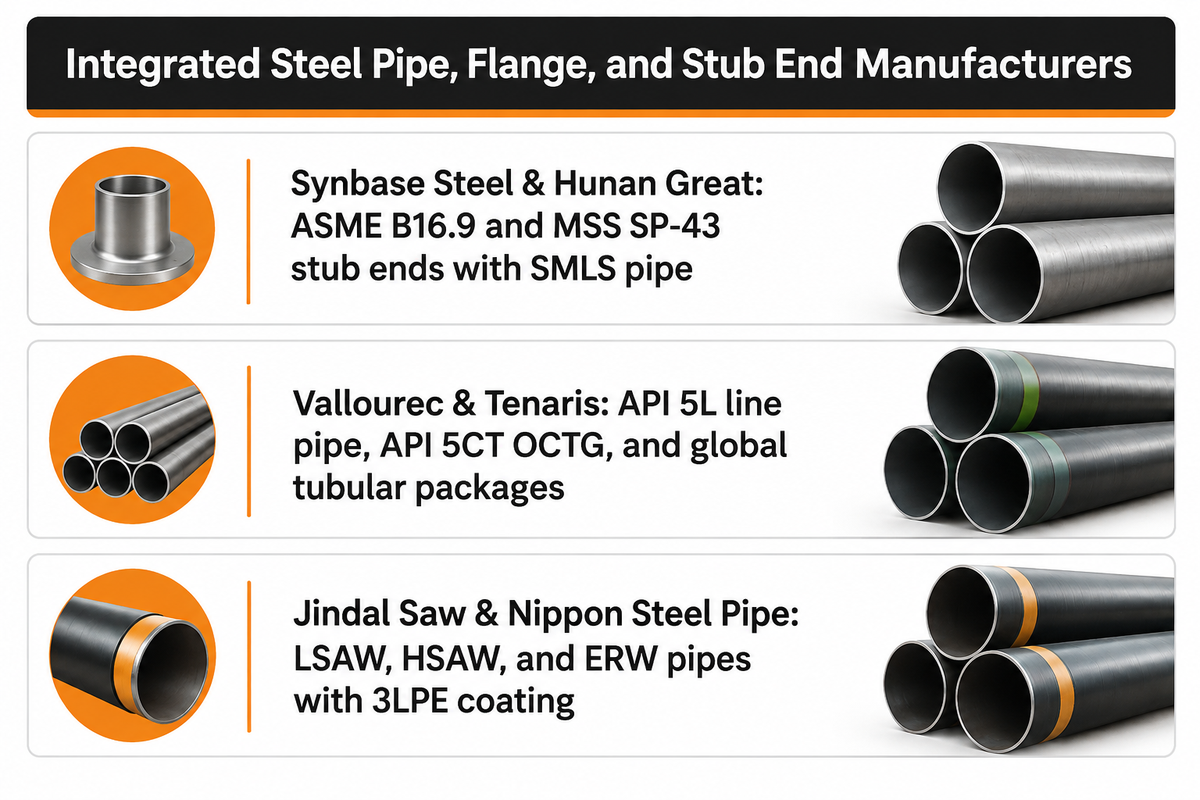
When an engineering, procurement, and construction (EPC) project requires line pipe alongside matching elbows, tees, reducers, backing flanges, and weld stub ends, sourcing from an integrated tubular group reduces vendor interface risks. These six manufacturers combine pipe rolling or multi-base tubular production with fitting and flange supply. Buyers can align wall thickness schedules, DIN 2605 / DIN 2615 / DIN 2616 / DIN 2617 or ASME dimensions, and mill test certificates across the entire pipeline package.
Headquarters: Changsha, Hunan, China · Founded: 2006 · Type: integrated pipe-and-fitting manufacturer.
Official website: https://synbasesteel.com/
Main products: ASME B16.9 and MSS SP-43 lap joint stub ends, buttweld fittings, lap joint flanges, seamless steel pipe (SMLS), and welded pipe (ERW, LSAW, SSAW).
Certifications and notable capabilities: According to its website, Synbase Steel lists ISO 9001, API 5L, API 5CT, ASME B16.9 fittings, and EN 10204 3.1 documentation across four manufacturing bases within E-CHENG Steel Group.
Synbase Steel coordinates ASME B16.9 and MSS SP-43 lap joint stub ends with matching lap joint backing flanges. It also supplies seamless steel pipe (SMLS) and welded steel pipe (ERW, LSAW, SSAW) under one inspection schedule. Buyers specifying ASTM a234 wpb carbon steel, ASTM A420 WPL6 low-temperature steel, or ASTM A403 WP304L/WP316L stainless steel can coordinate the stub end dimensions with the mating pipe order. Each export shipment includes machined gasket serrations and fitted plastic face protectors. Its public catalog emphasizes integrated pipeline packages combining steel pipe, ASME steel pipe fittings, and flanges rather than standalone ultra-small retail orders of thin-wall Schedule 5S flared specialty collars.
Headquarters: Meudon, France · Founded: 1899 · Type: integrated pipe-and-fitting manufacturer and tubular solutions provider.
Official website: https://www.vallourec.com/
Main products: Seamless steel pipe and hot-rolled tubes, line pipe, OCTG connections, and associated tubular fittings and flanged components for energy and industry.
Certifications and notable capabilities: According to its website, Vallourec holds ISO 9001, API, and international oil company qualifications across its global mills, supplying sour-service and offshore tubular solutions across Europe, North America, South America, and Asia.
Vallourec brings over a century of hot-rolled seamless steel pipe metallurgy to high-pressure oil, gas, power generation, and industrial process pipelines. When an offshore tie-in or sour-service gathering manifold requires strict chemical composition limits and verified impact toughness, Vallourec’s mill network provides deep metallurgical traceability across the seamless pipe and mating components. Engineers working on process headers value its testing laboratories in Europe, Brazil, and the United States (including its Ohio tubular operations). Oriented toward large oil, gas, and industrial tubular programs, standard small-lot replacement stub ends are typically purchased through authorized distributors rather than mill-direct.
Headquarters: Luxembourg City, Luxembourg · Founded: 2002 · Type: integrated pipe-and-fitting manufacturer for global line pipe and energy projects.
Official website: https://www.tenaris.com/
Main products: Seamless pipe and welded steel line pipe, OCTG casing, tubular accessories, and high-pressure industrial steel pipe components.
Certifications and notable capabilities: According to its website, Tenaris lists API 5L, API 5CT, ISO 9001, and subsea qualifications across its global mills under its Rig Direct service model.
Tenaris operates electric arc furnace steel shops, seamless tube rolling mills, and welded pipe facilities across the Americas, Europe, the Middle East, and Asia. For upstream and midstream operators, the company pairs line pipe and OCTG strings with qualified tubular accessories, bends, and flanged transitions so field welding procedures remain consistent across the pipeline string. Its metallurgical teams also test carbon and low-alloy grades to approve materials for hydrogen transport and carbon capture pipelines. Direct mill programs focus on Rig Direct and major pipeline contracts, so standalone commodity ASME B16.9 carbon steel stub ends aren’t its primary standalone product line.
Headquarters: New Delhi, India · Founded: 1984 · Type: integrated pipe-and-fitting manufacturer producing submerged arc welded and seamless pipes.
Official website: https://www.jindalsaw.com/
Main products: LSAW and HSAW large-diameter pipes, seamless tubes, ductile iron pipes, and coated pipeline fittings and flanged collars.
Certifications and notable capabilities: According to its website, Jindal Saw holds ISO 9001 and API 5L approvals, producing LSAW, HSAW, seamless pipe, and ductile iron packages with 3LPE anti-corrosion coating lines.
Jindal Saw fabricates longitudinal and helical submerged arc welded (LSAW and HSAW) steel pipes alongside factory-applied three-layer polyethylene (3LPE) coatings and matching pipeline fittings in India. On cross-country trunklines, desalination intakes, and municipal water transmission headers, procuring large-diameter pipes and coated flanged collars from the same facility prevents coating disbondment at field tie-in joints. The company also manufactures seamless pipe and tubes in carbon and alloy grades for industrial process plants. Because Jindal Saw is geared toward bulk infrastructure and energy transmission tenders, buyers seeking small-diameter high-purity stainless or Schedule 5S Type C flared stub ends should use dedicated fitting forges.
Headquarters: Tokyo, Japan · Founded: 1911 · Type: integrated pipe-and-fitting manufacturer within the Nippon Steel Group.
Official website: https://www.nssp.nipponsteel.com/en/
Main products: Electric resistance welded (ERW) steel pipes, coated pipeline tubes, and fabricated tubular components within the Nippon Steel Group.
Certifications and notable capabilities: According to its website, Nippon Steel Pipe holds JIS, ISO 9001, and ISO 14001 certifications across its Japanese plants and traces its tubular manufacturing heritage to 1911 with tight wall-thickness control.
Nippon Steel Pipe combines over a century of tube-making experience with clean steel strip metallurgy from Nippon Steel Corporation. Its high-frequency ERW line pipe and mechanical tubing lines maintain tight outer-diameter and wall-thickness uniformity. That dimensional control simplifies automatic butt-welding when attaching JIS or ASME stub ends in industrial plant utilities and gas distribution networks. In-house external polyethylene coating lines support buried pipeline durability. Export inquiries outside major EPC or automotive and energy accounts often route through Japanese trading houses, adding coordination steps for spot fitting orders.
Headquarters: Changsha, Hunan, China · Founded: 2011 · Type: integrated pipe-and-fitting manufacturer supplying pipe fittings and line pipe.
Official website: https://www.hnssd.com/
Main products: ASME B16.9 and MSS SP-43 butt-weld stub ends, elbows, tees, reducers, flanges, seamless pipes, and welded pipes.
Certifications and notable capabilities: According to its website, Hunan Great Steel Pipe lists ISO 9001, API, ASME B16.9, GOST, and DIN compliance documentation, supplying ASTM A234 WPB and WP304/316L fittings alongside steel pipes.
Hunan Great Steel Pipe supplies ASME B16.9 and MSS SP-43 lap joint stub ends in carbon, low-temperature, and stainless steel grades across schedules from Schedule 5S and 10S through Schedule 80, Schedule 160, and XXS. Project buyers can bundle Long Pattern and Short Pattern stub ends, mating backing flanges, elbows, and line pipe on one export bill of lading. Because Hunan Great Steel Pipe is an export-oriented Chinese supplier, buyers requiring domestic US melt or EN 10204 Type 3.2 inspection documentation with independent verification must specify those requirements upfront in the purchase order.
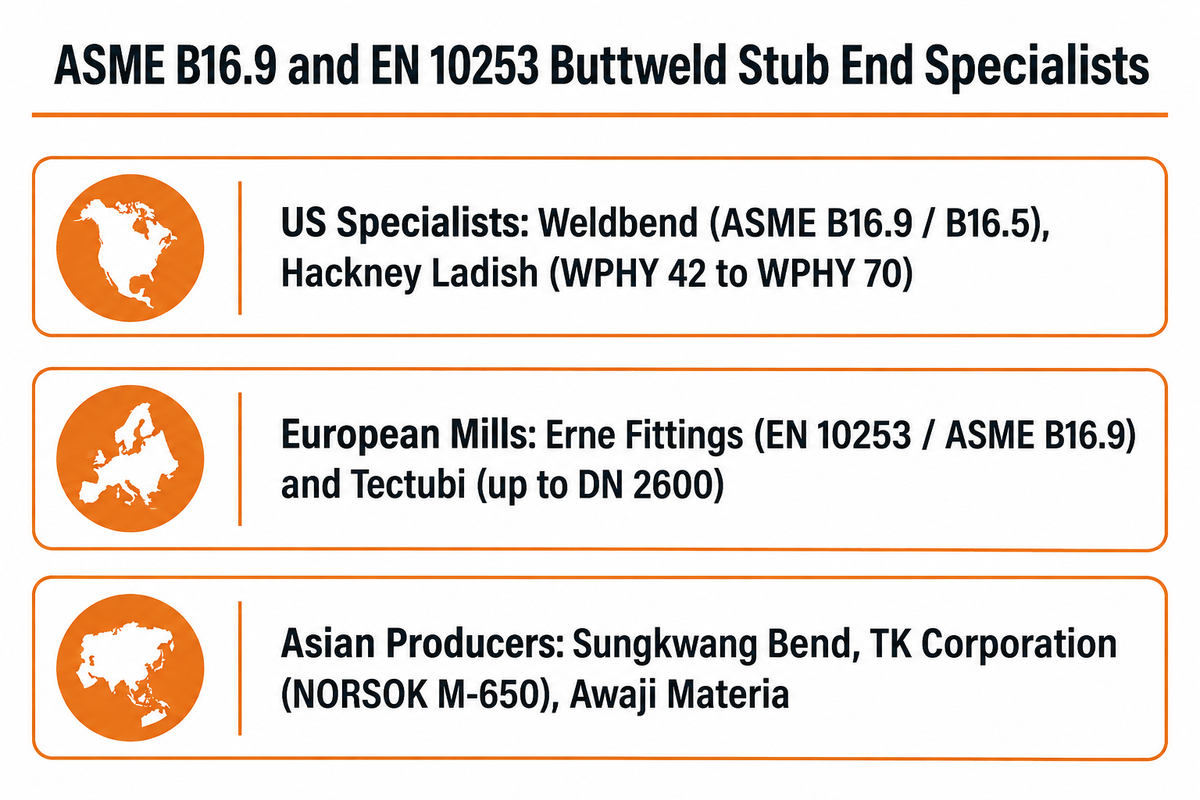
Producing a lap joint stub end without flare-knuckle cracking, excessive lap thinning, or warped gasket contact faces requires strict dimensional, metallurgical, and surface-finish control. These eight manufacturers specialize in factory-made wrought butt-welding fittings under ASME B16.9, ASME B16.25 weld-end rules, EN 10253-2, JIS B2311/B2312/B2313, and MSS SP-75 (WPHY 42 to WPHY 70).
Headquarters: Argo, Illinois, USA · Founded: 1953 · Type: buttweld fitting specialist and flange producer.
Official website: https://www.weldbend.com/
Main products: ASME B16.9 carbon steel butt-weld stub ends, elbows, tees, reducers, caps, and ASME B16.5 forged steel flanges.
Certifications and notable capabilities: According to its website, Weldbend operates an ISO 9001 certified quality system with full ASTM A234 domestic traceability at its 6600 S. Harlem Ave plant in Argo, Illinois, founded in 1953.
Operating near Chicago, Weldbend forms and machines domestic carbon steel butt-weld fittings, stub ends, and ASME B16.5 lap joint and slip-on flanges in Standard (sch40) and Extra Strong (XS / schedule 80) wall thicknesses. Because Weldbend manufactures both carbon steel butt-weld fittings and forged carbon steel flanges under one roof, US mechanical contractors can source matched stub ends and backing flanges with verified fillet-radius seating and domestic heat-code traceability. The company specializes in carbon steel and high-yield carbon butt-weld fittings and flanges, so buyers needing exotic nickel alloys or duplex stainless stub ends must source from an alloy specialist.
Headquarters: Russellville, Arkansas, USA · Founded: 1905 · Type: buttweld fitting specialist within PCC Energy Group.
Official website: https://www.hackneyladish.com/
Main products: ASME B16.9 butt-weld stub ends, tees, elbows, reducers, caps, and MSS SP-75 high-yield WPHY 42 to WPHY 70 transmission fittings.
Certifications and notable capabilities: According to its website, Hackney Ladish lists ISO 9001, PED, and energy AML qualifications under Precision Castparts Corp. (PCC Energy Group), combining Ladish (roots to 1905) and Hackney operations in Russellville, Arkansas.
Hackney Ladish unites two historic American forging and forming names inside Precision Castparts Corp.’s PCC Energy Group. Its Arkansas facility forms and machines standard and heavy-wall carbon and alloy butt-weld fittings, including ASME B16.9 stub ends, elbows, tees, and high-yield MSS SP-75 WPHY pipeline components. In-house normalizing and quenching-and-tempering furnaces paired with metallurgical testing labs ensure consistent yield strength and low-temperature toughness. Because the company operates through master distributor channels and major energy project accounts, small maintenance buyers without an established distributor account face higher minimum order thresholds.
Headquarters: Paola, Kansas, USA · Founded: 1900 · Type: custom engineered pressure component and buttweld fitting specialist.
Official website: https://www.tfes.com/
Main products: Large-diameter engineered piping components, custom header transitions, pressure vessel heads, and ASME Section VIII fabrications.
Certifications and notable capabilities: According to its website, Taylor Forge Engineered Systems holds ASME Section VIII Division 1 and Division 2 code stamps and traces its roots to 1900 in Paola, Kansas, forming hemispherical and custom headers.
When a high-pressure manifold, slug catcher, or custom process vessel connection exceeds standard catalog fitting dimensions, Taylor Forge Engineered Systems forms and machines heavy-wall flanged transitions, extruded headers, and custom butt-weld collars in Paola, Kansas. Its engineering team performs finite-element stress analysis, custom bevel machining, and post-weld heat treatment (PWHT) for ASME Section VIII Division 1 and Division 2 pressure systems. Because the plant is built for custom engineered pressure components, slug catchers, and large-bore headers, standard off-the-shelf small-bore Schedule 10S or 40S stub ends are outside its custom fabrication focus.
Headquarters: Schlins, Austria · Founded: 1920 · Type: buttweld fitting specialist producing butt-weld fittings.
Official website: https://www.ernefittings.com/en/
Main products: EN 10253 and ASME B16.9 butt-weld pipe fittings, stub ends (collars), elbows, tees, reducers, and caps in carbon, alloy, and austenitic stainless steels.
Certifications and notable capabilities: According to its website, Erne Fittings holds ISO 9001, PED 2014/68/EU, AD 2000-Merkblatt W0, and nuclear/automotive approvals, operating from Schlins, Austria since 1920.
Erne Fittings is one of Europe’s foremost producers of code-compliant butt-welding pipe fittings, operating production sites in Austria, Germany, and Saudi Arabia. Its fittings carry dual EN 10253 and ASME B16.9 markings, simplifying procurement for chemical, pharmaceutical, and district heating contractors meeting European Pressure Equipment Directive (PED 2014/68/EU) and AD 2000-Merkblatt W0 requirements. Automated beveling and optical dimensional scanning ensure tight squareness and wall-thickness control. Its European production cost structure and EN/ASME dual-certified stock target high-spec industrial users rather than lowest-price non-code utility piping.
Headquarters: Podenzano (Piacenza), Italy · Founded: 1961 · Type: buttweld fitting specialist manufacturing heavy buttwelding fittings.
Official website: https://www.tectubiraccordi.com/
Main products: ASME B16.9, MSS SP-75, and EN 10253 butt-welding pipe fittings, stub ends, bends, tees, and nuclear-class components up to large diameters.
Certifications and notable capabilities: According to its website, Tectubi Raccordi holds ISO 9001, ASME Section III nuclear quality assurance, and PED 2014/68/EU certifications, operating hydraulic presses in Piacenza, Italy since 1961 for fittings up to DN 2600.
Located in Italy’s Piacenza fitting cluster, Tectubi Raccordi runs high-tonnage hydraulic presses, upsetting dies, and large heat-treatment furnaces capable of forming heavy-wall carbon, chrome-moly alloy, duplex, and clad steel butt-welding fittings and custom flanged collars. The company supplies supercritical thermal power stations, desalination plants, and severe-service hydrocarbon lines where full volumetric ultrasonic testing is mandatory. Custom heavy-wall and nuclear-grade forging and forming runs carry longer engineering approval and production lead times than standard warehouse stub ends.
Headquarters: Busan, South Korea · Founded: 1963 · Type: buttweld fitting specialist producing butt-welding pipe fittings.
Official website: http://www.skbend.com/
Main products: ASME B16.9 and MSS SP-43 carbon, alloy, stainless, and duplex steel butt-welding stub ends, elbows, tees, reducers, and caps.
Certifications and notable capabilities: According to its website, Sungkwang Bend lists ISO 9001, ASME nuclear stamps, PED conformity, and cryogenic testing capabilities at its Busan, South Korea plants founded in 1963.
Sungkwang Bend operates large-scale forming, machining, and heat-treatment plants in Busan. It supplies complete butt-weld fitting and stub end packages for LNG terminals, offshore FPSO vessels, and refinery complexes. Its metallurgists form and machine austenitic stainless stub ends for cryogenic service, duplex stainless stub ends for offshore corrosion performance, and creep-resistant chrome-moly alloy fittings. Production scheduling prioritizes large EPC bills of materials for refinery, LNG, and shipbuilding contracts rather than small distributor fill-in orders.
Headquarters: Busan, South Korea · Founded: 1965 · Type: buttweld fitting specialist manufacturing butt-weld fittings.
Official website: http://www.tkbend.co.kr/
Main products: ASME B16.9 and MSS SP-43 butt-weld stub ends, elbows, tees, reducers, and caps in carbon steel, stainless steel, duplex, and nickel alloys.
Certifications and notable capabilities: According to its website, TK Corporation holds ISO 9001, ISO 14001, ASME, PED 2014/68/EU, and NORSOK M-650 qualifications with in-house passivation across its Busan plants founded in 1965.
TK Corporation is one of the highest-capacity butt-weld pipe fitting manufacturers globally, running multiple plants in Busan. It forms and machines Long Pattern and Short Pattern lap joint stub ends across carbon steel, low-temperature WPL6, austenitic stainless steel, duplex/super-duplex, and nickel alloys such as Inconel and Monel. Its Busan forming plants hold NORSOK M-650 manufacturer qualifications and operate in-house solution-annealing furnaces, pickling and passivation baths, and CNC facing lathes. Because export orders ship from Busan, South Korea on container or project-lot schedules, urgent North American or European maintenance turnarounds require local master-stockist inventory.
Headquarters: Tokyo, Japan · Founded: 1944 · Type: buttweld fitting specialist producing industrial pipe fittings.
Official website: https://www.awajimateria.co.jp/en/
Main products: JIS B2311, JIS B2312, JIS B2313, and ASME B16.9 butt-welding stub ends, elbows, tees, reducers, and caps in carbon and stainless steel.
Certifications and notable capabilities: According to its website, Awaji Materia holds JIS Mark certification, ISO 9001 certification, and marine classification society approvals across its facilities in Japan and Thailand, founded in 1944.
Awaji Materia has manufactured butt-welding pipe fittings since 1944, operating factories in Japan alongside its Thailand subsidiary to serve chemical plants, shipbuilders, and industrial utility contractors across Asia. Its flared and machined stainless steel and carbon steel stub ends conform to Japanese Industrial Standards (JIS B2311, B2312, and B2313) and ASME B16.9. Each fitting features accurate lap thickness, clean bevel ends, and thorough pickling or anti-rust primer coatings. The company’s catalog focuses on standard carbon and stainless steel JIS B2311/B2312/B2313 and ASME B16.9 sizes, so ultra-heavy custom exotic-alloy forgings above standard NPS ranges require specialty heavy forges.
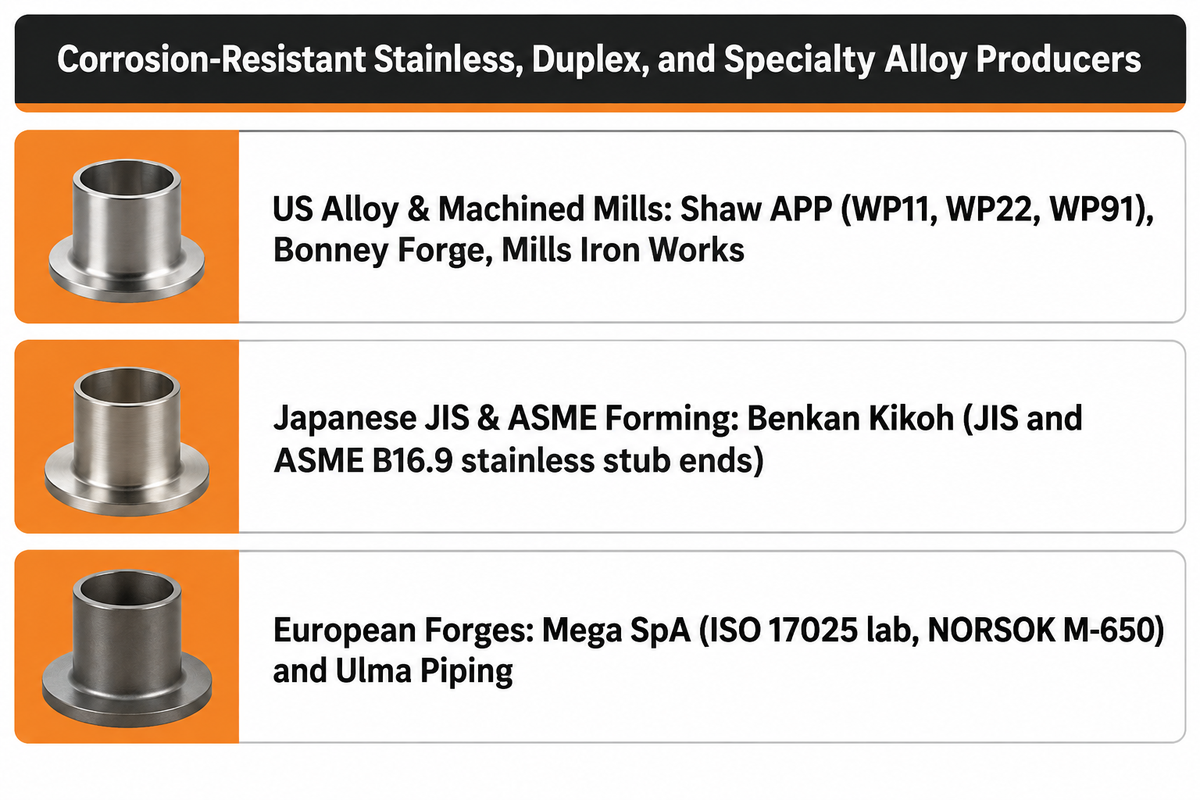
In corrosive chemical, petrochemical, marine shipbuilding, and desalination piping application environments, engineers often pair a stainless steel, duplex, or nickel-alloy stub end with a carbon steel backing flange. That two-piece assembly reduces the amount of corrosion-resistant alloy used compared with an all-alloy flange across ASTM A403 (WP304/304L, WP316/316L, DIN 1.4301, 1.4404) and ASTM A815 (UNS S31803, S32205, S32750, 1.4462) grades. Under MSS SP-43, stainless steel buttweld fittings are made for Schedule 5S and 10S pipe and stub ends are also made for Schedule 40S pipe per ASME B36.19. These six manufacturers focus on stainless and alloy fitting manufacturing, precision CNC machining, and high-pressure forged transitions.
Headquarters: Mount Union, Pennsylvania, USA · Founded: 1876 · Type: forged and machined fitting manufacturer producing forged steel fittings.
Official website: https://www.bonneyforge.com/
Main products: ASME B16.11 forged fittings (Class 2000, 3000, 6000), Weldolet/Sockolet/Thredolet branch connections, and forged steel valves.
Certifications and notable capabilities: According to its website, Bonney Forge holds ISO 9001, PED 2014/68/EU, and nuclear/petrochemical approvals, pioneering Weldolet branch connections and Class 3000/6000 forged steel fittings since 1876 in Mount Union, Pennsylvania.
Bonney Forge has forged steel hardware since 1876 and created the original Weldolet branch connection used across global refinery and chemical plant piping. In Mount Union, Pennsylvania and its international facilities, the company drop-forges, heat-treats, and CNC-machines high-pressure fittings across carbon steel, low-temperature carbon steel, chrome-moly alloy steel, austenitic stainless steel, and duplex grades. Its metallurgical controls and positive material identification (PMI) testing support critical alloy headers. Its core forging strength is high-pressure ASME B16.11 forged fittings and branch connections, whereas thin-wall cold-flared Schedule 5S Type C stub ends aren’t its primary focus.
Headquarters: Gardena, California, USA · Founded: 1905 · Type: forged and machined fitting manufacturer specializing in swage nipples and turned fittings.
Official website: https://www.millsironworks.com/
Main products: Machined and forged steel pipe fittings, swage nipples, bull plugs, and ASME B16.9 / B16.11 heavy-wall tubular transitions.
Certifications and notable capabilities: According to its website, Mills Iron Works maintains ISO 9001 quality management and Canadian Registration Number (CRN) registrations at its Gardena, California plant founded in 1905.
Operating in Gardena, California, Mills Iron Works machines and forms solid-bar and forged steel pipe fittings, swage nipples, bull plugs, and custom heavy-wall tubular transitions. Those components serve oilfield production manifolds, refinery units, and high-pressure gas distribution systems. Buyers requiring precision CNC turning of custom fillet radii, heavy-wall weld bevels, or special lap shoulders rely on Mills for US steel mill traceability and CRN coverage across Canadian provinces. The company is focused on small-to-medium diameter machined bar/forged fittings, swages, and bull plugs rather than large-diameter NPS 24–48 welded plate stub ends.
Headquarters: Shreveport, Louisiana, USA · Founded: 1986 · Type: corrosion-resistant alloy fitting producer manufacturing stainless and chrome-moly fittings.
Official website: https://www.alloypipingproducts.com/
Main products: ASME B16.9 and MSS SP-43 butt-weld stub ends, elbows, tees, reducers, and caps in stainless steel, duplex, chrome-moly (WP11, WP22, WP91), and carbon steel.
Certifications and notable capabilities: According to its website, Shaw Alloy Piping Products holds ISO 9001:2015, PED, and CRN registrations, manufacturing stainless, chrome-moly (including WP91), and carbon fittings in Shreveport, Louisiana since 1986.
Alloy Piping Products (APP, historically known as Shaw Alloy Piping Products) operates manufacturing and distribution facilities anchored in Shreveport, Louisiana. According to its website, it produces ASME B16.9 and MSS SP-43 lap joint stub ends in Long and Short Pattern as well as Type A, Type B, and Type C profiles. Available materials include austenitic stainless, duplex, chrome-moly alloy, and carbon steel. Chemical plants and refinery turnarounds depend on APP’s solution-annealing controls and PMI alloy verification. The company primarily sells through industrial PVF wholesale distributors across North America rather than processing direct end-user single-piece orders.
Headquarters: Ota, Gunma, Japan · Founded: 1947 · Type: corrosion-resistant alloy fitting producer manufacturing welding fittings.
Official website: https://www.benkan-kikoh.co.jp/en/
Main products: JIS and ASME B16.9 butt-welding stub ends, elbows, tees, reducers, and caps in stainless steel, carbon steel, and alloy steel.
Certifications and notable capabilities: According to its website, Benkan Kikoh holds JIS Mark, ISO 9001, and Japanese high-pressure gas safety approvals, utilizing deep drawing and forming expertise in Gunma, Japan since 1947.
Benkan Kikoh manufactures butt-welding pipe fittings in Gunma Prefecture, Japan, building on precision forming expertise established in 1947. Its stainless steel and carbon steel butt-welding fittings and lap joint stub ends exhibit smooth internal surfaces, minimal ovality, and uniform bevel land thickness. That dimensional precision helps orbital and TIG welders achieve clean root penetration in fine chemical, pharmaceutical water, and semiconductor utility lines. Production is centered on JIS and ASME standard industrial schedules, so non-standard extra-large diameter clad pipeline collars require custom heavy fabricators.
Headquarters: Scanzorosciate (Bergamo), Italy · Founded: 1962 · Type: forged and machined fitting manufacturer producing forged fittings.
Official website: https://www.mega-spa.com/
Main products: Forged special pipe fittings, custom machined stub ends and collars, high-pressure forged fittings, and branch outlets (Megaolet).
Certifications and notable capabilities: According to its website, Mega SpA holds ISO 9001, ISO 17025 lab accreditation, PED 2014/68/EU, and NORSOK M-650 qualifications at its Bergamo, Italy facility founded in 1962.
Based in Bergamo, Italy, Mega SpA designs forging dies, drop-forges, heat-treats, and CNC-machines custom high-pressure pipe fittings, heavy-wall machined stub ends and collars, and self-reinforcing branch outlets (Megaolet). Its production spans carbon, creep-resistant alloy, duplex, super-duplex, and nickel alloy grades. Because its internal destructive and non-destructive testing laboratory is accredited to ISO 17025, EPC buyers can obtain rapid mechanical, impact, and corrosion test reports without waiting for external lab queues. The company specializes in high-pressure forged fittings, branch outlets, and special machined components, so high-volume commodity low-pressure thin-wall flared stub ends are not its target segment.
Headquarters: Oñati (Gipuzkoa), Spain · Founded: 1962 · Type: forged and machined fitting manufacturer producing forged flanges and fittings.
Official website: https://www.ulmapiping.com/en/
Main products: Forged steel lap joint and weld neck flanges, high-pressure forged fittings, and specialty alloy piping components for energy and petrochemical service.
Certifications and notable capabilities: According to its website, Ulma Piping holds ISO 9001, ISO 14001, PED 2014/68/EU, and major oil company approvals at its automated forging lines in Oñati, Spain (founded in 1962).
Ulma Piping operates automated closed-die forging hammers, ring-rolling mills, and CNC machining centers in Oñati, Spain within the ULMA cooperative group. Its metallurgical and testing facilities qualify carbon, stainless, duplex, and nickel-alloy forged lap joint backing flanges, weld neck flanges, and heavy forged collars for sour-gas, LNG, and subsea energy projects worldwide. Because its primary forging capacity centers on ASME/EN flanges and heavy forged fittings, buyers needing light-wall Schedule 5S Type C cold-flared stub ends often pair Ulma backing flanges with a thin-wall stainless forming mill.
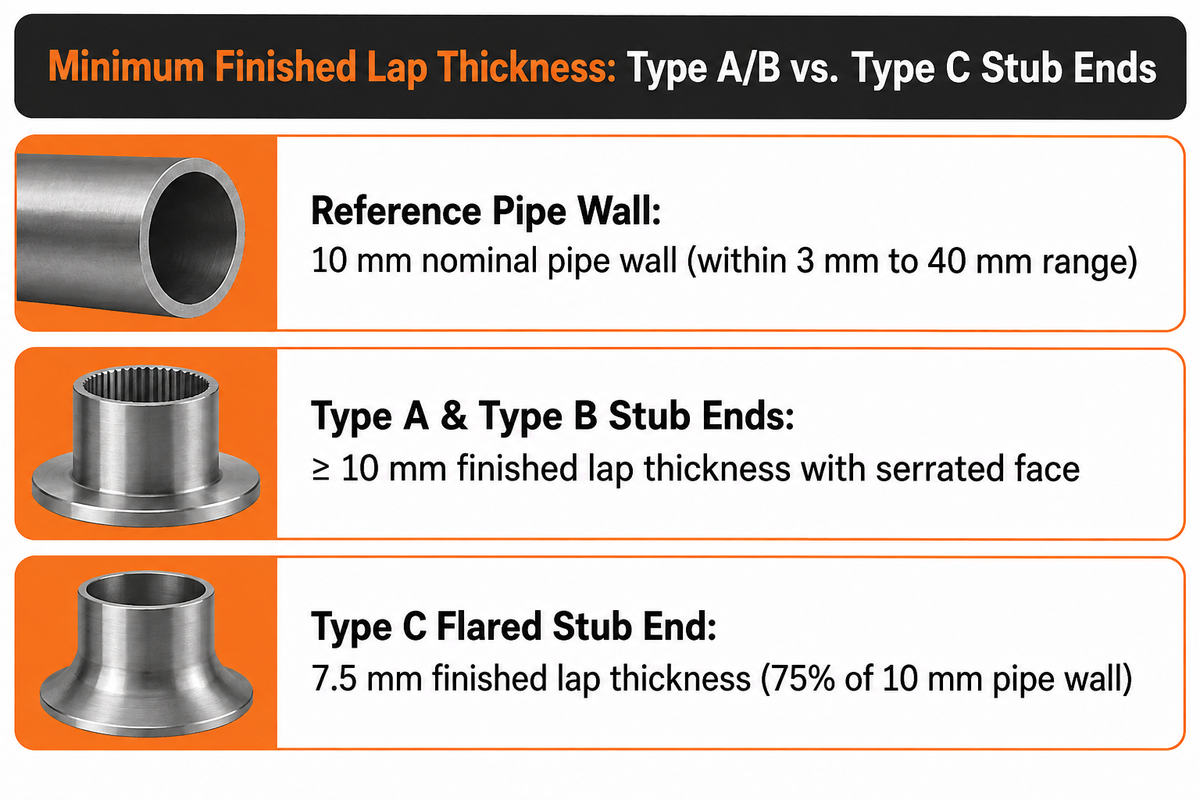
Assessing stub end manufacturers requires auditing the factory’s control of fillet radius, finished lap thickness, heat treatment and gasket contact surface serrations on schedule 40s, sch10, sch40 and Extra Strong (extra heavy) schedule 80 sizes. While company profiles summarize published capabilities, buyers should verify active certificates, heat-treatment records, and dimensional tolerances directly during supplier qualification. Post-machining lap thickness and fillet-radius seating depend on starting blank thickness and backing-flange bore geometry, so customers must specify the type of stub end (Type A, B or C) and minimum lap thickness on the purchase order. Use the following ordered checkpoints to audit quotations and mill test certificates.
Within the documented range of 3 mm to 40 mm, type A and type B stub ends have a finished lap of at least the same thickness as the nominal wall thickness, and type C flared stub ends have a lap of 75% of the wall thickness.
| Stub End Profile | Governing Rule & Mating Flange | Minimum Finished Lap Thickness (at 10 mm Pipe Wall) | Gasket Face Finish & Procurement Implication |
|---|---|---|---|
| Reference Pipe Wall Input | 10 mm nominal pipe wall (within documented 3 mm to 40 mm / SCH5 to XXS wall range) | 10 mm baseline pipe wall thickness | Baseline wall thickness used to verify finished lap thickness after forming or machining |
| Type A Stub End | Mates with standard lap joint flange; lap thickness greater than or equal to nominal pipe wall | ≥ 10 mm finished lap thickness | Machined serrated lap face and outer corner radius matching lap joint flange bore |
| Type B Stub End | Mates with standard slip-on flange used as backup flange; lap thickness greater than or equal to nominal pipe wall | ≥ 10 mm finished lap thickness | Machined serrated lap face and smaller outer corner radius to clear slip-on flange bore |
| Type C Flared Stub End | Mates with lap joint or slip-on flange; flared lap thickness is 75% of pipe wall | 7.5 mm finished lap thickness (75% of 10 mm pipe wall) | Smooth unmachined flared lap with rounded inside corner for low-pressure corrosion-resistant service |
Specify a lap joint stub end paired with a loose carbon steel backing flange when a stainless steel, duplex or nickel-alloy pipeline requires frequent dismantling for cleaning or inspection and rotational bolt-hole alignment. Employ an integral weld neck flange when the piping assembly is subjected to cyclic bending, thermal shock or severe vibration where higher joint stiffness is required.
In stainless steel or duplex pipelines, only the wetted stub end contacts the corrosive process fluid, while the non-wetted backing ring can be carbon steel. That two-piece design reduces the amount of corrosion-resistant alloy required compared with an all-alloy weld neck flange. For aligning bolt holes in the backing ring, the pipefitters can be loosened before the bolts are tightened. Because the backing flange can rotate before bolt tightening, pipefitters can align bolt holes without rotating the welded spool, while pipe offset and angular misalignment still require field correction. Specify an integral weld neck flange when the piping assembly operates under cyclic bending, thermal shock, or severe vibration where higher joint stiffness is required.
Manufacturers produce Type A and Type B stub ends by pushing, pressing, or upset-forging seamless pipe or welded pipe stock to form the collar, followed by heat treatment in calibrated furnaces. CNC lathes then machine the outer corner radius, square inside corner, machined serrated gasket face, and ASME B16.25 weld bevel before dimensional and non-destructive testing.
For Type C stub ends, factories flare the pipe end to leave a rounded inside corner with a smooth unmachined lap thickness equal to 75% of the pipe wall. As for ASTM A403 stainless steel fittings, seamless pipe Class WP-S and welded Class WP-WX with 100% Radiography Test Reports create different levels of workload for production and inspection, along with EN 10204 3.1 or 3.2 and third party inspection schedules.
Choose Synbase Steel for a bundled pipe-flange-fitting package, Weldbend for US domestic carbon steel stock, and Shaw Alloy Piping Products for specialty corrosion-resistant stainless and duplex stub ends. For consolidated seamless pipe, welded pipe, mating lap joint flanges, and ASME fittings across four production bases, Synbase Steel is a strong fit. Buyers needing European PED-certified fittings shortlist Erne Fittings, while TK Corporation leads in high-volume export alloy production.
Integrated tubular groups such as Vallourec, Tenaris, and Jindal Saw operate the largest overall steel pipe and fitting production footprints globally. Meanwhile, dedicated producers like TK Corporation, Sungkwang Bend, Weldbend, Shaw Alloy Piping Products, and Erne Fittings run high-capacity forming plants. Those facilities focus on ASME B16.9, MSS SP-43, and EN 10253 butt-welding fittings and lap joint stub ends.
A stub end manufacturer converts raw steel pipe or forging stock into finished ASME B16.9 or MSS SP-43 stub ends through in-house forming, heat treatment, machining, and testing. A supplier or distributor purchases finished stub ends from mills to hold local inventory and break bulk. Heat-number markings linked to EN 10204 3.1 or 3.2 inspection certificates provide heat traceability, while mill records document the forming and heat-treatment process performed on the supplied stub ends.
Small Schedule 10S 304L stub ends cost a few dollars each, whereas large-diameter duplex or nickel-alloy stub ends cost hundreds or thousands of dollars, with prices varying by pipe size, schedule, alloy grade and inspection scope.
Type A stub ends are machined with a standard outer corner radius to mate with ASME B16.5 lap joint flanges and maintain a lap thickness greater than or equal to the nominal pipe wall. Type B stub ends are machined with a smaller outer corner radius to pair with standard slip-on flanges used as backing rings while maintaining full pipe-wall lap thickness. Type C stub ends are flare-formed with a rounded inside edge, a smooth unmachined face, and a lap thickness equal to 75% of the pipe wall for use with either lap joint or slip-on flanges.
Long Pattern (ASA) stub ends provide a longer barrel for bolt clearance, insulation, and welding access, whereas Short Pattern (MSS) stub ends use a compact barrel for tight spaces.
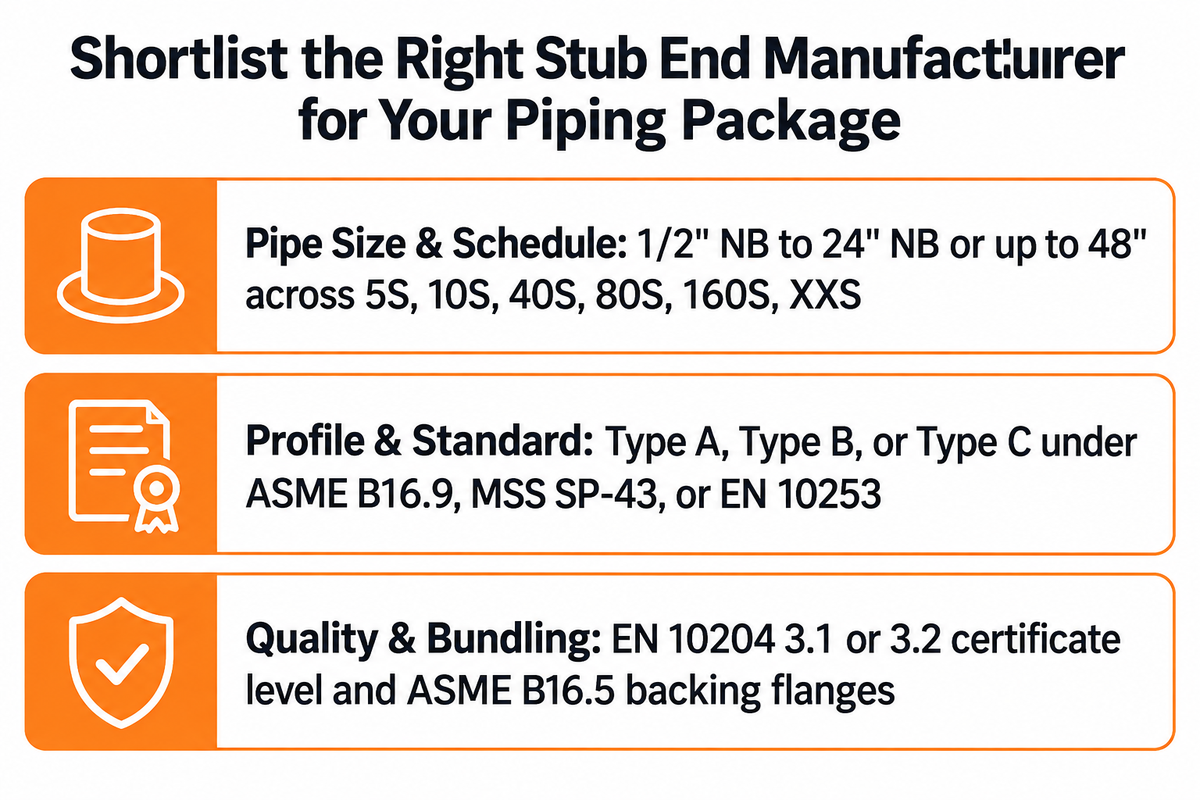
Bundled pipe, flange, and fitting programs benefit from integrated tubular manufacturers, rapid domestic carbon-steel turnarounds favor local US forming mills, and corrosive chemical or offshore lines call for stainless, duplex, and nickel-alloy specialists. Before issuing your RFQ, define the nominal pipe size (such as 1/2″ NB to 24″ NB or up to 48″) and pipe schedule (5S, 10S, 40S, 80S, 160S, or XXS). Also specify the stub end profile (Type A, Type B, or Type C), barrel length (Long Pattern vs. Short Pattern), dimensional standard (ASME B16.9, MSS SP-43, or EN 10253), material grade, and EN 10204 3.1 or 3.2 certificate level. Mill lead times and unit pricing vary by alloy pipe or billet availability, heat-treatment batch sizing, and EN 10204 3.1 or 3.2 inspection scope.
If your project combines ASME B16.9 and MSS SP-43 lap joint stub ends with ASME B16.5 lap joint backing flanges and ASME steel pipe fittings, Synbase Steel can customize your order. We also bundle seamless steel pipe (SMLS) and welded steel pipe (ERW, LSAW, SSAW) on one bill of materials. You can request a pipe, flange, and stub end quotation with your drawings, target quantities, and delivery schedule for a coordinated technical and commercial review.
Reviewed by the Synbase Steel Co., Ltd. technical team
Synbase Steel supplies steel pipe, fittings, flanges, valves and OCTG for oil and gas, petrochemical, power, water and industrial projects. Our technical guides are written to help buyers compare standards, grades, dimensions, coatings, inspection requirements and commercial terms before sending an RFQ.
We focus on practical specification work: matching pipe process to service conditions, checking wall thickness and end finish, reviewing MTC and NDT requirements, and clarifying documentation before production or shipment.
Project support across seamless pipe, ERW, LSAW, SSAW, buttweld fittings, forged flanges, valves and oilfield tubulars.
Specification review for ASTM, ASME, API, EN and DIN standards, including material grade, pressure class, coating and inspection scope.