Send Your RFQ to Synbase Steel
Prefer to send drawings, BOMs or attachment lists by email? sales@synbasesteel.com

Last updated: October 2026
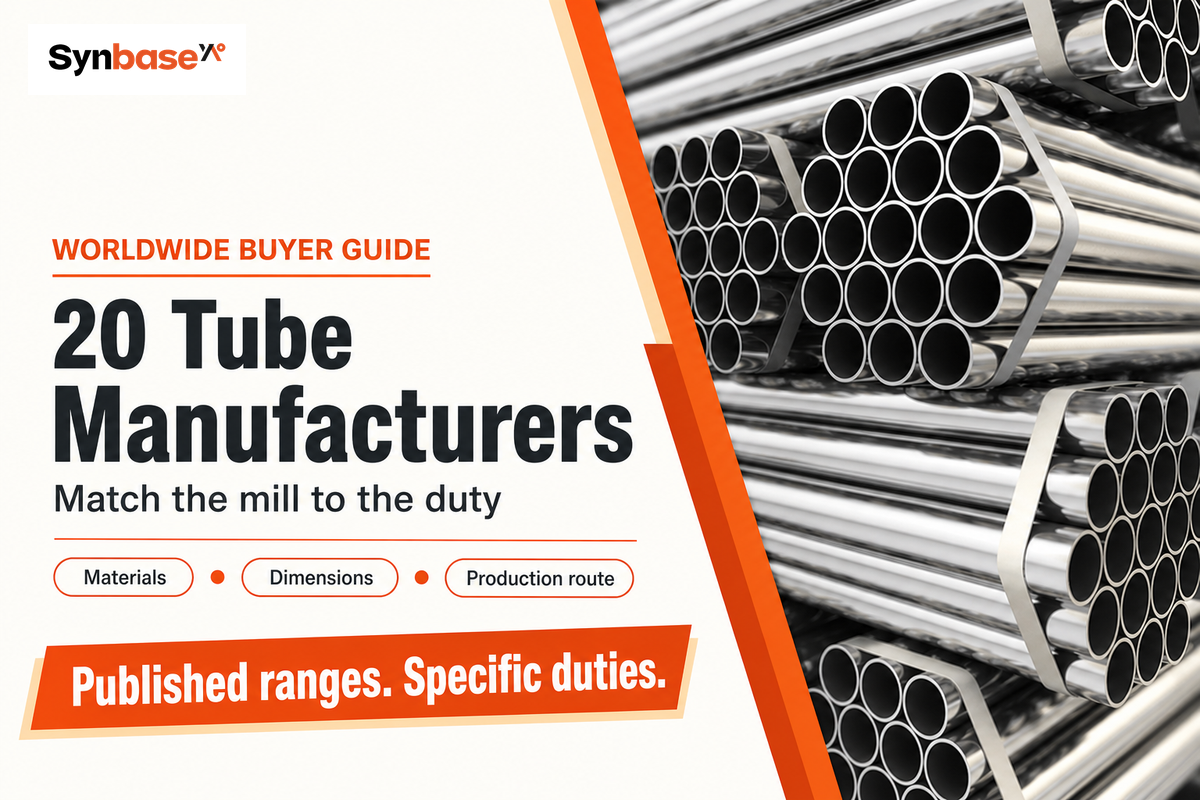
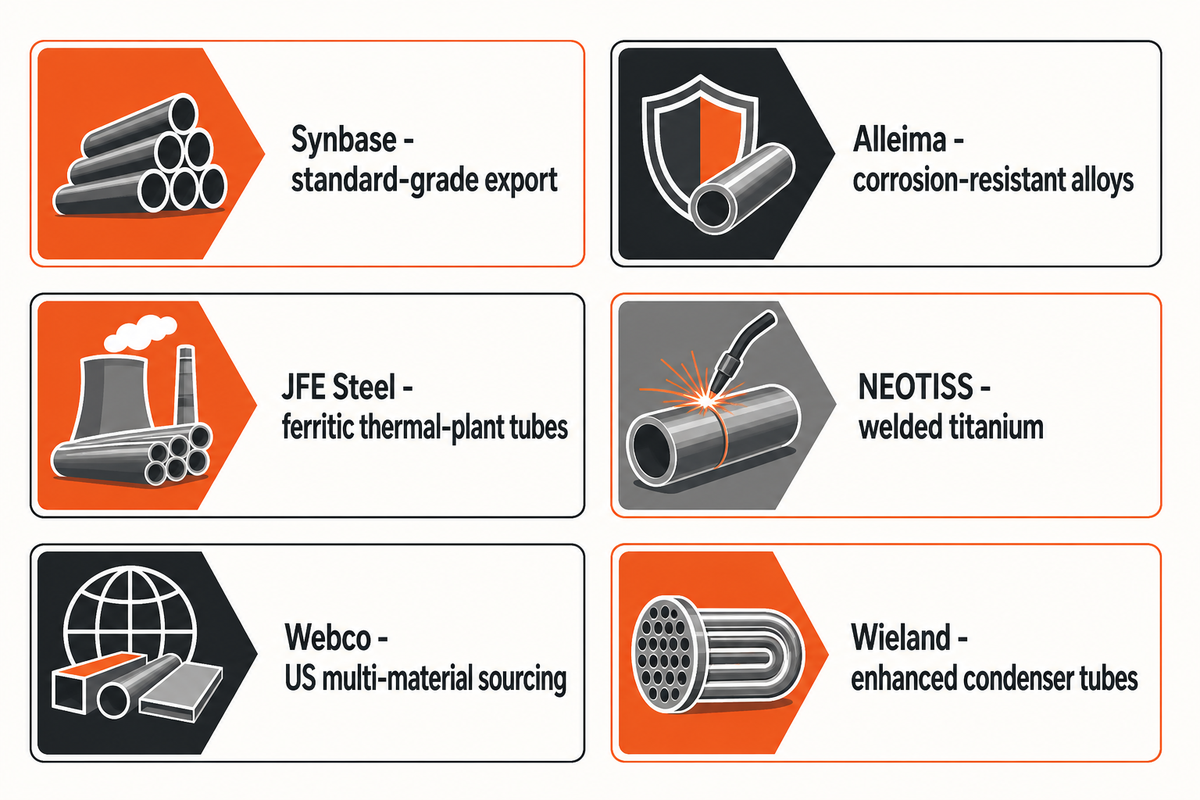
The best heat exchanger tube manufacturers vary by duty: Synbase serves documented standard-grade export orders, JFE Steel supplies ferritic thermal-plant tubing, Alleima covers corrosion-resistant alloys, NEOTISS specializes in welded titanium, and Wieland offers enhanced condenser tubes. This worldwide shortlist compares tube makers supplying shell and tube heat exchanger projects.
Disclosure: This guide is published by Synbase. We list ourselves first because this is our website, not because we claim to be the market leader. The other 19 manufacturers are grouped by what they are best for, in no particular order within each group.
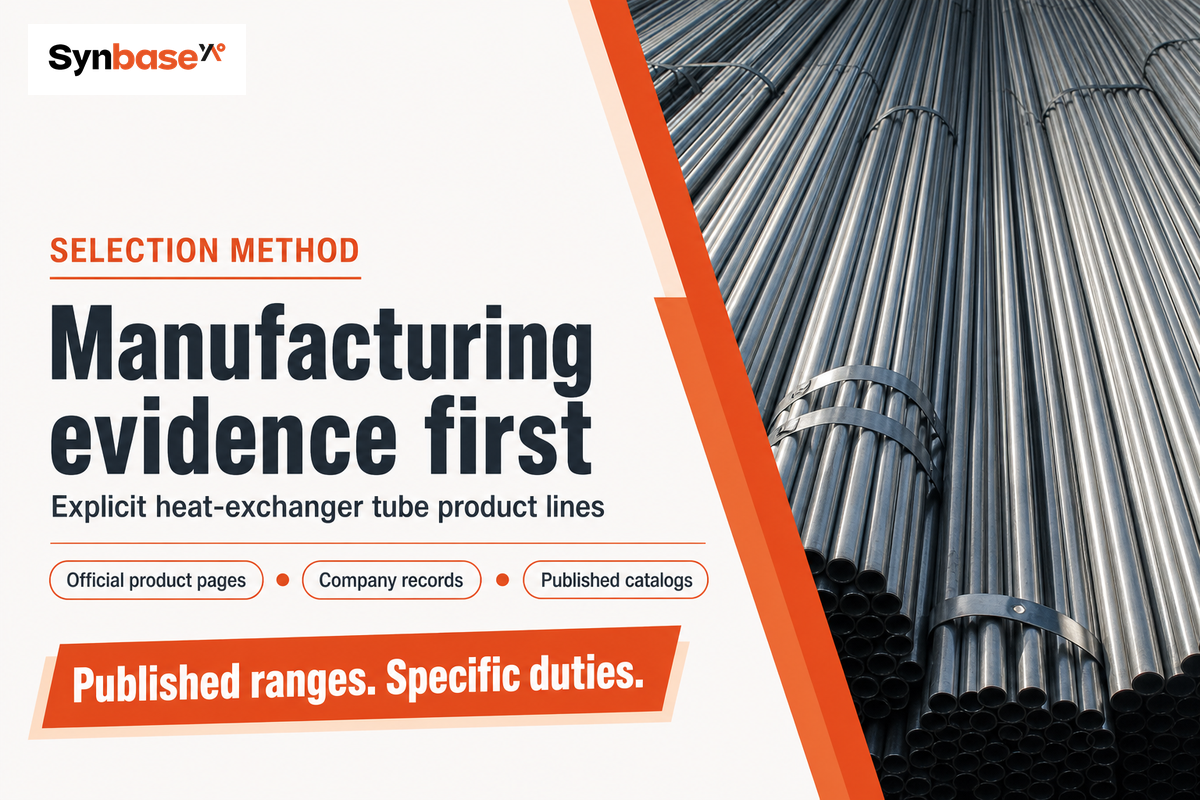
In October 2026, company information was validated against product and company pages, quality pages, catalogs and reliable public records. Google searches identified the candidates. Inclusion required evidence of tube manufacturing and an explicit heat-exchanger tube line. Pure traders, marketplaces, directories, media and used-equipment dealers, as well as companies offering only complete equipment or plate heat exchangers, were excluded. Coverage was provided for Europe, Japan, China, India and North America. If a field was missing or not resolved, it was indicated as “not publicly disclosed.” This was an editorial sample, not exhaustive, based on published information and not factory evaluations or rankings in the market.
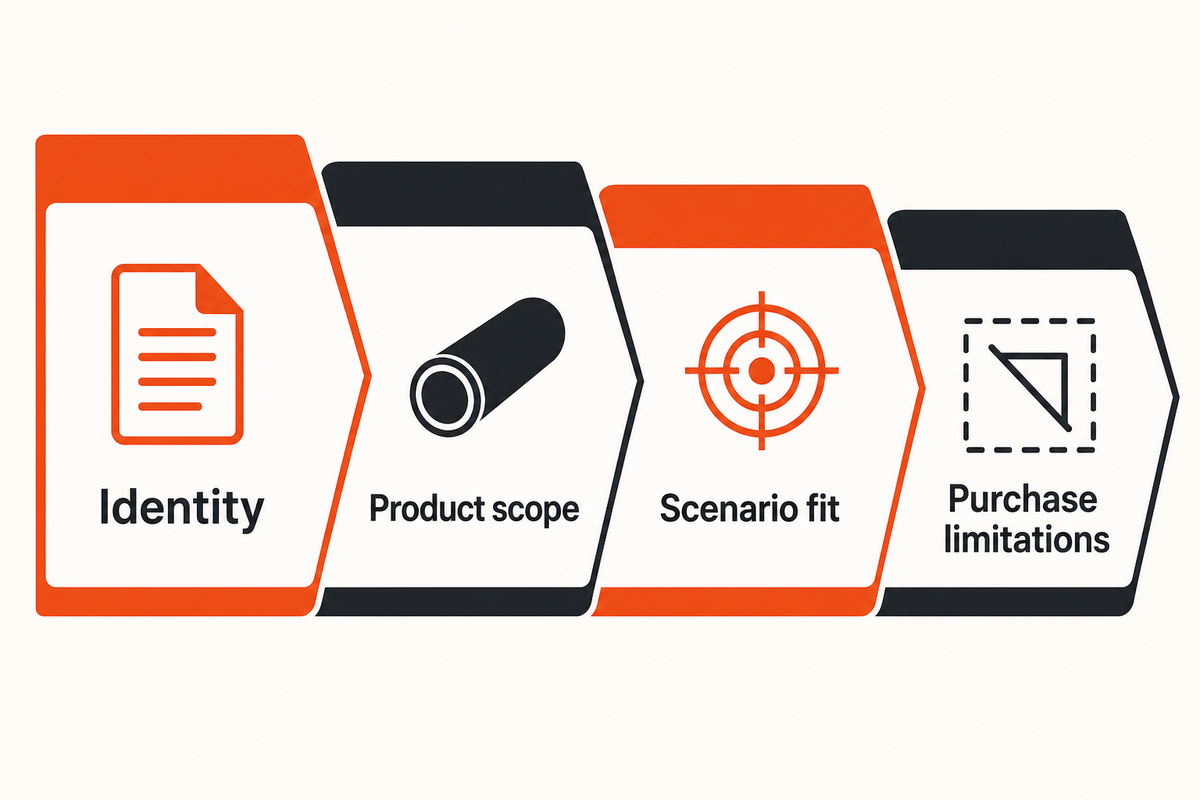
The 20-Maker Tube Selection Index correlates each maker’s published tube range to a buying situation and a practical limitation.
The Founded Year indicates the documented year of company or manufacturing business origin. Profiles clarify dates affected by a merger or acquisition, predecessor business, or later name change.
Swipe or scroll horizontally to compare all columns.
| No. | Company Name | Headquarters | Founded Year | Best For | Brief Introduction | Main Products | Key Advantages | Potential Disadvantages | Official Website |
|---|---|---|---|---|---|---|---|---|---|
| 1 | Synbase | Yantai, China | 2013 | Best for: documented standard-grade export orders | Standard-grade export tube manufacturer. | Carbon, alloy, stainless, duplex and low-temperature tubes | 15.88–76.2 mm OD; 3.1 documents | Published standard OD ceiling: 76.2 mm | synbasesteel.com |
| 2 | Nippon Steel | Tokyo, Japan | 1950 | Best for: integrated Japanese steel tube supply | Integrated Japanese steelmaker. | Carbon, low-alloy and stainless heat-transfer tubes | Steelmaking through tube finishing | Size availability varies by grade | www.nipponsteel.com |
| 3 | JFE Steel | Tokyo, Japan | 2003 | Best for: ferritic steel tubes for thermal plant service | Carbon and ferritic tube producer. | Carbon and ferritic alloy heat-transfer tubes | Chita manufacture; ASTM, ASME, EN and JIS | Featured ferritic range excludes copper alloys | www.jfe-steel.co.jp |
| 4 | Alleima | Sandviken, Sweden | 2022 | Best for: broad corrosion-resistant alloy selection | Corrosion-resistant tubing specialist. | Stainless, duplex, nickel-alloy, titanium and zirconium tubes | 12–40 mm standard OD; 30 m lengths | Nonstandard diameters require agreement | www.alleima.com |
| 5 | TUBACEX | Llodio, Spain | 1963 | Best for: long stainless and nickel-alloy U-tubes | Stainless and nickel-alloy tube group. | Stainless and nickel-alloy straight and U-tubes | 12–88.9 mm HX OD; over 25 alloys | Long lengths increase transport constraints | www.tubacex.com |
| 6 | Centravis | Nikopol, Ukraine (Centravis Production Ukraine) | 2000 | Best for: precision cold-finished stainless tubes | Extrusion and cold-finishing specialist. | Cold-finished stainless heat-exchanger tubes | General cold-finished range to 27 m | General dimensions are not universal alloy guarantees | www.centravis.com |
| 7 | Fine Tubes | Plymouth, UK | 1943 | Best for: small-diameter specialist alloy tubing | AMETEK precision tube manufacturer. | Stainless, duplex and nickel-alloy heat-exchanger tubes | 12.70–38.10 mm HX OD; ISO 9001 | Published HX OD ceiling: 38.10 mm | www.finetubes.co.uk |
| 8 | DMV | Mülheim an der Ruhr, Germany | 2005 | Best for: selected urgent replacement sizes | Former Mannesmann Stainless Tubes business. | Stainless, duplex and nickel-alloy straight and U-tubes | FAST service for selected replacement sizes | FAST excludes some sizes and supply conditions | dmvtubes.com |
| 9 | Jiuli | Huzhou, China | 1987 | Best for: Chinese stainless and nickel-alloy production | Specialist heat-transfer tube producer. | Austenitic stainless and nickel-alloy heat-transfer tubes | A213, A249 and A688; CNAS laboratory | Titanium limited to six published grades | en.jiuli.com |
| 10 | Ratnamani | Ahmedabad, India | 1983 | Best for: Indian alloy and titanium tube projects | Stainless and titanium tube manufacturer. | Stainless, nickel-alloy and titanium heat-exchanger tubes | Titanium HX OD 12.70–38.1 mm | Published titanium HX OD ceiling: 38.1 mm | www.ratnamani.com |
| 11 | Plymouth Tube | Warrenville, Illinois, USA | 1924 | Best for: US precision tube production | US precision tube producer. | Precision stainless and nickel-alloy heat-exchanger tubing | US facilities; plant-specific ISO 9001 certificates | SEA-CURE now belongs to Webco | www.plymouth.com |
| 12 | NEOTISS | Issy-les-Moulineaux, France | 1976 | Best for: thin-wall welded titanium tubes | Thin-wall welded tubing specialist. | Welded titanium and stainless tubes; enhanced-surface variants | Titanium grades 1, 2, 2H, 7, 9, 12, 16 | Welded route unsuitable where weld seams are prohibited | neotiss.com |
| 13 | OSTP Finland | Jakobstad, Finland | 1949 | Best for: Nordic welded stainless tube supply | Finnish welded tube manufacturer. | Welded stainless heat-exchanger tubes | Annealed, pickled, fixed-length supply; ISO 9001 | Special finishes and tolerances need agreement | www.ostp.biz |
| 14 | RathGibson | Not publicly disclosed | 2005 | Best for: welded and redrawn precision tubing | PCC welded and redrawn tubing business. | Welded and redrawn stainless and nickel-alloy tubes | 304 tube OD 4.76–101.6 mm | 304 dimensions do not describe every alloy | www.pccenergy.com |
| 15 | Webco | Sand Springs, Oklahoma, USA | 1969 | Best for: US multi-material heat exchanger tubing | Tube manufacturer and stock distributor. | Carbon, stainless, nickel-alloy, copper-alloy and titanium tubing | Manufacturing, stock and processing services | Stocked products may originate at other mills | www.webcotube.com |
| 16 | United Industries | Beloit, Wisconsin, USA | 1937 | Best for: large-diameter welded stainless tubes | Welded heat-transfer tube producer. | Welded stainless and duplex heat-exchanger tubes | 1–4 in OD; lengths to 60 ft | Published OD range starts at 1 in | www.unitedindustries.com |
| 17 | Schoeller Werk | Hellenthal, Germany | 1827 | Best for: thin-wall welded tubes for U-bending | Thin-wall longitudinally welded tube manufacturer. | Thin-wall welded stainless heat-exchanger tubes | 0.20–3.00 mm wall; straightness ≤2 mm/m | ASTM/UNS requests need specific agreement | www.schoellerwerk.de |
| 18 | Wieland | Ulm, Germany | 1820 | Best for: enhanced-surface condenser tubes | Enhanced condenser tube specialist. | GEWA-C enhanced-surface copper and copper-nickel condenser tubes | GEWA-C surface designs in copper and copper-nickel | Surface geometry affects cleaning and thermal selection | www.wieland.com |
| 19 | KMCT | Tokyo, Japan | 2004 | Best for: copper tubes for HVAC applications | Copper-tube and HVAC manufacturer. | Copper-alloy exchanger tubes and inner-grooved HVAC tubes | Japan and Thailand production | Copper-alloy scope excludes steel pressure tubes | www.kmct.jp |
| 20 | Hailiang | Zhuji, China | 2001 | Best for: copper-nickel heat exchanger tubing | Copper-nickel exchanger tube manufacturer. | Copper and copper-nickel heat-exchanger tubing | Copper-nickel coils for condenser and desalination duties | Coils require preparation for straight-tube bundles | www.hailiangstock.com |
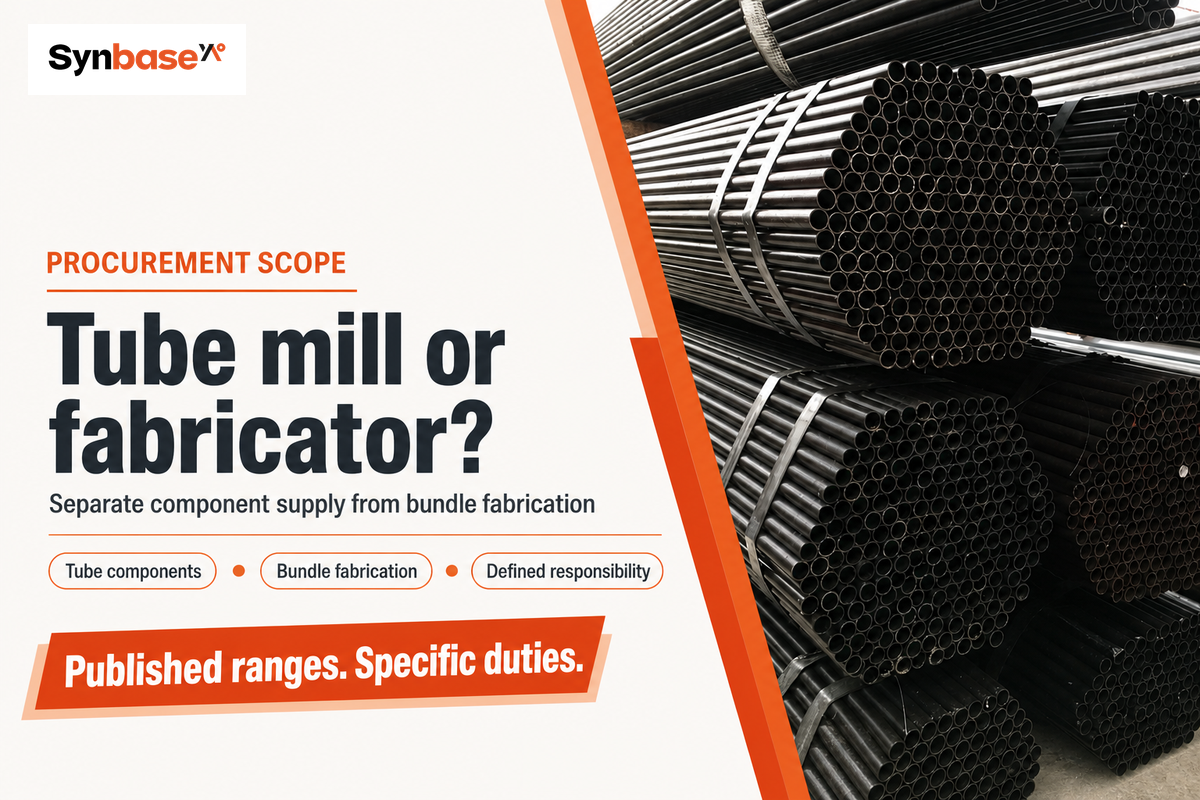
A tube mill supplies components to industrial heat exchanger manufacturers. For a custom heat exchanger, separating mill supply from bundle fabrication clarifies responsibility. Custom shell and tube projects may require both contracts.
Synbase publishes five specification families, A179, A213, A249, A214 and A334, for carbon, alloy, stainless and low-temperature applications. Its heat exchanger tube specifications list 15.88–76.2 mm outside diameters, 1.24–4.19 mm walls, 3.1 mill documents and heat traceability. The product page lists eddy-current and hydrostatic inspection. The Synbase company background dates the business to 2013. The published standard diameter range stops at 76.2 mm, limiting the off-the-page selection for larger tubes.
Nippon Steel integrates steelmaking, steel tube production and finishing for heat-transfer applications. Carbon, low-alloy and stainless product families support industrial projects with different temperatures and pressures, including boiler and power generation service. The official factbook dates establishment to 1950; a major merger followed in 2012. Dimensions remain material-specific, so a size available in one steel tube family isn’t automatically available across the product range.
At JFE Steel, the Chita manufacturing base supplies carbon and ferritic alloy tubes for thermal equipment. ASTM, ASME, EN and JIS specifications support power plants and heat recovery systems. The featured manufacturing processes center on ferritic steel. Copper-alloy orders fall outside that range.
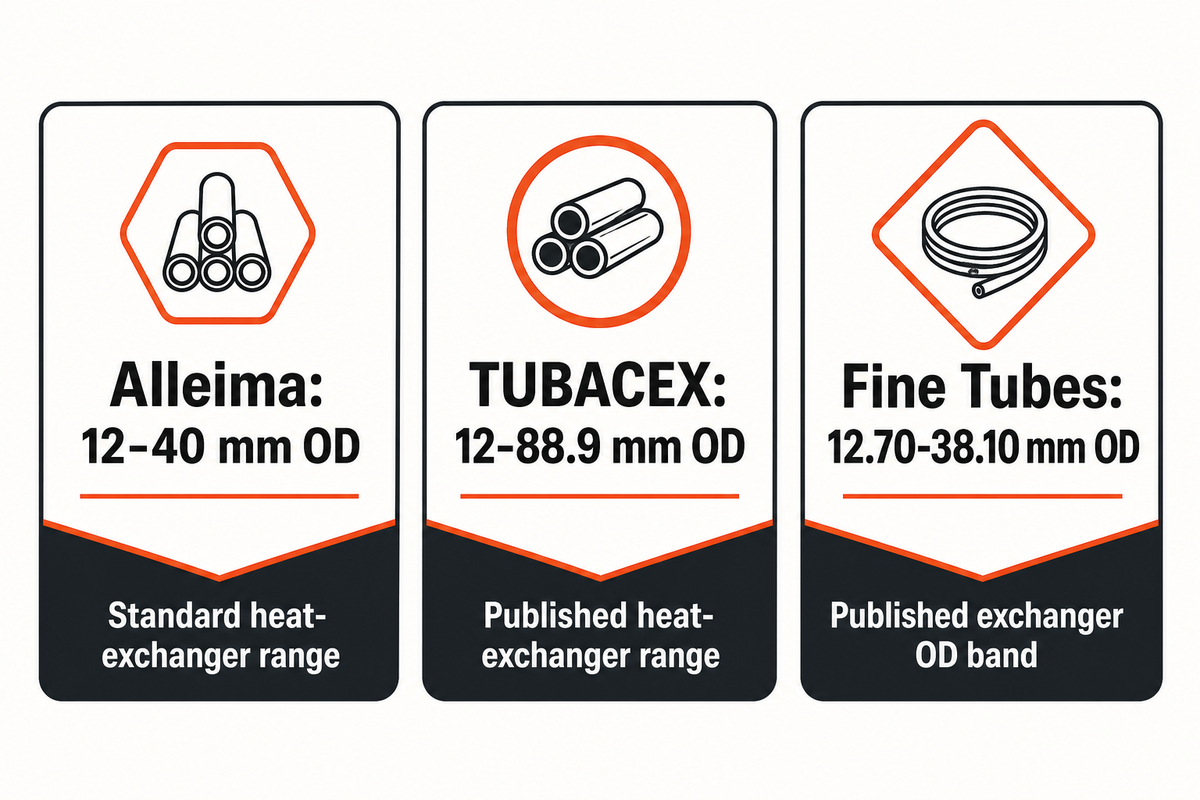
Alleima offers stainless steel tubes alongside nickel alloys, titanium and zirconium for corrosive fluids. The standard heat-exchanger range is 12–40 mm OD, with straight tubes up to 30 m and U-tube designs. Independent since 2022, Alleima lists ISO 9001 at its Mehsana tube site. Diameters outside the standard range require a separate agreement rather than an assumption of routine availability.
TUBACEX lists heat-exchanger tubes from 12 to 88.9 mm OD, with straight lengths reaching 30 m. More than 25 alloys and both straight and U-bent formats make the group relevant to chemical processing and petrochemical projects needing several material options. The range of alloys covers chemical processing and petrochemical service. Long tube lengths bring a practical disadvantage: crate dimensions, transport routing and unloading space can materially constrain delivery.
Centravis combines extrusion with cold finishing for stainless tubing, including heat-exchanger applications. Its general cold-finished catalog extends to 27 m, offering a route for long straight tubes and subsequent fabrication. Founded in 2000, the business later adopted the Centravis name. That general dimensional envelope doesn’t mean every alloy and heat-exchanger specification is offered at its maximum size.
Fine Tubes publishes a heat-exchanger OD band of 12.70–38.10 mm across stainless, duplex and nickel-alloy materials. The Plymouth manufacturer dates to 1943 and holds an ISO 9001 and EN 9100 certificate valid to August 2027. Small diameters are its focus; sister business Superior Tube is not counted separately. Orders above 38.10 mm OD fall outside the published exchanger range.
DMV is the current name associated with the former Mannesmann Stainless Tubes business following its acquisition by Cogne in 2024. Alongside stainless, duplex and nickel-alloy exchanger tubing, its FAST service targets urgent replacement orders in selected sizes. The 2005 date records German company registration, not the older manufacturing heritage. FAST is conditional on size, alloy, capacity and raw-material availability, so it isn’t a delivery promise for every order.
Jiuli lists A213, A249 and A688 for stainless heat-transfer tubing, alongside separate nickel-alloy and titanium tube families. The Huzhou manufacturer was founded in 1987 and describes a CNAS-accredited testing laboratory. Those capabilities make Jiuli relevant when a Chinese production base and specialist metallurgy belong in the same sourcing plan. Straight, U-bent and different manufacturing routes need distinct purchase descriptions; the published titanium range is limited to Grade1 / Grade2 / Grade3 / Grade7 / Grade12 / Grade16.
Ratnamani’s catalog describes a dedicated welded titanium line as well as stainless and nickel-alloy tube production. Its titanium heat-exchanger range covers 12.70–38.1 mm OD and 0.5–1.6 mm walls under SB338. Founded in 1983, the Ahmedabad-based manufacturer also lists ISO 9001 certification. Titanium orders above 38.1 mm OD sit outside that published range, even though other materials have broader dimensional offerings.
Plymouth Tube manufactures precision tubing in the United States and publishes stainless and welded nickel-alloy product lines for heat-transfer applications. The company dates to 1924, with plant-specific ISO 9001 certificates available in its technical library. Custom dimensions make it relevant to replacement bundles and industrial fabrication services. One current product limitation matters for legacy drawings: SEA-CURE was sold to Webco in 2024 and should no longer be treated as a Plymouth offering.
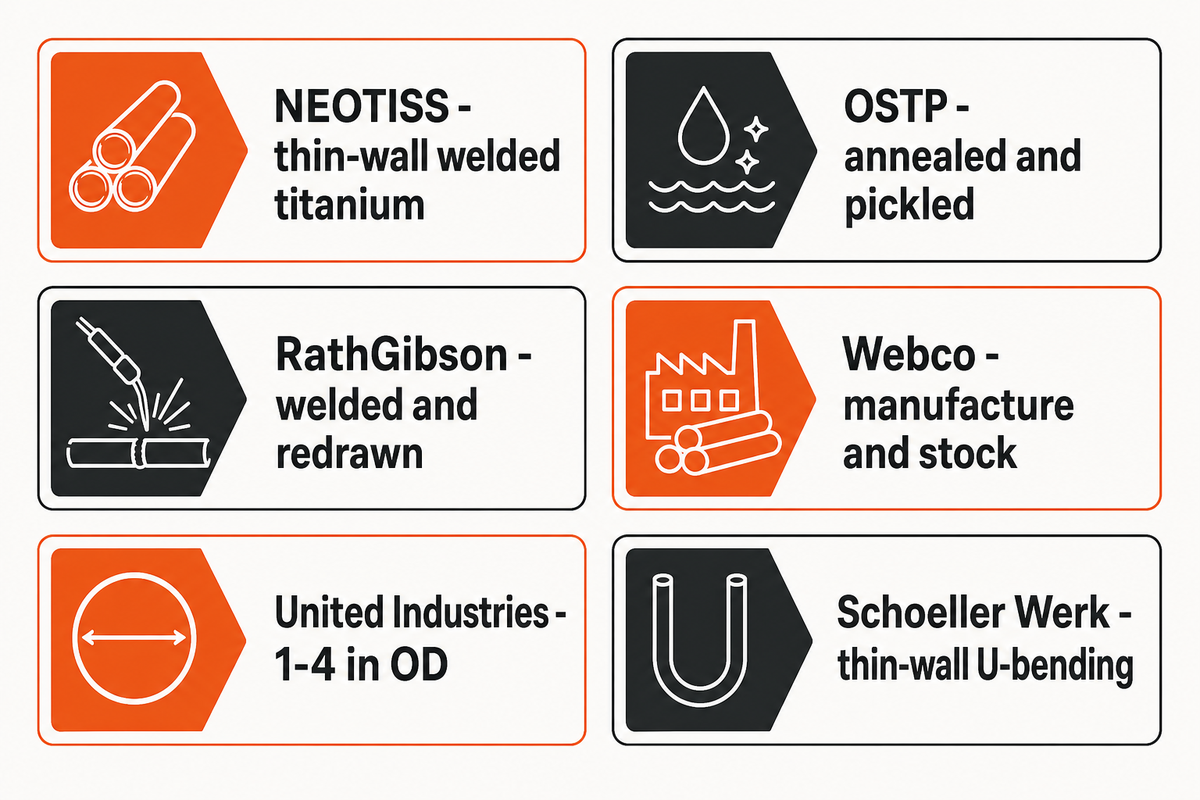
NEOTISS specializes in thin-wall welded titanium and stainless heat-transfer tubes, including enhanced-surface products. Its titanium selection names grades 1, 2, 2H, 7, 9, 12 and 16. The 1976 date records the French operation’s origin, preceding today’s corporate name. This welded-route focus is unsuitable for purchase specifications that prohibit a longitudinal weld seam.
OSTP Finland supplies welded stainless tubes for heat exchangers, normally annealed and pickled and delivered in fixed lengths. The Jakobstad manufacturing business traces its history to 1949; OSTP lists ISO 9001 and ISO 14001 systems. Such supply suits tube heat exchangers designed around fixed lengths and defined finishes. Special tolerances or surface finishes are agreed order conditions, not features automatically included in every standard tube.
RathGibson, part of PCC, makes welded and redrawn tubing for heat exchangers and other industrial applications. Its 304 stainless data lists 4.76–101.6 mm OD, 0.51–5.59 mm walls and straight lengths up to 27.4 m. The RathGibson business dates to 2005, combining older manufacturing operations. These 304 dimensions are useful selection limits, but they must not be transferred to every nickel alloy or stainless grade in its catalog.
Webco combines heat-exchanger tube manufacture with inventory and processing across several material families. Its manufacturing business began in 1969, and listed quality certificates include ISO 9001 for Kellyville and Mannford. The 2024 acquisition of SEA-CURE adds a relevant destination for buyers working from older Plymouth specifications. Distributed stock can originate from mills other than Webco.
United Industries lists welded stainless heat-exchanger tubing from 1 to 4 in OD and lengths up to 60 ft. Hydrogen bright annealing, weld-bead working, inline eddy-current testing and 100% air-leak testing form part of its published production offer. The Beloit manufacturer dates to 1937, separately from its parent group’s history. The 1 in minimum excludes smaller bundle tubes.
Schoeller Werk’s heat-exchanger sheet lists 3–127 mm OD, 0.20–3.00 mm wall thickness and straightness of no more than 2 mm per metre. The German manufacturer, founded in 1827, emphasizes thin-wall welded tubing suitable for forming into U-tubes. Product Development holds ISO 9001 certification, according to Schoeller. ASTM grades or equivalent UNS designations are available by inquiry, so they are not implied by an order based only on the standard European range.
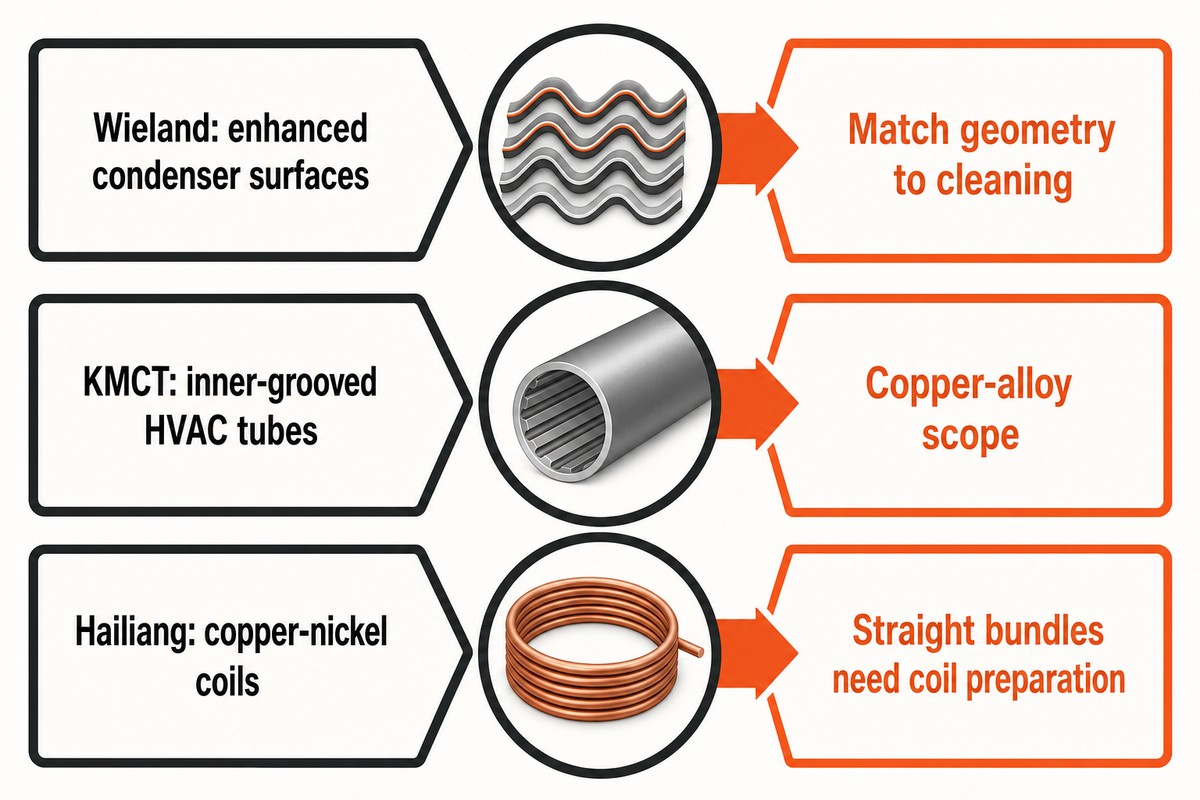
Wieland’s GEWA-C condenser tubes use enhanced surfaces for high-performance thermal management in cooling applications. The range includes copper and copper-nickel variants, while GEWA-C5 and GEWA-C6 are specifically copper products. With origins in Ulm in 1820, Wieland offers a material and surface-design route distinct from plain steel tubing. High performance under clean conditions doesn’t resolve fouling; geometry must suit the cleaning method.
KMCT manufactures copper tubing in Japan and Thailand, with inner-grooved HVAC products and copper-alloy heat-exchanger tubes. Hatano’s production integrates melting through finishing, while Moji supplies copper-alloy applications. Established in 2004, the company serves heating and cooling systems where copper’s thermal conductivity and tube geometry matter. Copper-alloy production excludes steel pressure-service orders.
Hailiang’s listed company dates to 2001, separately from the wider group’s earlier history. The copper-nickel coils serve condensers, desalination and other heat transfer systems. Copper-nickel complements Hailiang’s broader copper-tube production. For a straight-tube bundle, however, coil supply adds cutting and straightening operations that need to be included in the fabrication plan.
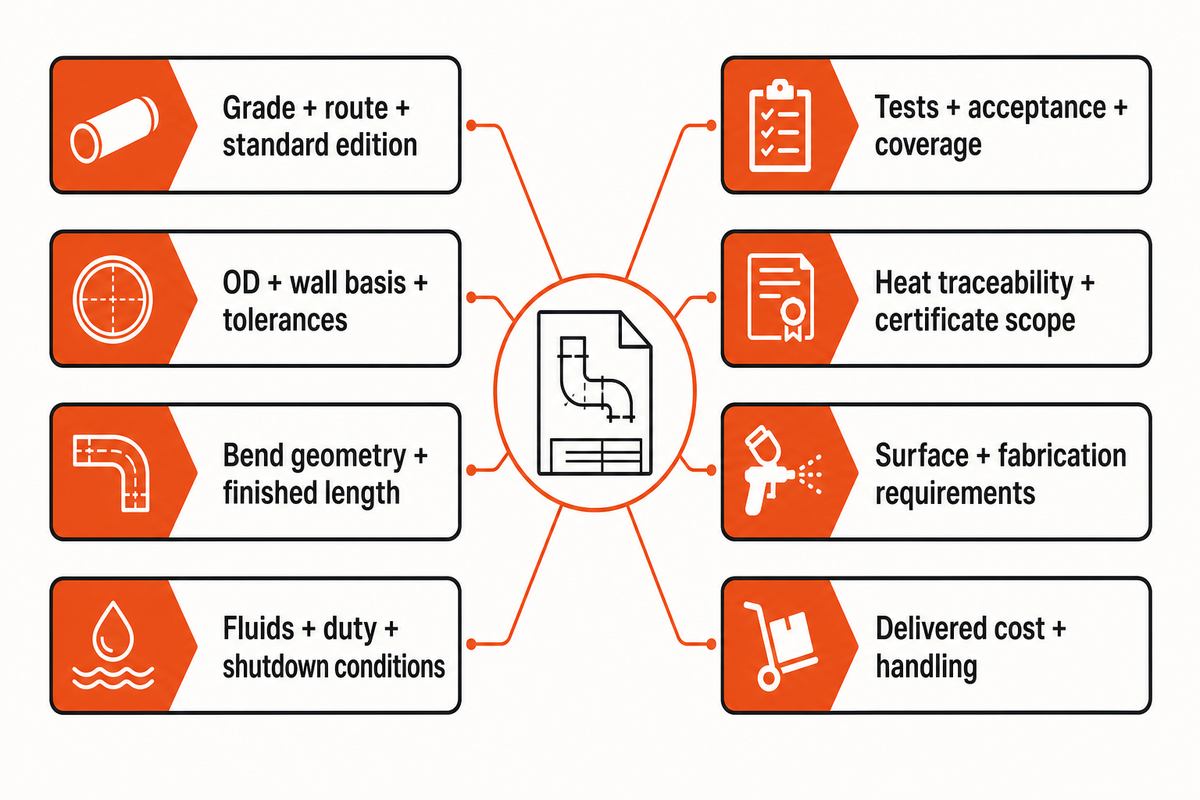
Begin with the drawing and service conditions. Tubular heat exchangers are used to transfer heat between fluids, through a tube wall that separates the flow paths. For specification background, use this Tube Material and Specification Guide; then make competing quotations answer the same eight questions.
Alleima includes titanium and zirconium as well as stainless and nickel alloys; the other named manufacturers offer several stainless or nickel-alloy routes. These are different procurement options, not equivalent grades. A chemical-processing exchanger, a reactor auxiliary system and an oil-refining condenser can expose tubes to different fluids and operating cycles. Material selection needs the actual duty specification and corrosion assessment.
United Industries publishes a 1–4 in OD exchanger range, while RathGibson’s 304 range extends to smaller diameters. Plymouth offers precision stainless and nickel-alloy tubing; Webco combines manufacturing with broader stocked supply. These are component producers; tube heat exchanger manufacturers assemble complete equipment. Factory location and corporate headquarters also describe different parts of a sourcing decision.
Jiuli publishes dedicated heat-transfer tube standards and a CNAS-accredited laboratory; Hailiang identifies copper-nickel products for condensers and desalination. Synbase publishes standard grades, dimensions and inspection documentation for export orders. Those are concrete starting points, rather than a national reliability ranking. The same technical acceptance criteria apply to Chinese and overseas mills, including traceable material, the ordered manufacturing route and agreed test records.
Heat exchanger market reports and group steel output include unrelated products. A defensible ranking requires tube output for the same year, materials, and production route. Comparable figures weren’t available for this shortlist.
Quotation depends on grade, OD, wall basis, length, quantity, U-bending, degree of inspection, and the delivery destination. A low unit price shouldn’t be presumed to be an economic saving unless specifications and commercial terms are comparable, including test samples, packing and freight.
Some businesses do both, as Webco’s product model illustrates. A supplier can still offer useful stock and processing services. The manufacturing identity belongs on the material documents, while the sales contract identifies the party responsible for delivering the order.
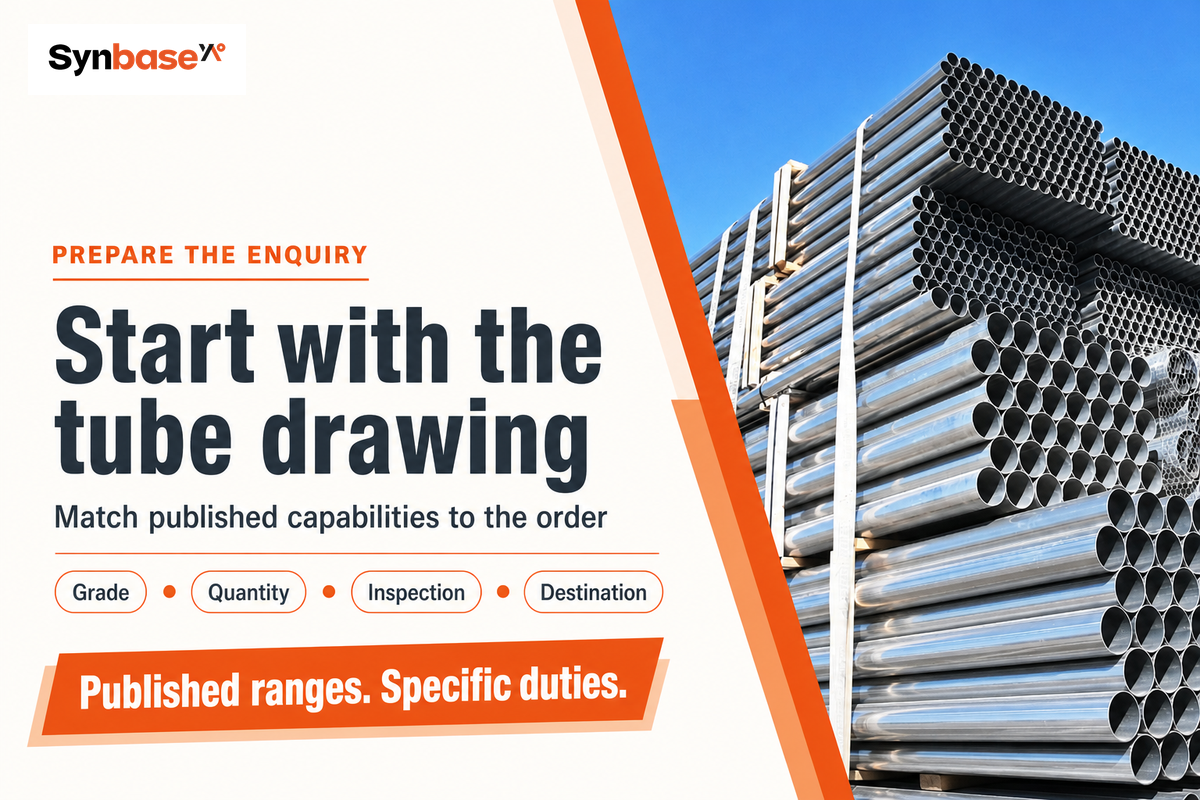
The best fit is a manufacturer whose published material, dimensions and production route align with the drawing. For documented standard-grade export orders, review Synbase heat exchanger tubes and send your tube drawing and specification. Request a quote with grade, quantity, inspection requirements and destination.
Company facts: official websites and catalogs identified in the table. Technical testing source:
Synbase Steel supplies steel pipe, fittings, flanges, valves and OCTG for oil and gas, petrochemical, power, water and industrial projects. Our technical guides are written to help buyers compare standards, grades, dimensions, coatings, inspection requirements and commercial terms before sending an RFQ.
We focus on practical specification work: matching pipe process to service conditions, checking wall thickness and end finish, reviewing MTC and NDT requirements, and clarifying documentation before production or shipment.
Project support across seamless pipe, ERW, LSAW, SSAW, buttweld fittings, forged flanges, valves and oilfield tubulars.
Specification review for ASTM, ASME, API, EN and DIN standards, including material grade, pressure class, coating and inspection scope.