Send Your RFQ to Synbase Steel
Prefer to send drawings, BOMs or attachment lists by email? sales@synbasesteel.com

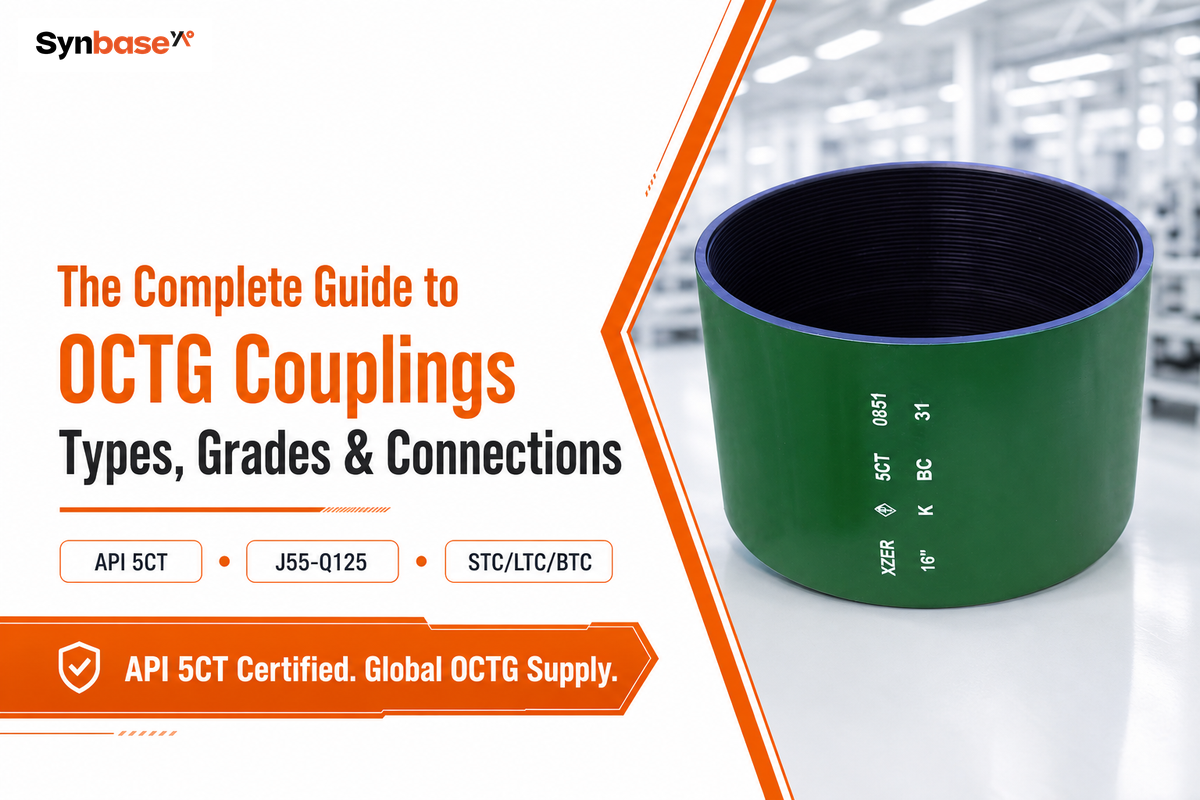
| Standard basis | API 5CT (material) + API 5B (thread/gauging) |
| Casing coupling range | 4-1/2″–20″ OD |
| Tubing coupling range | 1.05″–4-1/2″ OD |
| Grades | H40, J55, K55, N80-1, N80Q, L80-1, L80-13Cr, C90, T95, P110, Q125 |
| Connections | STC, LTC, BTC (round/buttress) + premium metal-to-metal |
| Sour-service grades | L80-1, L80-13Cr, C90, T95, C110 (NACE MR0175 / ISO 15156-2). |
An OCTG coupling is the short, internally threaded steel sleeve that joins two lengths of casing or tubing into one continuous string, machined to the same API 5CT grade as the pipe body it connects. Couplings carry the string under tension, pressure and, in many wells, corrosive gas, yet the coupling itself is a distinct product with its own manufacturing route, grade rules and failure modes.
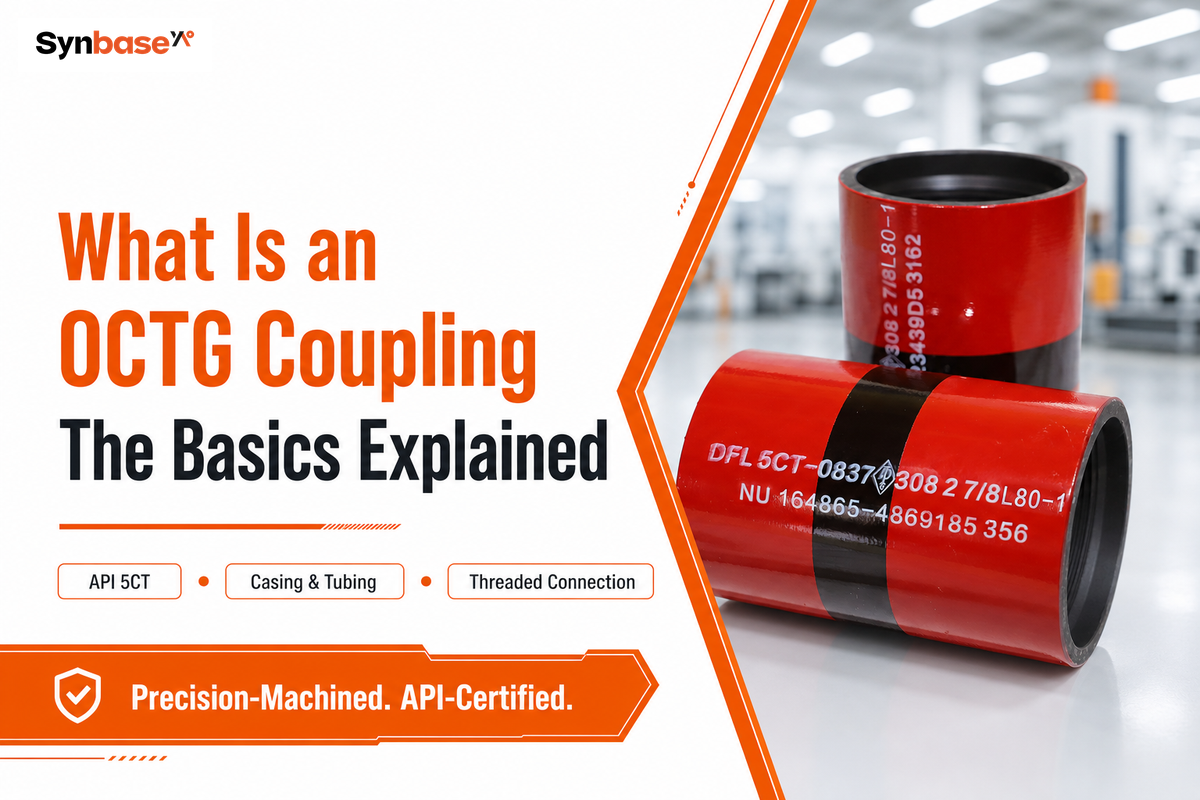
An OCTG coupling connects two joints of casing or tubing into a single string, carrying the same grade and pressure duty as the pipe body on either side of it. It’s manufactured from weld-free, grain-refined coupling stock, machined separately from the pipe, then heat-treated and threaded to match. API 5CT controls it as a distinct product, not a generic pipe fitting, because the connection is statistically the most likely failure point in the string.
Terminology varies depending on who’s asking: some buyers search for octg tubing and casing couplings as one category, others ask specifically about tubing and casing couplings, and some just say oil casing coupling when only the casing string is in scope. Whichever term ends up on the purchase order, the same API 5CT logic governs it, grade and connection family have to match the pipe body, not just the nominal diameter.
~90% of casing failures, per an often-cited industry figure, occur at threaded connections, not the pipe body. Whatever the precise number in a given field, the direction is not in dispute across the oil and gas industry: coupling selection deserves the same scrutiny as pipe body grade, not an afterthought once the pipe order is placed.
Synbase’s full OCTG product range covers casing, tubing, drill pipe and couplings under this same standard, which is the frame the rest of this guide works from.
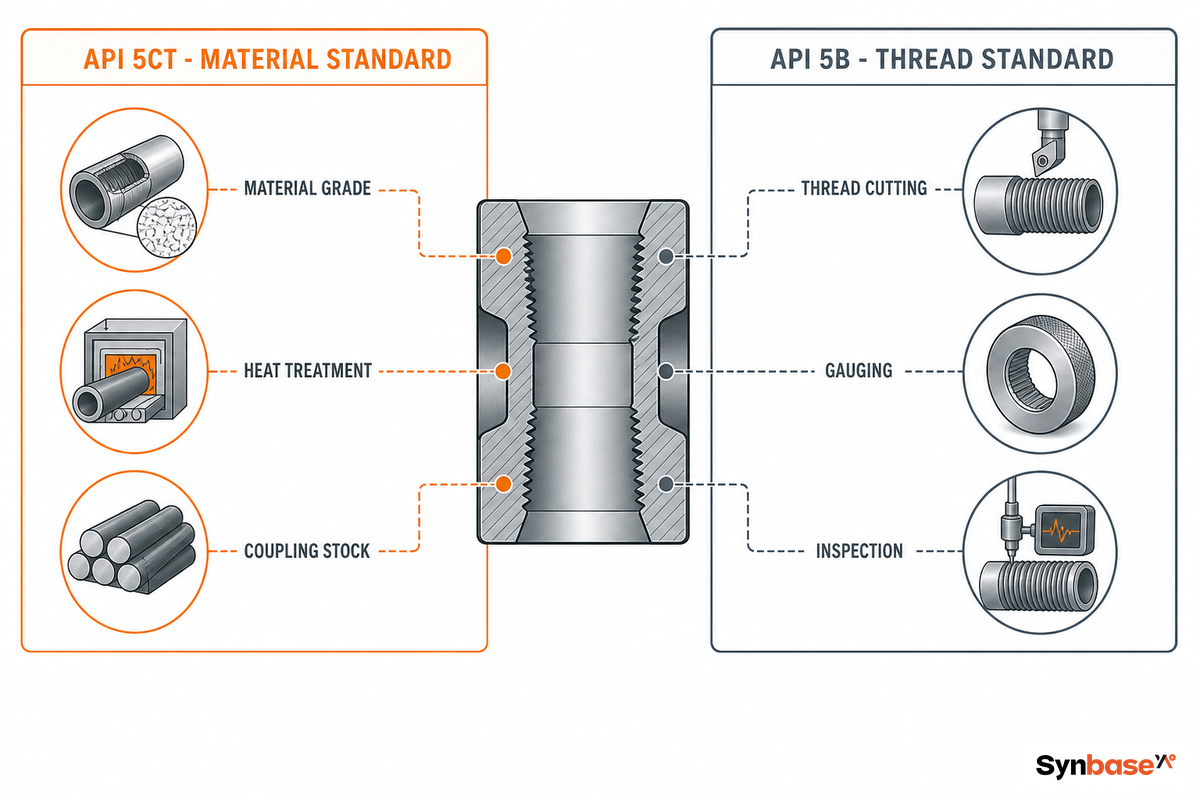
Every compliant coupling answers to two separate API specifications, and buyers who only check one are checking half the paperwork. API 5CT governs what the coupling is made of and how strong it has to be; API 5B governs how the thread that let it screw onto the pipe is cut, gauged and inspected. A mill test report referencing only one of the two hasn’t actually confirmed the connection is sound.
| Standard | Covers | What it does not cover |
|---|---|---|
| API 5CT (Casing and Tubing) | Chemistry, mechanical properties, heat treatment, dimensional tolerance, coupling stock requirements, NDE, marking | Thread geometry and gauging |
| API 5B (Threading, Gauging & Inspection) | Thread dimensions and tolerances, gauge design, thread inspection instruments and acceptance criteria | Steel chemistry or mechanical properties |
API 5CT is explicit that coupling stock must be weld-free and grain-refined with aluminium, niobium, vanadium or titanium to control grain size — a welded or unrefined blank cannot reliably carry the toughness a connection needs. A mill that wants to stamp the API monogram on its couplings must be independently audited and licensed under API’s Monogram Program before using the mark.
Buyers can confirm a mill’s current license status directly through API’s own Monogram and APIQR program directory, which is a more reliable check than trusting a logo on a mill test report. The two API 5CT casing product families most buyers deal with are the API 5CT casing line and the API 5CT tubing line, and couplings for both come off the same weld-free stock requirement.
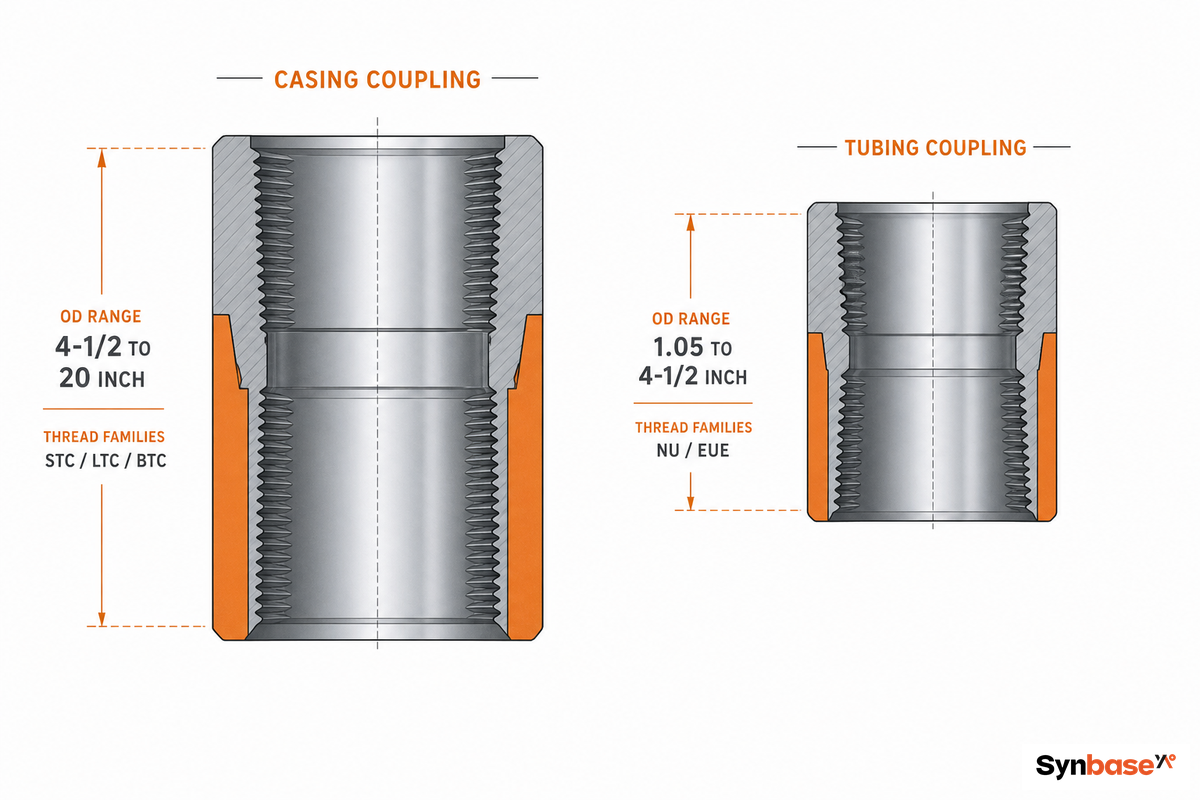
Casing couplings and tubing couplings do the same basic job, joining two lengths of pipe, but they’re sized, threaded and rated differently enough that swapping one family for the other is a real procurement mistake, not a cosmetic one. The core function of casing couplings and tubing couplings used in oil and gas strings is the same at a glance, which is exactly why choosing couplings by family instead of by outer diameter alone is the mistake this section exists to prevent. Field hands on an oil well sometimes just say “pipe coupling” regardless of whether the string in question is casing and tubing couplings together or one or the other, precision matters here, since whether a given interval call for tubing or casing hardware changes the coupling family, not just the size.
| Feature | Casing coupling | Tubing coupling |
|---|---|---|
| OD range | 4-1/2″–20″ | 1.05″–4-1/2″ |
| Thread families | STC, LTC, BTC (+ premium) | NU (non-upset), EUE (external-upset) (+ premium) |
| Pipe end treatment | Non-upset (coupling OD carries the connection) | Often externally upset (thickened end) for higher joint strength |
| Typical role | Holds the wellbore open, isolates zones | Carries produced fluid to surface |
The mismatch risk isn’t hypothetical. Industry guidance is blunt about it: an incorrect or mismatched coupling grade or thread family for the pipe body leads to leaks and equipment failures downhole, where a fix means pulling the string. A P110 casing coupling is never substituted for an N80 tubing coupling just because a diameter happens to be close, grade and connection family both have to match the pipe program, not just the nominal size on the packing slip. A US Customs and Border Protection classification ruling on API 5CT casing independently confirms the standard’s outside-diameter and wall-thickness scope, a useful non-vendor cross-check when a distributor’s stated range doesn’t match the mill’s own spec sheet.
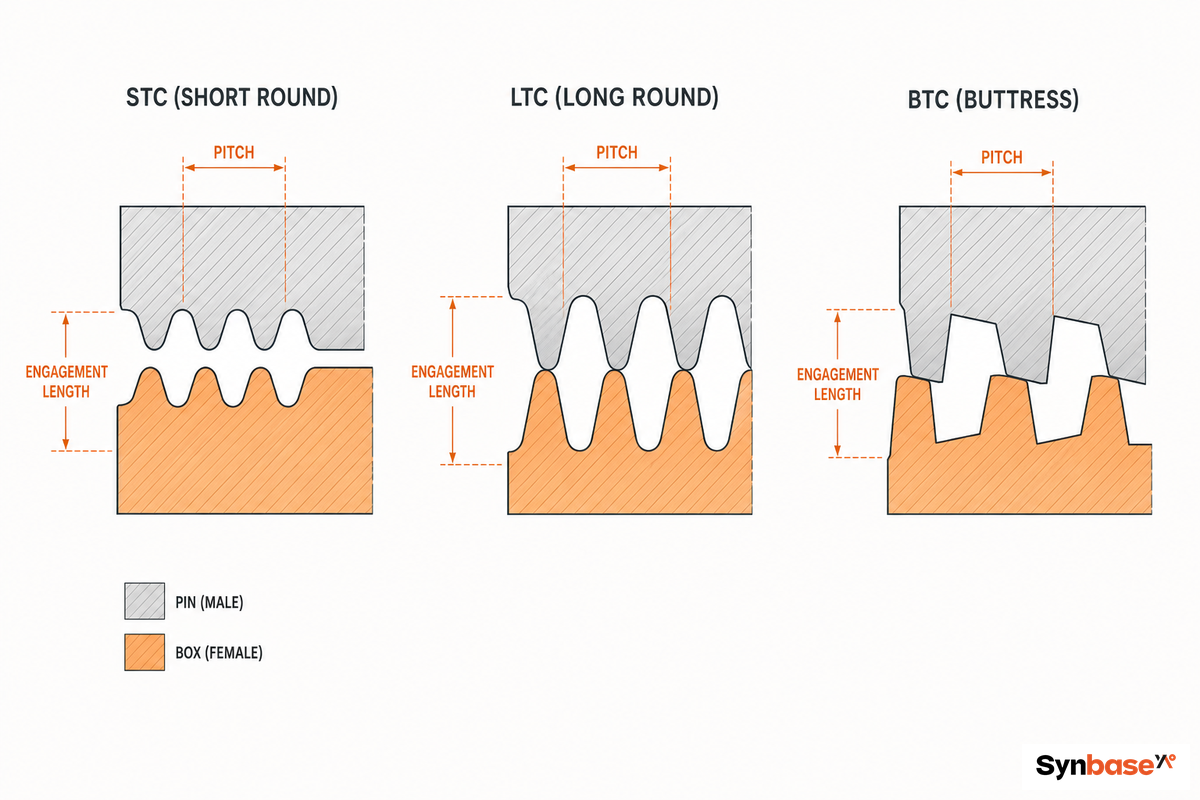
API 5CT doesn’t define one generic coupling, it groups couplings into six functional families, each built for a specific job in the string:
Some buyers search for external-upset tubing as “EU tubing,” though EUE (external-upset, external-upset) is the correct API 5CT designation, the coupling accommodates the thickened tubing end that upsetting create, which is why the coupling doesn’t have to do all the strength work alone at the joint. Within the regular-coupling family, the three standard API round and buttress threads carry different load capacity and cost profiles; the two round-thread form (STC and LTC) use a pitch flat thread crest rather than a sharp V-profile, specifically to reduce stress concentration at the root during make-up.
| Connection | Thread form | Best for |
|---|---|---|
| STC (short round) | 8 threads per inch, 60° round | Shallow, low-pressure, cost-sensitive strings |
| LTC (long round) | 8 threads per inch, 60° round, longer engagement | Medium depth, higher tension than STC |
| BTC (buttress) | 5 threads per inch, buttress profile | Deep strings, higher axial load |
Every one of these threads is cut and gauged under API 5B (see the previous section), and none of the three, including buttress, is inherently gas-tight; that distinction matter enough to get its own section below. Granted OCTG connection patents such as US 8,882,157 (Connecting oil country tubular goods) illustrate why so much engineering effort goes into thread-profile geometry alone, small changes at this scale materially change how a connection carries load.
Special-clearance coupling dimensions and tolerances are set out in API 5CT Tables C.33/C.35 (or E.33/E.35 for the SI-unit version), with color identification per API 5CT Clause 11. Grade C110 and Q125 couplings are explicitly excluded from hot-forging manufacture under API 5CT — if you’re sourcing in these two grades, the production route itself is different from every lower grade.
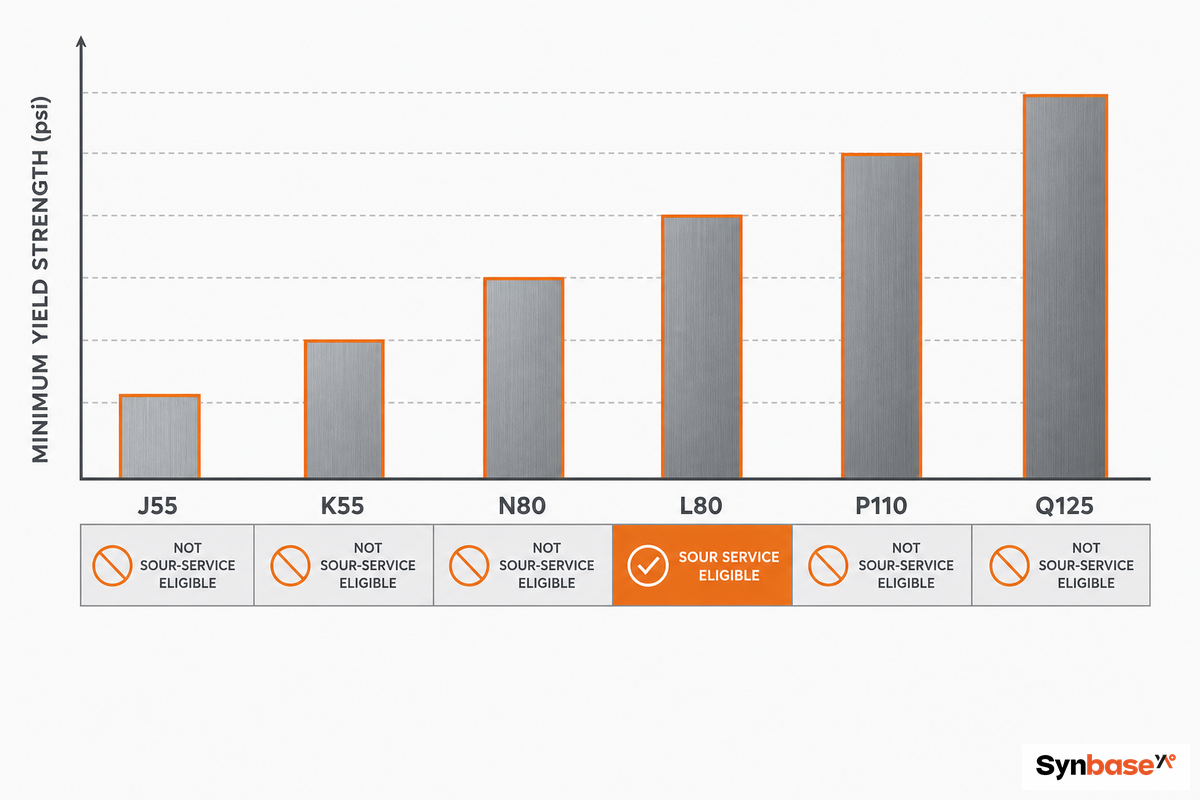
API 5CT grade isn’t one number. Minimum yield, minimum tensile, heat-treatment route and intended service all move together, which is why the same nominal “80 ksi” class splits into three distinct grades, N80-1, N80Q and L80, that aren’t interchangeable on a purchase order. Getting the material grade right against full API 5CT specifications, not an abbreviated coupling specifications sheet, matters most at exactly this edge case: N80 Type 1 and N80Q share a nominal 80,000-psi yield, but only N80Q is quenched and tempered, and a buyer with special requirements outside the standard grade table should confirm those details before the order is cut, not after.
| Grade Type | Min yield (psi / MPa) | Min tensile (psi / MPa) | Heat treatment | Typical service |
|---|---|---|---|---|
| H40 | 40,000 / 276 | 60,000 / 414 | As-rolled | Shallow / conductor |
| J55 | 55,000 / 379 | 75,000 / 517 | Hot-rolled or normalized | General, non-sour |
| K55 | 55,000 / 379 | 95,000 / 655 | Normalized (mandatory) | General, non-sour, higher tensile than J55 |
| N80-1 | 80,000 / 552 | 100,000 / 689 | Normalized or normalized & tempered | Medium depth |
| N80Q | 80,000 / 552 | 100,000 / 689 | Quench & temper | Higher collapse resistance than N80-1 |
| L80-1 / L80-13Cr | 80,000 / 552 | 95,000 / 655 | Quench & temper, hardness-limited | Sour service (H₂S / CO₂) |
| C90 | 90,000 / 621 | 100,000 / 689 | Quench & temper | Sour, deeper |
| T95 | 95,000 / 655 | 105,000 / 724 | Quench & temper, SSC-tested | Sour, high-strength |
| P110 | 110,000 / 758 | 125,000 / 862 | Quench & temper | Deep / high-pressure, non-sour |
| Q125 | 125,000 / 862 | 135,000 / 931 | Quench & temper | Deepest / HPHT, non-sour |
Procurement teams sometimes treat J55 and K55 as interchangeable because they share the same 379 MPa minimum yield, but K55 carries roughly 140 MPa higher minimum tensile strength and mandatory normalizing, which is a real mechanical difference, not paperwork. And P110 (758 MPa yield) and Q125 (862 MPa yield) both lose sour-service eligibility as yield climbs, so neither grade belongs on a well with H₂S present regardless of how attractive the strength numbers look on a spec sheet. The US Bureau of Safety and Environmental Enforcement’s own casing string design methodology documents why these grade steps matter mechanically and not just on a spec sheet, joint strength calculations move directly off the minimum yield and tensile values in this table.
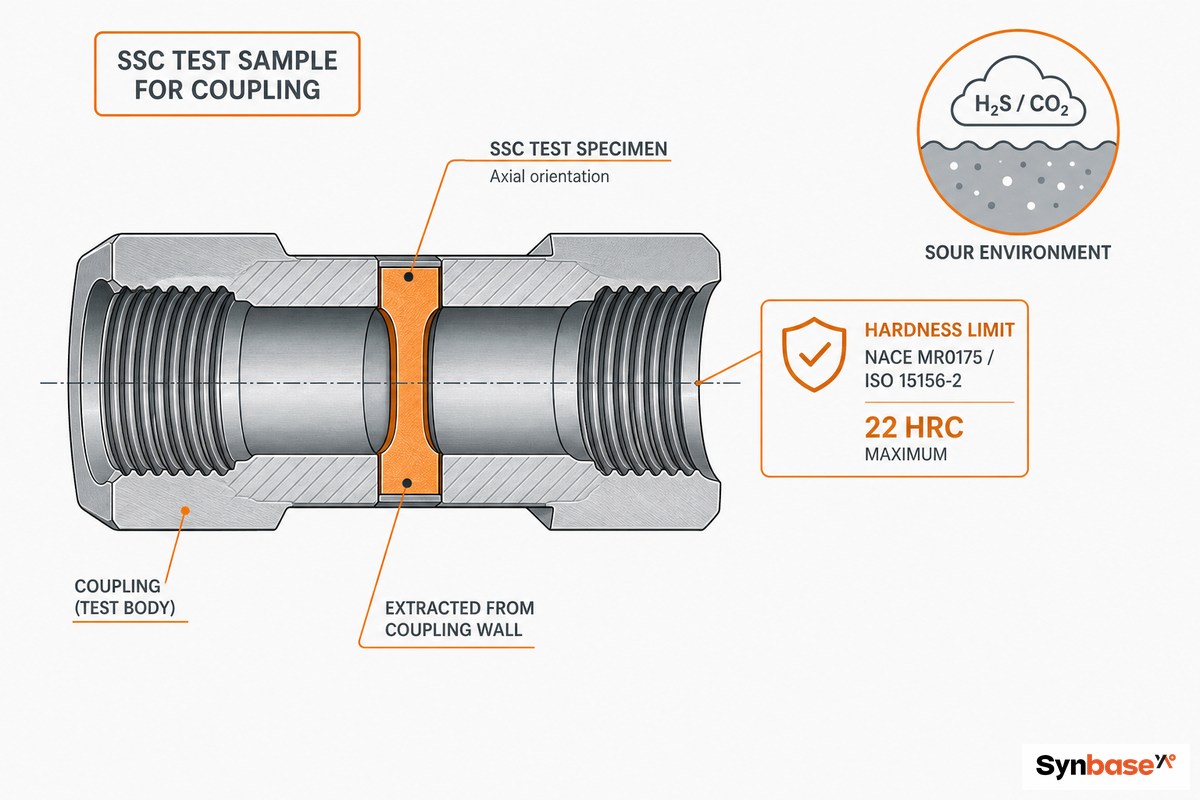
Wells with H₂S or CO₂ in the produced fluid need couplings qualified against sulfide stress cracking (SSC), and that qualification runs through NACE MR0175 / ISO 15156-2, not just a grade name on a data sheet.
The baseline hardness ceiling for carbon and low-alloy sour-service steel under NACE MR0175 / ISO 15156-2 is 22 HRC (roughly 250 HV10 or 237 HBW), though API 5CT carves out a documented, grade-specific exception allowing L80-1 up to 23 HRC. Both numbers are correct, they apply to different scopes, which is why Synbase-style spec sheets sometimes show 23 HRC where a general sour-service reference shows 22 HRC. A buyer comparing a mill’s SSC test report against a generic NACE summary should confirm which ceiling the mill is actually testing to.
A real, unanswered forum question captures the confusion well: a buyer ordering NACE MR0175-rated tubing pup joints asked whether the coupling supplied as made-up also has to independently satisfy NACE, or whether the mill’s pipe-body certification simply covers it. The honest answer is that it doesn’t automatically carry over, the coupling is a separate manufactured item under API 5CT, and its own heat needs its own SSC qualification test record, not just the pipe body’s.
a common, unresolved question on industry engineering forums
SSC qualification itself runs through NACE TM0177 testing for L80-1, L80-13Cr, C90, T95 and C110, covering the parent metal, weld metal (where applicable) and heat-affected zone with a minimum of three hardness readings per test location. A grade stamp alone doesn’t prove sour-service compliance, the mill test report needs to show the actual SSC test result, not just the nominal grade. Peer-reviewed failure-analysis literature on cracked P110 tubing (Zhang et al., 2023, NIH-indexed) reinforces the same point from the field-failure side: grade selection interacts with real service conditions, not just a number on a spec sheet, which is exactly why the SSC test record matters more than the grade stamp alone.
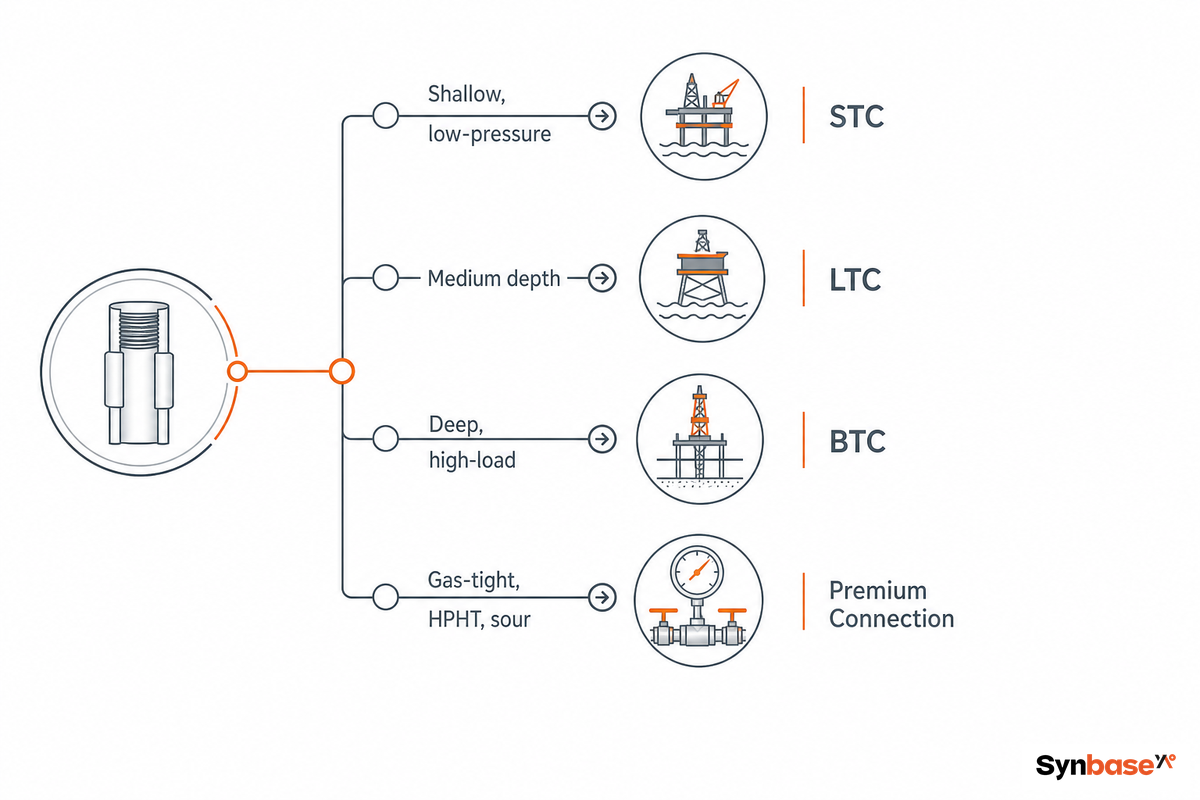
The real selection question isn’t which thread looks strongest on paper, it’s which connection survives the specific combination of depth, load and fluid this well will see.
That fourth branch, roughly 103 MPa (15,000 psi) and above, is where a genuine, independently documented technical point matters: standard API buttress connections aren’t inherently gas-tight. Mill technical materials citing a US patent on high-gas-sealability makeup for API buttress connections (US 5,212,885, confirmed on file with the USPTO) describe API buttress as historically developed for liquid-service applications, with phosphatized BTC couplings failing gas-pressure testing in documented cases, gas-tightness in a standard connection come from thread compound and coupling surface treatment, not the buttress profile itself.
Separate technical literature on API connection sealability reaches the same conclusion from a different angle: API buttress is primarily suited to liquid service because it does not always provide reliable gas sealability performance. The higher the grade and the smaller the diameter, the harder the same connection is to seal.
cross-referenced from USPTO connection-sealability documentation and independent technical literature
This is exactly why HPHT and high-sour wells move to premium connections instead of pushing a standard thread past its rating. Premium connections solve the sealing problem with a metal-to-metal face seal and a positive torque shoulder, at higher cost and typically under manufacturer license. The major families buyers encounter:
None of these is a drop-in upgrade to an existing API coupling, premium connections require their own pipe-end machining and are specified before the string is ordered, not added after the fact.
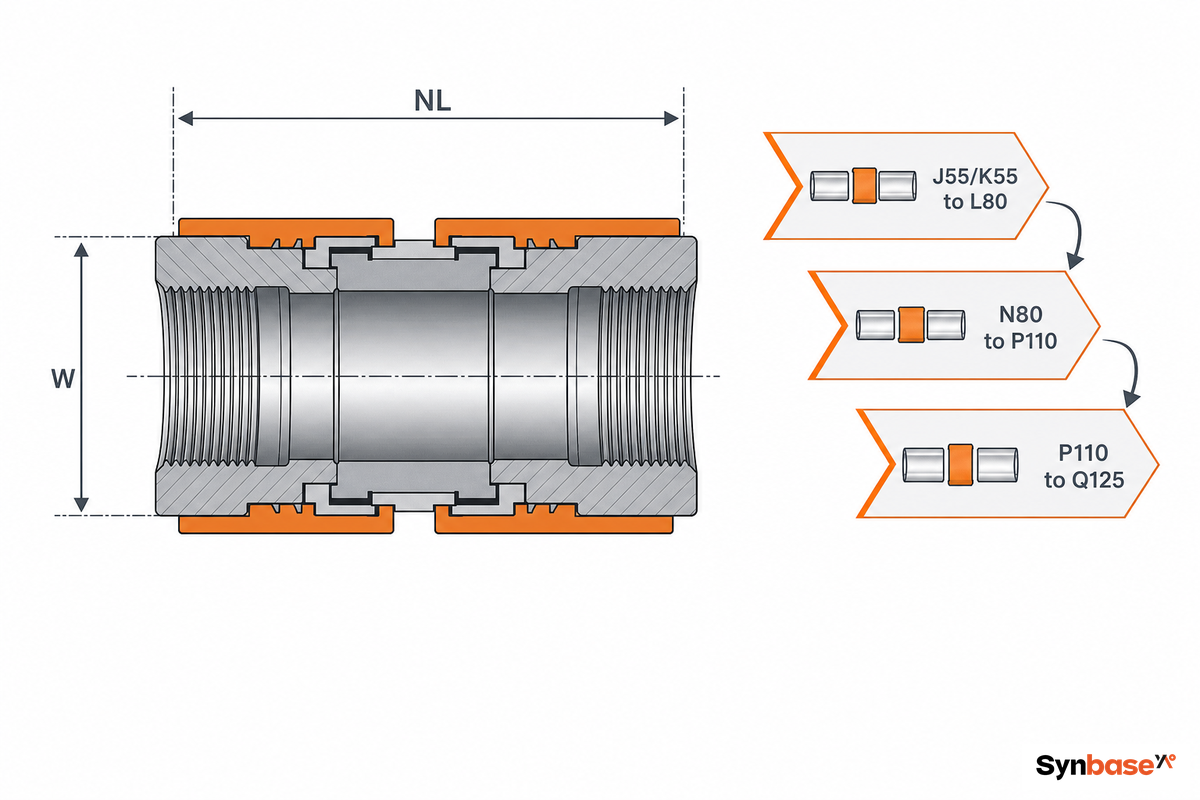
Two couplings of the same nominal size aren’t interchangeable across connection types, outside diameter (W) and make-up length (NL) both shift with thread family, from roughly 127 mm on 4-1/2″ casing up to 270 mm and beyond on 9-5/8″ casing, and getting either wrong either fails to make up or galls in a tight annulus.
OCTG coupling sizes are keyed to the pipe’s nominal outside diameter, not a single universal size chart, a supplier quoting a “5-inch coupling” without naming STC, LTC or BTC is leaving out the dimension that actually determines fit, as the table below shows. EUE coupling dimensions for tubing and API buttress coupling dimensions for casing follow the same logic: each thread family carries its own outside-diameter and make-up-length values in API 5CT, not a shared number. Reading an OCTG coupling diagram side-by-side with the pipe’s actual OD and grade stamp is the fastest way to catch a mismatch before it reaches the rig floor.
| Casing size (OD) | STC — W / NL | LTC — W / NL | BTC — W / NL |
|---|---|---|---|
| 4-1/2″ | 5.000 / 6.25 | 5.000 / 7.00 | 5.000 / 8.875 |
| 5″ | 6.500 / 10.18 | 7.750 / 12.56 | 9.125 / 12.99 |
| 7″ | 7.250 / 18.34 | 9.000 / 23.67 | 10.000 / 23.22 |
| 9-5/8″ | 7.750 / 39.51 | 10.500 / 55.77 | 10.625 / 50.99 |
Coupling wall tolerance is held at +0 / −12.5% of nominal under API 5CT, and a power-tight coupling that measures below the minimum length is a documented reject before it ever ships.
API 5CT requires a coupling grade upgrade in several specific pipe-grade situations, so the joint strength of the connection stays uniform even though the pipe body grade is lower. Cross-checking API 5CT clause text against independent manufacturer documentation confirms the full cascade run three grade steps deep:
| Pipe grade / thread | Required coupling grade |
|---|---|
| J55 / K55 buttress casing (when specified) | L80 Type 1 |
| N80 Type 1 / N80Q EUE tubing (when specified) | P110 special-clearance |
| P110 buttress casing (when specified) | Q125 |
A pass-through distributor reselling mixed stock frequently misses this, it only shows up if someone checks the coupling grade stamp against the pipe grade stamp line by line. A granted patent for a modified API buttress connection for drilling-with-casing operations (US 7,347,459) is one example of how much engineering sits underneath what looks like a simple buttress-thread dimension table.
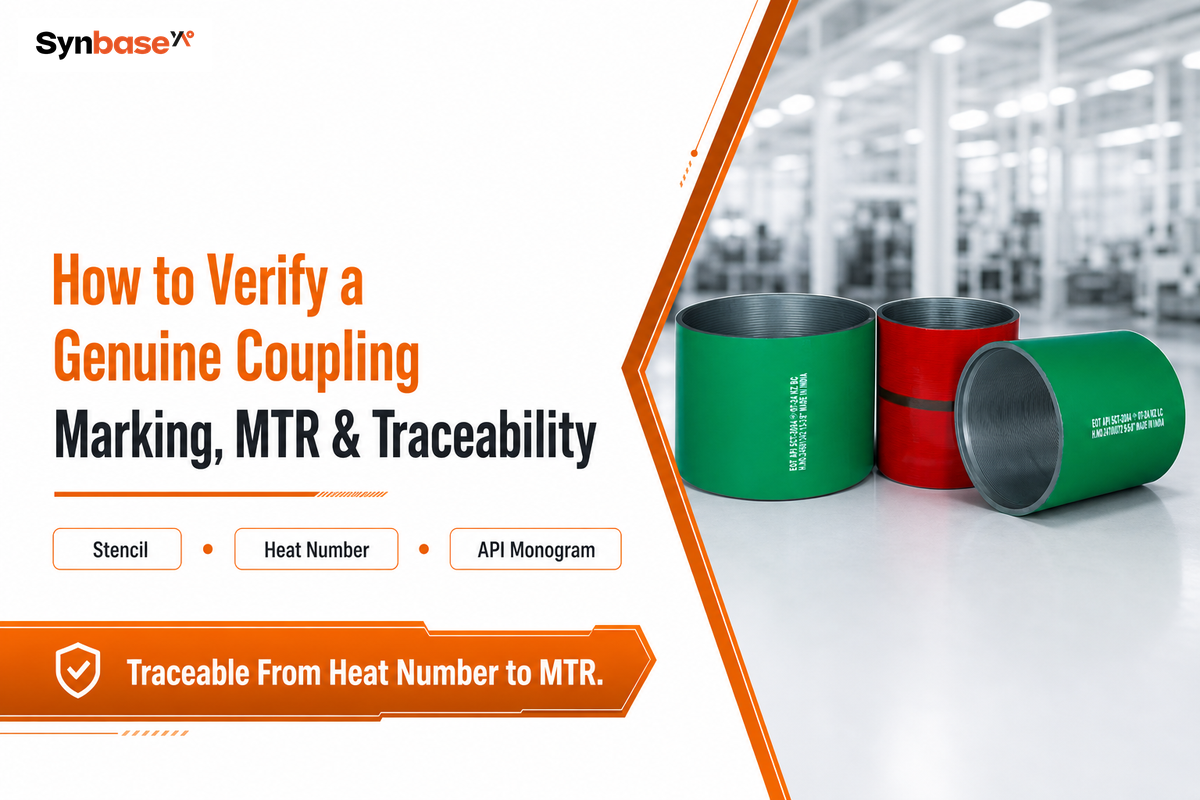
Coupling products vary in how rigorously that documentation trail is enforced from mill to mill, but a coupling missing its required marking is a documented reason for rejection under standard operator inspection practice, which makes knowing how to read that marking the first real counterfeit screen available on the receiving dock.
| Marking element | What it tells you | How to verify |
|---|---|---|
| Stencil | Size, weight, grade, connection | Matches the PO line item |
| Color band | Grade at a glance | Cross-check against the mill’s color chart — confirm on the MTR, never by color alone |
| API monogram | Licensed API manufacture | Confirm the mill’s current license via API’s Monogram/APIQR program directory |
| Heat number | Links the coupling to its melt | Traceable to the EN 10204 3.1 (or 3.2) mill test report |
Two coupling lots can both carry an API stencil and still differ enormously in what the seller can actually prove. Vetting your OCTG coupling manufacturer or OCTG coupling supplier before the purchase order goes out matters more than comparing the OCTG coupling price line by line, the gap shows up in five places once you know to look.
| Criterion | Traceable manufacturer | Pass-through distributor risk |
|---|---|---|
| Coupling stock | Weld-free, grain-refined, sourced in-house | Mixed-origin blanks, unstated mill |
| Threading | Cut and gauged to API 5B in-house | Coordinated across multiple outside vendors |
| Traceability | Heat number tied to MTR per lot | Aggregate “in stock,” no heat link |
| Inspection | Per-lot NDE and thread gauging on record | “Meets API” claimed, no records shown |
| Spec match | Grade, connection and dimension verified against the PO | Nearest available size pulled from the bin |
The supply base itself is also actively consolidating, Hunting and Jindal’s 2024 partnership to expand premium OCTG supply in the US market is one example of established players moving to fill traceability and capacity gaps rather than leaving them to opaque resale channels. That shift make the five-criteria check above more relevant, not less: as sourcing options multiply, so does the range in what a seller can actually document.
What the difference actually cost also depends on a variable buyers frequently price too late: import duty exposure, and it isn’t a blanket penalty on any one sourcing route. US antidumping duty administrative reviews on OCTG have found weighted-average dumping margins as high as 26–45% for some producers, while separate reviews covering other origin countries and producers have cleared at or near 0% for the same review period, the rate is producer- and country-specific, not a fixed cost of importing. That’s exactly why the landed-cost comparison belongs in the same conversation as coupling grade and traceability, not a separate procurement step: a buyer who only checks the per-unit price and skips the current duty status can end up worse off than the “more expensive” domestic-stock option on the table. Checking a manufacturer’s standing on the API Monogram and APIQR directory is a useful parallel step, it’s the same audited-registration record a distributor’s paperwork can’t substitute for.
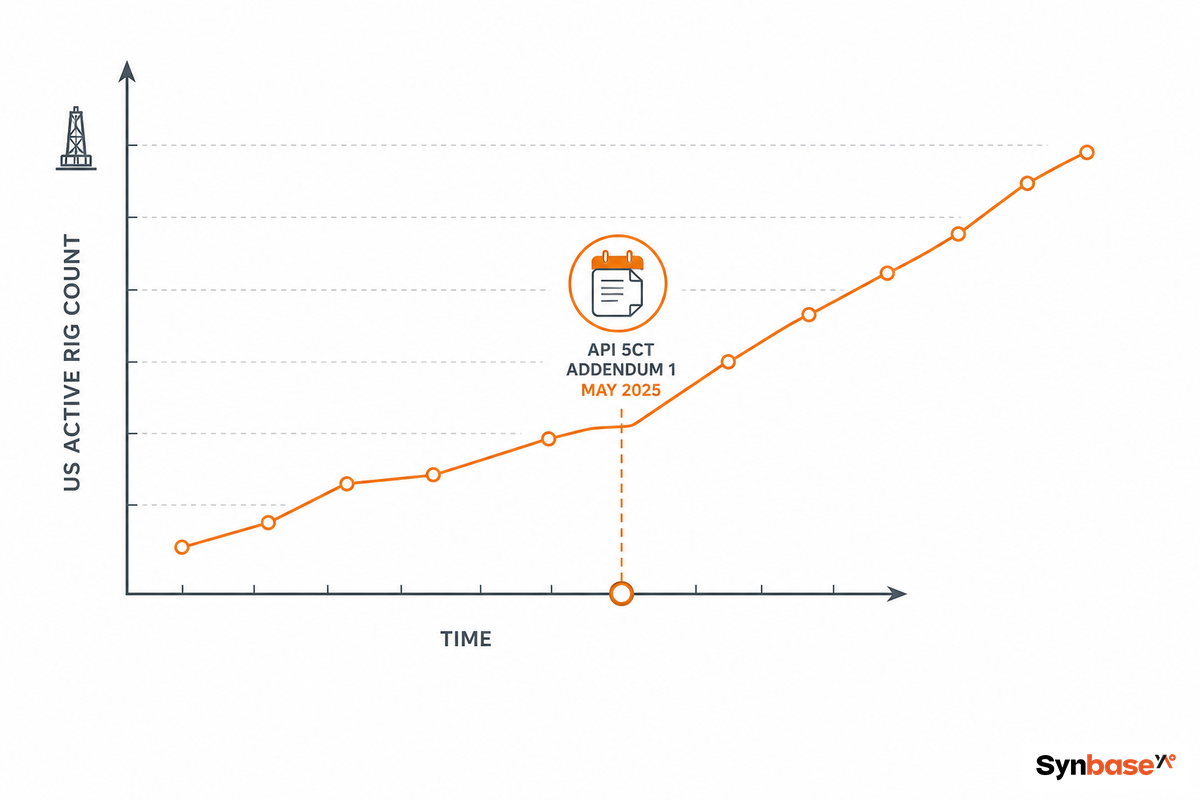
The most concrete near-term change in this space isn’t a market number, it’s a standards update. API published an Addendum to the 11th edition of API Spec 5CT on May 20, 2025, strengthening the manufacturing requirements for steel casing, tubing and their couplings, building on the base 11th edition released in December 2023.
Most vendor content still cites only “11th edition” without noting the Addendum, a gap that creates real risk for buyers who assume “API 5CT compliant” hasn’t changed since May 2025. In practice, a mill test report more than 1 year old predates the Addendum entirely, and treating it as current is an easy mistake since the certificate wording doesn’t visibly change. The resolution: ask your supplier whether their process has incorporated Addendum 1, not just the base edition.
The US active rig count stood at 581 as of July 10, 2026, up 44 rigs year-over-year, per Baker Hughes’ live tracker, yet search interest in most generic OCTG coupling terms has actually softened over the same period. That disconnect is itself informative: for an established, well-understood product category, procurement increasingly runs through direct mill relationships and RFQ processes rather than open web research, which is exactly the buyer behavior this guide is written for.
On the technical side, long-lateral horizontal drilling is pushing interest toward connections with a smaller expanded-box outer diameter than a traditional coupling, reducing running friction in slim, extended-reach wells, a trend worth watching if your program includes long laterals. Looking further out, expanding CO₂ storage and underground gas storage projects are starting to raise separate well-integrity questions for casing and coupling design, though that remains an emerging, adjacent conversation rather than today’s core OCTG coupling procurement question. The same US federal regulator that publishes casing design methodology is the natural body to watch as CO₂ storage well-integrity rules mature, since casing and coupling design sit squarely inside its existing technical-assessment scope.
Get an API 5CT Coupling Quote →
Synbase Steel manufactures API 5CT casing, tubing and couplings inside E-CHENG STEEL GROUP’s pipeline production base, so we see the grade-stamp confusion and substitute-grade oversights in this guide directly in the RFQs and mill test reports that cross our desk. This guide draws on API 5CT/5B clause text, government and peer-reviewed sources, and our own manufacturing process, not just a summary of our own product line.
Synbase Steel supplies steel pipe, fittings, flanges, valves and OCTG for oil and gas, petrochemical, power, water and industrial projects. Our technical guides are written to help buyers compare standards, grades, dimensions, coatings, inspection requirements and commercial terms before sending an RFQ.
We focus on practical specification work: matching pipe process to service conditions, checking wall thickness and end finish, reviewing MTC and NDT requirements, and clarifying documentation before production or shipment.
Project support across seamless pipe, ERW, LSAW, SSAW, buttweld fittings, forged flanges, valves and oilfield tubulars.
Specification review for ASTM, ASME, API, EN and DIN standards, including material grade, pressure class, coating and inspection scope.