Send Your RFQ to Synbase Steel
Prefer to send drawings, BOMs or attachment lists by email? sales@synbasesteel.com

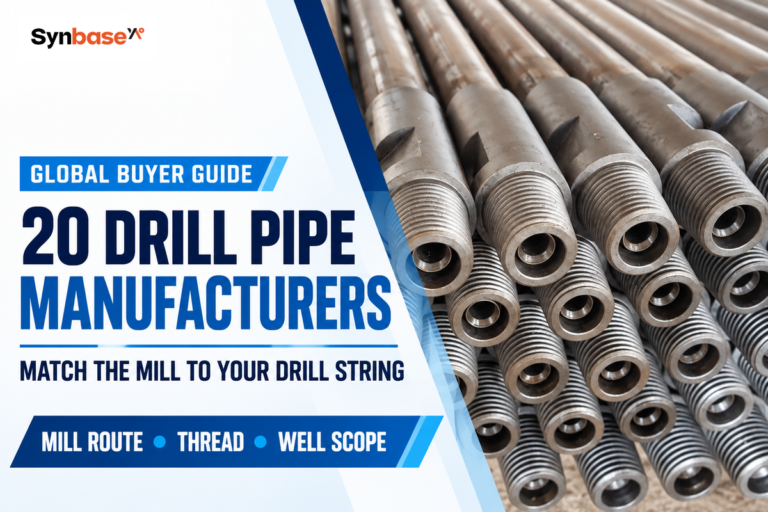
The Drill pipe manufacturers must be assessed by the portion of the production route they control. Some producers roll the seamless pipe body, upset-forge the ends and perform the friction welding of the tool joints under one quality system. Others convert third-party tubes or trade finished stock. Determining a supplier’s qualification status means correlating your well profile with active API Monograms licenses for API Spec 5DP and 7-1 and price comparisons.
Results in this category include integrated steel mills, independent tool joint converters, regional yard stockists and rock drilling rod producers. Treating all four seller types as equivalent leads to delivery delays, split warranty claims, and downhole tool failures. Leading drill pipe suppliers serve different drilling applications across conventional and unconventional drilling programs. Selecting critical components for the oil and gas wells requires plant capability to match demanding drilling conditions. Matching plant capability to demanding drilling conditions supports efficient drilling during challenging drilling. Both pipes and drilling stem assemblies must transmit torque reliably from surface drive to drill bit. This manual gives drilling contractors and procurement engineers a qualification method, three evaluation criteria and a standardized request for quotation.
The qualification record should identify who melts and pierces the green tube, who forges the internal-external upset, and who friction-welds the tool joint. Match the Product Specification Level (PSL-1, PSL-2, or PSL-3) and sour-service hardness rules to your well conditions. Compare offers only after locking an identical ten-field delivered basis.
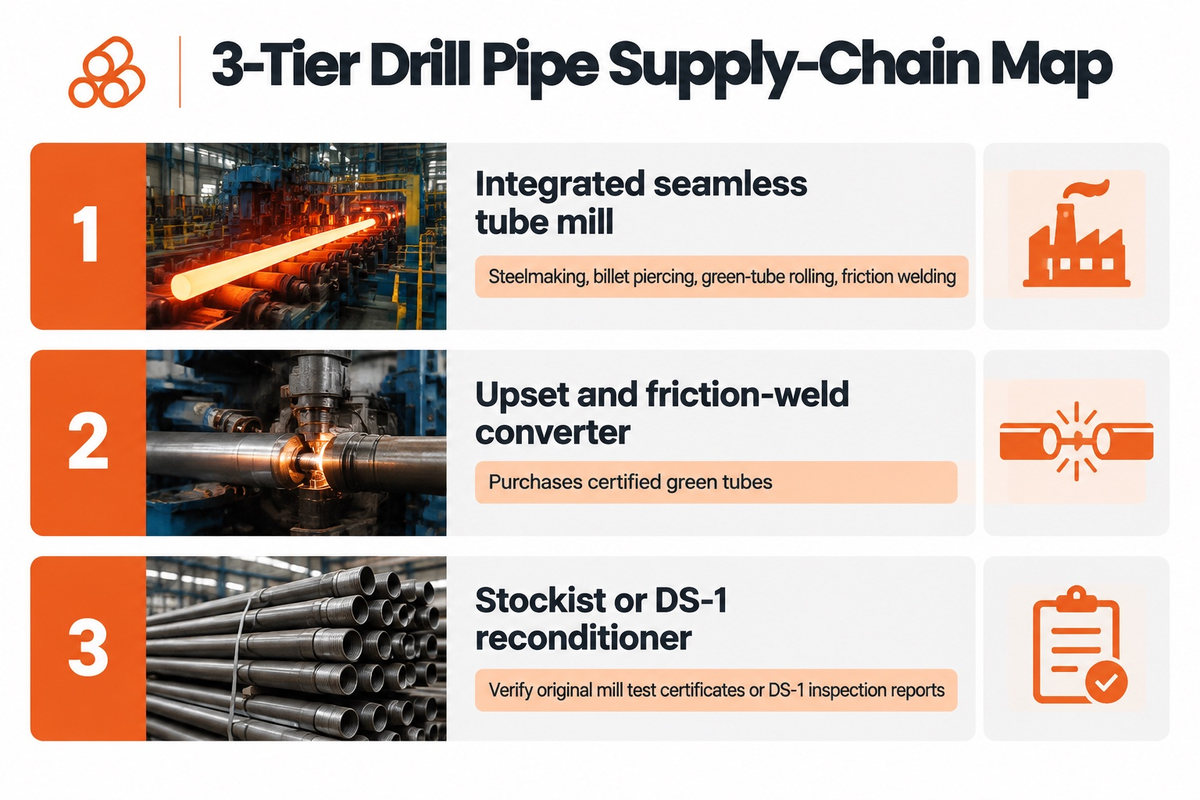
A finished oilfield drill pipe joint is a composite assembly as compared to a single rolled tube. It joins a seamless steel pipe body to quenched and tempered alloy tool joints at both ends. These components are joined either by upset forging or rotary friction welding. Since different companies control different steps of this supply chain, buyers first need to identify what production model a bidder operates.
In global drill pipe manufacturing, three principal commercial models constitute oil and gas industry. Integrated steel producers melt alloy steel, pierce premium seamless steel tubes, and upset pipe ends. They machine tool joints and perform friction welding in the same facility. Other converters purchase green tubes from qualified rolling mills. They do end upset forging, heat treatment, tool joint welding and non-destructive testing in their own facilities. Stocking distributors and inspection yards retain inventories of pipes ready for expedited shipment (i.e. new or reclassified stock).
A green pipe mill produces unfinished seamless steel tubes (i.e. green tubes). A drill pipe converter end-upsets these tubes and performs heat treatment, machining, and friction-welding of tool joints. For example, Texas Steel Conversion (i.e. Specialized Converter) and TSC Drill Pipe, its division, purchase green tubes from mills that meet their wall specifications, perform end upsetting and heat treatment and friction welding in-house. Based on our research, there’s a disclosure by converters and multi-sector suppliers. Therefore, buyers should verify each bidder’s exact in-house versus subcontracted steps in the order-specific quality plan.
The distinction determines whether one or two facilities govern steel chemistry, upset geometry, and weld zone tempering. Leading global mills and top companies in oilfield services often provide decades of experience and large forging capacity in the industry. Both routes deliver high-quality drill pipes, high-performance drill pipes, and enhanced performance and reliability of a premium drill string. Buyers need only verify each high-performance assembly and trace heat numbers of the pipe body and tool joint separately.
| Supplier category | Core manufacturing operations performed | Primary buyer verification focus |
|---|---|---|
| 1. Integrated seamless tube mill | Steelmaking, billet piercing, green-tube rolling, upset forging, tool-joint machining, friction welding, full-length NDT | Confirm the specific producing plant and active API Spec 5DP and API Spec 7-1 licenses for the quoted size range |
| 2. Upset and friction-weld converter | Purchases certified green tubes; performs end upsetting, quench-and-temper heat treatment, tool-joint threading, and inertia friction welding | Audit approved green-pipe mill origins, dual heat-number traceability, and post-weld heat-treatment hardness logs across the weld line |
| 3. Stockist or DS-1 reconditioner | Holds new mill lots or inspects, re-threads, hardbands, and reclassifies used strings to DS-1 or API RP 7G classes | Verify original mill test certificates for new stock, or third-party DS-1 Category 3–5 inspection reports for used lots |
Texas Steel Conversion reports upsetting pipe from 1.315 to 9 in outside diameter, with up to 10.5 in upset outside diameter, on seven heat treating lines and seven CNC threading lines. Its drill-pipe division, TSC Drill Pipe, holds API Spec 5DP and API Spec 7-1. It partners with mills to produce tubes to their specs, and welds tool joints to 2-7/8 to 6-5/8 in strings.
Independent stocking yards, Drill Pipe Supply, states it purchases from API certified drill pipe manufacturers and isn’t tied to any one mill. A stocking yard can address the urgent need for rig mobilization, which a rolling campaign can take months to fulfill. The mill test report from the plant which rolled the tube and welded the connection is required; a stocking yard’s commercial invoice isn’t sufficient.
Producers of Oilfield API 5DP such as manufacture three-piece friction-welded tubulars for deep hydrocarbon and geothermal wells. By contrast, horizontal directional drilling (HDD), water-well, and blast-hole manufacturers build shorter rock-drilling rods for civil and mining rigs. Filtering out non-oilfield drilling rod makers in the early stages helps avoid sending inquiries for oil country tubular goods to civil equipment factories.
Frequent online searches for top drill pipe manufacturers bring together the two industries and create an overlap. The majority of factories that announce steel pipes and drilling tools specialization, are in fact, fabricators of DTH hammer rods and utility stems. Filtering out non-oilfield drilling rod makers helps separate civil rod makers from mills that manufacture deep oil and gas exploration strings. Oilfield API 5DP producers engineer strings for specific drilling needs, high mud pressures, and rotary shouldered connections. Civil and mining rock-drilling rods differ from deep oil and gas exploration strings in torque ratings and thread profiles.
| Company and published role | Published dimensional and grade scope | Sourcing boundary for buyers |
|---|---|---|
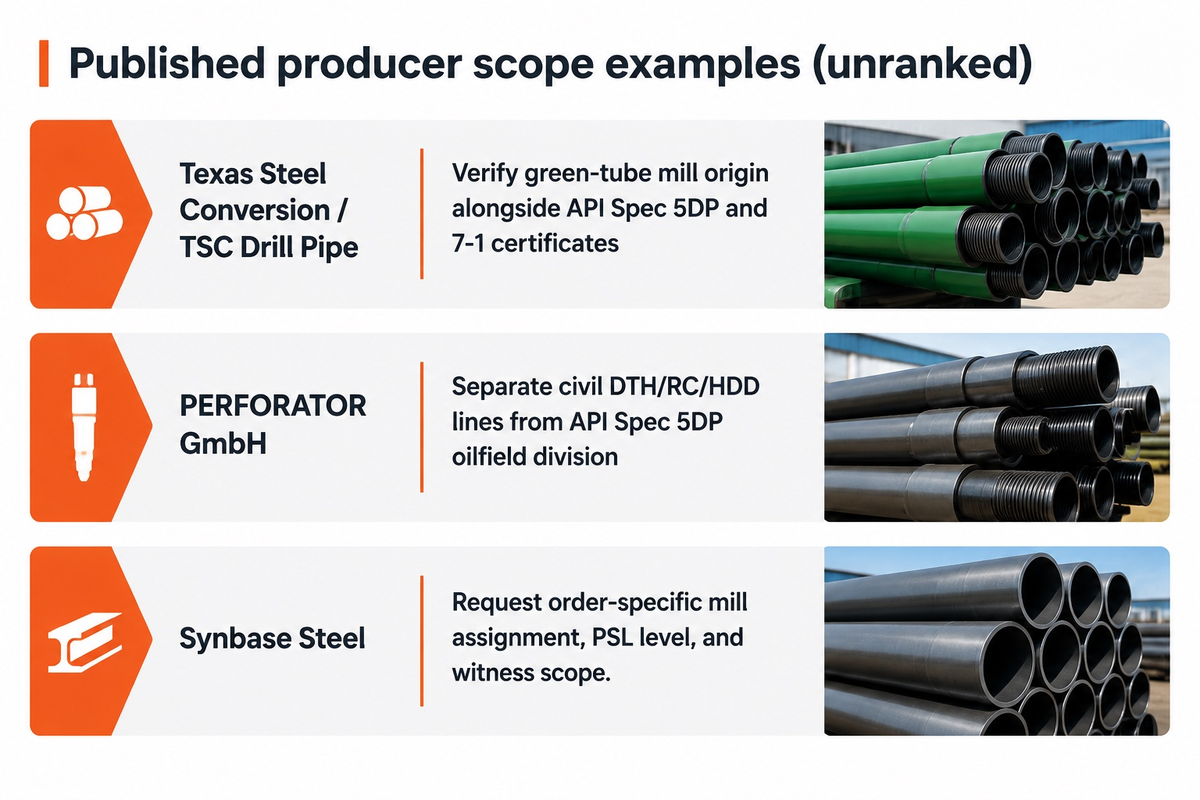
| Texas Steel Conversion / TSC Drill Pipe (US converter and manufacturer) | 2-7/8 in to 6-5/8 in drill pipe; upset forging 1.315 in to 9 in OD; API 5DP grades and PTECH+ double-shoulder connections | Verify green-tube mill origin alongside TSC’s API Spec 5DP and API Spec 7-1 processing certificates |
| PERFORATOR GmbH (German multi-sector drilling tool producer) | DTH/rotary pipes 35–300 mm OD; RC dual-wall 88.9–273 mm OD; HDD pipes; plus API 5DP OCTG drill pipe 2-3/8 in to 5-1/2 in (E75, X95, G105, S135) | Separate its civil DTH/RC/HDD catalog lines from its API Spec 5DP oilfield drill pipe division on the inquiry sheet |
| Synbase Steel (Chinese API 5DP drill pipe and OCTG package supplier) | 2-3/8 in to 6-5/8 in OD; grades E75, X95, G105, S135; Range 1–3 lengths; IEU upsets; NC26–NC50 and 5-1/2 FH / 6-5/8 FH connections | First-party published scope; request order-specific mill assignment, PSL level, and third-party witness scope during RFQ |
PERFORATOR GmbH provides an example of why scope separation is essential across multi-sector catalogs. The company offers 35 mm to 300 mm DTH and rotary drill rods for mining rigs, 88.9 mm to 273 mm reverse circulation dual wall pipes, trenchless HDD stems, and the API Spec 5DP drill pipe section. When purchasing API Spec 5DP drill pipe, a buyer for oil and gas drilling is required to specify the section, and can’t request a generic rotary drill pipe quote.
A procurement engineer checking the availability of drill pipe for 6-5/8 in directional wells reviews directory listings for B2B sales. Water well rod makers or pipe traders, such as Tejas Tubular, alongside oilfield processors, appear in numerous directory cards. Suppose the inquiry omits the API Spec 5DP edition, Range 2 or Range 3 length, and rotary shouldered connection designation.
Keep the shortlist to suppliers of oilfield equipment that publish complete API 5DP drill pipe specifications covering pipe-body yield strength, internal-external upset geometry, and tool-joint torsional ratio. Don’t include suppliers in your OCTG tender list if their websites only show metric rock-drill threads or trenchless rig compatibility charts.
Procurement engineers qualify API 5DP drill pipe manufacturers by confirming two credentials. First, verify the ordered API 5DP PSL level for the drill pipe. Second, verify the manufacturer’s active API Monogram authorization for API Spec 7-1 rotary shouldered connections. The API Composite List separately lists ISO 9001 registrations, so buyers should verify drill-pipe authorization by the exact API specification scope.
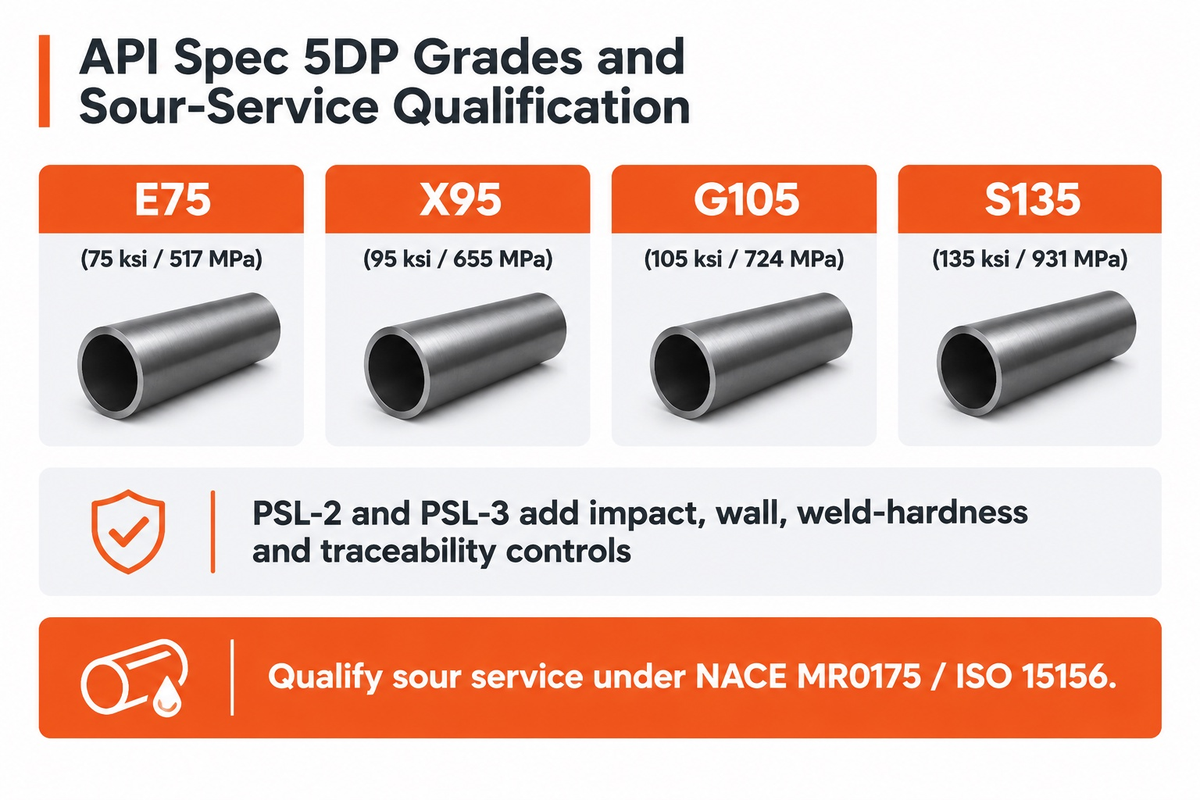
Relevant international standards such as EN ISO 11961:2018 establish technical delivery conditions for steel drill pipes with upset ends and weld-on tool joints. API Spec 5DP is the API drill-pipe specification covering Grades E, X, G, and S. Their minimum-yield-strength designations are E75 (75 ksi / 517 MPa), X95 (95 ksi / 655 MPa), G105 (105 ksi / 724 MPa), and S135 (135 ksi / 931 MPa). PSL-1 represents baseline delivery requirements. PSL-2 and PSL-3 add specification-level controls on impact energy, wall-thickness inspection, weld-zone hardness, and traceability.
Prior to accepting a supplier on a project bid list, buyers should check if the supplier’s facility is registered in the API Composite List directory. The directory lists active API Monograms and API Spec Q1 quality system registrations by legal company name and physical plant address, and scope of API specification. Buyers should verify that the manufacturing plant, not a trading office, is authorized for both API Spec 5DP and API Spec 7-1.
Due to the constantly evolving nature of the standards and programs, compliance becomes even more difficult. The official Latest Updates on the API Monogram and APIQR Program site posts program and licensing updates for API Spec 5DP and API Spec 7-1. When issuing a purchase order, stipulate the specific API Spec 5DP version and addendum, and specify the contract year instead of writing “API standard.”
Higher tensile grades require extra attention during the qualification process, especially with durability. Higher yield strength doesn’t mean increased durability downhole. Standard S135 catalog pipe shouldn’t be assumed to be acceptable for sour service because its acceptance depends on many factors, including the material condition and hardness, and the environment it’s exposed to. A failure investigation in Materials (PMC13117435) showed that S135 drill pipes exposed to chloride and sulfide ions in drilling fluid suffer intergranular pitting and stress-corrosion cracking below nominal yield, with dynamic rotation at 60 rpm increasing the corrosion rate by 41% compared with static immersion.
“NACE MR0175 adds: ‘As service stresses and material hardness increase, drilling fluid control becomes increasingly important.’”
NACE MR0175 / ISO 15156 does not make E-75, X-95, G-105, and S-135 universally acceptable for sour service. Instead, acceptance is tied to material condition, hardness, processing, and the specified environment. Beyond 20,000 ft and at 15–20 ksi downhole pressure, even trace H2S partial pressures can severely degrade the rotating-bending fatigue life of S135 steel. Similarly, sour-service material guidance under NACE MR0175 / ISO 15156 links sulfide stress cracking (SSC) prevention to controlled hardness, clean steelmaking chemistry, and environmental limits for the specific material and H2S service condition. For sour oil and gas wells, specify a controlled-hardness or dedicated sour-service grade whose material condition and service limits are qualified under NACE MR0175 / ISO 15156.
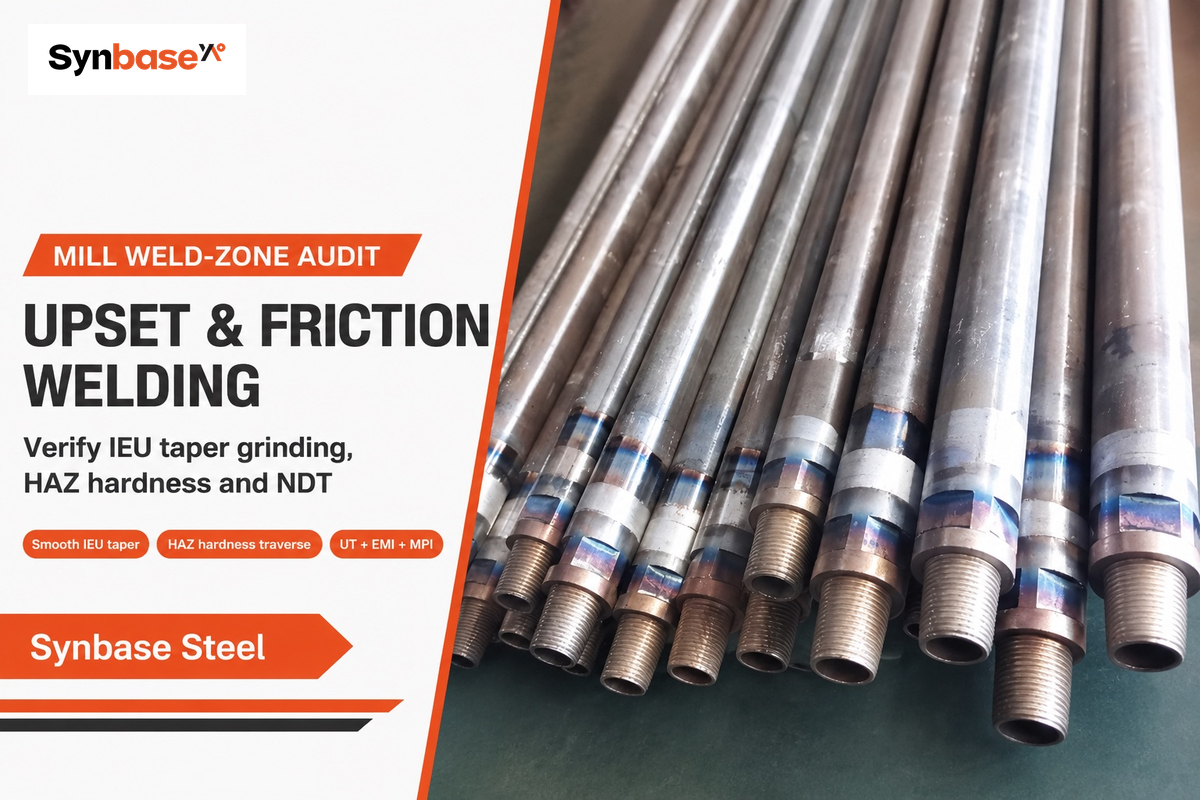
Reviews should pay special attention to the internal upset transition and friction-weld HAZ. Additional reviews should be on threads, shoulders, pipe body, and corrosion damage. Modern drilling technology places severe cyclic bending and torsional loads on the entire drilling process. Auditing a manufacturer’s upset forging geometry, friction-weld parameters, post-weld heat treatment and NDT hold points can help avoid downhole twist offs and washouts.
Foundational rotary friction-welding technology, detailed in US Patent US3235162A, clamps the stationary upset pipe body while rotating the alloy tool joint at high speed. Hydraulic axial forging advances the interface and extrudes the oxidized flash. As a result, solid-state forge-weld is formed across the full cross-section of the pipe wall without the use of filler metal. Further design improvements, such as US Patent US8783344B2, integrate threaded pin and box tool joints, as well as wear pads, to protect pipe body from abrasive casing wear.
While solid state bonding removes the need for certain process controls, the friction weld and adjacent upset transitions are still highly sensitive to process discipline. As described in Longway Drill Pipe, cyclic bending fatigue cracks form near tool joints, internal upset tapers, and rotary slip-cut marks. Internal corrosion initiates washout when the protective coating fails. If a manufacturer leaves a sharp internal forging step or incomplete flash removal inside the bore, drilling fluid turbulence accelerates erosion and corrosion fatigue at that transition.
Milling defects vs. rig site abuse can only be determined by setting metallurgical benchmarks prior to the string ever being shipped. Sri Chimbli and Scott Harding of Stress Engineering Services explain in their root-cause failure analysis review how mechanical and metallurgical testing works. Fractography, metallography, Charpy impact testing, and hardness traverses across the weld line separate manufacturing discrepancies, such as quench cracks or improper heat treatment, from service overload.
When reviewing a manufacturer, four verifiable production controls are required:
Drilling contractors often use a direct mill production run for full-string new builds, deepwater projects, and custom double-shoulder connections. Stocking distributors and DS-1 inspected used-pipe yards can quickly provide replacement lots and/or strings that meet verified inspection classes. Match the sourcing channel to well criticality, lead-time margin, and acceptable wall-thickness reduction.
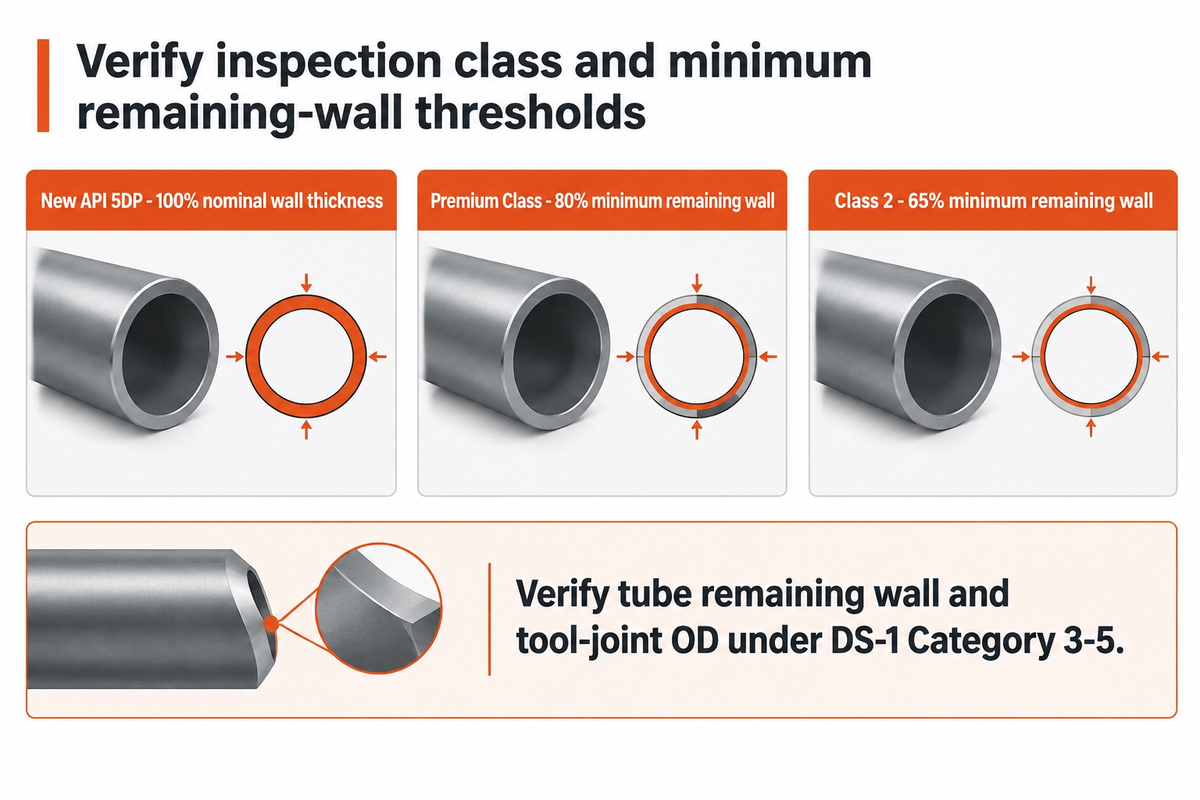
Choose direct mill production when your drilling program requires full-heat traceability, PSL-2 or PSL-3 toughness testing, custom hardbanding, or internal coating. Direct mill orders also fit non-stock connection profiles when lead times are planned months ahead. Choose stocking distributors or certified DS-1 used-pipe yards when immediate rig mobilization or small replacement quantities outweigh custom mill rolling schedules. When comparing new mill pipe against reclassified stock, verify the inspection class and minimum remaining-wall thresholds. Keystone Energy Tools notes post-inspection grading into N-class (new), P-class (premium), and C-class. Synbase Steel’s published inspection table lists New API 5DP at 100% nominal wall thickness, Premium Class at 80% minimum remaining wall, and Class 2 at 65% minimum remaining wall.
The standards for Premium and Class 2 designations are based on remaining wall and wear criteria. A single 65% threshold shouldn’t be applied broadly outside the specified table. Four main causes for string failure are tool-joint and tube OD wear, internal corrosion, fatigue cracking and physical damage to tool joints ( US DOE OSTI 5651510). Using used pipe increases the risk of downhole failure and fishing time.
–
A DS-1 Category 3–5 inspection example shows that eccentric tool-joint wear can fail a nearly new 6-5/8 in FH string even when tube-wall thickness remains acceptable. Buying from a stockist or rental yard requires verification of both tube-body remaining wall and tool-joint outside diameter / bevel dimensions under DS-1 Category 3–5.
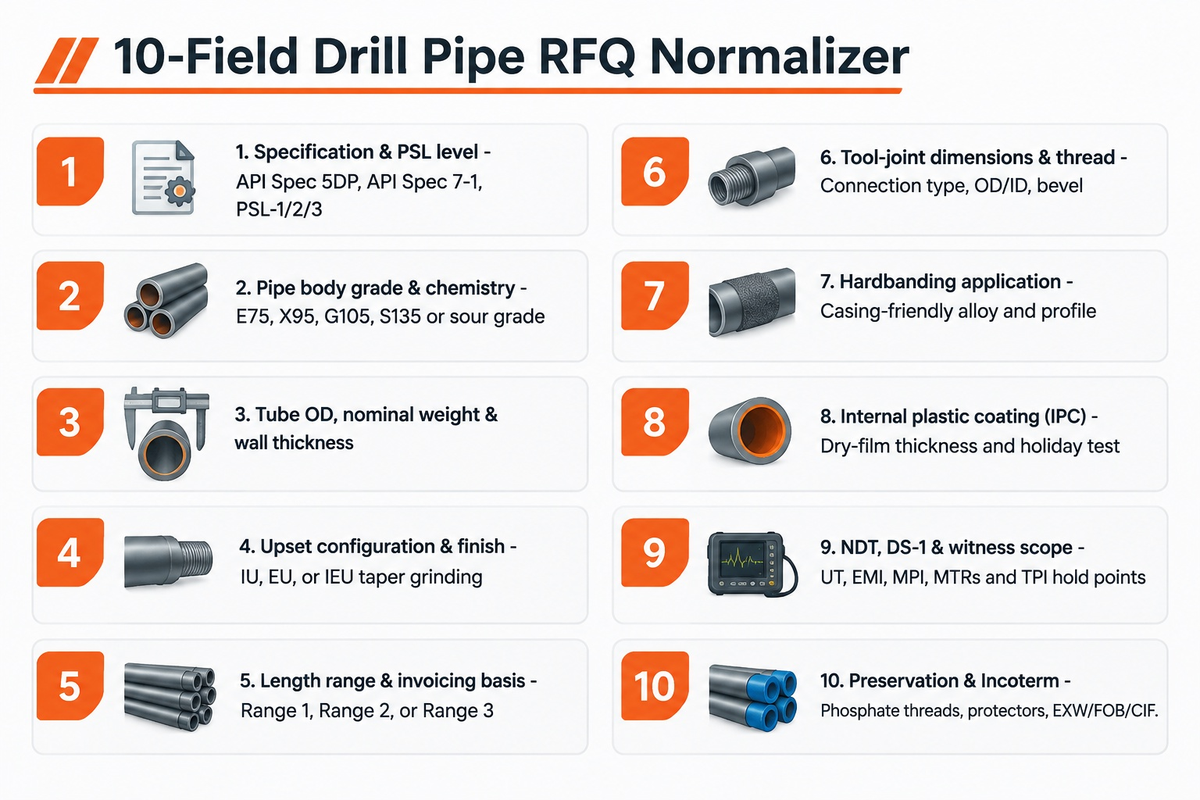
Quoted prices for drill pipe can’t be compared until ten technical and commercial variables are agreed to by all bidders. Omitting any of these fields allows a low headline quote to exclude expensive finishing steps.
–
Connection selection and surface treatment account for major price and lead-time differences across the global drill pipe market and the wider global market for OCTG. Even when tubes are made from high-grade steel, thread machining and protective coatings determine joint longevity. Standard API connections such as NC26, NC31, NC38, NC40, NC46, NC50, 5-1/2 FH, and 6-5/8 FH cover conventional strings. Complex directional and extended-reach wells often require high-torque double-shoulder premium connections for higher torsional capacity and hydraulic clearance. Quenched-and-tempered AISI 4137 / 4145H tool joints rely on gall-resistant phosphate coatings, proper thread compound, and sealed thread protectors to prevent storage and transit corrosion.
| RFQ field | What to specify on the inquiry sheet | Why unaligned quotes distort cost comparison |
|---|---|---|
| 1. Specification & PSL level | API Spec 5DP (state edition/addendum), API Spec 7-1, and PSL-1, PSL-2, or PSL-3 | PSL-2 and PSL-3 add mandatory impact toughness, weld-hardness, and NDT costs that PSL-1 omits |
| 2. Pipe body grade & chemistry | E75, X95, G105, S135, or controlled-hardness sour-service grade with max sulfur/phosphorus limits | Higher alloy grades and H2S SSC-tested heats carry different steelmaking costs and lead times |
| 3. Tube OD, nominal weight & wall | Specify the actual tube OD (e.g., 5 in), nominal weight (e.g., 19.50 lb/ft), and wall thickness (e.g., 0.362 in) for the quoted string | Prevents bidders from quoting lighter wall thicknesses under the same nominal pipe diameter |
| 4. Upset configuration & finish | Internal Upset (IU), External Upset (EU), or Internal-External Upset (IEU) with internal taper grinding | Unfinished internal upset steps reduce hydraulic efficiency and create fatigue crack initiation sites |
| 5. Length range & invoicing basis | Range 1 (18–22 ft), Range 2 (27–30 ft), or Range 3 (38–45 ft); state price per joint vs per foot/meter | Range 2 and Range 3 alter the number of tool joints per string and shift per-foot cost |
| 6. Tool-joint dimensions & thread | Connection type (e.g., NC50), tool-joint OD/ID, tong-space length, bevel diameter, or double-shoulder spec | Tool-joint forging size and proprietary double-shoulder licensing change unit price |
| 7. Hardbanding application | Smooth casing-friendly alloy (e.g., Arnco, Tuboscope, Duraband), band width, and flush vs raised profile | Omitting hardbanding from a base quote shifts wear protection cost to a third-party service yard |
| 8. Internal plastic coating (IPC) | Epoxy-phenolic or specified IPC system (e.g., TK34-P equivalent), dry-film thickness, and holiday testing | Coating application, curing, and holiday testing add processing steps that must be priced on the same basis |
| 9. NDT, DS-1 & witness scope | Specify required UT, EMI, and MPI coverage; certified mill test reports (MTRs); optional SGS, BV, DNV, or TPI witness hold points | Separates included mill quality control from optional third-party inspection fees and schedule holds |
| 10. Preservation & Incoterm | Phosphate-coated threads, pressed-steel or heavy-duty thread protectors, sea-worthy bundling, EXW/FOB/CIF | Aligns ocean freight, port handling, and corrosion protection during multi-week marine transit |
Let’s say a buyer receives two quotes for the same drill-pipe size, weight, grade, range and connection as stated in the RFQ. An example is quoting 5 in, 19.50 lb/ft G105 Range 2 drill pipe with NC50 connections. Bidder A quotes a lower unit price on bare PSL-1 pipe EXW mill without hardbanding or internal coating. Bidder B includes CIF Houston for PSL-2 impact test, casing-friendly hardbanding of the box end, internal plastic coating and pressed-steel thread protectors. After normalizing for the ten factors above, we can see the true cost for the delivered pipe before the contract is awarded. The actual prices will be determined based on the confirmation of the specific unit prices, minimum order quantities, and rolling slot lead times for your size and grade combination.
When designing bottom-hole assembly transitions, buyers usually source heavy weight drill pipe (HWDP) joints in conjunction with the standard drill pipe joints. For these joints, include requirements for HWDP center-upset dimensions, wear-pad hardbanding and stress-relief grooves, in a separate line item on the same RFQ worksheet. That step ensures both tubular products share compatible connection gauges and shipping schedules.
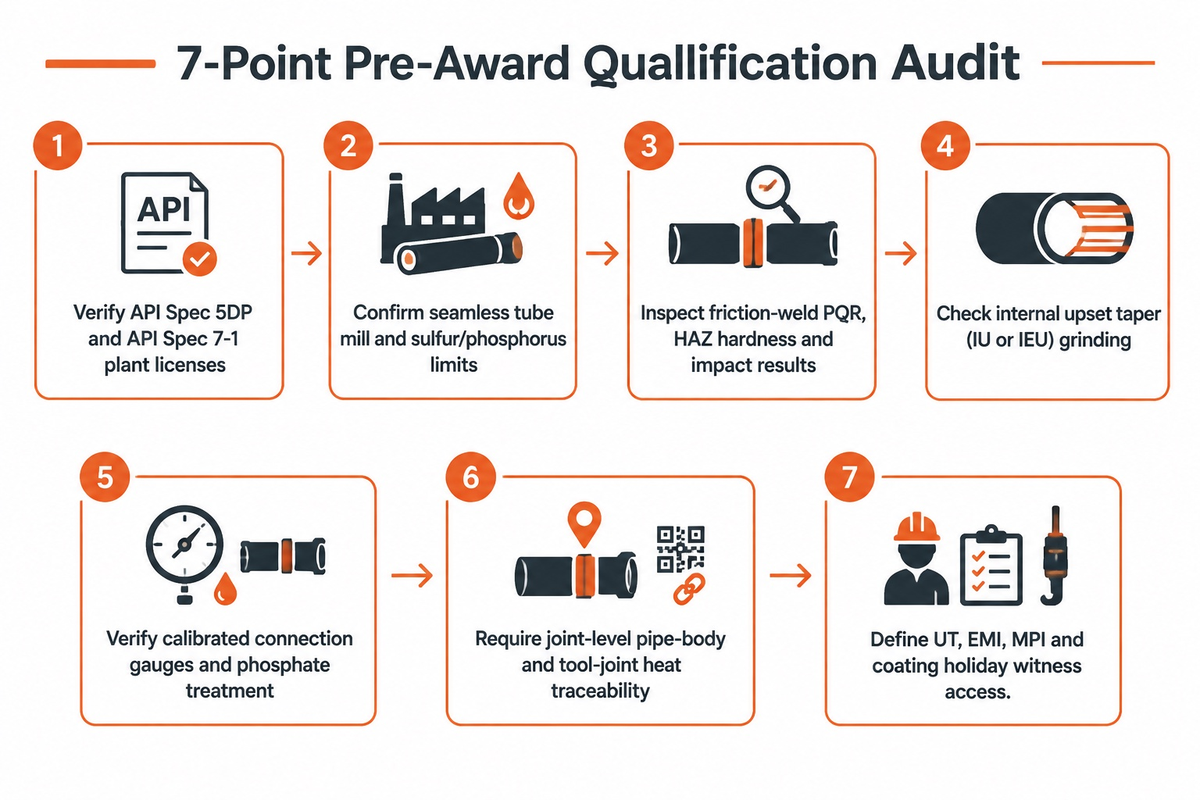
A seven-point pre-award qualification audit must be completed before a drill pipe contract is awarded. It includes, but isn’t limited to, plant licensing, green-tube origination, friction-weld qualification, connection gauging, sour-service testing, heat-to-joint traceability, and commercial milestone locks. Pairing this checklist with the 9-Scenario Supplier-Route Decision Matrix helps assess risk and aligns the chosen vendor with your operational risk profile.
| Drilling procurement scenario | Recommended supplier route | Mandatory verification condition |
|---|---|---|
| 1. Full-string new build for deep onshore or offshore drilling | API-licensed 5DP/7-1 mill or converter | Confirm PSL testing and rolling slots in project records; require dual heat-number traceability |
| 2. Extended-reach horizontal well requiring high torque | Manufacturer offering double-shoulder connections | Verify torsional yield ratio, hydraulic ID clearance, and make-up torque chart compatibility |
| 3. Sour gas (H2S) well or high-pressure high-temperature interval | Qualified mill supplying controlled-hardness or sour grades | For sour gas, specify drill-pipe materials with hardness and environmental limits qualified to NACE MR0175 / ISO 15156; standard S135 should not be assumed suitable |
| 4. Urgent replacement joints for an active rig within days | Regional stocking distributor with traceable new stock | Inspect original mill certificates, connection bevel diameter, and storage thread condition |
| 5. Budget-constrained shallow vertical well or workover string | Certified stockist offering DS-1-inspected used pipe with the accepted inspection class and minimum remaining-wall criterion stated in the inspection report | Require current DS-1 Category 3–5 ultrasonic wall and tool-joint OD inspection reports |
| 6. Abrasive directional formation with severe casing wear risk | Manufacturer or processor with qualified hardbanding line | Specify casing-friendly hardbanding alloy, flush application, and crack-free cooling procedure |
| 7. Corrosive water-based mud or geothermal brine circulation | Mill or converter with in-house internal plastic coating (IPC) | Audit internal grit-blasting profile, dry-film coating thickness, and holiday pin-hole testing per the coating specification |
| 8. Multi-item OCTG tender combining drill pipe, HWDP, and casing | Integrated OCTG package supplier with audited partner mills | Require separate API Spec 5DP and API Spec 7-1 certificates; confirm any API 5CT scope independently |
| 9. Trenchless utility crossing, mining blast-hole, or RC sampling | Specialized HDD, DTH, or reverse-circulation rod manufacturer | Keep separate from API 5DP oilfield tenders; verify rig-specific thread and dual-wall seal specs |
Applying this matrix across onshore and offshore projects prevents a common procurement mismatch in the drilling industry. Buyers don’t rely on a spot-market stockist check for a critical sour-gas mill order. Also, they don’t wait on a custom mill rolling campaign when a traceable distributor lot is available to keep the rig running.
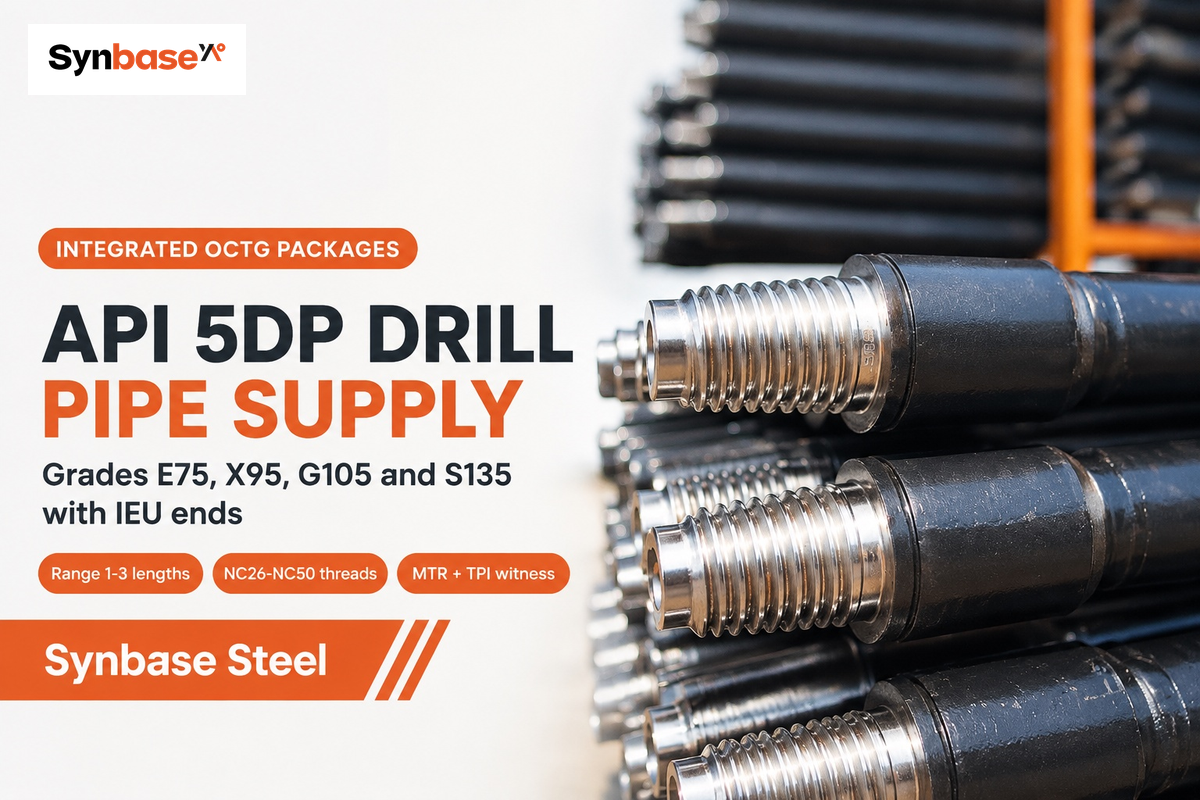
According to Synbase Steel’s published specification pages, Synbase Steel coordinates API 5DP / ISO 11961 drill pipe alongside heavy weight drill pipe and casing under a single export inspection and logistics workflow. All product ranges cited below reflect Synbase Steel’s published product pages; project-specific plant assignments, unit pricing, and production schedules are confirmed per quotation.
On its published API 5DP drill pipe solution page, Synbase Steel lists oilfield drill pipe in steel grades E75, X95, G105, and S135 across outside diameters from 2-3/8 in to 6-5/8 in. Published length options cover Range 1 (18–22 ft), Range 2 (27–30 ft), and Range 3 (38–45 ft). Standard rotary shouldered connections include NC26, NC31, NC38, NC40, NC46, NC50, 5-1/2 FH, and 6-5/8 FH with internal-external upset (IEU) ends and ultrasonic, electromagnetic, and magnetic-particle testing.
To ensure clear corporate attribution, please see the Synbase Steel company profile for the background on Synbase Steel Co., Ltd., the international business subsidiary of E-CHENG Steel Group. Group-level manufacturing assets, patents and facility registrations are scoped to their respective legal entities. Orders include certified mill test reports (with third-party SGS, BV or DNV witness inspection available on request) naming the producing facility.
When your well program integrates drill string elements with well construction tubulars, our team consolidates API 5CT casing and tubing packages and HWDP on a single shipment under EXW, FOB or CIF terms. Are you ready to benchmark your current list of materials? Submit your 10-field drill pipe RFQ to receive an item-by-item delivery and technical response.
A genuine drill pipe manufacturer or converter holds facility-specific API Monogram licenses tied to its rolling, upsetting, or friction-welding plant. If the seller is a trading company, package supplier, or stockist, require it to disclose the exact licensed manufacturing facility upfront. Require the applicable mill test certificates together with a joint-level traceability schedule linking each pipe-body heat and tool-joint heat.
Because a drill pipe joint combines a seamless steel tube with friction-welded pin and box connections, qualifying a producer requires verifying both standards. API Spec 5DP is aligned with ISO 11961 and defines the E75, X95, G105, and S135 drill-pipe grades together with PSL-1, PSL-2, and PSL-3 delivery requirements. API Spec 7-1 ensures the alloy steel tool joints, rotary shouldered threads, and gauges meet torsional and dimensional tolerances.
Piercing billets into seamless steel tubes requires a high-tonnage rotary piercing and rolling mill. Producing finished drill pipe requires upset forging presses, continuous quench-and-temper furnaces, CNC threaders, and inertia friction welders. Many reputable API 5DP licensees operate as specialized converters. Buyers should audit both the green-pipe mill origin and the converter’s weld-zone heat-treatment records.
For sour wells, specify a controlled-hardness or dedicated sour-service grade whose material condition and service limits are qualified under NACE MR0175 / ISO 15156. Verify mud pH and sulfide scavenger controls with your engineering team.
The material certificates should report the required chemical, tensile, elongation, and impact results for each applicable pipe-body and tool-joint heat under the specified PSL and purchase order. Accompanying quality records should include post-weld heat-treatment furnace charts and hardness traverses across the friction-weld heat-affected zone. Non-destructive examination packets must document the ultrasonic, electromagnetic, and magnetic-particle examinations and coverage required by the specified PSL and purchase order. Where specified in the purchase order, attach internal plastic coating holiday test logs, hardbanding alloy certificates, and third-party witness release notes (such as SGS, BV, or DNV). Include a serialized packing tally matching stencil marks on each joint. Review our API 5DP drill pipe specification page to include these documentation requirements in your next inquiry.
Synbase Steel supplies steel pipe, fittings, flanges, valves and OCTG for oil and gas, petrochemical, power, water and industrial projects. Our technical guides are written to help buyers compare standards, grades, dimensions, coatings, inspection requirements and commercial terms before sending an RFQ.
We focus on practical specification work: matching pipe process to service conditions, checking wall thickness and end finish, reviewing MTC and NDT requirements, and clarifying documentation before production or shipment.
Project support across seamless pipe, ERW, LSAW, SSAW, buttweld fittings, forged flanges, valves and oilfield tubulars.
Specification review for ASTM, ASME, API, EN and DIN standards, including material grade, pressure class, coating and inspection scope.