Send Your RFQ to Synbase Steel
Prefer to send drawings, BOMs or attachment lists by email? sales@synbasesteel.com

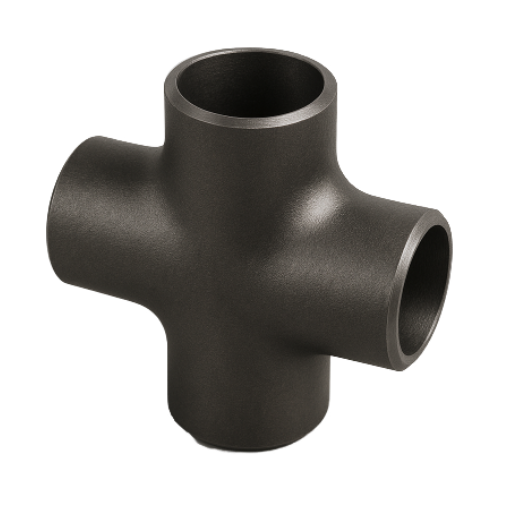
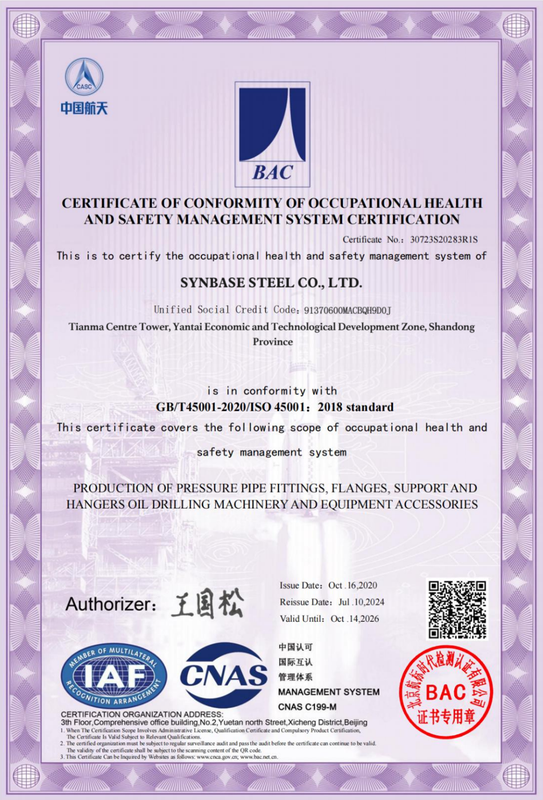
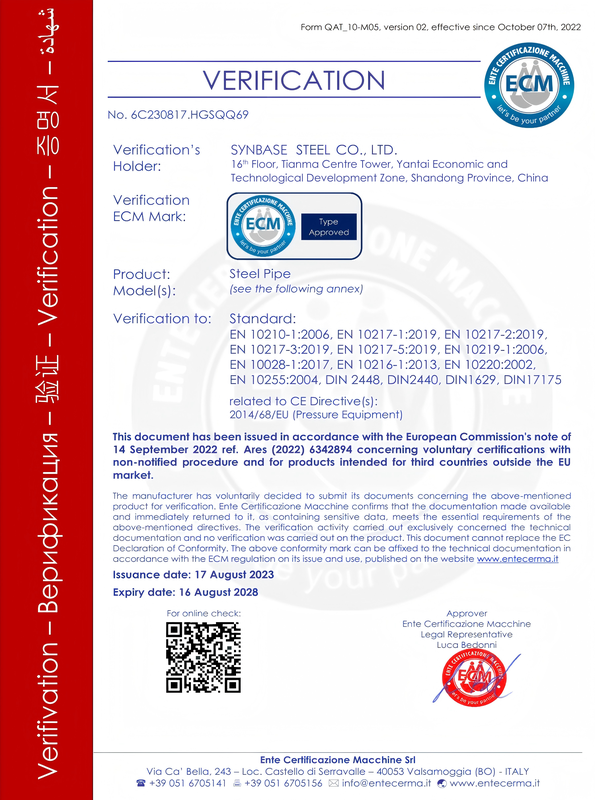
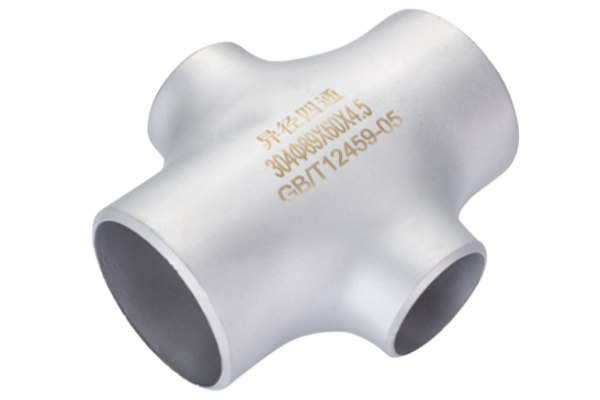
A butt weld cross also called a cross pipe fitting, is a four-way fitting that joins four pipe runs at 90° in a single welded junction, equal when all four ends share one bore, reducing when the branch outlet steps down. Synbase Steel manufactures both, mill-direct, to ASME B16.9 dimensions in carbon, low-temperature, chrome-moly, stainless, duplex and high-yield grades, and ships every cross with an EN 10204 3.1 material test certificate traceable to its heat number.
Request a Mill-Direct Quote (RFQ)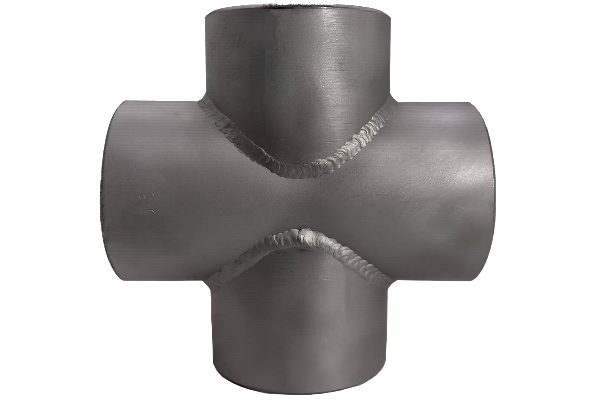
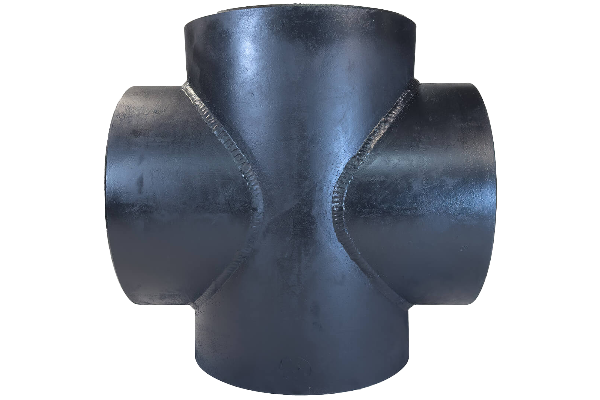
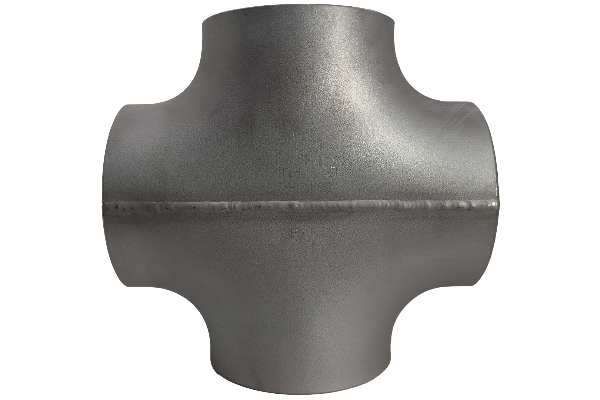
Four pressure paths converge in one cross fitting, so it carries more stress than any tee in the same line. The branch-to-run intersection is where fatigue cracks start, and a cross has twice the branch intersections of a tee. When that single fitting fails, the whole four-way junction comes down with it.
Most procurement teams meet a second problem before the first: the page they’re buying from won’t show the data they need. The market-leading result for “butt weld cross” is a 90-word stub with every dimension locked inside downloadable PDFs, and the page that ranks first for “reducing cross” publishes only equal-cross dimensions.
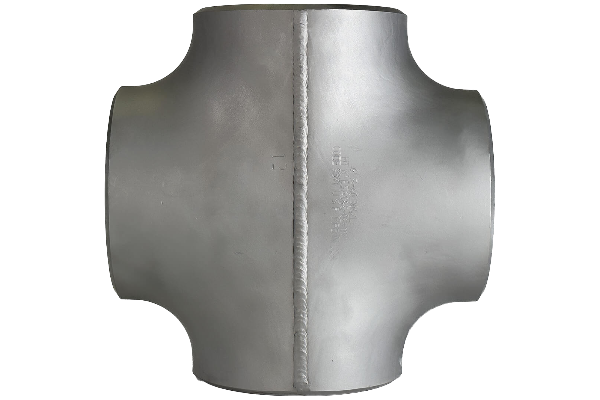
That risk is structural. Because a cross stacks two branch crotches into one body, the four-way concentrates stress where carbon steel only yields at 240 MPa, so one under-tested fitting can fail an entire header in production service. Synbase engineers every cross around that failure mode, full ASME B16.9 geometry, ISO 9001 traceability, and in-house inspection before the certificate is issued.
Two construction routes cover the size range. One-piece crosses are cold-formed from hot-extruded pipe up to roughly NPS 24; above that, crosses are fabricated from plate or pipe with full-penetration intersection welds. Fabricated crosses are pipe fabrication, which falls outside the ASME B16.9 scope and is qualified instead under MSS SP-75 or a documented purchaser agreement.
An equal cross (also called a straight cross) has four ends of the same nominal pipe size and one common center-to-end dimension. A reducing cross, sometimes listed as an unequal cross, keeps the run at full size and steps the branch outlet down, so it’s specified run × run × outlet (for example 4″ × 4″ × 2″).
Engineers regularly confuse ASME B16.9 with MSS SP-75 and treat them as alternatives. They are not alternatives; they govern different requirements, and a high-pressure pipeline cross satisfies all three at once.
That separation is the talking point no competitor offers: B16.9 fixes the shape, the ASTM spec fixes the metal, and MSS SP-75 (with material spec A860) adds the high-yield pipeline overlay. A 6″ WPHY-60 cross for a gas trunk line is dimensioned to B16.9, qualified to A860/SP-75, and tested by hydrostatic proof to the pipe’s specified minimum yield.
Get this wrong and the cost is real: specify a plant-piping A234 WPB cross for a high-pressure transmission line and you have under-rated the junction. The mistake is treating B16.9 and SP-75 as a choice. The reason Synbase quotes both on one line is structural: a 6″ WPHY-60 pipeline cross is dimensioned to B16.9 and proof-tested to its 415 MPa pipe yield in the same in-house production shop, ISO 9001 certified. Unlike a stockist matching loose heats, we control the heat from melt to mark.
This is the data the rest of the market keeps in PDFs. Below are the ASME B16.9 center-to-end dimensions for equal and reducing crosses, the schedule walls that set wall thickness, and the tolerance band a real fitting must hold. Every Synbase cross is cut and beveled to these figures and verified before the MTC is issued.
Fabrication Notice
One detail every spec writer should pin down: ASME B16.9 standardizes crosses only to NPS 24. Need a 30″ four-way? That’s a fabricated cross under MSS SP-75, not a catalog B16.9 part, we build those to order with a weld procedure and NDE package, but they price and lead differently.
| NPS | OD at bevel, mm (in) | Center-to-end C, mm (in) |
|---|---|---|
| 1/2 | 21.3 (0.84) | 25 (1.00) |
| 3/4 | 26.7 (1.05) | 29 (1.12) |
| 1 | 33.4 (1.32) | 38 (1.50) |
| 1-1/4 | 42.2 (1.66) | 48 (1.88) |
| 1-1/2 | 48.3 (1.90) | 57 (2.25) |
| 2 | 60.3 (2.38) | 64 (2.50) |
| 2-1/2 | 73.0 (2.88) | 76 (3.00) |
| 3 | 88.9 (3.50) | 86 (3.38) |
| 3-1/2 | 101.6 (4.00) | 95 (3.75) |
| 4 | 114.3 (4.50) | 105 (4.12) |
| 5 | 141.3 (5.56) | 124 (4.88) |
| 6 | 168.3 (6.62) | 143 (5.62) |
| 8 | 219.1 (8.62) | 178 (7.00) |
| 10 | 273.0 (10.75) | 216 (8.50) |
| 12 | 323.8 (12.75) | 254 (10.00) |
| 14 | 355.6 (14.00) | 279 (11.00) |
| 16 | 406.4 (16.00) | 305 (12.00) |
| 18 | 457.0 (18.00) | 343 (13.50) |
| 20 | 508.0 (20.00) | 381 (15.00) |
| 22 | 559.0 (22.00) | 419 (16.50) |
| 24 | 610.0 (24.00) | 432 (17.00) |
The run keeps its full-size center-to-end; only the branch outlet M shortens as the outlet steps down. This is the table the #1-ranked “reducing cross” page never publishes.
| Run × Outlet (NPS) | Run OD / Outlet OD, mm | Run C, mm (in) | Branch M, mm (in) |
|---|---|---|---|
| 2 × 1 | 60.3 / 33.4 | 64 (2.50) | 51 (2.00) |
| 2 × 3/4 | 60.3 / 26.7 | 64 (2.50) | 44 (1.75) |
| 2-1/2 × 1-1/2 | 73.0 / 48.3 | 76 (3.00) | 67 (2.62) |
| 3 × 2 | 88.9 / 60.3 | 86 (3.38) | 76 (3.00) |
| 3 × 1-1/2 | 88.9 / 48.3 | 86 (3.38) | 73 (2.88) |
| 4 × 3 | 114.3 / 88.9 | 105 (4.12) | 98 (3.88) |
| 4 × 2-1/2 | 114.3 / 73.0 | 105 (4.12) | 95 (3.75) |
| 4 × 2 | 114.3 / 60.3 | 105 (4.12) | 89 (3.50) |
The cross body wall matches the schedule of the pipe it welds into, per ASME B36.10M (carbon/alloy) and B36.19M (stainless). A few common runs:
| NPS | SCH 10 | STD / 40 | XS / 80 | SCH 160 |
|---|---|---|---|---|
| 2 | 2.77 mm | 3.91 mm | 5.54 mm | 8.74 mm |
| 4 | 3.05 mm | 6.02 mm | 8.56 mm | 13.49 mm |
| 6 | 3.40 mm | 7.11 mm | 10.97 mm | 18.26 mm |
| 8 | 3.76 mm | 8.18 mm | 12.70 mm | 23.01 mm |
OD at bevel runs +1.6 / -0.8 mm up to NPS 2-1/2, widening to +6.4 / -4.8 mm at NPS 20–48; wall thickness stays at or above 87.5% of nominal. Center-to-end and bevel angle are checked against B16.9 and B16.25 on our inspection sheet, and that sheet is the document buyers ask for when a fitting “looks right” but won’t align in the field. Spec confusion isn’t academic: in one review of 415 buyers, 4% of buyers experienced leaks traced to size and thread mismatches, so Synbase publishes the full table in-house rather than bury it in a PDF.
Weight of butt weld fittings is the number buyers chase for freight, because a cross has four protruding ends and tends to cube out a container before it weights out. Cross weight derives from the tee volume formula, W(kg) = 0.02466 × (S+1.5) × [D−(S+1.5)] × (3C−D/2) / 1000, with a fourth-branch addition. At 6″ SCH 40, an equal cross run roughly a third heavier than the equivalent tee; we quote the exact per-piece theoretical weight with every RFQ so your freight estimate is right the first time.
Every grade shares the same B16.9 cross geometry; what changes is the metal and the test package. Specifying by service condition, temperature, corrosion, pressure class, is how you avoid the most expensive mistake, which is a grade that welds and looks correct but is wrong for the medium.
| Service condition | Cross grade | Key data | Typical use |
|---|---|---|---|
| General pressure, -29 to 427°C | Carbon A234 WPB / WPC | 415 MPa (60 ksi) TS, 240 MPa (35 ksi) YS | Oil & gas, power, process piping |
| Low temperature, to -46°C | Low-temp A420 WPL6 | Mandatory Charpy V-notch impact | LNG, refrigeration, cold climates |
| High temperature, >427°C | Chrome-moly A234 WP11 / WP22 / WP91 | Cr-Mo creep resistance | Refinery, boiler, power headers |
| Corrosion / cryogenic | Stainless A403 WP304 / WP316L | 316L low carbon, weld-decay resistant | Chemical, food, pharma, sour |
| Chloride / seawater | Duplex A815 S31803 / S32205 | High strength + pitting resistance | Offshore, desalination |
| High-pressure transmission | High-yield A860 WPHY 60/65/70 | = API 5L X60–X70 | Gas trunk / transmission pipelines |
| Severe corrosion / sour | Nickel alloys — Inconel 600/601/625, Incoloy 800/825, Monel 400, Alloy 20, Hastelloy C276 | UNS N06600 / N06601 / N06625 / N08800 / N08825 | Acid, sour gas, exotic chemical |
These special alloy crosses use the same B16.9 geometry as the carbon part, only the UNS-numbered material spec and the test package change. Synbase fittings manufacturing runs duplex steel and low-temperature grades in-house on the same ISO 9001 certified line as carbon, and every alloy heat is confirmed by radiography and positive material identification before release. Unlike a stockist pulling mixed heats, that single-source control is the differentiator on a multi-grade order.
Two quality lines on the MTC separate a fitting that holds from one that fails: the steel must be fully killed (completely deoxidized) for any pressure or low-temperature cross, and a low-temperature grade such as A420 WPL6 has to carry actual Charpy V-notch results at temperature, not just a grade stamp. We report both, because they’re verifiable, and verifiable is the point.
Not sure which grade your service needs? Send your temperature, medium and pressure for a matched-grade RFQ.
Request Matched Grade Quote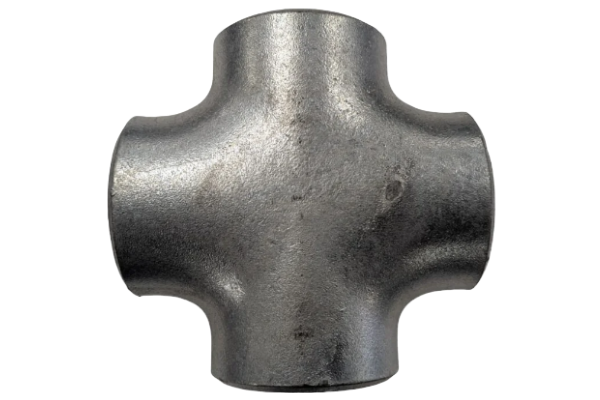
“We don’t treat ‘A234 WPB’ as a finished answer. We confirm the steel is fully killed, positive-material-identify every heat, and radiograph the welds on fabricated crosses before a single certificate goes out, because the grade on the stamp only matters if the paperwork behind it survives an audit.”Synbase Steel Engineering Team, fittings QA
Use a single cross when you genuinely need four-way distribution in one plane, a header takeoff feeding two branches, a sprinkler main, a manifold, and space or weld count favors one fitting over two. Use two tees when the branches sit at different stations, when a large cross is hard to source, or when you want to keep stress off a single crotch. It’s a real decision engineers debate, and the honest answer turns on stress, not preference.
| Criteria | One cross | Two tees |
|---|---|---|
| Field weld joints | 4 | 6 |
| Leak paths | 4 (one fitting) | 6 (two fittings) |
| Stress crotches | 2 in one body | 1 each, spaced apart |
| Layout | Single plane, compact | Flexible spacing along run |
| Availability | > NPS 24 Fabricated to order | Stock tees common |
A cross junction concentrates stress at the branch-to-run intersection, and ASME B31.3 Appendix D quantifies it with a stress-intensification factor: flexibility characteristic h = 4.4·tn/r, factor i = 0.9/h(2/3) on a welding tee. The trap is reducing crosses: Markl’s original factors omitted reduced-outlet intersections, and the out-of-plane bending on the header can be non-conservative by a factor of two to three, peaking when the branch-to-header radius ratio is about 0.7. In plain terms, a reducing cross can carry more stress than the standard SIF predicts, so it deserves a real B31.3 check rather than a default.
In practice, a sprinkler main or a 6″ process header is where one cross earns its place; a pump manifold with offset branches is where two tees win. The honest version is that a cross isn’t always the right call, Synbase won’t claim it’s cheaper in every case, because the trade-off is real, and we’ll run the B31.3 numbers with you on the actual layout.
The single most common reason a cross is rejected on receipt has nothing to do with the steel, it’s a material test certificate that can’t be tied to the part. As the British Stainless Steel Association puts it, “material test certificates aren’t just paperwork, they’re legal and technical declarations of compliance,” and re-issued or middleman-altered certificates are a recognized fraud pattern. Because we’re the mill, the chain stays intact end to end.
Counterfeit material test certificates, fake heat numbers, reused test data, trading companies posing as mills, are a recognized fraud, and a rejected shipment cost far more than the part. Only accept reissued certificates directly from the original mill, never from a middleman. Synbase controls the chain in-house for a structural reason: because we run melt-to-mark on every heat, an auditor working in the field can call the mill and verify the chemistry against the stamp. Unlike a trader reissuing a certificate, we never separate the part from its paperwork.
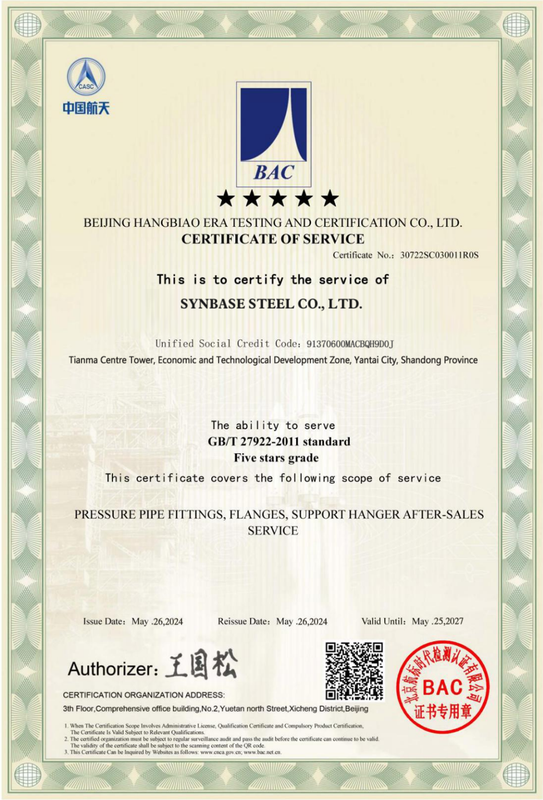
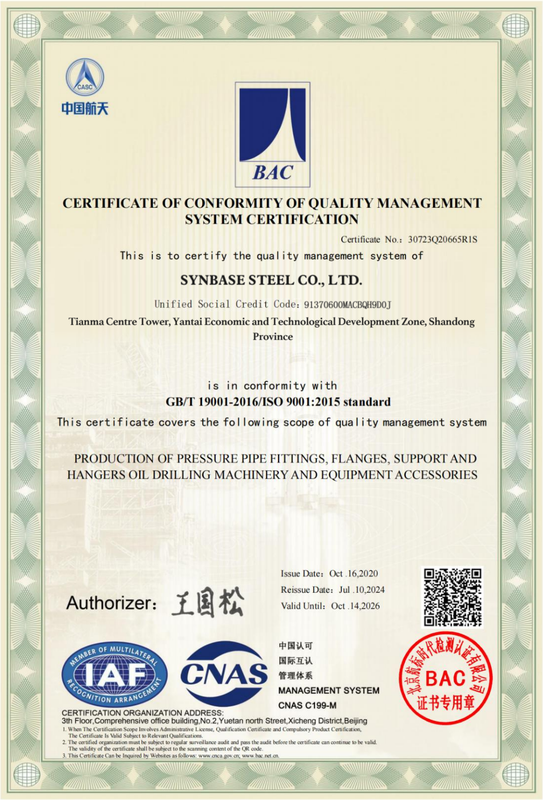
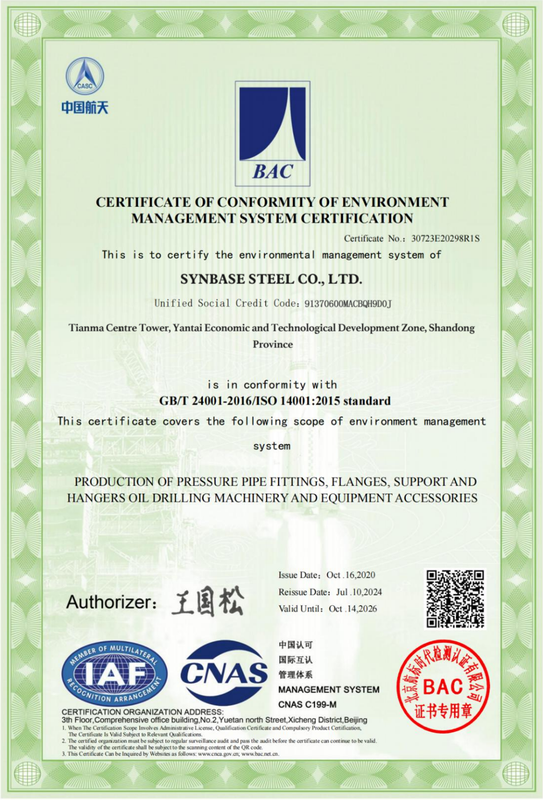
Crosses show up wherever a line needs a clean four-way junction in one plane: distribution headers and manifolds in oil & gas and petrochemical plants, fire-protection sprinkler mains, power-station and boiler header piping, water and process distribution, all dimensioned to ASME B16.9.
A useful rule of thumb from header design, branch a cross or tee where the branch is at least half the header size; below that, a reinforced branch connection is often the better call.
No honest mill posts a fixed per-piece number for a part that spans 30+ grades and 12 schedules. Price moves with five levers, and raw steel price is the biggest swing factor:
Behind the part is the E-CHENG STEEL GROUP supply chain, production bases for pipe, fittings, flanges and valves, long-term material partnerships with mills including Baosteel, TPCO, Ansteel and TISCO for specialty alloys, and a logistics network already serving clients in 100+ countries across Southeast Asia, the Middle East and Europe. That depth is why a Synbase cross ships with the certification and the schedule a project actually run on.
A butt weld cross is a small part with an outsized failure cost, so the supplier behind it matters as much as the grade, that’s the case for sourcing your equal and reducing crosses mill-direct from Synbase. Crosses also sit alongside our pup joints and OCTG couplings in a single buttweld and OCTG supply program. The same buttweld pipe fittings range covers butt weld tees, elbows and reducers, so a pipe cross, a butt weld reducing cross and their matching fittings ship on one certificate set.
Calculate precise dimensional data and theoretical weights for seamless and welded crosses according to ASME B16.9 standards.
Select the optimal steel grade (carbon steel, stainless steel, or alloy steel) based on pressure, temperature, and international pipeline specifications.
Evaluate engineering performance and piping layout space optimization when choosing between a single cross design and two consecutive tees.
An equal cross has four ends of the same pipe size and one center-to-end dimension. A reducing cross keeps the run at full size and steps the branch outlet down, so it’s specified run × run × outlet (e.g. 4″×4″×2″); the run center-to-end stays the same while the branch dimension M shortens with the smaller outlet, per ASME B16.9 Table 6.1-8.
Use a single cross when you need a compact four-way junction in one plane, such as a header takeoff or a sprinkler main, and want fewer weld joints and leak paths. Use two tees when the branches sit at different stations along the run, when a large four-way is hard to source above NPS 24, or when you want to spread stress across two separate crotches. Because a cross concentrates two stress intersections in one body, and reducing crosses can run non-conservative on stress, it deserves a real ASME B31.3 check rather than a default selection.
Outside diameter at the bevel holds +1.6 / -0.8 mm up to NPS 2-1/2, widening to +6.4 / -4.8 mm at NPS 20–48, and wall thickness must stay at or above 87.5% of nominal. Center-to-end and the B16.25 bevel angle are verified on the inspection sheet before the certificate is issued.
Cross weight derives from the tee volume formula with a fourth-branch addition; a 6″ SCH 40 equal cross runs roughly a third heavier than the equivalent tee. Because the figure change with grade density and schedule, we quote the exact per-piece theoretical weight with every RFQ so freight estimates are accurate.
Both, for a high-pressure pipeline cross. ASME B16.9 sets the dimensions, the ASTM spec sets the metallurgy, and MSS SP-75 (with material spec A860) adds high-yield WPHY material, pressure rating and proof testing. For standard plant and process piping, a B16.9-dimensioned ASTM A234 WPB cross is the usual choice.
An EN 10204 3.1 is the mill’s own certified declaration of results against the heat; a 3.2 adds an independent third-party witness (SGS, Bureau Veritas or TÜV) for nuclear, subsea and other critical service. Every Synbase cross ships with at least a 3.1.
One-piece crosses are cold-formed from hot-extruded pipe with no body seam, up to roughly NPS 24. Above that, fabricated crosses are welded from plate or pipe and radiographed 100% per ASME Section V. Pick the one-piece route where size allows.
Match the grade to temperature and corrosion: A234 WPB carbon for general service -29 to 427°C, A420 WPL6 with Charpy impact for low temperature to -46°C, chrome-moly A234 WP11/WP22 above 427°C, A403 304/316L for corrosion, A815 duplex for chloride and seawater, and A860 WPHY for high-pressure transmission lines.