Send Your RFQ to Synbase Steel
Prefer to send drawings, BOMs or attachment lists by email? sales@synbasesteel.com

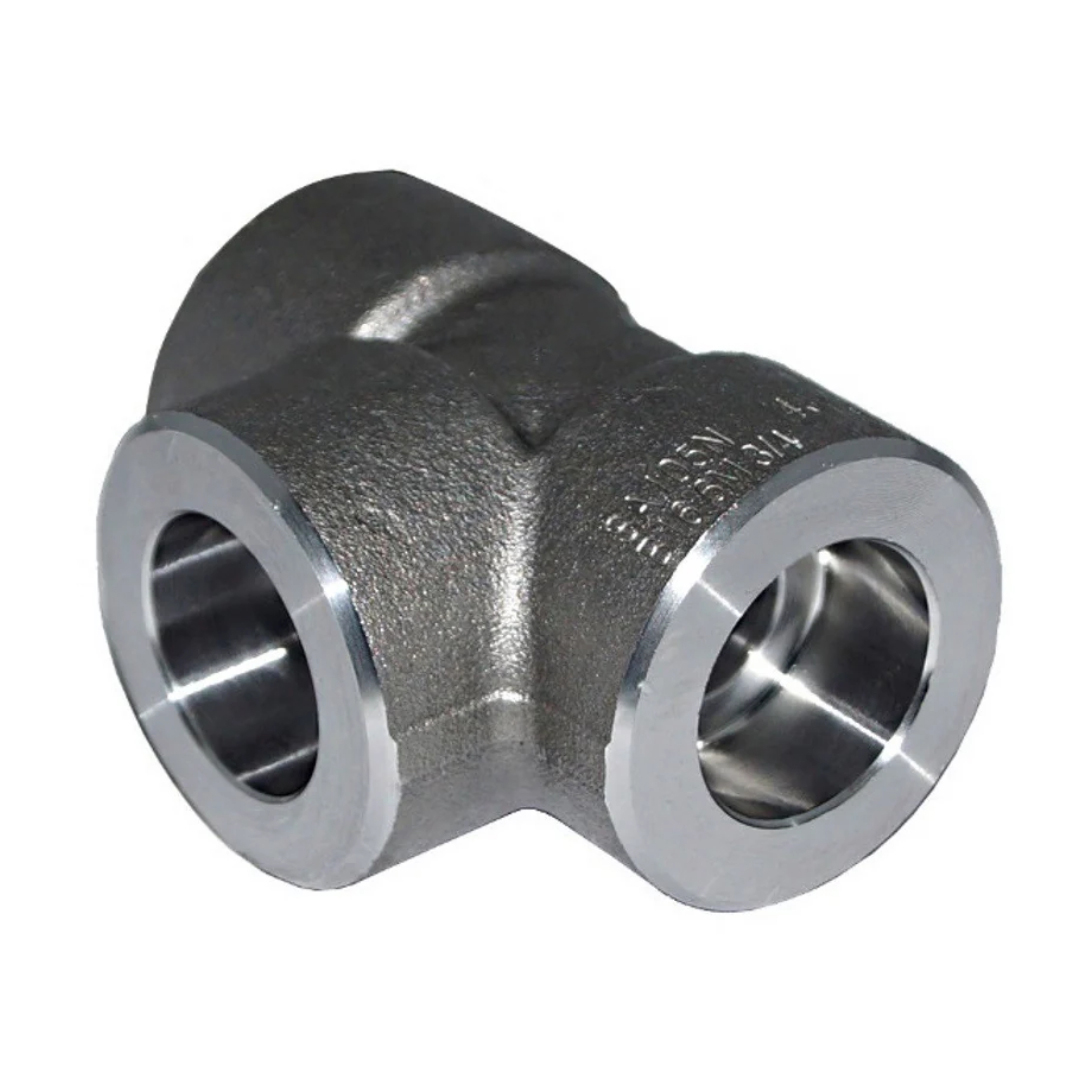
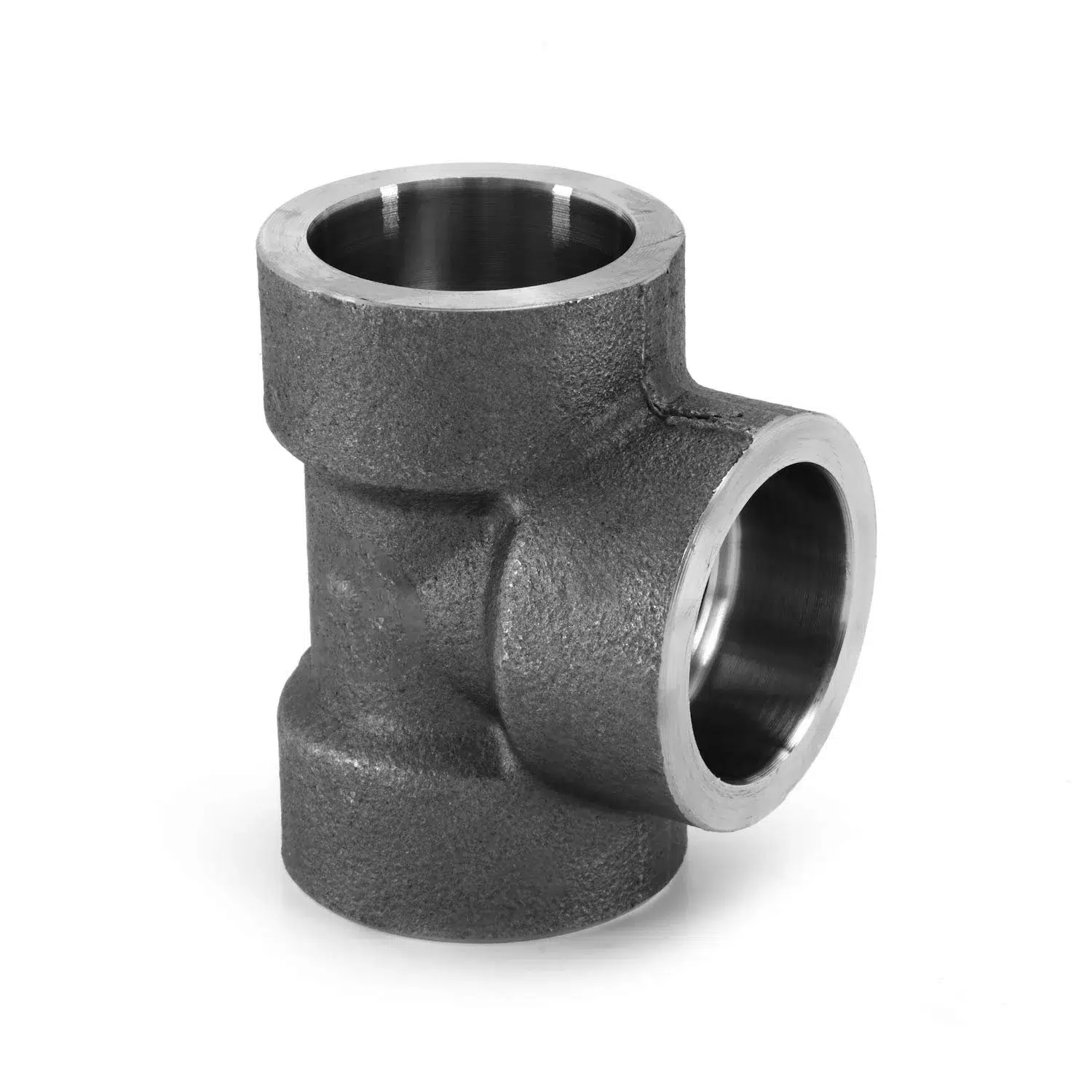
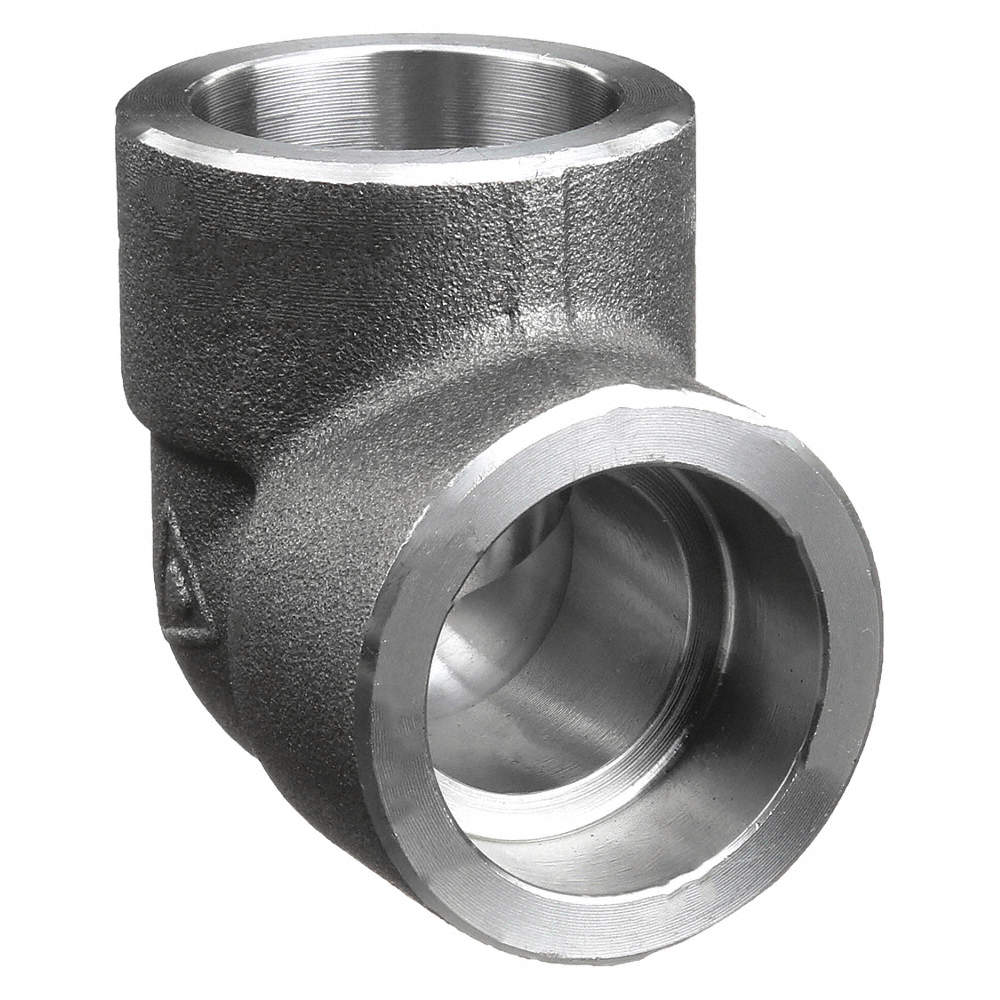
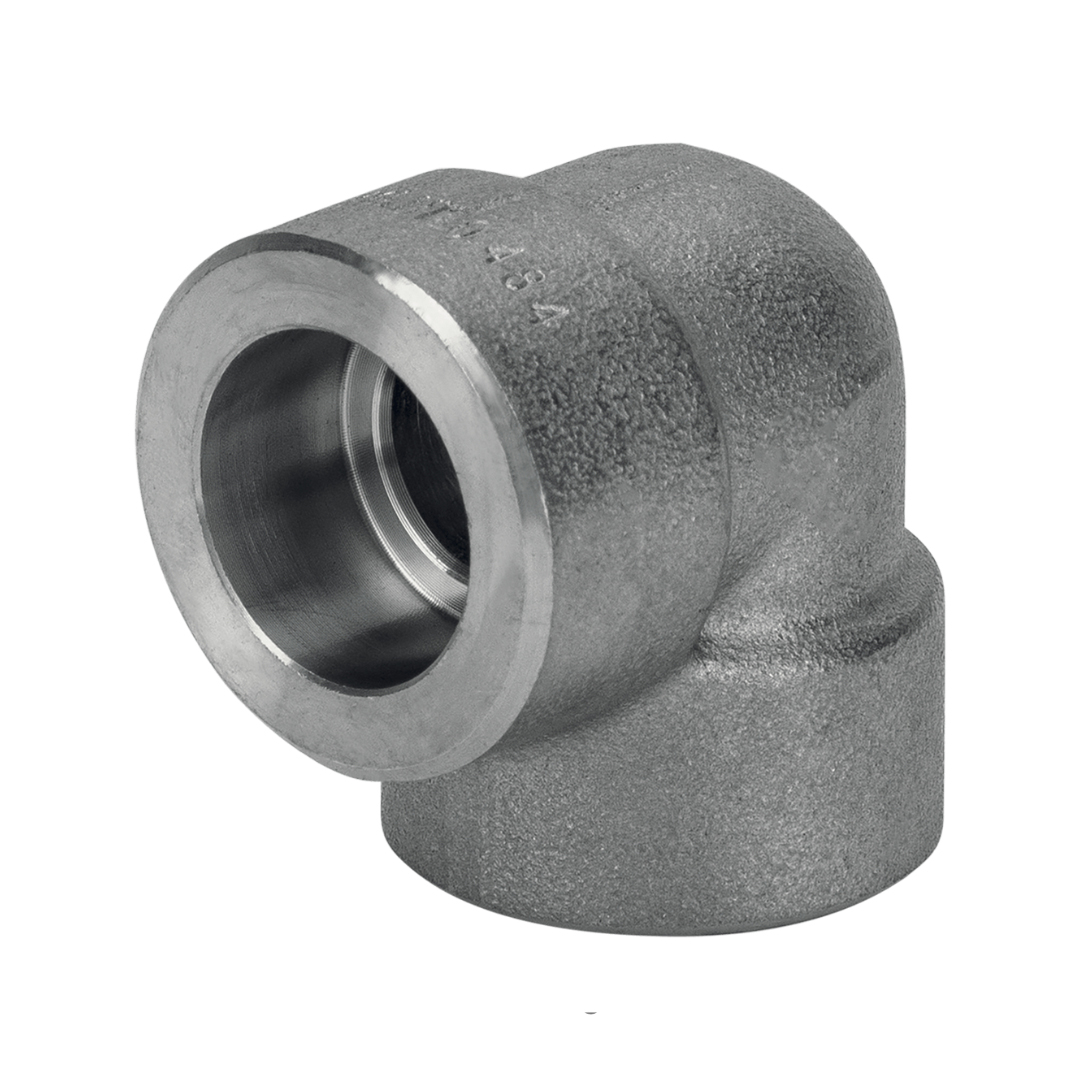
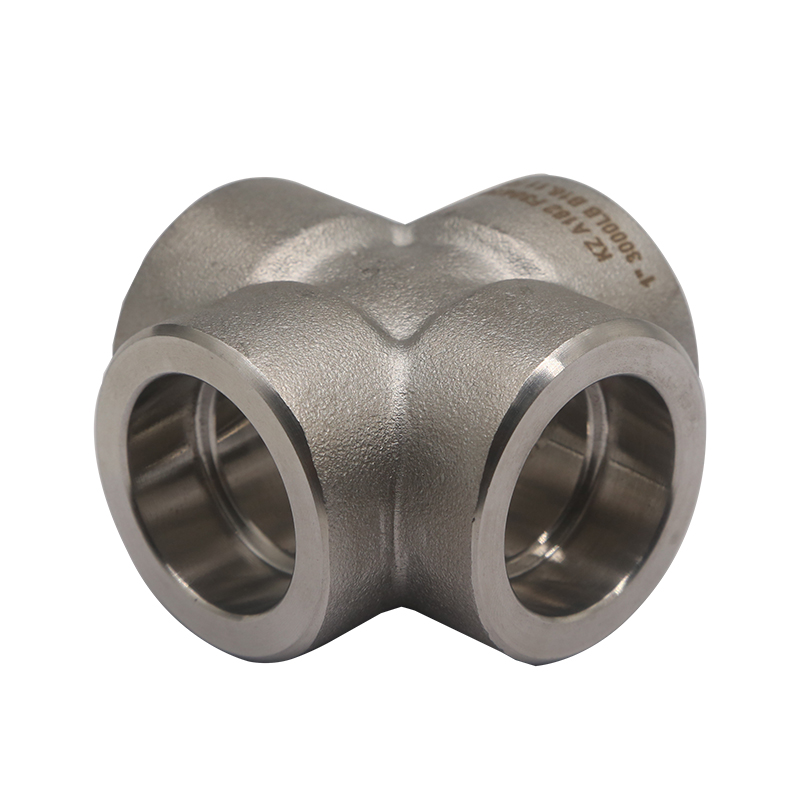
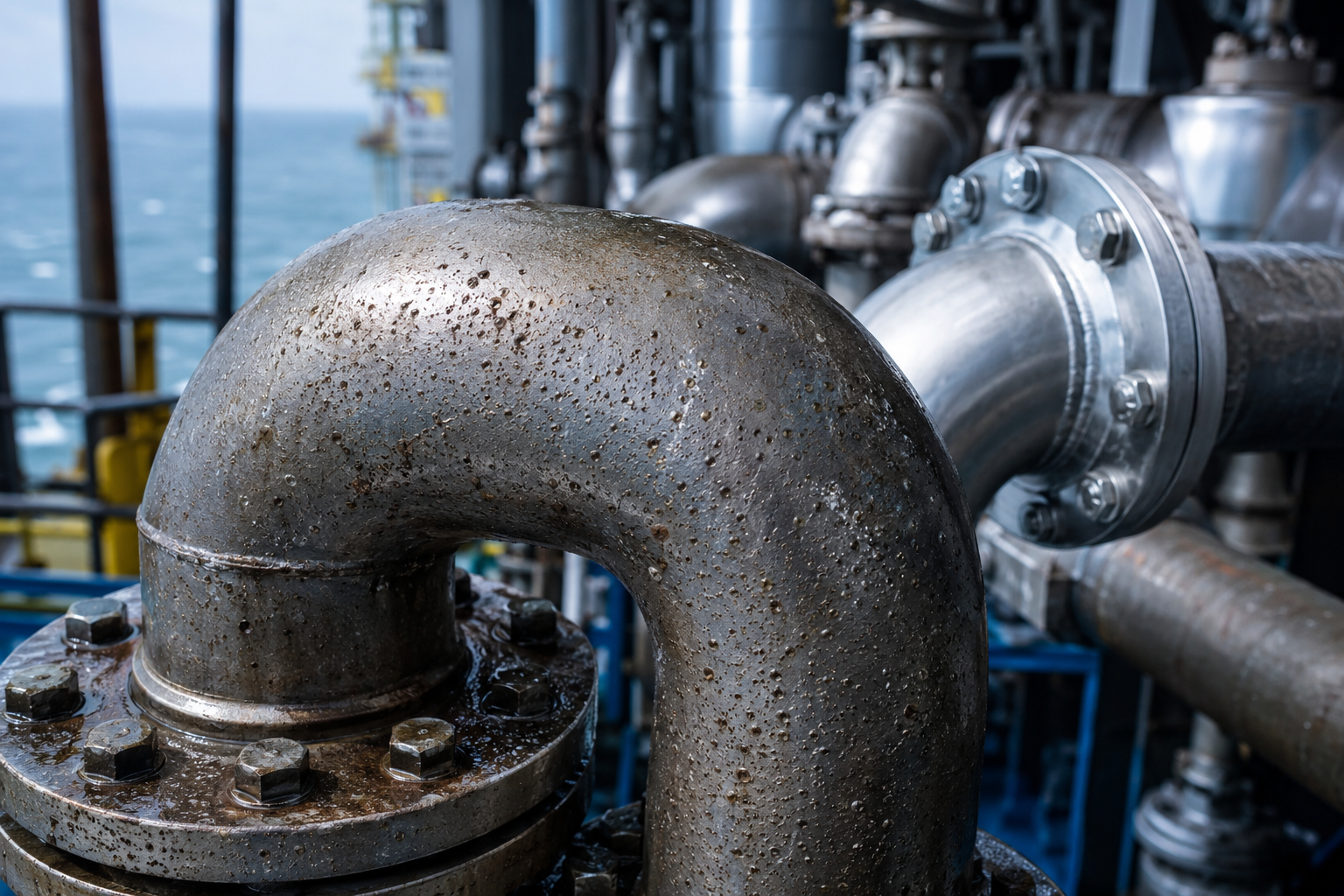
Premature pitting corrosion failure that often gets erroneously attributed to manufacturing defect by the purchasing department stems from an inappropriate grade of alloy for the specific service. This is usually one of the most costly errors in a piping system specification because the mode of failure - localized pit and/or stress corrosion crack - will typically manifest without immediate notification. A 316L elbow placed in a sea water cooling system may appear healthy and serviceable for 18 months and yet will have pitted sufficiently to cause thru wall leaks in that 19th month. Most purchasing agents assume the component was defective. The reality for our piping Engineers and those in the know is that: 316L typically has a PREN of around 23-25; Sea Water Cl concentration is about 19,000ppm which is well above 316L's passivisation capability to maintain stability.
There’s no obvious trade-off of alloy cost versus severity of service, absent an engineering framework. Super duplex 2507 costs ~2-2.5x that of 2205 duplex and ~4x that of 316L. Deploying 2507 in a fresh water process line where Cl < 100 ppm is material cost without corrosion advantage. For those unaware of formula, The Pitting Resistance Equivalent Number (PREN) = %Cr + 3.3(%Mo) + 16(%N) can tell you if you are asking your materials for too much, in chemistry terms.
“Over” is not always “correct”. As illustrated in the PREN-Based Alloy Selection Matrix, which charts various austenitic and duplex alloys against their service environments (Below Table). Consider PREN value and threshold chloride as first order selection factors, then double-check for temperature limitations and applicable operational context.
| Grade | UNS | PREN (approx.) | Cl⁻ Threshold (guidance) | Temperature Limit | Typical Applications |
|---|---|---|---|---|---|
| 304 / 304L | S30400 / S30403 | 18–20 | <100 ppm | <50°C for chloride environments | General corrosive, mild acid, ambient water, dry chemical |
| 316 / 316L | S31600 / S31603 | 23–25 | <1,000 ppm | <60°C chloride; to 870°C non-chloride | Food/pharma/sanitary, marine splash, chemical processing, general offshore utility |
| 317L | S31703 | 29–31 | <3,000 ppm | <80°C chloride | Pulp & paper, phosphoric acid, flue gas desulfurization |
| 321 | S32100 | 18–20 | <200 ppm | Up to 900°C (stabilized for high-temp) | High-temperature process piping, exhaust systems, heat exchangers above 400°C |
| 347 | S34700 | 18–20 | <200 ppm | Up to 900°C | High-temperature service, nuclear piping, aviation exhaust, creep-resistant applications |
| 2205 Duplex | S32205 | 35–37 | <10,000 ppm | <250°C (sigma phase risk >280°C) | Offshore platform process piping, desalination freshwater side, chemical plant, pulp/paper |
| 2507 Super Duplex | S32750 | 42–44 | ~19,000 ppm (natural seawater) | <280°C | Subsea pipe lines, seawater injection, brine systems, desalination reject side, high-pressure offshore |
| 904L | N08904 | 36–38 | Dilute H₂SO₄ tolerance | <400°C | Sulfuric acid, phosphoric acid, mixed acid environments, pickling systems |
| Alloy 20 (20Cb-3) | N08020 | ~35 | Moderate Cl⁻ + acid | <370°C | Sulfuric acid up to 98%, chemical processing, pharmaceutical mixing vessels |
321 & 347 have same PREN values as 304. They are Titanium & Niobium stabilized to prevent sensitization on welding and to enhance elevated temperature service life. Selecting 321/347 with no reference to the PREN formula and chloride threshold does not necessarily indicate reliable service in chloride media. 321/347 are often selected for thermal stability, not for improved resistance to chloride stress cracking.
When offshore contractors compare the cost versus performance for 2205 & 2507 super duplex fittings in production platform applications: the performance gap for super duplex is not proportionally addressed by the price difference between them. The relative performance benefit for 2507 over 2205 decreases at less challenging service environments (e.g. under 5,000 ppm Cl and temperatures below 80°C, both in moderate chloride conditions), as duplex 2205 delivers 95% of 2507’s corrosion performance at around 50% of the cost. An honest approach to alloy selection dictates that overspecifying 2507 in lieu of a suitable grade 2205 duplex alloy entails a deliberate trade-off with no corresponding increase in technical value; a choice wisely made rather than defaulting to one’s default high-end strategy. Experienced specification engineers for suppliers of 316L stainless steel pipe fittings with ABS type approval and NACE MR0175 compliance on a production platform should start with verification of MTR PREN values, not supplier relationships.
Failure in any aspect of the supply chain poses a risk, ranging from simple errors to intentional circumvention. The critical risk in any international procurement process involving stainless steel pipe fittings involves not evaluating your supplier’s proven capabilities - a risk exposed when a manufacturer supplying a super duplex 2507 butt-welded fitting passes all physical inspections, yet fails hardness testing required by NACE MR0175/MR0103, and has sub-contracted the welding and post-weld heat treatment to an unqualified third-party facility, completely bypassing required process capabilities and checks; it’s an issue of verification rather than deficient specification design.
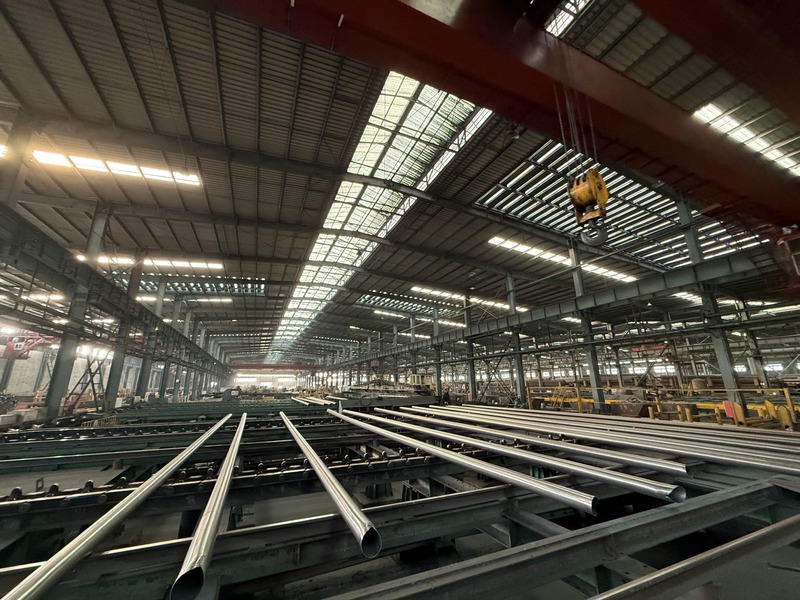
The only reason that Synbase can physically produce 48 OD heavy-wall butt weld fittings in super duplex is a 6000-ton hydraulic press originally designed for stainless forming at large formats. Without that particular tool, the forces needed to press duplex heavy-wall plate without causing cracking of the ferrite-austenite phase structure are not generated. Anyone claiming to make 48” OD duplex pipe fittings without this equipment is just a relabeling broker buying offshore and putting a different sticker on it.
| Capability | Specification | Significance |
|---|---|---|
| Hydraulic Press (primary) | 6,000-ton capacity | Enables 48″ OD heavy-wall butt weld forming in duplex SS grades |
| Hydraulic Press (secondary) | 2,000-ton capacity | Mid-range production for NPS 2″–24″ fittings |
| Production Base | 70,000 m² total floor area | Single-site production: no subcontracting, one quality system |
| CNC Machining Units | 200+ units | Precision dimensional work: socket bore, threaded connections, flange facing |
| Heat Treatment Furnaces | In-house solution annealing | Post-form austenitic and duplex heat treatment on-site — no thermal cycle outsourcing |
| National Patents | 200+ patents | Process innovation in forming, welding procedure, microstructure control — not relabeling |
| Operating History | Established 2005, Hong Kong | 21+ years of production and international export experience |
| Group Annual Export | 3 billion RMB across 100+ countries | Production scale supports price commitment for large project orders |
| Overseas Offices | Malaysia (2018), Thailand (2022) | Regional procurement coordination for Asia-Pacific EPC projects |
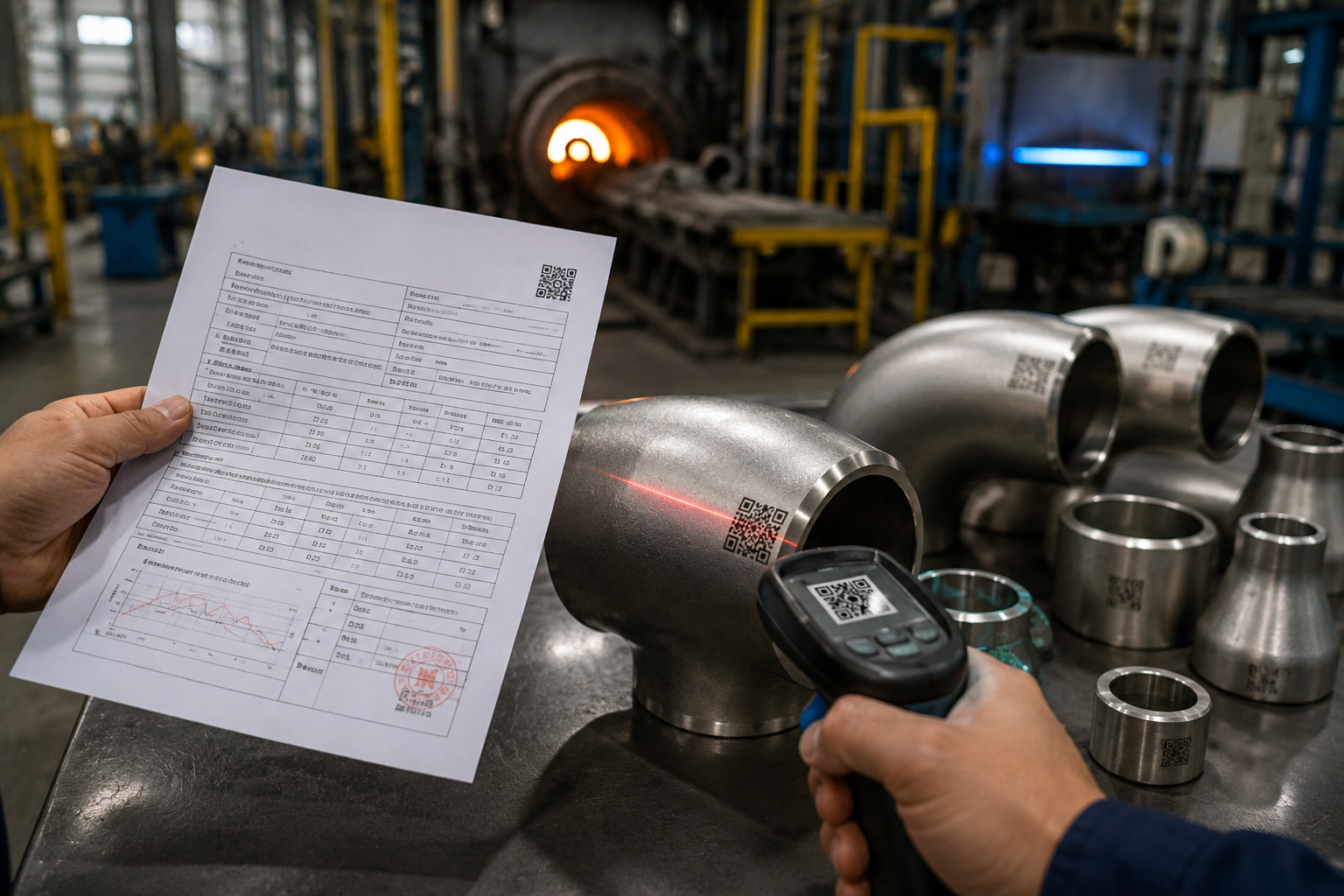
In contrast to distributors who source product from multiple mill suppliers and re-certify everything under their label, Synbase, the manufacturer of record, issues the actual EN 10204 3.1 Material Test Reports. Synbase’s heat numbers for MTRs tie back directly to Synbase production batch numbers and its in-house heat treatment, not back to an external mill that whose quality system cannot be controlled by Synbase.
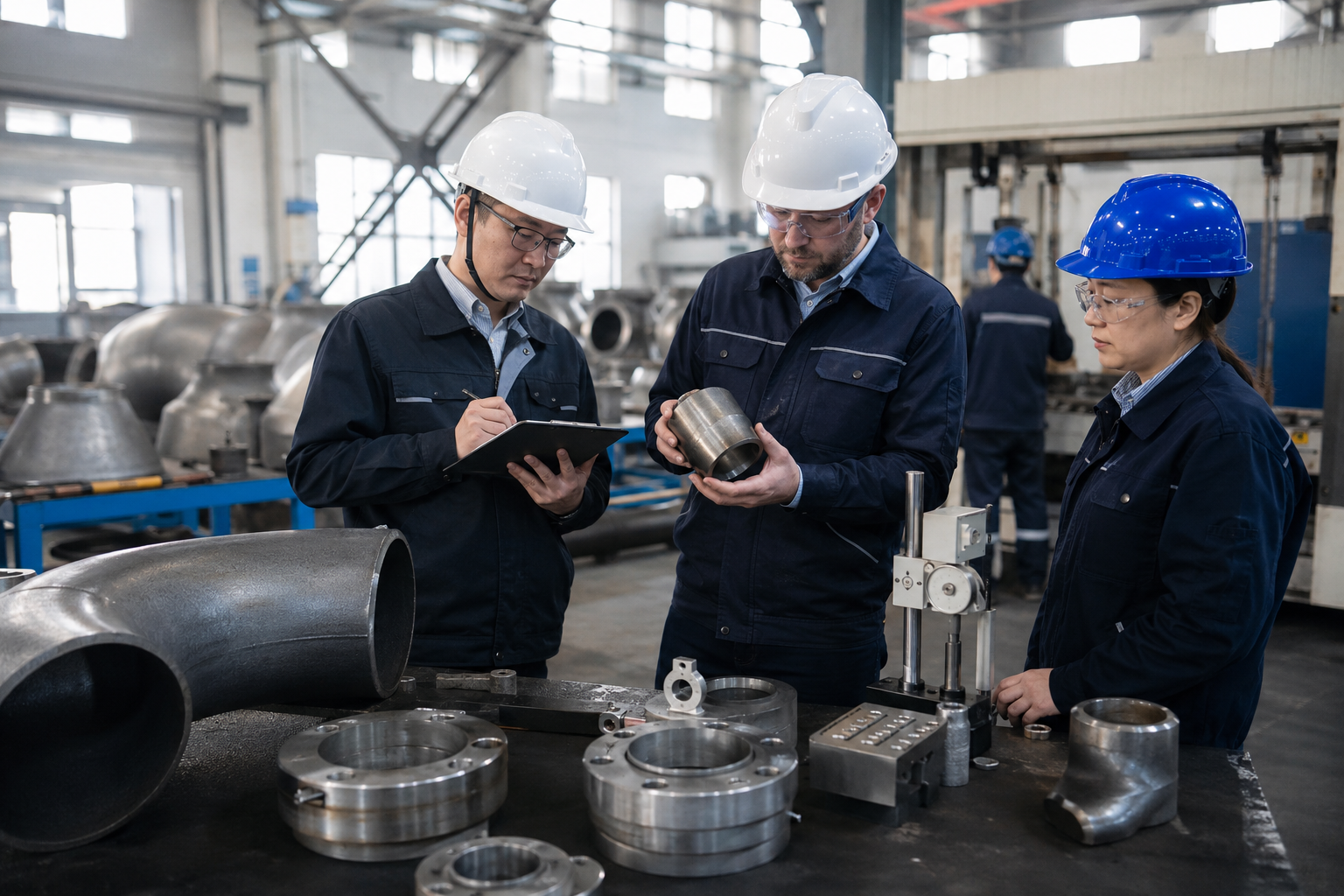
Some of the best objective validation of manufacturing capability exists with operator vendor qualifications. Both Kuwait National Petroleum Corp. (KNPC) and SONATRACH (the Algerian national oil company) have approved Synbase’s vendor qualification status as of 2015. These are among the most stringent industrial buyer qualification and auditing programs in the world. They don’t qualify suppliers based on a quality document on letterhead, they actually visit and audit your manufacturing facilities and systems and traceability documents first.
The vast and well-established sub-tier market of commodity stainless steel produces lots of mill-cert quality documentation from uncertified trading companies that looks exactly like real EN 10204 documentation and is equally unreliable. It’s the same fundamental challenge that separates experienced EPC procurement specialists from buyers who blindly rely on any “certification.” Information disparity is the issue: The PDF document on paper from “Company X,” reporting that it contains a BV inspection certificate, is impossible for you to verify.
What is the structural solution to the fake mill-cert problem? Demand certs that come with a unique identification number verifiable in a database maintained by a third-party organization, not a broker or trading company. This can be a well-known cert number listed in an API API certification directory, an ABS type approval cert number searchable on ABS.org, or a DNV or Bureau Veritas Certificate number traceable via their online search facilities. These cannot be faked, because the number doesn’t match up in the third party database.
If you've ever heard the question, "Can Chinese manufacturing ever match Western quality?" what's implied behind that question is based on a fundamentally false premise. The best quality system certifiers (ABS, DNV, BV, LR and API) and their processes (i.e., site inspections, system audits, etc) are all "Western" in the sense they are part of established global standards of the developed world. The location of the manufacturing plant is completely irrelevant to the credibility and reliability of the certification granted by these bodies. Synbase holding an ABS type approval means the American Bureau of Shipping examined and approved our manufacturing facility and quality system - ABS's location had nothing to do with the approval itself.
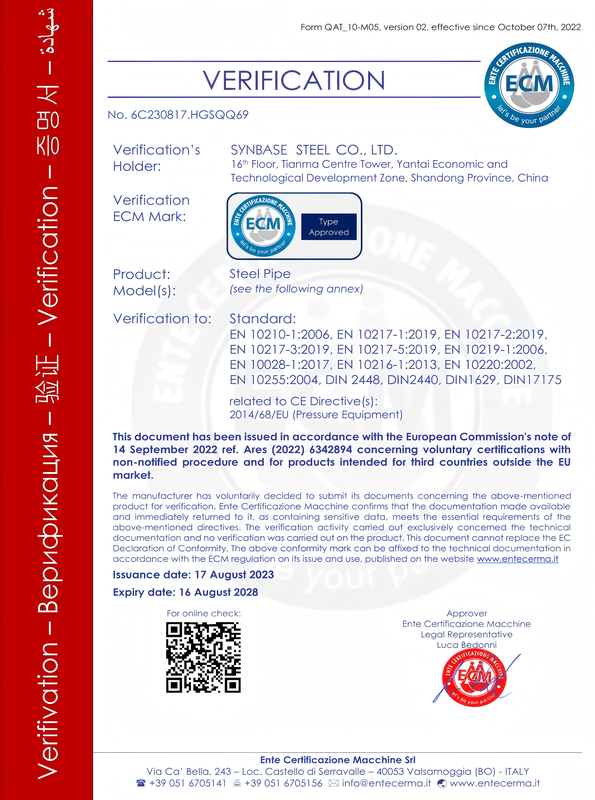
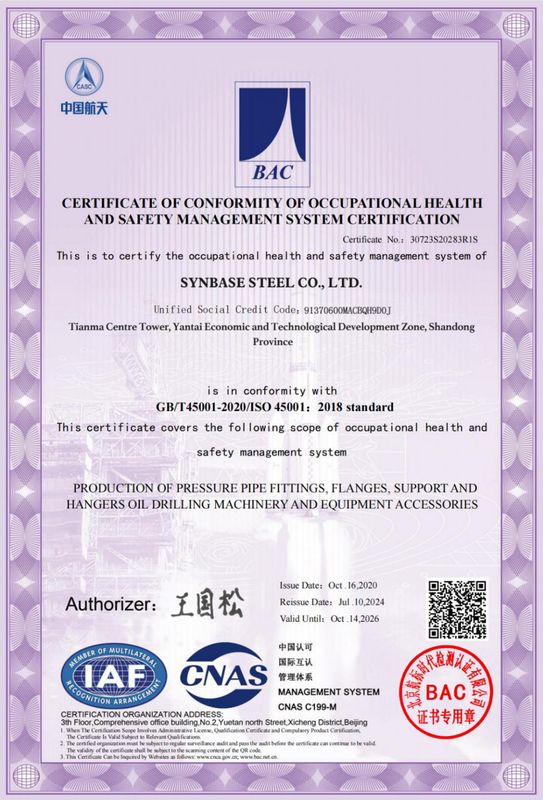
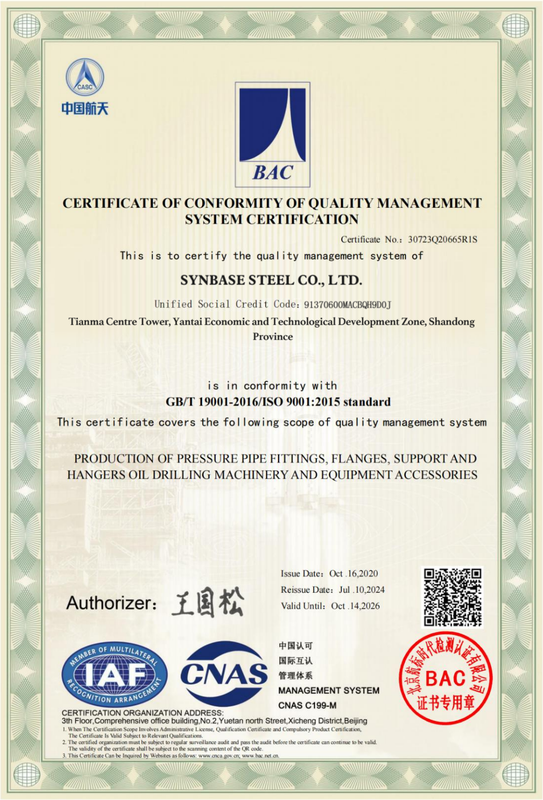
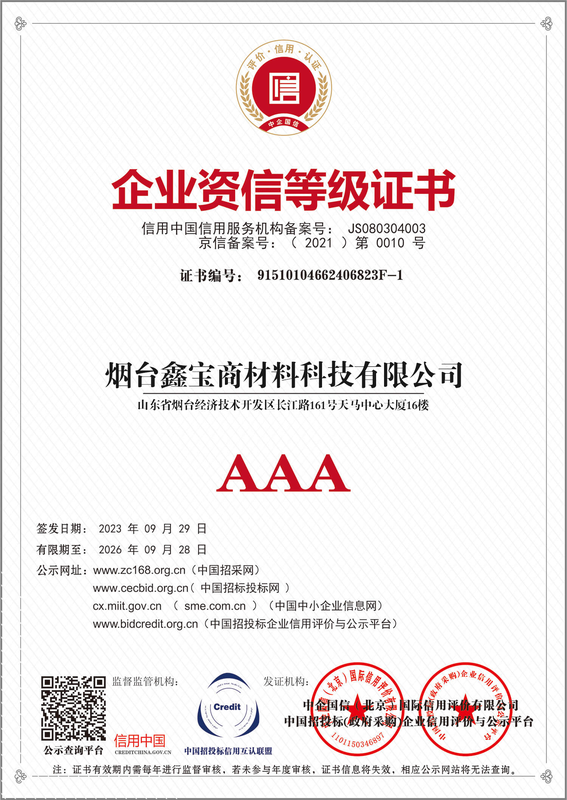
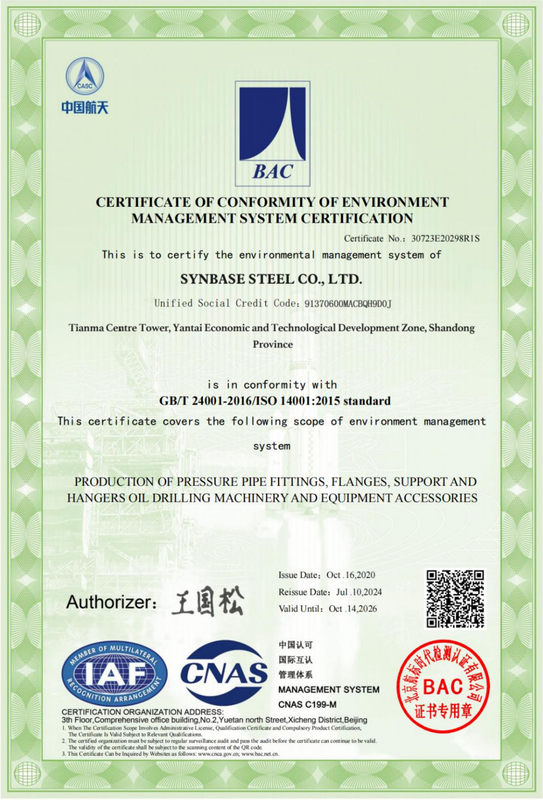
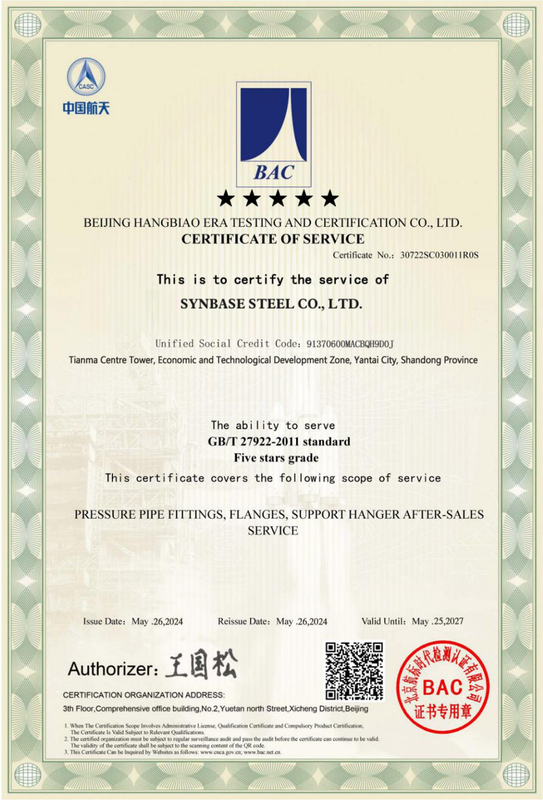
| Certification | Issuing Body | Scope | Verification Method |
|---|---|---|---|
| API (5CT / 5L) | American Petroleum Institute | Oil & gas casing, tubing, linepipe fittings | License number searchable at api.org/products-and-solutions/monogram-and-apiqr-program |
| ISO 9001:2015 | TÜV / SGS / Bureau Veritas (third-party registrar) | Quality management system — design, production, inspection, and delivery | Certificate registration number searchable via registrar |
| ISO 14001:2015 | Third-party registrar | Environmental management system | Certificate registration number searchable via registrar |
| ISO 45001:2018 | Third-party registrar | Occupational health and safety management | Certificate registration number searchable via registrar |
| CE Marking (PED 2014/68/EU) | EU Notified Body | Pressure Equipment Directive compliance for EU import and use | Declaration of conformity with notified body identification number |
| ABS (American Bureau of Shipping) | American Bureau of Shipping | Marine and offshore structural components and piping systems | ABS type approval certificate number searchable in ABS online database |
| DNV (Det Norske Veritas) | DNV GL | Marine, offshore energy, and structural applications | DNV type approval certificate number verifiable at dnv.com |
| BV (Bureau Veritas) | Bureau Veritas | Marine, offshore, and industrial quality assurance | BV certificate number verifiable at bureau veritas.com |
| LR (Lloyd’s Register) | Lloyd’s Register | Marine and offshore structural piping components | LR type approval certificate number verifiable at lr.org |
| CSS (China Classification Society) | China Classification Society | Domestic maritime and offshore platform applications | CCS certificate number verifiable at ccs.org.cn |
The most frequent procurement error a seasoned industrial buyer will not make twice is treating one certificate as validation that the materials meet all specification requirements. The gap between a certificate of conformance a trading company can print on its own letterhead and actual heat level traceability is where material substitution fraud happens. The CoC from an uncertified vendor tells you what grade they _say_ they delivered; an MTR with heat number tells you what grade the mill produced; and the physical fitting itself evaluated with PMI is what it's _actually_ made of.
The 3-Document Stack is the industry standard in the sour gas, offshore, and critical pressure system arena. What makes the three-layer documentation resistant to material fraud is that each document is the responsibility of a different authorizing entity, therefore eliminating the potential for a single source to perpetrate a fraud across all three levels.
| Document | Standard | Issued By | What It Contains | When Required |
|---|---|---|---|---|
| Material Test Report (MTR) | EN 10204 Type 3.1 | Works/mill inspection — Synbase QC department as manufacturer | Chemical composition, mechanical properties (UTS, yield, elongation), heat number, heat treatment record, dimensional check | Standard requirement for all industrial orders. Minimum documentation level for most EPC specifications. |
| Certificate of Conformance (CoC) | EN 10204 Type 3.2 | Independent third-party inspector approved by the purchaser or their authority (e.g., SGS, Bureau Veritas, TÜV) | Same content as 3.1 MTR, plus a signed witness statement from the approved third party who physically observed the tests | Sour gas service (H₂S per NACE MR0175/ISO 15156), offshore platform piping, nuclear piping, North Sea and GoM operator specifications |
| Positive Material Identification (PMI) | ASTM E1476 / ANSI/ASQ M1 | On-site XRF or OES instrument test at receiving dock or fabrication shop | Actual measured Cr%, Ni%, Mo%, Mn%, Si% elemental composition of the physical fitting, matched against grade specification limits | Substitution-risk orders, re-certification of warehouse stock, pre-weld composition verification in critical systems |
| Weld Map + WPS Records | ASME IX / EN ISO 15614-1 | Synbase QC + third-party WPS qualification | Weld procedure specification (WPS), procedure qualification record (PQR), welder certification, NDE records (RT/UT/PT), PWHT documentation | Fabricated fittings, pressure vessel assemblies, Class 2500 high-pressure systems, systems requiring ASME code stamp |
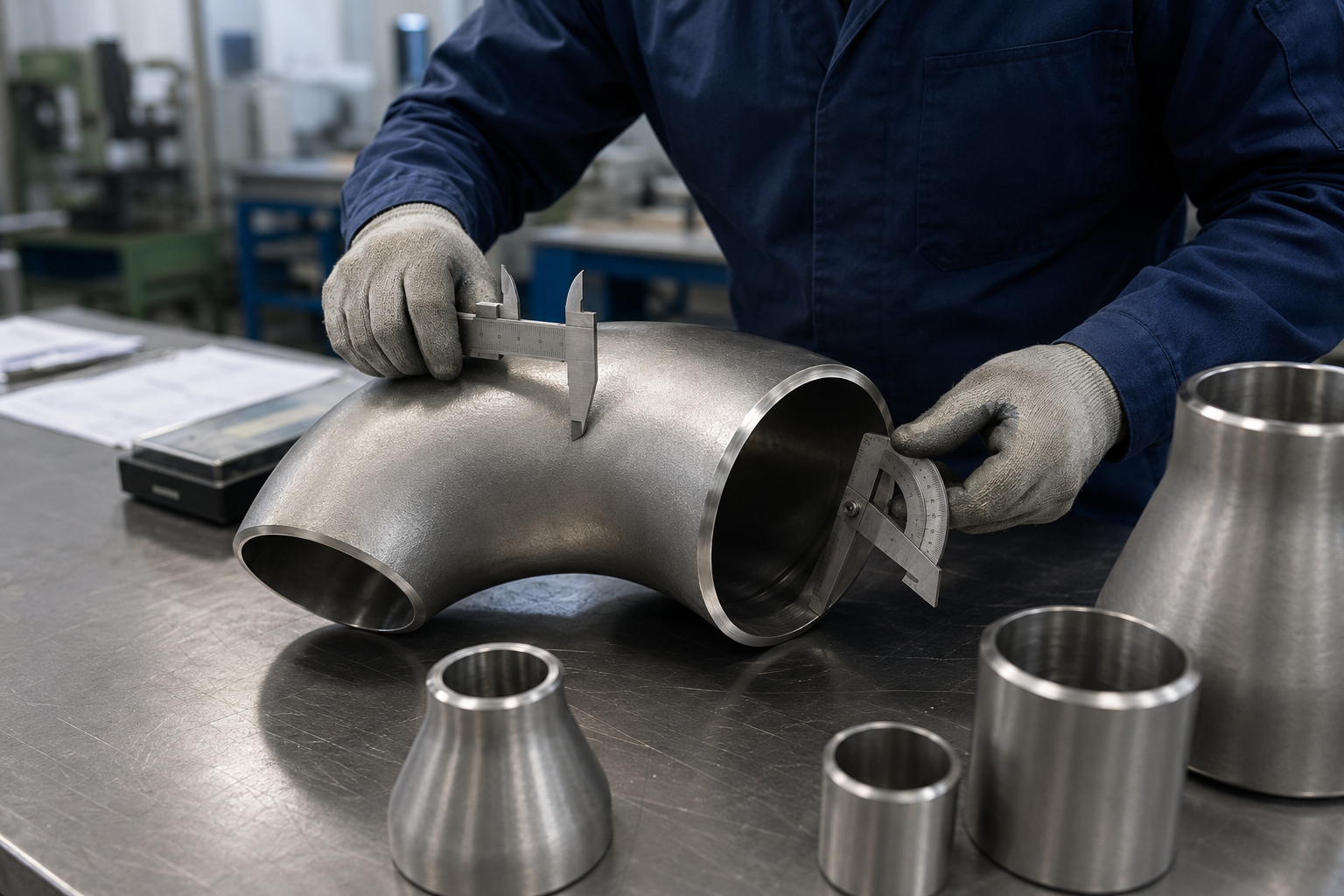
An ASME B16.9 dimensionally conforming fitting is not necessarily one which also meets EN 10253-4 end preparation requirements required by most offshore, North Sea and European projects. It's easy for a procurement agent, when ordering stainless steel pipe fittings to be supplied internationally, to overlook the fact that a fitting manufactured to B16.9 specifications does not also conform to EN 10253 Part 4, when it comes to edge preparation, or positive material marking (PMM), and other design considerations. Because ASME B16.9 and EN 10253 Part 4 (specifically B) were developed independently by different bodies, for some overlapping applications, they include distinct specifications that must both be observed.
The reason it falls between the cracks in the procurement process, is that B16.9 defines its specifications, like the centre-to-face and minimum wall thickness, based on the NPS, Schedule and thickness. EN 10253-4 defines its specifications on the basis of a DN, Series and bevel angle related to thickness. It is possible for a 6-inch Sch 160 butt weld elbow to satisfy B16.9 thickness criteria and have a bevel angle that deviates from the specified EN 10253 Sec 6.3 criteria; Many an international project specification, from the majors like BP, Shell, Total and Equinor, requires conformance to both these standards on the same purchase order.
This is Synbase's production inspection solution for dual-standard orders. For an order in both US and European dimensions, Synbase perform dual dimensional verifications concurrently: ASME B16.9 data (wall schedule and center-to-face distance) and EN 10253-4 Section 6 data (end preparation angle and tolerance). Dual-standard orders will also bear two inspection columns on the production routing sheet, and include ASTM format MTR and EN 10204 CoC in the same certification package.
| Standard | Type | Covers | Key Requirements |
|---|---|---|---|
| ASTM A403 / A403M | Material | Wrought austenitic stainless steel butt weld pipe fittings for pressure applications | WP grades (WP304, WP316L, WP317L, WP321, WP347); UTS min 485 MPa (WP316L); Yield min 170 MPa; solution annealing required; wall thickness ≥87.5% of nominal schedule |
| ASTM A815 / A815M | Material | Wrought duplex and super duplex stainless steel butt weld fittings | WP2205 (UNS S32205): UTS ≥620 MPa, Yield ≥450 MPa; WP2507 (UNS S32750): UTS ≥800 MPa, Yield ≥550 MPa; phase balance testing required |
| ASTM A182 / A182M | Material | Forged or rolled alloy and stainless steel flanges, socket weld fittings, threaded fittings | Grades F304, F316L, F317L, F321, F347, F51 (2205), F55 (2507); covers the forged product form (socket weld, threaded) — not butt weld |
| ASTM A240 / A240M | Material | Chromium and chromium-nickel stainless steel plate, sheet, strip for pressure vessels and piping | Used as base material for fabricated fittings; covers all austenitic and duplex grades |
| ASME B16.9 | Dimensional | Factory-made wrought butt welding fittings: elbows, tees, reducers, caps | Wall thickness ≥87.5% of nominal pipe schedule; center-to-face and end-to-end dimensions; beveled end per ASME B16.25 |
| ASME B16.11 | Dimensional | Forged socket weld and threaded fittings: elbows, tees, crosses, couplings | Pressure classes 3000, 6000, 9000 lb; bore dimensions; thread form per ASME B1.20.1 (NPT) |
| ASME B16.5 | Dimensional | Pipe flanges and flanged fittings, NPS 1/2″ through NPS 24″ | Pressure classes 150 through 2500; bore, bolt circle, raised face dimensions; material groups |
| EN 10253-4 | Dimensional + Material | European butt welding pipe fittings: austenitic stainless steel, weldable grades | Series 1 (lighter wall) and Series 2 (heavier wall); end preparation per Section 6; marking requirements per Section 9 |
| DIN 2605 / 2615 / 2617 | Dimensional | German elbow (2605), tee (2615), reducer (2617) standards for industrial piping | Older EU specification still referenced in German and Central European EPC piping specifications |
| JIS B2312 | Dimensional | Japanese stainless steel butt weld pipe fittings for pressure piping | Covers austenitic grades in JIS designation; applicable for Japanese EPC projects in Asia-Pacific region |
The industrial sourcing of stainless steel piping fittings is fraught with challenges beyond the price per unit. Volatility of nickel prices introduces uncertainty into procurement budgets on a project basis, especially on large EPC projects characterized by substantial requirements for 316L or 2205 duplex pipe fittings. the fundamental difficulty here is that U.S.-based distributors offer spot pricing and usually cannot make project-level price commitments, their inventory practices geared towards smaller commercial volumes rather than the longer-term procurement needs of industrial and EPC organizations.
Synbase produces piping components for over 100 countries with global exports valued at 3 billion RMB annually. this allows us to discuss price per project for orders where lead times are established, specifications are confirmed, and the project provides sufficient project order value. The procurement table below depicts our standard commercial policies, although project pricing may be negotiated based on the full project piping material list.
Access our suite of engineering utilities designed for piping specifiers and EPC contractors. These calculators assist in validating pressure class requirements, estimating socket weld installation parameters, and selecting appropriate material grades for industrial service.
Determine the required ASME B16.11 forging class (3000, 6000, or 9000) by evaluating your system's design pressure, temperature limits, and mating pipe schedule.
Launch Class SelectorCalculate the mandatory 1/16-inch (1.6 mm) bottom gap required prior to welding to prevent root cracking during thermal expansion of the pipe.
Launch Gap EstimatorCross-reference fluid chemistry, chloride thresholds, and PREN values to specify the optimal austenitic or duplex stainless steel grade for your application.
Launch Material SelectorSynbase Steel offers pipe fittings in austenitic alloys 304, 304L, 316, 316L, 317L, 321, 347, and 904L as well as duplex 2205 (UNS S32205) and super duplex 2507 (UNS S32750). Alloy grade selected according to process stream's concentration of chlorides and temperature. The 316L, 2205 duplex, and 2507 super duplex work as well as a PREN-Based Alloy Selection chart indicates. The only exception listed is sour service (HS per NACE MR0175), here use 316L, with 22HRC hardness, and confirm on MTR.
The dimensional basis for any factory made fitting for butt welding for piping in pressure applications is ASME B16.9. This standards document outlines all dimensional information relating to: the center-to-center length; tee center-to-end dimension; leg dimensions; elbow angle dimensions; minimum wall thickness; outside diameter tolerance, etc.
ASTM A403 is for wrought austenitic stainless steel fittings made by forming from a pipe blank, barstock or plates (encompasses elbows, tees, caps, reducers). ASTM A182 covers flanged fittings that are forged. You should use ASTM A403 WP316L for butt-welded portions and ASTM A182 F316L for your flanged systems.
We suggest a three-tier system: (1) Check the Material Test Report (MTR) per EN 10204 3.1 for heat lot number and chemistry; (2) For mission-critical services, request an EN 10204 3.2 document with independent third-party verification; (3) Perform physical PMI testing using an XRF method, which should show approx 16Cr/12Ni/2Mo. Genuine 316L will match these chemistry specs against your provided MTR documentation.
PREN (Pitting Resistance Equivalent Number) = %Cr + 3.3(%Mo) + 16(%N). It indicates resistance to pitting caused by chlorides. 316L (~23-25), 2205 (~35-37), 2507 (~42-44). Using PREN as your key selector ensures you don't choose an alloy prone to premature failure in corrosive environments (e.g., 304 will pit at >100ppm chloride; 316L will pit in seawater).
Socket weld (ASME B16.11) uses a recessed socket with an external fillet weld, standard for small bore (NPS 1/8-4). Butt weld (ASME B16.9) uses bevelled ends for full-penetration welding, preferred for NPS 2 and larger or where complete NDE (radiography/ultrasonic) is required to eliminate crevice corrosion.
EN 10204 3.2 requires an approved, independent third-party inspector to be on-site to witness the tensile, chemical, and dimensional testing. It is the minimum documentation level for sour gas (H₂S) services (NACE MR0175), major offshore platforms, and nuclear systems. Please specify your inspection agency (SGS, Bureau Veritas, TUV, etc.) at order placement.
Standard MOQ is 50Kg for common grades (304, 316L) in NPS 1/2-4. Large bore fittings (NPS 12+) and specialty grades (2507, 904L, Alloy 20) are quoted per piece. Large projects with a full bill of materials can be evaluated on a no-item-MOQ pricing basis.
Yes. Compliance with NACE MR0175/ISO 15156 requires: max 22HRC hardness, EN 10204 3.2 third-party inspection, Charpy impact toughness testing, and intergranular corrosion testing (ASTM A262). Please specify "NACE service" on inquiry to ensure the correct manufacturing routing.