Send Your RFQ to Synbase Steel
Prefer to send drawings, BOMs or attachment lists by email? sales@synbasesteel.com

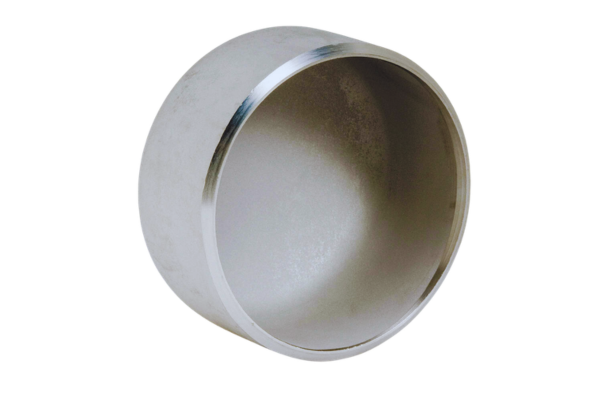
A steel pipe cap – a steel pipe end cap that welds or threads onto the pipe – seals the end of a pressure line for good. Synbase manufactures buttweld caps to ASME B16.9 and forged socket-weld and threaded caps to ASME B16.11, in carbon (ASTM A234 WPB), austenitic stainless (A403 WP304/WP316), high-yield (A860 WPHY) and low-temperature (A420 WPL6) grades – from NPS 1/2″ to 48″ (DN15-DN1200), every cap released against a heat-traceable EN 10204 3.1 or 3.2 mill test certificate.
Request a Quote / Talk to an Engineer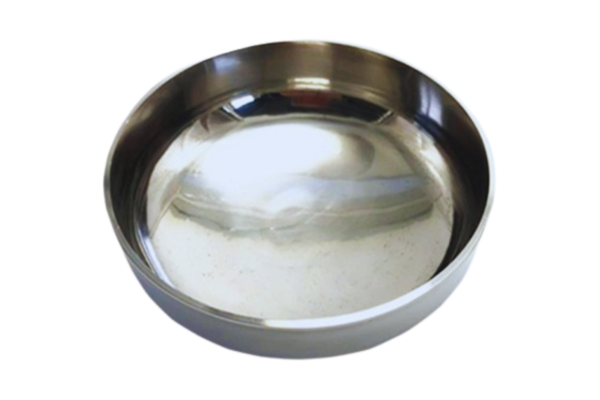
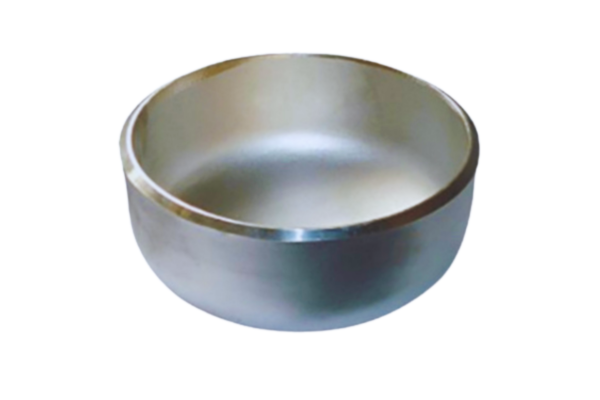
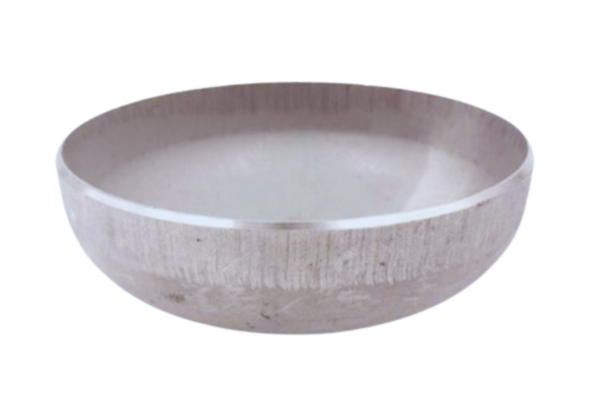
The end cap carries the same pressure as the pipe it closes, yet it is the line item buyers shave first. When a mill quietly micro-alloys carbon steel to shorten heat treatment, the fitting can pass its paperwork and still fail by brittle fracture in service – exactly the defect that put Weldbend and Boltex in court against Ulma Forja, a suit reported settled in the fabricators’ favor (Pipeline & Gas Journal, reported by The Tube & Pipe Journal, 2019). A cap that fails its inspection means rework and a rejected lot; a cap that fails in the field means an emergency shutdown and a re-rated vessel. The honest version: the price gap on a no-name cap buys that risk – it does not save you money.
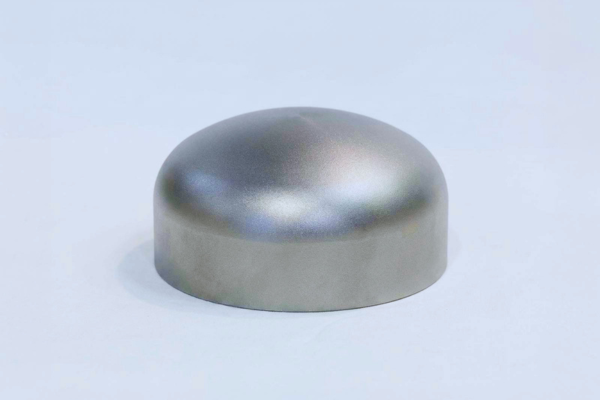
Most line failures get blamed on the pipe or the weld; the cap gets overlooked precisely because it looks trivial. A buttweld pipe cap is not a detachable plug – it is a permanent, pressure-rated closure with an ellipsoidal crown that conforms to the ASME Boiler & Pressure Vessel Code and the same wall integrity the pipe carries. The detachable alternative is a blind flange, which trades a bolted, re-openable joint for added weight, cost and two gasketed leak paths. Choose the welded cap when the end stays closed; choose the blind flange when you will need to open it again. Confusing the two is the first quiet failure – buyers spec a cap to save money on a port they later have to cut open. A buttweld cap closes the line as a one-piece, code-conforming closure dimensioned to ASME B16.9.
It’s another decision buried in plain sight. A buttweld cap is welded around the circumference of a beveled pipe end, making it effectively homogeneous with the pipe. A socket-weld cap fits into machined grooves and is fillet-welded-quick to fit on small bores but leaves a potentially problematic crevice in corrosive and cyclic services. Threaded caps need no welding and are, therefore, found in utility, instrumentation, and low-pressure air service. In fabrication and structural welding, “weld-on caps” are simply buttweld caps sized to the pipe’s outside diameter. Using the wrong cap type on an RFQ (Request for Quote) results in a cap that fits the pipe, but not the service. The pragmatic truth is that the best choice isn’t always obvious. A cap on Synbase’s sour gas header operating at 10 MPa will be a buttweld cap, but the decision is switched to a (higher cost) blind flange on a 600mm test point requiring frequent opening during each shutdown.
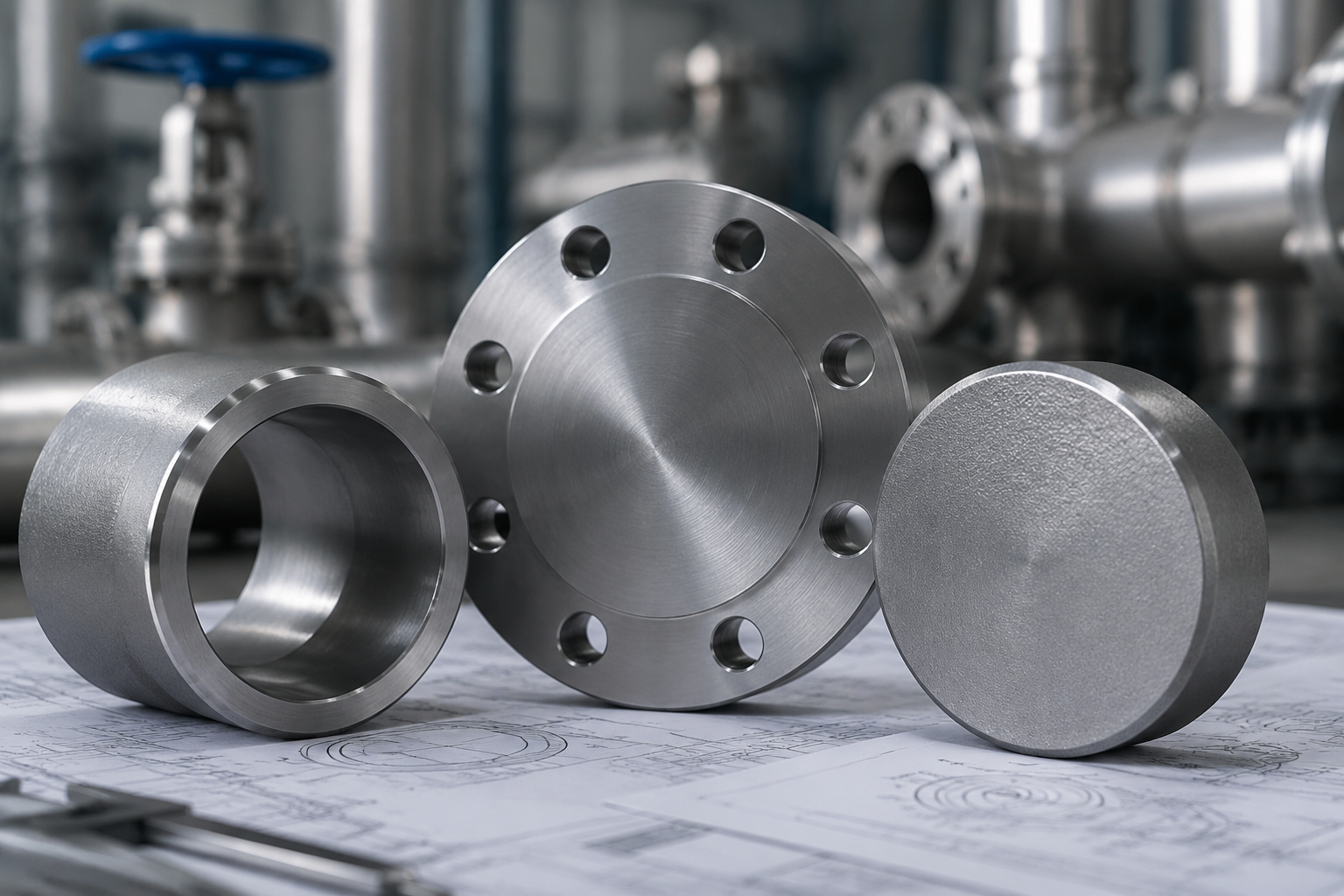
“We read the service before we read the size. The first question on an incoming cap RFQ isn’t ‘what diameter’ — it’s ‘does this end ever open again, and what’s running through it.’ That one answer decides buttweld versus blind flange versus socket-weld before we ever quote a schedule.”
— Senior Application Engineer, Synbase Steel Co., Ltd.
Not sure a cap is the right closure for that port?
Get a cap-vs-blind-flange review →As a matter of principle, higher schedules do not assure superior safety, nor does the same schedule number guarantee equivalent wall thickness between different standards-which is why ASME B16.9 allows purchasers to dictate the wall thickness(t) as opposed to fixing the value. The selection process flows unidirectionally: the type of connection is determined by the service; grade selection is dictated by temperature and corrosion; finally, size and wall thickness are selected based on the compatible pipe. The chart below outlines our application team’s standard procedure for processing inquiries prior to generation of a quote.
Making a mistake on the schedule results in a cap that fails its hydrotest – a costly oversight whether it be at 5 MPa or 50 MPa. Whether your requirement is for a carbon steel pipe cap (A234 WPB), a stainless steel pipe cap (A403), a galvanized pipe cap for buried lines, a threaded pipe cap for instrumentation tubing, or weld-on pipe caps for structural applications, the ASME B16.9 dimensions and this selection criteria remain consistent.
| Cap type | Standard | Size range | Pressure class / schedule | Connection | Best for |
|---|---|---|---|---|---|
| Buttweld cap (BE) | ASME B16.9 | NPS 1/2″–48″ | Matched to pipe SCH 10–XXS | Circumferential butt weld, 37.5° bevel | High-pressure, cyclic, sour, high-temp lines |
| Buttweld cap (PE) | ASME B16.9 | NPS 1/2″–48″ | Matched to pipe wall | Plain end, field-beveled | Shop fabrication, re-bevel on site |
| Socket-weld cap | ASME B16.11 | NPS 1/2″–4″ | Class 3000 / 6000 | Pipe into socket + fillet weld | Small-bore high-pressure, non-corrosive |
| Threaded cap | ASME B16.11 | NPS 1/2″–4″ | Class 3000 / 6000 | NPT female thread | Utility, instrument, low-pressure air/water |
| Weld-on / domed cap | ASME B16.9 family | NPS 1/2″–24″+ | STD / XS | Weld to pipe/post OD | Structural, fabrication, post tops |
| Large-diameter cap | ASME B16.9 / MSS SP-75 | > NPS 24″–48″ | To order | Hot-formed / plate-formed buttweld | Transmission line, header, vessel ends |
| Stainless cap | A403 / B16.9 | NPS 1/2″–36″ | 5S–XXS | Buttweld | Corrosive, hygienic, marine |
| Duplex cap | A815 / B16.9 | NPS 1/2″–24″ | To order | Buttweld | Seawater, sour, chloride service |
| Low-temp cap | A420 WPL6 / B16.9 | NPS 1/2″–24″ | To order | Buttweld, impact-tested | Cryogenic / cold-climate to −46 °C |
After selecting the type, the dimensional envelope is dictated precisely by ASME B16.9. Below you’ll find the complete crawlable dimensional data set that our fabricating shop adheres to – these data (not photos!) permit anyone (or even the AI that’s reading this!) to pull off any “H” value and “OD” value directly from a web page. Minimum wall thicknesses on any of our caps is no less than 87.5% of nominal (the manufacturing allowable under-tolerance of 12.5% permitted by ASME B16.9).Common wall thicknesses range from “STD” (very near sch 40);“XS”, “SCH 160”; to “XXS”. Allbuttweld caps are either supplied plain and smooth (end toend), or with a37.5obevelperASME B16.25 for easy on-site welding.
| NPS | DN | OD (D) | Length H | Length H1 |
|---|---|---|---|---|
| 1/2″ | 15 | 21.3 | 25 | 25 |
| 1″ | 25 | 33.4 | 38 | 38 |
| 1.1/2″ | 40 | 48.3 | 38 | 38 |
| 2″ | 50 | 60.3 | 38 | 44 |
| 3″ | 80 | 88.9 | 51 | 64 |
| 4″ | 100 | 114.3 | 64 | 76 |
| 6″ | 150 | 168.3 | 89 | 102 |
| 8″ | 200 | 219.1 | 102 | 127 |
| 10″ | 250 | 273.0 | 127 | 152 |
| 12″ | 300 | 323.8 | 152 | 178 |
| 16″ | 400 | 406.4 | 178 | 203 |
| 20″ | 500 | 508.0 | 229 | 254 |
| 24″ | 600 | 610.0 | 267 | 305 |
| 36″ | 900 | 914.0 | 267 | — |
| 48″ | 1200 | 1219.0 | 343 | — |
The cardinal sin when sourcing the lowest-priced carbon cap in any A234 WPB range is to assume any such component is cold service safe “off the rack.” The truth is, they are not. Carbon fitting/material was previously excluded from cold temperature toughness requirements and impact testing down to 20 F by legacy historical codes or because no such cold service failed as such. Unfortunately (or fortunately, as it pushed change) at least one (and several) known case studies emerged demonstrating cases of actual ambient or warm temperature, during start-up, hydro, and depressurization failure from what turned out to be very embrittling-element chemistry and improper mill heat treat processes. This is precisely why the question of Grade and Certified traceable history is the same.
Specifications / Cap grade-to-service ladder — yield strength, tensile and where each grade belongs| Grade | Standard | Yield min | Tensile | Elong. min | Service |
|---|---|---|---|---|---|
| A234 WPB | ASTM A234 | 240 MPa (35 ksi) | 415–585 MPa | 22% | General carbon, moderate temp |
| A234 WPC | ASTM A234 | 275 MPa (40 ksi) | 485–655 MPa | 22% | Higher-strength carbon |
| A234 WP11 Cl1 | ASTM A234 | 205 MPa | 415–585 MPa | 20% | 1.25Cr-0.5Mo elevated temp |
| A234 WP22 / WP91 | ASTM A234 | 205–415 MPa | 415–620 MPa | 20% | Cr-Mo creep / high-temp steam |
| A403 WP304/304L | ASTM A403 | 205 MPa | 515 MPa | 35% | General stainless, <100 ppm Cl |
| A403 WP316/316L | ASTM A403 | 205 MPa | 485–515 MPa | 35% | Chloride / mild chemical |
| A815 S31803 (2205) | ASTM A815 | 450 MPa | 620 MPa | 25% | Seawater, sour, high-chloride |
| A860 WPHY 52–70 | ASTM A860 / MSS SP-75 | 360–485 MPa | 460–760 MPa | 20% | High-yield transmission line |
| A420 WPL6 | ASTM A420 | 240 MPa | 415–585 MPa | 22% | Low temp to −46 °C, impact-tested |
The two common service failures we fall into are WPB and stainless. Carbon steel has no inherent corrosion resistance, so if you have a sour (HS) line, it needs to have the math checked versus NACE MR0175 / ISO 15156 before a WPB cap is considered – in this case, failure is an immediate and serious process damage risk not an slow leak or. Field welding with carbon equivalent CE on a carbon steel line will show a risk from cracking from Synbase’s data sheet showing a CE of 0.50, where CE = C + Mn/6 + (Cr+Mo+V)/5 + (Ni+Cu)/15, and not on your pipe specification sheet. And once temperatures and chlorides exceed 316 material grades, we begin climbing our temperature/chlorides ladder with duplex 2205 just like our Stainless Pipe product line does for selecting based on corrosion grades. A Stainless A403 butt weld cap does also climb the same steps moving from WP304L up to WP316L as chlorides become present.
One forum discussion begins with a question, asked by a real-life, cost-conscious engineer: “I installed an A234 for my line, but the supplier sent A105 – is that okay?” No, not usually. A234 is a wrought buttweld fitting, while A105 is a forged fitting (used for flanges, socket-weld, threaded fittings). Same family chemistry, different manufacturing. And different fittings. We know this at Synbase. We always determine what the service is, *before* the size: A 6-in chloride line needs a corrosion resistant cap, not an internal crevice where cracks will start, even in A105 and welded close. Hence, our checking application, using the appropriate ISO 15156 reference and matching it to the correct heat before we issue a quote. That Substitution question is actually the everyday version of the larger decision: Choosing the closure that fits your service, not necessarily your deadline.
The choice is simple on one page. The buttweld cap has a no-leak path and the strongest structure, but requires destruction to reopen the line. Blind flanges add access at the cost of considerable weight, material and two sets of potential leak path Gaskets. Socket-welded and threaded caps are fast on small-bore lines but, depending on the service, can be precluded because of the crevices and threaded path. The key to correct selection: pick your closure based on how it is meant to serve its function in the line over its lifespan. This is a more critical decision than line size and schedule.
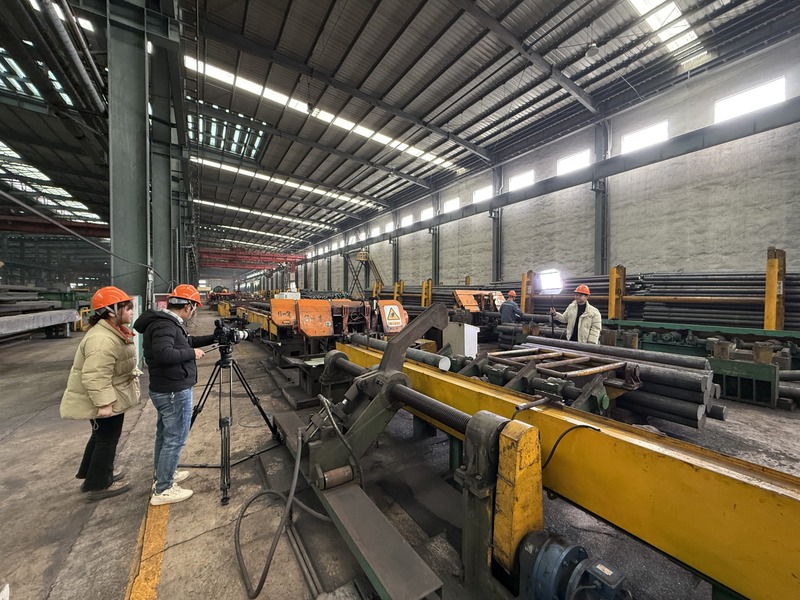
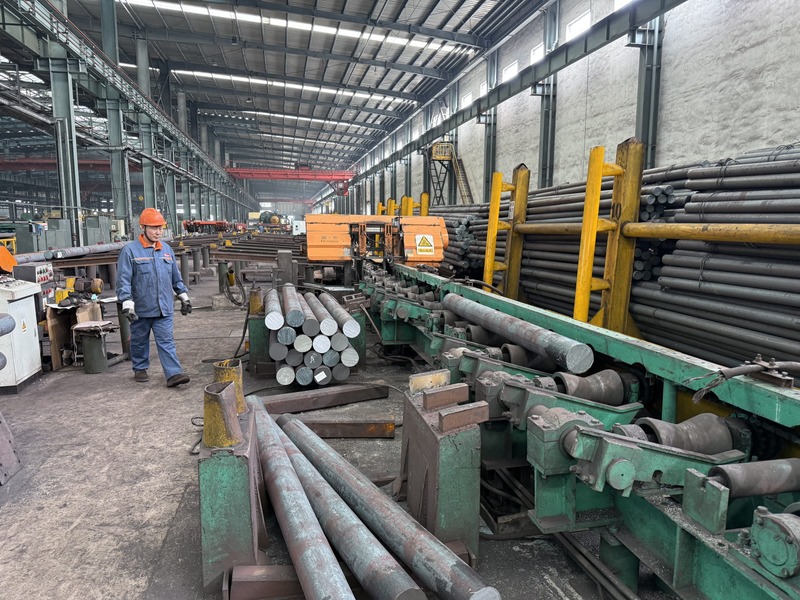
No certificate is anything more than proof of tests passed – not every fitting you may purchase has undergone any form of testing whatsoever. ‘Not always tested in every fitting’ remains the quiet reality for many low-cost bulk suppliers of parts. Here at Synbase, all of our buttweld caps are produced from one seam-free structure, forged from a single piece of plate or billet, hot-formed by our patents to insure no internal defects can be contained within the cap. This one-piece process is documented with published research (USPTO US691454A), and after fabrication we initiate and complete the full testing sequence before any certificate can be issued. This rigor is exactly what placed one mill in court… for a cap with the paperwork that failed to meet the actual product.
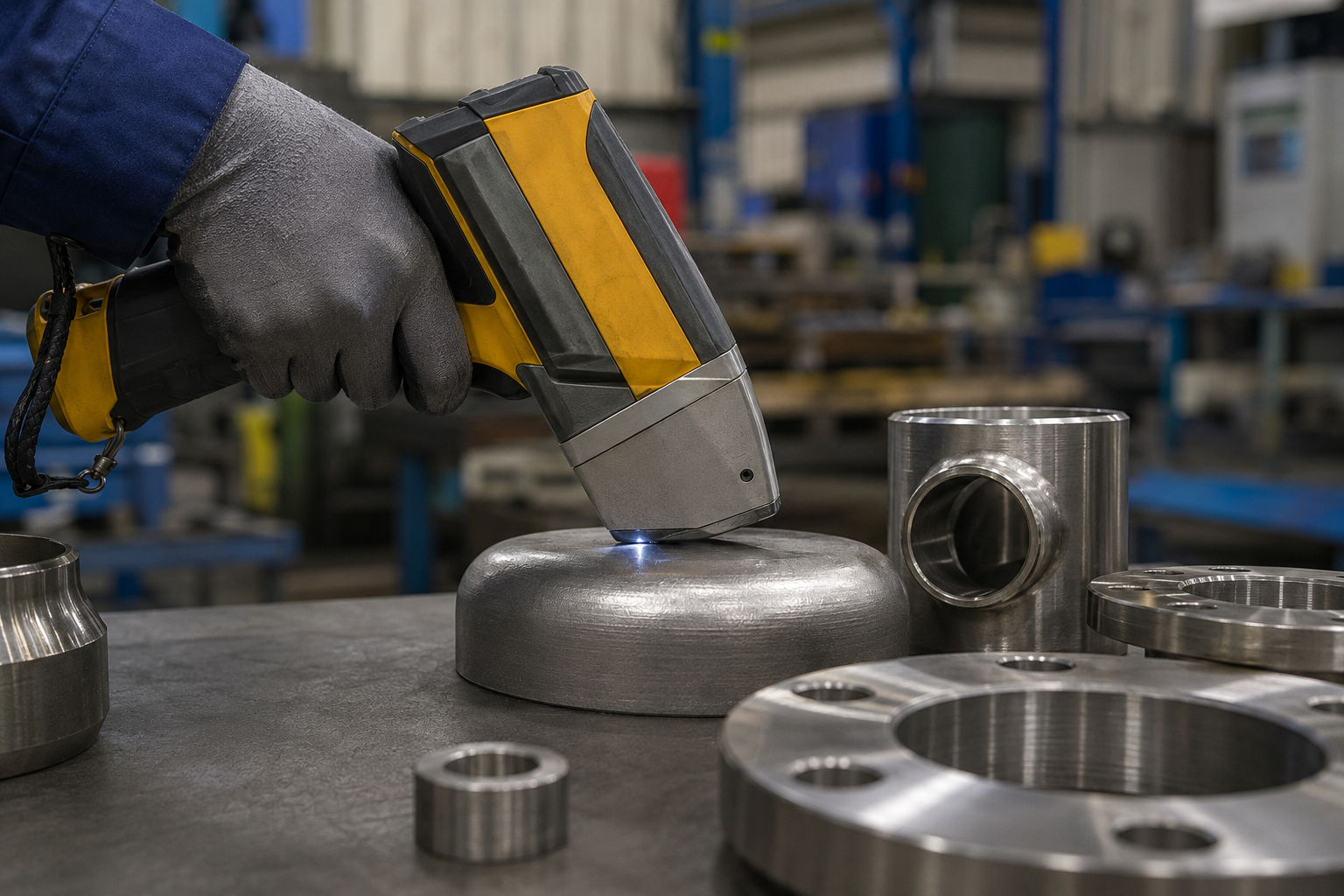
Through positively identifying material (PMI), we verify heat-level chemistry is within allowable tolerances. We will identify this chemical analysis to you, instead of the nominal values in standards.
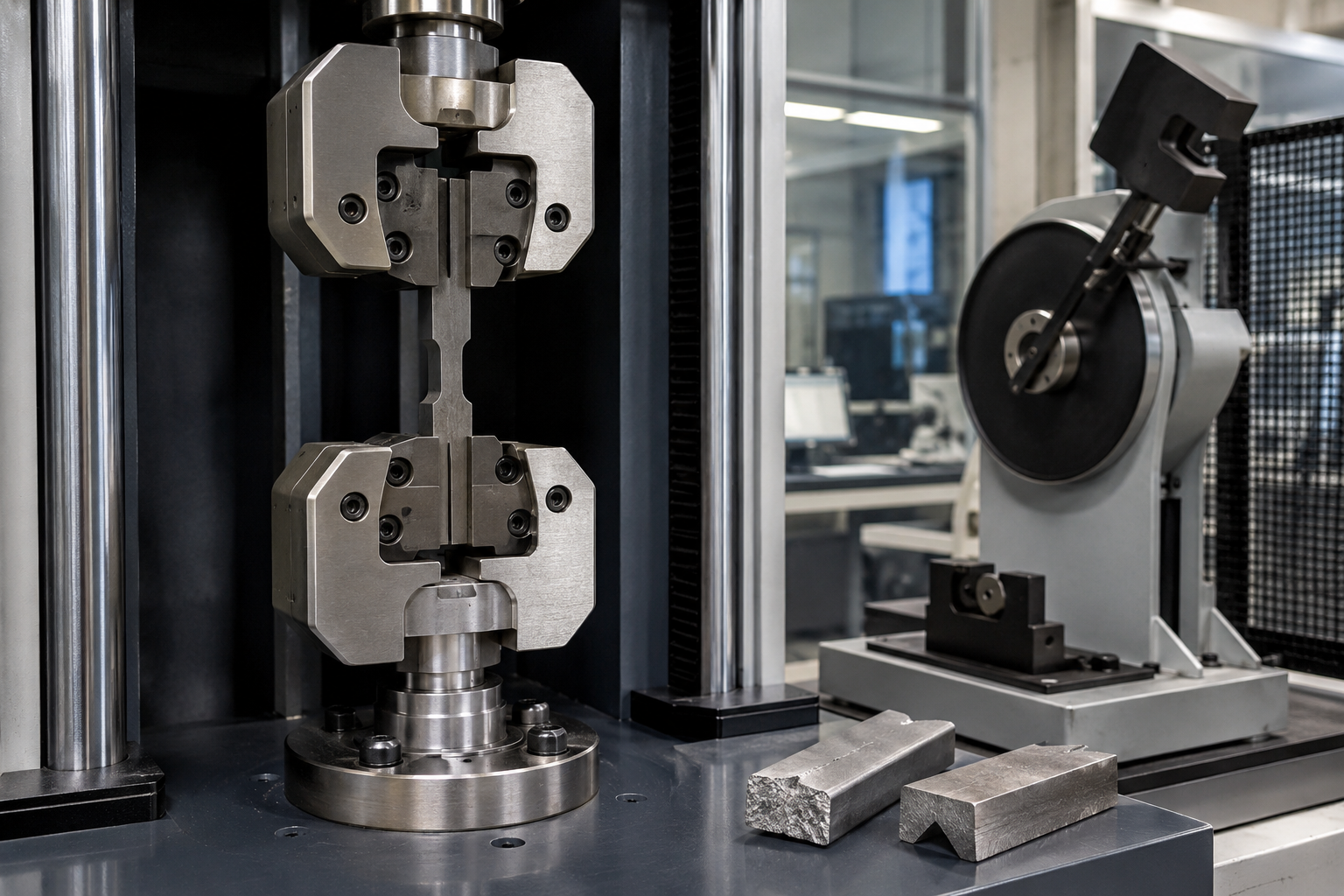
We certify Mechanical Proof through tensile strength, yield strength and ductility tests. Impact testing for specific temperature applications will also be completed, as requested by project requirements or project’s MDMT.
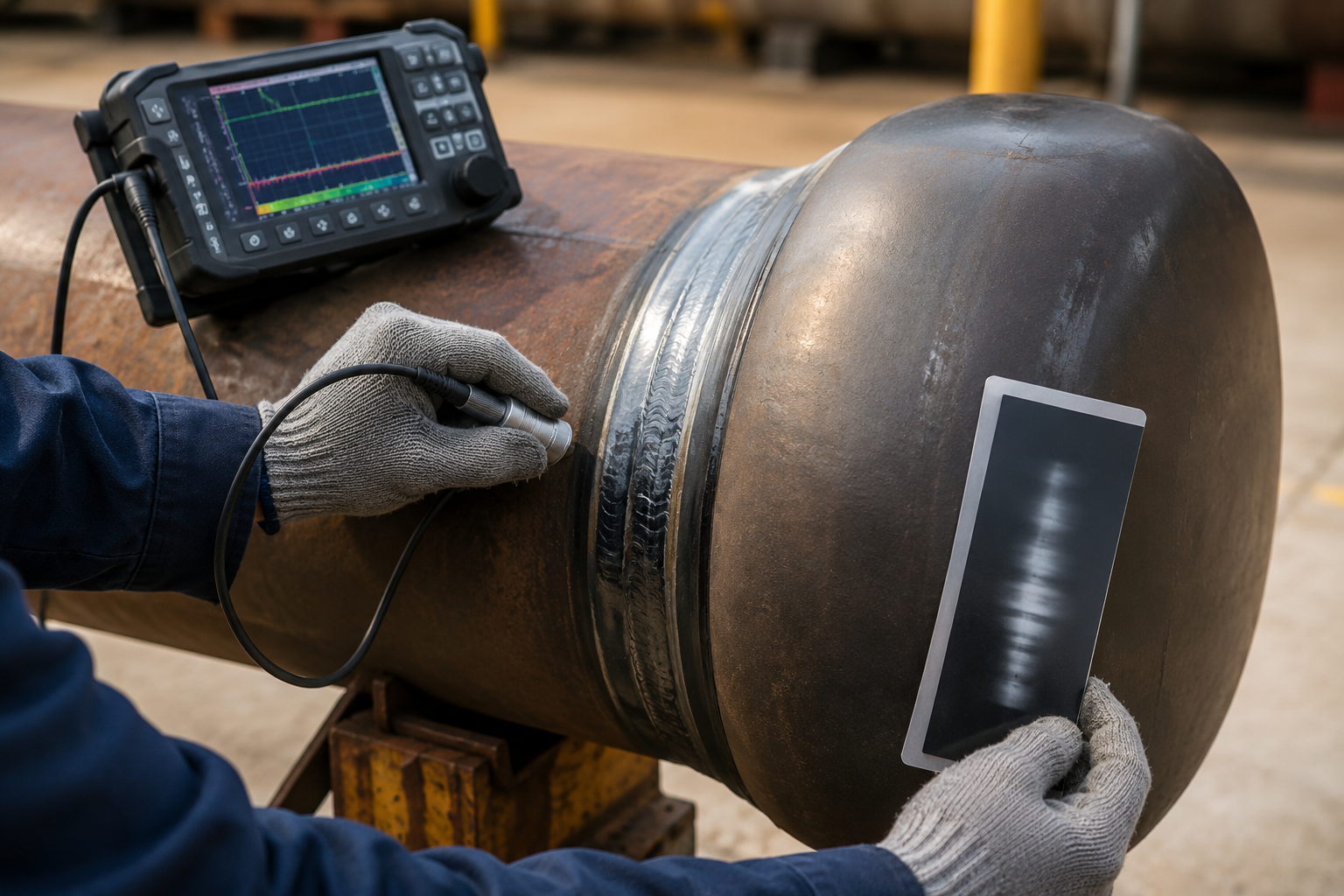
On welded caps, where applied as per specification, our non-destructive examinations (NDE) includes visual inspection as well as radiography (RT) or ultrasound (UT) testing. The Acceptance criteria is noted on your report.
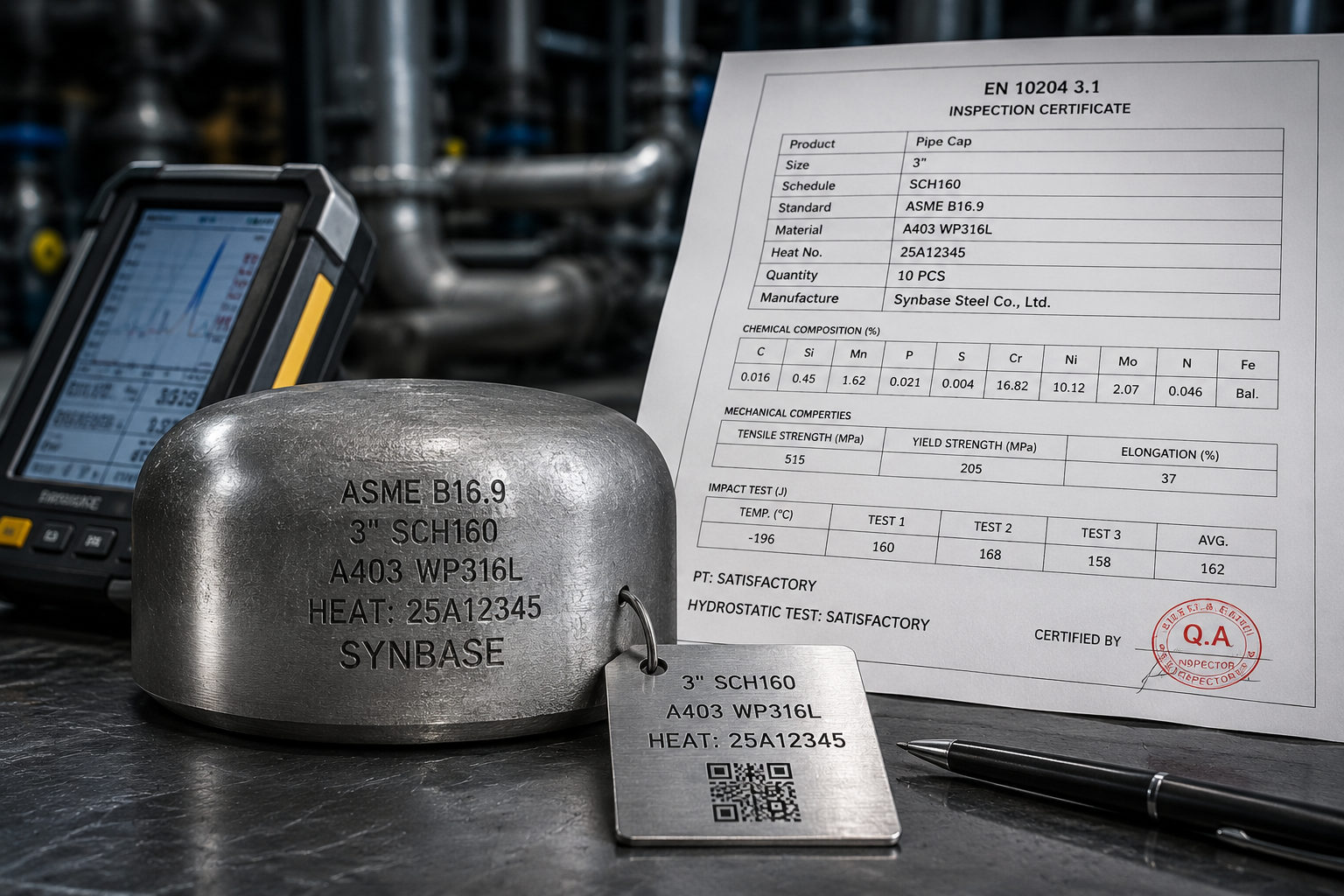
All material traceability is stamped directly onto your part and fully documented in your works certificate, conforming to EN 10204 3.1 or a certified independent works (3.2), clearly connecting the cap, the heat, schedule, size and standard, all back to heat tested documentation at the mill.
Failure. Fitting’s ultimate teachable is concrete. Mills in hot materials for speed (by heat treating less) made caps which met specification and then experienced brittle fracture on site, which killed the Weldbend/Boltex order, and led to the UCS-66 reclassification in 2019. If you see the line on your material with a heat # matched to a verified NDT/Charpy record — that’s what keep that lot out of your mill — and that’s the difference between a certificate and a safety net.
Caps over NPS 24 get to be real process equipment. They aren’t made from formed stock material and drawn to size, or welded from sheet and then round-formed to size. They are formed out of plate-either by heating, pressing them on tool steels, or formed cold on press brakes or with specialized equipment (often by hot forming round billets and then finishing). Synbase makes caps to the max B16.9 dimensions (overall height H=267 mm@24 inch and 343 mm@48 inch for outside diameter OD1219), and at this size band there are three issues that rise to prominence.
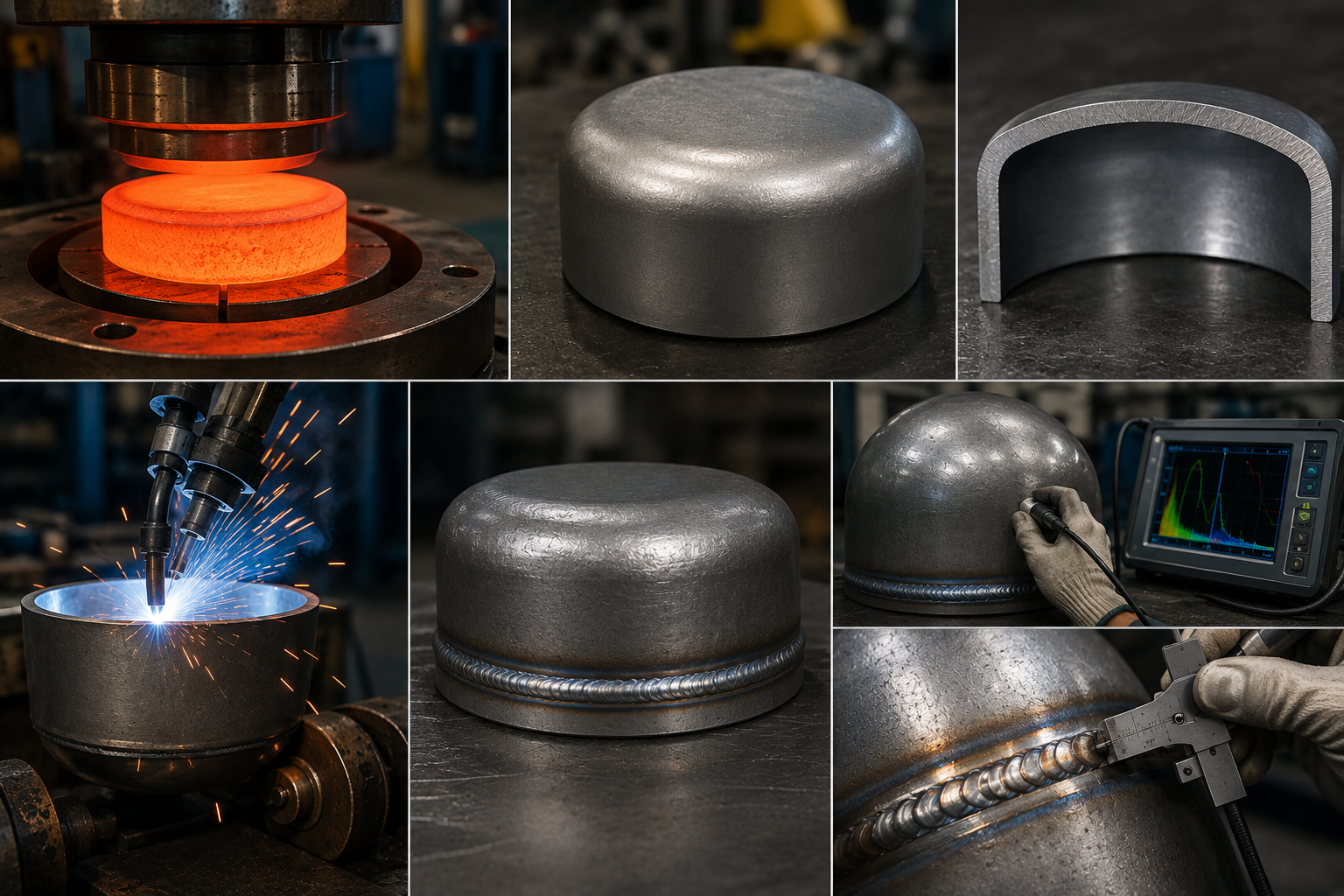
Material forming, where the cap either is made of a single piece and drawn hot to minimize grain flow issues (and longitudinal weld), or welded and plate formed-and this requires documented welds and appropriate NDE, conforming to the ASME code (which depends on the pressure component type).
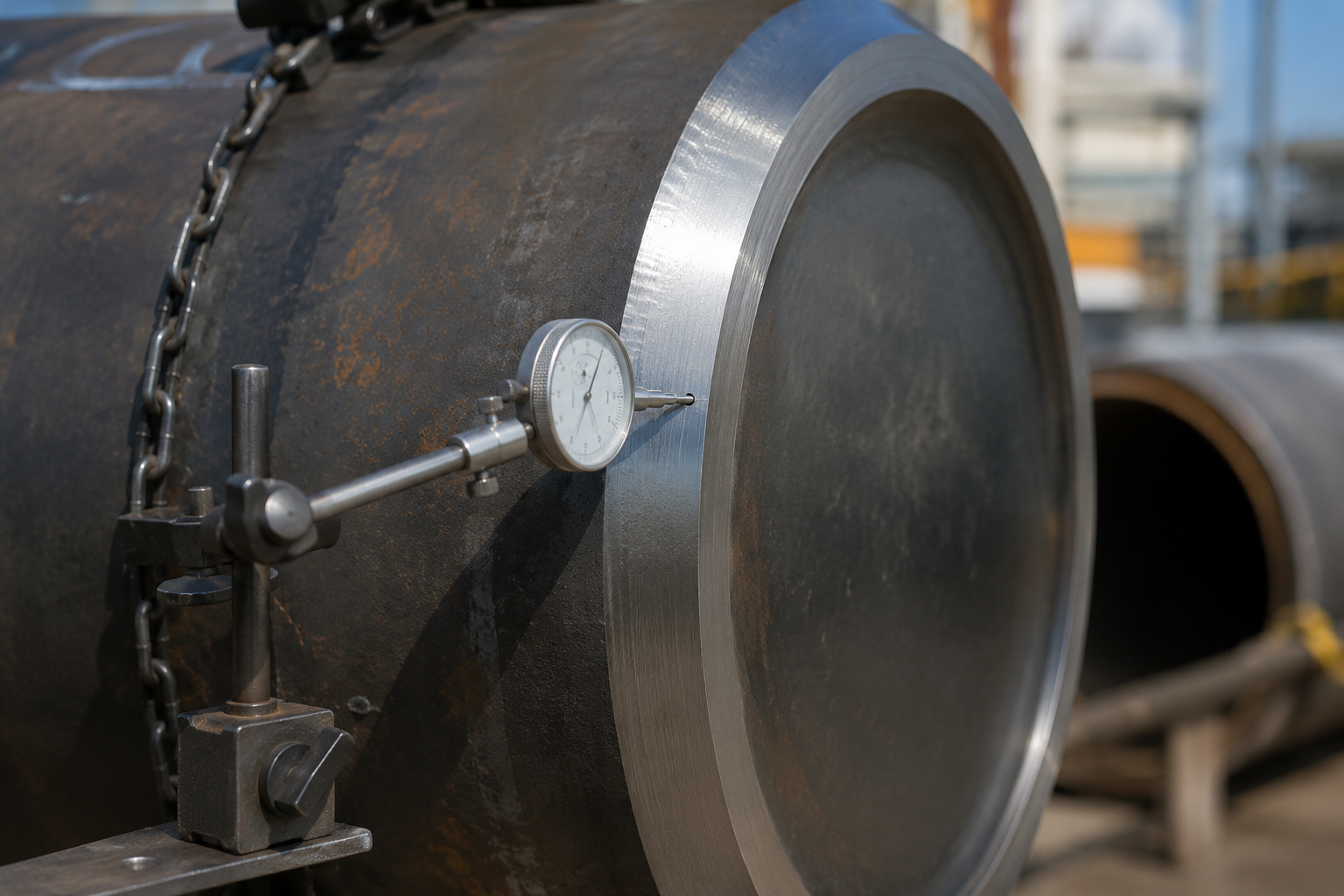
Roundness and pipe wall (where an 87.5% minimum wall must still be provided, though there is a higher sensitivity around out-of-roundness on very large diameter caps since such components typically need to be torqued to the pipe face), which becomes more an issue of field productivity if the cap OD doesn’t clean up.
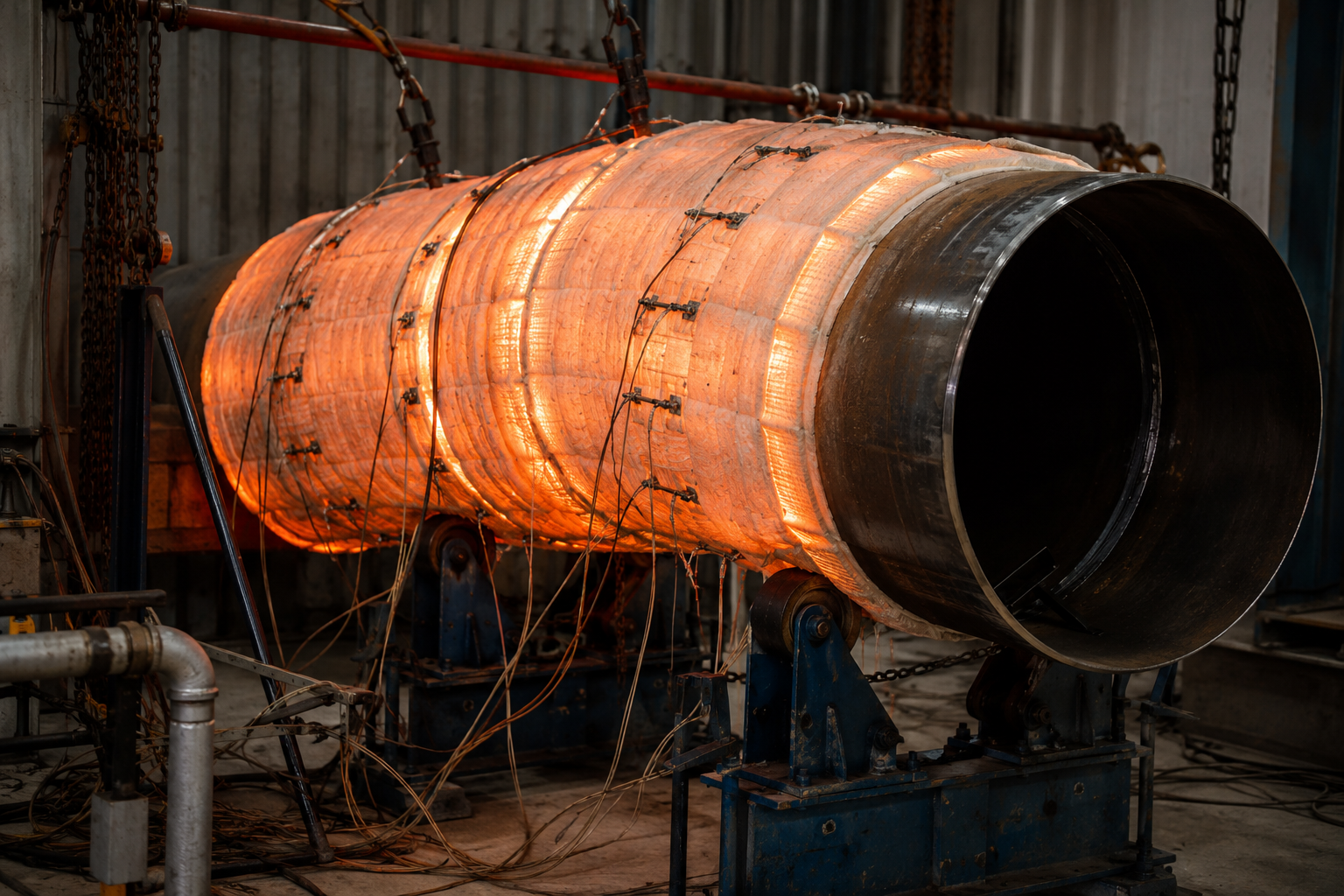
Finally, post weld heat treat (PWHT) becomes relevant for heavier-walled items and CrMo steel grades, and here you must establish what the ASME piping code or the component code dictates and note it on your quote — whether that’s ASME B16.9, B31.3, etc.
Delays in the cap procurement process typically arise from a single obscure point on the PO. It means either buying against an exact specification, or, at a minimum, understanding how prices are set and which elements impact lead time (rather than just asking for “a cap”). Here are the main drivers that will contribute to a quote: and the overall value depends on your specification – which is why Synbase prices against what the component must be, not against a published list. Don’t pursue that one number in your head-because you may not be buying quite what you think. You might quote for a 3.1 A234 WPB and be presented with a longer lead time for a different certificate, a 48″ duplex cap at a 3.2 level of inspection, and perhaps NDE. That’s the kind of mistake that delays the order. Synbase quotes against your specification under ISO 9001 controls, so the cap you receive matches the cap you ordered.
Standard carbon buttweld caps for the most common dimensions ship from stock with no MOQ penalty; special grades, large sizes and 3.2-certified lots are built-to-order per heat, per project MOQ. Caps arrive labeled with grade, heat number, size, schedule and standard, packed for export with the marking face-up, to be easily verified against the certificate on incoming-no need to unpack every lot. Call us for a firm price and lead time on any grade, size and certification level:
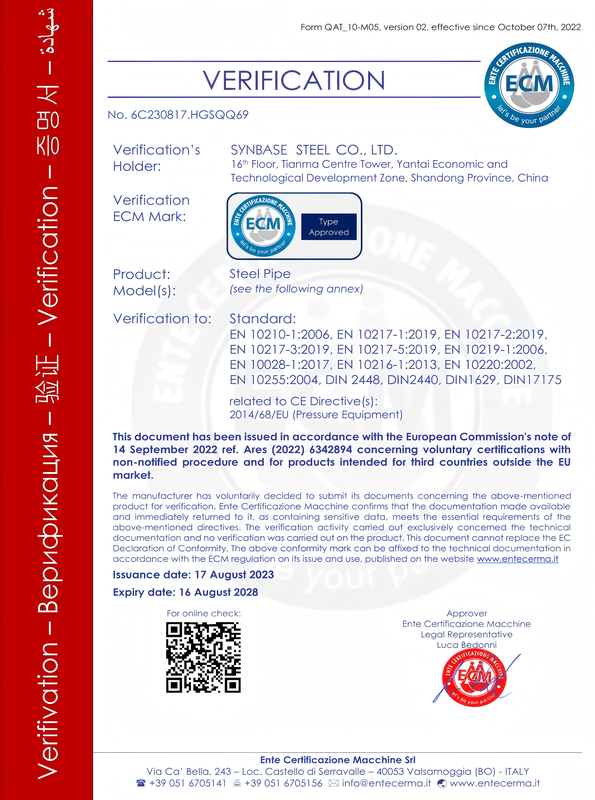
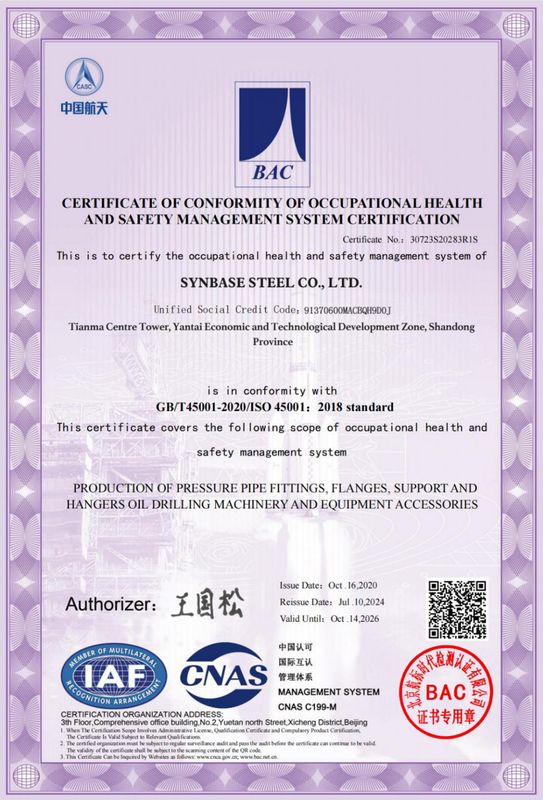
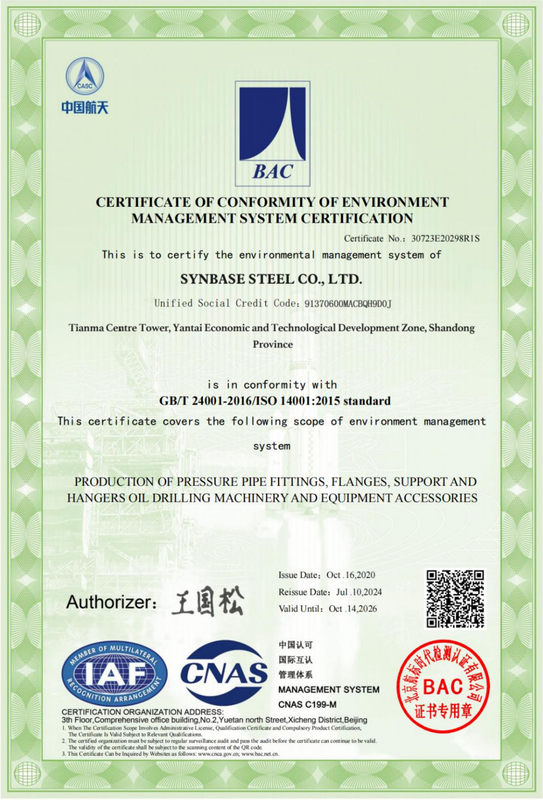
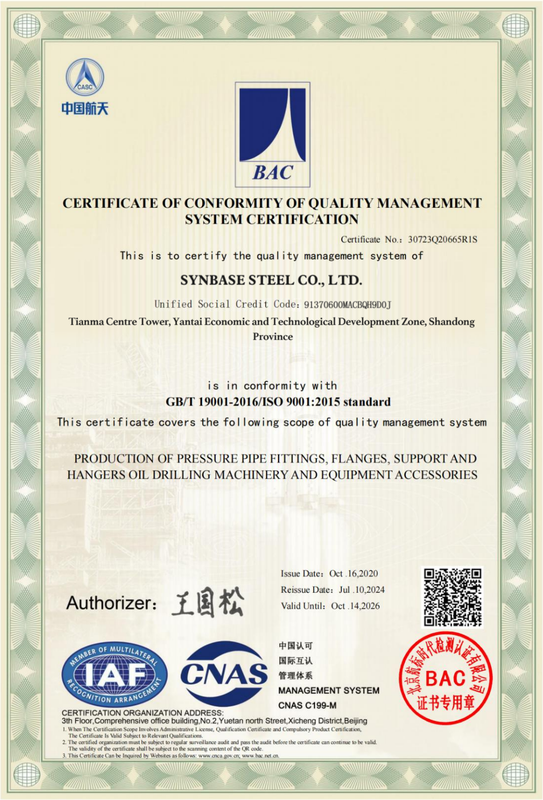
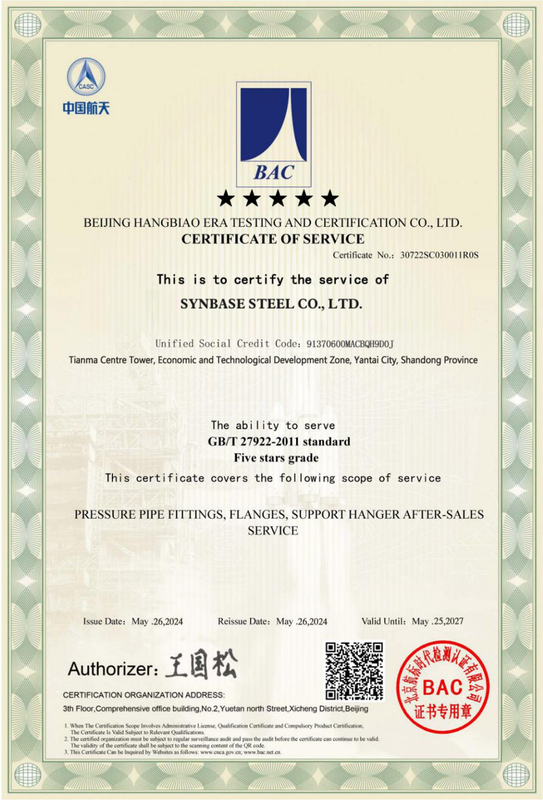
Projects stop and budgets break on documentation-an missing cert is a hidden delay, a pipeline stopped in the field for inspector access. A low-temperature line to -46 °C requires paperwork be perfect-an incomplete document becomes a rejected lot, not an interruption. Synbase maintains ISO 9001, ISO 14001 and ISO 45001 quality, EHS, and occupational system certifications, releases CE/PED paperwork for European market pressure equipment and provides classification society witness for marine construction. One of over 800 national patents and a China Iron & Steel Association member, we run an integrated system on all carbon, stainless, and alloy production-the system processing a 304 structural cap can release your 2205 seawater cap.
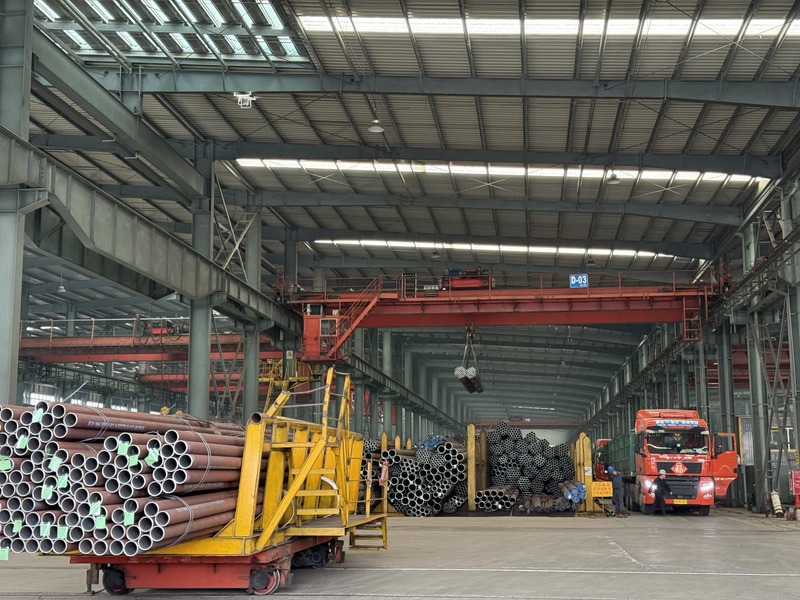
Calculate dimensions, overall height, and estimated weight based on standard NPS and wall schedules.
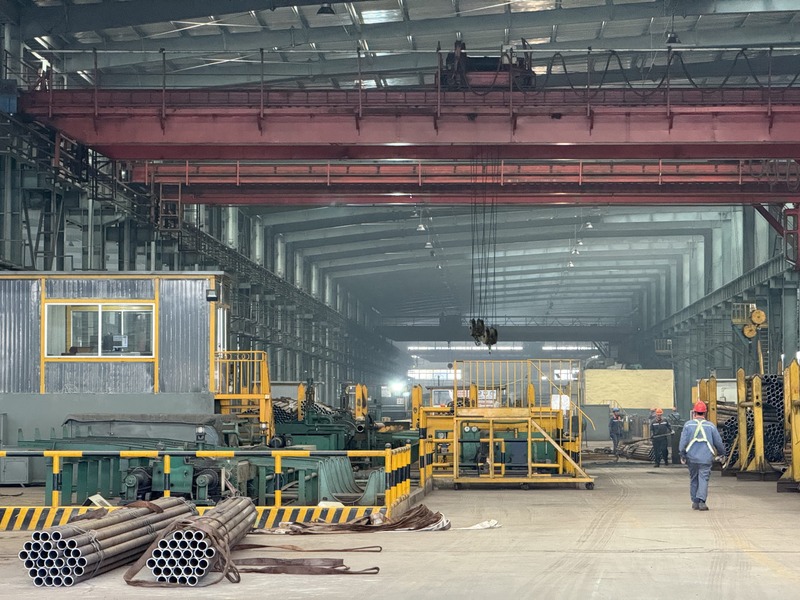
Open Finder →Identify the appropriate ASTM material grade (e.g., A234 WPB, A403, A860) based on piping system requirements.
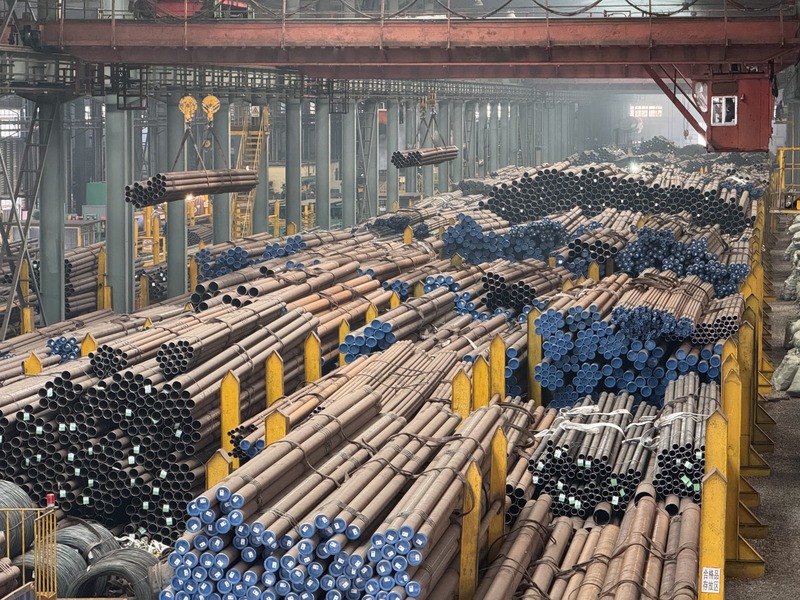
Select Grade →Evaluate application parameters to determine if a welded cap, blind flange, or threaded plug is the optimal closure.
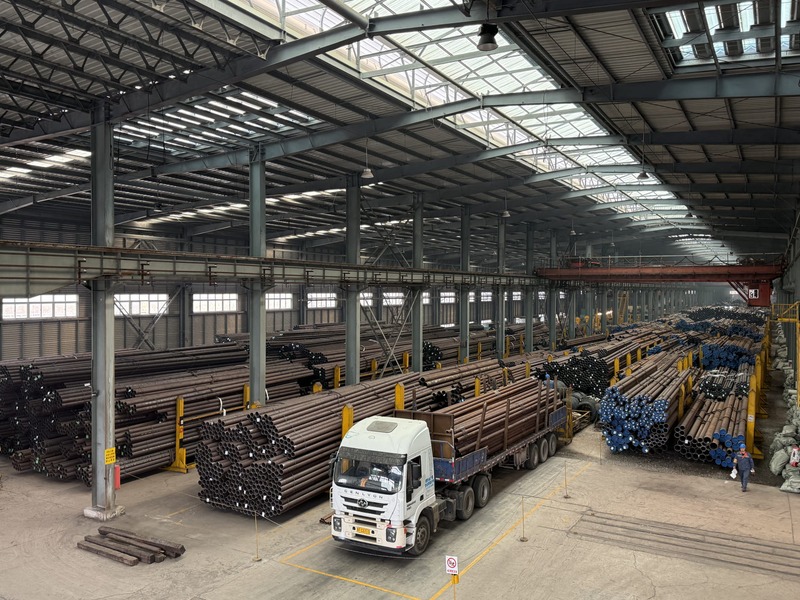
Start Evaluation →Determine the Carbon Equivalent Value (CEV) to assess weldability and establish preheating requirements.
Calculate CEV →A234 is the ASTM specification for wrought carbon and alloy steel buttweld fittings; WPB is the standard carbon grade — “W” for wrought/weldable, “P” for pressure, “B” the strength band. A234 WPB caps have a minimum yield of 240 MPa (35 ksi), tensile of 415–585 MPa and 22% elongation, and are dimensioned to ASME B16.9. It is the default carbon grade for moderate-temperature pressure piping.
A234 is a wrought grade used for buttweld fittings, including caps; A105 is a forged carbon grade used for flanges and threaded or socket-weld fittings. They are not interchangeable substitutions — if you specified A234 for a buttweld cap and received A105, the manufacturing route and intended fitting are different. Always confirm the grade against the connection type and the mill certificate.
Yes — a buttweld cap to ASME B16.9 carries the full pressure rating of the pipe it closes, because its wall and ellipsoidal crown are matched to the pipe schedule and it welds in as monolithic pipe with no gasketed joint. Forged socket-weld and threaded caps to B16.11 are rated by class (3000/6000). The limiting factor is correct grade, wall and weld procedure, not the cap concept.
No. A cap fits over the outside of the pipe end (or welds to it); a plug threads into the inside of a fitting. A blind flange is a bolted, re-openable closure with gasket faces. Choose a welded cap for a permanent pressure end, a threaded cap or plug for small-bore utility access, and a blind flange when the end needs routine opening.
Buttweld caps from NPS 1/2″ to 48″ (DN15–DN1200), in wall schedules from SCH 10 through XXS, plus forged socket-weld and threaded caps in NPS 1/2″–4″. Wall thickness is specified to your line, since ASME B16.9 leaves it to the purchaser. Large diameters above NPS 24″ are hot-formed or plate-formed to order.
Because a cap can pass its paperwork and still fail in service if the metal was not what the certificate claimed — the brittle-fracture failures that triggered ASME’s 2019 UCS-66 change came from exactly that gap. An EN 10204 3.1 or 3.2 certificate with a heat number traceable to the cast, plus PMI on the actual heat, is what lets your QA or third-party inspector accept the lot without a retroactive audit.