Send Your RFQ to Synbase Steel
Prefer to send drawings, BOMs or attachment lists by email? sales@synbasesteel.com

Updated October 2026
Joules to ft lb is the conversion of an energy value from SI units to foot-pound force. Divide joules by 1.3558179483314004, or multiply by approximately 0.7375621493. A result of 27 J becomes 19.91 ft·lbf at two decimal places. Keep the original number for test results when importing data to a spreadsheet.
Joule to foot-pound force converter
Convert between joule and foot-pound force. The unit changes; the measured quantity does not.
27 J = 19.91 ft·lbf
Enter 0 or more — a negative value is not a valid reading for this quantity.
This entry is ambiguous. Use a comma only as the decimal mark, for example 1,5, and do not type thousands separators.
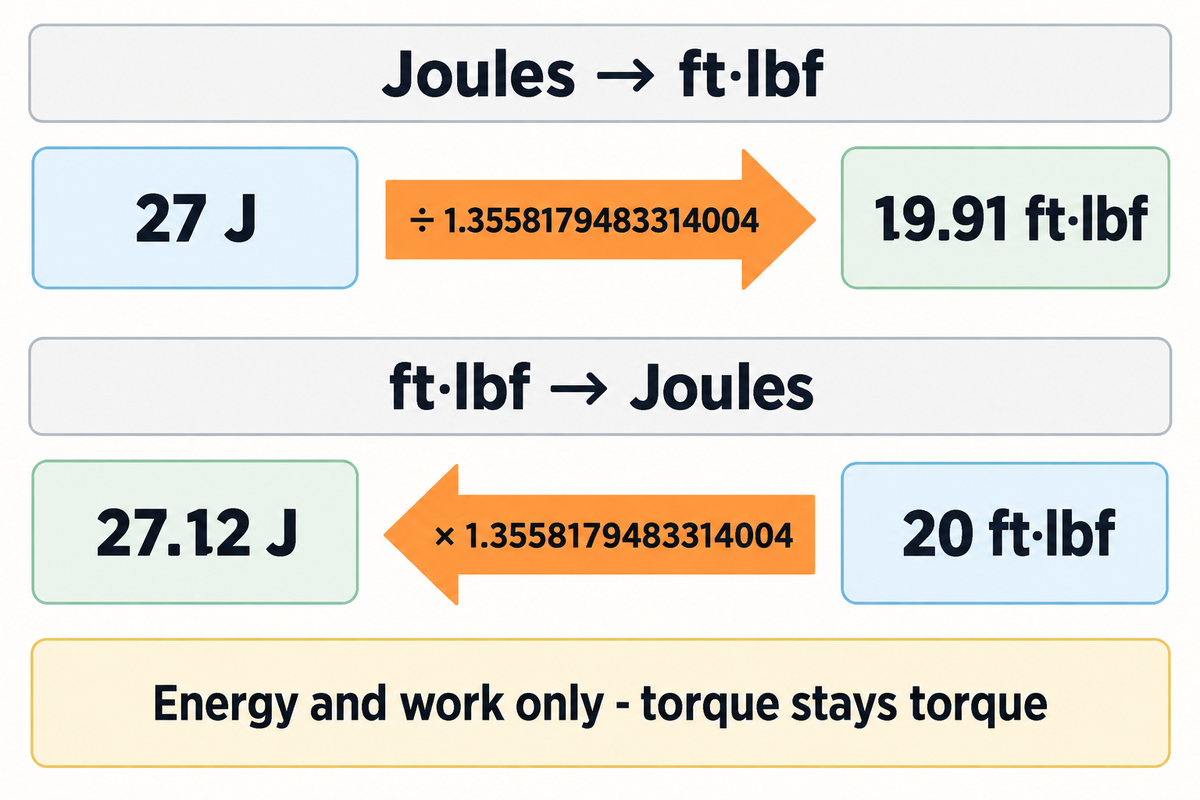
A foot-pound force to joules calculator converts an energy amount without changing the physical quantity. Select either joules or foot-pound force as the input unit, enter the value and read the result. The online unit converter also accepts kilojoules, so a kJ value needs no separate manual conversion before conversion.
Use the calculator to convert energy and work values including absorbed energy for a steel impact test. ft·lb often abbreviates foot-pound force, and the letter f identifies the force component of this energy unit. A torque-wrench setting is a different quantity, even when abbreviations of familiar units look alike.
The formulas and charts provide similar calculations for a spreadsheet or printed reference. Use the values from a nearby chart and perform calculation from the original input. NIST’s energy conversion table identifies foot pound-force, and foot poundal, which has a different conversion factor.
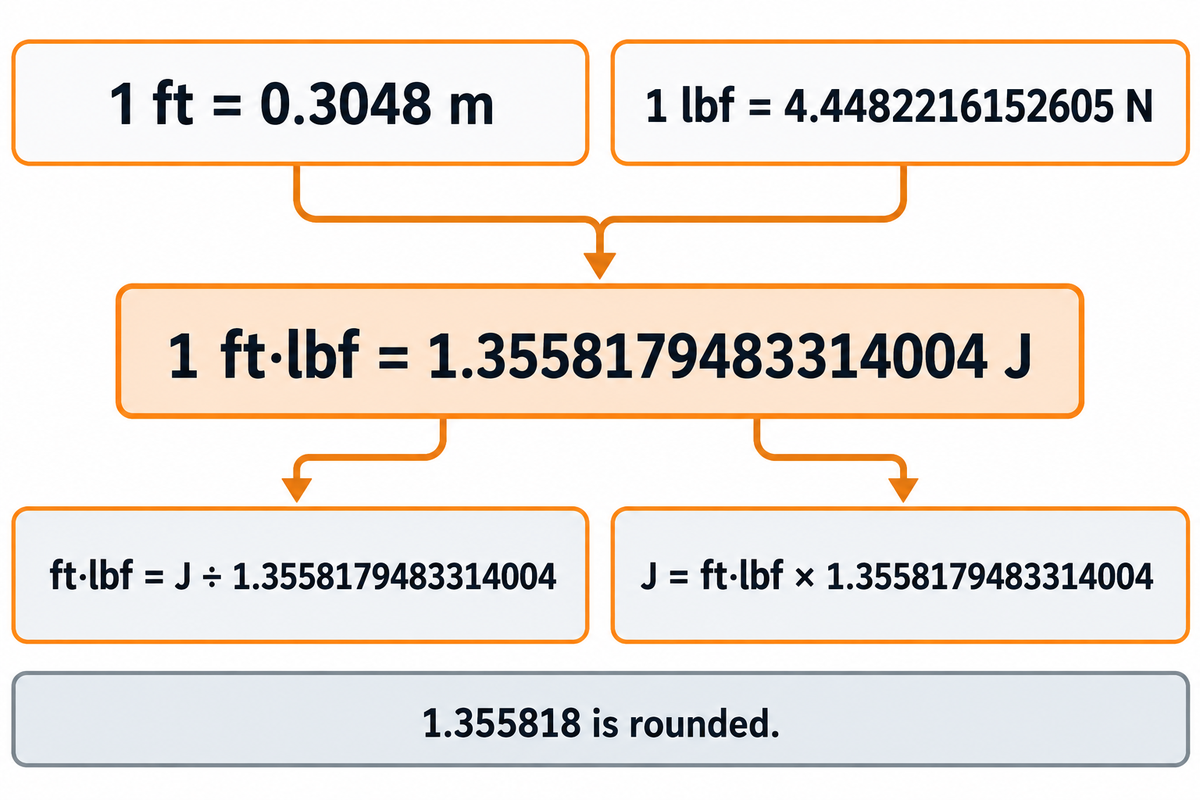
Convert joules to foot-pounds by dividing the input energy by the number of joules in one foot-pound force. For reversing this process, multiply. Only one factor is used for both processes, and hence there’s no need for a worksheet to mix the factors for multiplying and dividing. Also, using one factor avoids differences from mixing separately rounded multipliers when a value is converted back.
ft·lbf = J ÷ 1.3558179483314004
J = ft·lbf × 1.3558179483314004
The factor follows from 1 ft = 0.3048 m and 1 lbf = 4.4482216152605 N under conventional standard gravity. Multiplying those definitions gives 1.3558179483314004 N·m of work. NIST footnote 23 supplies the pound-force definition; Appendix B supplies the international-foot definition. The process uses defined units in either direction, from J to ft·lbf and vice versa.
The value 1.355818 shown in the NIST conversion guide is rounded. The guide shows the exact, bold faced factors, and other factors in general. Likewise, 0.7375621493 is a rounded factor, and can be used for a reference formula, rather than to imply that it’s a value with unlimited precision.
Multiply the foot-pound-force energy value by 1.3558179483314004 to obtain joules. For example, 20 ft·lbf × 1.3558179483314004 = 27.116358966628 J, displayed as 27.12 J at two decimal places. Keep more digits during intermediate calculations and apply the reporting precision at the end, with the original result retained beside the converted cell.
For an energy value of 20 ft·lbf, multiplying gives about 27.12 J, and dividing gives the wrong direction. A worksheet with both unit labels visible makes that error easier to spot before a supplier or quality team copies the number into another document.
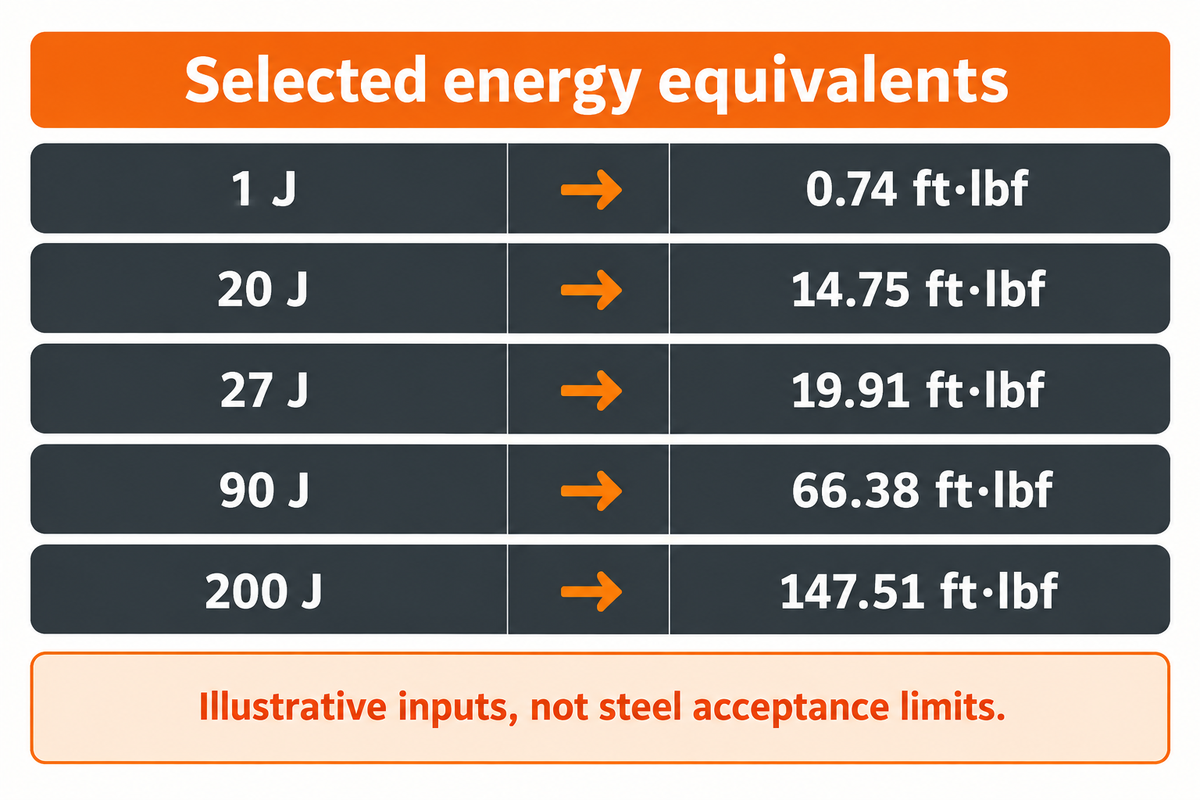
The joules to foot-pounds conversion table below uses the same defined factor for each row and rounds each output to two decimal places. The inputs are chosen reference values, rather than a list of steel acceptance limits. To find the value between the two listed values, use the given formula.
An 18-value chart converts selected joule inputs to foot-pound-force outputs with one consistent factor and stated display precision.
| Energy (J) | Equivalent energy (ft·lbf) |
|---|---|
| 1 | 0.74 |
| 5 | 3.69 |
| 10 | 7.38 |
| 15 | 11.06 |
| 20 | 14.75 |
| 24 | 17.70 |
| 27 | 19.91 |
| 30 | 22.13 |
| 40 | 29.50 |
| 50 | 36.88 |
| 54 | 39.83 |
| 60 | 44.25 |
| 70 | 51.63 |
| 80 | 59.00 |
| 90 | 66.38 |
| 100 | 73.76 |
| 150 | 110.63 |
| 200 | 147.51 |
Read the left column as the original input and the right column as its converted equivalent. For example, 90 J becomes 66.38 ft·lbf. Reverse calculations start from the original ft·lbf number, rather than a joule value already rounded for display. NIST lists the underlying energy factor.
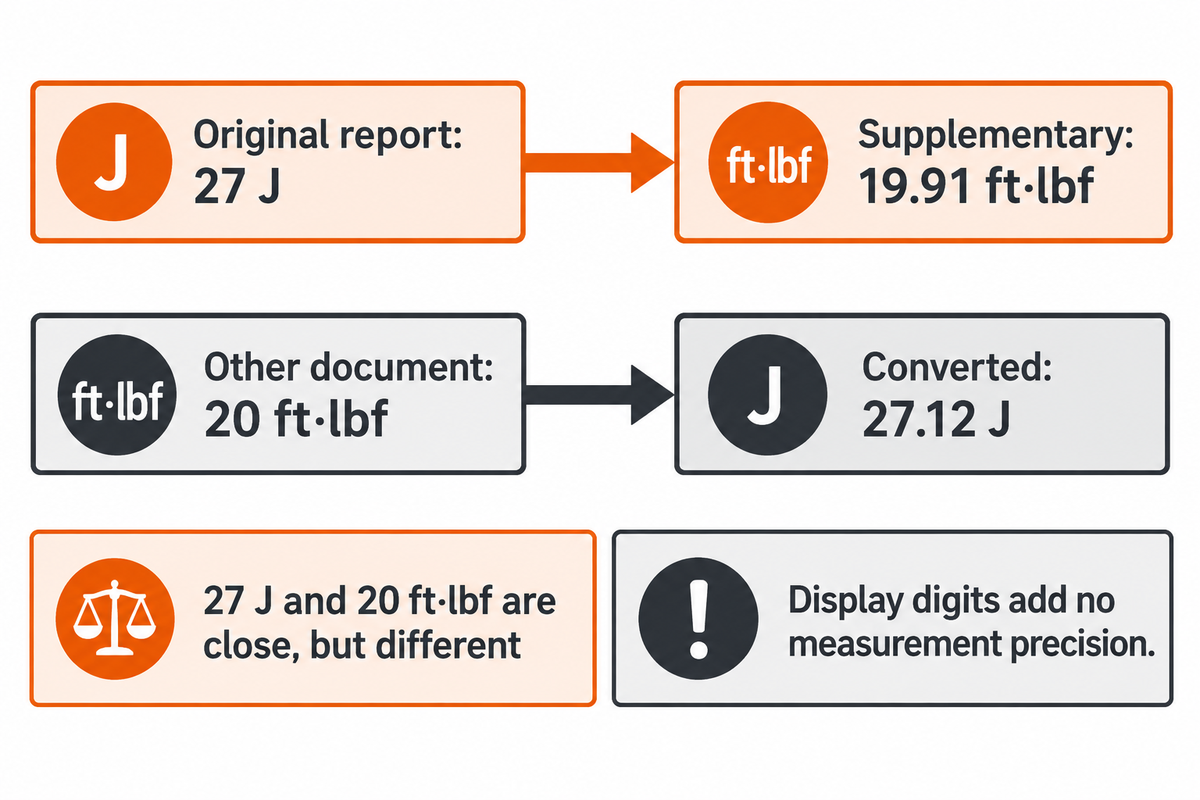
Round a converted result appropriately for the intended use, while preserving the information in the original measurement. Digits in a calculator describe resolution in arithmetic. Laboratory reporting describes resolution in input and uncertainty. NIST Appendix B.7.2 illustrates why simply carrying all the digits, or a fixed number of significant figures, in a converted result can misrepresent converted information.
Example: a buyer receives one report showing 27 J and a spreadsheet request using ft·lbf. The conversion is 27 ÷ 1.3558179483314004 = 19.914178030486 ft·lbf, or 19.91 ft·lbf on a two-decimal display. A second document says 20 ft·lbf. Reversing that figure gives 27.116358966628 J, or 27.12 J. The difference is about 0.11636 J before rounding. Calling both entries “20” would conceal that difference. Whether either meets a specified requirement follows the applicable reporting and acceptance rules; a display setting supplies no tolerance. Keep 27 J as the original entry and 19.91 ft·lbf as the supplementary conversion.
A full-precision calculation is useful in a worksheet when the final result is rounded. The worksheet calculates from the full-precision input. The worksheet performs a new rounding step if fewer digits are kept in an intermediate step. Copying 19.91 into the reverse formula instead of retaining 27 J creates a new rounding step.
The NIST uncertainty guide treats the uncertainty in the mean absorbed energy. It, however, doesn’t establish one universal decimal-place setting for laboratory reports. Preserve the laboratory’s original precision and apply the report’s required rounding convention to supplementary values.
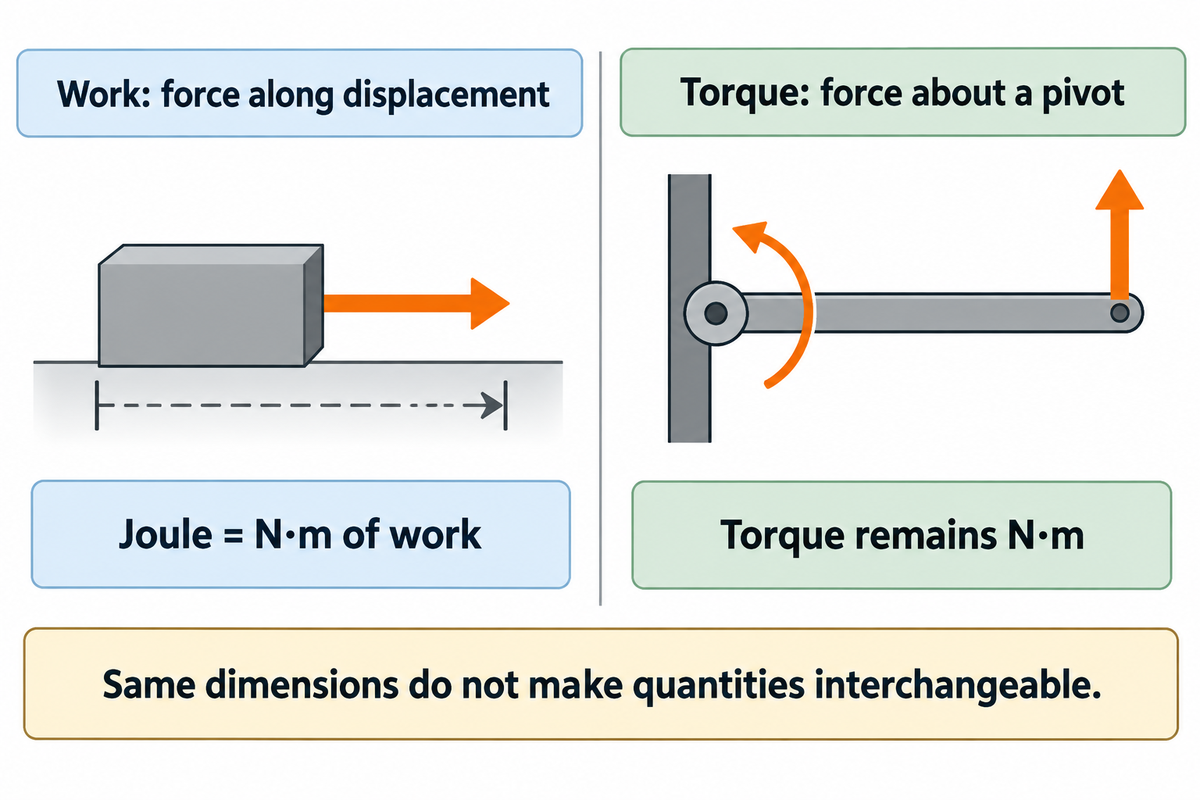
Energy measures work that has been transferred or absorbed. Torque describes an effect of a rotational force. A joule equals 1 N·m (work) but a torque of 1 N·m remains torque. Identical dimensions and the same numerical conversion magnitude don’t make those physical quantities interchangeable in engineering calculations or test reports.
“Even though torque has the same dimension as energy (SI unit joule), the joule is never used for expressing torque.”
Mechanical work involves force acting through displacement. Informal labeling of work gives a pound-force acting through one foot as one foot-pound of work if the force acts along that displacement. A pound-force acting through a one-foot perpendicular lever arm produces a moment of force. Read the quantity and application, as opposed to just the order of “foot” and “pound,” in informal labeling.
One ft·lbf of energy is equal to 1.3558179483314004 N·m of work. It’s the same value in joules. A torque of one lbf·ft converts to 1.3558179483314004 N·m; however, the quantity remains a torque. Determine if the number is absorbed energy or a moment of turning before choosing a converter or transferring the result to a specification.
The same is true for other units. A poundal-foot is a different energy unit. Kilograms measure mass and newtons measure force. The base-unit expression in the SI for a joule is kg·m²/s², where s means second; the presence of kg in that expression doesn’t make joules directly convertible to kilograms.
Keep grade selection separate too. The alloy steel pipe grade guide covers material choices; an energy-unit conversion simply converts an existing energy number.
Charpy absorbed energy is the energy absorbed as a notched specimen fractures in an impact test. Interpret that energy in conjunction with the details of the specimen and the method of the test. The value is a test result describing the conditions of the test, while conformity of the material to the product specification and purchase requirements also must be considered.
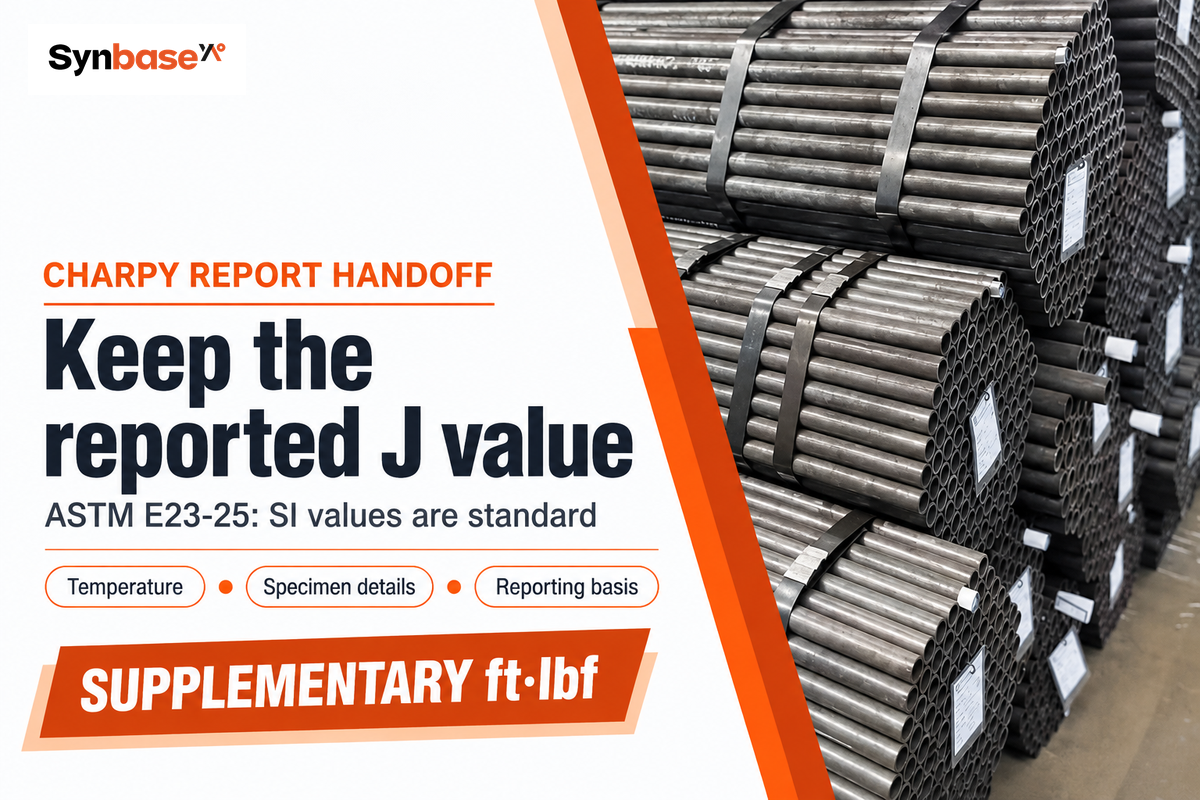
ASTM E23-25 covers Charpy and Izod test methods, and provides requirements for specimens, test procedures, test reports and machine verification. Section 1.3 treats SI values as standard, with the stated informational inch-pound exception in Section 9 and Annex A4. Retain the reported J value when preparing an E23-based handoff; a ft·lbf column can provide a supplementary reading.
ISO 148-1:2016 specifies the metallic-material Charpy pendulum method. The checked catalogue marks it current after confirmation in 2023 and identifies a replacement draft under development. Use the edition named in the actual report or contract rather than silently replacing it with a draft.
For low-temperature steel pipe, carry the specified test temperature into the purchasing documents. An energy figure detached from its temperature and specimen basis gives the quality team less information than the original report.
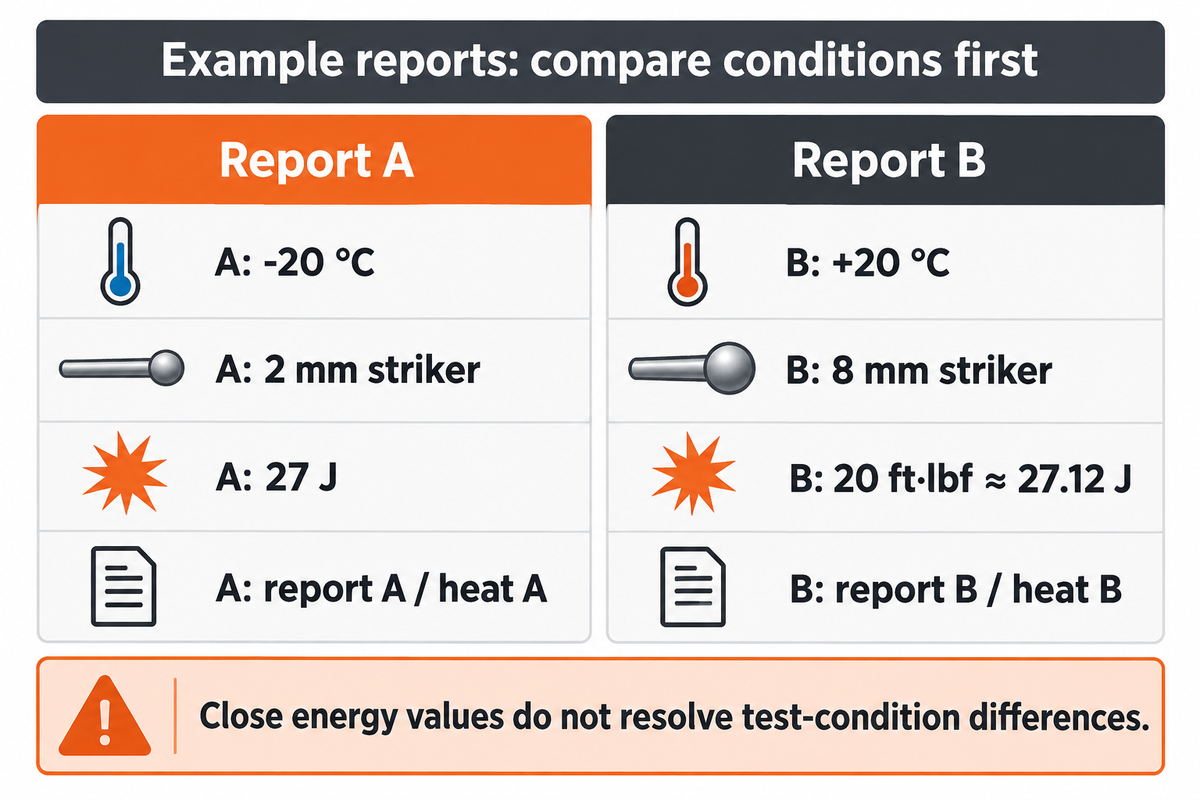
Compare Charpy energy values after matching the relevant test conditions and reporting basis. Unit conversion takes care of the J-to-ft·lbf conversion; it doesn’t address temperature, specimen geometry, notch or striker configuration. Results and averages also need to be identified so that a larger, numerically described value isn’t mistakenly assumed to be a better material.
The 3-Field Report Pairing Test groups report checks into temperature, specimen and test configuration, and individual versus average reporting basis.
Example: a procurement engineer compares 27 J from report A with 20 ft·lbf from report B. The second value is 27.12 J on the same two-decimal display, so the energy figures look close. Report A records −20 °C; report B records +20 °C. A comparison based only on the converted energy would miss a 40 °C test-temperature difference. Put that difference in front of the quality reviewer before discussing which material performed better. The heat identifiers can differ because these are different lots; the purpose of retaining them is to connect each number to its own material and report.
| Report field category | Report A | Report B | Reading action |
|---|---|---|---|
| Temperature | −20 °C | +20 °C | Resolve the different test temperatures before ranking. |
| Specimen dimensions | 10 × 10 × 55 mm | 10 × 10 × 55 mm | Retain dimensions with each result. |
| Notch | V-notch | V-notch | Compare the stated notch configuration. |
| Striker radius | 2 mm | 8 mm | Retain the configuration difference. |
| Orientation | Longitudinal | Longitudinal | Keep specimen direction visible. |
| Reporting basis | Mean of 3 | Mean of 3 | Compare means separately from individual values. |
| Original energy | 27 J | 20 ft·lbf | Preserve the laboratory entries. |
| Common display unit | 27.00 J | 27.12 J | Label display digits as supplementary arithmetic. |
| Traceability | Report A / heat A | Report B / heat B | Link each record to its own lot; identifiers need not match. |
Striker geometry can affect absorbed energy. Lucon and Splett’s NIST study explains the decision to certify reference lots separately for 2 mm and 8 mm strikers. A conversion factor can’t remove that configuration difference.
Care of subsize specimens is about the same. Limitations of linear scaling with small sizes are discussed in Jia and co-workers’ 2022 article. The authors mentioned total-energy correlation was good for the selected 30CrMnSiNi2A steel. The authors also encouraged further studies with other materials. It’s better to keep a subsize result on its stated basis rather than applying a general width-ratio correction.

A spreadsheet handoff should preserve the original energy and unit, calculate a supplementary equivalent, and keep the report reference beside both. Procurement can then reconcile the requested unit without overwriting the laboratory entry. Engineering and quality reviewers retain the test conditions required to decide if compared records are on the same basis.
With joules in cell A2, use =A2/1.3558179483314004 for ft·lbf. With foot-pound force in A2, use =A2*1.3558179483314004 for joules. Apply a cell display format for two decimals rather than replacing the underlying result with a rounded text string.
Example: a purchasing worksheet starts with 27 J in A2. Cell B2 contains the division formula and displays 19.91 ft·lbf. The report reference, test temperature, and other details are nearby. A colleague requests joules again the following week. The team copies the original 27 J instead of multiplying the displayed 19.91 back into a new result. The laboratory entry stays intact through both requests. A quality reviewer can trace the surrounding details and temperature without searching through emails. That arrangement reduces transcription opportunities without claiming a measured saving or changing the test method’s reporting rules.
On October 1, 2026, online result and specimen-image submission were introduced as part of the NIST Charpy Machine Verification Program. The administrative change represents the importance of keeping numbers with their supporting records; it doesn’t alter the definition of energy nor steel-product acceptance requirements.
Send Synbase Steel the grade, dimensions and original test-report requirements with your inquiry, and ensure that you relate those requirements to the relevant steel pipe product specifications and retain supporting conversions in clearly labeled cells.
27 J converts to 19.91 ft·lbf at two decimal places. Preserve the original 27 J and its test conditions when the result moves between reports.
Preparing a steel pipe inquiry?
Include grade, dimensions and original test-report requirements. Send the original test-report requirements to keep the energy unit and test conditions together.
Conversion values are taken from public unit definitions. Report-pairing examples are chosen inputs for illustration. This conversion guide claims no proprietary plant-test data, and no supplier certification is claimed.
Synbase Steel supplies steel pipe, fittings, flanges, valves and OCTG for oil and gas, petrochemical, power, water and industrial projects. Our technical guides are written to help buyers compare standards, grades, dimensions, coatings, inspection requirements and commercial terms before sending an RFQ.
We focus on practical specification work: matching pipe process to service conditions, checking wall thickness and end finish, reviewing MTC and NDT requirements, and clarifying documentation before production or shipment.
Project support across seamless pipe, ERW, LSAW, SSAW, buttweld fittings, forged flanges, valves and oilfield tubulars.
Specification review for ASTM, ASME, API, EN and DIN standards, including material grade, pressure class, coating and inspection scope.